Urban Atmospheres


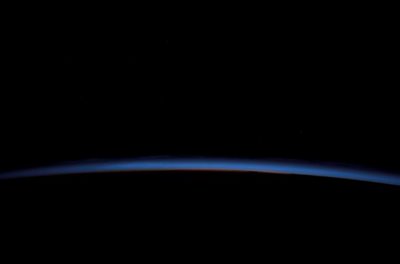
[Image: “Glowing, silvery blue clouds that have been spreading around the world and brightening mysteriously in recent years will soon be studied in unprecedented detail by a NASA spacecraft.” New Scientist].

Some unrelated items of atmospheric news…
First, the phenomenon of “noctilucent clouds” is under investigation. These are clouds “which glow at night, form in the upper atmosphere, at an altitude of about 80 kilometres, and their glow can be seen just after sunset or just before sunrise. ‘Even though the Sun’s gone down and you’re in darkness, the clouds are so high up, the Sun is still illuminating them.'”
However, could a city deliberately build upward curving traps of air, thermally concentrating moisture in huge, rising chimneys, giving its citizens a kind of Air TV – abstract films of silvery blue clouds coiling across the sky, mercurial and noctilucent? Gone would be Seasonal Affective Disorder; in its place you’d have this fairy tale gossamer light, glowing metallic on the edges of all things. Add to that the microscopic sounds of water crystallizing inside distant clouds – amplified throughout the canyons of the city – and you’d have a kind of climatopia.
Meanwhile, “many of the skyscrapers in Shanghai could become quite dangerous” due to the high winds they’re now producing. This effect is seemingly parodied in Mission Impossible III when Tom Cruise parachutes out of a Shanghai skyscraper – only to find that his chute fails to open due to the torque of neon whirlwinds lashing him about between corporate bank towers. (Yes, I’ve seen Mission Impossible III).
In an inadvertant moment of architectural criticism, “the Shanghai municipal government identified skyscrapers as one of the biggest potential threats to the city.”
Ages ago, in a no doubt now embarrassing BLDGBLOG post, the idea of urban wind-guns was explored, wondering, simultaneously, what impact surburban tract housing might have on the storms that eventually blow through a city. Fences, back porches, forests cut down or left to grow: how do these affect the speed of regional wind systems?
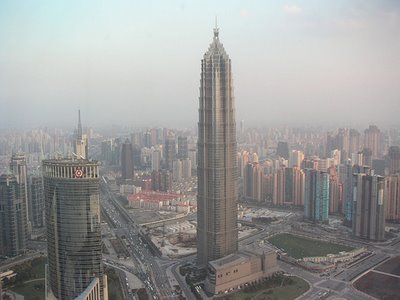

[Image: By krisstr, from the Shanghai Flickr group].

Shanghai city authorities have more or less answered that question, suggesting that “more trees can be planted to block part of the winds,” and that “the walls of the buildings should be fortified while notice signs are put up to signal potentially dangerous areas.” Pockets of atmospheric turbulence within the city. (How do skyscrapers affect the flight-paths of airplanes?)
Finally, air wells, tropospheric rivers, and electromagnetic weather control all meet in this surprisingly long but very interesting article.
There, we discover that “huge filamentary structures” in the sky act as “preferable pathways of water vapor movement in the troposphere (the lower 10-20 km of the atmosphere) with flow rates of about 165 million kilograms of water per second. These ‘atmospheric rivers’ are bands from 200 to 480 miles wide and up to 4,800 miles long, between 1-2 kilometers above the earth. They transport about 70% of the fresh water from the equator to the midlatitudes, are of great importance in determining the location and amount of winter rainfall on coastlines.”
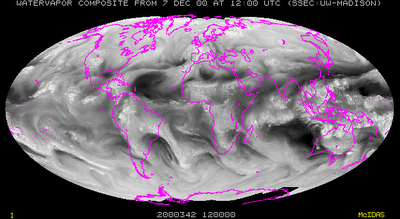

[Image: The aforementioned tropospheric rivers, a kind of fluted cobwebbing of intercontinental air pressure].

The following devices – towers, air wells, etc. – were all designed to help tap into these rivers, turning the sky itself into an aquatic reservoir.
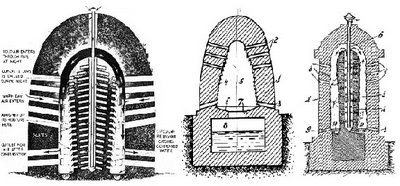
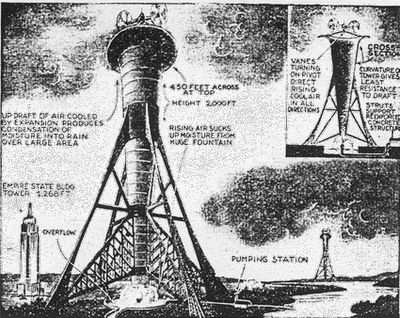
You basically build one of those things at a geo-atmospherically strategic location; you make youself a cup of tea; their height and geometry trigger downdrafts; then the internal chambers cause condensation of vapor from air. Thus, an air well. The end of drought through tropospheric riverways.
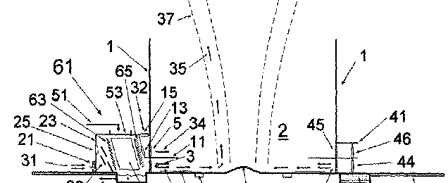
Here’s a diagram of one of the machines working:

The article, of course, also discusses electromagnetic weather control, such as the notorius HAARP Project, pictured here –
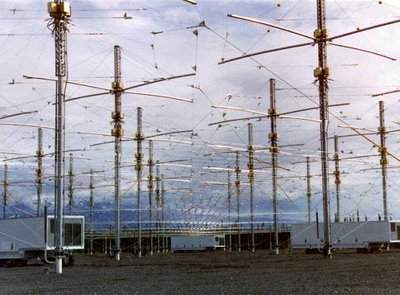

– but there’s a (very little) bit more on that in an earlier post.

(Thanks to Scott Webel for the air wells article; and to the incomparable things magazine for the link about Shanghai).

Extratextually Terrestial (Paper topographies: 2)


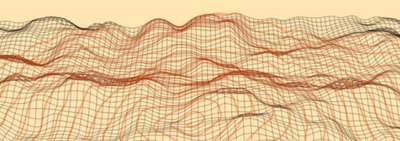
“Given a certain acquaintance with the Metaphysics of Spirals, it is possible to represent a landscape using one single continuous line…”
So we read at Chronotext.org, where we find this fascinating take on The Book of Isaiah, Chapter 40 – here, topographically re-typeset as a literally Biblical terrain. The text itself is suitably geographical in reference, detailing “the return of exile, from Babylon to Jerusalem, through the wilderness.”


Much more – including terrestrial wave-animations and other forms of textual “terrain generation” – at Chronotext.org.

(Via Coudal. Earlier: Paper topographies: 1).
Ring-structure and the vortex


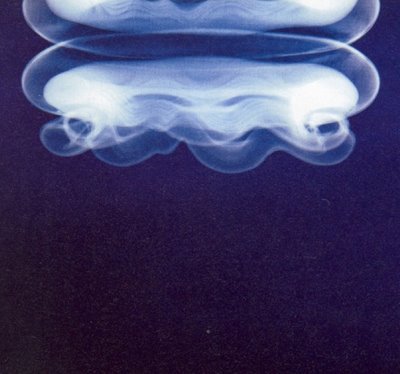
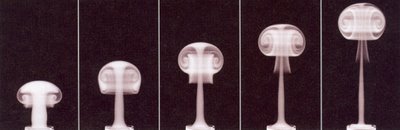
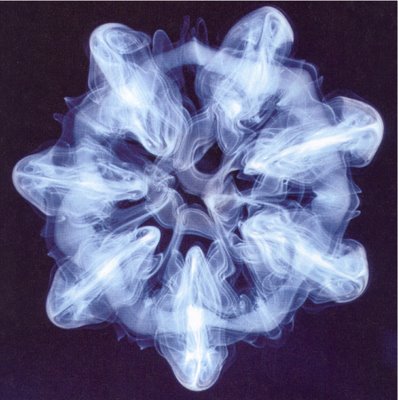
[Images: The structural science of vortex rings. “A vortex ring forms when a very quick burst of fluid shoots out of an opening,” Freud writes – er, this article tells us. “As the fluid moves forwards, it spreads out and its front edges curl back. If the speed of the burst is fast enough, the curling fluid eventually curls all the way round, until it is travelling forwards again in the direction of the original burst.” Etc. So could such vortices be used as a new form of undersea propulsion – or perhaps an underwater art show, perfect vortices spiraling off through colored water, liquid crystals, magma? If you’re still curious, this PDF version of the New Scientist article mentioned above will tell you all about the fluid-mechanical work of Kamran Mohseni and Mory Gharib, including a brief aside on “superfluid gyros” and “vortex-formation velocity.”]

Paper topographies: 1


Though I may be late to the game here, I’ve recently discovered the origami of Eric Gjerde. These are all examples of his work, taken from Eric’s various flickr sets: surface become structure; paper, terrain; folds made into space and topography.


Methods, tips, techniques, etc., can all be found on his website.

(Somewhat related: the paper sculptures of Richard Sweeney).

Tracking Ants

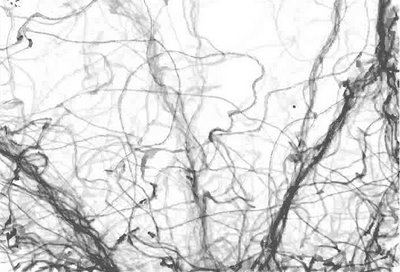
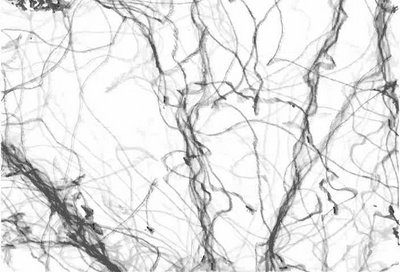
Continuing our recent, if somewhat unexpected, ant theme, here is a project that maps the paths of walking ants.


The project, by Sean Dockray, consists of a short video loop that “documents a pheromonal portrait made by Argentine ants. While the ants in the video are real (they were shot in a single 45 minute long take) the trails are created in a piece of custom software, which tracks each ant frame-by-frame.”


“The more that ants walk on a particular path, the darker that paths gets. Over time, the paths either disappear or are reinforced by more walking. In this way, the video is a kind of mutable, spatialized collective memory.”

(See also Wormholes in Wood, and the almost unbelievable images of subterranean ant architecture at Nest-casting; and thanks to Sean Dockray for supplying the filmstills!).

Absolute Superlinearity


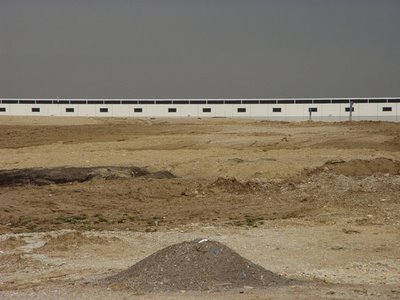
The Gear Tek Corporation takes us on a brief visit to “the longest building I have ever seen,” located somewhere in the “physically oppressive and hallucinatory” flatlands of Illinois.


“This is the longest building I have ever seen,” GTC writes. “It is totally windowless and stretches for at least a mile, although it seems to defy laws of space-time so it may be longer or shorter than that.”

The building’s absolute superlinearity appears to be a “spatial illusion” that is only amplified by the “simple gray rectangles which glide along the blank facade like dotted lines on an overlay. It looks like an Ellsworth Kelly interpretation of Superman chasing a train.”

(Links to the original Gear Tek Corporation post have been removed because the URL now resolves to a porn site. Thanks to Tim Drage for the tip!)

Glowing oceans


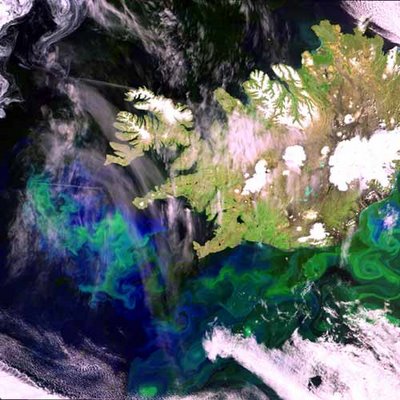
[Image: Here we see phytoplankton illuminating the Denmark Strait, forming solar-mineral arabesques, glowing traces. “While phytoplankton are tiny taken by themselves, together they can cause color shifts in ocean water, which in turn is detected by orbiting spacecraft.” Next, you build triangular frames, squares and circles afloat on the ocean – then fill them all in with phytoplankton: a sea of shining geometry. Cubes of light cast adrift across the North Sea, photographed from below by divers. Courtesy European Space Agency].

Nest-casting


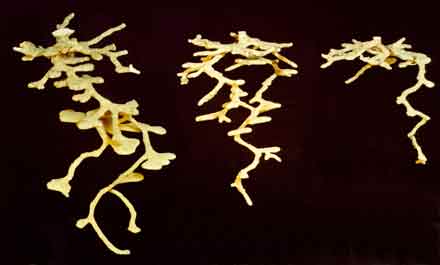
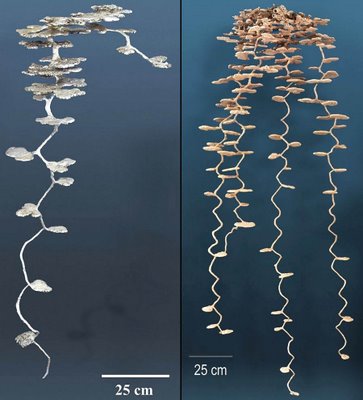
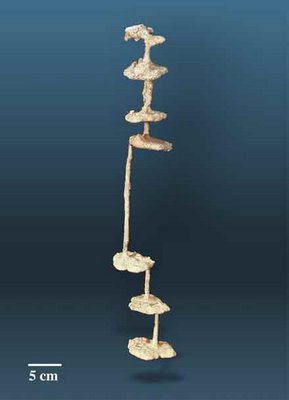
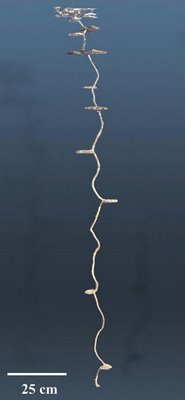
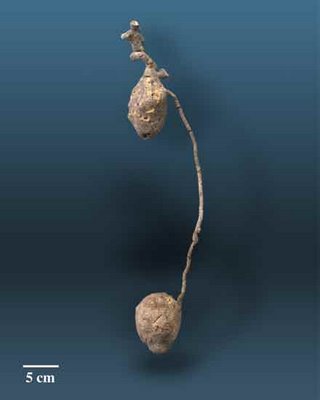
In the Fall of 2001, Cabinet Magazine introduced us to Walter Tschinkel, a professor of entomology at Florida State University. Tschinkel “has been making plaster casts of ant nests since 1982, when he first heard of the strength of orthodontic plaster. The painstaking process involves pouring the plaster down the opening as quickly as it will go in. After the plaster hardens, the excavation begins, but the nest must be taken out piece by piece. (One harvester ant nest, for example, took some five gallons of plaster and came out in 180 pieces.)”


“Sometimes more than ten feet tall, the nests are as beautiful in structure as they are complex.”


In a fascinating research paper (available through Florida State University as a PDF), Tschinkel describes subterranean ants’ nests as “shaped voids in a soil matrix.” These casts, Tschinkel tells us, offer “an invaluable way to visualize ant colonies as they are, that is as a three-dimensional network of tunnels and chambers.”


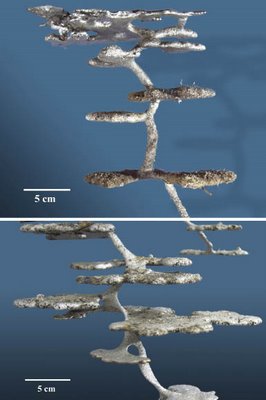
In an even more interesting – not to mention better illustrated – paper (also available as a PDF) Tschinkel takes us on a verbal tour of this buried architecture: “In contrast to shafts,” he writes, the chambers all “had more or less horizontal floors and a horizontal outline ranging from near circular when small, to multi-lobed when large. In vertical cross-section, they were flattened or slightly domed, with the horizontal dimension much greater than the vertical. All chambers were about 1 cm high, floor to ceiling, no matter what the floor area. Shafts usually intersected chambers at an edge, and connected sequential chambers. Below about 15 to 20 cm, chambers always began as lateral, horizontal-floored extensions from the outside of a spirally-descending shaft that therefore intersected the inner edge of the chamber at an angle ranging from 25º to about 70º.”


The social behavior of the ants is, in many ways, what produces the structures. Tschinkel refers to “movement zones,” in which “partially overlapping sequences from the center of the nest to the periphery” are traced and retraced by individual ants. These movements gradually erode at the walls, expanding surfaces into actual rooms. These “spaces,” then, are really the physical results of social activity, in which a surface becomes a route becomes a chamber – and further branchings spread outward (or downward) from there. (Substantially more information on this – including the influential role of carbon dioxide – can be found in this PDF).


“Chamber morphology,” meanwhile, “was rarely elongated and shaft-like.” Rather, each chamber “began as a niche in the outer wall of a shaft.” Etc. etc.
The process of making these casts almost always kills the ants in the nests, however; but that is “not something I like doing,” Tschinkel says.
Of course, the urge toward revealing invisible architecture can overwhelm even the best…

(Thanks to jpb for the link! And this post is directly related to an earlier post, Wormholes in Wood, which discusses the more conceptual aspects of such a project).

Air Wonder Stories


This 1929 cover from an American speculative fiction magazine inspired Janey Cook to rebuild that fantastic sky city using Lego.


[Images: New air city by Janey Cook; photographs by Calum Tsang and Allan Bedford. Air Wonder Stories cover from Frank R. Paul’s online gallery of sci-fi cover art. More covers coming up soon, in fact, because most of them are completely ridiculous – though architectural. Meanwhile, see the Lego Escher at gravestmor and, of course, The Brick Testament].

(Thanks to Peter Hoh for the link!)

Wormholes in Wood

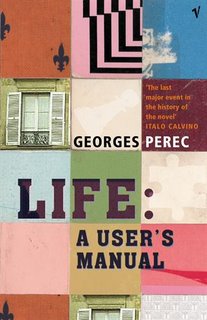
Emilio Grifalconi, a character in Georges Perec’s 1978 novel Life: A User’s Manual, at one point discovers “the remains of a table. Its oval top, wonderfully inlaid with mother-of-pearl, was exceptionally well preserved; but its base, a massive, spindle-shaped column of grained wood, turned out to be completely worm-eaten. The worms had done their work in covert, subterranean fashion, creating innumerable ducts and microscopic channels now filled with pulverized wood. No sign of this insidious labor showed on the surface.”


Grifalconi soon realizes that “the only way of preserving the original base – hollowed out as it was, it could no longer suport the weight of the top – was to reinforce it from within; so once he had completely emptied the canals of the their wood dust by suction, he set about injecting them with an almost liquid mixture of lead, alum and asbestos fiber. The operation was successful; but it quickly became apparent that, even thus strengthened, the base was too weak” – and the table would have to be discarded.
In preparing to get rid of the table, however, Grifalconi stumbles upon the idea of “dissolving what was left of the original wood” that still formed the table’s base. This would “disclose the fabulous arborescence within, this exact record of the worms’ life inside the wooden mass: a static, mineral accumulation of all the movements that had constituted their blind existence, their undeviating single-mindedness, their obstinate itineraries; the faithful materialization of all they had eaten and digested as they forced from their dense surroundings the invisible elements needed for their survival, the explicit, visible, immeasurably disturbing image of the endless progressions that had reduced the hardest of woods to an impalpable network of crumbling galleries.”
And if we could sculpt and harden our own paths through cities – across continents – what wormholes of structure and space might we find?

(Earlier on BLDGBLOG: Wormholes).