Fault whispers

It seems that “a pair of shiny, stainless-steel spheres measuring 7 feet in diameter and standing 50 feet apart” will soon be installed in a new San Diego park by artists Po Shu Wang and Louise Bertelsen. Together, the spheres will “enable visitors to ‘eavesdrop’ and monitor the earthquake fault” that cuts diagonally through the city.
From the San Diego Union-Tribune:

A small microphone lowered into a tube ending near the fault would transmit the sounds of typical, infinitesimal subterranean movement. The sound, which the artists would make audible to humans, could be heard in the park through a loudspeaker mounted inside a cone-shaped opening in the sphere. In addition, they plan to use new cell-phone technology to connect the mike to an international communications system. People all over the world could “dial up” to hear what the artists call “fault whispers.”

(Story via The Dirt. Earlier: resonator.bldg, in which we learn that a man “equipped with seismometers… can turn architectural structures into giant musical instruments and demolish buildings with sound alone.” See also Dolby Earth).

Sun-cancellation cloud

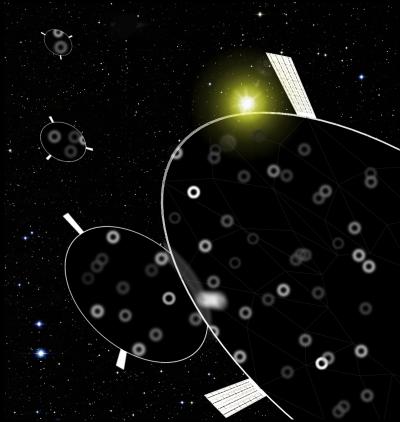
Will “a swarm of umbrellas” protect the Earth from global warming? Roger Angel, at the University of Arizona, apparently hopes so. In Angel’s plan, “a trillion miniature spacecraft, each about a gram in mass and carrying a half-meter-diameter sunshade… would act as a mostly transparent umbrella for the entire planet.”

[Image: The anti-sun space-umbrella cloud, by Roger Angel. Because of the cloud, sunlight is “spread out, so it misses the Earth” – leaving everyone down here pale and confused (but free of global warming)].

The whole thing “could be deployed in about 25 years at a cost of several trillion dollars,” and it “would be accelerated into space by a large magnetic field applied along 2,000-m-long tracks. With each such launch sending out 800,000 flyers, the project would require 20 million launches over a decade.” According to EurekAlert!, this actually means “launching a stack of flyers every 5 minutes for 10 years.”
So will this flying sun-cancellation machine really go live? Shouldn’t we perhaps use derelict buildings instead, hurling gigantic anti-sun clouds of ruined architecture into space – empty tower blocks and football stadia and Thames Water filtration plants, all blocking out the harmful rays? Sunlight passing through the windows of churches casts shadows on farms, affecting harvests… and the temperature on earth will never change.

(Via Roland Piquepaille, on a tip from Bryan Finoki).

Hotelicopter

“At the new Winvian resort in Litchfield County, Conn.,” the New York Times reports, “you can spend the night in a restored 1968 Sikorsky Sea King helicopter, so tricked out that Austin Powers might have piloted it. That’s a 17,000-pound mix of the plush and the industrial, of chilled Champagne and crystal waiting atop a stainless-steel fridge alongside an aerospace dashboard.”

[Image: A screen-grab from the Winvian website].

The Winvian isn’t open yet, on the other hand – and it’s priced well out of most holiday budgets. At up to $2000 a night, you’d expect more than just complimentary champagne; perhaps your hotel room can actually take off and rock you to sleep over the Litchfield Hills…
When the hotel does open up – on January 1st, 2007 – visitors will get to choose from amongst “18 cottages designed by 15 architects. Each cottage is conceived around a Connecticut theme: besides Helicopter (Sikorsky builds them in Stratford), others include Beaver Lodge, Camping Cottage, the Treehouse, Secret Society and Industry.” Rumor has it, there’s also a reproduction Hedge Fund Management Office and the much-anticipated George W. Bush Cocaine Suite.
Ah, Connecticut…

[Image: A screen-grab from the Winvian website].

BLDGBLOG will gladly accept offers of a few nights’ stay.

(Earlier: Resort Hotels of the Stratospheric Future!)

Paradise Now

Arcadia by Invertebrate is a project “assembled from images that share the tag ‘arcadia’ in an online photo-sharing website.” Effaced, cropped, combined, and altered, the images then serve as surreal maps of earthly paradise: a stereotyped landscape of personal leisure, backyards, and harmless wildlife, all in the shadow of distant mountain ranges.

Fascinatingly, these are the source images from which Invertebrate built the project.

How would it look, I wonder, if you used the word “prison” as your tag, instead – or “suburb,” “home,” or, for that matter, “paradise”? What about “office” or “hospital” or “factory”? Or, less architecturally, something like “police”?
In any case, don’t miss Borderville, Invertebrate’s earlier and tactically similar project, featured on BLDGBLOG several months ago. For Borderville, “Invertebrate posted a request to the online film community for the titles of movies featuring border crossings. Borderville is assembled out of objects ripped from these movies.”

(Borderville, and Invertebrate, first discovered via Cabinet Magazine).

War City

[Image: Jens Liebchen].

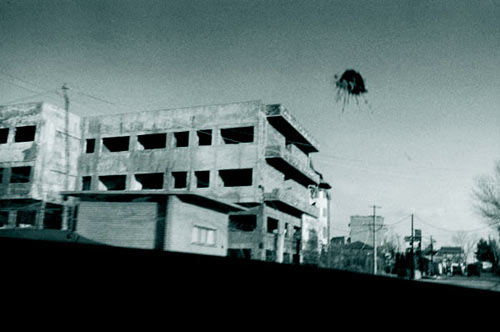
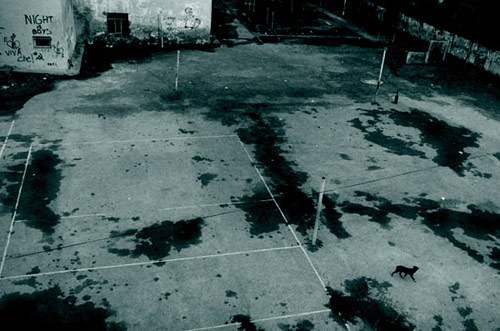
Lens Culture introduces us to German photographer Jens Liebchen’s series DL07: stereotypes of war.
For the project, Liebchen “constructed a series of black-and-white photos of a city under seige [sic] – menacing helicopters buzzing abandoned buildings, furtive figures scrambling down deserted streets, smoke-filled skylines, blood-stained walls and sidewalks, too-young children armed with machine guns… Yet he took all of these photos in a city (Tirana, Albania) while it was at peace.”

[Images: Jens Liebchen].

More at Lens Culture.

The Subterraneans

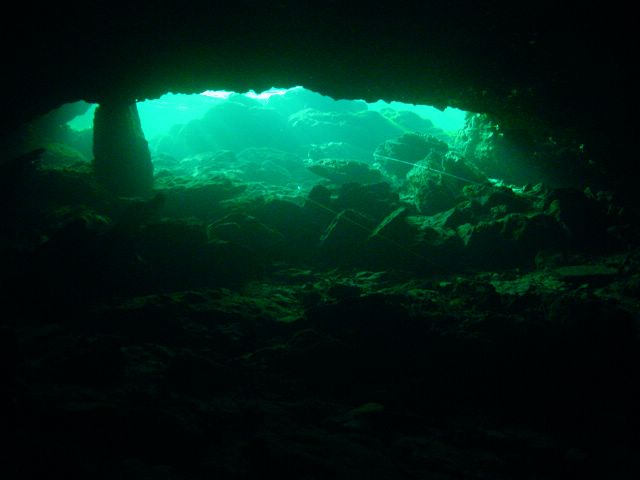
“About 120 miles east of Albuquerque, on the eastern edge of the town of Santa Rosa, N.M., lies a tiny oval of blue water—a spring-fed sinkhole about 80 feet wide and 81 feet deep—known as the Blue Hole. Sometime ago a group of scuba divers dove into the Blue Hole, eager to explore every nook and fissure of the smooth-walled sinkhole. After climbing out, they realized one of their divers had disappeared. Six months later, the body of that diver finally surfaced, but not in Santa Rosa. It was discovered, the story claims, in Lake Michigan—more than a thousand miles away—naked, waterlogged and with much of its skin scuffed off, as if it had been pushed and scraped through miles of rocky tunnels.” The one, terrible word BLDGBLOG was gouged into his flesh…

(Story via Warren Ellis; image via Wikipedia).

Offshore

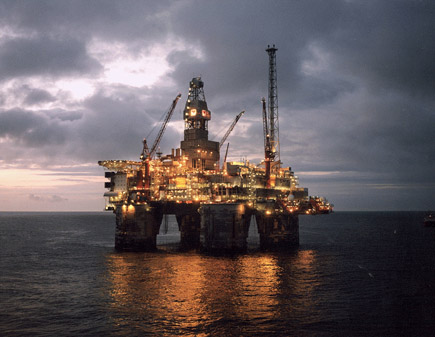
HEIDRUN[Image: Courtesy of Statoil].

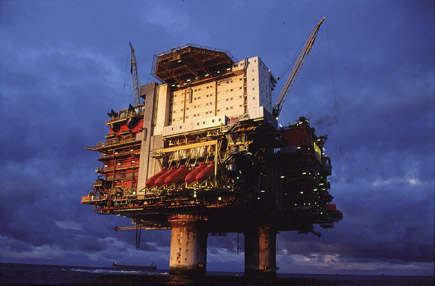
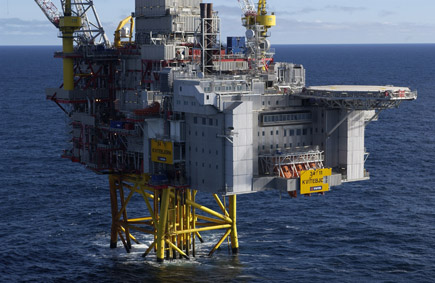
I was flipping through a copy of Archive the other night when I came across a spread of recent print ads by Norwegian oil giant, Statoil. The ads featured cities and skyscrapers and the Roman Colosseum all Photoshop’d perfectly onto offshore oil derricks; they looked like instant and futuristic offshore micro-utopias – or perhaps even some weird, mechano-robotic version of Arnold Böcklin‘s Isle of the Dead.
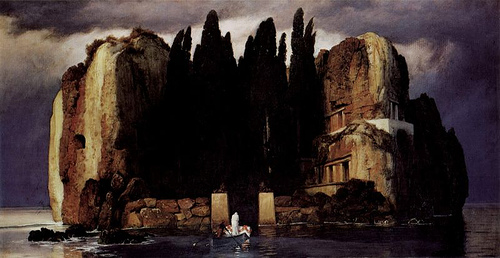
0[Image: Arnold Böcklin].

In any case, I wanted to post the ads here – but all I could find online were Statoil’s own press images. Those, however, induced a kind of minor panic attack, as the offshore structures they document easily rival, and possibly surpass, the most far-fetched architectural speculations of Constant Nieuwenhuys.
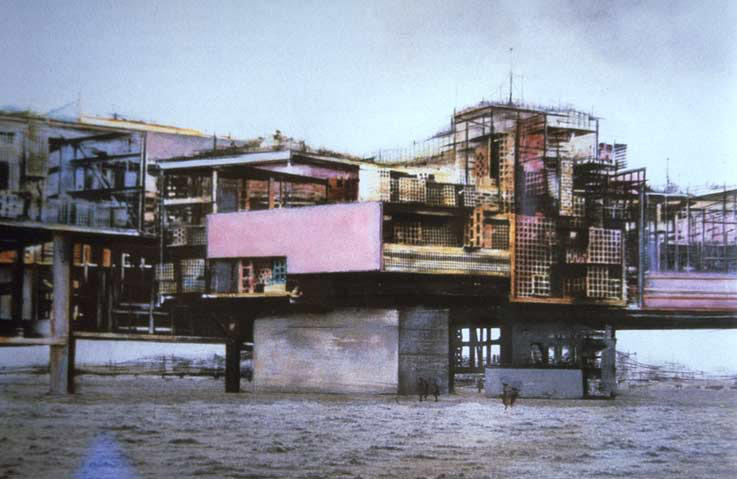
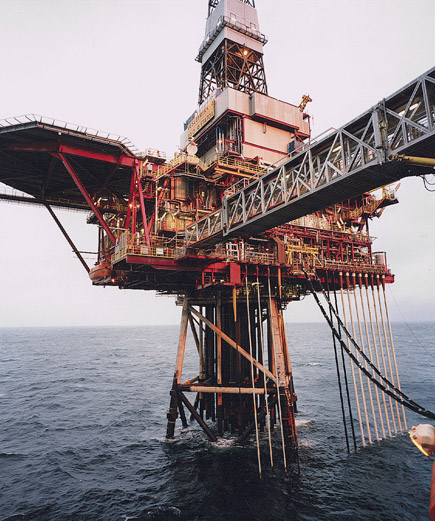
0STATFJORD A[Images: Constant vs. Statoil].

So here are some photos – and anyone who runs across online versions of the Statoil ads, let me know.
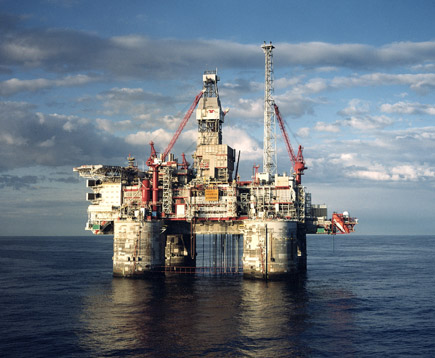
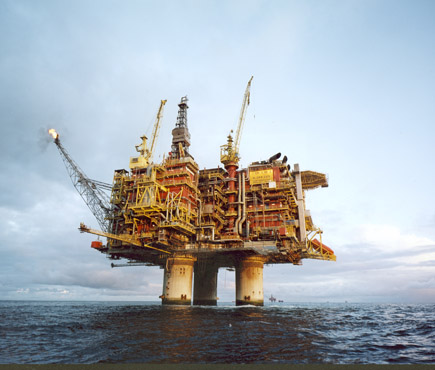
0[Images: Courtesy of Statoil].

These next two shots were actually taken inside the legs of one of the derricks; as such, the photographer is standing below sealevel.
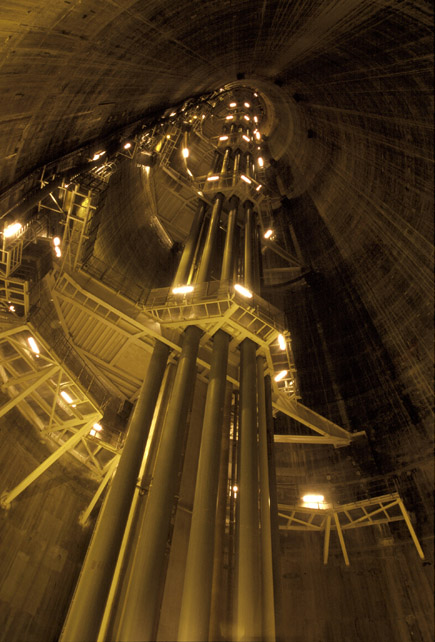
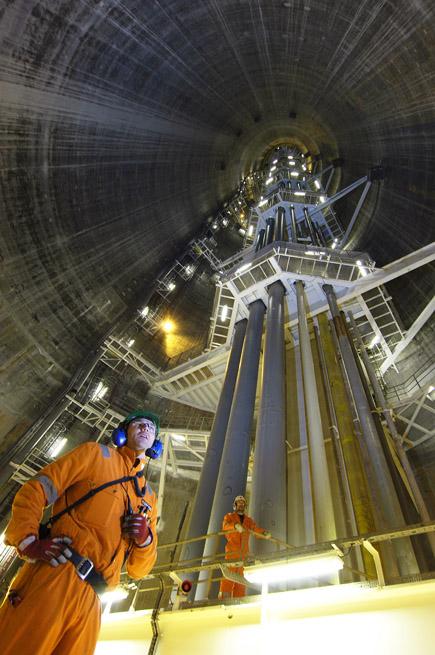
Troll AI skaftet på Troll A[Images: Courtesy of Statoil].

But then I got to thinking how, toward the beginning of The Aeneid, we read that Aeneas and his crew have been tossed about by a string of storms and bad navigation, moving island to island against their will:

For years
They wandered as their destiny drove them on
From one sea to the next…

They are accidental exiles, always docking on the wrong shore.
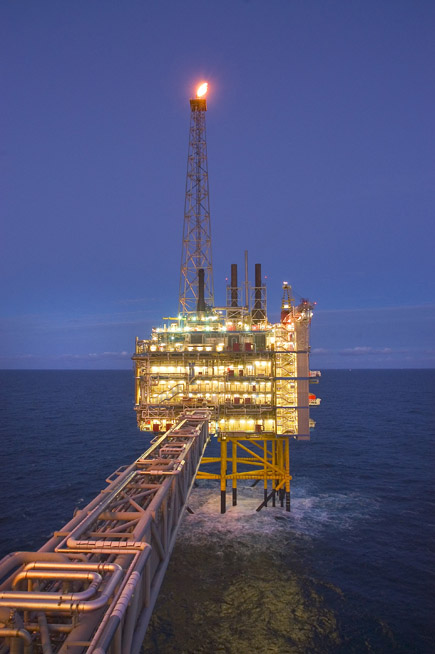
[Image: Courtesy of Statoil].

Unsurprisingly, Aeneas is soon fed up with trying “[t]o learn what coast the wind had brought him to,” so he confronts a random islander – not realizing that it’s actually his mother (his mom happens to be Venus, and she likes to wear disguises). He demands:

Tell us under what heaven we’ve come at last,
On what shore of the world are we cast up,
Wanderers that we are, strange to this country,
Driven here by wind and heavy sea.

Etc. etc. – it’s the endless drama of origin and detour.
My point is simply: how might the Aeneid have been different if the Mediterranean Sea they’d explored had actually been full of oil derricks, a manmade geography of machine-islands, industrialized stilt-kingdoms each more fantastic than the rest – and so they’d set sail beneath the anchored legs of support understructures and maintenance gantries, roping up their ships for the night in the shadow of artificial hills and disguised islands? An Aeneid for the machine age.
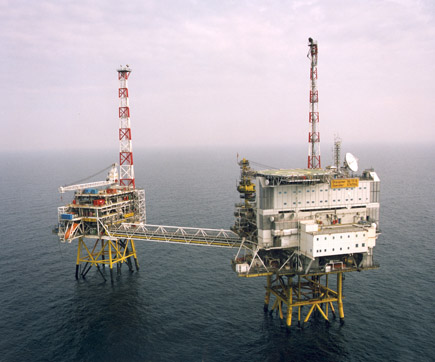
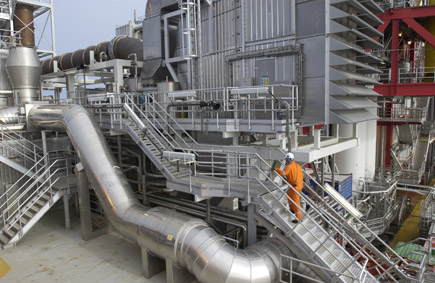
[Images: Courtesy of Statoil].

More practical questions include the reuse of these structures: what unintended future functions might these aging derricks be repurposed for? Once their fields run dry, will they be left standing till inevitable collapse? Or will a maritime preservation movement swoop in to save them?
Further, will corporate tax havens of tomorrow be built at sea, in private archipelagos of platform-cities, an experimental terrain for new concepts of financial sovereignty?

[Note: Just to be absolutely clear here, all images of oil derricks used in this post come courtesy of Statoil].
Chicago’s Inner Flute-Ruins

[Image: The old tower blocks of Chicago’s Cabrini-Green, transformed by demolition into totem pole-like wind instruments, flute-ruins, a musically-active wasteland whistling to itself behind security fences. Photographer unknown; spotted at Archinect. It seems worth briefly pointing out, however, that Cabrini-Green could instead have been architecturally salvaged and later reused—and, given a different economic model, the towers could also have been refurbished. Indeed, through that latter link we learn that the combined weight of London’s existing tower blocks is an astonishing forty million tons—meaning that high-rise building materials constitute a near-geological presence in many cities, and they should not simply go to waste…].

sea.net

Wired reveals what “a permanent presence in the ocean” might look like, if that “presence” consisted entirely of manmade submersibles.

[Image: From Wired].

This underwater robotic metropolis is otherwise known as the NEPTUNE Project. Specifically, Wired writes, the project “would string 10 semiautomated geobiological labs across the Juan de Fuca tectonic plate off Washington, 8,000 feet underwater. Each would have cameras, lights, robots, and sensors, all connected to the surface via optical cable to transmit data on everything from the biomass of microbes to the effects of ocean temperature on weather.”
According to the project’s own website, the “goal is for NEPTUNE to appear as a seamless extension of the global Internet, connecting users anywhere on shore to the sensors on the seafloor.”

[Image: A future seafloor exploratorium. Image provided courtesy of the NEPTUNE Project and produced by CEV].

As Space.com reported back in 2003, “the network itself will cover a region roughly 310 miles by 620 miles (500 kilometers by 1,000 kilometers) in size. More than two dozen experimental sites will form nodes along the sub-sea cable system. Nodes will be situated about 62 miles (100 kilometers) apart” – making the whole thing only slightly smaller than Great Britain.
On the other hand, the NEPTUNE Project should be thought of as a terrestrial analog for other, more far-flung, research stations: according to John Delaney, for instance, a similar set-up could be used to explore the oceans of Europa (about which more can be found here).
Given some oxygen tanks, it could also be the perfect location for a new public lecture series on architectural design…

(Not quite related: Open Ocean Aquaculture).

New Zealand is Droning

Apparently this sound (which I can only hear through headphones) is causing quite a stir in the northern districts of Auckland. The sound is so maddening, it seems, that it’s inspired some residents “to take drastic action” – which, in one case, means purposefully deafening oneself with the roar of chainsaws.
In fact, “for those who can hear it, the sound is the bane of their lives.”


The sound also reveals where unexplained acoustic phenomena, dishonesty, and urban real estate intersect: “Some have been reticent to give away more details of their predicament for fear that reports of persistent humming could adversely affect the resale price of their homes.”
One of the researchers trying to locate the sound’s origins “rules out geological factors. ‘It’s more likely to be things like pipes under the ground – you know, gas pipes, sewerage pipes, factories in the distance.'” CIA installations, perhaps.
“This is not the first incidence of humming in New Zealand,” we’re told. Oh, no. “In 2005, New Zealand author Rachel McAlpine wrote a book called The Humming… largely inspired by the author’s own experiences in the seaside town of Puponga on the northwest tip of New Zealand’s south island which was itself at the centre of a humming mystery some years back.” That man was later arrested.
In McAlpine’s novel we read how “life is becoming increasingly frustrating for [a character named] Ivan because he is plagued by an underground humming that he tries to disguise with an increasingly bizarre array of devices.”
If it were my story to re-tell, however, Ivan would soon become so unbelievably good at manufacturing sonic camouflage that he turns into the terror of post-Blair Great Britain. (He moves to Britain). Completely silent, exploding noiseless weaponry over the city of Birmingham, Ivan’s Joseph Conrad-inspired, acoustically avant-garde ransom demands are met not with payment stashed inside a pre-arranged safety deposit box – but by a visit from a certain, rather well-known, secret agent of the crown… Unfortunately, James Bond is almost immediately captured – having been dumbfounded by a house full of mirrored rooms, someone else’s mobile phone, and a weird echo, coming as if from behind him, that induces a state of cognitive paralysis. Bond is then subjected to a series of unbearable noise-tortures, leading some in the audience to laugh and others to accuse the film of being an unacknowledged remake of The Ipcress File. But, once the enemy is brought back on screen, transformed by his life of sonic dissimulation, he addresses Bond through a grotesque series of hand-held voice-cancellation machines – and we see that something altogether more terrifying has been planned…
Of course, it has long been known that if you “listen carefully… you can hear the Earth singing quietly to itself.”

They live underground. They are everywhere but seem to come from nowhere. They barely exist, but never leave. If sounds have shadows, they are the shadows of a sound. Researchers call them the background free oscillations of the Earth.

These “background free oscillations,” however, while more or less totally unrelated to the New Zealand drone, discussed above, are also unexplained. This endless terrestrial resonance could be “buildings shuddering in the wind,” for instance – or it could be “the constant throb of fluctuating atmospheric pressure all over the Earth.” It could even be the combined effect of all the oceans’ waves crashing on all the earth’s shores simultaneously. It could even – though let me pull the blinds closed as I write this – it could even be the rumble of invisible stealth bombers breaking the sound barrier out at sea…

(Thanks, Marcus! Earlier: Sound Dunes, Dolby Earth, and so on).

BLDGberry

Though it’s kind of insane to post this here, I was excited nonetheless to see that BLDGBLOG is featured in the new Blackberry Pearl ad campaign


It pops up in the context of author Douglas Coupland‘s everyday telephonic activities; at 12:45pm, according to the little Flash animation, Coupland “settles a lunchtime architectural argument” by going to BLDGBLOG.


The logo’s so bigtime they got shy and hid the other half…
That’s right.
So I’m retiring on the royalties to Brazil, where I’ll re-reverse the flow of the Amazon River and report back in a few years’ time.

(Thanks, Douglas!)