The mine hijackers

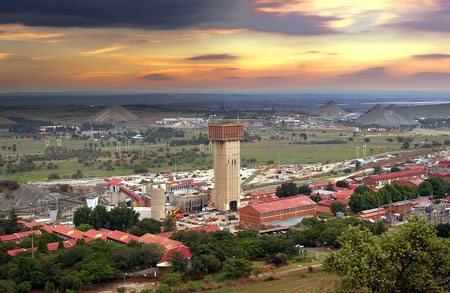
[Image: The Tau Tona mine; courtesy of AngloGold].

The gold mines of Johannesburg, South Africa, Herald Scotland reports, “are veritable underground cities, with tunnels winding for hundreds of miles more than two miles below the surface of the Earth.” To counter temperatures often higher than 40ºC, mine operators “continuously pump down refrigerated air into the subterranean cities where miners and other workers wear special jackets packed with ice to counter temperatures so high that the rock itself is hot to the touch.” Indeed, at the Tau Tona mine outside Jo’burg – “the deepest and biggest [mine] in the world with more than 500 miles of tunnels” – “miners will be working in temperatures as high as 50ºC, requiring cooling systems of enormous power and sophistication with capacities more [than] three million times that of a domestic refrigerator.”
These “capacities” include the production of at least “20,000 tonnes of ice a day, which is crushed and pumped along pipes that run down through the mine tunnels and galleries. As the iced water warms up it is pumped back to the surface to be re-frozen.” Rig several dozen of these up to a small nuclear power plant, and you could gradually make your way to the center of the earth… That, or construct an artificial glacier outside Cape Town.
Glaciers are the future of architectural design.
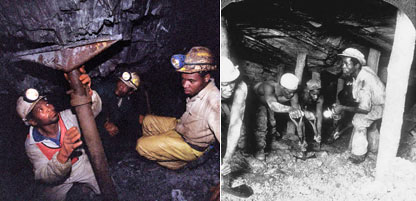
[Image: (left) Workers in a South African gold mine; via Voice of America; (right) “Miners cutting an exploratory tunnel in the Crown goldmine. Johannesburg, South Africa, c. 1935.” (Via) ].

In any case, the most fascinating aspect of this whole story for me is that, down in the “disused shafts and tunnels” beneath the city of Johannesburg, whole illegal communities have been found. Mineral smugglers – or those who would carry pieces of the earth’s surface across political borders – “live for up to a year at a time below ground without surfacing, mining illicit gold estimated to be worth nearly £400 million a year for three international criminal syndicates.”
Quoting at great length:

The unlawful miners ‘hijack’ closed-off sections of legitimate mines, plunder them and provide the syndicates with tonnes of gold to smuggle abroad. Armed with handmade grenades to fend off intruders, they face death by suffocation and even insanity [!] in the appallingly nightmarish conditions in which they live.
‘There is no fresh air, it can be as hot as 38ºC, everything is very compressed and the humidity is very high,’ said police explosives expert, superintendent Joe Meiring. ‘They work there, they sleep there, they eat there. It is hot and dark, and they age very quickly. They even smoke down there, which is very dangerous because of the methane gas present in mines which can explode as a result of the slightest spark.’
Meiring was one of the commanders of a 20-strong police team, which had undergone months of special training, that last week invaded one of the illegal tunnel complexes and arrested 60 rogue gold-diggers. All of them were black, all of them typically desperate to do anything to earn a living in an economy where unemployment runs at more than 40%, where social welfare benefits are meagre, and where the gap between the fabulously wealthy – both black and white – and the overwhelming majority of the desperately poor is as stark as it is shocking.
Unable to drive out their neighbouring ‘slum dweller’ panhandlers, who use AK-47 assault rifles and beer bottle ‘grenades’ stuffed with explosives and iron waste shrapnel as deterrents, the mine companies turned to the police to begin tackling the problem.

And therein lies a novel (or two).

(Thanks, Bryan!)

The Invent-a-Micronation Contest…

BLDGBLOG readers, now is your chance to shine: using 100 words or less, tell us what kind of micronation you would found – and where. Would it be an agricultural utopia, ruled by lottery, prone to war? Or a tropical island paradise, funded by bonds in coconut futures? Perhaps a polysexual fantasy on a hovercraft, roaring nonstop across the oceans of the world? Or a quiet Arctic refuge? A little mountain town somewhere, full of friends and wine?
Winners – decided by yours truly, with some friendly advice from my colleagues, all of us reacting instinctively, without strict criteria – will receive a free copy of The Lonely Planet Guide to Micronations, by John Ryan, George Dunford, and Simon Sellars. And, yes, you can draw, you can paint, you can do whatever you might need to do visually, but submit it all to me by email no later than Friday, December 15th, 2006. And put “Invent-a-Micronation Contest” in the subject line, or your little baby might get junk-mailed.
If you need quick tips, examples, criteria, etc., see BLDGBLOG’s brand new interview with Simon Sellars, one of the Lonely Planet book’s co-authors – or take a look at Wikipedia’s entry on micronations.
And, why not: you can submit more than once. In fact, please do.

Gazprom City

Der Spiegel reports on Gazprom City: the future, rather evocatively named St. Petersburg headquarters for Russian energy giant Gazprom, currently the subject of a high-profile design competition.

This new “city,” however, will just be a cluster of high-tech administrative buildings, although the main tower “is to rise at least 300 meters (985 feet) into the sky and symbolize the growing power of the firm. It is also to be situated just opposite the famed 18th century Smolny Cathedral on the Neva River in historic St. Petersburg.”
This location has proved rather controversial.

Because Gazprom City “is part of a longer range plan by Russian President Vladimir Putin to boost the prestige of his home city,” however, it seems unlikely that the project will be held back. This, after all, may be St. Petersburg’s newest architectural moment: “Much of the development that has occurred in recent years has benefited Moscow, whereas St. Petersburg has seen little change. Only recently, with the celebration of the city’s 300th birthday in 2003, did the city begin awakening from its centuries-long sleep. But even as high-tech projects and a new theater designed by Sir Norman Foster have gone ahead, major changes to the city center, with its numerous UNESCO-protected royal residences and palaces, are considered taboo.”

In any case, the winner of the competition will be announced on December 1st, and the actual tower should be fully constructed by 2016.

Until that time, here’s a quick bet that at least one person out there – whether they’re a novelist, a filmmaker, a graphic artist or even just a refreshingly ambitious architectural student – will design, write, film, or draw some futuristic sci-fi dystopia called Gazprom City, simply because the name is so cool. Of course, you’ll probably get sued. But think Perdido Street Station – described by this reviewer as “Metropolis meeting Gormenghast in the heart of Dickensian London” – goes to Renaissance Paris via, perhaps, Nostromo… and you get the picture.
So: Gazprom City. Artists and writers, show us what will happen there.

(Image credits: In order, these are designs by Daniel Libeskind, Jean Nouvel, Herzog & de Meuron, OMA, Massimiliano Fuksas, and RMJM. Story found via things magazine).

architectural-theory.pdf

The fellows at Archfarm have added to their series of architectural PDFs – unfortunately referred to as “fascicles” – with Peter Yeadon’s recent thoughts on nanotechnology.
In that paper (download the fascicle), Yeadon introduces us to structures in “an age of molecular manipulation,” in which we’ll see “the dawn of nanofactories, robust molecular machine shops that harvest atoms from a reservoir of molecules to make sophisticated materials, devices, and systems one atom at a time.”

What could such minuscule inventions possibly have to do with the making of architecture and cities? A nanometer is about a million times smaller than the diameter of a pinhead, and a thousand times smaller than the length of a typical bacterium… How could these tiny achievements possibly have any bearing on the work of an architect?

Read his fascicle and find out.

Archfarm has also published an interview with Sonia Cillari (download the PDF), about emotion and interactivity in architectural design, as well as Usman Haque’s rough guide to “open source architecture” (PDF), published last summer.

The series veers a tiny bit too close to the world of Deleuzian eyeglasses and trendy jargon, I have to say, but it’s a great format and I’ll be interested to see where they go next. For instance, might I humbly recommend they publish The Pruned Guide to Futurist Geo-Hydrology… That, or BLDGBLOG will start its own series of PDFs – and then everyone can stare in awe at my fascicles.

Tennis, beer, and Tudor houses

[Image: Little Moreton Hall, “an early model of energy efficiency,” according to the Guardian Weekly].

“The energy-efficient building of the future,” we read, “was constructed 500 years ago,” during the Tudor reign:

Homes of the 1500s are still liable to lose less heat than their mock-Tudor counterparts constructed over the past few years, according to tests carried out for the power supplier British Gas. Tudor properties, with their oak beams plus wattle and daub infills, leaked 10 cubic metres of warm air an hour for every square metre of wall against 15.1 for a mock-Tudor home built in the 1960s… The surprise result is an indictment of recent government regulations but it has brought some pleasure to traditionalists of the architectural community such as the Prince of Wales. ‘Wind turbines, solar panels and other hi-tech green devices might get the media attention, but the smartest way to save energy may be to live in a Tudor house and insulate the attic and repair the windows,’ said Hank Dittmar, chief executive of the Prince’s Foundation for the Built Environment.

In other words, the article concludes, “the Tudors may be able to claim sustainable homes as another first, alongside tennis and beer.”

Adventures in architectural development

[Image: Ripping up British railroad tracks in Angola under Chinese supervision; New York Times].

An excellent – if gigantic – article about international development, foreign aid, construction contracts, and “China’s African adventure” was published last weekend in the New York Times.
There, we find China reconsidered as a kind of economic event with infrastructural effects in distant landscapes. In Africa, for instance, “China has already begun, in myriad ways, to serve the interests of [developing nations], while the United States, preoccupied with terrorism, has seen its dominant status slip. Angola, once a cold-war pawn, can now serve as a kind of test case in the latest struggle to shape Africa’s destiny. Call it Chinese-style globalization.”
The article is quick to point out that China already has “a long history as a development partner; Africa is dotted with gigantic sports complexes and People’s Halls built by Chinese engineers at the behest of dictators.” It will now be dotted with Chinese-built roads, railways, and conference centers.
Quoting at length:

Four or five miles along the asphalt road that runs east from Kaala, a small town in central Angola, a Chinese construction company has carved an unexpected right turn, a broad dirt path that runs over a rise through scrubby forest. The path, which has no marking, winds past a basketball court – recreation for the work force – and then empties out into a vast plaza of meticulously smoothed earth. Dump trucks ferry loads of dirt back and forth. At the far end of the plaza, obscured by tree trunks that have been uprooted and laid carefully on their sides, are train tracks. The whole scene, invisible from the road, conjures the stupendous designs of the evil genius in a Bond film.
The weed-covered tracks are the remnants of a railway built by British engineers a century ago to transport precious minerals from the heart of the continent to the port of Lobito, more than a thousand miles away. The Angolan government is paying a consortium of Chinese companies $1.9 billion to completely reconstruct the tracks, the bridges, the stations, the equipment, all shattered by a quarter-century of warfare and neglect.

Like something out of a J.G. Ballard novel – or perhaps a Chinese rewriting of Heart of Darkness – we read how, throughout Angola, old urban plans are still visible “but the cities themselves had crumbled away.” However, with Chinese help, a “new city, Luanda Sul, has begun to sprout above the vast, teeming slums of Luanda [Angola’s capital]. On a hilltop south of the city, Sonangol has built a giant aluminum-and-glass conference center, a state-of-the-art facility for international conferences as yet unplanned, to be serviced by an international airport as yet unfinished. Portuguese and Brazilian construction companies are building their headquarters along perfectly smooth boulevards. Members of the new corporate class are spending $80,000 and up to buy one of the rose or pale green houses overlooking the sea. It’s a new world for a new, legitimate kind of wealth.”
It seems totally legitimate to wonder, then, what future literatures might emerge in such a setting. Will Chinese middle managers with a taste for spy novels write, under pseudonyms, the first great Graham Greenian thrillers of the 21st century? Mineral rights, emerging diseases, oil fields, ethnic tension, and weekend flights back home to Beijing… What future plots will take shape during the final years of “China’s African adventure”? Will a Chinese Archigram publish its own delirious manifestos for instant development, modular villages built with oil money on the shores of manmade lakes?
In any case, the New York Times continues: “The Chinese are a mysterious presence in Angola. Everyone seems to know about them and their assorted projects, but few people have actually seen them, and scarcely anyone can claim to have talked to them. The Chinese rarely venture beyond the encampments in which they live and work.”
Meanwhile, if your curiosity about China has been piqued, don’t miss another gigantic article from the New York Times about that nation’s industrially over-exploited Yellow River.

[Image: The city of Zhengzhou, on the banks of the Yellow River; New York Times].

“The Yellow River, curving through regions only intermittently touched by the country’s boom, offers a tour of the pressures and contradictions bearing down on China, and of the government’s efforts to address them,” we read.

Most astonishing, cities beside the river like Yinchuan, Luoyang and Zhengzhou – places few Americans have ever heard of – are racing to become China’s next new regional urban center with almost hallucinatory building booms. Yinchuan, a modest, ancient capital, is building an entire city district for a vast government complex and is adding 20 million square feet of construction every year through 2011. Luoyang, once the capital of the Zhou dynasty, has built a cluster of futuristic sports stadiums that look like a grounded armada of metallic, alien spaceships.

Finally, one more recent article from the New York Times… This one re-introduces us to Rem Koolhaas‘s topologically self-connected headquarters for China Central Television (CCTV) in Beijing.

That building, we read, will be “one of the largest ever constructed,” and it will loom “like some kind of science-fiction creature poised to stomp all over the surrounding central business district.” It’s due for completion by the end of 2007.
Read a bit more about the project at BusinessWeek – or in Koolhaas’s own, and ultimately somewhat content-less, Content.

To Catch a Thief

An all-female gang of teenage apartment burglars has been arrested in Santiago, Chile.

According to the BBC, the women “were infamous for climbing up buildings in Santiago to burgle luxury apartments… Lurking in the gardens of expensive parts of Santiago, the four girls hurled ropes and hooks up to balcony railings, hauled themselves up and walked through the flat windows. They then walked out of the buildings as if they were visitors.”

Incredibly, two of the girls were “heavily pregnant,” yet “they still managed to climb up to the third floor of some flats.”

(Story via tiny nibbles; photos of Santiago via Wikipedia).

Frog Hotel

[Image: Manuel Roig-Franzia/Washington Post].

Panama’s Hotel Campestre now caters to an unusually specific clientele: endangered frogs.
There, frogs “get the full spa treatment. Daily cleansing rinses. Exotic lunches. Even 24-hour room service.” In fact, it is “the frogs’ own Hotel California,” we read, “a place where they could check in but could never check out.”
Mixing metaphors, the hotel is nothing less than “a Noah’s Ark for frogs,” its residents arriving in the specimen boxes of concerned volunteers and scientists. There are “glass frogs with skin so translucent that their organs are always on full display.” There are “frogs that look like rocks and eat freshwater crabs, aggressive tree frogs and shy, nocturnal toads.” There are even frogs with “a taste for the good life.” This means that the males of the species “happily hop on the backs of the much larger females, who carry them around for as long as 80 days searching for just the right spot to breed.”
I’ve tried this method, and the results are spectacular.
Perhaps coming soon: Honeymoon at the Frog Hotel, a new film by Pixar…

(Thanks, Nicky!)

An orbiting array of reflective balloons

[Image: “An orbiting array of reflective balloons focuses sunlight onto the surface of Mars, providing extra heat and solar power for human colonists.” Via New Scientist. The plan being illustrated here would specifically use “300 reflective balloons, each 150 metres across, arranged side-by-side to create a 1.5-kilometre-wide mirror in orbit.” This would thus create “Earth-like conditions” on Mars – and perhaps inspire some strange future version of the Narcissus myth, in which a whole civilization turns its eyes to the nighttime skies… only to be confronted with an unmoving reflection of itself. What new astronomies are we doomed to construct? Of more earthly concerns, could we build small clouds of mirrored balloons, and – when our teenage neighbors aren’t shooting them down – amplify urban solar power intake during the off-season? Manhattan, masted to a thousand clouds of silver balloons, all shining].

(Thanks, Bryan! Related: Pruned’s Let there be light!)

Utopian Typography

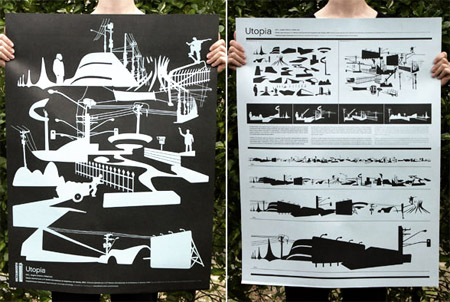
Utopia, pictured above, is a “digital typeface that portrays the mixture between the modernist architecture of Oscar Niemeyer and informal occupation of the urban space that shapes major Brazilian cities.” In other words, all the letters look like buildings designed by Oscar Niemeyer, jumbled up in Brazilian proximities.

[Images: BLDGBLOG written in Utopia; the whole font, posterized].
Utopia was designed by Angela Detanico and Rafael Lain; because their site uses Flash, however, you can’t directly link to the font. But it’s there.
So if somebody stumbles on a city full of Oscar Niemeyer buildings… will they suspect hidden messages in every glance?

Beijing Underground

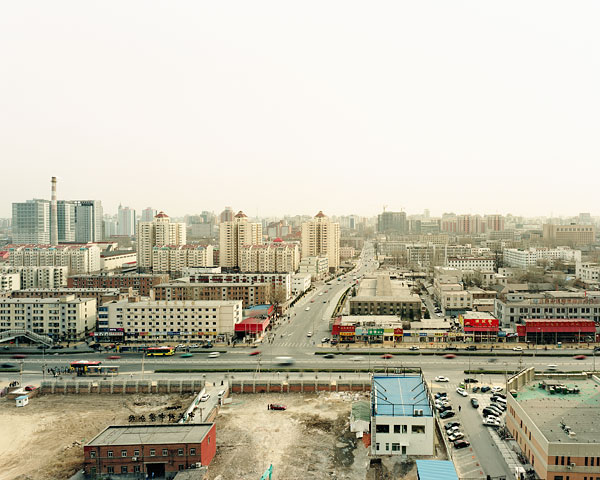
[Image: Chengfu Lu, Haidian District, Beijing (2004) by Sze Tsung Leong].

Apparently Beijing hopes “to ease congestion and other urban growing pains plaguing the city” by going underground.
“City planners have identified 17 key areas of the city for subterranean development, and envision an eventual ‘underground town‘ spanning 90 million square meters by 2020.”
This new subterranean Beijing “would quadruple the amount of underground space now being utilized in the city, which is currently at about 30 million square meters… Underground floor space [has] expanded by three million square meters in Beijing annually, [accounting] for 10 percent of the city’s total floor space completed each year” – much of which has been “devoted to parking and other traffic use.”

(Thanks, Alex P.!)