The horrible secret of Number 6 Whitten Street

A story I’ve been meaning to write about for several weeks now involves a family in South Carolina who moved into a newly purchased house.
They were all messing about one day, doing chores, cleaning up, moving in, when they “found a secret room in their home behind a bookcase” – but “what was inside,” we read, “was a nightmare beyond their wildest dreams.”

[Image: A suburban house that is otherwise unconnected to this post].

Inside the room was a hand-written note.
The note said “You Found It!”
It turns out, the note explained, that the house was infested with “the worst types of mold including Stachybotrys, the so-called Toxic Black Mold,” which can cause “respiratory bleeding” in infants.

[Image: Toxic black mold].

The stunned homeowners, thinking they might be the victims of a weird hoax, hired an environmental engineer – only to discover that the problem was even worse than they thought; the house contained “elevated levels of several types of mold, including Aspergillus, Basidiospores, Chaetomiu, Curvularia, Stachybotrys and Torula.”
The town’s local news station calls this “the horrible secret of Number 6 Whitten Street.”

(Thanks, David W.!)

The year is 2099…

“A magnetically levitated train could theoretically take you from New York to London in 54 minutes,” the Discovery Channel informs us. “But you’d have to go 5,000 mph through a 3,100-mile-long tunnel that was itself floating in the Atlantic Ocean. How might that work?”
Well, let’s find out.


Of course, if this interests you, don’t miss parts two and three.

All eyes on the city

Like some rogue branch of the independent film industry, private security firms are now installing what The New York Times calls “one of the most comprehensive high-tech public surveillance systems in the world,” and they’re doing it in China.

[Image: Surveillance cameras for sale in China; photo by Timothy O’Rourke for The New York Times].

While these cameras and other forms of remote sensing are being installed to keep Olympic athletes and their screaming fans safe during the coming summer’s Games, the worry is that the surveillance will simply stay put:

Long after the visitors leave, security industry experts say, the surveillance equipment that Western companies leave behind will provide the authorities here with new tools to track not only criminals, but dissidents too… Indeed, the autumn issue of the magazine of China’s public security ministry prominently listed places of religious worship and Internet cafes as locations to install new cameras.

Think of it as the becoming-cinematic of urban space. Some of the technologies being installed include, but are not limited to, the following:

Honeywell has already started helping the police to set up an elaborate computer monitoring system to analyze feeds from indoor and outdoor cameras in one of Beijing’s most populated districts, where several Olympic sites are located. The company is working on more expansive systems in Shanghai, in preparation for the 2010 World Expo there – in addition to government and business security systems in Guangzhou, Shenzhen, Nanjing, Changsha, Tianjin, Kunming and Xi’an. General Electric has sold to Chinese authorities its powerful VisioWave system, which allows security officers to control thousands of video cameras simultaneously and automatically alerts them to suspicious or fast-moving objects, like people running. The system will be deployed at Beijing’s national convention center, including the Olympics media center. I.B.M. is installing a similar system in Beijing that should be ready before the Olympics and will analyze and catalog people and behavior.

And so on.
James Mulvenon, director of the Center for Intelligence Research and Analysis, remarks that “the pace of technological change means that products with mainly civilian applications, like management computer systems with powerful video surveillance features, [have] blurred the distinction between law enforcement and civilian technologies.” And it’s in that blurring that some U.S. security firms have potentially brushed up against the outer edge of illegal commercial activity: that is, supplying China with these cameras might at least partially violate “a sanctions law Congress passed after the Tiananmen Square killings” in 1989.

[Image: Surveillance in China; photographer temporarily unknown, though this appeared in The New York Times several months ago].

All of this also highlights the increasingly intense overlap between film production, the political administration of urban space, and the private security industry, whereby three otherwise unrelated fields become nearly indistinguishable from one another – or, perhaps more accurately phrased, they become erstwhile partners in pursuit of different goals.
In fact, I have often thought it would be interesting – and I have actually written an entire unpublished novel about a very similar idea, set in London (attention, editors! seriously!) – if a well-known, and wealthy, film production firm such as Universal Pictures, or Warner Brothers, or even Film Four, were to sign a legal contract with, for example, the City of London, after which Universal would financially underwrite the installation of a brand new and geographically extensive security camera system.
Universal (or whomever – maybe Bollywood will do this) would retain all legal rights to the footage thus generated – the ultimate reality TV show: London in real-time – yet they’d be contractually obligated to let the City of London use the footage for law enforcement purposes. Beyond a certain timeframe, though, Universal keeps all the film.
Meanwhile, the City has found itself an additional revenue stream and a partner in fighting crime (or, at least, in filming it), and reality TV – reality cinema – has never had it so good. A bottomless well of new footage.
All London needs is a good editor™.
So might that be the urban security model of the future? Cities will lease urban image rights to film production firms? Your willful participation will simply be assumed.
Soon, London, New York, and Tokyo are owned by Sony Pictures; Paris, Rome, and New Delhi sign binding contracts with Warner Brothers; and every other city in between falls to one of half a dozen rival production companies.
Armed film companies replace mayors and town halls as the urban administrators of tomorrow.
Taxes are cut almost to nothing: government revenue is entirely film-generated. You can syndicate the events of yesterday on televisions round the world, and earn tens of millions of euros in the process.
After all, what would you do if you found out that New Line Cinema, or Dreamworks, or Canal+, had just installed tens of thousands of cameras throughout greater Moscow – and that the footage being generated was starting to show up on TV?
We are the stars now®.
Perhaps I should add that I think this is a very dystopian scenario, and I am not at all advocating that it be implemented; nonetheless, the literary and cinematic possibilities are, for me, quite exciting – and, to be frank, it sounds financial workable for both parties.
In any case, if you’re off to Beijing for the Olympics next summer, don’t forget to look your best: you’ll be on film…

(Vaguely related: Filmmaker Adam Rifkin talks to Wired about the cinematic possibilities of CCTV – with belated thanks to Christopher Stack!)

Adventures in Stacking

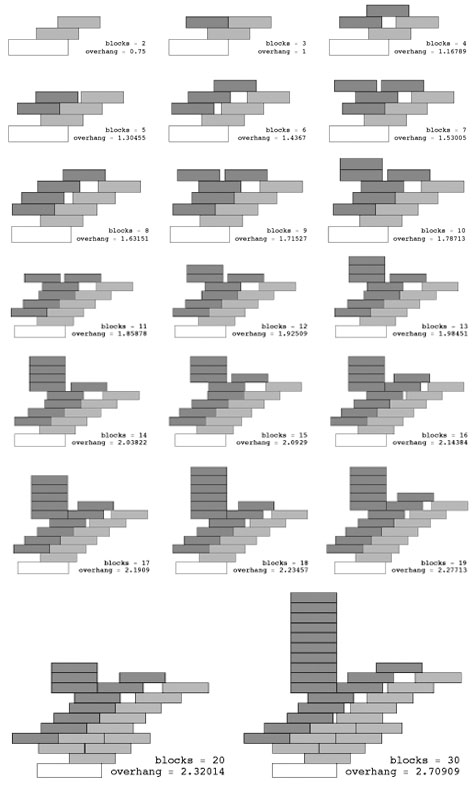
New Scientist published an awesome article this week about nothing more complex than stacking blocks of wood (subscriber-only)… But, oh, how complex that task can be. It’s the combinatorial architecture of the well-balanced stack.

[Image: The diagrammatic mathematics of a structural experiment by Mike Paterson and Uri Zwick, as reported in New Scientist].

Computer scientists Mike Paterson and Uri Zwick have calculated new shapes and arrangements for the so-called “overhang problem,” by which one attempts to stack blocks outward from the edge of a table so that the blocks “overhang” as far as possible (before the stack collapses, or before you and your friends go out for more beer).

Strategically speaking, it turns out to be a matter of well-placed gaps, pressures, and weights.

[Image: Two abstract stacks by Mike Paterson and Uri Zwick].

In two papers, available as PDFs (here and here), Paterson and Zwick write about balancing “harmonic stacks,” then stabilizing them, through “minute displacements” of space and weight within the stack structure.

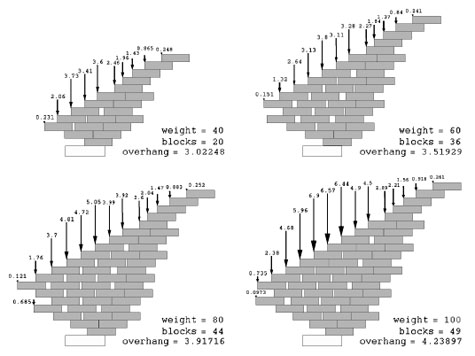
A stack is said to be balanced if there exists a collection of forces acting between the blocks along their contact intervals, such that under this collection of forces, and the gravitational forces acting on them, all blocks are in equilibrium.

We read about loaded stacks and point weights, and “combinatorially distinct arrangements.”

[Image: May the force stack with you; diagram by Mike Paterson and Uri Zwick].

The authors advise that

one should, at least in principle, consider all possible combinatorial stack structures and for each of them find an optimal placement of the blocks. The combinatorial structure of a stack specifies the contacts between the blocks of the stack, i.e., which blocks rest on which, and in what order (from left to right), and which rest on the table.

They talk about parabolic stacks and spinal stacks (“A stack is spinal if its support set has just a single block at each level”), and about the spatial structure of brick walls, describing “well-behaved collections of forces that stabilize symmetric and asymmetric brick-wall stacks.”

[Image: More stack madness by Mike Paterson and Uri Zwick].

But what are the architectural implications of all this? Are there any?
Or, in this age of advanced materials, are basic formal considerations such as these reduced to useless tinkering? Why worry about well-balanced stacks, in other words, when you can just put some cantilevered I-beams up there and be done with it, making experiments like these instantaneously obsolete?

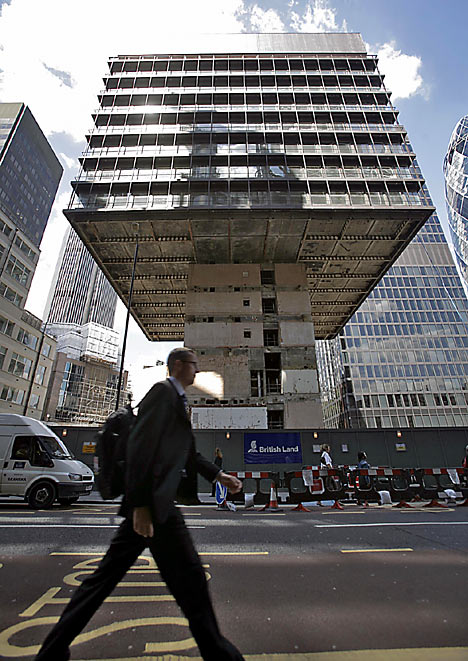
Superficially, these diagrams actually remind me of the demolition of London’s P&O Building this summer, in which the building was taken apart from the ground up, as if disappearing into the sky – thus exhibiting a rather unique variety of the overhang problem.

[Image: London’s P&O Building gets demolished in reverse; via the Daily Mail. To see what brain death feels like, meanwhile, don’t miss the typically moronic comment thread over at Gizmodo, where brains go to die].

So are there tens of thousands of overhang problems on display right now in the jungly tangles of rebar and steel that remain camouflaged behind the facades of architectural structures? Deep in the guts of engineered buildings the world over, are there interesting mathematical lessons to learn – provided we change how we look at walls and windows?

Is this the architectural equivalent of Rimbaud’s “systematic derangement of the senses” – to see mathematics and topology where others see mere elevators and unused attic floors? Inside our buildings, might there yet be more to find?

[Image: View larger! Speculative demolition in Halle-Neustadt, via Nickzilla].

We could actually attempt to answer that question.

Given billions of dollars, zero insurance liability, and a whole fleet of Komatsu wrecking machines, could you re-examine the overhang problem from an architectural standpoint, seeing how many floors and offices you can remove before a building tips over?

You’d make little Gordon Matta-Clark-esque incisions throughout the city – taking out whole floors and elevator shafts – cutting away at every building, one executive office suite at a time, till each building begins to tilt, warp, or list… at which point you’d stop, take a photograph, calculate something, then submit the image to a mathematics journal, thus winning the next Fields Medal for Applied Mathematics.

All of Manhattan a demolitionist research lab for extremely well-funded and aggressive mathematicians.

Could you then exhibit these removed pieces elsewhere – showing, say, the entire, fully intact eastern elevator shaft from the Empire State Building at the Guggenheim Abu Dhabi, forming some weird and abstract concrete pillar in the sky, whistling quietly in the desert wind, home to seagulls?

Modernist Totem Poles, you’d call it – and you could then steal the elevator shafts from the Transamerica Pyramid, the Sears Tower, the Chrysler Building, and Taipei 101.

In any case, does the stacking problem contain an architectural lesson? Read the original two papers featured in New Scientist to find out.

Planet Battery

A few months back, Nature published an article stating that the “Earth beneath our feet might act as a gigantic circuit built by microbes to power their metabolic systems.”

It’s not a planet at all, then, but a bio-electrical deposit rotating in space. A living battery.
And while that obviously sounds far-fetched, we actually read that these microbes function as a “geological battery,” and that this battery is made from “networks of tiny wires linking individual bacterial cells into a web-like electrical circuit.” These circuits could extend for miles – hundreds of miles – whole continents and island chains, linked by reefs.
Who knows?
The article also describes these things as “sediment batteries” – so I have a hard time not imagining some old river in the Andes coming down out of its mountain chain, weathering through and eroding the outer soils and bedrock, exposing elemental belts of copper, silver, zinc, and gold, then depositing those fragments in vast, glittering deltaic arrays downstream.
Over the years, microbes move in; the sediments, hundreds of feet deep now and miles wide, begin fluttering with an undetectably faint electrical trace; finally, that remote riverbed, with its weird subsurface nets of energy, and its scattered metals, and its rare microbes, begins generating power… Birds flock toward it, their migration routes scrambled. Nearby compasses go akimbo.
Over the hills, there is a valley of light. You walk toward it.
The Earth is shining.
Religions develop. Their adherents worship geological deposits.
The person in charge of researching all this is called a geobiologist. One such researcher quips that he’s been studying “microbe-driven sediment batteries.”
Someday you’ll just take a power cord – and plug it into the Earth.

(You can read the original article in this PDF. See also BLDGBLOG’s look at the wire garden – and, of course, Merry Christmas! May your day be free of desolation and abandonment. And thanks, Steve, for originally pointing this story out to me).

Green and pleasant land

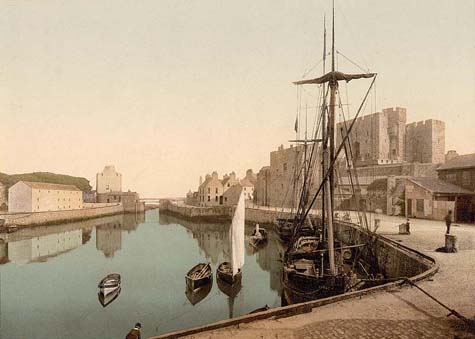
[Image: Castle Rushen, Castletown, Isle of Man, via Old UK Photos].

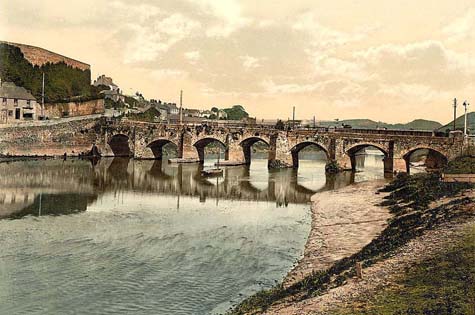
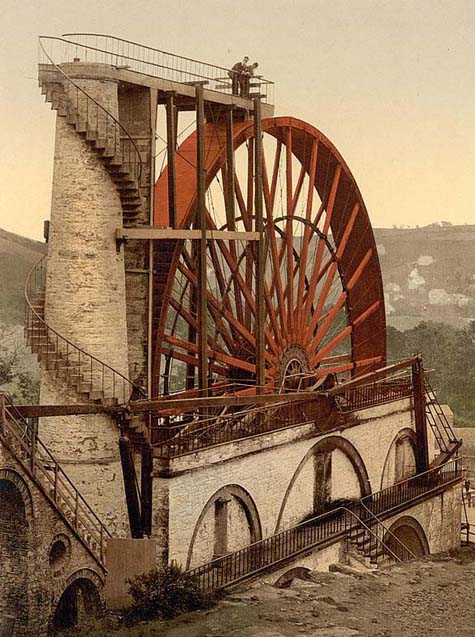
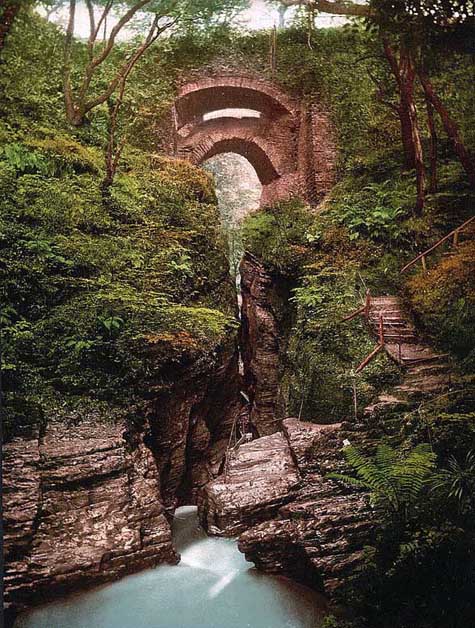
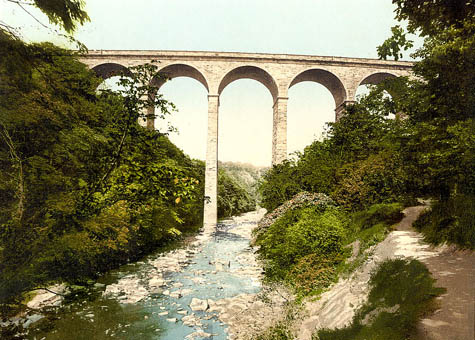
I was poking around for images this morning and I somehow ended up at a site called Old UK Photos. They collect old, public domain photographs of the UK (rather cheekily including Ireland) – but some of the photos are so extraordinarily beautiful, and so hard to believe that they really are photographs, that I felt like re-posting a few here.

[Image: Wiltshire, Salisbury Plain, Stonehenge, via Old UK Photos].

The fact that I’ve also been to many of these places adds a weird layer of delayed misrecognition to many of the scenes, as if stumbling upon landscapes from trips I forgot I’d taken (which is almost accurate).
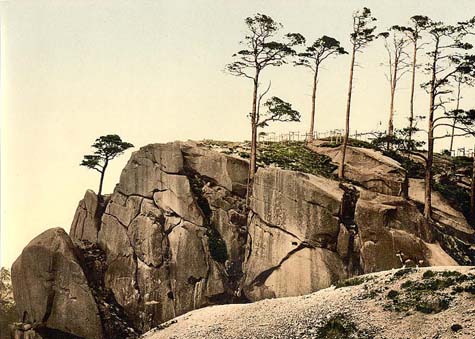
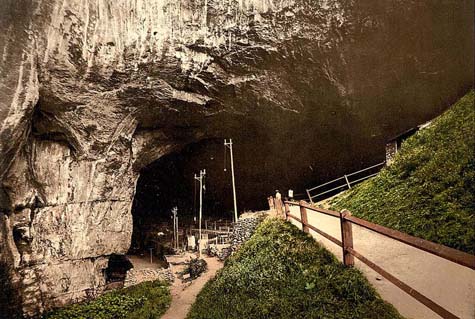
The old pier in Bangor. One of the Peak District caves. Edinburgh castle.
And, of course, Stonehenge, pictured above from those years in which it hadn’t yet been fenced off.
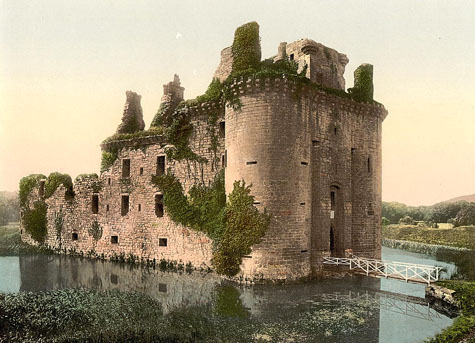

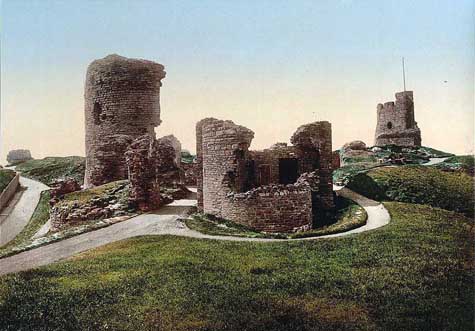
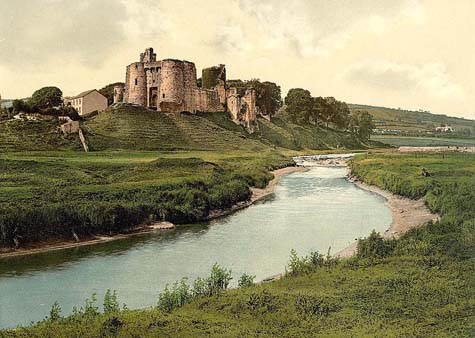
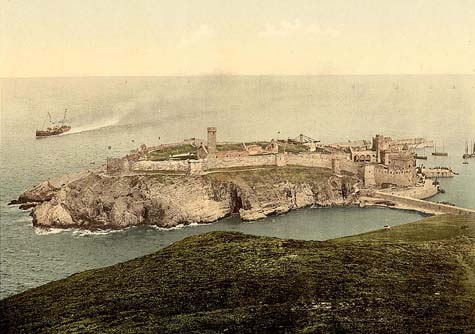
[Image: Caerlaverock Castle, Dumfriesshire; Peel Cathedral, Isle of Man; castle in Aberystwyth, Cardiganshire; castle in Kidwelly, Carmarthenshire; Peel Castle, Isle of Man; and Ballower Mount, Ramsey, Isle of Man; all via Old UK Photos].

I don’t have all that much to say about these, in fact, other than to point out that they seem to instill something between nostalgia (for myself, an Anglo-American) and a wistful need to travel through non-automobile-based landscapes – and perhaps even a somewhat Gothicized sense of fictive possibilities, like something out of BLDGBLOG’s recent interview with novelist Patrick McGrath.
That said, then, here are some photos, with crumbling castles on distant hills and even mysterious pieces of old machinery.
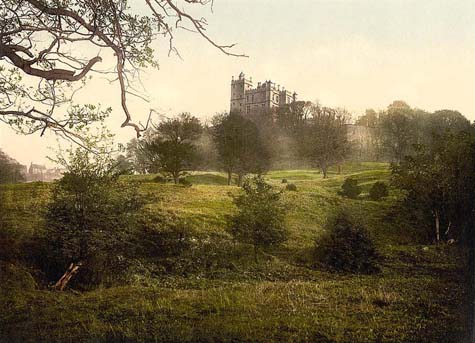

[Images: Castle at Bolsover, Derbyshire; castle in Kidwelly, Carmarthenshire; bridge in Carmarthen, Carmarthenshire; the Wheel at Laxey, Isle of Man; Devil’s Bridge, Aberystwyth; Templand Bridge, Cumnock, Ayrshire; The Blackrock in Cromford, Derbyshire; entrance to a cave outside Castleton, Derbyshire; all via Old UK Photos].

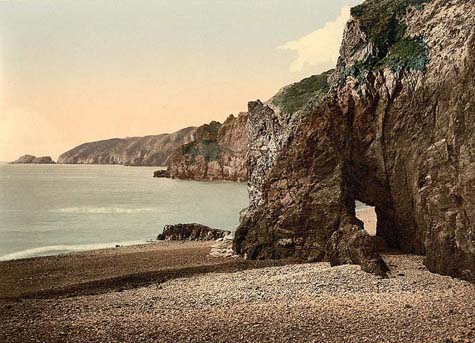
Some of the coastal photographs – of bays, inlets, coves, rock arches, and cliffs – seem to imply a labyrinthine island geography so complicated and ornate in its expanse, and so remote, that people still must be discovering new places there today… But then, of course, that describes the British Isles. Unless you spend all your time in Leicester Square.
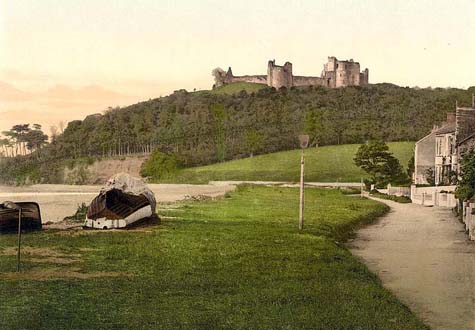
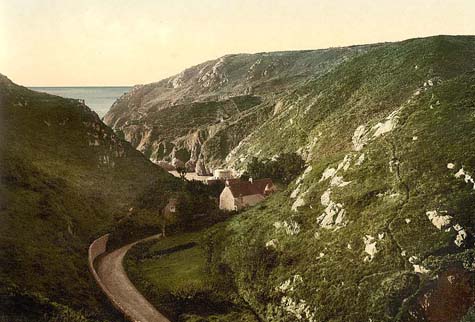
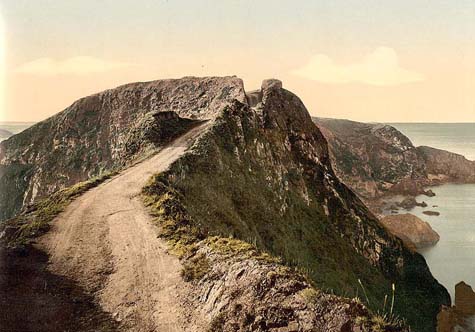
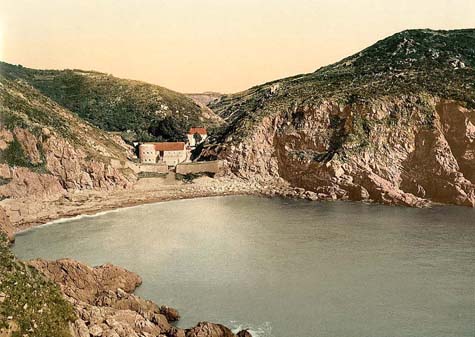
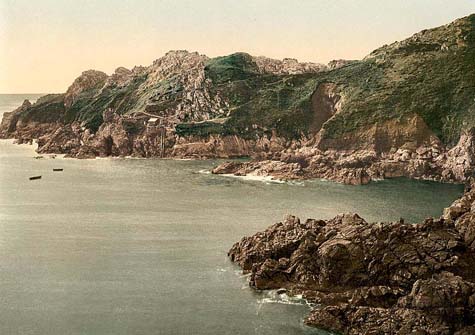
[Images: Castle in Llanstephan, Carmarthenshire; Petite Bot, Guernsey, Channel Islands; La Coupee, Sark, Channel Islands; Dixcart Bay, Sark; Sugarloaf Rock at Port St. Mary, Isle of Man; the coast at the Gouffre, Petite Bot, and the harbor at La Moye Point (3 images), Guernsey; via Old UK Photos].

Actually, I’m reminded of something I read a few years ago in a book called The Dragon Seekers: How an Extraordinary Circle of Fossilists Discovered the Dinosaurs and Paved the Way for Darwin – which is that a particular stretch of British coastline, near Lyme Regis, is full of fossils.
The book opens with the story of Mary Anning, an amateur “fossilist” – she made an income selling bits of backbones and fragments of mastodons, jigsaw puzzle-like pieces of species that no longer exist – who stumbled upon, if I remember correctly, the body of an ichthyosaur – but only because there had been a landslide. Without that tidally inspired collapse of a nearby cliff, Anning perhaps would never have found her fossil; it would have remained buried in the cliffside for years – decades, centuries – to come.

Although she had an eye for fossils, she could not find them until they had been exposed by weathering – an achingly slow process. But when wind and rain and frost and sun had done their work, she would find them, peeking through the surface. Others were buried so deeply in the cliffs that it would be aeons before they were ever discovered.

The idea that the fossils of as yet undiscovered creatures still lie buried somewhere in the cliffs of Dorset is almost overwhelmingly interesting.
In any case, the bottom two images are from Bangor, Wales, where my brother and I once stayed in a youth hostel and ate soup. We hiked outside of town one afternoon and we looked up at a tree covered in drooping sleeves of loose vegetation, then we fell asleep on a hillside in some farmyard nearby, jumping over a fence and lying down amidst lichen-covered rocks and small bushes.
In fact, I’m a little embarrassed to admit this, but I was reading The Lord of the Rings and so the whole experience was tinged with an air of the mythic.
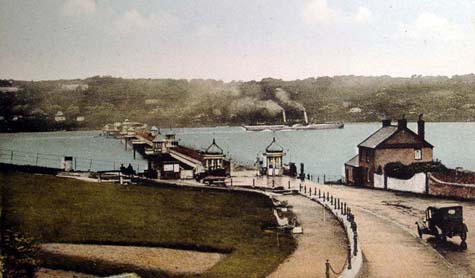

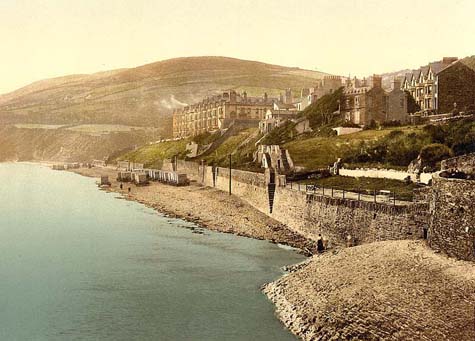
[Images: Garth’s Pier in Bangor, Caernarfonshire, and a view of Bangor from Anglesey, via Old UK Photos].

Anywho, the old lighthouse at Corbiere, on the Channel Island of Jersey, makes a nice painterly silhouette in this next photo.

[Image: The lighthouse at Corbiere, Jersey, Channel Islands, via Old UK Photos].

And the old paths still whirl and turn through hills, leading somewhere, going everywhere.

[Image: Moulin Huet, Guernsey, Channel Islands, via Old UK Photos].

All of these images, plus a few more, are also saved in a Flickr set I put together this afternoon.

(The title of this post paraphrases a line from William Blake’s poem Milton. Meanwhile, it may not be entirely related to the images in this post, but I do recommend giving at least a quick read to BLDGBLOG’s interview with Patrick McGrath for some thoughts on the literary impact of these – or similar – landscapes).

Religion by Satellite

[Image: The Crucifixion as seen via Google Earth; by The Glue Society].

Australian artists The Glue Society have put together a series of altered satellite views showing what certain Biblical events would have looked like if seen via Google Earth.
Above, for instance, is the Crucifixion.
Below, we see Moses parting the Red Sea; Adam and Eve sunbathing nude in the Garden of Eden; and Noah’s Ark stranded on a dry spit of land amidst Flood waters.
By the way, whatever happened to the CIA’s search for Noah’s Ark…?

[Image: Biblical scenes as seen via Google Earth; by The Glue Society].

According to the Creative Review – where this project was first spotted – the artists are now “aiming to produce further works using the same satellite imagery next year but this time relating to mythological occurrences and major historical events.”
Personally, I can’t wait; the idea is genius.

(Spotted on the Creative Review, with big thanks to Michael G.!)

Church of God, Elevator

[Image: Chartres Cathedral as rendered in Quake 3, via Quake 3 World, an image that has almost nothing to do with this post].
When Mark Twain visited Montreal in 1881, he said that it was the first time he’d ever been in a city “where you couldn’t throw a brick without breaking a church window.” Montreal, you see, has lots of churches.
Twain was then told, however, that the city would soon build another church – and perhaps another, and another – and “I said the scheme is good,” Twain responded, “but where are you going to find room? They said, we will build it on top of another church and use an elevator.”
Church of God, Elevator.
Does this off-the-cuff remark from a 19th century novelist exhibit a more adventurous sense of space and structure than the buildings which pass for architectural design today?
In any case, all of this reminds me of a post here on BLDGBLOG last summer in which it was proposed that “elevators could be used as prayer chapels – vertically nomadic radial spaces in which the pious… could spend time alone and think.”
Paraphrasing myself, then, a year later, could you construct an earthless Vatican made of nothing but elevators riding up and down throughout the atmosphere? Off in the urban distance you see what surely must be a mirage: a glass and steel cathedral hovering two miles off the surface of the earth, made of nothing but elevator-chapels, a metallic mist of lifts, a sky-cloud of holy space in western sunlight.
From earth to the moon, on the Sistine Elevator.

(Twain quotation found thanks to an anonymous commenter on this post this morning).

Monolith Moderne

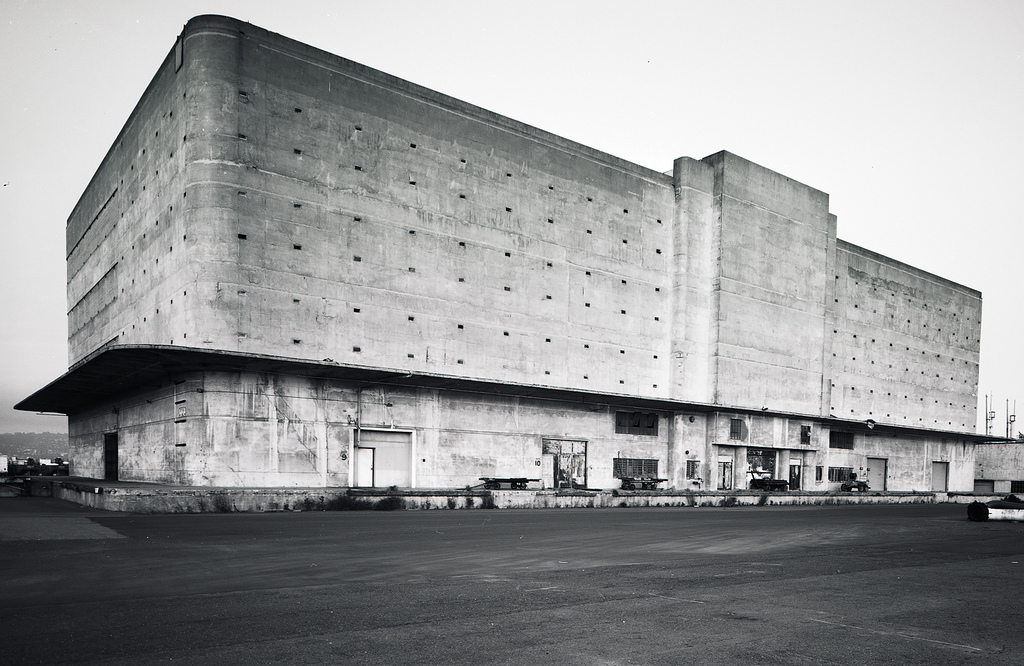
[Image: The Kaiser Shipyard’s General Warehouse, photographed by Jon Haeber; more images here. View larger!].

This perforated monolith – all 158,000 square feet of it – stands on the waterfront in Richmond, California, north of Berkeley, part of the Henry J. Kaiser shipyards. It was photographed here by Jon Haeber.
I emailed Haeber a few weeks ago to find out more about the structure – and the building has a fairly interesting backstory.
For starters, its architect is apparently unknown, although it is rumored to have been designed by John B. Anthony. Anthony, Haeber explained, “did work for WWII ship baron Henry J. Kaiser in the same period that the warehouse was constructed, so it would be reasonable to assume that he played an integral role in the design, especially considering its similarities with his other designs.” For instance, Anthony also built the quasi-futurist Art Moderne Joseph W. Harris House in Berkeley.
This “massive square concrete building,” we read elsewhere, though the building is very clearly not a square, was “the general warehouse, from which ships received their finishing touches – blankets, mops, brooms and all the other individual pieces of furnishings and equipment needed to completely fit out a self-contained floating vessel.” The warehouse even appears on a t-shirt.
Now, however, the buildings just sits out in the rain, doing nothing, storing air.

[Image: The warehouse at night, photographed by Jon Haeber; view original].

Haeber, meanwhile, “[has] not been in inside, and I do not know anyone who has. It is currently owned by a storage company, and they seem to be very protective of the site. I don’t believe official access is possible,” he continues, “and it’s relatively sealed.”
In any case, if you enjoy urban ruins, military history, or just interesting photography, be sure to check out Haeber’s other images of the site, including his own exploratory tour through “the below-ground galleys that adjoin the five shipways, where water was pumped out on a massive scale and the iconic ‘Rosie the Riveters’ welded and assembled hundreds of U.S. warships.”
Indeed, these drydocks “produced the most ships in the shortest time in history,” and you can read more about their wartime history courtesy of the National Park Service or Rosie the Riveter.

(Thanks, Jon!)

The city of retroactive mathematics

[Image: Nested salt shakers spotted on Dezeen… Wait a minute – it’s Cameron Slayden‘s diagram of how the Poincaré Conjecture was proved; via Science].
Science used the above diagram about a year ago to illustrate how mathematician Grigori Perelman had come to prove the infamous Poincaré Conjecture.
I won’t get into specifics – after all, I don’t understand them (Perelman used “Ricci flow,” or “a procedure for transforming irregular spaces into uniform ones,” in order to prove that something or other will always be a hypersphere…).
Nonetheless, in the above image we see how “negatively curved regions (blue) must expand while positively curved regions (red) contract. Over time, the original dumbbell-shaped surface evolves into a sphere.”
This proves something.
But the above image could just as easily be an architectural diagram.
And so I imagined that a mathematician might show up in a distant city someday, perhaps in the irradiated marshlands of Belarus, only to realize that all the buildings around her are actually 3D illustrations of unsolved geometrical conjectures – only people are living inside them, raising kids and doing laundry. Eating bagels and writing blogs, surrounded by zeta landscapes in glass and brick variations on the Riemann Hypothesis.
That’s not a corridor at all but a glimpse of elliptic curve cryptography – it’s non-commutative geometry in concrete.
The city is built algebra.
An odd mix of ornamental numerologies in the city’s high street adds up to nothing less than a new way to predict prime number sequences.
Our mathematician thus rushes back to her hotel room, frantically writing numbers and making sketches of buildings on the bedside stationery, looking outside as cars pass by, the sun going down, exaggerated shadows of pedestrians looming up and down the facades of cinemas, and she senses proximity to something wonderful… Something hidden in mathematics that she might soon solve.

The Husband Who Would Not Die

My wife just pointed out a new article about the disappearance of England’s notorious “missing canoeist,” John Darwin.
Five years ago, Mr. Darwin disappeared after going canoeing in the North Sea. “A paddle was found,” The Guardian reported, “and weeks later the red wreckage of Darwin’s canoe washed up.”
But what happened? Did he drown? Was he abducted? Murdered? Secreted away to a London warehouse and subjected to light and sound torture in a locked room?

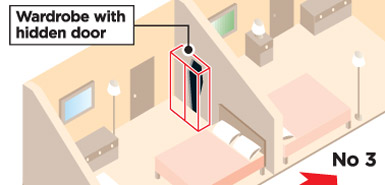
[Image: Illustration by Andrew Norfolk for The Times].

No: John Darwin was living in a secret passageway connected to his old master bedroom. That is, before he fled to Panama.
He’d sneak out through a secret door in the back of the closet at night and sleep next to his wife, warm and cuddly. The next day he’d go back into his secret room and read BLDGBLOG.
He had faked his own death, see, to avoid paying bills.
Turns out the unfortunately named Darwins “purchased the adjoining properties [next to their own house], at No 4 and No 3 The Cliff, in Seaton Carew, 15 months before Mr Darwin disappeared.” Thus his disappearing plan could commence: “a 5ft high hole in the wall allowed Mr Darwin to emerge from a room at No 4 The Cliff and slip back into the master bedroom in the couple’s home at No 3. An 18 inch wide connecting passageway was hidden behind a makeshift wardrobe with a false plywood back.”
The new owner of No 3 stumbled upon the secret closet door and said it was “like something from Narnia.”
In any case, John Darwin has now turned himself in: “He had had enough of being dead,” his wife explained to police.

(Thanks, Nicky!)