Aqueous

[Image: From Amphibious Architecture; photo by Chris Woebken].

New York architects The Living, mentioned in an earlier post, are behind another noteworthy project: Amphibious Architecture.

This one, completed in collaboration with xClinic, Natalie Jeremijenko, and many others, and commissioned by the Architectural League for the recent exhibition Toward the Sentient City, is an environmental monitoring station—a subtle filigree of colored lights—floating in the rivers of New York.

[Image: From Amphibious Architecture; photo by Chris Woebken].

As such, it is more or less a direct outgrowth of their earlier project River Glow.

Amphibious Architecture is a floating installation in New York’s waterways that glows and blinks to provide an interface between life above water and life below… Two networks of floating interactive tubes, installed at sites in the East River and the Bronx River, house a range of sensors below water and an array of lights above water. The sensors monitor water quality, presence of fish, and human interest in the river ecosystem. The lights respond to the sensors and create feedback loops between humans, fish, and their shared environment. An SMS interface allows citizens to text-message the fish, to receive real-time information about the river, and to contribute to a display of collective interest in the environment.

The idea of text-messaging fish adds a dream-logic to this project that I find intensely enjoyable. A man lost somewhere in the middle of the Atlantic Ocean who retains his sanity only by texting Leviathan. Screenplay by Ernest Hemingway.

[Image: From Amphibious Architecture; photo by Chris Woebken].

Check out more of The Living’s work on their website—and spend a few moments, while you’re at it, with the decisively trans-species design work of their collaborator, Chris Woebken. Woebken’s well-known Animal Superpowers project is particularly fantastic.

Cliff House

I randomly came across this image, below, of Adolph Sutro‘s now-lost Cliff House, perched on the rocks outside San Francisco. It stood for eleven years, from 1896-1907, before being destroyed by fire.

[Image: The Sutro Cliff House, San Francisco].

This gallery of images is extraordinary; the house is so badly situated on its site that it appears simply to be hovering over the rocks on an artificial ground plane. It’s like a continental afterthought, the dream of western architecture pushed beyond its ability to retain anchorage. But it’s a cinematic sight, to say the least.

For more about Adolph Sutro, meanwhile, don’t miss the wave motors of California.

Ghostly

I spent Halloween afternoon over in New York’s West Village, being given a tour of a gut-renovated townhouse by one of the home’s owners. While a description of the actual house will appear next spring in an article I’m writing for another publication, what struck me most was the opening half of the home tour. The homeowner and I stood there alone in the downstairs kitchen, as I listened to her describe what used to be there: the walls that got taken down, the halls that no longer exist, the lost backyard and the missing stairs. We were surrounded by a halo of absent spaces, rooms that had been cut out around the edges and removed.

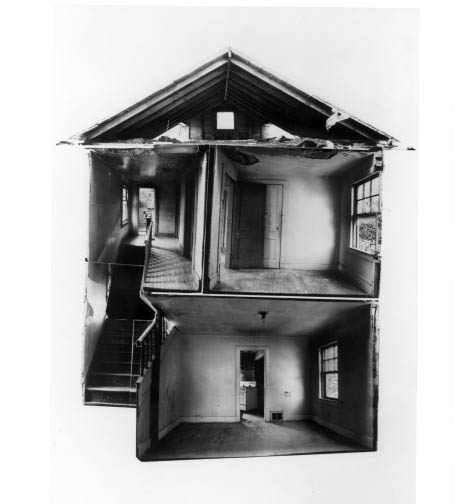
[Image: A photo-collage from Splitting by Gordon Matta-Clark].

And it seemed that you could put together a long and fascinating series of home renovation interviews, with people describing, from memory, the missing architecture around them: where rooms used to be, perhaps entire buildings. It’d be as much an architectural podcast as an experiment in narrative neurology: how former buildings are remembered and described.

I have no idea how long this sort of thing could sustain anyone’s attention, to be honest; but what might be called oral histories of missing space could extend from demolished buildings to whole war-destroyed towns, from renovated suburban homes to newly partitioned spaces in a nearby office high-rise. The point would be to tour buildings based only on what those buildings used to be.

In a sense, it’s the appeal of ruins.

Perhaps you go on a camping trip to a distant country, where you hike deep into the desert, heading for a series of abandoned villages beyond the mountains northwest of the airport. They are Roman sites, some say, but others suggest a 2500-year old fringe culture outside imperial reach. Either way, as the group of you sits down to cook dinner around a fire—flames lighting up a circle of illegible building forms eroding back into sand—your guide starts to tell a story. The only thing he’s describing, however, is an imaginary building that looms around you, he says, on all sides, with rooms, spiral stairways and halls, and the occasional door resting alone somewhere in the darkness, that no one has yet to open. Temples form in the outline of his story: things that used to be but are no longer. The description goes on for hours. You realize, when the moon disappears behind the mountains and your campfire has burned out, that you’ve been taken several hundred rooms deep into some massive, impromptu architectural edifice produced on the spot by the guide.

Perhaps it could become an alternative oral tradition: buildings handed down, generation after generation, to form a kind of speculative-architectural harddrive inside of which a culture stores its myths. Great events remembered by the rooms they supposedly occurred within.

In any case, it also seems like an interesting opportunity for an iPhone app… Instead of a Phantom City of the unbuilt avant-garde, it’s a removed city of the various rooms that used to be there. You could walk into any building in the city and get descriptions and floorplans of the spaces that no longer exist. Renovation detector. Your phone starts to beep as you walk through missing walls.

New Local Worlds in Section

[Image: “Moravian Mount” from New Local Zlín by Margaret Bursa].

In a recent post I included an image from Margaret Bursa’s project New Local NY, which she produced while a student at the Bartlett School of Architecture. Bursa’s tutors for that project were Mark Smout and Laura Allen, of Smout Allen; and I should right away that I’m consistently amazed at the quality of work coming out of Smout Allen’s studios.

I thought, then, that I should take the occasion to share more images from Bursa’s projects. You can check out her website here.

[Images: From New Local NY by Margaret Bursa].

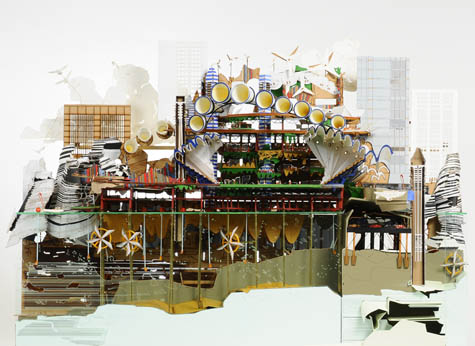
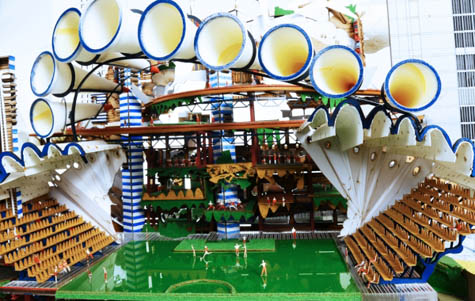
New Local NY features “a ‘landscape of movement’,” Bursa writes. It “takes the form of a condensed urban playground on the west side of Manhattan, overhanging onto the River Hudson,” and it was at least partially inspired “by the ongoing relocation of immigrants and cultures to America, in particular Sokol, a Czech mass-exercise movement, promoting togetherness, flocking, fresh air and cultural pride.”

The result is an intensely colorful, wind-powered megastructure, sitting comfortably astride the worlds of home craft and experimental architecture.

[Image: From New Local NY by Margaret Bursa].

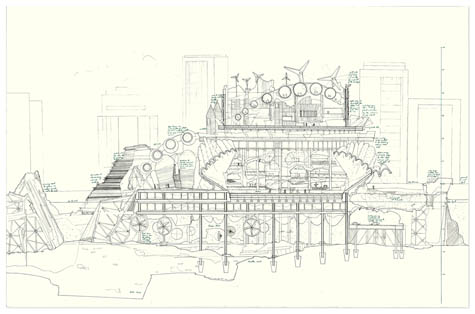
Here are some amazing sectional sketches:

[Images: From New Local NY by Margaret Bursa; larger version one and two].

Then there is New Local Zlín, an earlier companion piece to New Local NY.

Zlín, Bursa explains, is the fading capital of the Bata shoe-making empire:

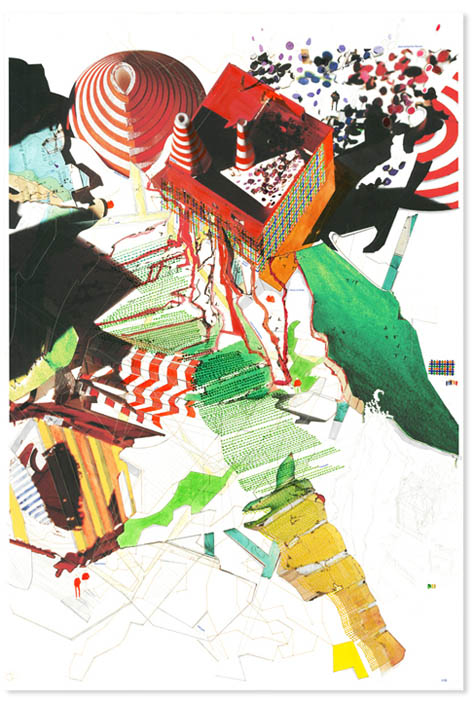
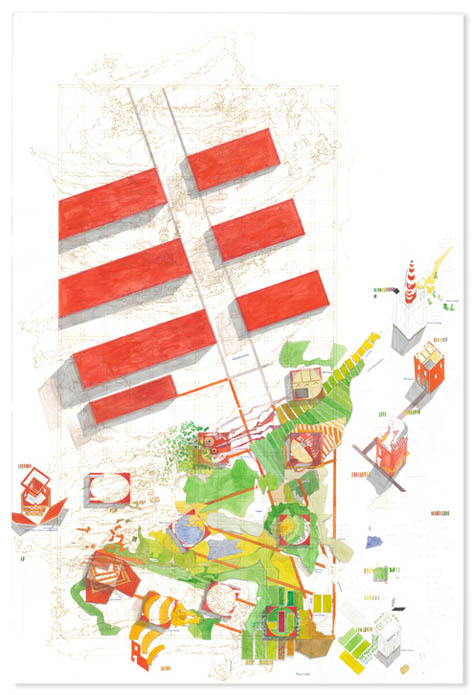
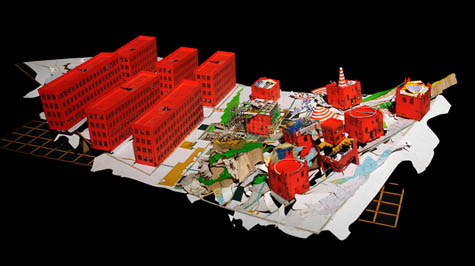
The Czech town of Zlín is the site of a social, industrial and architectural experiment begun by Tomas Bata in 1894. However, his shoe-making factories that were once the town’s driving force no longer operate and so the social and commercial structure of the town and its suburbs are in decline. Responding to the New Local Manifesto, a layer of facilities is laid over and interwoven into the residential neighborhoods where seven housing typologies are afforded dual functions of work and domestic life such the House of Drink, where both production and consumption are combined.

The images, again, are drenched in color and extraordinarily detailed.

[Images: “House of Drink,” “Greenhouse,” and town plan from New Local Zlín by Margaret Bursa].

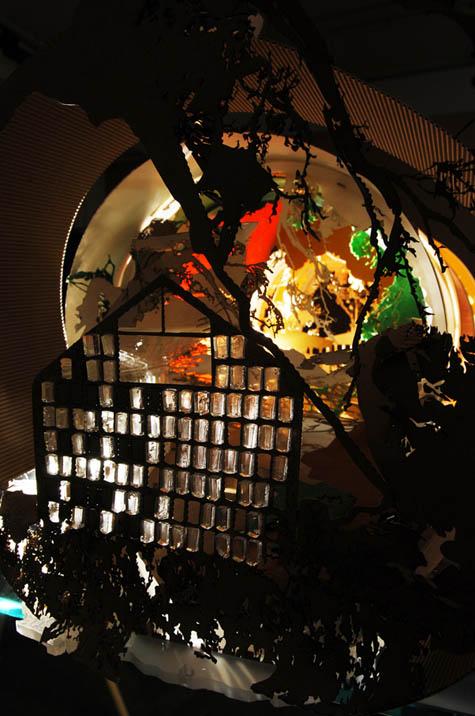
The next project is a kind of tube-diorama: you look into the miniature landscape and see autumn trees, a ruined Greek temple, and a many-windowed architectural section standing in silhouette.

The project seems to come with the implication that, when you look inside a telescope, perhaps it’s possible that you might simply be seeing a world inside the telescope—that is, an optical device that, instead of revealing new worlds from afar, actually contains local worlds within it.

[Image: From Layered Landscapes by Margaret Bursa].

Called Layered Landscapes, the project is a “compositional map,” Bursa writes, and it comes complete with hardcover book and poster.

[Images: From Layered Landscapes by Margaret Bursa].

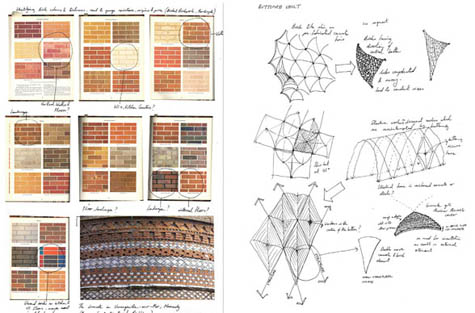
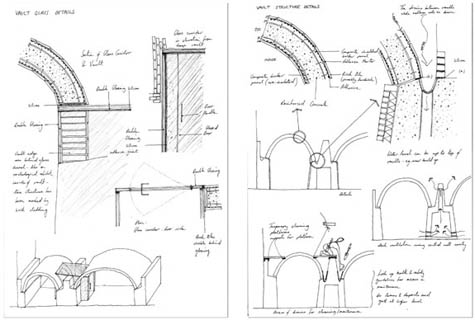
Finally, I have a weird affinity for sketches of archways, and so I’d be remiss if I didn’t include this short series of brick studies—called, unsurprisingly, Brickscape.

[Images: From Brickscape by Margaret Bursa].

In any case, there’s some great work in there. Check out Bursa’s site for a bit more.

Mine / Stack / Vertigo

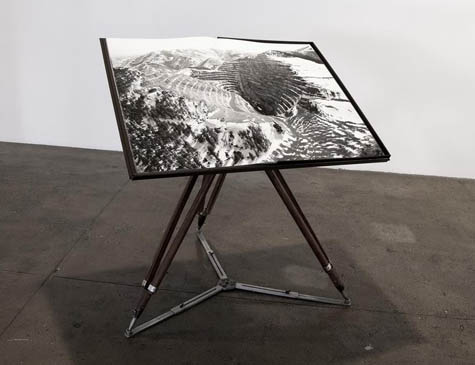
[Image: Michael Light, Bingham Pit photograph mounted and on display].

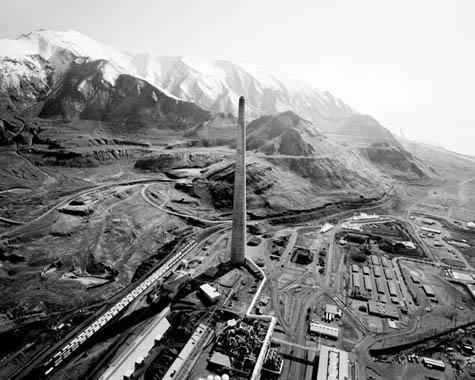
A beautiful new book of photographs by Guggenheim Fellow Michael Light has been released. Called Michael Light: Bingham Mine/Garfield Stack, and released by Radius Books, it includes an essay by “experimental geographer” Trevor Paglen.

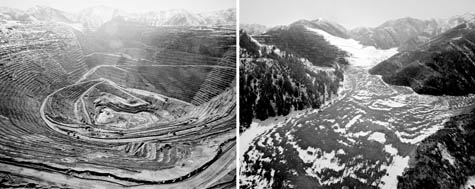
[Image: Two photos from Michael Light: Bingham Mine/Garfield Stack].

Light, well known for, among other things, his aerial photographs of the American west, “pursuing themes of mapping, vertigo, human impact on the land, and various aspects of geologic time and the sublime,” as Radius Books describes it, has put together a collection of 22 images from his surveys of the Bingham Pit and the Garfield smelter stack.

The sheer scale of each site—one a void excavated into the surface of the earth, the other one of the tallest structures in the United States—is mind-blowing:

Located at 8,000 feet in the Oquirrh Mountains—20 miles southwest of Salt Lake City—the Bingham Canyon copper mine is the largest man-made excavation on the planet. Its hole reaches more than half a mile deep and its rim is nearly three miles in width. It has produced more copper than any mine in history.

[Image: Michael Light, “Garfield Stack, Oquirrh Mountains and Ancient Beach of Great Salt Lake” (2006)].

Meanwhile:

The mine’s Garfield smelter stack, situated at the edge of the Great Salt Lake about 10 miles away, is the tallest free-standing structure west of the Mississippi River, and is only 35 feet shorter than the Empire State Building.

In a nearly 9-page interview with Afterimage, Light comments:

I work with big subjects and grand issues, and I am fascinated about that point where humans begin to become inconsequential and realize their smallness in relation to the vastness that is out there. In my archival work I also enjoy inserting a certain kind of revisionist politics into big iconic subjects that are owned by the world, where I can tell a story through my particular prism, in a way that hopefully offers a fresh perspective.

This is part of his ongoing interest in taking apart “the fundamental building blocks of landscape perception and representation.”

The book is available through Radius.

Who would want to be an architect?

Who would want to be an architect?” the Times asks. In answering that question, the article focuses more or less entirely on London’s Bartlett School of Architecture—whose students have been producing some amazing work lately, work that I have often posted about here on BLDGBLOG. Here, here, here, and here, for instance.

But, the article claims, “Leave the future to Bartlett students and we’ll all be living in car-crash spaces that occasionally come into focus as giant mechanised spindly crustacea.”

[Image: “Oops” by C. Loopus].

Reading such things easily prompts the familiar zing of schadenfreude—but it also seems totally inaccurate. If only it were as cut-and-dried as mistaking student work for what someone will produce professionally later; if only it were as easy as extrapolating from someone’s earliest university sketchbooks to see how they’ll someday end up.

I’m reminded here of Lebbeus Woods’s recent short essay on the work of Rem Koolhaas: there was “another Rem,” Lebbeus writes. Looking back at one of Rem’s early projects—an unsuccessful bid for the Parc de la Villette in Paris—Lebbeus suggests:

This project reminds us that there was once a Rem Koolhaas quite different from the corporate starchitect we see today. His work in the 70s and early 80s was radical and innovative, but did not get built. Often he didn’t seem to care—it was the ideas that mattered.

Over on his own blog, Quang Truong puts it more simply: “Young Koolhaas was just so punk.”

(Of course, parenthetically, Truong’s formulation opens up a whole series of possible readings through which we could interpret Rem’s ongoing career moves; we could say, for instance, that Rem is still “punk,” to use that term deliberately, but his decisions to work for clients like the Chinese government are just him giving the finger to you. That is, if punk is a universal form of energetic rebellion, then don’t assume that every punk will remain forever on your side).
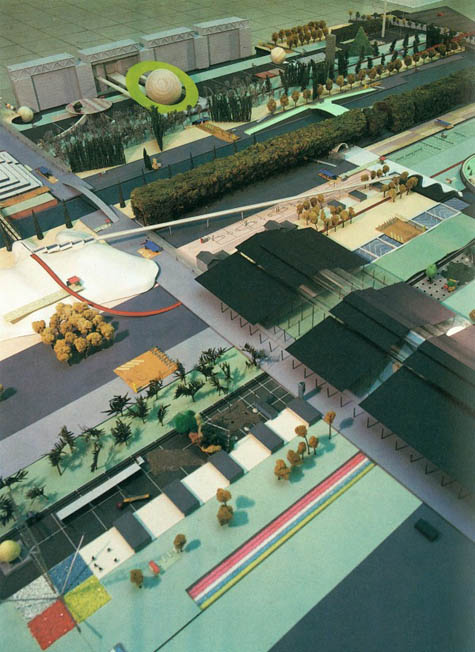
[Image: From Rem Koolhaas’s unbuilt proposal for the Parc de la Villette in Paris, via Lebbeus Woods].

In any case, my point in citing Lebbeus’s essay in this context is to agree with the Times that student work can often stand on the absolute fringes of incomprehensibility, charged with the energy of poetry, myth, or confrontational politics, even verging on functional uselessness—but it’s also an ongoing joke at nearly every architecture crit I’ve been to over the past few years that, upon surviving their final day of project criticism, those students “can now get back to designing minimalist boxes.” In other words, there simply is not the assumption in these studios that now you are prepared only for the construction of rhizomes and biomorphopedic multi-agent typology swarms. There is obviously a problem if that is all you have been taught to do; but it’s not one or the other. Being taught how to make short films about architecture—more on this, below—doesn’t mean you can’t simultaneously be taught how to renovate a kitchen or how to market yourself to new clients.

The fact of the matter, anyway, is that very few clients today will actually pay to construct “car-crash spaces that occasionally come into focus as giant mechanised spindly crustacea.” If architecture school is the only time and place in which you can have the freedom to explore that sort of thing, then I don’t see any reason why you should be told not to do so. Again, if that’s all your architecture school offers you, leaving you alone to sort out the business of client management as you go, then of course your educational track needs reconsidering.

However, much of the Times‘s criticism seems predicated on the assumption that, if architecture is a vocational trade, similar to plumbing, then it cannot simultaneously be an expressive art, akin to film, painting, or literature. But, of course, it is both. In fact, the controversy more or less instantly disappears: architecture is the imaginative production of future worlds even as it is the act of building houses for the urban poor or the obtaining of technical skills necessary for rationally subdividing office floorplates.

[Image: From a project by Margaret Bursa for the Bartlett’s Unit 11, taught by Smout Allen].

Having said all this, the Times article ends up being a formulaic list of reasons why such-and-such an industry is doomed to fail—too many people want to pursue it, we read, not enough people want to fund it, and hardly anyone understands anymore what made it so popular in the first place. But replace the word “architecture” with “writing,” and “Bartlett School of Architecture” with “Iowa Writers Workshop”—or use “music” and “Mills College”—and you’d get a nearly identical article.

There are some very real questions to ask about the nature of architectural education today—and, when it comes to things like how architects write, I am probably in agreement with the author of the Times article (and with many of the students quoted in the piece)—but holding up the overall profitability of the industry, and the likely financial success of its individual practitioners, as the only criteria by which we should judge an architecture school seems absurd to me.

I’ll end this simply by citing some provocative statements made in the article’s comments thread—provocative not because I agree with them but because they’re well-positioned to spark debate. I’ll quote these here, unedited, and let people discuss this for themselves.

—The Bartlett “seem to want to be an architecture school and a school of alternate visual media culture at the same time. More often than not these agendas work against each other… They should make a choice and be clear about it. Are you training students to be architects or something else that has to do with architecture? What should a student expect to learn when they finish school? What are you being prepared for. If bartlett graduates go on to become film-makers, and video game designers, and such, maybe its a good idea to say it is not an architecture school and say it is a school of visual media. Then you will attract students with that goal in mind.”

—From the same commenter: “Consider, if a school opens up and starts teaching alternative medicine (acupuncture, aromatherapy, Atkins diet, chiropractic medicine, herbalism, breathing meditation, yoga,etc), gives its graduates medical degrees and sent them off to hospitals and emergency rooms to perform surgery, a lot of people would have a problem with that. This is, in effect, what the architectural profession is doing when it allows schools like the Bartlett to give architecture degrees.”

—”architectural education is still a leftover of that idea of the businessman/artiste producing unusual shapes for art critics”

—”The profession does not work. It’s economically non viable. Our work is pure iteration. Far too time consuming, and as a result, it’s impossible to charge anyone for the work we have actually done.”

And on we go…

(Spotted via @brandavenue and @ArchitectureMNP).

Robotism, or: The Golden Arm of Architecture

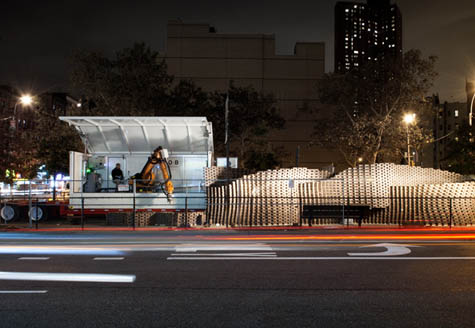
For the past four weeks, an orange robotic arm has been constructing a brick wall in south Manhattan.

[Image: Pike Loop by Gramazio & Kohler].

Neither a new Berlin Wall nor part of a delayed realization of Superstudio’s Continuous Monument, the machine was, in fact, built and programmed by Swiss architects Gramazio & Kohler. It is now the focus of an exhibition, called Pike Loop, at Storefront for Art and Architecture.

Tonight—Tuesday, October 27—at 7pm, Storefront will be hosting a public event in celebration of the project, down at the wall itself, free and open to the public. Here’s how to get there from Storefront. Be sure to stop by.

100

Even knowing how much it annoys certain people whenever I mention The BLDGBLOG Book on this website, I’m ridiculously excited—and admittedly quite stunned—to see that the book is #92 on Amazon.com’s list of the 100 Best Books of 2009.

[Image: Six of Amazon.com’s 100 Best Books of 2009].

To be on a list that includes J.G. Ballard, Thomas Pynchon, Nicholson Baker, A.S. Byatt, William T. Vollmann, and many more is just totally astonishing to me. But it’s a fantastic testament to the strength of the architects, photographers, writers, illustrators, historians, artists, cartographers, musicians, geologists, and more whose work appears in the book, as well as to the book’s designers, MacFadden & Thorpe. So thanks, Amazon!

In fact, there have been many fantastic books published this year, all worth checking out if you get a chance, including China Miéville’s The City & The City, David Gissen’s Subnature: Architecture’s Other Environments, Owen Hatherley’s Militant Modernism, Leslie Chang’s Factory Girls, James Lawrence Powell’s Dead Pool: Lake Powell, Global Warming, and the Future of Water in the West, Tom Zoellner’s Uranium, Stephen Asma’s On Monsters, the paperback reissue of Infrastructural City, Greg Grandin’s Fordlandia: The Rise and Fall of Henry Ford’s Forgotten Jungle City, and a million more.

(Thanks to Lauren Gilbert for pointing out the list!)

The Sphere and the Labyrinth

[Image: The cooling towers of the Ferrybridge power station; photo by Eric de Mare].

The above photo has really stuck with me since seeing it last week over at Millennium People—not only its juxtaposition of architectural types (the narrative ornamentalism of a small English church almost literally overshadowed by the minimalist hyper-functionalism of the cooling towers) but the photo’s implied collision of material activities (prayer, say, vs. the illuminative processing of rare fuels).

I might even suggest that it presents us with some strange, nuclear-Anglican revision of what Manfredo Tafuri would call the sphere and the labyrinth—that is, the altarpiece meets the reactor core—but the station is actually coal-powered, not nuclear at all. The image is nonetheless quite stimulating.

Imagine disused cooling towers repurposed as a church—or a library—or Chartres Cathedral put to work as a nuclear power station, its filigrees of saints and masonry trembling as atoms split and machines spin wildly in the basement.

Fossil Reactors

There are as many as sixteen 2-billion-year old nuclear reactors in the rocks beneath Gabon. Considering their age, they are also, unsurprisingly, completely natural.

[Image: The natural clocks and ticking stratigraphy of the Oklo uranium deposit, courtesy of the Curtin University of Technology].
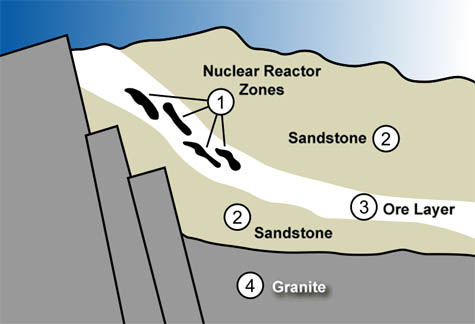
“In 1972,” the Curtin University of Technology explains, “the very well preserved remains of several ancient natural nuclear reactors were discovered in the middle of the Oklo Uranium ore deposit.” The university adds that each of these equatorial African reactors “operated on an intermittent basis for a period ranging from a few years to hundreds of thousands of years. The total time period over which the reactors operated is thought to be about a million years.”

In one specific case, we read in a report published five years ago by Physical Review Focus, a chain reaction in the uranium-rich rocks “cycled on and off every three hours.”

The idea that radioactive deposits beneath the Earth could self-react and undergo fission was first proposed by physicist Paul Kazuo Kuroda. The internal clock of a geological formation, Kuroda suggested, given contact with water, could simply start ticking away:

In 1956, nuclear chemist Paul Kazuo Kuroda of the University of Arkansas in Fayetteville predicted that a chain reaction could develop in natural uranium deposits, generating heat just as the reactor in a nuclear power plant does. His suggestion proved prophetic when, in the 1970s, others discovered several burned-out natural reactors in the Oklo uranium mines in Gabon.

Amazingly, “researchers still don’t know precisely how the fossil reactors managed to burn slowly for more than 150,000 years, when they could have exploded violently.” The presence of underground water seems especially fortuitous in that regard—it helped to avoid a nuclear detonation.

That’s plausible because the water molecules would collide with neutrons whizzing through the uranium and slow them down, a process called moderation. Because slower neutrons more efficiently split the uranium nuclei in a chain reaction, the water would promote the reaction and cause the reactor to heat up. Eventually, however, the heat would boil away the water, shutting the reaction down until more water could collect.

It was a pulsing rhythm, a geologic throb: based on present-day chemical measurements taken of specific isotopes in the nearby rocks, “the researchers estimate that the reactor ran for 30 minutes and then shut down for two and a half hours.”

[Image: A diagram of the Oklo uranium deposit, courtesy of the U.S. Department of Energy].

I’m reminded again here of William Burroughs’s extraordinary and haunting suggestion, from his novel The Ticket That Exploded, that, beneath the surface of the earth, there is “a vast mineral consciousness near absolute zero thinking in slow formations of crystal.” Here, though, it is a mineral seam, or ribbon of heavy metal—a riff of uranium—that stirs itself awake in a regularized cycle of radiative insomnia that disguises itself as a planet. Brainrock.

Gabon’s “natural nuclear fission reactors,” according to Wikipedia, “are the only known sites in which natural nuclear reactors existed. Other rich uranium ore bodies would also have had sufficient uranium to support nuclear reactions at that time, but the combination of uranium, water and physical conditions needed to support the chain reaction was unique to the Oklo ore bodies.”

Of course, this process created what we would now call nuclear waste—including plutonium. These otherwise extraordinarily dangerous waste products, however, have been entombed within the earth for two billion years. The Curtin University of Technology points out that “this is so long that all of the radioactive waste products (even those with million year half lives) have decayed away.” They have also hardly even moved: the plutonium, according to the U.S. Department of Energy, “has moved less than 10 feet from where it was formed almost two billion years ago.”

Are there thus structural lessons to be learned from the rocks at Oklo? “By analyzing the remnants of these ancient nuclear reactors and understanding how underground rock formations contained the waste, scientists studying Oklo can apply their findings to containing nuclear waste today,” the DOE goes on to suggest. This is another way of saying that the Oklo uranium deposits are being studied as natural analogues for how high-level nuclear waste might behave in an artificial repository like Yucca Mountain (watch for a long and fascinating interview with a geophysicist from Yucca Mountain here on BLDGBLOG next week).

We might say, then, that a geological formation, like some nuclear version of Spanish architect Vicente Guallart’s notion of geologics, has partially inspired an architectural form.

The timescales are all wrong for this, meanwhile, but if geomythology is the study of ancient folk tales, oral traditions, and regional myths to see if they contain camouflaged references to real, but prehistoric, geological events—earthquakes, tsunamis, volcanic eruptions, and more—what geomythological influence might the throbbing and automechanized Oklo uranium mines play? How extraordinarily interesting would it be to come across a series of old myths about an intelligent presence in the rocks of equatorial Africa, a kind of mineralized Mother Nature winking at everyone from below—and to realize that they’re referring to the reactions at Oklo. A spirit in the Earth.

Finally, do these naturally occurring reactions come with the implication that our present-day nuclear reactors are, in a sense, simulated geological processes, not unlike artificial diamond-creation chambers? Nuclear reactors become models of already existing natural events. They are terrestrial reenactments, you might say.

Scientific American has a five-page article about the Oklo phenomenon, if you’d like to read more.