Inhaling 9/11

[Image: The South Tower of the World Trade Center on 9/11; photographer unknown].

On the flight over to Chicago last week I read an intense and frightening article in Discover about the wide range of post-9/11 illnesses that have begun to develop in New York City.
As most people no doubt know, tens upons tens – if not hundreds – of thousands of people literally inhaled the World Trade Center towers in the collapse and aftermath of 9/11.
It was the malign aerosolization of late modernist architecture, producing “the most dangerous atmospheric conditions ever to occur on American soil.”
The “sky was glittering with glass” that day:

A toxic cloud composed of industrial waste and human remains crept out from the aching, smoldering pit at Ground Zero and wound its way into the adjoining streets. Its vapors circled around and up buildings, pumped in and out of nostrils, mouths, and lungs, and stung the eyes of every woman, child, man, bird, and beast within a wide range. It spread itself on building walls and inside boiler rooms and left its trail on parked cars, handrails, and public benches. That day, New York City was blinded by a perpetually sickening haze. It poisoned the minds of politicians who acted with hubris and paranoia. It obscured the vision of responders and residents, many of whom acted with heroism and reckless bravado, never thinking that their actions might be endangering themselves, their families, their cities, and their very future. The cloud billowed southward, over the river, enveloping everything in the dust and debris of blown-apart lives.

Breathing this “toxic cloud” has led to people coughing up “brown and pinkish-bloody” clots of tissue; it has led to organ failure; and the article even introduces us to a man who, five years later, “started bleeding everywhere – out of my ears, mouth, penis, and anus, and none of the doctors could figure out why.”
Indeed, the “number of seriously ill New Yorkers could climb to 300,000 in the near future,” and these serious illnesses run the gamut from “internal chemical burns” and “chronic respiratory and gastrointestinal conditions,” many of which will be fatal, to “rare blood cancers” and asthma attacks.

[Image: “Within a few hours’ time, a person exposed to the fumes could ingest toxins that would otherwise take a year to accumulate in a typical environment”; photographer unknown].

None of which seems surprising when you read about what actually went up in the air that day:

The Twin Towers contained tens of thousands of computer terminals, each housing about four pounds of lead, and an untold number of fluorescent bulbs that contained mercury. Released metal particles from the smoldering pit of the World Trade Center were so fine that they could easily slip past a paper face mask and reach deep into lung tissue, where they are poorly soluble in lung fluid. Metals and glass can remain trapped there for long periods of time and make their way into the heart.

It’s also important to note, for my voting American readers, that the leadership of Rudy Giuliani does not fare very well in this article.
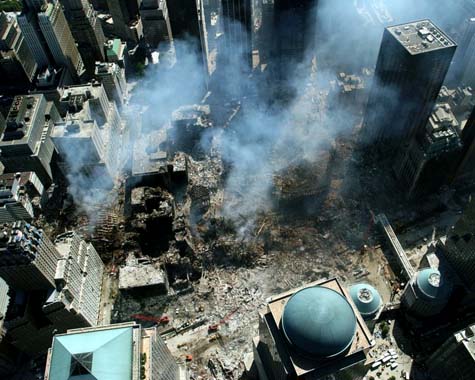
[Image: After the towers’ collapse; photographer unknown].

After much more detail about both the “plume” itself and about the various environmental failures that occurred up and down the political chain of command, the article ends magnificently: “While the courts try to determine who is responsible for the environmental debacle following 9/11, countless New Yorkers continue to live and work near Lower Manhattan with the assumption that it is safe. The dust is now out of sight, out of mind, and possibly in their lungs, hearts, and bloodstreams.”
So this is what happens when you pulverize and burn modern architecture: plumes of cadmium, thallium, benzene, silver, zinc, osmium, carbon monoxide, sulfuric acid, nickel, and lead drift outward into the city, snowing invisibly into local waterways, settling on windowsills and dusting the floors of homes, shops, and offices, salting food on plates at outdoor cafes, entering bloodstreams and sticking to clothes. Fiberglass and fire retardants, arsenic and rubber – asbestos, soot, and paper – all enter the atmosphere and form undetectable weather systems too vaporous and ghostlike to track.
Which leads me to wonder about what sort of post-bombardment aerial conditions existed in cities like Dresden or Hiroshima, after they were destroyed in World War II, when architecture was not made from such things – when there were not home computers and circuitboards to burn and when homes weren’t full of flame retardant fabrics and PVC.
Were different and earlier forms of pulverized architecture somehow safer to breathe?
In fact, if I can be excused a brief moment of contextually inappropriate speculation, would it be possible to impregnate buildings with good things – with good chemicals: with vitamins and medicines and even seeds – so that future 9/11s release beneficial plumes and so that the inhalation of architectural smoke is no longer catastrophic?
Or would that just encourage terrorist attacks, arson, and urban warfare?
In any case, the article in Discover is well worth a half-hour or so of your time – especially if you lived or worked in lower Manhattan or Brooklyn during the weeks after 9/11.

Galaxy Chicago

[Image: Famous buildings in Chicago, via the Chicago Architecture Foundation].

I’m in Chicago, wandering around the city for the first real time since I left six years ago, looking at a hundred thousand new brick-and-limestone private condo developments, crossing and recrossing the Chicago River on foot, staying in various hotels, visiting houses, checking out gigantic roof decks, writing up stories for work, attending dinners, feeling almost overwhelmingly nostalgic, giving a talk about BLDGBLOG, hanging out soon with this guy… but I’ll almost definitely be back in San Francisco before I have time to post again.
In the meantime, hello from Chicago!

A Pavilion in New York

[Image: Glowing pavilion by Minsuk Cho, at the Storefront for Art and Architecture, NYC].

New York’s Storefront for Art and Architecture today kicks off nearly a month’s worth of events, in celebration of the Storefront’s 25th anniversary. The list of speakers is long and well-curated; they’ll be speaking inside Minsuk Cho’s pavilion, in Petrosino Park, and the nightly events will last until October 16.
So if you’re in New York, you now have something to do every night for the next 26 days. Be sure to stop by.

(The Storefront for Art and Architecture, of course, also hosted Postopolis!)

It came from outer space

This is how the world will end: with a quiet bit of news on the BBC.
I got home from work last night to find out, incredibly, that “[h]undreds of people in Peru have needed treatment after an object from space – said to be a meteorite – plummeted to Earth in a remote area.”

[Image: A spectacular glimpse of the Leonid meteor shower, circa 1999; photo by Wally Pacholka].

The object “left a deep crater” that immediately began “spewing fetid gases,” and everyone who has “visited the scene” has since “been complaining of headaches, vomiting and nausea.”
A local villager, worried for himself and for his neighbors, says: “We don’t know what is going on at the moment, that is what we are worried about.”
It’s a virus from space!
So I half-seriously expected to wake up this morning and read that the entire population of Peru has been wiped out by clouds of alien zombie-dust; that militaries have been mobilized; that families are now scrambling in all possible directions to find a safety that will no longer come; and that the catastrophe continues to spread… In eight days’ time it reaches the streets of San Francisco, where I’ll be live-blogging the outbreak from behind a plywood barricade.
But it turns out that we don’t need to worry after all: the scientists quoted in the original article are right.
It wasn’t an object from space at all but “a fireball,” the appearance of which led people to hike out into the wild and find “a lake of sedimentary deposit, which may be full of smelly, methane rich organic matter.”
This “rich organic matter” made everyone ill – infected by rot and vegetation. It’s a kind of petro-illness.

Limey

[Image: Habitat 825, by Lorcan O’Herlihy].

In an earlier post I mentioned a housing project by LA architect Lorcan O’Herlihy.
That building, called Habitat 825 – built right next door to the Schindler House and deliberately designed so as to cast no shadows onto its historically listed neighbor – has a particularly memorable use of the color lime green.
Now, thanks to a coworker of mine, I have a few photos…

[Images: Habitat 825, by Lorcan O’Herlihy].

And I love this building! O’Herlihy’s use of volume and color just knocks me out.
For more Lorcan O’Herlihy, visit the firm’s website or read this earlier post on BLDGBLOG.

(Thanks, Chelsea!)

The school of 5000 corpses

In the Guardian today, Jonathan Glancey reports on London’s subterranean housing boom, pointing out that the urge for literally underground architecture has now hit the city’s public sector.

Case in point: the St. Marylebone school.
With the advisory input of their architect, the school’s officials decided that “the only way the school could expand physically was onwards and downwards through its pocket-sized playground.”
Unfortunately, the resulting project, a “fine example of intelligent urban design, thoughtful landscape gardening, worthwhile architecture and quiet delight,” dug straight into the “remains of some 5,000 corpses” almost as soon as construction began.
Rather than unearthing some super-virulent strain of the Black Death, however, sending all the small schoolgirls home coughing, decimating the population of northwest Europe… the project was completed to everyone’s satisfaction, and now St. Marylebone has an underground gymnasium.
And Glancey likes what he sees. He concludes:

It is also a project that deserves to set a precedent for much new city architecture. Much of this can be built underground, when not in flood zones, in one form or another, sometimes because this is the only way to go for a client unable to afford the price of land, or else restricted by perfectly sound conservation policies, and sometimes because – like most supermarkets, shopping malls and other structural detritus – it should be, as a matter of common decency, buried out of sight.

I’m not exactly in agreement with him that we should start putting our supermarkets underground; in fact, an upcoming article in Dwell makes the opposite case quite convincingly: i.e. supermarkets shouldn’t be windowless boxes but pleasantly open places in which to walk around, complete with outdoor horizons and panoramic views.
But imagine the future settings for novels and films! Underground malls in Canterbury. Irish theme-bars 27 stories below the surface of the Earth. Three kilometers of escalators take you down and down – and down – passing through mirrored corridors… till you arrive at the local arts cinema. There are rumors of a BMW dealership another mile or so below.

(Thanks, Nicky! Earlier on BLDGBLOG: Hello. Welcome to my squash cave)

12 Houses: The Wonderfully Puzzling and Colorful Use of Spatial Volume

After participating in a roundtable discussion with architect Lorcan O’Herlihy yesterday at Dwell on Design, I decided to look into his work a bit more – and it’s been a great way to spend time. Lorcan has both a great sense of modernist architectural volume and a brilliant eye for color; the lime green he used on a multi-unit residence in West Hollywood, for instance, is extraordinary. I’ll see if I can dig up some photos of the finished building.
The following images, meanwhile, are just a random look at three or four of O’Herlihy’s most interesting projects. To start with, here is a recent building in Los Angeles, called Gardner 1050.

[Images: Gardner 1050, by Lorcan O’Herlihy].

I’m a particular fan of the outdoor footbridges, as they criss-cross a shared entry courtyard in the all-pervading sunlight of LA.
O’Herlihy, you see, has a small thing for residential bridges: these next images feature the Fineman residence – a house with its own “enclosed glass-walled bridge.”

[Images: The Fineman house, by Lorcan O’Herlihy].

This next image gives us a bird’s-eye rendering of O’Herlihy’s proposal for a new dormitory and “Educational Facility” at CalArts – more information about which is available on O’Herlihy’s website.

[Image: Proposal for CalArts, by Lorcan O’Herlihy].

In a nutshell, though, the circulation-friendly building complex uses a “shifted” east-west axis “to take full advantage of the complete spectrum of the optimal solar angle.” This not only “supports the passive ventilation system,” it means that “the need to artificially and mechanically condition an internal corridor year round can be eliminated resulting in a significant reduction in the net energy demand over the life of the building.”
Below, then, you see the architectural logic behind O’Herlihy’s Norton Avenue Lofts, going from a bare-bones diagram of abstract spatial volumes –

[Image: The Norton Avenue Lofts, by Lorcan O’Herlihy].

– to the final renderings of the project’s exterior.

[Images: The Norton Avenue Lofts, by Lorcan O’Herlihy].

In any case, I know I’m not exactly going into much detail with these projects – in fact, I’m just sort of whipping out a bunch of cool, unrelated images without offering any real or substantive analysis – but I still want to point out one more: O’Herlihy’s 12 Houses, an almost Bach-like study in formal variation.

[Image: 12 Houses by architect Lorcan O’Herlihy].

The original idea behind 12 Houses, we read, was “to create individualized identities and experiences for each house using shared elements of design and construction.”
As a result, O’Herlihy generated “four prototypes”:

Starting from a simple main floor plan consisting of two adjoined rectangular bars, a second floor is created by pulling up or pushing down one bar – either in complement or contrast to the topography of each site. From these two formal gestures, four variations emerge: up, down, long, short. Further variation is produced by siting (for privacy and views), adjustment of each prototype in response to stringent building envelope limits, and a carefully-developed palette of exterior/interior materials.

I absolutely love the puzzle piece-like results.

[Image: 12 Houses by architect Lorcan O’Herlihy].

But let me pre-empt some criticism right away: yes, this is simply another kind of suburban sprawl, destined to grace tasteless cul-de-sacs, surrounded by well-watered lawns and reachable only by private automobile – yet the houses are also beautifully devised and formally stimulating.
I also have an active soft spot for systems like this, and so I’m easily seduced by basic variations upon simple architectural plans – the same animating principal behind Palladianism, for instance. The mathematics of the ideal villa, indeed.

[Image: 12 Houses by architect Lorcan O’Herlihy].

O’Herlihy’s 12 Houses are apparently slated for construction, too: they should be ready for inhabitation by Spring 2008.
For more projects by Lorcan O’Herlihy, book a visit to his firm’s website.

Sci-Fi Regionalism

Yesterday was another good day at Dwell on Design, with a handful of talks in the morning followed by more general mingling in the exhibition space all afternoon.

North Carolina-based architect Frank Harmon – behind the exquisite Prairie Ridge Eco Station, pictured below, designer of Duke University’s Smart House, and architect of many, many other great projects – gave the final speech of the conference, presenting his firm’s work in the context of “new regionalism.”

[Images: The Prairie Ridge Eco Station, an open air classroom designed by Frank Harmon].

Frank talked about the use of local materials; how to survive humidity, thunderstorms, summer dry spells, and the harsh winter cold without using electricity, putting architecture itself to use as a local climate modification system; and, finally, the blending of traditional design styles with what could be called global architectural modernism. He showed us a church, a pottery museum, the aforementioned Prairie Ridge Eco Station, an ironworkers’ studio, and a few other of his firm’s own projects.
One of the most interesting sequences of images he showed was a quick sketch describing the sinusoidal shape of local wind patterns over the North Carolina landscape – which he then clicked away from to reveal the wing-like angled slope of a roof he’d designed to fit into the local windscape almost perfectly.
It’s hard to exaggerate how exciting I find that sort of thing.
In any case, Frank Harmon’s work is well worth checking out in more detail – and a great Q&A with him is coming up in a future issue of Dwell (where, in full disclosure, I now work) – so here’s his website.
But I wanted to follow up here with a few other quick thoughts – because I was on a panel with Frank after his talk, alongside Gwynne Pugh, Lorcan O’Herlihy, and Reed Kroloff, and in the spotlit glare of being on stage I might have been a tad less articulate than I’d hoped to be.
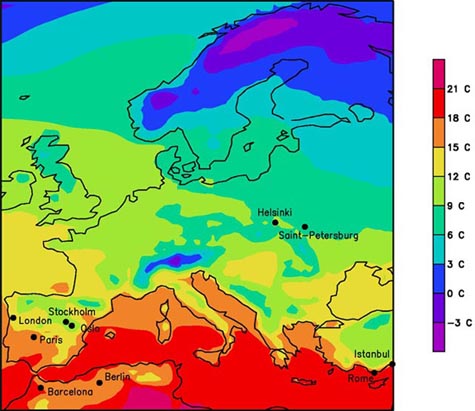
Briefly, then, I mentioned a climate map, published earlier this summer, in which Europe has been re-mapped according to what its regional climates will be like in the year 2071 A.D.

The map is initially quite confusing, but it shows that London will have the climate of Lisbon, Portugal; Berlin will have the climate of northern Algeria (!); and Oslo will feel like Barcelona (and so on).
So the question I wanted to propose to the other speakers was: how can architects account for these sorts of wild fluctuations in both weather and climate through architectural design? How can a building be prepared – structurally, materially – for future climate change?
Or, more relevant to Frank Harmon’s presentation, especially in the context of “new regionalism”: what if you build a house that’s perfect for North Carolina as North Carolina now exists – but what happens to that house in, say, twenty years’ time, when North Carolina is more like Houston, Texas, or even like Key West?
In which case, what about the new, modern, glass-walled housing stock of Berlin when it finds itself baking in Algiers-like desert temperatures? (How I would love to see sand dunes rolling through the streets of Berlin!)
This, if anything, is the real new regionalism: a regionalism that includes future transitions so out of the ordinary that they verge on science fiction.
It’s sci-fi regionalism – architectural design in an era of global climate change.

Fire Department Psychiatry

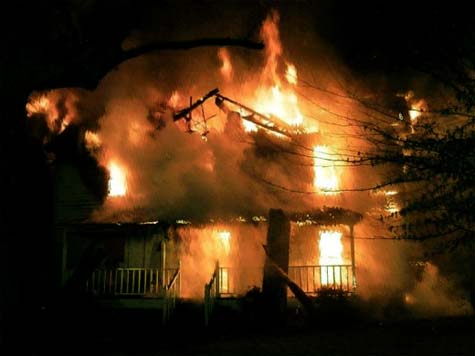
One of the presenters this morning at Dwell on Design – I believe it was Gwendolyn Wright – mentioned a fire department that had once employed a psychiatrist to help solve mysterious house fires.

They had noticed, apparently, that some recent fires involving stately old Victorians occurred immediately after those houses’ residents had got divorced.
And it wasn’t just insurance fraud.

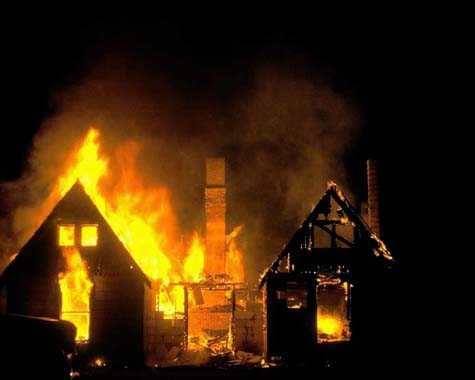
What really happened, the psychiatrist proposed, was that the houses themselves had been blamed, or scapegoated, for the interpersonal strife that once occurred within them – and those houses had thus been destroyed.
It was anti-maritally inspired arson – another front in the war against architecture – with the house as the enemy to be destroyed.
At least that’s what I think the speaker said.

(Note: I’m sure there were many other factors involved in those fires – and this is, by no means, some over-arching explanation for all domestic fires in the United States – but it did make a fascinating anecdote: desperate people depressed, even enraged, by architecture, setting fire to the very thing they think has limited them).

Well-behaved Homes

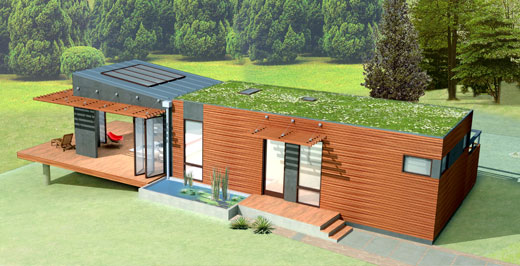
[Image: The Glidehouse by Michelle Kaufmann].

Architects Michael McDonough and Michelle Kaufmann are now on stage here at Dwell on Design.
Their topic is “Well-behaved Homes.”
Michael, in full performance mode, explains that building houses using conductive materials (metal, for instance, which is also used to make pots and pans) instead of using insulating materials (he specifically refers to aerated autoclave concrete, used in the majority of European houses) is inherently problematic from the standpoint of energy efficiency and climate control.
He talks about the importance of mechanical engineers in coming to understand the movement of air through enclosed architectural structures.
McDonough’s firm is now developing what he calls the eHouse, a kind of domestic research station in New York state through which they can test out the use of more energy-efficient – and climate-appropriate – building materials.

[Images: Michelle Kaufmann’s mkLotus house].

Michelle Kaufmann, meanwhile, still speaking as I type this, is introducing everyone to green roofs, rainwater catchment, passive/active solar energy systems, and the relatively streamlined construction process involved in assembling one of her projects. She even, briefly, touched on issues of affordability (or the lack thereof).
She just finished up, in fact.
Anyway, I can’t help but wonder, referring to the title of this panel, what a non-well-behaved home might be.
In fact, one of the respondents literally just mentioned this, in a passing reference to the possibility of “outlaw homes,” which she describes as homes whose owners tear up the front yard to plant vegetable gardens.
But is that not just another way of being well-behaved? Eating right, being a good neighbor?
What if you installed a shake table in your front yard?
Is there a modernism for bad neighbors?

(Note: I’ll be live-blogging the Dwell on Design conference this weekend; expect more posts soon – and bad editing or typos might have to stay up for now. Please excuse any such editorial lapses…)