Reburbia

Launching just today is an awesome new ideas competition called Reburbia.

In a future where limited natural resources will force us to find better solutions for density and efficiency, what will become of the cul-de-sacs, cookie-cutter tract houses and generic strip malls that have long upheld the diffuse infrastructure of suburbia? How can we redirect these existing spaces to promote sustainability, walkability, and community?

How would you put the suburbs to better use? Would you replace them altogether?
Or, from spaceports to agricultural plots, from newly walkable town cores to micronations, what should the suburbs become? Perhaps empty, foreclosed houses should be transformed into, say, zoos for the displaced native species of the region… Or perhaps every house on a certain cul-de-sac should be linked by paths and awnings and turned into a library: fiction in one house, history in another… Or perhaps the suburbs should simply become a ruins park, rotting in on themselves in summer thunderstorms.

Co-sponsored by Inhabitat, the contest’s judges are Jill Fehrenbacher, Sarah Rich, Fritz Haeg, Paul Petrunia, Thomas Ermacora, Allan Chochinov, and myself. It’s a fantastic group of people to be with, I have to say, and I can’t wait to see how people respond.
So go theoretical, go structural, go narrative, go botanical, go cynical, go scifi: tell us how you would redesign the suburbs.
Check out the Reburbia website for more info, including the schedule.
And good luck!

Thanks!

[Image: From Kevin Slavin‘s talk last night at the BLDGBLOG Book launch party; there is an interview with Slavin in the book – don’t miss it! Photo by Matt Jones].

I’ll be on the road again for nearly two days, presumably without internet access, flying down to Sydney for Urban Islands.
However, I had a blast last night at The BLDGBLOG Book launch party and so I wanted to say thanks to everyone who came out. Even with last night’s Tube-flooding rain storms, we managed to pack the place out.
Kevin Slavin, who appears in a previously unpublished interview in The BLDGBLOG Book, kicked off the whole thing with a fantastic introduction to his own work – covering urban games, homesickness, the digital uncanny, payphone hijacking, and even shark clamps. Matt Jones has already uploaded a few pictures of Kevin in action. I was also excited as hell finally to meet Siologen, of the sadly now-missing International Urban Glow, after being blown away by his photos for so many years – some of which appear in the book – as well as to meet Magnus Larsson of Dune fame, novelist Clare Dudman, P.D. Smith of Doomsday Men, designer Anab Jain, blogger Andrew Ray behind the excellent Some landscapes, and all the other people I got to see again.
So thanks – it was a great night.
It also seemed like a well-timed launch, as I’m still reeling from the fact that the book was chosen just this week by Amazon.com as one of their “Best Hidden Gems of 2009… So Far.”
In any case, huge thanks, as well, to the Architectural Association, Wired UK, and Liam Young for teaming up to make last night happen.
Also, I forgot to mention the other day that July 5th was BLDGBLOG’s 5th birthday – so happy birthday, little mo’, and thanks for being there to host my writing.
Regular posts will return soon…

10 Reasons to Read The BLDGBLOG Book

Considering the image that’s been sitting up on top of the righthand column here for several months now, it might be hard to have missed the fact that there’s a BLDGBLOG Book coming out. However, it also might not be entirely clear what the book is about, what’s in it, or even who it’s for; it might not be clear, in other words, why you should consider reading it.
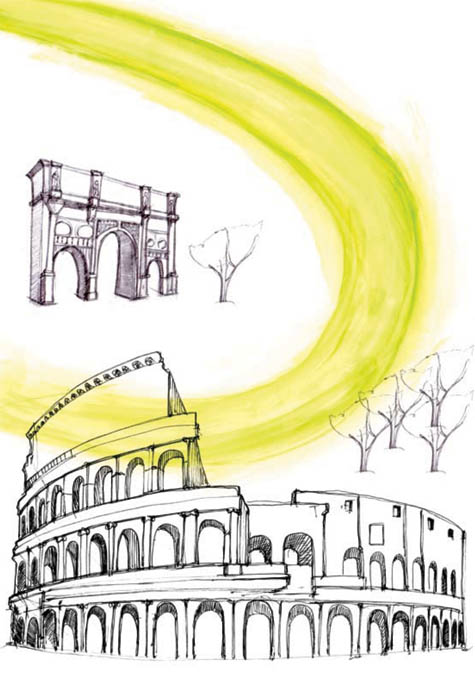
[Image: An illustration by Brendan Callahan, from The BLDGBLOG Book].

I thought, then, as the book is now shipping around the world and there’s even an official launch party tomorrow night at the Architectural Association in London, that there’s never been a better time to give everybody a quick tour through the book’s major highlights.
So here is a typically internet-ish list of ten reasons why you should read The BLDGBLOG Book.

1) The book itself! There are nearly 300 pages, close to 115,000 words, and approximately 275 images – and the whole thing is crammed full of sidebars, long captions, running text, and interstitial chapters scattered like blog posts in between. While you could sit down and read the whole thing through in two or three sittings, most likely it will become something you can turn to again and again – at the beach, in the studio, on an airplane flight – to look for ideas, visual inspiration, or even just a list of further things to read.
Write notes in the margins. Google things you’d never heard of before. Reread a few sections.
Option certain ideas for future blockbuster films…
There’s so much content in The BLDGBLOG Book that there’s undoubtedly something for everyone: buildings, myths, gadgets, and paintings, short stories, maps, and comics, Mars photography, Gothic horror, and brand new interviews. It’s got 19th-century ruins paintings, artificial glaciers, and countless speculative projects by some of today’s most exciting architects – among a hundred thousand other things that will hopefully keep you coming back to the book for a long time to come.
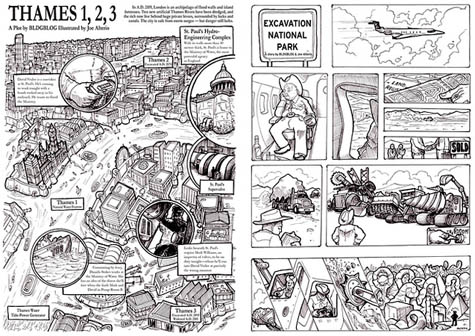
[Images: Two original comic strips by Joe Alterio and BLDGBLOG for The BLDGBLOG Book].

2) For years now I’ve suggested that architectural ideas can be articulated, often extraordinarily well, in the form of graphic novels and comic books – so it seemed like I should finally try that theory out for myself. The book thus comes with two original comic strips, created in collaboration with San Francisco-based illustrator Joe Alterio: “Thames 1, 2, 3” and “Excavation National Park.” They’re featured on the inside covers, one of them without words, the other a much longer scenario in which most of London is underwater, transformed into “an archipelago of flood walls and island fortresses.” There are Conradian references and tide-energy machines.
Joe’s artwork, I have to say, is stunning – it’s precise and clean, yet tightly energetic – and, with any luck, he and I will be working together again in the future. (Joe also designed the logo for Postopolis! LA).
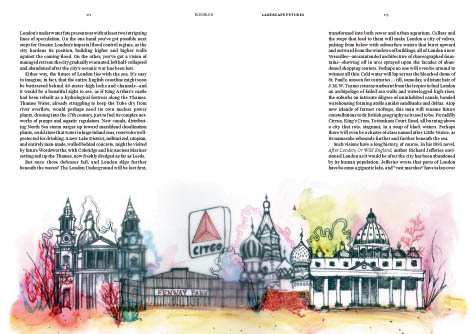
[Image: An illustration by Brendan Callahan, from The BLDGBLOG Book].

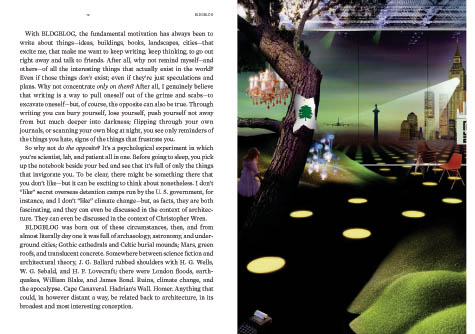
3) The book also has dozens of full-color, original illustrations by Brendan Callahan, a friend and former coworker. Brendan and I spent many a lunchtime break together back in San Francisco going over preliminary sketches and ideas for the book – and I think he hit the ball right out of the park here, coming back at the end, after sometimes excruciatingly vague art direction from yours truly (sorry, Brendan!), with detailed and very witty full-page images: architectural reefs, domesticated Northern Lights, endangered geological formations, underground cities, sound mirrors, overgrown freeways, hot air balloon concerts of subliminal nighttime music, buttressed buttresses, and even Miesian prescription drugs…
For Brendan’s illustrations alone, the book is well worth picking up.

4) The book is dotted with awesome interviews – from edited versions of BLDGBLOG’s earlier discussions with classicist Mary Beard, urban explorer Michael Cook, theorist and historian Mike Davis, game designer Daniel Dociu, photographer David Maisel, novelist Patrick McGrath, photographer Simon Norfolk, and writer Jeff VanderMeer, to an expanded interview with architect Lebbeus Woods – discussing his project “Einstein Tomb,” Arthur C. Clarke’s novel Rendezvous with Rama, and much more.
Beyond that, there are brand new, exclusive, and otherwise unpublished interviews with Archigram co-founder Sir Peter Cook, architect and writer Sam Jacob, musician DJ /rupture, urban games entrepreneur Kevin Slavin, and author Tom Vanderbilt. There are even short email interviews with fellow bloggers Bryan Finoki and Alexander Trevi, as well as with photographers Stanley Greenberg and Richard Mosse – lending the book so many other voices that, even if you don’t like my own particular take on things, it should be easy enough to find a perspective here that appeals to you.
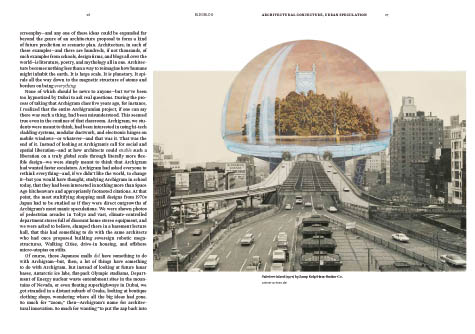
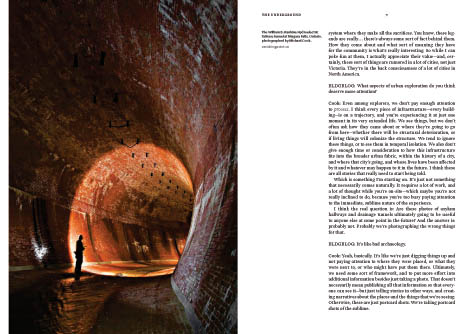
[Images: Spreads from The BLDGBLOG Book].

5) The book wouldn’t be half as visually interesting as it I think it’s turned out to be without the eye-popping photography of Edward Burtynsky, Michael Cook, Emiliano Granado, Stanley Greenberg, Ilkka Halso, David Maisel, Richard Mosse, Simon Norfolk, Bas Princen, Siologen, and many, many others (including NASA, the United States Navy, and the Army Corps of Engineers).
All of even that, however, is in addition to architectural projects from Smout Allen, Agents of Change, Archigram, ArandaLasch, Minsuk Cho & Jeffery Inaba, FAT, Vicente Guallart, Lateral Office, Studio Lindfors, LOT-EK, Andrew Maynard, Haus-Rucker-Co., Joel Sanders, and Iwamoto Scott – and there are posters by Steve Lambert and Packard Jennings, video game environments by Daniel Dociu, “spam architecture” by Alex Dragulescu – and the list goes on and on.
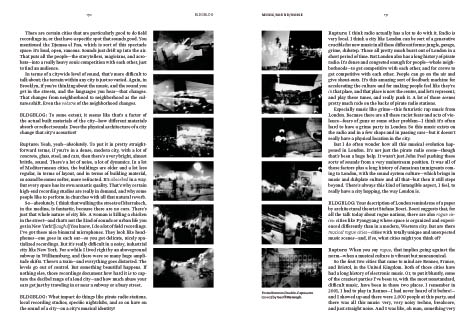
[Image: A spread from The BLDGBLOG Book, designed by MacFadden & Thorpe].

6) The book is beautifully designed by MacFadden & Thorpe – with a clear and legible use of the page grid, great font choices (including Avenir, which you see in BLDGBLOG’s logo), full-bleed images, and different-colored paper.
It’s a solid book: it looks and feels great, and it’s durable.
Designers Brett MacFadden and Scott Thorpe worked down to the tiniest level of detail to get it all lined up and functioning; Scott and I, in particular, often met after work last year at MacFadden & Thorpe’s Mission studio to go over the book, page by page – a fantastic way to put together a project like this.
One minor design detail that I like, for instance, becomes apparent after you shelve the book: the spine itself contains the table of contents.

7) It’s probably not entirely surprising that I might have one or two good things to say about the book, having spent so much time working on it – but I’m not the only one. Here’s a brief sample of what other people think of The BLDGBLOG Book
The back-cover blurbs come from Academy Award-winning director Errol Morris; Jeff Gordinier, Editor-at-Large of DETAILS magazine and author of X Saves the World; Justin McGuirk, Editor-in-Chief of Icon; Lawrence Weschler, National Book Critics Circle Award-winning author of, among many other things, Mr. Wilson’s Cabinet Of Wonder; Joseph Grima, executive director of New York’s legendary Storefront for Art and Architecture; and Sarah Rich, managing editor of the Worldchanging book.
Meanwhile, just this past weekend, The Guardian wrote that the book has a “Wellsian ability to conjure up the structures and spaces of the future,” and that it “fizzes with new ideas about the architecture that frames our lives.”
Literally tonight, then, as I sat down to read back through this post on a quest for lame phrases or typos, Amazon.com announced that The BLDGBLOG Book is one of their “Best Hidden Gems of 2009… So Far” – calling it a “gorgeous object” that will “build a new room in your brain.”
Wired enthusiastically recommends that you read it – as does Dwell – and SEED Magazine has called it one of their “Books to Read Now,” adding that The BLDGBLOG Book‘s “freewheeling explorations of how we may come to interact with our buildings, our cities, and our planet draw from every branch of science (plus a few from science fiction).”
Allison Arieff calls it “highly recommended reading.”
Obviously, not everyone in the world is going to like the book – and if you don’t, of course, let me know what you think in the comments – but hopefully these are a good indication that the book has been put together well.
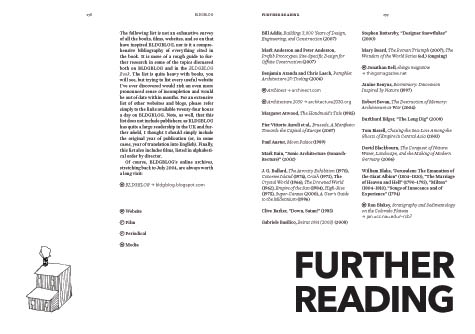
[Image: The beginning of the Further Reading list, from The BLDGBLOG Book].

8) Toward the end of the book is an extensive “Further Reading” list, mostly referring to print media (I decided that a list of blogs and websites would rapidly become obsolete, as they come and go so quickly). However, this is a solid reading (and viewing) list, encompassing everything from Foucault’s Pendulum to Ghostbusters, Bunker Archeology and William Burroughs to Giordano Bruno and Alfred Hitchcock, Piranesi to Papillon.
The only down side, of course, is that I already have a half-dozen things I’d like to add – for instance, John Christopher’s Death of Grass and Kaputt by Curzio Malaparte – but that’s life.
If you are at all curious about which books, films, and magazines (and even a few websites) are being consumed behind the scenes here at BLDGBLOG, there’s no better place to start than The BLDGBLOG Book‘s long list of Further Reading. Photocopy it and give it to friends. Or read your way through it, checking off titles one by one.

[Image: The Autographs page, from The BLDGBLOG Book].

9) Coming just after the Further Reading list there is… the Autographs page.
This is where you can ensure your copy of The BLDGBLOG Book becomes totally unique to you, as each copy comes with pre-labelled spaces in which to collect certain autographs… by Lebbeus Woods, Walter Murch, Siologen, Steven Spielberg, Rachel Whiteread, and even Brad Pitt. Why not?
Now Brad Pitt, for instance, is all but guaranteed to be confronted someday with a copy of The BLDGBLOG Book – and if you ever decide to get rid of the thing it will be worth $500 on eBay. Value-added!
Unfortunately it’s now impossible for anyone to get every name signed – with the death of novelist J.G. Ballard – but it would be genuinely interesting to see who can fill up the autographs fastest. Going to Denmark on holiday? Well, bring along The BLDGBLOG Book in case you run into Bjarke Ingels. Headed for Los Angeles? Better bring The BLDGBLOG Book – and stop by CLUI or SCI-Arc to get signatures from Matthew Coolidge and Mary-Ann Ray…

10) Finally, why should you read The BLDGBLOG Book? Again, because of the content.
There are so many interesting things in there, from tectonic maps of the earth’s evolving surface to previously unpublished documentation of a campaign to stabilize geological forms in Utah using spray-on adhesives manufactured by the automobile industry. There are acoustically sophisticated underground cities accidentally discovered by rural farmers and there are U.S. military plans for the weaponization of hurricanes. There is the flooded London of the 27th century and there is the deliberate demolition of architecture as an act of international war.
Lost film sets, space seeds, and Stalinist sleep labs sit beside occupied cities and flying orchestras; fossil rivers flow by rogue adventure tourism firms, hydrological models, and the groaning sounds of climate-changed glaciers.
There are buildings, speculative cities, and landscape futures.
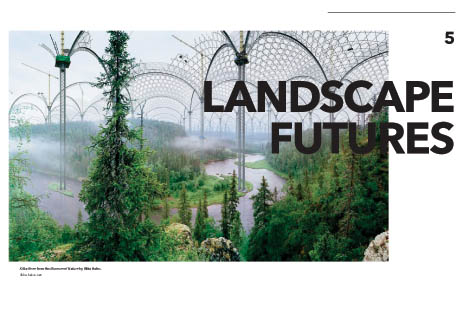
[Image: A spread from The BLDGBLOG Book, featuring a photograph by Ilkka Halso].

So check it out if you get a chance – I hugely appreciate any and all interest in the book. If you’ve bought a copy already, of course, I owe you a genuine thanks!
And, again, if you’re in London on Tuesday, 7 July, from 6-8pm, I’d love to see you at The BLDGBLOG Book‘s official launch party at the Architectural Association.

Corridors of Power

After the National Security Agency “maxed out the capacity of the Baltimore area power grid,” according to an article in The Register – itself citing The Baltimore Sun – due to the near-endless electrical needs of its wire-tapping supercomputers, the NSA has begun planning the construction of a brand new, $2 billion data center in the deserts of Utah.

[Image: Photo by Thundered Cat].

There, a vast, million-square-foot warehouse might thus soon rise at the intersection of two major national “power corridors.” The Agency, we read, hopes eventually “to decentralize its computing resources and tap regions with ample supplies of lower-cost electricity.”
While I’ve already written about the literary implications of server farms – that is, server farms as the library of the future – and I don’t want to repeat that analysis here, I’m led to at least two further questions:

1) Is there a role for architects in the construction of rural data centers for the U.S. intelligence services, and what might Vitruvius, for instance, have to say about the spatial needs of supercomputers? Would De architectura have contained an extra chapter about the square-footage of rural data centers if Vitruvius had been alive today – and, if so, what might it have said? For that matter, what if Rem Koolhaas had written Delirious New York during an age in which that city’s major IT operations took place inside windowless, hydroelectrically powered warehouses in the Hudson Valley (or even Québec)? What spatial lessons might these ex-metropolitan data warehouses entail? Further, if, say, SOM were to design every governmental server farm in the United States, and if those server farms were then used to store sensitive information about the habits of U.S. citizens – what international calls they make, what books they buy from Barnes & Noble, what movies they rent from Netflix or even Sugar DVD – would that represent an ethical compromise? Is it morally right to design spatial envelopes for server farms, when the computers housed therein might be used in invasive ways?

2) I’m actually quite fascinated by the idea that the NSA has been looking “to decentralize its computing resources and tap regions with ample supplies of lower-cost electricity.” This comes with fascinating implications – for instance, that some random town in Wisconsin (or, of course, Utah) might unknowingly become host to several dozen supercomputers of extraordinary strategic importance in the pursuit of national security… even though the only real evidence that this undeclared hardware exists will be a mysterious strain on the town’s evening power supply. Each night at 8:30 the streetlights dim: it’s the harddrives cooling down, or warming up, or turning over for maintenance. Like some weird new version of Salem’s Lot, in which the anonymous presence haunting your town is actually a government server farm stored inside an old factory by the river, surrounded by cyclone fencing… After all, “regions with ample supplies of lower-cost electricity” might very well include towns in the Rockies, in Alaska, and out on the tornado-prone plains – and so, similar to Tom Vanderbilt’s exploration of decommissioned nuclear silos in the horizon-spanning ranchlands of the great American nowhere, there might yet be future spatial archaeologies written about military data centers, surveillance data centers, wiretapping data centers, any sort of top secret data center that once hummed away somewhere in the darkness, perhaps even disguised as suburban houses. That apparently empty bungalow you see at the end of your street, like the opening scene of War Games, in other words, is actually full of harddrives; it’s not Ed Gein coming home at 3am, strange packages in hand, it’s an Information Assurance officer coming back to check the fuses. It’s the informational gothic: the IT needs of Homeland Security narratively transformed into a new genre of mysterious blackouts and spatial paranoia.

(Originally spotted via @stevesilberman).

Going to Eleven

I’ve just been reading an awesome new publication by students from the Bartlett School of Architecture’s Unit 11, whose instructors are Mark Smout and Laura Allen of Augmented Landscapes fame.

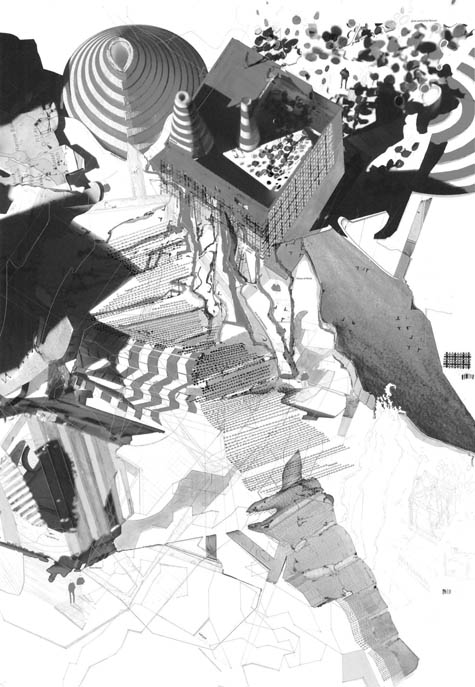
[Image: The “House of Drink” by Margaret Bursa, Unit 11].

The publication itself is called ELEVEN, and it will apparently be published twice a year; this particular issue has the running theme of “Field Operations.” While there is some brief theorizing about “guidelines of actions,” and how those guidelines can frame architectural space, it’s the individual projects that deserve attention.
What’s inside?

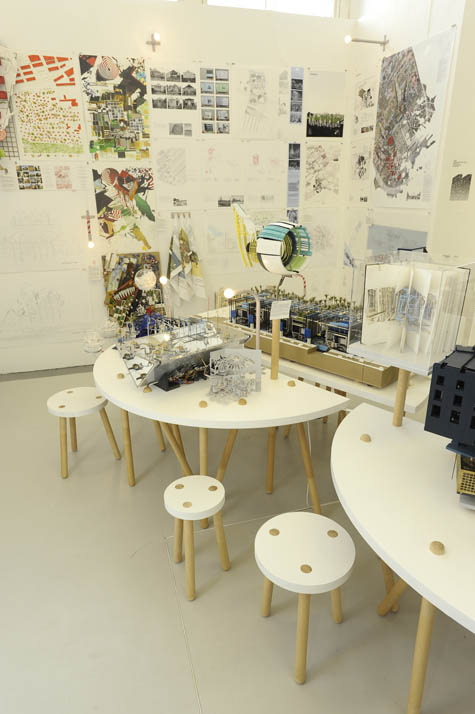
[Images: A display of Unit 11 projects; all images by Stonehouse Photographic].

There are “prophylactic wars and military utopias” by Luke Pearson (Pearson’s work, of course, having been previously explored on BLDGBLOG); a hydrological reengineering of the U.S./Mexico border by Joel Geoghegan; and weird 3D scans of the abyss, via the opiated writings of Thomas de Quincey, by Rae Whittow-Williams:

…the aim of the project translates the various hallucinations of Thomas De Quincey into the envelope of [an] existing house. Each environment is developed using differing techniques and processes of collaging space, forced perspective and iterative modelling in order to create a series of scale-less and absorbing hallucinatory spaces.

There are resonating buildings full of “drone pipes” and “sound bags” by Chris Wilkinson; the “rapid prototyping of a hyper-real Manhattan” by Alex Kirkwood; replicated replicas; Fabergé menageries; and much more.

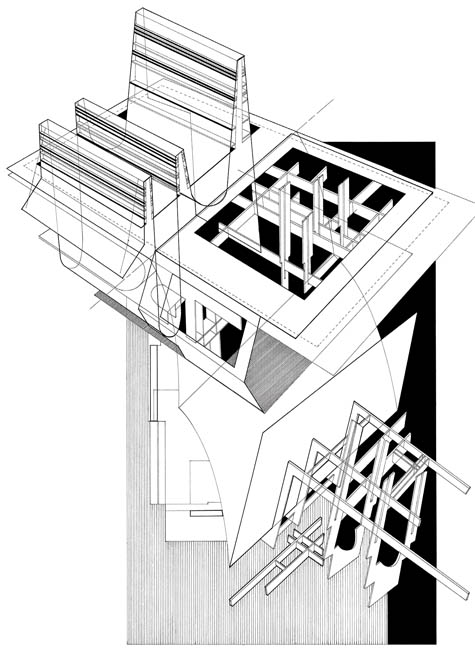
[Image: From “The Survey of London” by Will Jefferies, Unit 11].
It only costs £3, and it includes a foreword by Sam Jacob. Jacob suggests, praising the students for their initiative in starting the publication, that “we can argue – despite what Tafuri says – for the importance of architects writing their own histories, publishing their own agendas and documenting their own landscapes. By confusing (or fusing) production, reproduction and dissemination with the practice of architecture an expanded, speculative field opens up.”
You can buy it at the Architectural Association, RIBA, and Magma, as well as via smoutallen.com.

Romecore

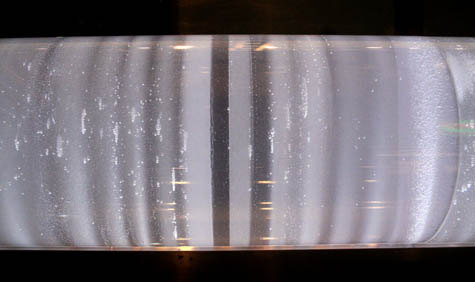
[Image: A Greenland ice-core at the Hayden Planetarium; for further reading, visit the U.S. National Ice Core Laboratory. Photo by Planet Taylor, used under a Creative Commons license].

Note: This is a guest post by Nicola Twilley.

The Crypta Balbi is a relatively recent, low-profile addition to Rome’s museum compendium. It’s billed variously—and confusingly—as a museum of archaeology, a museum of ancient Rome, and a museum of the Dark Ages. All of these descriptions are, in fact, cumulatively accurate, because the site is actually a city-block-sized core sample of Rome, threaded through with staircases, tunnels, and elevated walkways for visitors.

Crypta Balbi is located in an irregular pentagonal plot in the Campus Martius, an area that, unlike many regions in the ancient city, remained largely inhabited through the Middle Ages. In fact, according to Filippo Coarelli’s authoritative Rome and Environs: An Archaeological Guide, the Campus Martius was originally supposed to be kept free of buildings altogether and “reserved for military and athletic exercises.” However, historian Suetonius describes the city’s gradual encroachment, explaining that: “During his reign Augustus often encouraged the leading men of Rome to adorn the city with new monuments or to restore and embellish old ones.”

[Image: A satellite view of the city-block core sample, via Google Maps].
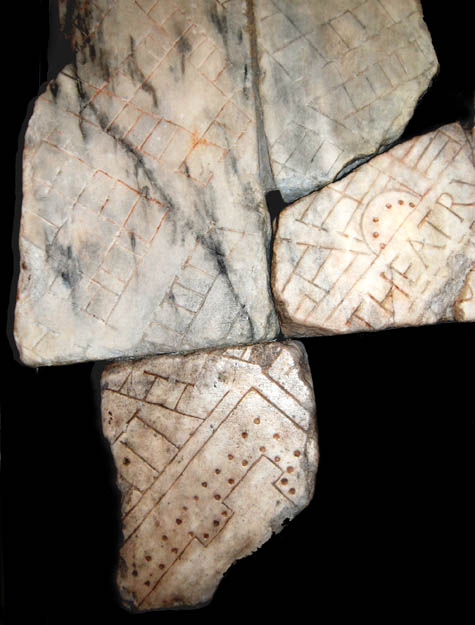
As a successful military general and favored member of Augustus‘s entourage, L. Cornelius Balbus the Younger stepped up to the plate, building a theater and attached crypta—a rectangular porticoed walkway where the theater’s scenery could be stored and around which the public might stroll, protected from the elements. Apparently, the Balbi Theater’s grand opening in 13 BC took place during one of the Tiber’s regular floods—meaning that it was, briefly, only accessible by boat. Nonetheless, the Theater and Crypta thrived, and they are depicted intact on a chunk of the Severan Forma Urbis, an amazing 60′-x-43′ incised marble map of the city created for public display in 203 AD.

Eventually, Rome’s earthquakes, fires, barbarian raids, and radical population shrinkage (from a million people in 367 AD to just 400,000 less than century later) combined with architectural re-use and the passage of time to take their toll. There isn’t much of the original Crypta left to see—a reconstructed stucco arch, and the massive travertine and tufa walls that now serve as foundations for modern houses in Via delle Botteghe Oscure and Via dei Delfini.

[Image: A fragment of the Forma Urbis, showing the Balbi Theater. For more on the Forma Urbis, visit the seemingly great but non-Mac-friendly Stanford Digital Forma Urbis Romae project].
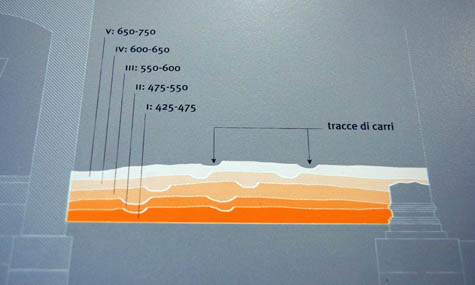
However, layered above the Crypta’s original floor plan are traces of this city block’s shifting usage—a condensed narrative of Rome’s destruction, accretion, and evolution. It is this series of transformations and reuses of both the Crypta and the urban space it occupies, rather than the fragmentary ancient ruins, that the museum aims to make visible. Like a series of stills from an impossible time-lapse film, the visitor who descends to the basement or climbs to the third floor can see this awkward cuboid chunk of city ruined, reshaped, reused, and reoriented over two thousand years of urban history.

Equally amazing are the expansive historical detours prompted by even trace elements in the urban core sample. For example, as early as the time of Hadrian, a “monumental” public latrine was inserted into a section of the Crypta. From the quantity of copper coins that fell, and weren’t worth recovering, archaeologists have extrapolated the amount of coinage in circulation in Western Europe during the latrine’s life-span. (Astonishingly, it was only in the 19th century that small change was to be this common again in Western Europe).

[Image: Museum display panel diagramming five distinct road levels wandering across the Crypta’s ruins (apologies for the quick snapshot)].

Two centuries later and a few feet higher, two graves bear witness to a city in ruins between the 5th and 7th centuries, as the prohibition against burial within city walls lapsed, and the dead were buried singly in abandoned buildings or beside roads. Ironically, in a museum that preserves the urban structures of each era equally, during the medieval period the Crypta actually housed one of the city’s largest lime-kilns, where the marble inscriptions, statues, and building blocks of classical Rome were brought to be crushed and melted down into lime (a key ingredient in the cement needed to build the city’s new Christian architecture).

In the 1940s, the convent that had occupied the site for the past four hundred years was demolished for a planned new Mussolini-era construction, which thankfully never materialized. Finally, in the 1980s, the Soprintendenza archeologica di Roma authorized the excavation of the abandoned city block; and, in 2002, the northwest corner was opened to the public, even as work continues on the rest of the site.

[Image: An interior view of the Crypta Balbi].

Aside from the execution, which is excellent, the very idea of a museum built into an urban core sample—a stratigraphic investigation of the shifting use of space over time—is incredibly exciting to me. Imagine a similar hollowing-out of urban space in Istanbul, Cairo, or Paris—residents as disoriented as tourists as they clamber through the hidden foundations and forms woven underneath and around their own city.

In New York, this might even be an idea whose time has come: as The New Yorker pointed out in December 2008, the expiration of a residential construction tax-abatement law encouraged builders to dig foundation trenches early, so as to secure better financing, but the subsequent recession has put many of these projects on hold, semi-permanently.

“What will become of the pits?” asks Nick Paumgarten, speculating that they could turn into “half-wild swimming holes, like the granite quarries of New England” or even “urban tar pits, entrapping and preserving in garbage and white brick dust the occasional unlucky passerby.” These are both attractive ideas, but with a little expenditure on zip-lines, elevated walkways, and interpretative signage, visitors could circulate around several millennia of Manhattan’s history, from the collision of the North African and American continental plates to the tangled evolution of New York’s water mains, via retreating glaciers and the housing bubble.

Meanwhile, back in Rome and less than a mile away from the Crypta, engineers have teamed up with the Soprintendenza to sink several new urban cores, this time in the guise of excavating the elevator and escalator shafts for a new subway line.

Angelo Bottini, director of the Soprintendenza, can hardly hide his excitement, telling the Wall Street Journal that, under usual circumstances, “We never get to dig in the center of Rome.” Sadly, it seems as though most of the finds will be documented and then destroyed, due to a shortage of museum space and the already astronomical construction costs (an estimated $375 million for one mile of track in the city center).

But how amazing would it be if the new subway station walkways and escalator shafts could themselves become Crypta Balbi-like museums of buried stratigraphy? Rome would be riddled with urban cores, awestruck tourists ascending and descending through sampled spatial histories across the city. Meanwhile the Sistine Chapel lies miraculously empty…

[Previous guest posts by Nicola Twilley include The Tree Museum, The Water Menu, Atmospheric Intoxication, and Park Stories].

Coil

[Image: From OnSite.12, Bed Supperclub, Bangkok (2009) by Sebastien Wierinck].

Sebastien Wierinck’s public furniture projects seem to lend themselves to some interesting misinterpretations. For instance, when I first saw the two projects pictured here I thought not only that they were one project, but that they were the black tentacles of some kind of furniture-laying machine.

[Image: From OnSite.12, Bed Supperclub, Bangkok (2009) by Sebastien Wierinck].

In other words, I thought, a tangle of black tubes suspended from the ceiling would, when needed, come coiling down to take the shape of whatever furniture you desired at the time: a bench, a table, a love seat, perhaps even a rug.
When you no longer need that particular chair, bench, or nightstand anymore, the coils would simply rewind upward into a canopy of tubes (or perhaps even be withdraw themselves into a machine somewhere in the center of the room, like what’s pictured in the first image, above).

[Image: From OnSite.14, Transmediale, Berlin (2009), by Sebastien Wierinck].

After a long day at work, then, you would walk into your house – which has no permanent furniture – and you’d see a shimmering mass of black tubes swaying in a slight evening breeze above your head.
You’d push several buttons, and the system would begin to move, drooping down in long loops and turning back and forth in tight corners and curves, all laying out the forms of temporary furniture – bed, table – as you get ready for a quiet night at home.

[Image: From OnSite.14, Transmediale, Berlin (2009), by Sebastien Wierinck].

Of course, this admittedly somewhat willful misinterpretation of the evidence at hand is not entirely wrong: after all, though Wierinck’s pieces don’t uncoil from the ceilings in ad hoc patterns, forming zones of temporary furniture throughout empty interiors, they are meant to be (literally) flexible, (somewhat) mobile, and easy enough to reprogram for other spaces.
But what a beautiful thought: that you could walk into an empty room, hit a few buttons, and then watch as custom, temporary furniture is 3D-printed into the space all around you.
Like a strange rain coming down from the ceiling, or the materialization of a dream, usable shapes gradually form – and then you sit, book in hand.
On demand, from above.

(Spotted on SpaceInvading).

Launch

[Image: All systems go… Original photo by Jim Grossman, courtesy of NASA].

This is just a quick note to get the word out, but I’m falling out of my chair excited to announce that The BLDGBLOG Book – which is finally shipping throughout the English-speaking world, it seems, with people emailing from Australia, Canada, the UK, and the United States to say that their books have arrived – will officially go live on Tuesday, July 7, with a two-hour launch party hosted by the Architectural Association and sponsored by Wired UK.
Here are the details:

The BLDGBLOG Book Global Launch Party
Sponsored by Wired UK @ The Architectural Association
Tuesday, 7 July 2009 | 6-8pm
36 Bedford Square, London
Free and open to the public | Cash bar

Plus special guest(s) to be announced! And here’s a map.
The basic gist of the evening is to show up, grab a drink at the AA bar (they serve Leffe, one of my favorite beers), take a look at some of the awesome student projects that will be on display that night throughout the building as part of the AA’s year-end exhibition (so bring a notebook! there will be cool ideas all over the place and students who deserve the attention), and then wander downstairs to the bookshop and dining area, in the basement, where the “launch” itself will take place.
So come by, have a drink, talk to people, flip through the book, purchase a copy from the AA bookshop, get it signed, do whatever it is that you want with it – enjoy the images, read the interviews, rest your beer on it, show it to people – and just sort of hang out till 8pm or so, when it all comes to a close. It’s not formal, and it’s not a lecture. If the weather’s nice, you can even step outside and enjoy the blue skies of Bedford Square.
Meanwhile, I owe a gigantic thanks to Brett Steele, director of the AA, for hosting this event and Thrilling Wonder Stories last month; to Ben Hammersley, associate editor of Wired UK, for his own interest in all things BLDGBLOG and for bringing me on board last month as contributing editor at the magazine; and to Liam Young, who was absolutely instrumental in seeing these plans come together.
Hope to see you there – and expect a very long post next week about The BLDGBLOG Book itself, which I’m excited to introduce to everyone, finally, now that is has officially hit the shelves.

Quick List 12: Of buried machines, ice tunnels, and stratigraphic euphoria

[Image: Photo of the Atlantic Avenue train tunnel taken by Joshua Lott for The New York Times; see below for more information].

In the interest of cleaning out a long file of recommended links, here’s a quick list of stories that I’ve otherwise missed:

—Two brothers in Louisiana are ridding their property of 40-year old levees: “In what experts are calling the biggest levee-busting operation ever in North America, the brothers plan to return the muddy river to its ancient floodplain, coaxing back plants and animals that flourished there when President Thomas Jefferson first had the land surveyed in 1804.”

—”Flu pandemics may lurk in frozen lakes,” Wired Science warns. “The next flu pandemic may be hibernating in an Arctic glacier or frozen Siberian lake, waiting for rising temperatures to set it free. Then birds can deliver it back to civilization.” I’m reminded here of the novel Cold Plague by Daniel Kalla, which I somewhat inexplicably read on a plane ride from New York to San Francisco this spring; the book’s story goes that a bottled water company has begun to ship and sell drinking water pumped from Antarctica’s subglacial Lake Vostok – a lake briefly mentioned in BLDGBLOG’s earlier interview with Kim Stanley Robinson – only to discover that a prion is in the water, causing irreparable brain damage and eventual death in everyone who drinks it… In any case, the Wired Science article quotes a scientist who “thinks migrating waterfowl regularly deliver influenza viruses to Arctic glaciers and lakes, where it becomes frozen in ice. When the ice melts, birds pick the virus up and transport it back south where it can infect humans.” Amazing. Nature’s secret virus cycles.

—While we’re on the subject of ice, check out this brief video shot inside the tunnels beneath Greenland’s melting ice sheet: “Unique video footage taken hundreds of metres inside the ice has revealed a complex subglacial network of interconnecting tunnels that carry water from the surface to deep inside the ice sheet,” we read in the Guardian. These tunnels, however, are one of the primary threats to the very existence of the ice sheet, lubricating the glacier’s accelerating slippage off of Greenland’s rocky base.

—Two cool links from Noah Shachtman’s Danger Room: “Military Scientists Explore Planet Hacking” (also see the climate change chapter of the The BLDGBLOG Book for more) and “Scientist Looks to Weaponize Ball Lightning” (perhaps the future of global warfare will look not unlike medieval sorcery, hurling lightning at one another from desert mountaintops).

[Image: Lightning storm over Boston, ca. 1967; photo courtesy of NOAA‘s NOAA’s National Weather Service Collection].

—Adventures in applied acoustics: according to a short article in Mother Jones, “Dangerous red tides that kill fish and marine mammals and are toxic, even carcinogenic, to humans, might be destroyed using bursts of ultrasound.” Audio warfare installations lining the Gulf Coast will vibrate red tides out of existence.

—Krispy Kreme doughnuts – which I was shocked to see all over Melbourne, Australia, on my visit last month – aren’t just bad for your arteries: “doughnut grease and other waste from a plant in Lorton have clogged up the county’s sewage system, causing $2 million in damage.” In fact, “The muck got so bad that a nearby pumping station began reeking of doughnuts, and a camera inserted into one of the pipes ‘got stuck in the grease, preventing inspection of the remainder of the line’.” The Lorton mentioned here is Lorton, Virginia – but I suspect they’ll start seeing the same problems Down Under

—Finally, many people will already know the story behind the discovery, in 1980, of the Atlantic Avenue train tunnel in Brooklyn, an underground viaduct that had otherwise lain abandoned beneath the city. If you don’t know it, the story is awesome. Now, however, Bob Diamond, the man who discovered the tunnel, believes that there’s yet more down there to find: “Behind a wall in the tunnel, near Atlantic Avenue and Hicks Street, he believes, there is a steam locomotive lying on its side like an abandoned toy train, in ‘pristine condition, a virtual time capsule.’ And he wants to dig it up.” I absolutely love the idea of exhuming buried machines from the surface of the city. I’m tangentially reminded of the bizarre story of the Air Loom Gang – in which an “influencing machine” controlled by British Parliament was accused of exerting mind control upon the citizenry – only re-imagining that story today, with a kind of modernday James Tilly Matthews convinced that the buried enginery of the city around him has begun to influence the thoughts of all the people he knows… He descends into the tunnels and basements of the city, armed with ground-penetrating radar, performing magnetic archaeology on every wall and floor, detecting the hulking, Lovecraftian shapes of machines whose existence other people so vehemently deny. In any case, I’m thrilled by the idea that, somewhere beneath your own apartment complex, in the stratigraphic euphoria of the city, there might be an abandoned train – in fact, there’s an earlier post here on BLDGBLOG about something remarkably similar.

(Links via delicious.com/bfunk, delicious.com/rgreco, delicious.com/javierarbona, and Steve Silberman. Previous Quick Lists: 11, X, 9, 8, etc. etc.).

Origin and Detour

It’s hard for me to read stories about human origins without feeling like there’s some kind of agenda at work, buried just beneath the surface. Modern humans are not African at all, the Piltdown hoax would have had us believe; our ancestors, lost to deep time, were in fact properly English, an anthropological pseudo-discovery that came just in time, its advocates hoped, to help save the British Empire’s reputation… or at least to boost a few specific careers.
Nonetheless, I’m something of an addict for stories about human origins.

[Image: A portrait of the Piltdown forgery in action, by John Cooke (1915); Richard Fortey’s recent book Dry Storeroom No. 1 has a great chapter on Piltdown].

Caught up in all of this are the fantasies of belonging that different origin stories allow us to project upon the present. For instance, if you feel at home in the grasslands of South Dakota, can you say it’s because you are “from” the plains of Africa? Or, if you love living in the American southwest, is it because humans really originated in the desert valleys of the Middle East? You’re simply sensing that deeper attachment?
In this context, the eroded riverine landscape of Olduvai Gorge has become something of the ultimate origin point for all of us, giving geological form to an idea so extraordinarily abstract (our very origins as living creatures) that its value is at least as much rhetorical as it is scientific.
I mention all this, though, because an article published earlier this month in New Scientist suggested that modern humankind’s primordial African ancestors might themselves have been immigrants – having walked south after a much earlier and, until now, undocumented evolutionary appearance in Europe.
Referred to casually as an “into Africa” scenario – as opposed to an “out of Africa” one – this would mean that “our ancestors lived in Europe and only later migrated to Africa, where modern humans are thought to have evolved.”
Europe, in this model, is the origin, Olduvai Gorge a mere inn along the way.
I don’t mean to overplay the possible political interpretations here – although I do want to say again that I simply cannot read stories like this without wondering what might be at stake in the acceptance of their conclusions, and if there isn’t a certain amount of wish-fulfillment going on (finally, Europe is the center once again!) – but do check out the original short article for more.
At the very least, it’s worth asking what might happen if we do make it all the way down to the very point of human origin – to that germinal site of all future reference and emanation – only to discover that it’s a meaningless detour.
Beneath the foundations, are there always deeper foundations?

(Also on BLDGBLOG: Early Man Site).

Infrastructure as Advertisement

For $200,000 a year, guaranteed for 20 years, totaling no less than $4 million, you could have the second-busiest subway station in Brooklyn named after you… or your product.
This station, “the nexus of subway stops at Atlantic Avenue, Pacific Street and Flatbush Avenue in Downtown Brooklyn,” we read in The New York Times, is about to be sold, however, to Barclays, becoming Barclays Station.
“They can call it anything they want, as long as my train’s on time,” one regular commuter quips – but to what extent is that really true?

[Image: The Chrysler Building – a sponsored building – montaged by Flickr-user Chalky Lives].

For instance, the same article cites several rejected proposals for the renaming of urban infrastructure – but $4 million is not, in many contexts, even a very large sum of money.
Super Bowl ads famously cost as much as $6 million dollars a minute – in which case $4 million for twenty years’ worth of public exposure is almost absurdly underpriced. In fact, the average marketing budget of a Hollywood blockbuster could quite easily absorb the cost of renaming a minor New York City subway station for the next decade – well into that film’s second life of digital sales, that is – and, to use another example, buildings are still known as, say, the Die Hard Building twenty years after the fact, even if they were never official renamed.
Somewhat bizarrely, for instance, I read literally just today that screenwriter Joe Eszterhas was paid $3 million, in 1992 dollars, for writing Basic Instinct – but he could simply have had a Manhattan subway station named after him.
Eszterhas Central.
Perhaps Shia LaBeouf should forego monetary payment altogether for the next Indiana Jones film – and get a new freeway in Los Angeles named after him.
In any case, as private sponsorship of public space becomes the urban norm, will we see acts of infrastructure becoming little more than spatially immersive forms of corporate advertisement?
If a Stephen King novel coming out next year had a small bridge in Maine named after it – for the next twenty years – the It 2 Bridge – surely this would not be a bad way to give King’s novel near-permanent cultural exposure?
Put another way, why buy one minute of Super Bowl time when you could buy twenty years’ worth of high-density urban exposure, associating a certain sidewalk, bridge, museum, or subway station with you and/or your product?
I’m reminded of the recent news that Kentucky Fried Chicken had branded paving installed atop Louisville potholes – fixing the city’s broken streets even while reminding everyone who lived there where they could buy fried breast meat.
Jason Kottke points out, after all, that institutions such as Rockefeller Center and Columbia University are also sponsored, in the literal sense that their names were allocated way back when based on who supplied the money. The Chrysler Building is another obvious example.
In the end, then, if you went to work each day boarding the subway at Terminator Salvation Station, surely at least for someone born today, taking that commute in twenty years’ time wouldn’t even seem that strange?
Sponsor a tectonic plate. Sponsor a moment in time. Sponsor fifteen minutes of foreign bombing: “Aid raids over Afghanistan today were brought to you by Target™…”
When will urban or national infrastructure simply become another form of advertisement?
Perhaps it won’t even be long before we start sponsoring lifeforms – newly discovered rain forest birds named after a Latinized version of Bayer, or entire new microorganisms engineered from scratch in university labs, named after the next film from Pixar.

(Via @nicolatwilley and kottke.org).