Going behind that door

[Image: 10 Downing Street, from the new virtual tour].

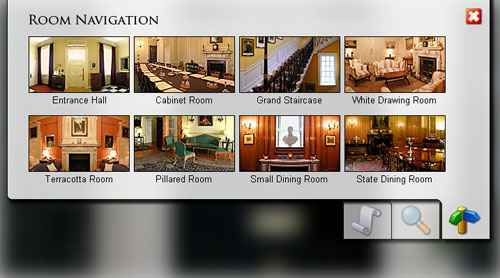
The BBC reports that London’s 10 Downing Street “has opened its famous front door to the public after more than 270 years, with a virtual tour for web users. Visitors can look at rooms, find out historical information and click on objects such as paintings and furniture for extra details. Tony Blair told the BBC the tour was ‘an excellent way of showing the tremendous history of this building’.”

[Image: 10 Downing Street, from the new virtual tour].

So I immediately thought of security risks: people casing the place to check for back doors, routes, cameras, blindspots. What to steal, whether it’s alarmed, where the nearest windows are. While all of that has no doubt been considered by the tour’s developers and their legion of security consultants, it would still be interesting to know how they did it, what specific steps were taken to deter possible burglars, terrorists, midnight visitors, and other unwanted guests. Were the truly expensive objects removed from display? Were surveillance cameras detached from the walls, and hidden?
Or, more architecturally, were whole internal stretches of the building somehow faked: some extra wainscoting and temporary wallpaper, all mounted on movable plasterboard, so that we, the unsuspecting public, never realize that the Prime Minister’s main study actually has two more doors… leading back to a series of rooms that aren’t in the tour at all – but that pop out and around to a dark corridor connected to the kitchen, through another door that’s been conveniently blocked with a refrigerator digitally added after the fact?
Who would know?
If it’s not uncommon for some governments to issue fake maps, or at least maps with whole cities missing – military bases left as empty mountain ranges, and so on – who’s to say a virtual tour of the ruler’s actual home would be any different?
From the BBC: “The tour’s developer, Aral Balkan, said: ‘I thought it was too interesting a project to pass up. Working on it has been very exciting and a great privilege. Downing Street is an extraordinary place and I hope to have captured a real sense of the history and importance that comes from going behind that door.'”

When the doors of the earth slam shut

[Image: Arenal Volcano, Costa Rica].

“Imagine if plate tectonics stopped tomorrow,” New Scientist suggests. A world without tectonics would be a world without earthquakes, the continents frozen in place, coastlines locked where they are. New mountains could never form, islands would stop emerging from the sea, and apartment insurance would be considerably cheaper.
While the end of tectonics is “not likely to happen any time soon,” the article reminds us, “a controversial new theory says it could [come to an end] in about 350 million years.” In fact, global tectonic activity may have ceased once before – “around 1.6 to 1.1 billion years ago, as a supercontinent called Rodinia formed.” At that point, “all plate tectonics could have ceased for 100 million years.” This caused the earth’s surface to thicken, forming “a large band of granites” that now “stretches across the northern hemisphere.”
But the internal roiling heat and liquid rock of the earth’s core and mantle gradually intensified, growing strong enough to punch through the earth’s rocky surface; this, kick-starting an era of volcanic eruption strong enough to break the continents apart, “would have got plate tectonics going again.”
The belts of the earth were soon turning; new mountains began to rise; island chains drifted, crashing into one another; coasts trembled from below as their guts turned to gravel.
And it all may happen again: according to Paul Silver, of the Carnegie Institution’s Department of Terrestrial Magnetism, the doors of the earth may slam shut in 350 million years, locking closed – perhaps initiating another one-hunded million years of terrestrial calm.

Architectural Sci-Fi

[Image: Steve Pike].

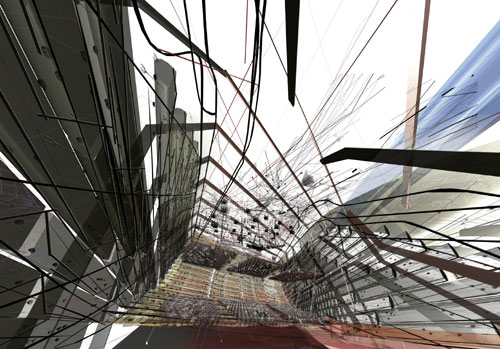
I picked up a few books yesterday at Hennessey + Ingalls, including a collection of student work from Unit 20 of the increasingly exciting Bartlett School of Architecture in London. The book is edited by Marcos Cruz and Salvador Pérez Arroyo, and its projects date from 1999-2002.
It’s also amazingly interesting.
I can’t find any links to it online, however, so I’ll just give you a random walk-through of the book’s contents…

[Image: James Foster].

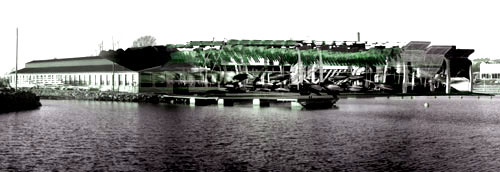
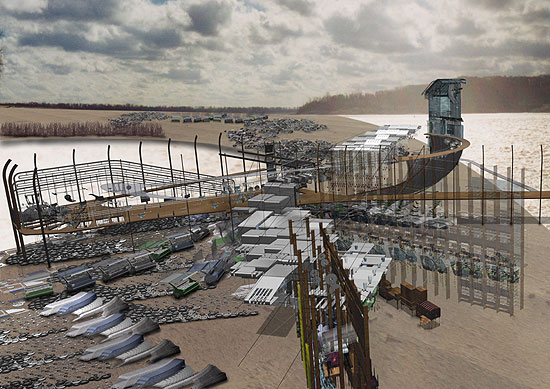
There’s James Foster’s “Inhabitable Growthscape,” a “series of incubators” which he constructed from vacuum-formed perspex and electronic circuitry; the system’s larger architectural applications are pictured above: it’s part boatyard, part aeroponic farm for the cultivation of “disease free cloned plants.”
There’s then a ten-page spread by Kevin Chu illustrating the industrial use of “clustering robots.” Chu describes a colony of “mining robots breeding on a lake in Helsinki,” as well as a cluster of similar robots “forming a silicon mining factory in Tenerife.” These are “small-scale insect-like robots which form a tactile and transformable surface,” although “the overall form alters according to the relocation of individual entities.” In other words, it’s an Artificially Intelligent swarm of robots transforming the surface of the earth into a quarry…
In fact, if I can interject something here, the book is a little preoccupied with insect shapes and machinery – to the point of looking like a deleted scene from Minority Report 2 – so I will say that architectural studios should be wary of turning themselves into machine-development classes; but that’s a minor complaint, and a larger discussion.

[Image: Lisa Silver].

We then turn to RIBA Award-winner Lisa Silver, whose architecture consists of “alien objects… fused, subverted and juxtaposed to form a unified whole.”
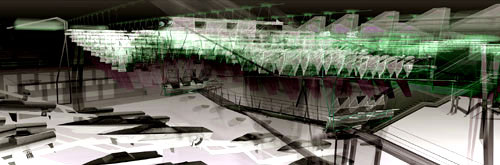
Specifically, Silver presents a space defined by “surfaces and meshes of varied transparency,” made from roof suspension systems and ramps. The result is a bricolage of car chassis and old farm implements, assembled on the banks of the Mississippi River.

[Image: Lisa Silver].

Tom Foster, then, proposes a “swarm of hyper crystallisation submersible robots” that will spend an entire winter underwater in the Gulf of Helsinki, “artificially enhancing the ice sheet from underneath.” This – referred to as “ice periphery management” – is done in the service of an “ice suburb” that “will exist [out on the ice] for 5 months of each year.” The ice sheet can be strengthened with “coolant filled reinforcement bars,” and the ice suburb will generate its own energy “from high winter winds and sea/ice movements.”
So you’ve got an entire sci-fi trilogy, economically compressed into a few renderings and photo captions.

[Image: Annika Schollin].

Returning to land, Annika Schollin writes about urban decay, abandoned buildings, and the formation of “micro-jungles within the urban structure.”
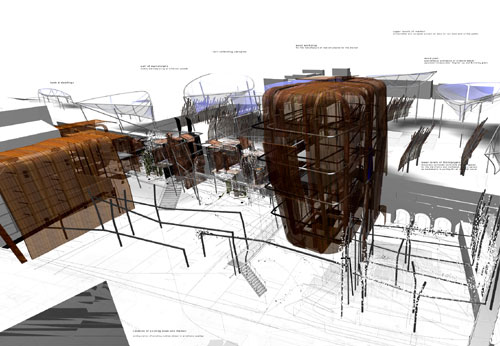
Concentrating specifically on London’s Brick Lane, Schollin describes how the unmaintained city is soon “reeking of rot and humidity.” Her project is a way of “[c]elebrating decay,” she explains, “as the organic inhabitants of the site begin to take over, weaving through, ambivalently undermining and reinforcing the built structure.” The actual architectural proposal appears to involve constructing a kind of permanent exoskeleton around the ruined markets of Brick Lane, complete with “water dispensing ducts” and a “hydro percolating roof.”
So – almost literally to repeat myself – architectural design becomes more and more like science fiction.

[Image: Annika Schollin].

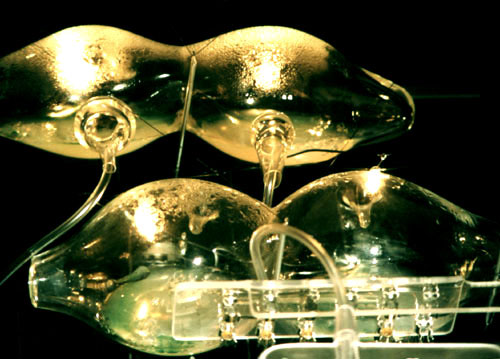
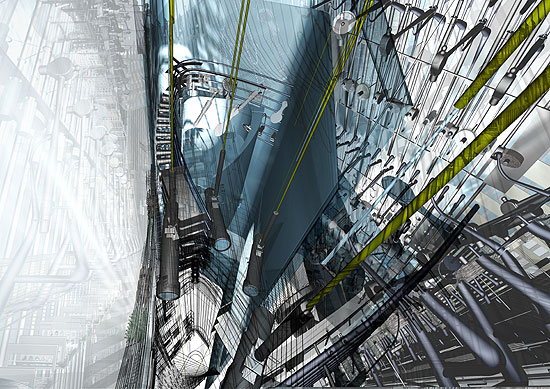
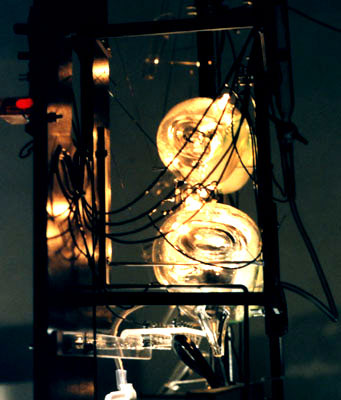
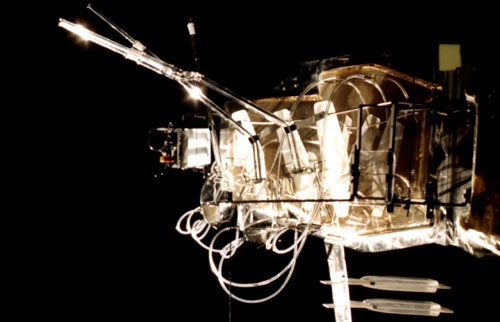
Other projects have a distinctly biological theme – including open bacteriological collaboration with the microbiology lab at University College London. Steve Pike, for instance, outlines an “algaetecture” of blown glass and high transparency acrylic. Inspired by the industrial manufacture of car windshields, these glass structures look simultaneously deformed, alchemic, and bio-anatomical.

[Images: Steve Pike’s “vitreous occupational chambers” and “monitor vessel support infrastructure”].

Pike explains how he built glass Interaction Vessels, Monitor Vessels, and Transformer Vessels, studying so-called algaetectural “parallels to human occupation.” He has an essay later in the book about contamination, the London Underground, and “non-sterile environments,” in which he proposes a catchment mechanism for airborne particles (the illustrations of which look like a scene from Alphaville).
I could go on and on here. I just think the ideas are great (excuse the enthusiasm, if this isn’t your thing).
For instance, there’s a project by Mark Mueckenheim called “London Urban Farming.” Mueckhenheim points out that the decline of farmland throughout the EU will necessitate “bring[ing] farming into the urban fabric.” He thus proposes a food processing plant “with a fish hatchery attached to its façade.”

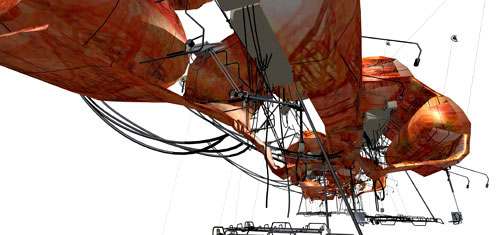
[Image: One of Mark Mueckenheim’s urban farms; again, note the insectile nature of student work produced for this unit].

The rest of the book confronts us with acoustic wind membranes; the city of Chicago as a kind of machine made out of retractable bridges; health clinics and sports research institutes; a hydroponic farm, by Stephen Clements, apparently modeled after the human nervous system; and even a Finnish fish farm, by Natalia Traverso Caruana, where “research labs and fish nets creat[e] a new luminous landscape” in the sea.

[Image: Natalia Traverso Caruana’s cultural HQ for Texaco].

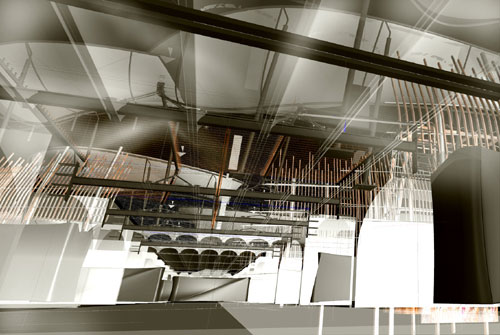
Caruana’s next project is a “cultural branch” for the headquarters of Texaco – it’s magnificently colored and practically leaps off the page.
There are strange photographic labs, and elevators that appear to analyze their passengers’ DNA. There’s even a plastic surgery lounge, or “Body Transformation” complex, proposed for Heathrow Airport, by Jia Lu (something tells me this will actually be constructed). Andy Shaw jumps in at the very end of the book with some robotic machine-space studies for “technical appliances based on the work of Eduardo Paolozzi.”
Etc. etc. etc.
In other words, I like the book. Unfortunately, it doesn’t appear to exist anywhere online, so you’ll just have to take my word for it – or you can visit the Bartlett’s various Unit 20 homepages.
Finally, my larger point in citing and describing so many of these projects is to demonstrate, in perhaps exhaustive detail, that some of today’s most imaginative artistic, technological, and even literary work is being produced in architectural studios. Whether you like their projects or not, in other words, architecture students are out-thinking, out-structuring, and out-performing novelists, hands down.
It is now architecture that lets us rethink the world anew.

The crisis of unspecified specificity

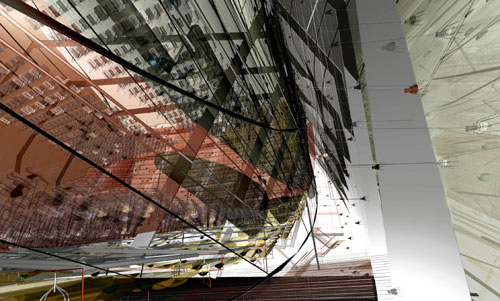
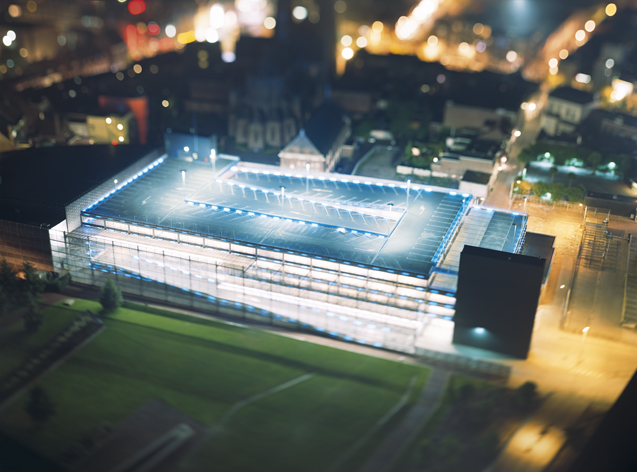
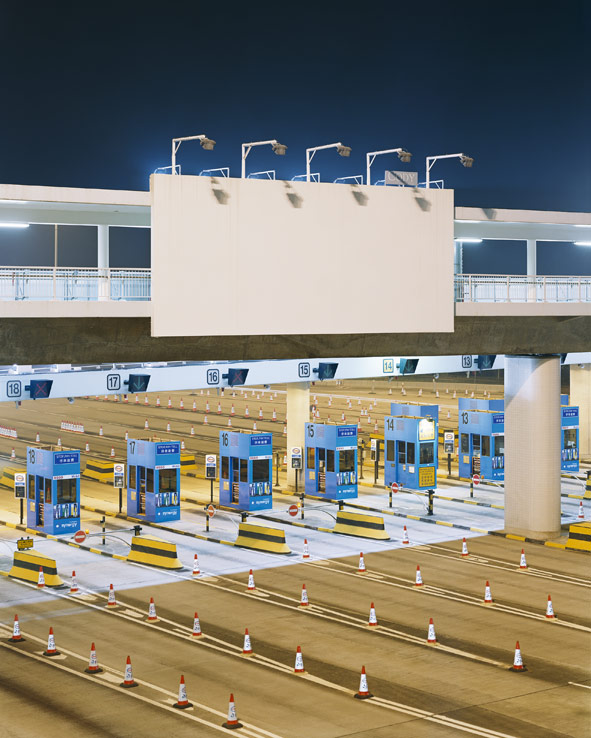
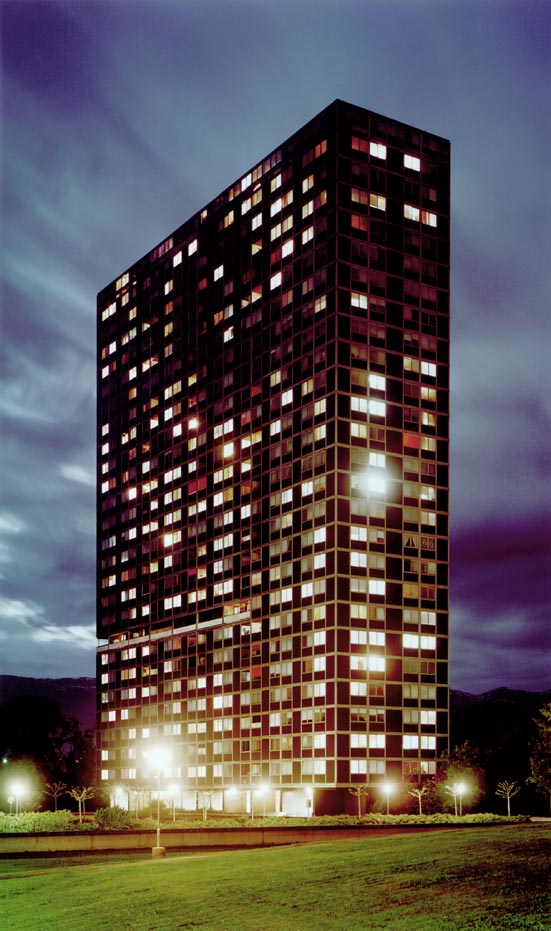
Photographer Frank van der Salm beautifully captures architecture on the edge of surreality: uninhabited and lit from within, it’s a world before its people arrive – or half a second after they’ve left.

[Images: ©Frank van der Salm. Sequence (2004) and Square (2006)].

Van der Salm’s work, according to critic Solange de Boer, “has been increasingly influenced since 1998 by other disciplines – ranging from the work of artists like Richard Long, Gerhard Richter and Andreas Gursky to the architecture of Renzo Piano.”
De Boer describes the “reality content” of these photos, and how that content “is undermined in various ways – by introducing movement in the image, by alternating focus and lack of focus, his use of color and the role played by light and artificial light.”

[Image: ©Frank van der Salm, Link (2004)].

However, as impressed as I am by Frank van der Salm’s work – and I am – I have to say that most of the essays re-published on his website are almost unreadable.
Art historians – and art critics, in general – are constantly moaning about there being some sort of crisis in whatever field it is they’re writing about – say, a remarkably well-funded New York photographer loses interest in her chosen subject matter and so becomes glum and sarcastic at cocktail parties, which gets all her other New York photographer friends depressed about the state of the industry, and so Artforum reports a “crisis” in contemporary portraiture – but the “crisis,” if it even exists (and it doesn’t – what was all that about fear-mongering in politics…? fake emergencies announced to receive more funding…?), is that it’s almost impossible to read about art anymore. He says, stoking the fires of fear.
Instead, an outdated vocabulary with no analytic or practical use gets combined with a weirdly unnecessary check-list of theorists and their books; and, all the while, the general public awareness of art in the world becomes limited to Apocalypto.
Which just means that someone at Yale will declare a “crisis in contemporary cinema,” and they’ll promptly be awarded a Mellon Fellowship. Thus armed, they spend a whole year outlining their new Horkheimerian approach to cultural discourse theory – which is a field they appear to have invented.
Only then to declare a crisis in it.

[Image: ©Frank van der Salm, Quarter (2002)].

In any case, while you’re on van der Salm’s website, reading about the “crisis in landscape” – which was experienced by approximately three people, I believe – click on “Artist,” then click on “Text,” then click on “Kopsa.” You’ll soon read that there’s “a kind of unspecified specificity” to Frank van der Salm’s photographs. Indeed, van der Salm’s imagery “relieves the specific” – which only “heightens the impact of the unspecified, the ‘artificial’, if you will.” Van der Salm “shows the specific and the unspecified at the same time, creating from the specific real a (new) unspecified, average.”
Apparently, Rosalind Krauss can even prove this.
Having said that, however, Frank van der Salm’s images are not “average in the dull sense of the word” – not at all: “they are just the opposite.”
And if you’re feeling confused while looking at these images, that is because “we see, recognize and understand” what they depict, but we “cannot accept” them. It even seems “as though we are being alienated by the sheer ‘logic’, by the sheer ‘neutrality’ of these banal images while our mind incessantly runs around in circles, wrapping itself up in the (to it) irrational equation specific + unspecific = artificial.”
I see.

[Image: ©Frank van der Salm, Loop (2005)].

(Frank van der Salm’s work first spotted at Conscientious).

Leaving empty space behind

[Image: From At This Rate, by Giles Revell and Matt Wiley].

Logging roads in tropical rainforests expose whole landscapes to disease, fire, drought, longterm human settlement, and uncontrolled future deforestation.
“Every second we lose an area the size of a football pitch,” Giles Revell and Matt Wiley write, describing the ecological motivation behind their new photographic series, At This Rate. “Every day we lose an area larger than all five boroughs of New York City… Every year we lose an area three times the size of Sri Lanka.”

[Image: From At This Rate, by Giles Revell and Matt Wiley].

Revell and Wiley produced At This Rate for a publication by the Rainforest Action Network; the project is “aimed at increasing awareness of the rapid destruction of our rainforests. If this destruction continues, half our remaining rainforests will be gone by 2025 and by 2060 there will be absolutely nothing left.”

[Images: From At This Rate, by Giles Revell and Matt Wiley].

However, what at first appear to be satellite images of obliterated rainforests are actually lone photographs of disintegrating leaves.
These “resemble maps of cities, emphasising the rate of deforestation,” fellow architecture blogger Kosmograd writes.

(Originally spotted at Kosmograd).

Yahoo! Picks of 2006

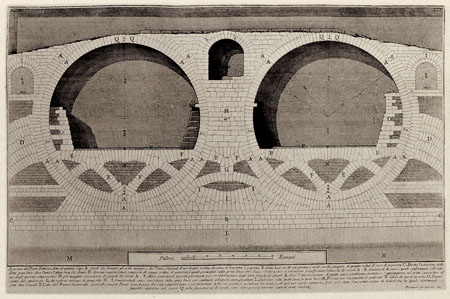
[Image: The interlocking circular network of compound arches beneath Rome’s Quattro Capi Bridge, engraved by G.B. Piranesi, patron saint of BLDGBLOG. Scanned from the insanely stimulating and highly recommended Complete Etchings].

If you’ll excuse a brief moment of celebratory self-reference, BLDGBLOG has just been named one of Yahoo’s top 25 Picks of the Year (right next to The Ricky Gervais Show, no less). So thank you, Yahoo!
And thanks to Alexander Trevi, as well, for pointing this out; don’t miss Alex’s own blog, Pruned – itself a former Pick of the Day.

Invent-a-Micronation: Contest Results

[Image: Utopia, one of the world’s most famous micronations, a speculative city of canals and well-ordered churchyards; via Wikipedia].

BLDGBLOG’s Invent-a-Micronation contest came to a fiery end last night, and there were some great entries. I’ve chosen a winner (revealed at the end of this post), but I’ve also decided to give brief rhetorical tours of several of the other ideas. So read on, micronationalists – and, in the process, remember to check out BLDGBLOG’s earlier interview with Simon Sellars, co-author of The Lonely Planet Guide to Micronations; be sure to buy a few copies of the book for everyone you know; and enjoy.
The micronational tour now begins…

• • •

Anne Ehrlich’s micronation would consist of “a bunch of people who want to live together, and display all their personal belongings on tables.” Specificity, after all, is the root of micronationalism. Everyone in Ehrlich’s world will sleep in “a giant mezzanine communal bed,” and there will be “no cupboards, drawers, wardrobes, safes, or other enclosing storage type devices.” The whole thing “would look quite a bit like the Vancouver flea market” (minus the communal bed).
Hannah Holden, meanwhile, suggests finding “an island locale, requiring no specific latitude.” The requirements of citizenship would include “lack of annoying and/or boring behaviour.” The micronation itself would achieve energy independence through “the use of wind, sun, and wave power,” which “will be exported if possible.”
Jesse Lewis emailed to describe the “Most Serene Republic of Anacanapana.” Anacanapana’s “territory is made up of Ephemeral Autonomous Regions – each EAR is a 5’5” radius encircling each citizen (this distance was chosen based on the height of the Eternal President).”
Thus, “as citizens move about, the territory of Anacanapana moves as well.”
Then there is Alphistia, submitted by Tony Skaggs. “At the moment,” Skaggs writes, Alphistia “does not claim territory, a house, or a condo… but it does exist. I created it when I was a 9 year old boy in Kentucky.” Alphistia even has its own newspaper, the Alphistian Times, as well as a capital city called Enteve.

[Image: A MetroTram map of Enteve, the capital of Alphistia; diagrammed by Johannes Bouchain, at his fascinating site Stadtkreation].

“Alphistia is a country in search of both land and people,” Skaggs tells us. “All the territory in the world is today claimed by nation states, although new countries have been formed or proclaimed in recent years, peacefully or not. Existing nations are jealous of their territory, no matter how small, but Alphistia would only come into existence by peaceful means. The challenges are great for a new-country project such as Alphistia, and this fact is acknowledged and accepted.”
Indeed, he concludes: “The creation of new land from the sea will also be explored as a solution.”
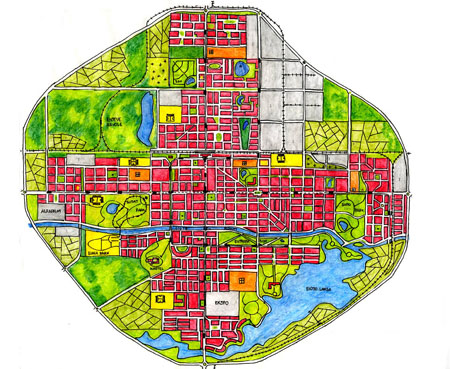
[Images: Enteve, the capital of Alphistia; the Alphistian postage stamp, printed by “a guy in Berlin who prints really professional looking stamps.” Map and stamp designed by Tony Skaggs].

Fellow Los Angeleno “Atom Debris” jumped in early with his Sovereign Dictatorship of MOB, “a nation whose territory consists of the body and personal property of M Otis Beard.” The state’s Constitution includes a provision that, should Dictator Beard ever find himself unconscious “for reasons other than normal sleep, my appointed medical personnel may rule as my Regents until such time as I regain consciousness.”
But who would stop them from secretly inducing a permanent coma…? A coma-d’état, as it were.
I was then quite pleased to receive an email from legendary link-smith cenoxo, who proposed an old Peter Sellers film – The Mouse That Roared – as the model for a future micronation: “Could there ever be a more capable triumvirate than Peter Sellers as Prime Minister, General, and Duchess?” cenoxo asks. His submission ends with a piece of cautionary advice “about snatching defeat from the jaws of victory: do not acquire any weapons of mass destruction that we happen to stumble across.”
Anamoglam, aka Dave Walen, suggests “[s]titching together the leftover ships of yesterday, to build the floating island of my shipwrecked maritime micronation”; this will be “Archigram meets Waterworld,” he writes. August Chesser instructed us to “[i]magine a great mass of yellow fluffy residences foaming up from the ground,” with “passageways framed by biological sculpture and petrochemical technology.” Along similarly imaginative lines, Hugo Bowne-Anderson mapped out a world of geological novelty, where “elements carve your continuous city out of the earthy crust” itself; and Eric Hunting suggested a micronation called Aquina, “an equatorial marine settlement on a pneumatically stabilized platform composed of nanofiber reinforced geopolymer cement.” Aquina would be constructed with “a flowing terraced structure akin to the mountain farms of Indonesia.”
And now we end with two of my favorites – one of whom is the winner.
An excellent and inspired idea, one that could very easily be developed into an entire series of animated films, came to us from Julian Smith. Smith’s “city-state of Flotsam (pop. 189) is built upon the back of a gargantuan giraffe named Twiga.”

[Image: Julian Smith].

“She walks the wide, open spaces of the world,” Smith explains, “from the Mongolian steppes to the Canadian tundra. The Flotsam aristocracy inhabit the marble domes and towers piled along Twiga’s spine, while the indentured servants are quartered in lighter, wooden structures that hang against her flanks like panniers. A funicular runs up her neck to her head, where the crow’s nest and cartographic lab are located. In Flotsam, maps are redrawn hourly as the landscape changes, with the city itself always at the centre.”
The winner, though, is Carl Douglas, a member of the so-called Barricades Commission, who sent in three fantastic images. “We have barricaded ourselves in a disused quarter of your city,” he writes. “Join us.”
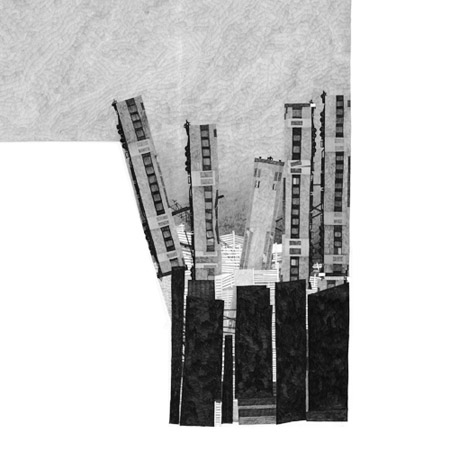
[Images: Carl Douglas].

Douglas proposed an urban micronation made of reclaimed and barricaded space; constructed from permanently borrowed architectural materials, it would take shape from the wreckage of a world it helps dismantle: “Liberate precast slabs! Gather beams and planks! Borrow bricks! Tear up your carpets! Upturn your vehicles! Fill gaps with shopping trolleys! Steal a crane!”
So congratulations, Carl – your free copy of The Lonely Planet Guide to Micronations should be on its way to you soon; and BLDGBLOG owes a huge thank you to everyone involved – if your micronations make any headway, be sure to keep in touch…

The Century Giant Lamp Tower

[Image: “No architect is credited with the design of the Century Giant Lamp Tower; a local art institute was asked to make a drawing that was then handed off to local experts to produce the renderings.” Courtesy Cui Chaoren/Guzhen Town/Metropolis].
The city of Guzhen, China, will soon be home to a “colossal 833-foot luminaire,” Metropolis reports. According to the building’s own promotional literature, it will be the “world’s only architecture shaped like a huge Western classical oil lamp.”
Indeed.
Metropolis points out that “the $38 million Century Giant Lamp Tower will stretch 430,560 square feet over 48 floors, with an immense glass chimney on which an array of images will be projected at night from inside. With an observation deck at its crown, the building has a base that will contain shops, restaurants, and a museum to document ‘humanity’s quest for light against darkness.'”
The idea was to design “a tangible icon that spoke of Guzhen as much as the Eiffel Tower spoke of Paris.” In that case, it may be helpful to know that Guzhen is “the lighting capital of China.” From Metropolis: “Just off Lighting Square is Guzhen’s main drag, Lighting Street, lined with more than a thousand showrooms. Every year the town hosts the China International Lighting Fair, one of the largest in the world. And in 1999 town officials announced plans to erect a lofty symbol of its native industry. What could be better than the world’s biggest lamp?”

By indirections

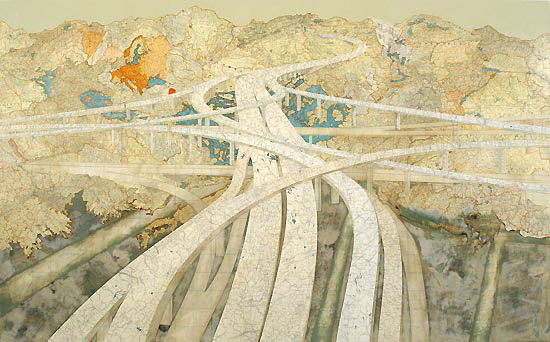
[Image: Matthew Cusick, The Course of Empire (Mixmaster II), 2006. Mixed media and maps on prepared panel; courtesy Lisa Dent Gallery. Photo by Wilfred J. Jones].

“Matthew Cusick’s maps lead nowhere,” Artkrush warns. His newest works depict “a series of Texas highways traversing allegorical landscapes” – a geography described by Cusick’s gallerist as “layered with animal migration paths, trading posts, and railroad depots.”
The above work, along with two other highway paintings, is on display now at the Lisa Dent Gallery in San Francisco.

Fault massage

A few days ago, Swiss engineers “halted an experiment to extract geothermal heat from deep below ground after it set off a small earthquake in the nearby city of Basel.” Nonchalantly described as a “mishap,” the earthquake “occurred after water was injected at high pressure into a five-km-deep (16,000-feet-deep) borehole.”

The idea that some earthquakes might have a human origin totally fascinates me. When it was suggested last year, for example, that Taipei 101, one of the tallest (and heaviest) buildings on earth, may have re-opened an old tectonic fault beneath Taiwan, what went otherwise unexplored was the possibility that some buildings might achieve the exact opposite: through sheer mass and fortuitous location, a building could perfectly weight a faultline… preventing it from rumbling again.

Think of it as a geological piano damper: a building—a whole city—that puts an end to earthquakes. (Yes, I’m aware of this film).

[Image: Los Angeles against the mountains; courtesy of SRTM Team NASA/JPL/NIMA].

Having recently moved to Los Angeles, I find myself thinking about earthquakes quite a lot; but I also find myself wondering if the surprising lack of seismic activity in the greater Los Angeles area over the past century has been precisely because of the amount of buildings out here. Is it possible that Los Angeles itself—this massive urban obesity—is a kind of anti-Taipei 101? In other words, it’s so massive and heavy that it has shut down the major tectonic faults running beneath the city?

For instance, I would love to discover that the Los Angeles freeway system performs a kind of constant seismic massage on local tectonic plates by spreading the tension outward. Specific bus lines, say—traveling north on Figueroa, or down La Brea, or west on Venice—have the totally unexpected effect of massaging local tension out of the earth.

Whole new classes of vehicle could come into existence; like hyper-industrial street-cleaners, these slow-rolling, anti-earthquake machines would drone through the twisting, fractal valleys of Hollywood, pressing strain out of the bedrock.

In fact, I’m reminded of David Ulin’s book The Myth of Solid Ground, where we meet a man named Donald Dowdy. Dowdy, who found himself under FBI investigation for taunting the United States Geological Survey with “a bizarre series of manifestos, postcards, rants, and hand-drawn maps, forecasting full-bore seismic apocalypse around an elusive, if biblical, theme,” also claimed that, “in the pattern of the L.A freeway system, there is an apparition of a dove whose presence serves to restrain ‘the forces of the San Andreas fault’.”

It’s absurd, of course—and yet I find myself wondering: if more and more people were to move to Los Angeles, and more and more buildings were to be constructed, perhaps we might hold the faults in place for a while—a decade, a century—before the earth regains the strength to break free.

(Meanwhile, be sure to check out my interview with David Ulin over at Archinect).

Wounded architectures shine

[Image: Bullet Lights, by Edwin Gardner].

Thanks to Bryan Finoki, I’ve discovered Bullet Lights, a proposal by Edwin Gardner.
Throughout Beirut, we read, there are uncountable thousands of bullet holes, small punctures in the walls of the city; these are architectural signs of “past violence, conflict and war.”
The idea behind Bullet Lights, then, is to reverse “the meaning and experience” of the city’s wounded walls by flooding them with light from within: the shells of old buildings, damaged by war, become chandeliers – Gardner’s “unexpected poetic moments of beauty.”
It is through damage that the buildings can shine.
There’s an old Coil song, called Titan Arch, that includes the line: “His wounds are shining” – which would be completely irrelevant to this post were it not for the fact that: 1) I’ve sometimes imagined scars – the healed remnants of wounding – as a kind of earthly astronomy, injurious constellations burning new white windows through the skin; and 2) that’s exactly what Gardner’s buildings would do for Beirut: they’re scarred, showing that the wounded have a brighter light within.

(Other trips through Beirut on BLDGBLOG: Future Beirut and beirut.bldg).