The First Million

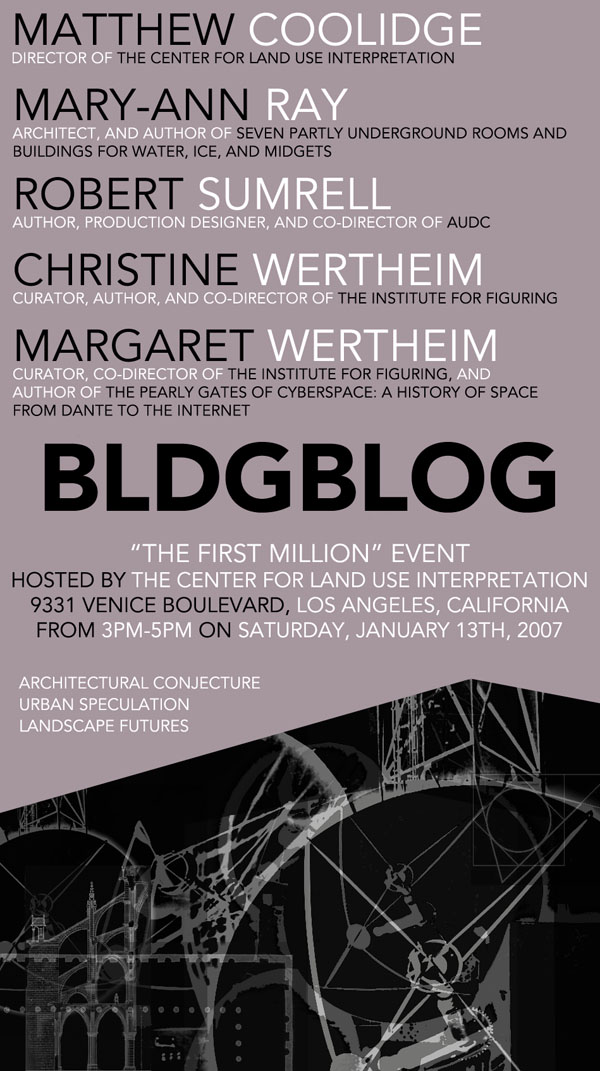
I’m immensely pleased to announce BLDGBLOG’s first event, on January 13th in Los Angeles, to be hosted by the Center for Land Use Interpretation.

The event is meant as a way to mark BLDGBLOG’s recent move to Los Angeles; to kick-start the new year in a conversationally exciting way; to celebrate being one of Yahoo’s top 25 web picks of 2006; and to meet a few of the one million readers who have now clicked through to read BLDGBLOG (some much-needed statistical caveats about that statement appear below) – and, thus, an event seemed like a good idea. It also just sounds fun.

So this Saturday, January 13th, from 3pm-5pm, at the Center for Land Use Interpretation in Culver City, Los Angeles, I’ll be introducing five speakers: Matthew Coolidge, Mary-Ann Ray, Robert Sumrell, Christine Wertheim, and Margaret Wertheim, who will speak for 15-20 minutes each.

Matthew Coolidge is Director of CLUI; as such, he’s one of the larger influences on BLDGBLOG, up there with J.G. Ballard, John McPhee, and Piranesi – so it’s immensely exciting for me to have him as a participant, and equally exciting that he and the CLUI staff are willing to host this event in their space. If you’re curious about CLUI’s work, consider purchasing their new book: Overlook: Exploring the Internal Fringes of America With the Center for Land Use Interpretation, or just stop by the Center at some point and say hello.

Back in 1997, then, I found myself in Rotterdam where I went to the Netherlands Architecture Institute several days in a row to use their architecture library; the NAi’s exhibit at the time was about Daniel Libeskind. While this proves that I’m possibly the world’s lamest backpacker, it also resulted in my stumbling across a copy of Mary-Ann Ray’s Seven Partly Underground Rooms and Buildings for Water, Ice, and Midgets, a book I highly recommend to just about anyone – and a book that may or may not even be responsible for my current interest in architecture.

So when I saw last week that Mary-Ann still lives in LA, and that her firm had actually worked on the facade of the Museum of Jurassic Technology – located right next door to the Center for Land Use Interpretation – I immediately gave her a call; and now she’s a speaker at the event.
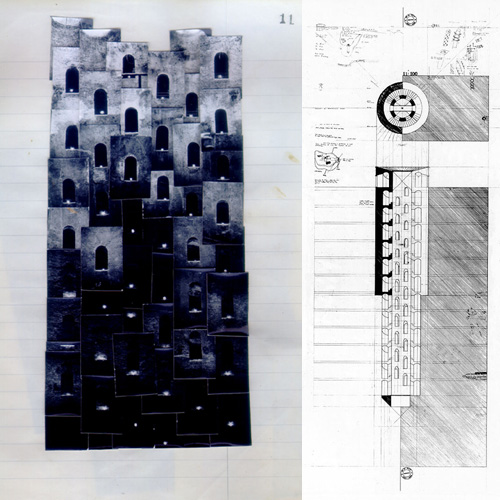
[Image: Mary-Ann Ray, from Seven Partly Underground Rooms and Buildings for Water, Ice, and Midgets].

Robert Sumrell, meanwhile, is co-director of AUDC. AUDC’s work explores the fields of diffuse urbanism and network geography, whether that means analyzing Muzak as a form of spatial augmentation or photo-documenting the town of Quartzsite, Arizona.

Interestingly, Sumrell also works as a production designer for elaborate fashion shoots and other high-gloss, celebrity spectacles. If you’re a fan of Usher, for instance, don’t miss Sumrell’s Portfolio 2; if you like topless women surrounded by veils of smoke, see his Portfolio 1. I like Portfolio 1.
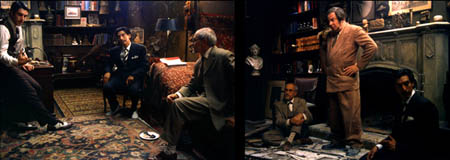
[Image: From Robert Sumrell’s Portfolio 4].

Then we come to Christine and Margaret Wertheim, co-directors of the Institute for Figuring, here in Los Angeles.

“The Institute’s interests,” they explain, “are twofold: the manifestation of figures in the world around us and the figurative technologies that humans have developed through the ages. From the physics of snowflakes and the hyperbolic geometry of sea slugs, to the mathematics of paper folding, the tiling patterns of Islamic mosaics and graphical models of the human mind, the Institute takes as its purview a complex ecology of figuring.”

Margaret will be presenting a hand-crocheted hyperbolic reef, “a woolly celebration of the intersection of higher geometry and feminine handicraft.” The reef is part craft object, part mathematical model in colored wool.

[Image: An example of “mega coral,” crocheted by Christine Wertheim].

Margaret is also an ace interviewer; don’t miss her conversation with Nicholas Gessler, for instance, collector of analogue computers. While you’re at it, don’t miss her “history of space from Dante to the internet”.

Meanwhile, Christine’s interests lie more in the realm of logic and its spatial representations. Christine has curated an upcoming show at the Museum of Jurassic Technology around the work of Shea Zellweger, an “outsider logician” and former hotel switchboard operator who developed a three-dimensional, internally rigorous representational system for logical processes.

Christine will thus be speaking on what could be called an illustrated spatial history of logic.
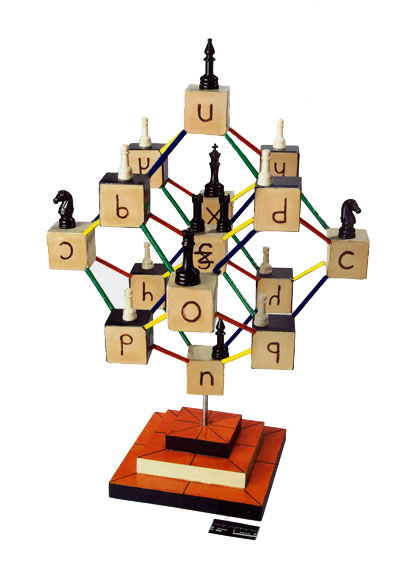
[Image: Part of Shea Zellweger’s logical alphabet; image courtesy of Shea Zellweger, via the Institute for Figuring].

Finally, the statistical caveats I mentioned above.

While it is true that my Sitemeter is now above one million – recording visitors to the site – it is also true that if you come to BLDGBLOG four times a week for a year, then you will be counted as 208 different people… So the accounting is a bit off.

Also, it is inarguably the case that at least 350,000 of those 1,000,000 visitors only visited one of the five following posts, which, thanks to Fark, Digg, MetaFilter, Boing Boing, etc., are overwhelmingly the most popular posts here: World’s largest diamond mine, Scientological Circles, The city as an avatar of itself, Transformer Houses, and Gazprom City.

Possible runners-up for that list – though those five really do take the cake – include, and I apologize for this blatantly self-indulgent yet strangely irresistible nostalgia trip: the interview with Simon Sellars, the interview with Simon Norfolk, the Aeneid-inspired look at offshore oil derricks, Chinese death vans, how to buy your own concrete utopia, Architectural Criticism, Where cathedrals go to die, the story of Joe Kittinger, London Topological, and L.A.’s high-tech world of traffic control. Actually, this one had a lot of readers, and the mud mosques were also quite popular…

But now I’ve wasted twenty minutes, assembling those links.

So I’ll link to others, instead. BLDGBLOG would still only be read by myself, my wife, and possibly two or three others if it hadn’t been for the early and/or ongoing enthusiasm of other websites who link in – including, but by no means limited to: Pruned, gravestmor, Archinect, things magazine, Inhabitat, Gridskipper, Boing Boing, Design Observer, Coudal, Artkrush, we make money not art, Subtopia, Ballardian, The Dirt, Apartment Therapy, Curbed LA and Curbed SF, City of Sound, Future Feeder, Archidose, Brand Avenue, Tropolism, hippoblog, Land+Living, Abstract Dynamics, Worldchanging, Warren Ellis, The Nonist, The Kircher Society, Conscientious, Centripetal Notion, and whoever it is that occasionally puts links to BLDGBLOG up on MetaFilter.

In any case, my final point is just to be honest and say that a million visitors is more like “a million visitors” – i.e. not quite a million visitors – and that, on top of that, many of those people only came through to see five or six particular posts in the first place. And that’s not even to mention the fact that many websites have more than a million visitors per month, and so the whole thing is not exactly awe-inspiring.

But who cares. If you’re in LA this weekend, consider dropping by; it’ll be a fun and casual event, not an academic conference, and you can tell me in person whether cone beats sphere.

(There’s also a full-size version of the event poster available).
Quick list 7

[Image: Mr. Housing Bubble; via Archis].

First, some landscape links:
“Mount St. Helens is drumming out a warning beat,” New Scientist reports. “Regular, repetitive earthquakes around the volcano are being triggered by the movements of a rock plug, reverberating in the neck of the volcano.” Incredibly, the plug is moving upward “at the rate of about 3 to 5 metres per day,” pushed from behind by “magma pressure” – which “could signal the build-up to some kind of eruption.”
On the other side of the world, meanwhile, Mt. Everest’s frozen peak is apparently sucking ozone out of the stratosphere; the ozone then cascades down the sides of the mountain in “katabatic winds,” or walls of cold air propelled downward by gravity. At its worst, these winds are “equivalent to mildly polluted city air and could pose respiratory problems” for climbers.
Sticking with New Scientist, we then learn that there are possible links between oxygen in the atmosphere and the pace of animal evolution – discovering, in yet another article, that too little oxygen can actually lead to Alzheimer’s disease.
In other words, it seems like non-senile humans are only possible on this planet within a very narrow range of oxygen saturation. So don’t forget to breathe.

[Image: Photo by Manfred Cage, via New Scientist].

Then there’s the ongoing possibility that we are already surrounded by thriving alien lifeforms – only we don’t know how to spot them.
“What if life elsewhere is different,” for instance, “based on an exotic alien anatomy and biochemistry?” Our planet could thus be teeming with organisms so alien that they don’t even appear to be alive.
This is a familiar topic on BLDGBLOG; see Unrecognized for what they are, or (the identically illustrated) Alien Planet.

[Image: Moon dust].

In other landscape news, scientists have developed artificial moon dust – a material otherwise referred to as a lunar simulant. The scientists simply “don’t have enough real moondust to go around,” we read, so manufacturing a replica was the only way to go; they’ve now “also begun work on more demanding simulants representing various locations on the Moon.”
Word has it, there is someone on the moon right now, building a small replica of the Earth… within which a small replica of the moon is under construction.
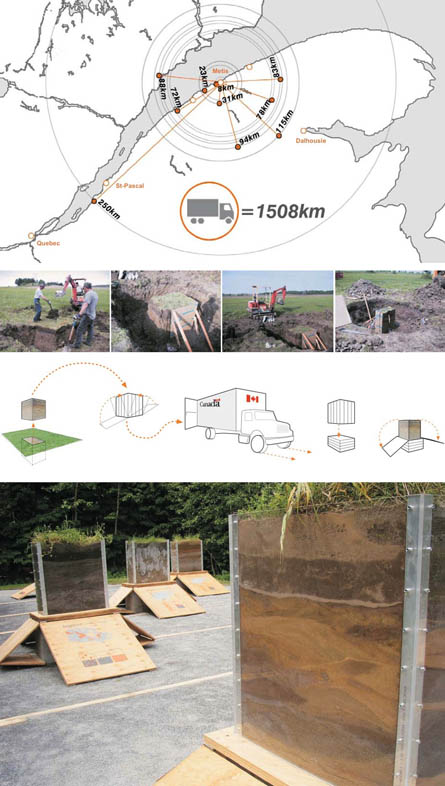
For some reason, though, the lunar simulant story reminds me of Lateral Architecture‘s “garden of soils” project – in which intact, three-dimensional samples of soil from throughout Québec were collected and publicly displayed in rectilinear containers, forming what look like colored chimneys of red and brown earth.
It’s the surface of the Earth, transformed into a readymade art object.

[Image: From Soil Horizon, 2005, by Mason White and Lola Shepherd of Lateral Architecture. This project is also featured in this book].

Meanwhile, don’t forget the “storm the size of a planet” now whirling its way across Saturn’s south pole, complete with “a well-defined wall of towering clouds ringing a dark eye.”
I continue to believe that the landscape architect of the future will somehow learn how to cultivate weather: microclimates and permanent storms hovering over desert gardens… A storm the size of a planet would simply be icing on the cake.

[Image: Polar auroras on Saturn, via Space.com; this is not the “storm the size of a planet,” on the other hand – I just like the picture].

Yet controlling the weather isn’t as far-fetched as it might sound. They’re already doing it in Beijing, for instance; and, here in California, the use of “hail cannons” appears to be on the rise.
The Ventura County Star describes how a “thunderous boom from a 20-foot cannon echoes over John Diepersloot’s apricot and peach orchards… breaking up hail stones before they can form.” Specifically, hail cannons, “which switch on when storms are approaching, are the latest high-tech device aimed at protecting crops from the volatile weather that hits California’s agricultural heartland, where a single hail storm or freeze can destroy a crop – and a local economy – overnight.”

[Image: A 19th-century hail cannon; see also that site’s look at Using Energy to Forcefully Alter the Weather].

Moving on to some urban and/or architectural links now:
It seems that “surveillance cameras in the city of Groningen have been adapted to listen out for voices raised in anger. Microphones attached to the cameras feed the sound signals to software that can detect voices that are aggressive in tone.”
Though this is supposed to “prevent fights breaking out,” it will probably: 1) do nothing of the sort; 2) have an unexpected deadening effect on conversations throughout the city: whereas two friends might once have passionately debated the literary merits of Jonathan Franzen, now they will just shrug defeatedly, break eye contact, and order more beer; or 3) 15-year old boys making loud farting noises will take over the streets at midnight.
Not to be deterred by such cynicism, the forces of surveillance have also developed a “device the size of a laptop that can see through walls.” This “will leave criminal suspects no place to hide from police or security forces.”

[Image: The Prism 200, courtesy of Cambridge Consultants].

The so-called Prism 200 system “uses radar to detect moving objects on the other side of a wall, and displays their position in three-dimensions on a built-in screen. It is sensitive enough to detect a person breathing,” we’re told.
Perhaps implying a future use for architectural design students, the Prism 200’s “through-wall radar” technology “can map an area in plan view, side view or in three dimensions.”
Meanwhile, Metropolis introduces us to “neighborhood intensification,” or “eco-density”:

Recently Portland and Vancouver established zoning and design guidelines to encourage the development of smaller houses, as long as they meet exacting design criteria. A new program in Vancouver that falls under the mayor’s overall policy of “eco-density” encourages the reconfiguration of lots in certain single-family districts. In Portland a new set of ordinances and guidelines seeks to promote “skinny houses,” intended to fit lots less than 36 feet wide.

[Image: An example of “neighborhood intensification,” or building smaller houses on smaller lots. Photo by John Morefield, courtesy of David Sarti, via Metropolis].

Speaking of the phrase “skinny houses,” articles continue to appear debating whether architecture can make you fat. The Guardian, for instance, reports that England’s Commission for Architecture and the Built Environment recommends that architects try “designing cities and housing that encourage exercise.” The reporter immediately sees “an image of a futuristic metropolis fitted with endless MC Escher stairwells and humiliatingly narrow doorways,” but the real solutions are much more obvious than that. Architects and urban planners can start by “incorporating cycle paths and pedestrian areas into their designs,” for example. “Parks and other green spaces encourage people to exercise, and if a shop is within walking distance, people are more likely to leave the car behind.” Etc.
All of which reminds me of a more or less unspoken theory about contemporary urban space: which is that we don’t need so many countless thousands of roads and parking lots in our cities because everyone drives a car; it’s that everyone drives a car because there are so many countless thousands of roads and parking lots in the way. You can’t get anywhere for all the parking lots surrounding you – and so you have to buy a car just to get out of there.
In any case, Inhabitat introduced us last month to a new high-rise project in Miami, designed by Chad Oppenheim. The building incorporates wind power into its very facade.

[Images: Building by Chad Oppenheim; images via Inhabitat].

As Inhabitat writes, the building works by “integrating green technologies including wind turbines, photovoltaic panels, and solar hot water generation” into its structure. The outer “exoskeleton” is really “a hyper-efficient structure that provides thermal mass for insulation, shade for residents, and architectural elements such as terraces and armatures that support turbines.”
It also looks good at sunset.

[Image: Building by Chad Oppenheim; image via Inhabitat].

However, this building also makes me wonder if the public’s negative reaction to wind farms might be different if we used more attractive windmills. In other words, instead of those free-standing, vertical helicopter blades – as most farms now use – why not try a sleek line of embedded turbines… a kind of Great Wall of Wind Power stretching across the landscape?

In the arches of bridges, turbines.
Finally, BLDGBLOG’s Sitemeter quietly ticked past the 1,000,000 visitors mark this past Friday; thanks to everyone who comes through now and again – hopefully it’s worth it. Expect more news about that soon.

(With some of these links supplied by none other than Alex Trevi).

The Geostationary Banana Over Texas

[Image: Screen-grab from the Geostationary Banana Over Texas homepage].

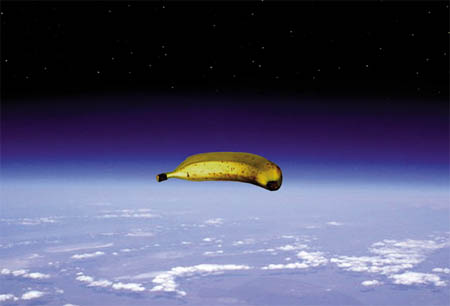
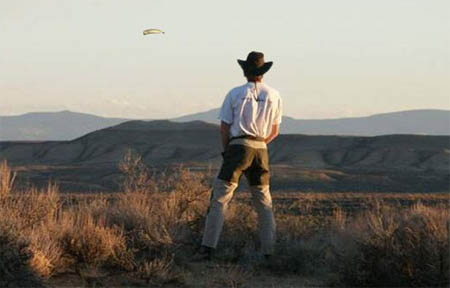
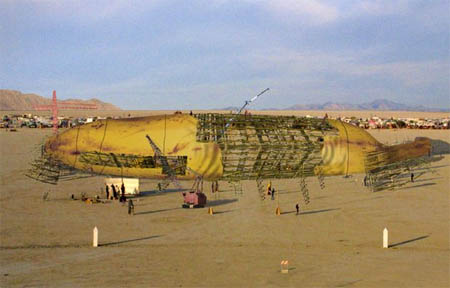
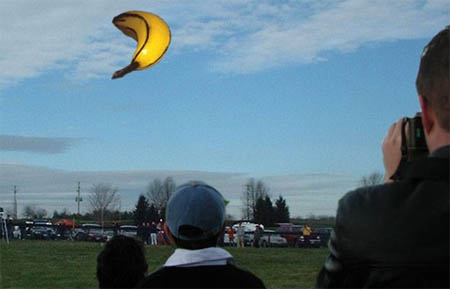
One of the funnier works of atmospheric installation art I’ve yet seen is the so-called Geostationary Banana Over Texas.
The project is described as “an art intervention placing a gigantic banana over the Texas sky.”

[Image: Another screen-grab from the Geostationary Banana Over Texas homepage].
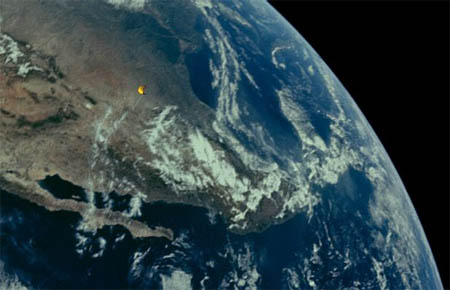
The banana, we read, “will float between the high atmosphere and Earth’s low orbit, being visible only from the state of Texas and its surroundings.” It will be 300m long, framed with bamboo, and filled with helium.
I’m 100% behind the idea.

[Images: More screen-grabs from the Geostationary Banana Over Texas homepage; the last image is particularly brilliant].

After all, the project’s organizers remind us, “a banana appearing in the Texas sky might seem like a ‘message’.”
Indeed.

(With a huge thanks to Michael Pace for the link! See also MetaFilter or Neatorama for more ).

Structuring the invisible

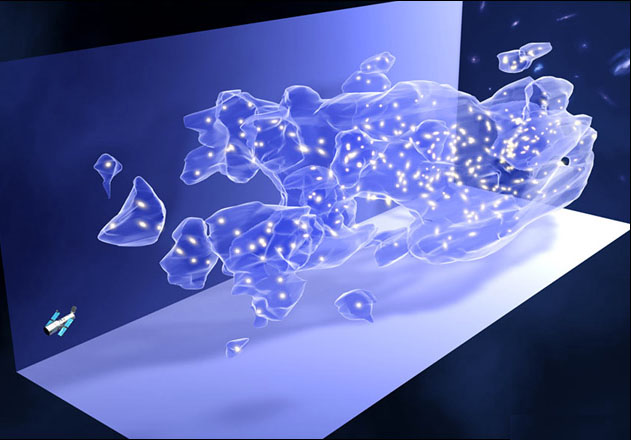
[Image: Courtesy of NASA/ESA/MASSEY, via the BBC].

“Astronomers have mapped the cosmic ‘scaffold’ of dark matter upon which stars and galaxies are assembled,” the BBC reports. Producing the map “involved nearly 1,000 hours of observations with the Hubble Space Telescope.” But it was time well-spent: the map now “confirms that galaxy clusters are located within clumps of this invisible material. These clumps are connected via bridges of dark matter called filaments. The clumps and filaments form a loose network – like a web.”
We are thus surrounded by structures of the invisible.
In an interesting analogy, we read that “the challenge of mapping the Universe has been described as similar to mapping a city from night-time aerial snapshots showing only street lights.” But now they have the actual physical layout of the streets – or something like that.
Having said all this, let me admit to an outsider’s sense that either 1) the astronomers are wrong: there is no dark matter; dark matter is just a calculational artifact of the current model used to represent universal space (and, thus, this map actually shows something else); or 2) they’re right about all of it – except the use of the word matter, which is referentially misleading; it is not matter at all.

(Earlier: See Filaments of space-time, where you can read about “huge arc-bubbles of light colliding with themselves in glowing, superskeletal networks, filling space like translucent caulk”).

Fictional ruins from fictional worlds

[Image: Science Building, London, England, 2003, by Carl Zimmerman. From Landmarks of Industrial Britain].

In two beautifully realized and conceptually fascinating projects, Canadian artist Carl Zimmerman creates “architectural utopias, fictional ruins from fictional worlds.”

[Image: Archives, Leeds, England, 2002, by Carl Zimmerman. From Landmarks of Industrial Britain].

Zimmerman’s Landmarks of Industrial Britain, for instance, is “a photographic series of fictional public buildings derived from small scale architectural maquettes.”
As the Art Gallery of Nova Scotia explains, the series “envisages a worker’s state in Britain at the time of the Industrial Revolution.”
Zimmerman himself writes that his work preys upon “the apparent willingness of the viewer to accept a fabricated past.” In the process, the lost industrial utopia he’s created – a false history convincingly rendered through the use of immense landscapes and architectural monumentalism – comes to look like a world designed entirely by Etienne-Louis Boullée.

[Image: Museum, Birmingham, England, 2002, by Carl Zimmerman. From Landmarks of Industrial Britain].

Zimmerman’s earlier series, Lost Hamilton Landmarks (referring to Hamilton, Ontario), apparently kicked off the artist’s ongoing interest in “Greek and Roman [architectural] prototypes.” This “neo-classical architectural language,” Zimmerman writes, attains much of its aesthetic power by “appealing to state authority and to instinctual desires for permanence and stability, security, sense of place, or even to the desire for the guidance of a parent.”

[Image: Mount Hamilton Sanatorium, 1995, by Carl Zimmerman. From Lost Hamilton Landmarks].

Zimmerman thus uses the authoritative language of neo-classical architecture to help convince his audience that these buildings once actually existed – and that they now stand ruined somewhere, cavernous, sublime, and empty.

[Images: Mausoleum, Woodlawn Cemetary, 1996, and Mount Hamilton Hospital, 1996, by Carl Zimmerman. From Lost Hamilton Landmarks].

After all, these are not real buildings.

[Image: Public Baths, Manchester, England, 2000, by Carl Zimmerman. From Landmarks of Industrial Britain].

Quoting the justifiably enthusiastic reviewer Meredith Dault at some length:

[Carl Zimmerman] makes photographs of imagined architectural spaces. He builds models, photographs them, and then digitally manipulates the photographs, creating vast, impossible spaces. Sepia-toned and laid out flat on tables in the gallery space, the photographs read, at first glance, like historical documents – they feel very much like 19th century architectural engravings – until you realize they can’t be because they’re all dated in the present. A closer look reveals that the buildings are set in huge, almost surreal, bleak landscapes – their titles want you to believe, however, that these buildings are plunked down in ordinary cities like Manchester and Leeds.

Zimmerman’s show at the Art Gallery of Nova Scotia appears to be over – but if it is still up, I would strongly recommend stopping by. Zimmerman’s models were on display alongside the photographs, and the exhibition sounds like it was well worth seeing.
What seems particularly interesting, to me, is that Zimmerman achieves a sense of near-total ruin, but he does so not through the depiction of structural collapse – he simply shows us grandiosity and silence.

[Image: War Memorial, Leeds, England, 2004, by Carl Zimmerman. From Landmarks of Industrial Britain].

If you’re feeling well-heeled, meanwhile, consider buying yourself some full-size prints of these images; you can do so at the frankly named buynewart. You can also see more deeply colored versions of Zimmerman’s work by visiting Toronto’s Stephen Bulger Gallery.

(Thanks, John Devlin! See also BLDGBLOG’s earlier look at the work of Oliver Boberg and Thomas Demand).

Moguls of air

[Image: Her Majesty’s Theatre, London; via Wikipedia].

“British composer Andrew Lloyd Webber warns that the auction of a wireless spectrum in London could doom music theater in the city’s West End,” Marketplace reports.
It’s an unintended musical side-effect of high-priced aerial real estate, or London’s property boom gone electromagnetic.
“Britain’s telecom regulator is to blame,” Webber says. “The regulator is planning to auction off to the highest bidder the airwaves used by theatres and concert venues. A cell phone company with deep pockets is likely to win. The fees could then soar and the theatres could be priced out.”
In the future, perhaps actors can simply schedule a wireless conference call with their intended audience…

Pamphlet Architecture 29 Awaits…

Princeton Architectural Press is still looking for the next installment in its Pamphlet Architecture series – which means they just might be looking for you.

“To promote and foster the development and circulation of architectural ideas,” they write, “Pamphlet Architecture is again offering an opportunity for architects, designers, theorists, urbanists, and landscape architects to publish their designs, manifestos, ideas, theories, ruminations, hopes, and insights for the future of the designed and built world. With far-ranging topics including the alphabet, algorithms, machines, and music, each Pamphlet is unique to the individual or group that authors it.”
They want ideas that possess “rigor and excitement,” with stimulating imagery and enthusiasm for the field.
However, you only have 13 days left in which to make your ideas both coherent and presentable – and you have to register.
And if you’re unfamiliar with the series, and need some examples of small, concentrated doses of architectural speculation, then let me point out this particular pamphlet, of which I am a long-term fan – although I lost my copy a few years ago – and I wrote about Tooling back in July.
If you still think you’re at a loss for ideas, you can always find the outer edges of a potential pamphlet just about anywhere: the San Francisco Sewer System Master Plan Project, for instance; or the gradual but complete depopulation of Venice; the Earth without people; the tomb of Agamemnon; the brick-lined subterranean world behind Niagara; a proposal for the exact and to-scale geotechnical recreation of the Mississippi River’s missing mountains; field results from your architectural experiments with Rogaine; some science-fictional extrapolations on London’s CTRL Project, complete with site visits and interviews; or even some Herculean, hydro-architectural taming of the North Pacific Gyre (you build a swimming pool around it, designed by FAT, then charge admission).
Etc. etc. – so get your brains firing, your fingers typing, and get published by Princeton.
And if any readers of BLDGBLOG win this thing, let me know.

Climbing Mt. Improbable

[Image: Matthew Putney, for the LA Times].

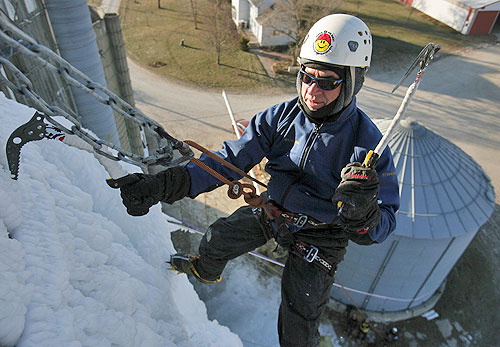
On the front page of the LA Times today, greeting the new year, is a story about a man with a plan in Iowa: “Surrounded by cornfields that stretch to the horizon,” we read, “in a place where molehills pass for mesas, avid outdoorsman Don Briggs has long dreamed of climbing a mountain. So he decided to build one.”

[Image: Matthew Putney, for the LA Times].

He’s not a geotechnical engineer, or some wildly charismatic salesman of earth-moving equipment; he’s just a man with a water hose and access to a few corn silos.
“Briggs spends most winter nights hosing down a quartet of grain silos on a friend’s farm – and relies on the Corn Belt’s frigid temperatures to transform the water into frozen walls of ice that tower nearly 70 feet straight up,” the LA Times writes.
“By the time he’s done, the ice encasing the outside of the silos is 4 feet thick in spots – and ready for the onslaught of ice climbers drawn to this strange marriage of farming and extreme sports.”

[Image: There would sometimes be “a heat wave,” Don Briggs told the LA Times, “when the temperature got up to 40 degrees or warmer, and all the ice would fall off the silos and we’d have to start all over.” Photo by Matthew Putney, for the LA Times].

The transformation of architectural structures into geological objects is something worth pursuing; in a way, it reminds me of a fairly minor pet peeve of mine, which is that people like Colin Farrell, or Lindsay Lohan, come out to Hollywood or move to Manhattan, and they make tens of millions of dollars… and they buy liquor with it. Or crystal meth and expensive dresses. Or whatever it is that River Phoenix did.
But when was the last time you heard about some hot young actor pocketing $20 million to star in a new Tony Scott film – then promptly disappearing into the plains of Iowa where he (or she) contracts out the multi-million dollar construction of a new mountain chain? Complete with manmade glacier?
Rather than buy Escalades, diamonds, and a few bottles of Courvoisier, in other words, why not compulsively build whole transparent cities of plexiglass, uninhabited in the mountains of central Idaho?
If you’re going to get addicted to something, make your addiction interesting.
Rather than donate all his money to Scientology, Tom Cruise funds the excavation of a spectacular series of show-caves, curling under the soil of Wisconsin. He sinks millions and millions of dollars into it, and dances on the couches of primetime news shows to sing the praises of subterranean topography.
Which is nothing compared to Robert Downey Jr., who is now rumored to have addicted himself to producing large-scale earthworks, made of polished obsidian, in eastern Washington state… He takes jobs in Uwe Boll films just to buy more rock…

(Thanks to N for the ice silo link!)

Inflationary Spaces of the Aero-Gothic Future

In the summer of 2005, a Swiss architecture firm called Instant designed an inflatable addition to the Berlin art space KW.

[Image: Courtesy of Instant].

According to I.D.‘s Michael Dumiak, the inflatable, “fiber-reinforced PVC foil” design served as “a temporary summer entrance to the museum’s bamboo garden,” complete with its own staircase and balcony.
The “surprisingly strong, see-through structure,” Dumiak explains, “consist[ed] of inflated stairs leading to an enclosure cantilevered over an 18th-century lane in the formerly communist east.”
It was an internal prosthesis for the building, in other words, a new interior that could be deflated and moved elsewhere.

[Image: Courtesy of Instant].

To function properly, and to support the weight of museum visitors, the project used an inflatable variant on structural tensegrity, a concept first developed by sculptor Kenneth Snelson with the input of Buckminster Fuller.
From I.D.: “By attaching two spiral tension cables beneath the weakest part of a strut, and connecting the parts to an air-inflated shell, [Instant’s project engineer Mauro Pedretti] found he could use thin and light – even transparent – materials and still carry heavy loads. One inflatable demo structure supports a light truck.”

[Image: Two renderings of the project, courtesy of Instant].

“Unfortunately,” we read, in Instant‘s own project recap, “the structure was rigid enough to withstand the loads but not its aggressive social urban context. As much as it was successful as a catalyst during the day, it was repeatedly vandalized during the night.”
You can see films of the structure, both real and rendered, on Instant’s website (click on “Detail,” then go to “ON_AIR”).
When I first saw the project, however, flipping through back issues of I.D. last night, I initially misunderstood it as being an entire museum addition, of perhaps indefinite duration – alas, it was a temporary installation, now long gone.
While thus deluded, though, I found myself imagining what might happen if you could design inflatable additions to suburban houses: your in-laws come to visit, or your weird and apparently unemployed uncle who doesn’t really talk to anyone stops by, but there’s literally no room for them inside the house. No worries: the smiling matron of this lucky household pops open some hinges on the back French doors and voilà: the house’s central air-conditioning doubles as an air pump, and you all watch in pleased awe as a twin house, identical in all respects to the one you’re now standing in, takes bloated shape in the lawn behind you. Even your uncle manages to say he’s impressed.
Whole suburbs of inflatable houses!
So I imagined a new chapter for Italo Calvino’s Invisible Cities, in which our untrustworthy narrator is taken out into the gardens of the king – whose courtiers proceed to inflate an entire palace, over a half-dozen acres, full of flamingos and orchids, unrolling in the summer heat. A thousand rooms. Turrets and hallways.
Somewhere in the midst of all that is the chamber you’ll be staying in…
Which reminded me of Tobias Hill’s novel The Cryptographer, in which an ultra-rich Bill Gates-figure purchases literally an entire borough of London, walling it off and transforming it into a private homestead (an agonizingly brilliant set-up for a book, although the story itself falls flat) – at which point I thought: you could inflate an entire borough that has never otherwise existed, sprawling across the marshy floodplains of SE London.
Call it Hackney 2, or Stoke Airington.
It’s one seamless piece of fiber-reinforced PVC foil. It looks like a huge plastic bag lying across the landscape – until the fans kick in. Two days later there’s a whole new city, complete with streets and traffic lights built into the plastic. The lamps have shades, the windows shutters. It’s a Gesamtkunstwerk so total it would make Mies van der Rohe panic.
To pay the investors back, you hire it out as a film set and produce award-winning mobile phone commercials there. Or strangely elaborate pornos, using transparent sets, described as “artistically stunning.”

[Image: Courtesy of Instant].

Finally, I came back to Instant and their inflatable design for KW.
What if it had been slimmer and less bulky, for instance, taking up less space inside the museum – and, in a way, more ambitious, with better funding? In other words, what if you could show up at KW with a bunch of air pumps and a different design, and – after clearing the building – you’d inflate a whole new interior, perfectly matched to the architectural plan, subdividing galleries, adding stairways and lofted office space?
You come back a day later and twist a valve, blocking air from entering one room – and so another room unfolds somewhere deeper in the structure. Which, in turn, causes a corridor to inflate, leading onward to another room – where you have a choice: you can either open a valve and inflate the rest of the ground plan, or you can leave the valve closed, and thus a four-story tower of inflated rooms will gradually lift itself above the courtyard…
Leading me to wonder if there’s some Hindu myth, or an obscure Upanishad, in which a multi-lunged god of air parades his wizardry of inflated worlds to stunned worshippers – or if there was a Christian heresy, from medieval Spain, in which the breath of God, a holy spirit animating base flesh, became interpreted as God, Inflationist, Lord of Balloons.
Had the heresy survived, a new breed of cathedrals would now dot the European landscape, supported by inflatable buttresses – inaugurating the Aero-Gothic. Aero-Romanesque. Aero-Baroque.

(To see how easy some of this could really be, take a long stroll through we make money not art‘s inflatable projects archive).

2006: The Year in Construction

Engineering News-Record has released its “Images of the Year” – and some of them are really fantastic.

[Image: Merle Prosofsky, Edmonton, Canada; “Backlighting diffused by early-morning fog dramatizes the beginning of the five-hour erection of a 310-tonne vacuum distillation tower. The 37-meter-long, 8.5-m-diameter tower will extract oil for OPTI Nexen’s $3.6-billion Long Lake steam-assisted gravity drainage project from northern Alberta’s oil sands.” Via ENR].

[Image: Timothy J. Gattie, Boise, ID; “The $330-million Otay River Bridge in Chula Vista, Calif. rises into the morning mist. ‘As the sun peeked through the fog, I couldn’t make out the bridge,’ says Gattie, area engineer for Washington Group. ‘So I put the sun behind the columns, and the picture came out.'” Via ENR].

[Image: Leah C. Palmer; “The scaffolded ‘village green’ of the recently completed St. Coletta School charter school in Washington, D.C., felt like the belly of the beast to Palmer… Palmer, who studied architecture, is fascinated by the framework of buildings.” Via ENR].

[Image: Brian Fulcher, Walnut, CA; “A tunnel construction enthusiast, Fulcher took this shot of workers on the Gotthard Base Tunnel, Sedrun, Switzerland, a Bilfinger Berger-led joint venture. The crew is installing steel support ribs which, with the shotcrete applied to the tunnel’s forward wall, prevent collapse. This portion of the tunnel was bored through ‘squeezing ground, which pushes in on the tunnel walls,’ Fulcher says. ‘It’s very dangerous work.'” Via ENR].

I’ve only uploaded four of my favorites; go to ENR for two dozen or so that I didn’t choose. Many of the images are like photographic updates of Fernand Léger and his Constructors, including this bizarre sky bicycle, or these two guys with their roped bottles of water.

All rights belong to the photographers credited above.

Mies van der Rogaine

I was thinking today about performance art pieces involving architecture, and I thought maybe someday there should be a man who travels around the world, visiting cities and jungles and deserts and islands – and it’s all so he can take Flomax inside famous architectural structures.

[Image: A bunch of pills, via the European School of Oncology].

It’s the new art of pharmaco-architourism.
Similarly, I was speaking to someone a few weeks ago about “gonzo” architectural journalism, and how most people seem to think that just means getting high before interviewing Rem Koolhaas, or taking hallucinogens, or a cannabinoid, etc., and then off you go on a plane to Dubai – but who’s to say a building would be any less interesting if you experienced it all jacked up on prescription diuretics? Or high on Cialis, for that matter? Every church in Rome, visited in a libidinal haze – surely some interesting journalism would result? You could sign yourself “The Cialisian.” Soon, you’ve got a monthly column in Vanity Fair.
For Christmas, you receive a specially tailored set of loose trousers.
Or you cover your head with a spot of Rogaine foam inside every building Mies van der Rohe ever designed – except, by the end of the piece, your hair is so long you’re actually refused entrance to Berlin’s National Gallery. Your book would be an instant, if controversial, bestseller.
It would be called Mies van der Rogaine.
Or you take heroic quantities of Prilosec in buildings built before 1500AD, and you pitch the resulting articles to Archinect. Pop some Adderall and plow through the High Gothic monuments of Europe, publishing your research in The New York Times.
The next year it’s Lipitor, or Effexor, or a whole rucksack full of Brovana inhalers, as you write about anything built by Le Corbusier.
Because then, of course, there’s Clozaril, for your upcoming feature on Gaudí…