Seeing the forest for the tree

Lawrence Weschler’s Convergence of Convergences Contest over at McSweeney’s revisits the above photo of a clear-cut forest in Sweden – where the void left behind by logging has visually reproduced the very thing that void destroyed. The return of the repressed, indeed…

(Image of Swedish forest originally submitted to McSweeney’s by Walter Murch).

Planet Bleach

Back in August, New Scientist reported that the landscape of Mars might be sterile due to the presence of hydrogen peroxide. The planet is bleaching itself, in other words, on a near-continual basis.

[Image: Via New Scientist].

Specifically, we read, “large amounts of hydrogen peroxide could be produced on Mars as a result of wind-blown dust grains rubbing together.” Because of these interactions – and the resultant electrochemical effects – hydrogen peroxide, “a harsh chemical used as a disinfectant on Earth may rain down on the surface” of the planet. “This process is similar to the way snow forms from water vapour in Earth’s atmosphere, ” we read. “However, the hydrogen peroxide falling on Mars would be in the form of microscopic grains.”
I find this image – the chemical snow of alien planets – quite striking.
Meanwhile, similar electrochemical conditions have been found in Chile’s Atacama Desert, where “photochemistry triggered by the region’s harsh sunlight plays an important role in creating these electric fields” – electric fields, generated in the region’s dusty soil, that produce trace amounts of hydrogen peroxide.

To eavesdrop on breaking glaciers from within

The New York Times reports on “a newly revealed island 400 miles north of the Arctic Circle in eastern Greenland.”

[Image: Jeff Shea/New York Times].

“Despite its remote location,” the Times explains, “the island would almost certainly have been discovered, named and mapped almost a century ago when explorers like Jean-Baptiste Charcot and Philippe, Duke of Orléans, charted these coastlines” – except that, until recently, the island was “bound to the coast by glacial ice.”
In other words, climate change – melting ice and rising sea levels – has turned a peninsula into an island.

[Image: Map of Greenland, courtesy of the New York Times].

“With 27,555 miles of coastline and thousands of fjords, inlets, bays and straits,” we read, “Greenland has always been hard to map. Now its geography is becoming obsolete almost as soon as new maps are created.” I’m tempted to say that that last sentence should be reversed, however: that the maps are becoming obsolete as soon as new geography is created.
For instance, there are the nunataks – or lonely mountains, in Inuit – which stick out from beneath the matrix of glacial ice. These features are now “being freed of their age-old bonds, exposing a new chain of islands, and a new opportunity for Arctic explorers to write their names on the landscape.”

[Image: The mountains of eastern Greenland: a future archipelago. Via Wikipedia].

From the New York Times:

“We are already in a new era of geography,” said the Arctic explorer Will Steger. “This phenomenon – of an island all of a sudden appearing out of nowhere and the ice melting around it – is a real common phenomenon now.” In August, Mr. Steger discovered his own new island off the coast of the Norwegian island of Svalbard, high in the polar basin. Glaciers that had surrounded it when his ship passed through only two years earlier were gone this year, leaving only a small island alone in the open ocean.

That image, of course, is both horrific and exhilarating – literally sublime: the discovery of terra nova, right here on a planet that once seemed topographically claimed. Surely our era is due for a new Jules Verne?
Meanwhile, as Arctic temperatures continue to rise, and as the Greenlandic ice cap continues to liquefy, we’ll see more and more spectacular – if catastrophic – shifts in global geography. (Whole new continents!)
And this won’t be limited to the Arctic: “Over the long term,” we read, “much larger sea-level rises would render the world’s coastlines unrecognizable, creating a whole new series of islands.”

[Image: Greenland’s thawing landscape; photo by Jeff Shea/New York Times].

In any case, I was fascinated to learn that “summertime ‘glacial earthquakes’ have been detected within the ice sheet” of Greenland. I can hardly imagine such a strange and haunting sound – like bells shattering – of pure ice heaving beneath your feet, as mile after mile of blue caves and tunnels shift their chambers to realign.
Is it possible, then, to drill contact microphones into the surface of Greenland and listen to this terrestrial baritone, the earth a reverberatory, to eavesdrop on breaking glaciers from within?

(With the use of the word “reverberatory” indebted to John Coulthart. Earlier on BLDGBLOG: Nova Arctica and When landscapes sing: or, London Instrument).

Architecture as a form of deliberate paranoia

I once knew someone who owned a drum machine on which he had been, he claimed, programming extraordinary amounts of really great music. Being naive to the thieving ways of the world, however, this friend – or aquaintance, really, from Canada – in fact the best friend of the fiancé of my girlfriend’s sister – came home one day to find that his drum machine had been stolen.

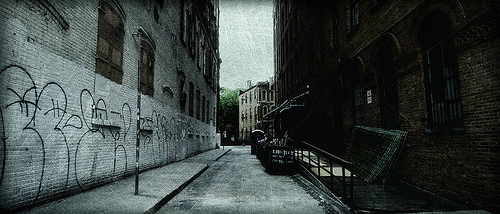
[Image: From Keith Kin Yan’s Overshadowed, a site – and photographer – previously discussed here].

This act of musical thievery propelled him into a state of unremitting paranoia so intense, and so interesting, that I still think about it, nearly fifteen years later.
What happened was that every time he went out to hear music – mostly at raves in New York City – he claimed that, at some point in the night, he had heard one of his own songs. Flagrantly stolen from his own stolen drum machine, then inscribed to vinyl – only to be spun, live, to the dancing masses – his music popped up at least once every few hours.
Wide-eyed, emotional, convincing: there he was, in front of us, the people who hung out with him, explaining that this song was his.
Of course, I mention all this because I wonder what the architectural equivalent would be.
Perhaps a man, or woman, who spends all of his or her time sketching strange buildings – detailing elevators that lead to elevators and hotel rooms that interconnect to secret swimming pools in which hundreds of people sit, talking – finds that his (or her) sketchbook has been stolen.
Fifteen years later, then, this person is on vacation with friends – but the hotel they’ve chosen looks awfully familiar.
Too familiar.
It’s his building.
“I designed this goddamn thing!” he screams, rattling door handles and staring through rotating glass doors at the swimming pool. He’s sweating, veins visible, pulsing on his forehead. Everyone takes a step back. Is my cell phone charged? one thinks. Should I call 911?
“This is my hotel!” the man screams, kicking over an ice bucket.
He gets so loud his friends start to panic, eventually punching him in the face, hoping it will knock him out; it doesn’t work.
The police arrive.
Our architectural sketcher is immediately arrested. He is strapped face-down to a table and injected with horse tranquilizers.
But the thing is: he’s right. He really did design that hotel. It really did come out of his sketchbook. That swimming pool really was his idea.
Even worse: so was the building across the street – a building he’s about to see when the police release him from custody.
And those buildings downtown? He designed them, too.
He designed this whole city, see: he sketched the whole thing in his now lost book.
Except he’s the only one who knows it. Not a single one of his friends believes him. In fact, people make fun of him, call him “Charles Manson” and point out the window at different buildings as if to antagonize him. “Did you design that, too?” Everyone giggles.
Soon, old friends are writing blog entries about him.
To escape the madness, the man moves to a new city, packing his bags and buying a dog – only to realize that everything about even that new city was all his idea.

(Perhaps coming soon: Sketchbook, starring Christian Bale).

Copenacre Quarry

[Images: Two shots of Copenacre Quarry, via Nick McCamley’s Secret Underground Cities site].
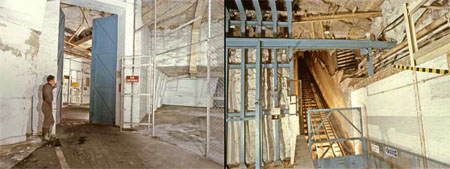
Last night I came across a review of the album Copenacre, by C4I, in an old back issue of The Wire.
Apparently inspired by Nick McCamley’s legendary book Secret Underground Cities, the musicians behind Copenacre tried “to evoke the dead air and constant low level hum of Copenacre Quarry‘s now abandoned navy testing and storage facility” in England.
In other words, it’s the soundtrack for an underground city.

[Images: Two more shots of Copenacre Quarry, via Nick McCamley’s Secret Underground Cities site].

“It’s not easy to understand the sonic appeal of these places,” The Wire continues, “until you’ve actually visited one.” On the CD, we read, strange sounds “flash through tunnels and massive steel doors clang and lock to disconcerting effect.”
Here are two examples: MP3 1. MP3 2.
Both of those excerpts, however, remind me of the early work of Lustmord, the nom de musique of LA-based sound designer Brian Williams. Lustmord’s discography became somewhat notorious in the early 1990s for, among other things, having been partially recorded inside abandoned mines, in the crypts of churches, and inside caves and cellars. The resulting, planet-shaking resonance and sub-bass could often put listeners’ headphones out of commission.
On an almost ridiculously great CD called The Place Where The Black Stars Hang, Williams achieves a similar effect – but he gets rid of the caves and architecture. Instead, we plunge headfirst into nearly an hour and twenty minutes of machinic astronomy; we rumble and drone inside with what sounds like a WWII airplane buzzing through deep space, recording the slow magnetic death of stars.
Gigantic radar systems bounce and reflect off nothing.
Needless to say, it’s not for everyone.

(See also BLDGBLOG’s look at Subterranean bunker-cities).

Yesterday in L.A.

Just a quick note of thanks to everyone who came out yesterday – and an apology to those who showed up but couldn’t get in. I really had no idea the crowd would be as big as it was, and it seems a good 50 or 60 people were left standing outside on the sidewalk! But for those of you who did get in, and who sat through two hours of tightly-packed darkness, I hope you saw some cool things, had a good time, and enjoyed the presentations.
So I just wanted to say thanks; I had a great time, and I’m already looking forward to the next event. Thank you especially to Matthew Coolidge, Steve Rowell, and Sarah Simons of the Center for Land Use Interpretation, both for lending their space and for helping set-up for the event; to Mary-Ann Ray; to Robert Sumrell; to Christine Wertheim; and to Margaret Wertheim; and last, but not least, to my wife, for helping me put everything together.
More soon.

Urban Design Review

I’m pleased to announce that the Summer 2006 issue of the Urban Design Review has been released; it’s also the first issue for which I served as Senior Editor. There will be many more to come.

The issue includes some fantastic work. You’ll find an amusing – and much-needed – analysis of New York Times Magazine real estate ads, written by Brand Avenue‘s own Chris Timmerman; Charles Jencks’s Iconic Building is reviewed by Michiel van Raaij, the latter being one of today’s most uncannily sharp-eyed critics of iconic architecture (van Raaij’s blog is worth a long visit); David Haskell gives us an essayistic look at urban event places, reviewing architectural attempts “to make the city a perpetual festival”; and, among many other texts – including short interviews with both Charles Jencks and Mike Davis – you’ll find an interview with Jinhee Park and John Hong of SINGLE speed DESIGN. SsD is now justifiably famous for their work on the ingenious – and beautifully inspiring – Big Dig House, a single-family home built from old Boston highway parts. The Big Dig House was reviewed three days ago in USA Today.
From SsD‘s own description of the project:

As a prototype for future Big Dig architecture, the structural system for this house is almost wholly comprised of steel and concrete from Boston’s Big Dig, utilizing over 600,000 lbs of recycled materials. Although similar to a pre-fab system, the project demonstrates that subtle, complex spatial arrangements can still be designed and customized from pieces of the I-93 offramps: Varying exterior and interior planes create an ascending relationship from ground to roof as large upper-level plantings blur interior and exterior relationships.

Houses built from highways.
The Urban Design Review is now all set to expand, through events and publications both, and it is always looking for more interested readers and writers; a forthcoming issue, in fact, is already in the works. It’s not BLDGBLOG in paper form, however, but something much better: a sustained look at the built environment, on a global level, using reviews of texts and exhibitions, open dialogues between practitioners in the field, and essays by theorists, students, professors, artists, and so on.
UDR is published by David Haskell’s Forum for Urban Design. (David is also Founder and Editor-in-Chief of Topic Magazine).
So check it out.

On the geotechnical invasion of paradise

It’s too small to see clearly, but you’re looking at an ad for Komatsu in which the entire top of a mountain has been sheared clean off.
The tagline? “Call the experts for any challenge.”

And there they are, driving away in yellow earth-moving equipment – mobile crushers, vibratory rollers, and minimal swing radius excavators – if you look carefully at the left side of the advertisement.
In a press release on their site, Komatsu writes how “[n]ew ways to develop hard terrain – sandstone, lava rock and basalt – had to be learned once the easily developed land was taken. As a result,” they write, “contractors are facing great challenges.”
Including, it seems, the obliteration of whole mountain peaks
Not ones to be intimidated by geology, however, Komatsu arrives with their “advanced land development practices” – “the absolute top” of the industry, they say – and their “world-class machines,” whose “powerful dozing and ripping force” puts the surface of the earth back in its place: as something we will build more suburbs on.
In any case, I’m tempted to propose the plot of some new, geotechnically futuristic version of Paradise Lost – perhaps the world’s first book about the geological invasion of Heaven (in which “devilish enginery” has been assembled inside a “hollow cube,” whilst an army of demons “turn[s] wide the celestial soil” to unleash “sulphurous and nitrous foam” upon a heavenly landscape “soon obscured with smoke”) – but a version that’s been written specifically for Hindus.
In other words, rather than Milton’s legion of demons, who rip minerals from the earth and hurl clouds of rock at the gathered phalanx of angels surrounding God, you’d read instead about a rogue group of anti-mountain engineers – tens of thousands of them, wearing hardhats and carrying bagged lunches – who have begun dismantling Mount Meru one hunk of granite at a time.
They drill, blast, doze, and mobile-crush their way upward, in an endless fleet of bright yellow trucks, reducing the Himalayan vaults of their own gods to mere gravel.

(Thanks, Ben! And thanks, Alex!)

Divided Kingdom

[Image: Circle Line Pinhole 32, from Rob Gardiner’s inspired photographic project, Walking the Circle Line, London].

Rupert Thomson’s recent novel Divided Kingdom is set in a world where the whole of Britain has been broken up into four sectors, the population itself forcibly “rearranged” according to emotional temperment.

Well-disciplined over-achievers are sent to one quarter; despair-wracked introspectionists another; pick-up truck driving nutters prone to violence take a third (I came I saw I lost my temper, its postcards read); and some other group I’m overlooking at the moment gets the last bit.

Walls and fences begin to appear; soon people complain of “border sickness” as they are further hemmed in by a series of Internal Security Acts. “Throughout the divided kingdom,” we read, “the walls of concrete blocks had been reinforced with watch-towers, axial crosses and even, in some areas, with mine-fields, which rendered contact between the citizens of different countries a physical impossibility.”

London itself is “divided so as to create four new capitals,” and each major bridge over the Thames is “fortified, along with watch-towers at either end and a steel dragnet underneath.” However, “in stretches where the river itself had become the border all the bridges had been destroyed. The roads that had once led to them stopped at the water’s edge, and stopped abruptly. They seemed to stare into space, no longer knowing what they were doing there or why they had come.”

[Image: From Under Blackfriars Bridge, London, by Rob Gardiner].

There is even a “tourist settlement called the Border Experience” constructed near one of the crossings – apparently learning from Venturi, complete “with theme hotels, fast-food restaurants and souvenir shops.”

In one sector, all the motorways “had been converted into venues for music festivals or sporting events, and others had been fortified, then turned into borders, their tall grey lights illuminating dogs and guards instead of traffic, but for the most part they had simply been allowed to decay, their signs leaning at strange angles, their service stations inhabited by mice and birds, their bridges choked with weeds and brambles or, as in this case, collapsing altogether. In time, motorways would become so overgrown that they would only be visible from the air, half-hidden monuments to an earlier civilization, like pyramids buried in a jungle.”

[Image: Circle Line Pinhole 16, from Rob Gardiner’s Walking the Circle Line, London].

While still a young boy, the narrator develops “border games” with a mate; they “prowl among the cement-mixers and scaffolding poles” next to “a section of the motorway that was in the process of being dug up,” and they use cardboard tubes to spy on guards stationed several acres away.

In any case, parts of Divided Kingdom read like descriptions of Dubai – or what Mike Davis refers to as Dubai’s “monstrous caricature of futurism,” as that city strives “to conquer the architectural record-books.”

There is something called the Underground Ocean, for instance. Thomson’s narrator and his entourage are led down into a basement warehouse, where they stand beside a lifeguard on a boardwalk in the dark:

The lifeguard’s voice floated dreamily above us. Any second now, he said, the scene would be illuminated, but first he wanted us to try and picture what it was that we were about to see. I peered out into the dark, my eyes gradually adjusting. A pale strip curved away to my right – the beach, I thought – and at the edge furthest from me I could just make out a shimmer, the faintest of oscillations. Could that be where the water met the sand? Beyond that, the blackness resisted me, no matter how carefully I looked.
“Lights,” the lifeguard said.
I wasn’t the only delegate to let out a gasp. My first impression was that night had turned to day – but instantly, as if hours had passed in a split-second. At the same time, the space in which I had been standing had expanded to such a degree that I no longer appeared to be indoors. I felt unstead,y, slightly sick. Eyes narrowed against the glare, I saw a perfect blue sky arching overhead. Before me stretched an ocean, just as blue. It was calm the way lakes are sometimes calm, not a single crease or wrinkle. Creamy puffs of cloud hung suspended in the distance. Despite the existence of a horizon, I couldn’t seem to establish a sense of perspective. After a while my eyes simply refused to engage with the view, and I had to look away.
“Now for the waves,” the lifeguard said.

It is interesting to note that, at the end of the book, in the Acknowledgements, Thomson cites S,M,L,XL by Rem Koolhaas as having been a literary resource.

[Image: Circle Line Pinhole 52, from Rob Gardiner’s Walking the Circle Line, London].

While it seems rather obvious that the book is not meant to present the next likely development in national governance or urban planning, many readers – i.e. Amazon reviewers – seem upset by the premise, and repeatedly point out that this “could never happen.” But surely that’s not the point? As with all of Thomson’s novels the writing is exquisite, at times dreamlike yet descriptively precise; the book is also one of the few examples I can think of where I actually wished the book had been substantially longer (it’s 336 pages).

If you do read it, let me know what you think.

[Image: Circle Line Pinhole 64, from Rob Gardiner’s Walking the Circle Line, London].

(Thanks to Steve & Valerie Twilley for the book! Meanwhile, for more of Rob Gardiner’s photographs, see Gardiner’s blog; I’m a particular fan of his London work).