[bracket]

Don’t forget that submissions for the first issue of [bracket] are due on Monday, February 2. The theme is “On Farming.”
[bracket] is a collaboration between Archinect and InfraNet Lab (who I posted about last week).
A description of what they’re hoping to address:

The first edition of [bracket] is centered around the theme of farming. Once merely understood in terms of agriculture, today information, energy, labour, and landscape, among others, can be farmed. Farming harnesses the efficiency of collectivity and community. Whether cultivating land, harvesting resources, extracting energy or delegating labor, farming reveals the interdependencies of our globalized world. Simultaneously, farming represents the local gesture, the productive landscape, and the alternative economy. The processes of farming are mutable, parametric, and efficient. From terraforming to foodsheds to crowdsourcing, farming often involves the management of the natural mediated by the technologic. Farming, beyond its most common agricultural understanding is the modification of infrastructure, urbanisms, architectures, and landscapes toward a privileging of production.

With a global food crisis looming, even the traditional farm’s impact on land, resources, and economics is in need of re-visioning. Other innovations have led to a growing number of people investing in shares of a local farmer’s crop, reducing trips to the supermarket and the cost of shipping food. Energy farming has seen immense diversification in the last decade with essential innovations in renewable energies such as wave farms, wind, tidal, solar, and even piezoelectrical.

Submission requirements and so on are available on their website.

Ride the Lightning

Sky-borne accumulations of car exhaust can cause lightning, New Scientist reports.

[Image: You bring the weather with you].

“In the south-eastern states,” we read, a recent study showed that “lightning strikes increased with pollution by as much as 25 per cent during the working week. The moist, muggy air in this region creates low-lying clouds with plenty of space to rise and generate the charge needed for an afternoon thunderstorm.”
So it seems like a bit of an overstatement to say that car exhaust actually generates lightning storms, but it’s nonetheless quite fascinating to think that the atmospheric conditions generated by traffic jams and congested freeways might also stimulate airborne electrical activity.
Traffic jams become a kind of planetary event. You could even construct lightning highways: deliberately planned, cultivated routes of positive charge.
Dubai, sick of skyscrapers (or simply bankrupted by them), instead builds itself a freeway dedicated to the electrical exploitation of the sky.
On a map of global lightning strikes, it shows up as an anomalous 50km stretch across the desert, where automotive wizards of the inner atmosphere summon light from the sky.
Metallica films its last music video there.
But the fact that you might not only be driving within a local weather system but actually creating one as you drive just fascinates me.
The weather above you is part of the traffic jam you’re in; it is an epiphenomenon of urban infrastructure.
Or, to re-describe climate change in a slightly more mundane way: there is so much car exhaust in the air right now that it has begun to generate its own weather.

The Year of Listening

[Image: Photo by Taylor Deupree].

At the end of 2008, musician Taylor Deupree wrote that he would start a new project on January 1, 2009: recording one new sound a day. He explains that he “will carry a small digital audio recorder with me every day of the year and record one sound per day throughout 2009. (…) this exercise will not only force me to listen more carefully every day, but open my own sound palette, expanding into field recording.”
He continues, avoiding the upper-case:

i will not set a time limit on each day’s recordings, but rather make each recording as long as it needs to be to capture whatever it is i’ll be capturing. along with the recorder i will carry a small notebook and make a note of date and time as well as location and “subject.”

After all, he concludes, “2009 will be a year of listening.”
The first dozen or more sounds are already up; you can listen to them at his blog. Note that you can play several files simultaneously, so it’s quite interesting to move up and down the page and start different files at different times; the blog becomes a kind of musical instrument made of field recordings, used-defined audio landscapes on demand.
You can listen to melting snow, a small stream, the inside of Grand Central Station, sand on the beach in Hawaii, and so on – acoustic snapshots of life on the planet.
Note that Deupree is also a photographer; some of his work is really fantastic. He also once produced an album with Savvas Ysatis called Tower of Winds, inspired by the inner electronic programming of Toyo Ito’s Tokyo building.

[Spotted at Rare Frequency].

Found Sound City

There’s a building somewhere in New York City: every time you go there – maybe it’s a bank or a department store or the office where you work – you hear what sounds like air-conditioning equipment, a distant droning noise in the background that you can’t quite place.
But it’s always there – maybe sometimes higher pitched than other days, but always audible.
One day, though, you happen to be there with some friends and you’ve got a videocamera. You’re filming each other goofing off, playing in the stairwells, and so on – but when you get back home and begin to watch the video you realize it’s actually quite boring. Making faces at a camera is not as interesting as you’d hoped it’d be.
So – overlooking the fact that this would not actually be possible – you begin to fast-forward the video at 4x speed, then 8x, then 16x, then 32x – and you realize, with a collective gasp, that that droning sound in the background is not a drone at all but a piece of music played slow to the point of unrecognizability. It’s Beethoven, say, or Jimi Hendrix.
Someone is playing incredibly slow music, like a kind of acoustic glacier, inside the building. It’s avant-garde Muzak.
You go a little crazy upon discovering this, however, and begin to make field recordings all over Manhattan, recording drones. You stand in alleys, beneath trees in Central Park, and inside abandoned warehouses, capturing ambient background sounds on tape. You visit the airport, deliberately seek out traffic jams, and illegally access basements on the Upper East Side.
And for the next six months you sit and listen to all of them at 32x speed – 64x speed, 128x speed – convinced that this world has strange music embedded in it somewhere and, if only you use your equipment right, you can find it.

SuperMax

It’s not exactly news, but something caught my eye the other week via Robin Sloan’s Twitter feed, so I thought I’d put up a quick post about it here.

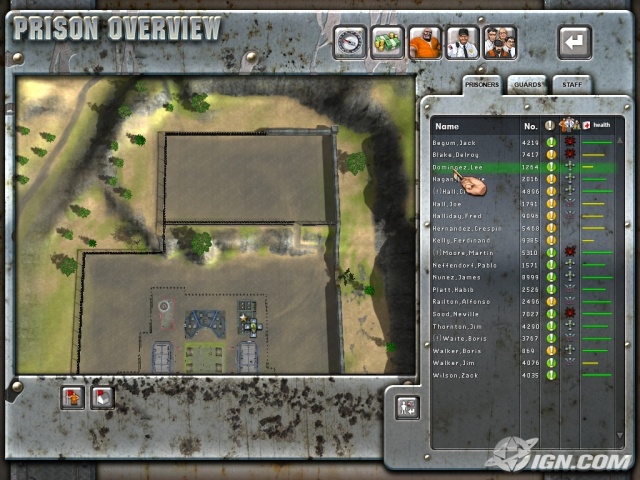
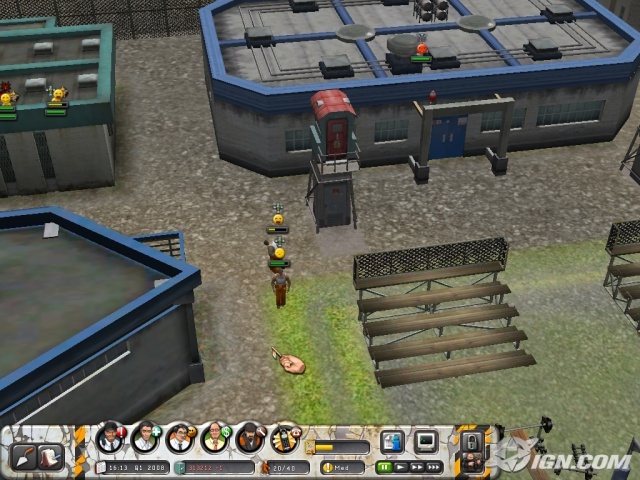
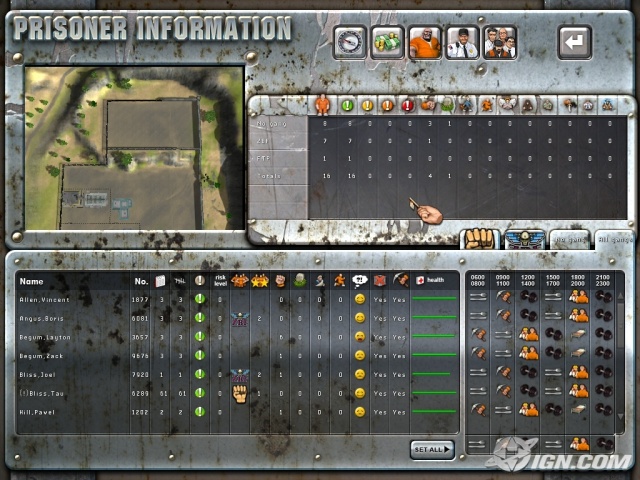
[Image: From Prison Tycoon 4: SuperMax. Image via IGN].
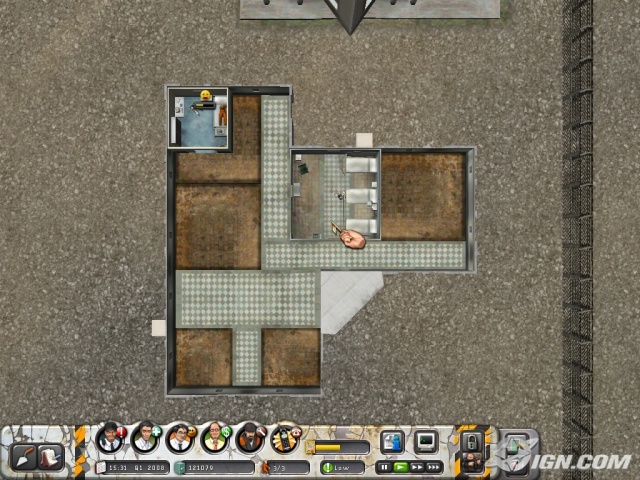
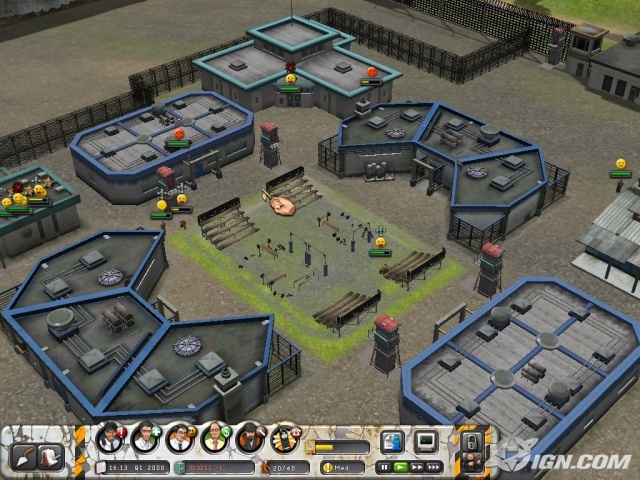
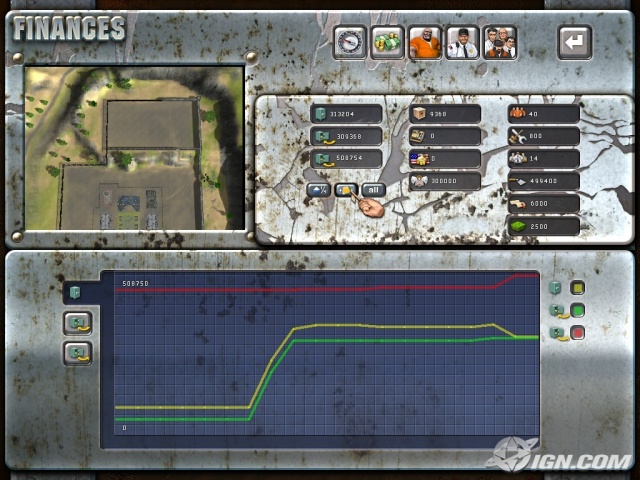
The description of Prison Tycoon 4: SuperMax, a ValuSoft game released in 2008, urges players to experiment in the architectural framing and administrative implementation of prison life.
“Build a profitable privately run prison from the ground up,” it says. “Every wall, every fence, every decision is yours. Start small and forge your reputation as a first rate warden. Grow your facility to SuperMax capabilities, housing the most dangerous and diabolical criminals on earth – all for the bottom line.”
Putting moral limits on our imaginations temporarily aside, perhaps we could even conceive of Prison Tycoon 5: Guantánamo Bay, or Prison Tycoon 6: Austrian Basement Edition. Prison Tycoon 7: Gulag.
Prison Tycoon 8: Escape from Abu Ghraib.
Or scrap the cheap political commentary and go for sci-fi: Inflatable Prisons in Space! The final level is a siege of the earth’s surface via space elevator, convicts raining down upon the planet like dark angels. The plot is loosely modeled on Paradise Lost.
Setting up the next game: Prison Planet.
Or famous prisons from literature – including Brian Aldiss’s rotating prison of Helliconia.
The Library of Babel reimagined as a SuperMax prison in the mountains of western Canada.
Prisons carved from glaciers undergoing catastrophic earthquakes as global climate change causes melt-off. You have to escape before the ice sheet collapses, teaming up with the very guards who once held you captive.
Prison Tycoon 10: Global Meltdown.

[Images: From Prison Tycoon 4: SuperMax. All images via IGN. If Mies van der Rohe had designed a prison, what might it have looked like?].
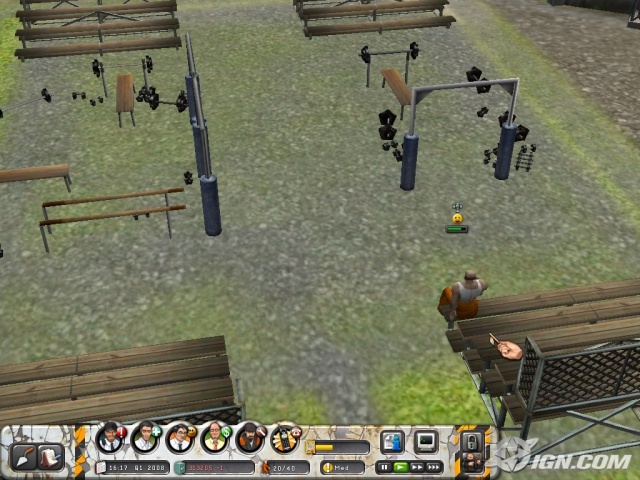
Of course, ValuSoft kicked all of this off back in 2005 with the original Prison Tycoon: “In Prison Tycoon,” we read, “you construct and maintain a private prison, hire the staff, and control the prisoners – all while trying to earn big money.”
But why not open the series to goals beyond “big money” and a swollen “bottom line,” and aim for sheer architectural complexity?
Or locational advantages, like the offshore oil rig -slash- ultramax prison in John Woo’s surprisingly great film Face/Off.
You construct an Alpine labyrinth that has no guards at all; the architecture itself is so bewildering that no one has ever escaped. Umberto Eco’s final novel is set there; or perhaps one of his characters dreams it.
Gormenghast: The Prison.

[Images: From Prison Tycoon 4: SuperMax. Images via IGN].

However, lest you now be tempted to purchase Prison Tycoon 4, I’d first suggest reading this review.
For instance:

Since it’s pretty much impossible to tell the difference between a guard and a prisoner in the yard, you’ll have to open up the submenu. From there you click on the guard tab, select a specific guard, look at the minimap to check the whereabouts of the guard, close the submenu, investigate the most recent known whereabouts of the guard, locate and right mouse click the guy (you can’t create a drag box to select anything in this game), move him into the action, right mouse click on a troubled prisoner, and select the beat-him-up icon. By the time you try to initiate all of this, a prisoner might have already died. If this all sounds convoluted it is. The whole game is like this, and it really hurts to not have a proper tutorial.

Sounds like fun.

Manhattan as a vascular organ

As part of their new water-themed issue, the beautifully designed New York Moon has produced this interactive map of the water systems of Manhattan.

[Image: The New York Moon‘s interactive map of the water systems of Manhattan; map by Zack Sultan].
“Beneath New York’s lattices of concrete, iron and landfill lie dozens of organic waterways,” they write. “Using data from an 1865 sanitation map and contemporary satillite photographs, this projection depicts Manhattan as a vascular organ, whose obscure opperation has had powerful bearing on the fate of the city.”
Older issues of the Moon are definitely worth checking out, including their recent look at deserts, underground acoustics, and the idea of a four-dimensional document for “investigating time and space.”
While you’re there, don’t miss the floating bog-city of Lake Titicaca:

Beginning with a sturdy floating bog, and then laying a base of totora reeds over it, the men, women and children of Uros work together, piling the reeds in a different direction every two weeks until they have created a latticework strong enough to hold six or seven homes and one kitchen on each island, a process that takes about eight months. All of the forty-odd islands are then anchored to sticks pitched into the lake’s floor, making the community buoyant but stationary. Though the islands at conception are about three to four feet thick, they will double over time as dying reeds are covered with newer, stiffer ones, a process of renewal repeated until it is time to build an entirely new island.

Note that I hereby pitch a jointly edited future edition of New York Moon, to be curated by BLDGBLOG and Pruned, around the theme of gardens. Late summer 2009.

BLDGBLOG @ Rice University

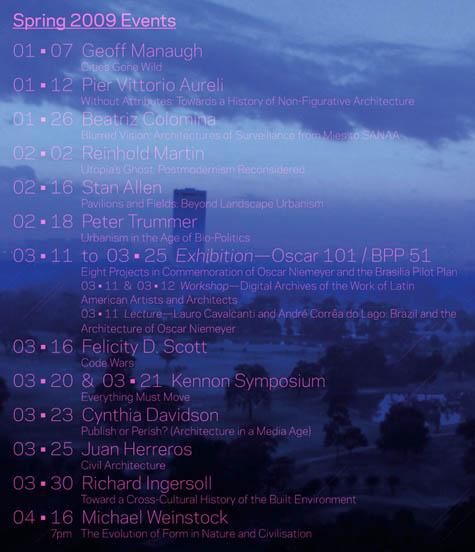
I’m excited to announce that I’ll be lecturing at the Rice University School of Architecture in Houston, Texas, in only two days’ time, kicking off their Spring 2009 lecture series.

[Image: View larger].

I’ve clearly got some very large shoes to fill with this series, however, as I’ve been lined up with everyone from Beatriz Colomina to Cynthia Davidson. Stan Allen, Juan Herreros, Richard Ingersoll, Pier Vittorio Aureli, Michael Weinstock, Peter Trummer – it looks like a fantastic series.
For my own part, I think I’ve got a great talk planned – called “Cities Gone Wild” – expanding from the lecture I gave back in November, sponsored by the Complex Terrain Laboratory, at University College, London.
This talk begins at 5pm on Wednesday, January 7; it’s free and open to the public; and it will take place in Anderson Hall.
I don’t know how many readers BLDGBLOG has in Houston – or, for that matter, at Rice – but I’d love to see some of you there. And please introduce yourselves, too, as I love meeting new people.
Also, at the end of my talk I hope to address the more general subject of blogging, if for no other reason than I can guarantee that there are students enrolled at Rice right now – and people living in Houston – who have something interesting to say and simply need a new platform from which to say it. I’d be happy to talk about establishing a blog and so on, as that’s not a topic I’ve much addressed throughout all of these talks.
Finally, I’ll be doing thesis reviews at the architecture department all day on Thursday and Friday, so if you happen to be enrolled in the courses I’ll be visiting, then cool. I look forward to meeting you!
And come out to the talk – it should be fun.

Stonehenge Beneath the Waters of Lake Michigan

[Image: Standing stones beneath Lake Michigan? Via Mark Holley].
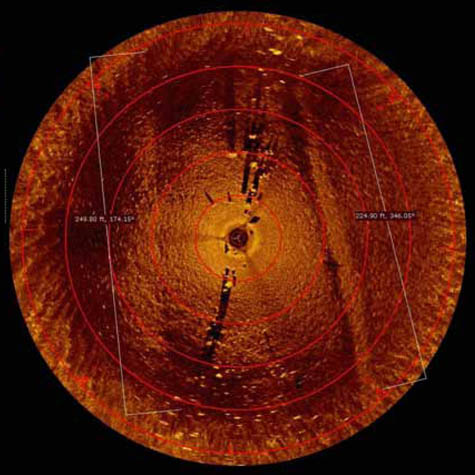
In a surprisingly under-reported story from 2007, Mark Holley, a professor of underwater archaeology at Northwestern Michigan College, discovered a series of stones – some of them arranged in a circle and one of which seemed to show carvings of a mastodon – 40-feet beneath the surface waters of Lake Michigan.

If verified, the carvings could be as much as 10,000 years old – coincident with the post-Ice Age presence of both humans and mastodons in the upper midwest.

[Image: The stones beneath Lake Michigan; via Mark Holley].
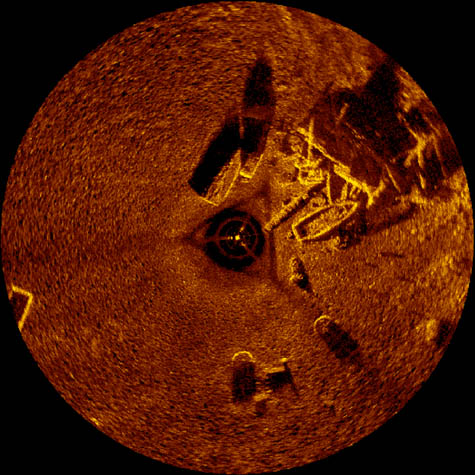
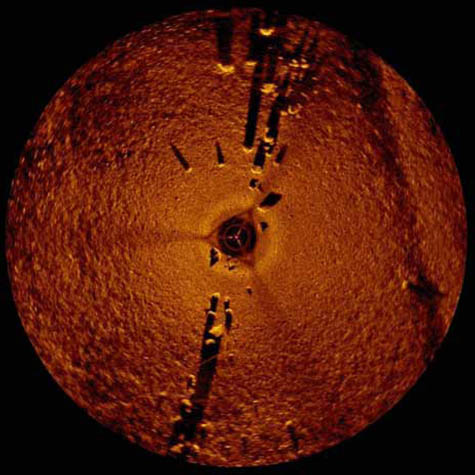
In a PDF assembled by Holley and Brian Abbott to document the expedition, we learn that the archaeologists had been hired to survey a series of old boatwrecks using a slightly repurposed “sector scan sonar” device. You can read about the actual equipment – a Kongsberg-Mesotech MS 1000 – here.

The circular images this thing produces are unreal; like some strange new art-historical branch of landscape representation, they form cryptic dioramas of long-lost wreckage on the lakebed. Shipwrecks (like the Tramp, which went down in 1974); a “junk pile” of old boats and cars; a Civil War-era pier; and even an old buggy are just some of the topographic features the divers discovered.

These are anthropological remains that will soon be part of the lake’s geology; they are our future trace fossils.

But down amongst those otherwise mundane human remains were the stones.

[Image: The “junk pile” of old cars and boat skeletons; via Mark Holley].
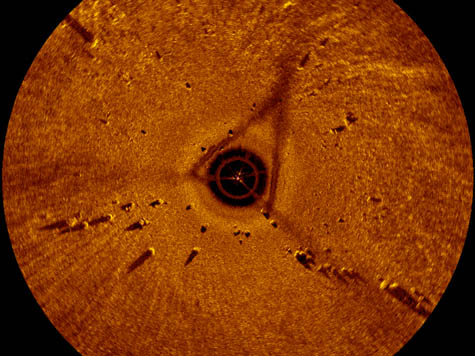
While there is obviously some doubt as to whether or not that really is a mastodon carved on a rock – let alone if it really was human activity that arranged these rocks into a circle – it’s worth pointing out that Michigan does already have petroglyph sites and even standing stones.

A representative of the University of Michigan Museum of Paleontology has even commented that, although he’s skeptical, he’s interested in learning more, hoping to see better photographs of the so-called “glyph stone.”

[Image: The stones; via Mark Holley].

So is there a North American version of Stonehenge just sitting up there beneath the glacial waters of a small northern bay in Lake Michigan? If so, are there other submerged prehistoric megaliths waiting to be discovered by some rogue archaeologist armed with a sonar scanner?

Whatever the answer might be, the very suggestion is interesting enough to think about – where underwater archaeology, prehistoric remains, and lost shipwrecks collide to form a midwestern mystery: National Treasure 3 or Da Vinci Code 2. But only future scuba expeditions will be able to tell for sure.

Of networks, grids, and infrastructures, or: How to make a planet

If I have several blogging resolutions for 2009 – and I do – one of them is definitely to read InfraNet Lab more often.

[Image: Offshore energy islands, via InfraNet Lab].

Easily one of the most interesting architecture blogs out there today – though it’s really an infrastructure blog, hopefully heralding a new focus for design writers in the next few years – and written by Toronto-based architects Mason White and Lola Sheppard, along with two contributors named Maya and Neeraj, it tracks massive infrastructure, waste, energy, and design projects across the global landscape, taking in geology, engineering, network economics, ecology, construction innovation, future fuels, and much more.

Read it and you’ll know how to “harvest energy from the earth’s rotation” using mega-gyroscopes, you’ll discover how a more efficient offshore seaweed industry might work, you’ll pick up clues for how to design a mountain and then how to connect that mountain to others using aerial tramways, you’ll get an architectural glimpse of habitat meshing, you’ll take an hallucinatory tour through Taiwanese mushroom farms, you’ll visit underground waste isolation sites in New Mexico, you’ll turn around and go the opposite vertical direction – into the sky – to farm water from the atmosphere, and you’ll even punt around the artificial inland waterways of Britain using strange mechanized structures and seeing that archipelago as hydrology first, geography later.

So go check it out – and make 2009 the year of networks, grids, and infrastructures.

Arrested Development

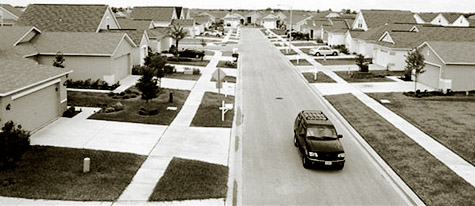
Instead of putting people under house arrest – where they’d stay at home all day, unable to leave their own property for weeks or months at a time – you instead send them out to some perfect suburb in the middle of, say, Nebraska or Utah, a remote development where each house is fully furnished and tastefully maintained, but each also has only one inhabitant: a minor criminal of some sort, dwelling on the immorality of shoplifting or tax fraud and serving-out a short period of house arrest. They can even get their mail redirected there, and watch Netflix.
But out on the far periphery are watchtowers, and the streets are lined with cameras.

In the winter of light

“There are architecture photographers [who] refuse to photograph anything from November up to February,” Michiel van Raaij writes on his blog Eikongraphia. “In their view the long shadows and dimmed light intensity of the winter season compromises their work. The effect is that – in the architecture media – not only the sun always shines, but that it is also never winter.”
There are several interesting observations here, but I’m particularly struck by the thought that the spherical trigonometry of the earth’s surface – and its angular effect on shadows – has an impact on how we might popularly view and represent architectural space.
By extension, then, if raised only on images of buildings in which there are no visible shadows – and in which surfaces thus appear to be all but shaved of ornament – are architects actually designing for a particular season of light? That is, buildings that are meant to look good, and photograph well, only in summer?
How amazing it would be to find that architectural styles begin to change – moving away from the Clement Greenberg-like flatness of international modernism toward a new era of ornamentally active deep surfaces – if something as simple as when photographs are taken were to change.
All the works of Frank Gehry, photographed in the anemic, angular light of midwinter. I sense a book idea here, if any enterprising photographers might be reading this…