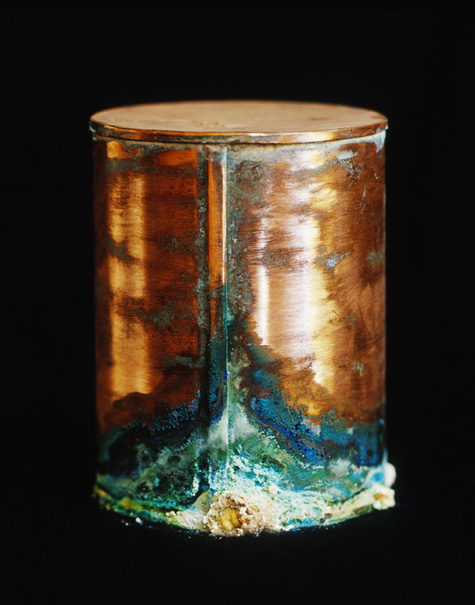
Death, dust, decay

[Image: From Library of Dust by David Maisel].

In an earlier post, I mentioned that there will be at least one more big event coming up in New York City that I’ll be a part of; the information for that is now available (at least on Facebook!).
On Monday, April 13, from 7-9pm, the New York Institute for the Humanities will be hosting a celebration of David Maisel’s recent, beautiful, and widely praised book Library of Dust.
This will take place at the Angel Orensanz Foundation, housed in an extraordinary, blue-ceilinged synagogue at 172 Norfolk Street, and it will be led by the indefatigable Lawrence Weschler.
Here’s a map.
The list of participants looks absolutely amazing, and I’m thrilled to be a part of this group. In addition to Maisel and Weschler, there will be writer, professor, and historian of photography Ulrich Baer; author Rachel Cohen; writer and historian Jennifer Michael Hecht; art historian Karen Lang; novelist Jonathan Lethem; photographer Joel Meyerowitz; novelist Ted Mooney; filmmaker Bill Morrison; Magnum photojournalist Gilles Peress; president of Wesleyan University and historian Michael Roth; author and critic Luc Sante; and poet Vijay Seshadri.
It sounds like an unbelievably interesting evening – and I hope to bring something to the table myself, as author of one the essays in Maisel’s Library of Dust.
So if you’re in New York that night, please come check it out – and more information about the event, including ticket pricing and availability, should hopefully be up on the Orensanz Foundation’s site soon, or on the website of the New York Institute for Humanities.
Also, on a tangent, should you be in Philadelphia, Lawrence Weschler will be speaking tomorrow night at the Penn Humanities Forum. If you don’t know Weschler’s book Mr. Wilson’s Cabinet of Wonder, then you need to pick up a copy ASAP.

(Earlier on BLDGBLOG: Library of Dust. On Archinect: Interview with David Maisel).

Circle and District

[Image: Napoleon in Egypt].

I started reading Nina Burleigh’s recent book Mirage on the flight over to New York this afternoon. Burleigh’s book is a review of Napoleon’s 1798 invasion of Egypt, during which “more than 150 French engineers, artists, doctors, and scientists – even a poet and a musicologist – traveled to the Nile Valley under the command of Napoleon Bonaparte and his invading army.”
Burleigh’s descriptions of 18th century Cairo stand out. She writes that the city was “a labyrinthine metropolis that frustrated and confused the invaders.” It was “a city of doors, mostly closed.”

Massive gates opened into the city, and the winding streets themselves often ended abruptly at smaller doors that defined neighborhood and community boundaries… Whole neighborhoods might be walled off, accessible only by a single door in a narrow street.

She writes that “The city frustrated Europeans. To their eyes, there was no logic to its street plan, and less order. Claustrophobic alleys ended at walls, or dwindled into walkways and disappeared.”
When an imperial cartographic project is kicked off a few months into the occupation, it “was deemed so daunting that at first the engineers hoped the order [to map Cairo] would be rescinded” – but, of course, “it was not.”
Edme-François Jomard, the cartographer in charge of the project, wrote: “The city is almost entirely composed of very short streets and twisting alleys, with innumerable dead-ends. Each of these sections is closed by a gate, which the inhabitants open when they wish; as a result the interior of Cairo is very difficult to know.” Jomard, Burleigh writes, would spend his time “knocking on gates that hid whole neighborhoods.”
How interesting to think of the Manhattanized equivalent of this – where, for instance, a small door at 1st and 13th Street might seal off an entire subdistrict of the island, a kind of undiscovered private archipelago of walled neighborhoods that maze outward in small streets barely wide enough to walk through.
You knock two or three times – and then crawl through a small circular door in the middle of a brick wall that could just as easily have been the entrance to a building. And then you’re gone, hiking through a part of the city you’d never even heard of before.
Of course, the Napoleonic approach to Cairo was, in the end, a military one; Burleigh adds that “These doors inconvenienced the French, and eventually Napoleon committed one of his most offensive acts – in the eyes of the Arabs – when he ordered them removed.” And so those old neighborhoods, previously sealed apart as if by airlocks, were made open for soldiers to pass through, the city remade for its military occupiers.

Kind of Blue


It’s nice to see a friend (and coworker) get an opportunity to discuss his work: Dwell‘s Design Director, Kyle Blue, talks to Arkitip about why we make Dwell the way we do, in this short video shot just the other day in the office. Congrats, Kyle!
Also visible in the background of the video are Brendan Callahan, illustrator of The BLDGBLOG Book, Michele Posner, Ryan Nelson, and Dakota Keck – as well as some spreads from our forthcoming May 2009 issue, my second third-to-last as Senior Editor.

Guardians of Architecture

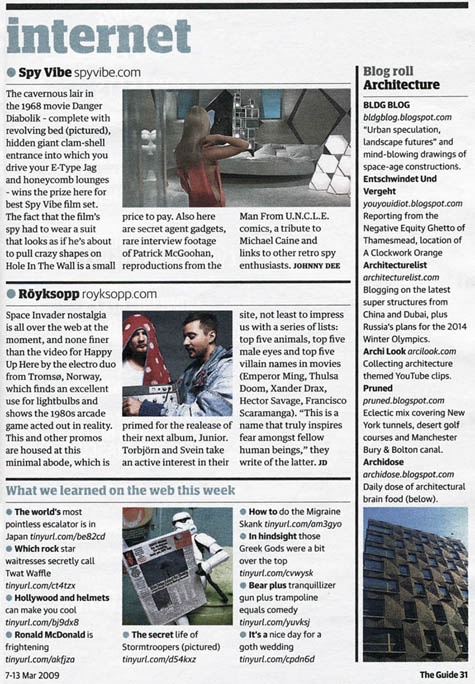
[Image: The Guardian‘s architecture blog roll, cropped down from a scan by John Coulthart; view larger].

I was excited to see that BLDGBLOG made it onto the Guardian‘s list of recommended architecture blogs this weekend, along with Pruned, Archidose, entschwindet und vergeht, Architecture List, and Arcilook. It seems notable that four of those, if you count BLDGBLOG, are written using Blogger.
Also, I’m hugely pleased that were able to include a brief mention of Pruned in the new (April 2009) issue of Dwell magazine – so take a look on p. 120 if you stumble on a copy. “Alexander Trevi’s Pruned offers readers a wild adventure into landscapes both real and imagined,” Dwell says. “At once practical and visionary.”
While we’re on the topic, don’t miss Dwell‘s new website, launched last week.

(Thanks to John Coulthart for pointing out the Guardian list!)

Surgeon of Space

[Image: Grapes, 2008, by Ai Weiwei; courtesy of Phillips de Pury & Company].

The new exhibition Ai Weiwei: Four Movements opened today in London at Phillips de Pury & Company, and it will remain on display until March 28. I’m proud to have contributed an essay to the show’s catalog, alongside a text by Arthur I. Miller.
My essay, “Ai Weiwei: Surgeon of Space” can be read in full online – and I have to admit that I like it! I don’t often write about furniture design here on BLDGBLOG, so it was particularly fun to be able to do so.
I suggest that “furniture for Ai Weiwei exists in a very interesting space, so to speak, and it comes with compelling conceptual possibilities.”

Furniture doesn’t just ornament a given space; it remakes and redefines the internal boundaries of the space itself. If furniture is something that breaks up space, offering punctuated moments of rest and stoppage and giving rhythm to a room, then it can also be deliberately misused. It can be contrapuntal and off-kilter, designed against the grain of the space it appears within. Furniture can interrupt, challenge, and deform.

The rest of the text veers from David Cronenberg to geology, by way of Gerrit Rietveld and German tunneling machines, Stone Age tools and psychoanalysis. From the essay:

Ai’s “Furniture”, subject to such interpretations, become not unlike allegories: small storylines in wood. They are narratives. “Tables at Right Angles”, 1998, is really just one table that has misunderstood itself, reeling back from its own projected double. Mistaking its own eccentric solidity for the architecture that surrounds it, this table will never realize that the world it thinks it touches is just another part of itself.

Of course, it would be a cliché to say that these works, thus described, are like poems – so let us instead suggest that they are screenplays: symbolically rich and heavy with implication, they have character, destiny, and tension all at once. They have drama. They can be argued about and reenacted. They have plots. Perhaps someday we might even see a film directed by David Cronenberg – based on a table by Ai Weiwei.

Check it out if you get a chance – and stop by the exhibition itself if you’re in London.
Meanwhile, if you’re looking for more of an introduction to Ai Weiwei’s work, nearly three years ago Archinect published a feature-length interview with him called “Fragments, Voids, Sections and Rings,” also well worth a read.

Seastead Design Competition

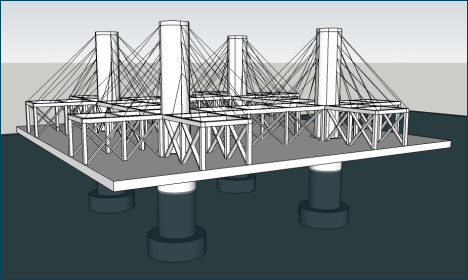
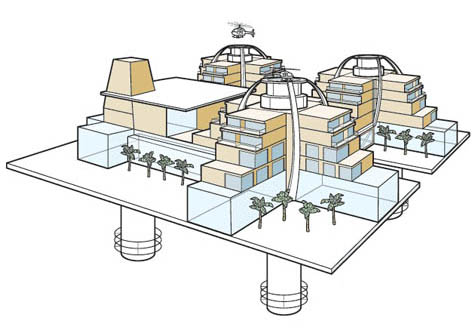
[Image: The basic platform; design your seastead atop this and win $1000].

The Seasteading Institute is sponsoring a design competition to see who can most interestingly visualize a permanent, microsovereign architectural state at sea.
“A seastead,” they write in the competition brief, “is a floating platform that allows people to permanently settle the ocean as they do land. Professional naval engineers have already designed a bare platform – a structure about 400×400 feet, roughly the size of a city block. What you build on the platform is up to you. It may be a hospital, a casino, a residential community, a cricket stadium, or something entirely different.”

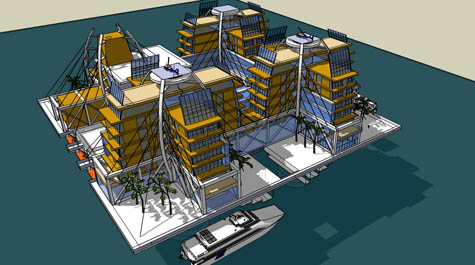
[Image: The sample design].

There are some basic engineering constraints that participants will have to heed, as explained both in the call-for-entries and in this forum, and a sample design has been supplied (see images above and below).
But if architects were asked to rethink the spatial design of offshore libertarian self-rule, what sorts of structures might we see?

[Image: An illustrated variation of the sample design, from Wired magazine].

For a little more background, Wired‘s Chris Baker covered the Seasteading Institute last month. Baker wrote that the Institute “doesn’t just want to create huge floating platforms that people can live on,” they are “also hoping to create a platform in the sense that Linux is a platform: a base upon which people can build their own innovative forms of governance. The ultimate goal is to create standards and blueprints that can be easily adapted, allowing small communities to rapidly incubate and test new models of self-rule with the same ease that a programmer in his garage can whip up a Facebook app.”
Here, architectural design would actually help to catalyze new forms of political sovereignty.
The cultural possibilities for these offshore spaces are effectively without limit – and they would be self-policed, falling outside the bounds of international law. This opens up a number of legal (not to mention moral) quandaries.
Baker reports that Patri Friedman, the Institute’s co-founder and executive director, speaking at a Bay Area conference held last fall, “notes that some enterprises – like euthanasia clinics – would incense local authorities, but almost all the ideas attendees [at that conference] come up with would capitalize on activities that skirt existing laws and regulations: Fish farming and aquaculture. Prisons. Med schools. Gold warehouses. Brothels. Cryonics intakes. Gene therapy, cloning, augmentation, and organ sales. Baby farms. Deafeningly loud concerts. Rehab/detox clinics. Zen retreats. Abortion clinics. Ultimate ultimate fighting tournaments.”
So what might these platforms look like? Submissions are due by May 1.

The Continuous Enclave: Strategies in Bypass Urbanism

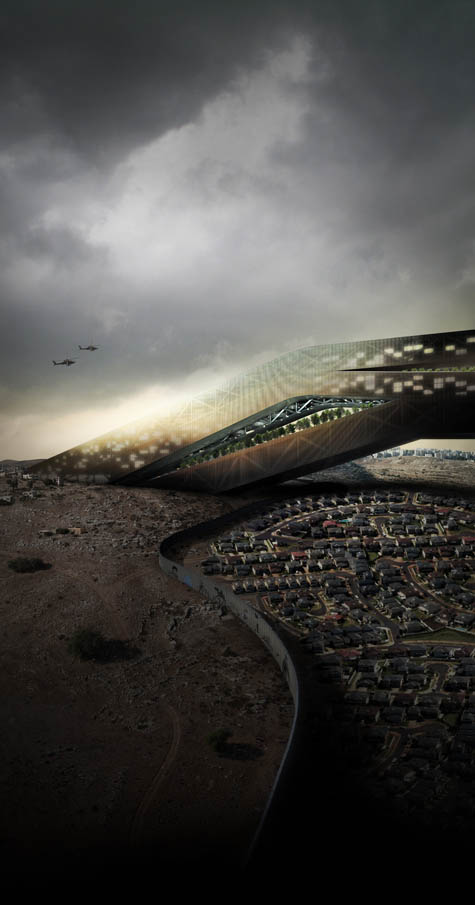
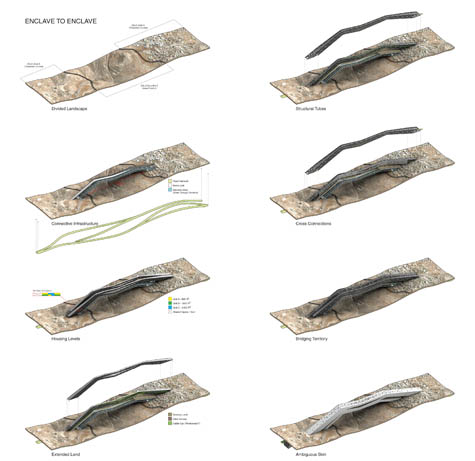
For his final student project presented last month at Rice University, Viktor Ramos produced The Continuous Enclave: Strategies in Bypass Urbanism.
[Image: From The Continuous Enclave: Strategies in Bypass Urbanism by Viktor Ramos; view larger].

The project explores how new forms of habitable infrastructure might be extrapolated from a geopolitical agreement – in this case, materializing architectural form from the legal interstices of the Oslo Accords.
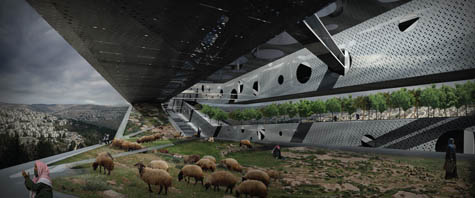
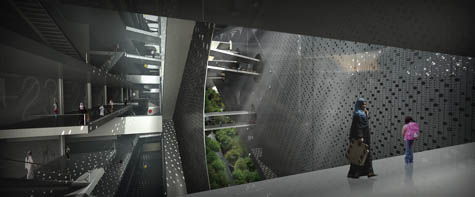
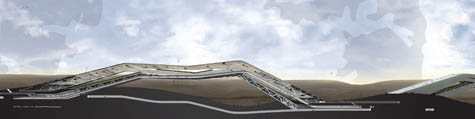
The result is a fantastic example of architectural speculation: genuinely massive – and impossibly cantilevered – bridges used as transport links, aerial housing, and skyborne agricultural complexes, all in one.
[Image: From The Continuous Enclave: Strategies in Bypass Urbanism by Viktor Ramos].

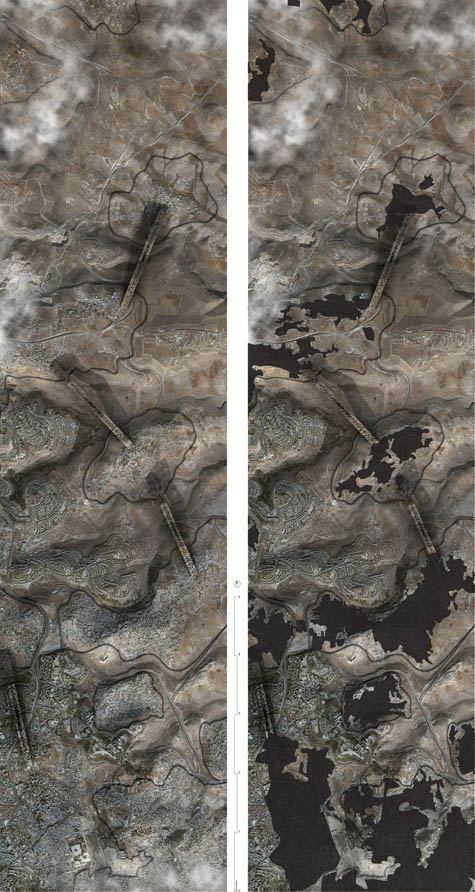
While clearly defying security protocols, as the “continuous enclave” and its network of bridges cross through sovereign Israeli airspace, these structures would link the dispersed islands of infrastructurally underserved territory now under Palestinian control.
From Ramos’s own project description:

This thesis takes a formal approach to understanding the Israeli-Palestinian conflict by studying mechanisms of control within the West Bank. The occupation of the West Bank has had tremendous effects on the urban fabric of the region because it operates spatially. Through the conflict, new ways of imagining territory have been needed to multiply a single sovereign territory into many. It is only through the overlapping of two separate political geographies that they are able to inhabit the same landscape.

One might say that these bridges present us with the staple as geopolitical form.
[Image: From The Continuous Enclave: Strategies in Bypass Urbanism by Viktor Ramos; view poster-sized].

“The Oslo Accords,” Ramos continues, “have been integral to this process of division.”

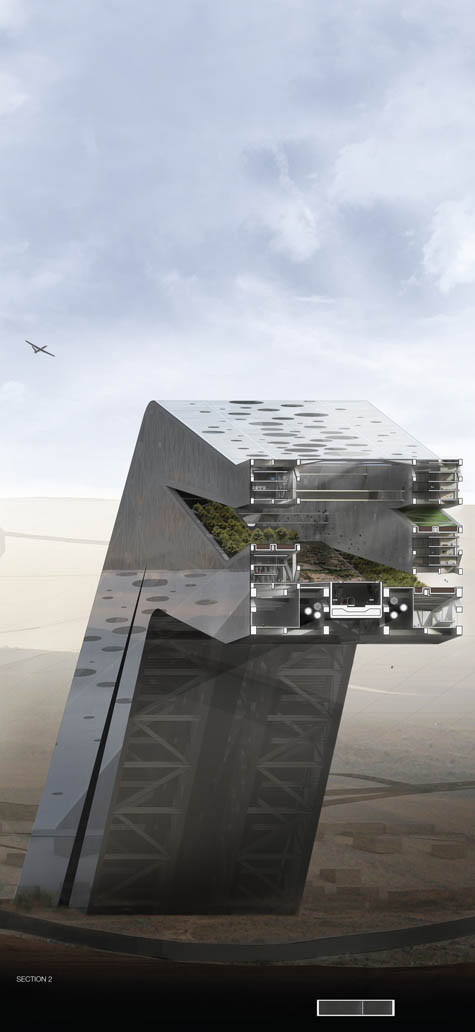
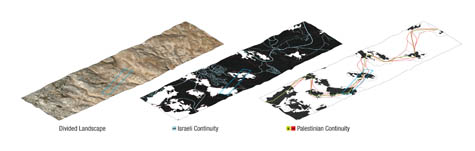
By defining various control regimes, the Accords have created a fragmented landscape of isolated Palestinian enclaves and Israeli settlements. The intertwined nature of these fragments makes it impossible to divide the two states easily. By connecting the fragments through a series of under- and overpasses, the border between the two states has shifted vertically.

In the following cross-section, you can see the internal stacking of the space – an inhabited borderzone that weaves through the lower atmosphere.
[Image: From The Continuous Enclave: Strategies in Bypass Urbanism by Viktor Ramos; view larger].

To my mind, the project avoids the most obvious and expected pitfall of such an approach – which would be to suggest, naively, that architecture can, in and of itself, lead to a more thorough and lasting peace in the region, as if the entirety of the Israeli-Palestinian conflict would be eradicated if only they had better architecture.
Ramos instead uses the Oslo Accords as a kind of spatial source-code from which unanticipated structural forms might be extracted.
For those of you who have read Delirious New York, it’s as if the Oslo Accords have been turned into a geopolitically active 1916 Zoning Law. That law, of course, established spatial guidelines – for instance, enforcing setbacks for buildings, leading to an era in which skyscrapers rose up like ever-narrowing ziggurats – from which the buildings of Manhattan would then be shaped.
As Koolhaas himself writes, in the wake of the Zoning Law architects would “have to carve the final Manhattan archetype from the invisible rock of its zoning envelope in a campaign of specification.”
In Ramos’s project, that “invisible rock” consists of disputed territorial claims hovering virtually over the geography of the West Bank. The distinct new form of spatiality “carved” from that rock is the bypass.
[Image: From The Continuous Enclave: Strategies in Bypass Urbanism by Viktor Ramos; definitely view larger].

Again, from the project description:

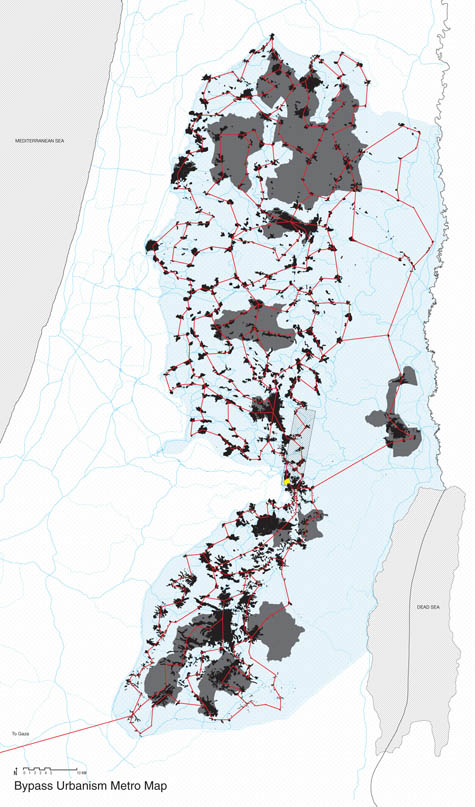
One feature of the Oslo Accords is the bypass road which links Israeli settlements to Israel, bypassing Palestinian areas in the process. These are essential to the freedom of movement for the settlers within the Occupied Territories. Extrapolating on the bypass, this thesis explores the ramifications of a continuous infrastructural network linking the fragmented landscape of Palestinian enclaves. In the process, a continuous form of urbanization has been developed to allow for the growth and expansion of the Palestinian state. Ultimately, this thesis questions the potential absurdity of partition strategies within the West Bank and Gaza Strip by attempting to realize them.

Thus creating what Ramos calls bypass urbanism, or a self-connected maze of new territories in the sky.
[Image: From The Continuous Enclave: Strategies in Bypass Urbanism by Viktor Ramos; view much larger: top, bottom].

There are any number of other directions such a project could go, but I’m particularly excited by the idea of applying this same sort of analysis to other conflict zones, elsewhere, all over the world.
Of course, the precedents for this are many. After all, what is the Berlin Wall but a piece of architecture pulled from the dreamscape of international legal infrastructure?
In fact, I’m reminded here of Rupert Thomson’s under-appreciated recent novel Divided Kingdom – especially because the basic premise of that book was at least partially inspired by Rem Koolhaas’s own student thesis project, Exodus, or The Voluntary Prisoners of Architecture. As Koolhaas wrote:

Once, a city was divided in two parts. One part became the Good Half, the other part the Bad Half. The inhabitants of the Bad Half began to flock to the good part of the divided city, rapidly swelling into an urban exodus. If this situation had been allowed to continue forever, the population of the Good Half would have doubled, while the Bad Half would have turned into a ghost town. After all attempts to interrupt this undesirable migration had failed, the authorities of the bad part made desperate and savage use of architecture: they built a wall around the good part of the city, making it completely inaccessible to their subjects.

The Wall was a masterpiece.

The U.S.–Mexico border would seem an obvious place for any investigation of “bypass urbanism” to begin; just today, the New York Times looked at the decaying after-effects of the Dayton Accords and their spatio-sovereign impact on the future of Bosnia; and Lebbeus Woods has long explored the architectural effects of political separation, from Paris and Berlin to Israel and Sarajevo, seeking out those fissures wherein geopolitics exhibits its own peculiar form of spatial tectonics.
But what new kinds of space might we yet extract from territorial agreements between, say, India and Pakistan over Kashmir, or Turkey and Greece over Nicosia – or, for that matter, what strange infrastructures might we build in Baarle-Hertog, what pavilions inspired by the Akwizgran Discrepancy, and how might most interestingly extract architecture from the international date line?
[Image: From The Continuous Enclave: Strategies in Bypass Urbanism by Viktor Ramos].

Even with so many precedents, it would seem, such studies have still barely begun.
You can see much, much larger versions of all of these images in this Flickr set: The Continuous Enclave: Strategies in Bypass Urbanism. They are incredibly detailed and well worth exploring in full!

(Viktor Ramos’s Continuous Enclave was produced at Rice University. It was advised by Troy Schaum under the direction of Fares el-Dahdah and Eva Franch, with additional input from John Casbarian and Albert Pope).
Listing Listward

BLDGBLOG has unexpectedly popped up on a list of The 100 Best Blogs, according to the Times.
I’m there alongside some very distinguished company, I have to say, including Owen Hatherley’s sit down man, you’re a bloody tragedy, and many of the blogosphere’s usual suspects, from Boing Boing, TreeHugger, and TechCrunch, to David Byrne, The Sartorialist, and so on. Alex Ross’s excellent The Rest Is Noise also made the list (don’t miss Ross’s book).
Of course, there are some very notable absences on the list, not least of which come from the vibrant architecture, cities, and landscape blogging scenes, of which I’ve always been excited to be a part.
The complete roster of 100 blogs is divided up into parts one and two – so check it out if you’re looking for new sites to read.
And thanks, by the way, for continuing to read BLDGBLOG! It’s frightening to say it, but the site’s fifth birthday is approaching this summer.

(Thanks to Clare Dudman for pointing it out!)

Mathscape

[Image: The finished “math playground” in Uganda, by Project H Design].

Project H Design recently completed the installation of a “math playground,” or Learning Landscape, at the Kutamba School for orphans of AIDS in rural Uganda.
Part outdoor classroom, part spatially immersive lesson in arithmetic, the project gives students a place to study in at least two senses of the phrase. On the one hand, it’s simply a forum for learning; on the other, it is literally a place to study: the space itself, if I’ve understood this correctly, serves as a model for play-based education.

[Images: The “math playground,” by Project H Design].

That is, within the numbered arrangement of tires and benches is a spatial pedagogy: using the landscape itself, any number of spatialized games, such as “Around The World” and “Match Me,” can be used to teach elementary mathematics.

[Images: One the finished benches, via Project H Design].

The didactic landscape was, at one point, simply a kind of mathematical test-landscape in a U.S. gymnasium before being tried out by the students on site in Uganda, before reaching its final installation.

[Images: Testing out the landscape, via Project H Design].

Check out the whole research, design, and installation process through their Flickr sets.

[Images: Via Project H Design].

I absolutely love the idea, though, that it might be possible to derive mathematical lessons from the built environment surrounding us. That, somewhere in the walls, roads, and buildings we find ourselves alive within, are equations waiting to be deduced, geometries to be studied, forces that we can isolate, graph, and understand. Whether through games or lectures, it is the spatial world itself that we study.

[Images: A handbook to spatial learning, via Project H Design].

Of course, this is one of the most basic things you do when you first study engineering: you look at a bridge, tower, or other structure and you try to figure out how it stands or works. Or you stand behind Notre-Dame in Paris, staring at those stone cobwebs of intersecting buttressed supports, and you try to understand how it is that cathedrals gravitationally function.
But how incredible would it be to realize that, say, your entire city had actually been organized by urban planners two hundred years ago as a kind of inhabitable lesson in mathematics or logical reasoning, like something from the early theories of Friedrich Froebel?
Who?
In an unbelievably interesting exhibition held two years ago in Pasadena, the Institute For Figuring explored the educational system of a now relatively under-known man named Friedrich Froebel and his influence on what we now call kindergarten. To quote from their online exhibition at length:

Most of us today experienced kindergarten as a loose assortment of playful activities – a kind of preparatory ground for school proper. But in its original incarnation kindergarten was a formalized system that drew its inspiration from the science of crystallography. During its early years in the nineteenth century, kindergarten was based around a system of abstract exercises that aimed to instill in young children an understanding of the mathematically generated logic underlying the ebb and flow of creation. This revolutionary system was developed by the German scientist Friedrich Froebel whose vision of childhood education changed the course of our culture laying the grounds for modernist art, architecture and design. Le Corbusier, Frank Lloyd Wright and Buckminster Fuller are all documented attendees of kindergarten. Other “form-givers” of the modern era – including Piet Mondrian, Wassily Kandinsky and Georges Braque – were educated in an environment permeated with Frobelian influence.

I don’t mean to imply here that Project H’s “math playground” in Uganda is an example of Froebelian education – because, as far as I’m aware, it is not – but I do mean to say that it would be amazingly cool if the spatial environments of modern life were organized more along educational lines.

[Images: A Froebelian garden for kids – that is, a kindergarten – brings spatial education to Los Angeles in this archival image, courtesy of the The Institute For Figuring].
Your every commute to work becomes part of a spatial curriculum, carving out education through space.
One of the questions here would be: could you reverse-engineer mathematical lessons from the environment that already surrounds you? Or do you need to purpose-build pedagogic spatiality?
In any case, read more about Froebelian education through the fascinating Institute for Figuring, and stop by Project H Design to find out how you can support the philanthropic construction of future Learning Landscapes elsewhere.

Landscape Anthropology

An exhibition called In Search of the Miraculous opened up last night at the Camera Club of New York. It runs till March 28th.

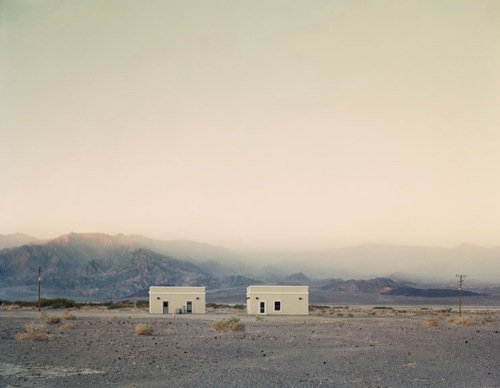
[Image: Two Structures, Death Valley, California, 2007, by Ian Bugaskas, from his series Sweet Water; courtesy of the Jen Bekman Gallery].
While the above image, by photographer Ian Bugaskas, one of the artists represented in the show, is not actually on display there, Baguskas will instead be exhibiting a series called Sansaram (Mountain People), which visually surveys a very particular landscape microculture in South Korea.
According to the Camera Club:

Ian Baguskas’s portraits made in South Korea of local mountain hikers depict the intersection of recreation and spiritual communion with nature. His project Sansaram from 2005, meaning “people of the mountain,” combines landscape views with documentary portraits of native visitors to the Sobaek mountains, encountered on hiking trails. The popularity of this activity can be attributed to the indigenous religion, which is centered on the worship of nature and mountain spirits, and has come to be fused with Buddhism.

The series, visible on Baguskas’s website (caution: resizes your browser and requires Flash), is a fascinating look at the intersection of geology and anthropology – in other words, how massive landforms can be appropriated by and incorporated into cultural movements and religious traditions.
The human experience of the earth’s surface here takes on the form of small picnics, ice cream carts parked on paved platforms, lone hikers gazing out over urban developments below, and families standing quietly in the sun. But behind all of that lies bedrock, a huge intrusion of solid, crystalline form that has pushed up from below into detectability and self-exposure.
This reminds me, though, that if I could start a university – or, for that matter, simply teach at one – I would love to form a new department, studio, or program called Landscape Anthropology, a specifically and enthusiastically spatialized look at human culture. From the layouts of medieval villages to the floorplans of corporate bank towers, from national parks and monuments to the strange geotechnical rearrangements we force upon rock, digging tunnels, excavating mines, and installing towns and cities, how do human beings experience the earth? This would seem to be one of the largest and most important questions we could possibly ask.
In any case, if you’re in New York City between now and March 28, consider stopping by the Camera Club for a glimpse of In Search of the Miraculous.

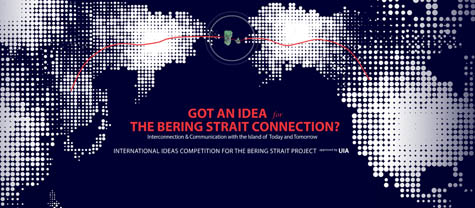
Bering Bridge

If you could design a bridge across the Bering Strait, connecting the U.S. to Russia, what would it look like? Come up with something good and you could win as much as $80,000 ($20,000, if you’re a student).
From the competition website:

This project is a dream project attempting to connect two continents. In a wide sense, it includes building a tunnel or a bridge at both ends of the strait, extending [the] existing railways of the United States and Russia, and laying a world highway around the coasts of the world, which require a massive amount of construction.

Your only two requirements are to design “a peace park with a bridging structure using the two islands, Big Diomede and Little Diomede at the Bering Strait,” and a “proposal of how to connect two continents.”
Of course, Russian engineers have already been considering digging a tunnel between the two continents, and the Discovery Channel has chimed in about how a bridge might actually be built across that “iceberg-swirled ocean near the Arctic Circle.”
But neither of those plans came with a total of $200,000 in prize money…
There’s a confusing clock ticking away on the competition website, but you appear to have until March 24, 2009, to register.