 [Image: Ripping up British railroad tracks in Angola under Chinese supervision; New York Times].
An excellent – if gigantic – article about international development, foreign aid, construction contracts, and “China’s African adventure” was published last weekend in the New York Times.
There, we find China reconsidered as a kind of economic event with infrastructural effects in distant landscapes. In Africa, for instance, “China has already begun, in myriad ways, to serve the interests of [developing nations], while the United States, preoccupied with terrorism, has seen its dominant status slip. Angola, once a cold-war pawn, can now serve as a kind of test case in the latest struggle to shape Africa’s destiny. Call it Chinese-style globalization.”
The article is quick to point out that China already has “a long history as a development partner; Africa is dotted with gigantic sports complexes and People’s Halls built by Chinese engineers at the behest of dictators.” It will now be dotted with Chinese-built roads, railways, and conference centers.
Quoting at length:
Four or five miles along the asphalt road that runs east from Kaala, a small town in central Angola, a Chinese construction company has carved an unexpected right turn, a broad dirt path that runs over a rise through scrubby forest. The path, which has no marking, winds past a basketball court – recreation for the work force – and then empties out into a vast plaza of meticulously smoothed earth. Dump trucks ferry loads of dirt back and forth. At the far end of the plaza, obscured by tree trunks that have been uprooted and laid carefully on their sides, are train tracks. The whole scene, invisible from the road, conjures the stupendous designs of the evil genius in a Bond film.
The weed-covered tracks are the remnants of a railway built by British engineers a century ago to transport precious minerals from the heart of the continent to the port of Lobito, more than a thousand miles away. The Angolan government is paying a consortium of Chinese companies $1.9 billion to completely reconstruct the tracks, the bridges, the stations, the equipment, all shattered by a quarter-century of warfare and neglect.
Like something out of a J.G. Ballard novel – or perhaps a Chinese rewriting of Heart of Darkness – we read how, throughout Angola, old urban plans are still visible “but the cities themselves had crumbled away.” However, with Chinese help, a “new city, Luanda Sul, has begun to sprout above the vast, teeming slums of Luanda [Angola’s capital]. On a hilltop south of the city, Sonangol has built a giant aluminum-and-glass conference center, a state-of-the-art facility for international conferences as yet unplanned, to be serviced by an international airport as yet unfinished. Portuguese and Brazilian construction companies are building their headquarters along perfectly smooth boulevards. Members of the new corporate class are spending $80,000 and up to buy one of the rose or pale green houses overlooking the sea. It’s a new world for a new, legitimate kind of wealth.”
It seems totally legitimate to wonder, then, what future literatures might emerge in such a setting. Will Chinese middle managers with a taste for spy novels write, under pseudonyms, the first great Graham Greenian thrillers of the 21st century? Mineral rights, emerging diseases, oil fields, ethnic tension, and weekend flights back home to Beijing… What future plots will take shape during the final years of “China’s African adventure”? Will a Chinese Archigram publish its own delirious manifestos for instant development, modular villages built with oil money on the shores of manmade lakes?
In any case, the New York Times continues: “The Chinese are a mysterious presence in Angola. Everyone seems to know about them and their assorted projects, but few people have actually seen them, and scarcely anyone can claim to have talked to them. The Chinese rarely venture beyond the encampments in which they live and work.”
Meanwhile, if your curiosity about China has been piqued, don’t miss another gigantic article from the New York Times about that nation’s industrially over-exploited Yellow River.
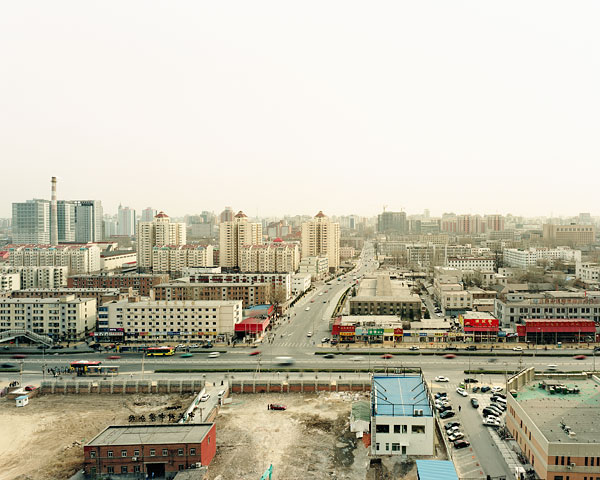
 [Image: The city of Zhengzhou, on the banks of the Yellow River; New York Times].
“The Yellow River, curving through regions only intermittently touched by the country’s boom, offers a tour of the pressures and contradictions bearing down on China, and of the government’s efforts to address them,” we read.
Most astonishing, cities beside the river like Yinchuan, Luoyang and Zhengzhou – places few Americans have ever heard of – are racing to become China’s next new regional urban center with almost hallucinatory building booms. Yinchuan, a modest, ancient capital, is building an entire city district for a vast government complex and is adding 20 million square feet of construction every year through 2011. Luoyang, once the capital of the Zhou dynasty, has built a cluster of futuristic sports stadiums that look like a grounded armada of metallic, alien spaceships.
Finally, one more recent article from the New York Times… This one re-introduces us to Rem Koolhaas‘s topologically self-connected headquarters for China Central Television (CCTV) in Beijing.
 That building, we read, will be “one of the largest ever constructed,” and it will loom “like some kind of science-fiction creature poised to stomp all over the surrounding central business district.” It’s due for completion by the end of 2007.
Read a bit more about the project at BusinessWeek – or in Koolhaas’s own, and ultimately somewhat content-less, Content.


 [Image: Manuel Roig-Franzia/Washington Post].
 [Image: “An orbiting array of reflective balloons focuses sunlight onto the surface of Mars, providing extra heat and solar power for human colonists.” Via
  Utopia, pictured above, is a “digital typeface that portrays the mixture between the modernist architecture of Oscar Niemeyer and informal occupation of the urban space that shapes major Brazilian cities.” In other words, all the letters look like buildings designed by Oscar Niemeyer, jumbled up in Brazilian proximities.
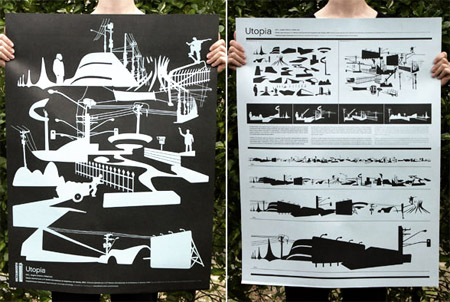 [Images: BLDGBLOG written in Utopia; the whole font, posterized].
 [Image:

 [Images: Sze Tsung Leong,
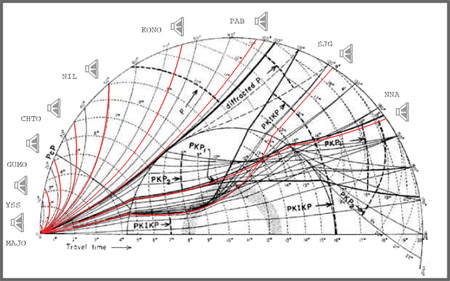 Artist
 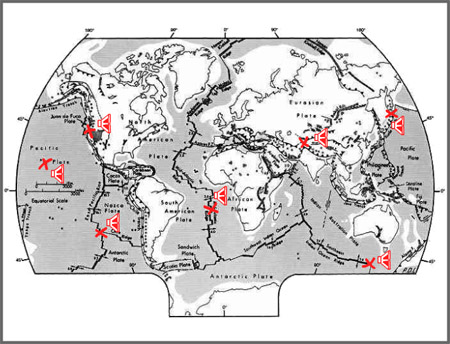 In this map of
 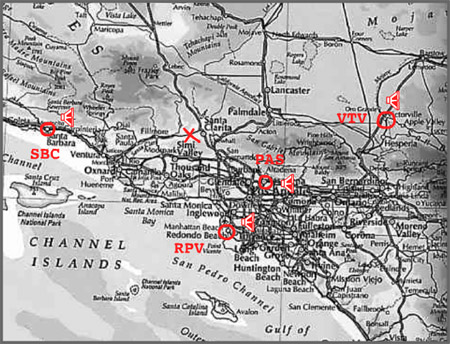 Meanwhile, Dombois also introduces us to the sonic seismicity of
  [Image: Resembling the birth, or perhaps death, of the universe under studio lights – or a black & white alternate ending to
  Going on right now in a New York City near you is
  And if someone complains that they actually need to use that phone… you know what to do.