Tectonic Warfare

In the 1985 James Bond film A View to a Kill – with a theme song by Duran Duran – Christopher Walken plays the bad guy, Max Zorin.


Zorin goes speed-boating with Grace Jones and grins a lot. He has blonde hair.
His plan? To blow-up the San Andreas fault outside San Francisco. This will cause a massive earthquake that will flood Silicon Valley and thus do something or other for Zorin’s own microchip business.
This will allow him to take over the world.
The plan is worked out – this is fascinating – using a model of the city, while flying around in a blimp. You’re in the realm of simulation, hovering anti-gravitationally above the planet – even while discussing a plan to weaponize the earth.


They may as well have hired BLDGBLOG to write the screenplay…
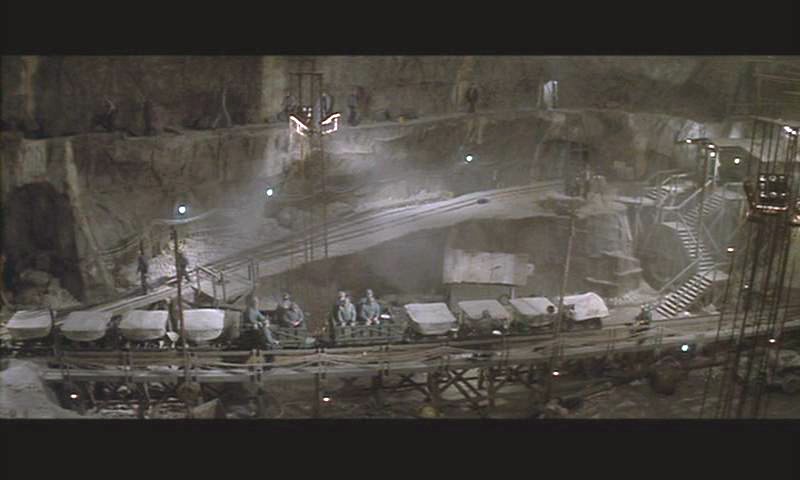
Because then Zorin goes beneath the earth’s surface, wearing a hardhat, where he gets into a discussion with some engineers about the geotechnical nature of the San Andreas fault – including how to blow the thing sky high.


Max Zorin, in other words, has declared tectonic war on the United States.


[Images: The mine Zorin’s dug, the sacs of explosives Zorin’s laid, the militarization of seismic activity Zorin has therefore achieved: yes, it’s James Bond in his mid-80s heyday].

Bond teams up with a female geologist to thwart this evil plan; needless to say, they thwart it.


Two quick points: harddrives are already landscapes, of magnetized silicon; therefore by bombing the San Andreas to achieve a kind of microchip/harddrive monopoly, Zorin is imploding the macro- into the micro-, one landscape into the other. William Blake would have loved this film!
Second, I’d bet $100 the U.S. military already has something like this in the works: surprise earthquakes in Iran, anyone? Surprise earthquakes in Pakistan?
I mention all this because I was thinking of Max Zorin and his View to a Kill when I read about Bill Ellsworth of the US Geological Survey and his suspicious seismic plan: “Ellsworth, his USGS colleague Stephen Hickman and Mark Zoback of Stanford University in California… will use an oil drilling rig to burrow to within metres of where earthquakes are born [on the San Andreas fault]. Then they plan to set up an electronic network and watch the tremors go off again and again… By drilling directly into the fault, the team will be able to observe the chemistry and physics of what happens before, during and after quakes as never before. “
Or so they claim.


[Image: A cross-section of Ellsworth’s San Andrean lab; from New Scientist].

The New Scientist reports that Ellsworth’s team will also use a strategy called the “virtual quake”: “During a natural quake, seismic waves created by movement at a fault are detected at the surface and analysed to estimate their point and time of origin. In their virtual quake the researchers turned this on its head by firing off seven explosions at the surface. They then used the newly installed sensors to detect these seismic waves at depth. Since the timing and location of the explosions were known, the team was able to map the structure of rock even more precisely” – and future strategies of tectonic warfare were no doubt noted…
Anyway, you can read more about it here and here; or you can watch the Bond film – or you can even declare tectonic war on some country yourself – earth as the planet-weapon – but either way be sure to think of BLDGBLOG…


You know he is.

Lunar urbanism 4

So you sign-up for a reality TV show under the premise that you’ll be flown to a Russian space-training camp for 8 days, and then blasted into near-earth orbit. The whole thing will be filmed. You will perform some kind of experiment involving the decay rate of tomatoes in space. You will high-five each other and think holy shit, mate – we’re astronauts
Back to earth, then, and you’re a celebrity, fresh from space. You tell all your friends and appear on talkshows. Everything’s exciting again.
Being terrestrial has never felt so good.


Only you weren’t actually flown to Russia – and you never quite made it into space.
You were flown in circles around the North Sea – at night – and then deposited with the other contestants at a remade air base in northern England. Your “space-training” was not performed by real astronauts, but by actors, with Russian accents.
The air base, meanwhile, “has been given a complete overhaul with plug sockets, manhole covers and light bulbs exchanged for their Russian counterparts. Food, toilet paper, matches and cigarettes have been imported from Russia and, when the contestants first arrive, they will be greeted by Russian military and taken in convoy through checkpoints… just one British crisp packet could give the game away.”
Meanwhile is it reassuring to know that the ideological difference between a British air base and a Russian one can be overcome using a bit of graphic design and some interior decoration?
Worth pondering, that.

The coming Kerouac

Signers of the so-called Asian Highway Agreement will convene their first meeting in a little less than a month, where they’ll discuss what the BBC calls a “new Silk Road… expected to start in Tokyo and terminate in Istanbul – passing though North and South Korea, China and countries in South-East, Central and South Asia.”

[Image: The Asian Highway Route Map].

It will, of course, look remarkably like yet another sprawling, concrete motorway system – but no matter. You’ll be able to drive from Japan to Finland without leaving the highway system.

[Image: An insanely uninspiring view of the AH1 near Bangkok, from the Asian Highway project’s own photo gallery].

What exactly will this new Silk Road allow you to see? Here’s a list of tourist attractions just waiting to be driven past – as well as a warning that the superhighway may help the spread of AIDS.
Meanwhile, I’d say give it 10-15 years once construction is complete before a new Kerouac goes riding that route, driving 90mph into the Himalayas, passing through Isfahan, arriving on the shores of the Bosporus, his or her mind-bending manuscript in hand… (Or maybe just a book about the first trans-Asian BLDGBLOG roadtrip).
Meanwhile, see this earlier post on your favorite source for Asian highway news (scroll down toward the bottom).

Cities that clean themselves

“A new type of concrete can clear the air by dissolving pollutants. Using light and air, photocatalytic concrete breaks down organic and inorganic substances responsible for air pollution,” reports Concrete Monthly (my latest cure for insomnia).
In 2003, as Wired tells us, the Italian firm Italcementi “coated 75,000 square feet of road surface on the outskirts of Milan with photocatalytic cement. It found nitrogen oxide levels were reduced by up to 60 percent, depending on weather conditions. A similar experiment in France found nitrogen oxide levels were 20 percent to 80 percent lower in a wall plastered with photocatalytic cement than one with regular cement.”
Let’s just hope they use that on the new Asian Highway project

On literary hydrology

“Imagine a river, wide and majestic, which flows for miles and miles between strong embankments, where the land is firm. At a certain point, the river, out of weariness, because its flow has taken up too much time and too much space, because it is approaching the sea, which annihilates all rivers in itself, no longer knows what it is, loses its identity. It becomes its own delta. A major branch may remain, but many break off from it in every direction, and some flow together again, into one another, and you can’t tell what begets what, and sometimes you can’t tell what is still river and what is already sea…” — Umberto Eco


[Image: “Canning River,” by Ursula Schneider].

(Yes, it’s cheesy as hell to quote Umberto Eco, but I don’t really care – because check out this one: “How beautiful the world would be if there were a procedure for moving through labyrinths…” How beautiful, indeed).

tropical.bldg

“Tropical Green” runs 9-10 February 2006, down in sunny Miami: “The two-day Tropical Green conference will be an invaluable experience for architects, interior designers, developers, city planners, politicians, and voters in search of learning the ways of 21st century design that will both help the environment and their wallets.” Check it out.

It’s funny, meanwhile, but I’m reading The Drowned World by J.G. Ballard, even as I post this, and his descriptions – written in 1962 – of a flooded, neo-tropical London have totally changed my conception of what “a tropical city” actually is.

In Ballard’s novel the sun has developed a kind of astrophysical Tourette’s Syndrome, and it’s started scorching the planet with radiation storms and UV bursts. This has melted the icecaps, raised the ambient global temperature to 120º+ and forced everyone to move to northern Canada and Siberia.

London has become a kind of backed-up toilet of silt and Jurassic vegetation, “a nightmare world of competing organic forms returning rapidly to their Paleozoic past.” Huge iguanas lumber around in the heat. Buildings left and right are collapsing, their lower six floors immersed in polluted seawater, “miasmic vegetation… crowding from rooftop to rooftop.”

The city is fossilizing.

As Ballard writes: “A few fortified cities defied the rising water-levels and the encroaching jungles, building elaborate sea-walls around their perimeters, but one by one these were breached. Only within the former Arctic and Antarctic Circles was life tolerable.”

[Image: The Drowned World‘s rather unimpressive cover…].

So the story goes that a research biologist is touring this neo-tropical London, boating from hotel to hotel across fetid lagoons, recording the types of plants that infest the city. Meanwhile monsoons are coming up from the south, everyone is dying of skin cancer and no one can sleep. The intensity of the sun’s radiation is making everything mutate.

In between some eyebrow-raising moments of bad pop-Nietzschean pseudo-philosophy – the surviving humans find themselves psychologically regressing down the totem pole of evolution toward… something or other; it’s all very psychedelic and 2001 – there are some cool descriptions of these new urban tropics:

“Giant groves of gymnosperms stretched in dense clumps along the rooftops of the submerged buildings, smothering the white rectangular outlines… Narrow creeks, the canopies overhead turning them into green-lit tunnels, wound away from the larger lagoons, eventually joining the six hundred-yard-wide channels which broadened outwards toward the former suburbs of the city. Everywhere the silt encroached, shoring itself in huge banks against a railway viaduct or crescent of offices, oozing through a submerged arcade… Many of the smaller lakes were now filled in by the silt, yellow discs of fungus-covered sludge from which a profuse tangle of competing plant forms emerged, walled gardens in an insane Eden.

Anyway, one could analyze the metaphors and all that – Ballard uses the word “competing” twice in the examples above (is he projecting a neo-Hobbesean vision onto Nature…? etc.) – but one could also find something better to do.

And, of course, one could also attend the sustainable design for tropical cities conference in Miami – and tell them you heard about it on BLDGBLOG…

The Corn Pile


[Image: Mark Kegans, for the New York Times].

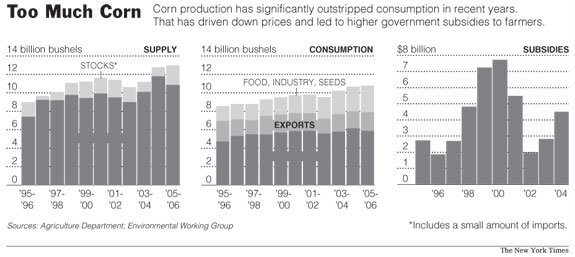
Government subsidies for agriculture in the U.S. are running an estimated $22.7 billion for 2005. These subsidies keep farmers out of bankruptcy, yet they also artificially sustain the market in certain crops, leading to literal mountains of excess grain in the American heartland; this over-supply then depresses the global market price for those grains, making them unaffordable to grow in developing countries, where people actually need the nutrition (and income).
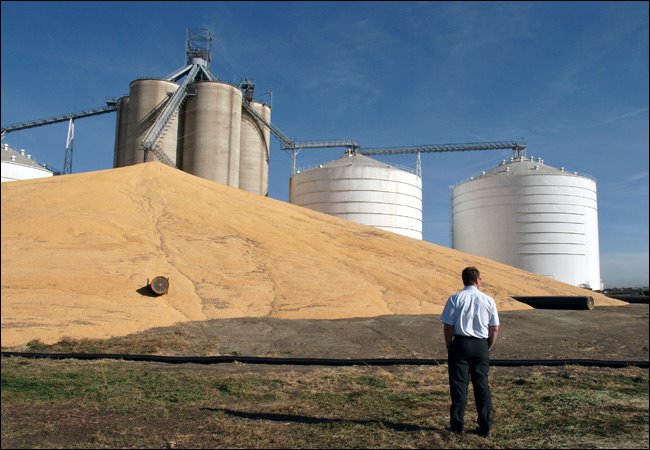
As the New York Times reported last week, Iowa has just made it through a banner year for corn production, “harvesting its second-largest corn crop in history” – and this has produced, yes, “the mega-corn pile.”


[Image: Mark Kegans, for the New York Times].

“Soaring more than 60 feet high and spreading a football field wide, the mound of corn behind the headquarters of West Central Cooperative here resembles a little yellow ski hill… At 2.7 million bushels, the giant pile illustrates the explosive growth in corn production by American farmers in recent years” – an excess capacity that has not only lowered the global market price for corn but has inadvertantly produced these strangely Aztec grain-sculptures, otherwise known as corn piles.


[Image: Mark Kegans, for the New York Times].

Due to subsidies, of course – not to mention “a large overhang of grain from last year, coupled with soaring energy costs and two Gulf Coast hurricanes that stymied transportation, and a severe drought that distorted prices” – this could be “the most expensive harvest ever for the federal government.”
It’s a good thing it’s so useful; as the New York Times says, these farmers “could always build a ski lift on the hill.”


What’s more interesting for me here, however, is not the complicated ins and outs of government farm subsidy programs – to which the Times article is an adequate introduction – but the landscape effects those subsidies have.
Not only are specific landscapes being overproduced – fields of corn vs. fields of wheat; fields of barley vs. fields of sunflowers; etc. – along with all the colors, smells, and sounds those landscapes entail – but the genetic variety of a given region has been artificially determined by the U.S. government.
My point is simply that there seems to be a whole unwritten history of: 1) agricultural micro-evolution as it is affected, or even guided, by government policies, where certain species fare better than others simply because the U.S. government likes them; and 2) the idea of a subsidized landscape.
What would happen, for instance, if it turned out that the head of the Department of Agriculture simply loved sunflowers – or lavender, or cotton? Landscapes of aesthetic usability. Landscapes that just look cool.
Or is the lower Mississippi, as reconstructed and back-levee’d by the Army Corps of Engineers a kind of subsidized landscape? Bought and paid for by Congress?
Or would it be landscapes we already have far too many of and therefore we have to subsidize them – lawns, for example, or mulched playgrounds on hills? You get paid by the government to construct and maintain them.
The national lawn quota of 2006.
Or it’s like a Don DeLillo short story: there’s a subsidy for airport runways only we’ve run out of airports to connect them to, so an entrepreneur goes out to South Dakota and buys up land, and he starts building unusable expanses of subsidized runways, prehistoric concrete geometries of overlapping rectangles – and he’s paid for it. More than he put in. He profits.
No one ever uses his runways.
It’s a kind of aviation landscape subsidy cartel.
Or a car park subsidy… No wonder there are so many.

Suburban earthworks


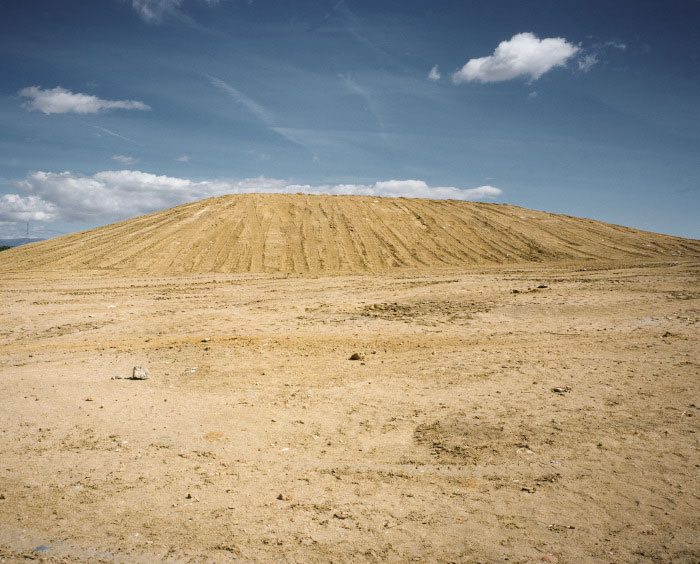
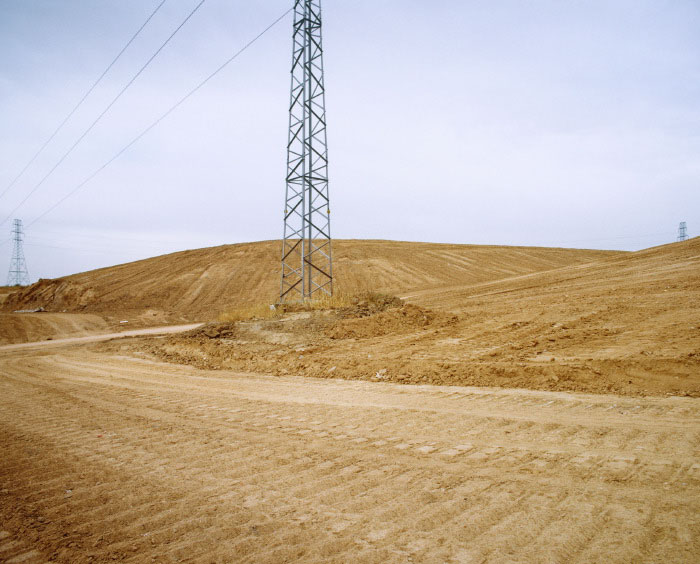
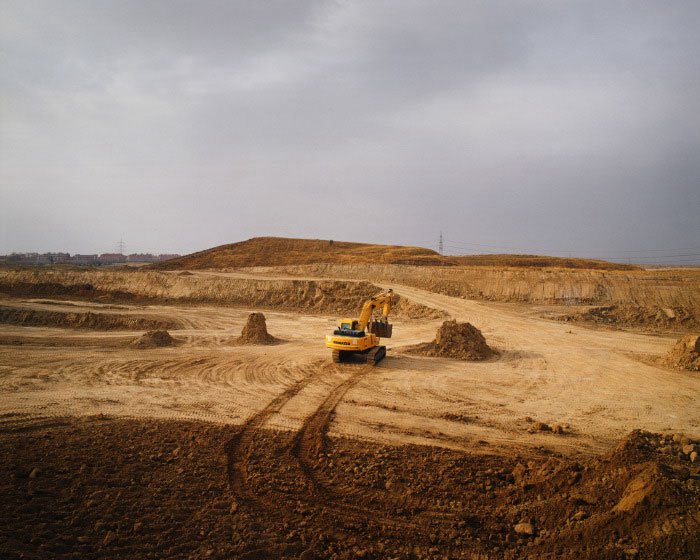
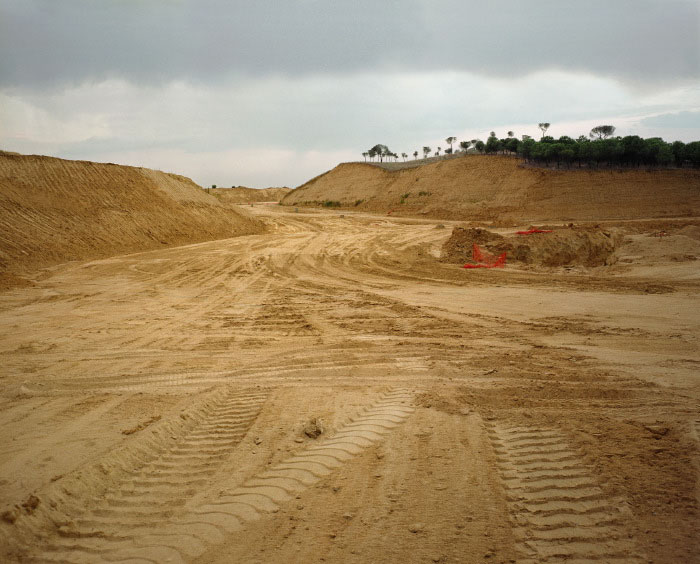
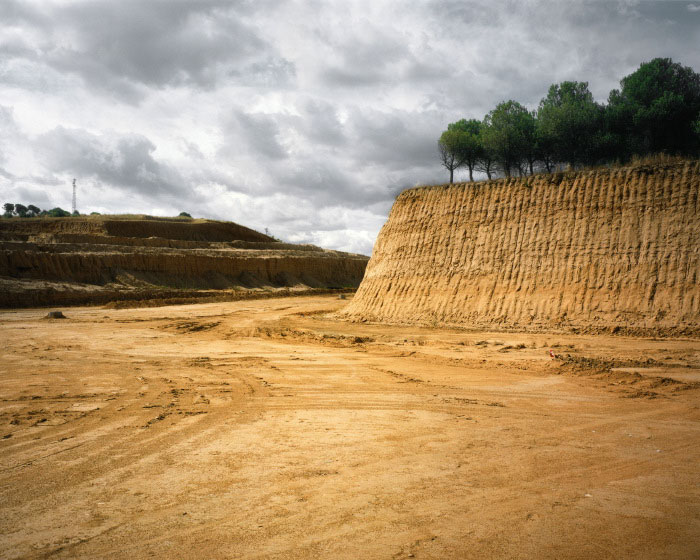
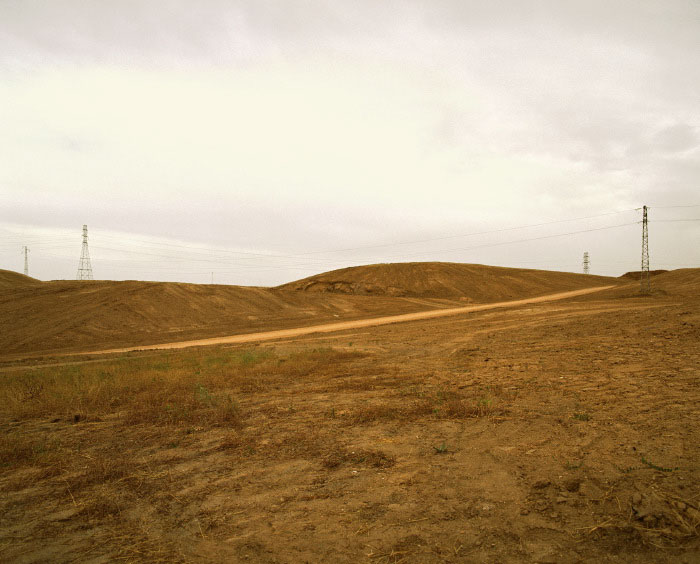
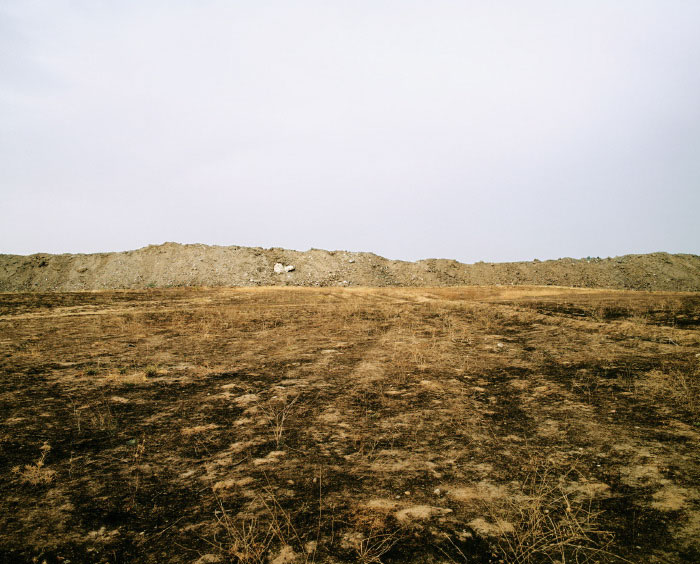
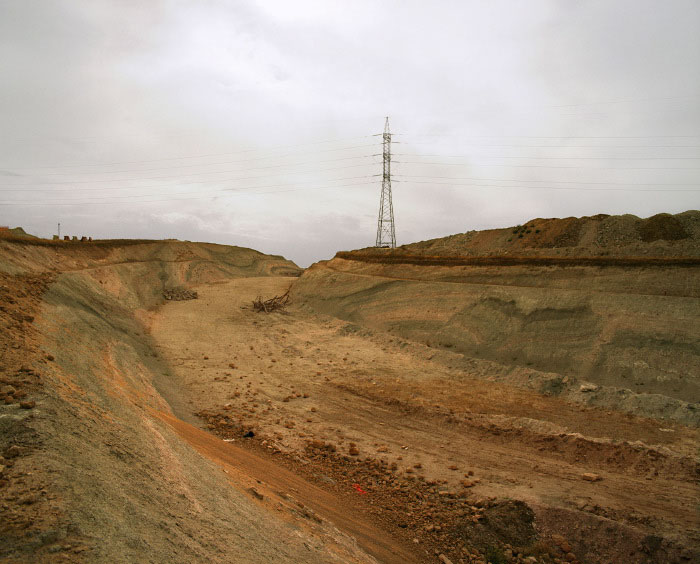
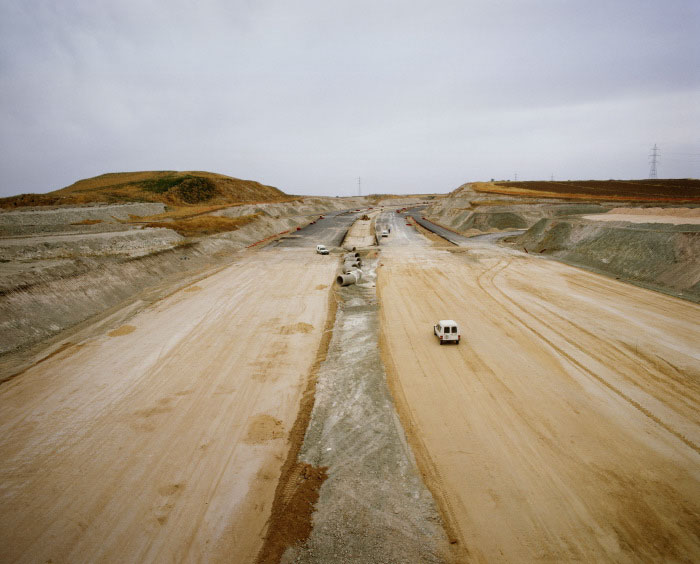
With genuine excitement I discovered the photography of Sergio Belinchón today, and excerpts from his series “Suburbia” (2002) appear both above and below.


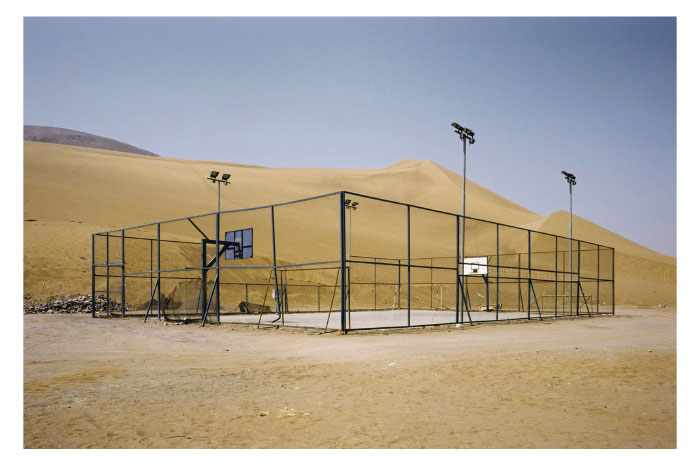
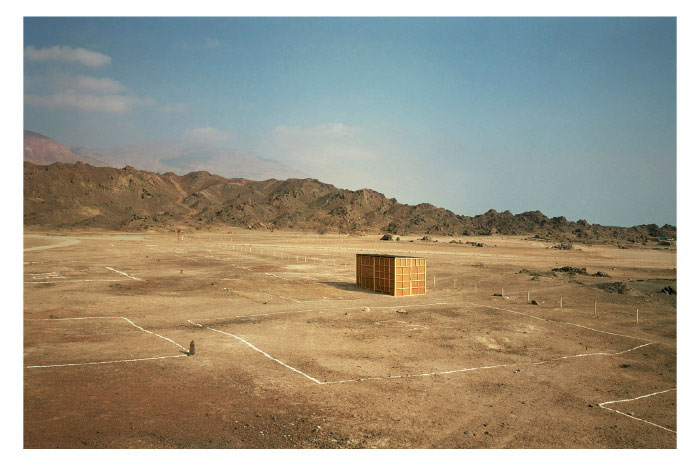
This is the earth immediately before the suburbs arrive, a planet stripped of its identity, prepared to accept housing, made ready for sprawl and subdivisions, human development; soil scraped down to rock, topography tilled, erased clear and reset back to graveled virginity so it can host our lawns and cul-de-sacs.
The earth as passive medium.


Like something between a Michael Heizer earthwork and a kind of pre-Aztec, sacred desert landscape – the Nazca lines, perhaps, ritually repaved – one could be excused for wishing that this preparatory stage could somehow last forever.
An endless topographical sculpture we could somehow also live within: forever moving earth from one lot to another; forever rearranging the labyrinth of abstract forms; forever exploring new combinations of infrastructure.
Yet even after the houses arrive, that’s what these suburbs continue to be; the earthwork doesn’t go away. These sewered tumuli and landscaped berms are just buried by grass and driveways.


To live in the suburbs is to live in a monumental earthwork sculpture. We just tend, after a certain point, not to see it.


In a recent review of Robert Bruegmann’s Sprawl: A Compact History, Witold Rybczynski reminds us that any argument about America being choked to death by limitless, amnesiac sprawl while Europe is sitting pretty amidst history-rich urban density (an argument I make all the time), is actually totally flawed.
That argument – my argument – ignores the built reality.
“Yet haven’t high rates of automobile ownership, easy availability of land, and a lack of central planning made sprawl much worse in the United States?” you might ask.
Well, most Americans seem to be “unaware that suburbs now constitute the bulk of European metropolitan areas, just as they do in America. We marvel at the efficiency of European mass transit, but since 1950, transit ridership has remained flat, while the use of private automobiles has skyrocketed. Just as in America.”


[Image: From Rybczynski’s review, at Slate].

Quoting Bruegmann: “Most American anti-sprawl reformers today believe that sprawl is a recent and peculiarly American phenomenon caused by specific technological innovations like the automobile and by government policies like single-use zoning or the mortgage-interest deduction on the federal income tax. It is important for them to believe this because if sprawl turned out to be a long-standing feature of urban development worldwide, it would suggest that stopping it involves something much more fundamental than correcting some poor American land-use policy.”
Last month, the New York Times Magazine published an article on Toll Brothers, a real estate development firm based in suburban Philadelphia whose ugly, boring, uninspired and wasteful “luxury homes” are now universally known as McMansions.
In the process, companies like Toll Brothers “have, over the past few years, transformed the American home into a corporate product” – a corporate product that sells remarkably well. “At the moment, one in four new homes in the United States is built by a large publicly traded home builder, but this ratio will probably change significantly. Several Wall Street analysts and most of the big home builders seem confident that their companies will be responsible for half of all new homes in the United States within 10 years and perhaps more (as the industry consolidates).”
I, personally, find this a bit depressing.


If Toll Brothers’ homes could be just 10% more energy-efficient – passive solar, for instance; just 10% less resource-intensive – smaller lawns, or perhaps lawns differently planted; made of just 10% more renewable materials – fewer PVCs; then the environmental, political, and even biomedical repercussions of the now global suburban lifestyle could be reduced accordingly.
But nope.


“Where (and how) will the next generation of Americans live?” the New York Times Magazine asks. “The big builders need to know, because they intend to build those places.”
Which means at least three things to me: 1) Toll Brothers and their ilk – as evidenced by Belinchón’s photographs – have very clearly replaced Robert Smithson as the leader of the American earthworks movement (not that art historians will notice this); 2) “the next generation of Americans” is totally screwed, frankly, unless all the young PBR-drinking hipster idealists go into green real estate development; and 3) if Robert Bruegmann is right, the next generation of Europeans is screwed along with them.
Well: 4) number 2) also applies to architecture bloggers.
In the meantime, before those future suburbs arrive, before roof trusses are framed and foundations are poured, we’ll be treated to the intoxicating and Heideggerian sight of more monolithic earthworks, more abstractions of tilled gravel, more smooth berms, fake hills, and geometric manmade canyons.
A world plotted, sold – and temporarily existing as sculpture.


(Sergio Belinchón discovered via Artkrush; Witold Rybczynski’s review discovered via Dan Polsby [thanks!]).

At Random

A whole host of things to waste your lunch-break on:


<1> Photographer David Allee – whose image “Blue Lagoon” appears above – has a show coming up at Princeton.
Allee’s photographs have studied, among other things, “the intrusive otherworldly effect of artificial light on man-made environments.” As Metropolis further explains: “Working with a large-format Linhof Technikardan camera, he positions himself in front of apartment buildings, houses, and gardens that are bathed in the overflow of floodlights from sports and recreation facilities. Using shutter speeds of two to three minutes, Allee subjects his film to the kind of intense light that turns night into an unnatural day…”

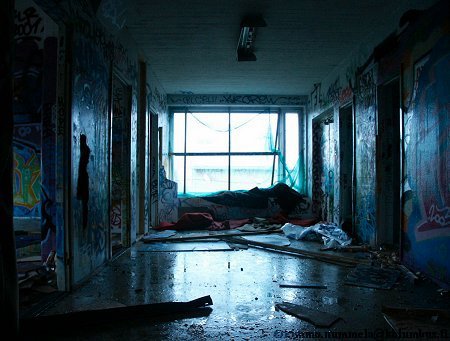
<2> Some Finnish bunker archaeology and post-military landscape exploration – old bastions, train yards, abandoned towns, even a “sea fortress” – at Kimmo Nummela’s Silent Wall.


This site includes a tour of the unsubtly named “toxic suburb of Alakiventie.”

<3> Reading this put me in a strangely good mood: “the devastation from the Gulf Coast hurricanes is serving as a strong reminder that possible disasters could lay waste to cities and states across the country.”
Wow. What kind of disasters?
“Officials in California worry about the collapse of aging levees in the delta of the Sacramento and San Joaquin Rivers, which might allow surging seawater to contaminate much of the state’s drinking water supply. A major concern in Seattle is the seismic vulnerability of the Alaskan Way Viaduct, a busy elevated highway in such peril that weight and lane restrictions were imposed on buses and trucks. In Montana, Idaho and Wyoming, there is the recurring danger of a volcanic eruption at Yellowstone National Park, while in Florida, attention has turned anew to cleaning up Lake Okeechobee, which sends polluted water into nearby rivers during heavy rains and floods.” Etc.


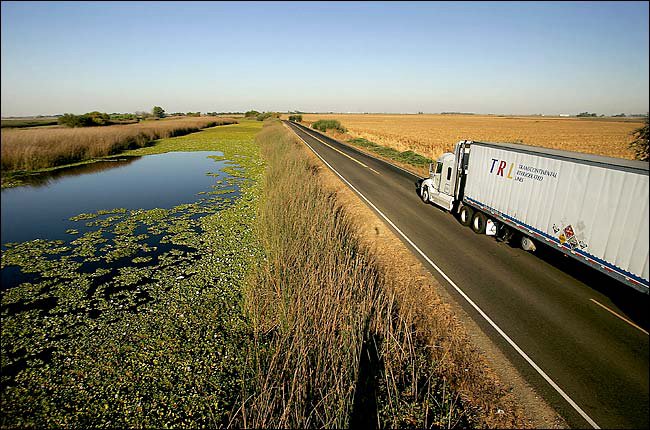
[Image: “A major earthquake near Stockton, Calif., where Highway 4 serves as a levee road, could be disasterous.” David McNew/Getty Images].

But at least I’ll be around to see what’s next, I suppose, after civilization. After the human. I’ll take notes, hiking through flooded cities like a modern-day Crusoe, crawling over concrete skeletons of collapsed highway flyovers, slowing dying of skin cancer. Grilling squirrel meat next to leaking power plants. My teeth falling out. I’ll meet heavily armed women wearing animal fur bikinis and – wait a minute – what –


<4> “Small clouds of dark matter pass through Earth on a regular basis,” the New Scientist reports. Those clouds “may be remnants of the first structures to form after the big bang.”


[image: EurekAlert!].

These are structures made entirely of dark matter, however, and they look like “flattened spheres or cigars with diameters about 4000 times the distance between the Earth and Sun.” And if that sounds nuts, remember that there could be “a million billion of them drift[ing] around the large dark matter halo that is thought to enclose our galaxy. Such a cloud may float through Earth every 10,000 years in an encounter lasting about 50 years… Their relatively wispy densities mean they could only nudge our planet out of its normal orbit by less than a millionth of a metre per second. Still, they may leave behind observable signatures.”
Such as BLDGBLOG.

<5> Continuing BLDGBLOG’s recent cosmology theme, here is a photograph of “star-forming pillars in a region known as W5 in the constellation Cassiopeia.”


[Image: Spitzer Space Telescope].

“Nestled within the dusty pillars are hundreds of embryonic stars,” says the New York Times, and yet these shining pillars “probably represent [only] the densest, most fecund remnants of a larger, cloud. [Note: that stray comma is the NYT’s]. It is being eroded by radiation and winds of particles from a ferociously bright star just out of the top of the picture.”
That photograph is also just an infrared version, taken from a section of this –


– which I’m sure you’ve seen. If not: it’s the “Pillars of Creation” in the Eagle Nebula – but even they are fading! Everything ends.

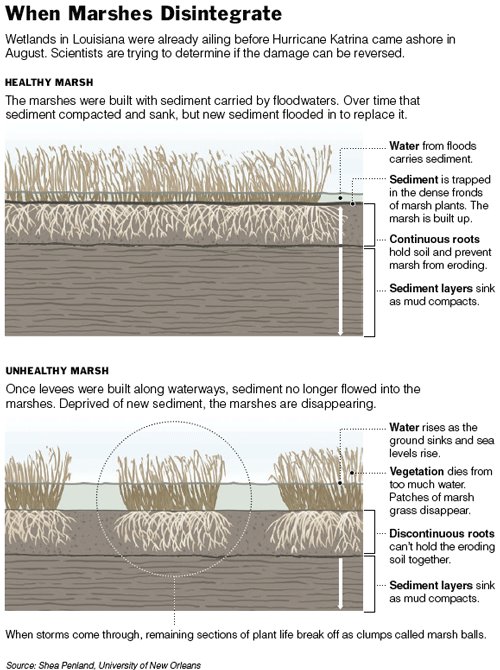
<6> And, man, is this entry getting depressing: the marshes of Louisiana are dying.


[Image: “Dead oak trees signal a marsh in danger ” Lori Waselchuk/NYTimes].

They’re breaking up into so-called “marshballs” and other “marsh debris” – but why? “The questions are complicated, and the answers turn on a number of factors, including the region’s geology, the ways people have engineered the flow of the Mississippi River, and the marsh-killing activities of the oil and gas industry.”


[Illustration: Al Granberg, New York Times].

This comes less than a week after we read that “[r]estoring Louisiana’s vanished wetlands, or even maintaining those that remain, will be impossible, according to an expert panel convened in 2004 by the National Academy of Sciences to consider a major proposal for wetlands restoration in the state. The panel says the time has come for state and local governments, businesses and citizens to start talking about which wetland areas can be preserved and which must be abandoned, a process it called ‘managed retreat.'”


[Image: “A view of canal systems that link oil fields south of New Orleans.” Lori Waselchuk/NYTimes].

But some people don’t want to retreat – that would be un-American. Dan Walker, for instance, a geologist with the National Academy of Sciences, says that, quote, “If we don’t draw this map, nature will.”
And we can’t let that happen.
For a more sustained look at the ins and outs of imperial hydrology see BLDGBLOG’s first post on Hurricane Katrina, Chapter 1 in John McPhee’s The Control of Nature – and, why not, Floating islands gone wild.

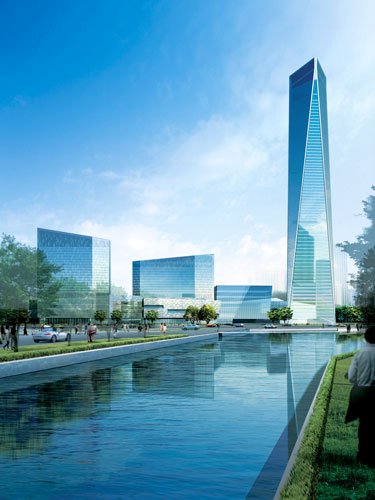
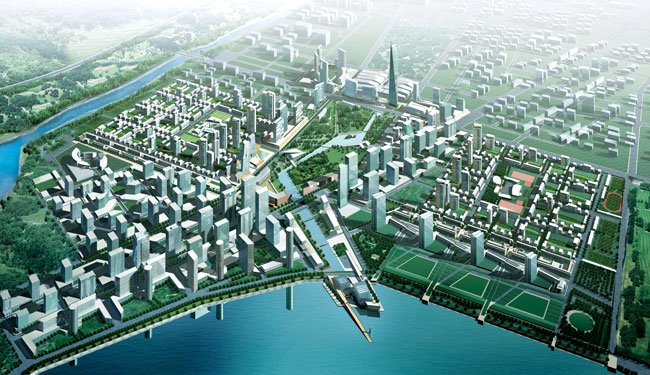
<7> BLDGBLOG has already reported on a new Russian utopia, but here’s one in South Korea: New Songdo City.
“New Songdo, a free-enterprise zone where English will be the lingua franca, is often called the largest private real-estate development in the world. When completed in 2014,” the New York Times says, “it is estimated that this $25 billion project will be home to 65,000 people and that 300,000 will work there. Amenities will include an aquarium, golf course, American-managed hospital and preparatory schools, a central park (like New York’s), a system of canals (like Venice’s) and pocket parks (like Savannah’s), a self-described patchwork of elements gleaned from other cities.”


[Images: Kohn Pederson Fox Associates].

A “patchwork of elements gleaned from other cities”? Yep – that means it will also look like every other city…
So it may not be utopia, but it is ubiquitous – and this is where it gets freaky: “A ubiquitous city is where all major information systems (residential, medical, business, governmental and the like) share data, and computers are built into the houses, streets and office buildings. New Songdo, located on a man-made island of nearly 1,500 acres off the Incheon coast about 40 miles from Seoul, is rising from the ground up as a U-city.”
Thomas More meets Minority Report.
And for more images of New Songdo, stop by Metropolis. Also, see BLDGBLOG’s Singapore Bio-utopia. (And more on this topic soon).

<8> I’ve hit the wall here; but I have about a hundred other links to add so I’ll come back for those. Till then –

Filaments of space-time


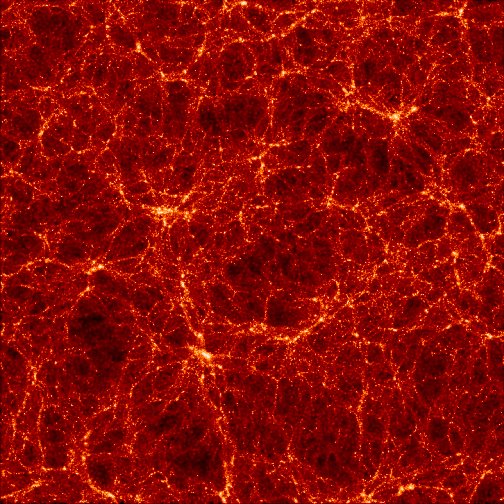
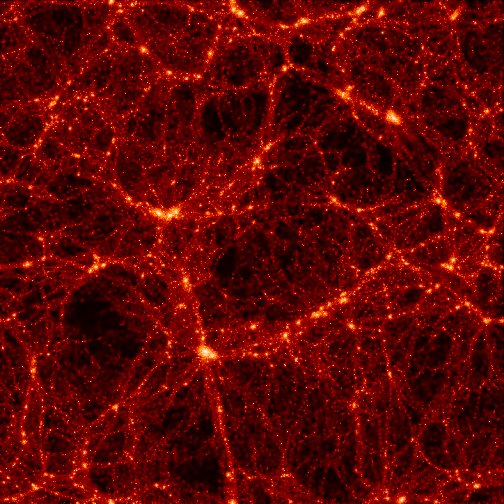
[Images: Density plots of matter in space – whorled lattices of knots and self-intersection – from the Max Planck Institute for Astrophysics].

At the University of Durham, UK, there’s a group of scientists and computer programmers who call themselves the Virgo Consortium for Cosmological Supercomputer Simulations – a name which leads me to wonder who is cosmologically simulating a supercomputer, and why.
But the purpose of the Virgo Consortium is to use “cosmological simulations” to study “the large-scale distribution of dark matter, the formation of dark matter haloes, the formation and evolution of galaxies and clusters, the physics of the intergalactic medium and the properties of the intracluster gas.”
So what’s this got to do with BLDGBLOG…?
Some comments at the end of a recent post made me think of images I’ve seen of intergalactic structure – what the universe looks like: webs of stars in space, huge arc-bubbles of light colliding with themselves in glowing, superskeletal networks, filling space like translucent caulk.
But when I went to find those images again I realized you can actually watch entire films, simulated fly-throughs, of the quantum void, passing through vaults of gravitational foam, and those interstitial spaces seemed perfect for a quick new post.


[Image: “Surrounding and stretching between galaxies, there is a rarified gas that is thought to posses a cosmic filamentary structure… This material is called the intergalactic medium (IGM) and is mostly ionized hydrogen (i.e. a plasma).” These images show “the formation of a galaxy cluster.” Structure, it seems, is really a compression or tightening – a focusing – of the surrounding medium. From Craig Booth/The Virgo Consortium].

So the Virgo Consortium, which I’ve mentioned, is a partner of the Max Planck Institute for Astrophysics, and among its tools are a Cosmology Machine and a Sun Grid Engine, both of which surely sound like something straight out of the novels of China Miéville.
Some of the images and simulations these institutes produce, however, are so intensely beautiful that simulations of the universe could perhaps be seen as something of a niche market for starving artists, a new genre of self-expression. Rather than writing novels – you simulate the cosmos. Over and over.


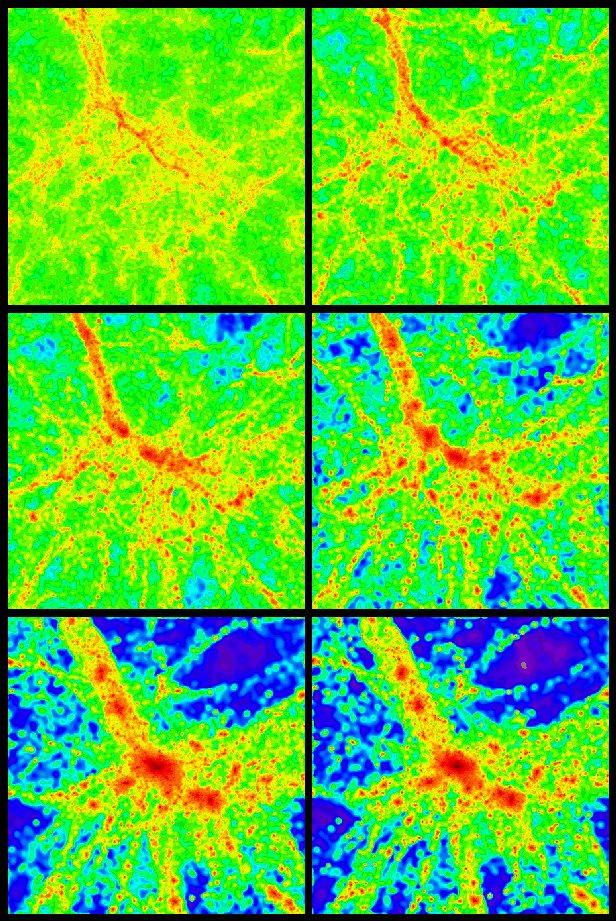
[Images: From the Millennium Simulation; time advances as you go down till “structures are abundant in the universe manifesting themselves as stars, galaxies and clusters.” (Images by the Virgo Consortium)].

So the following short films either take you flying through the universe for all too brief an instant, or they show structure crystallizing out of the universal void-plasma. Either way, enjoy: film 1; film 2 (which seems to portray the universe as a kind of malfunctioning television set); film 3; film 4; and – I like this one – film 5, a kind of slow, hypnotic, black-and-white cosmology as filmed by Jean Cocteau.


[Image: Cosmic filamentary structure – buttresses of light – foregrounded against gravitational darkness: Max Planck Institute].


[Image: A Warholian depiction of the universe: Max Planck Institute].