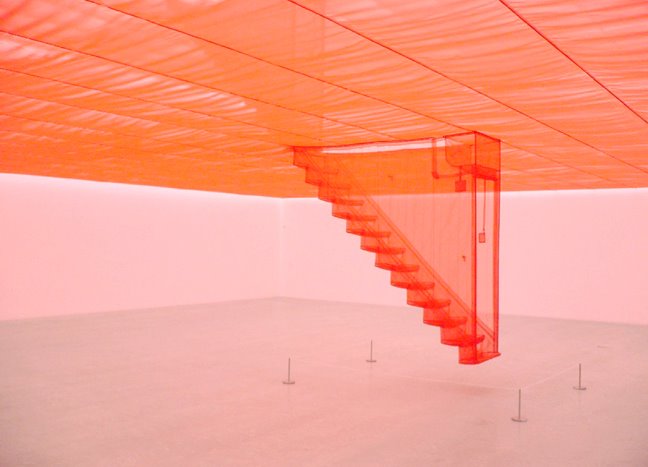
More Do-Ho Suh, this time photographed by gravestmor‘s own Marcus Trimble. It’s a set of stairs woven entirely from translucent nylon. Hanging in space.
Meanwhile, check out the previous post for information on Do-Ho Suh – and don’t forget to stop by gravestmor: it’s worth the trip.
Year: 2005
Woven interiors

Artist Do-Ho Suh replicated the complete interior of his old home in Korea – only he did it using translucent nylon.
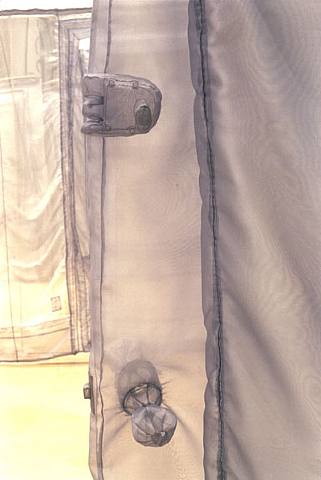
He took sewing lessons from old dressmakers so he could assemble the whole thing himself – and then he built another replica: of his apartment in New York City.


It sounds like the whole thing was inspired by a combination of nostalgia and insomnia; but he talks more about it here, in an interview with PBS.


Meanwhile, you can learn more at Brown University and at Artnet – which is where I found these images.
(Originally spotted at Blanketfort).
Battersea

[Image: Battersea Power Station, London, from where else but International Urban Glow (see earlier)].
The moon, England’s tidal fence and electrical Futurism

As the Independent reported this morning, England’s river Mersey may soon become “the first river in Britain to generate electricity from its tides” – using a tidal fence.

Plans are afoot to take advantage of “the Mersey’s vast renewable energy potential by constructing a tidal power fence which, according to initial estimates, could generate up to 2,000 megawatts of electricity, enough to power 15 per cent of the North-west’s electricity requirements. The Mersey offers more tidal power potential than virtually any other river in Europe, by virtue of its 10-metre tidal range and strong currents which are a by-product of its shape and its position on England’s windy North-west coast.”
It is, in other words, about to become a machine.
First, water at high tide will be shut into a sequence of locks and gates; in this respect, the tidal fence is not unlike a standard shipping canal. But then, as the river drops with the tide, the trapped water – now at a higher elevation – will be “allowed to escape through the turbines of a hydroelectric plant.”
This will turn the water’s gravitational potential energy into electricity.

Tidal fences, however, are only one technical option – there are also tidal turbines, for example, and there are important differences between turbines and fences. (For more on this, see Daily Kos).
But why should we care about tidal power at all?
“Tidal power is more dependable than wind due to its predictable nature thus making it a better source of electrical energy for feeding the baseload of the national grid. The tides run almost 6 hours in one direction and then reverse and run for 6 hours in the opposite direction thus giving a power source that is available 24 hours a day unlike wind and solar.”
Or, as we read in this press release: “Seawater is 832 times as dense as air; therefore the kinetic energy available from a 5-knot ocean current is equivalent to a wind velocity of 270 km/h.”
The point is that tidal power kicks wind power’s a**.
Meanwhile, the technology itself verges on the occult.
Norway, for instance, is experimenting with moon power at a new station built by Hammerfest Strøm AS: “The rise and fall of the sea, caused by the Moon’s gravitational tug on the Earth, could be generating electricity for hundreds of thousands of homes within five years if the new Norwegian power station proves successful. The power station, which resembles an underwater windmill, began generating electricity for the town of Hammerfest. Although still largely a prototype, the generator is the first in the world to harness the power of the open sea and be connected to an electricity grid.” (See the details in their own technical PDF).
So, sure, all tides are lunar, and therefore all tidal power is lunar power… but it’s still fascinating.
It’s like something straight out of Aleister Crowley.
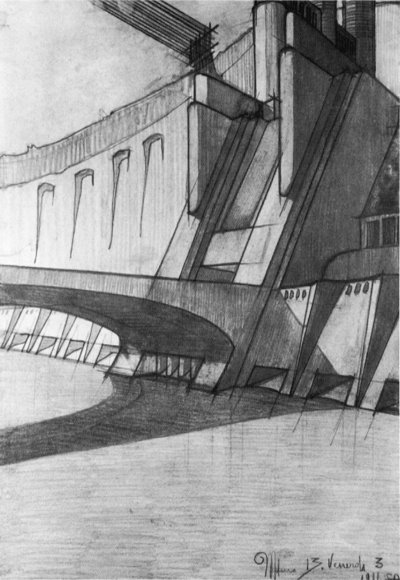
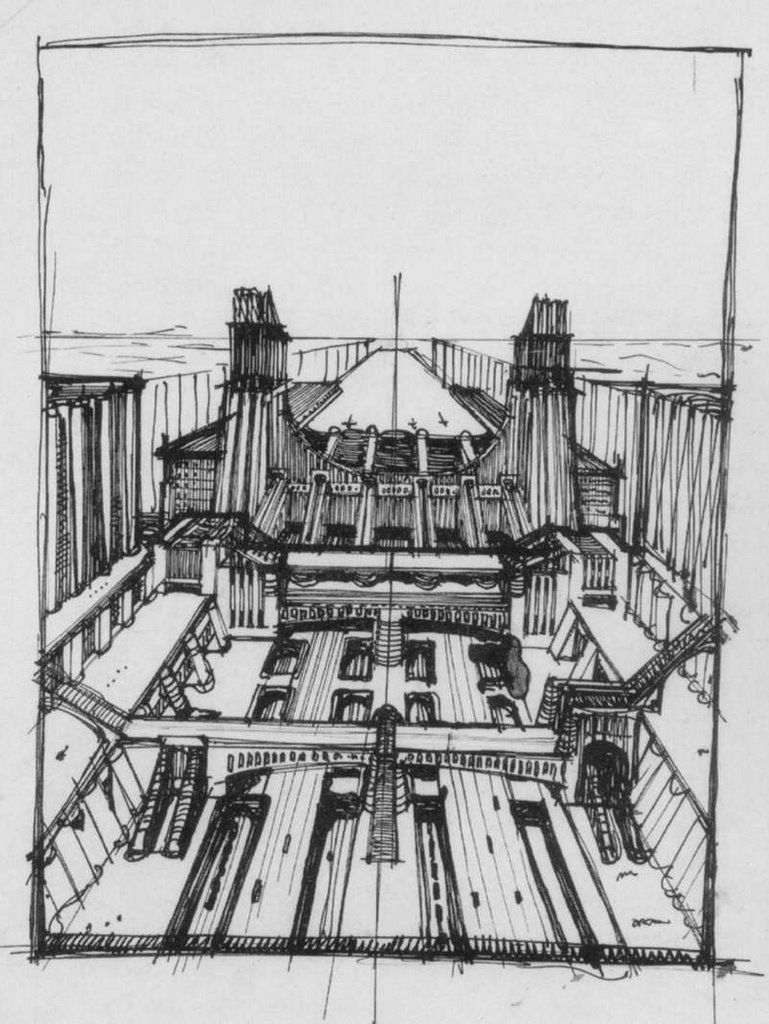
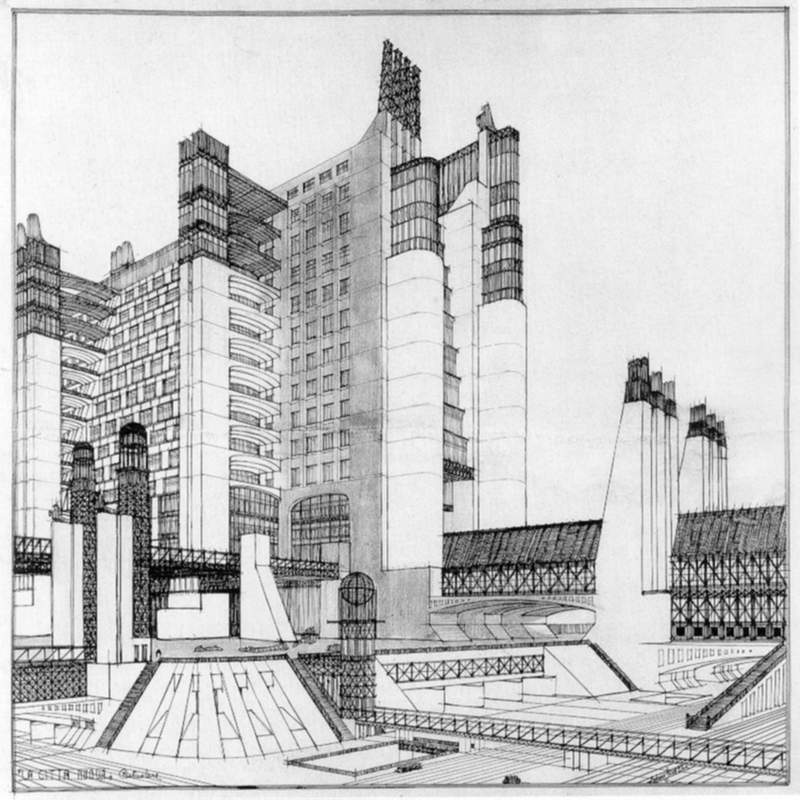
Meanwhile, the images that you’re seeing scattered throughout this post are all by Italian Futurist architect, Antonio Sant’Elia. Not a single one of them is of a tidal fence, a tidal turbine, or even of a hydroelectric dam; but his obvious exuberance for monumental power-generation structures is: 1) so bizarre it’s almost touching; and 2) just waiting to be copied by a new generation of architects, gamers, novelists and filmmakers.
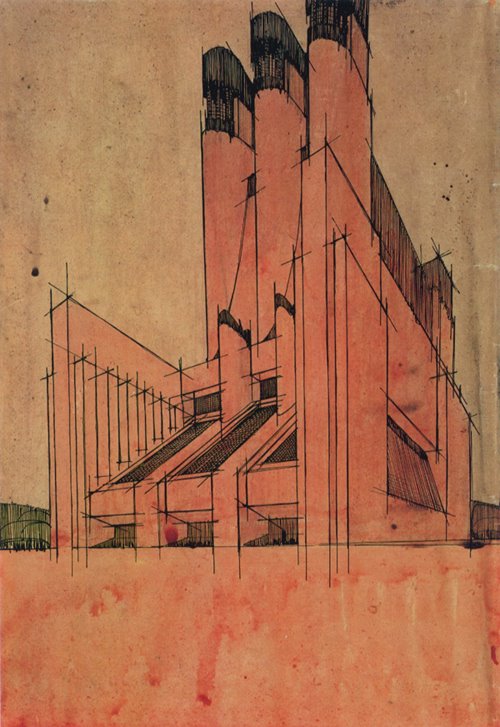
Herculean and abstract concrete structures humming with hydroelectric power. Submerge ten of these things in the Mersey… and England just got a whole lot brighter.
Lifting Venice – Again
Turns out those plans for elevating Venice aren’t even new!
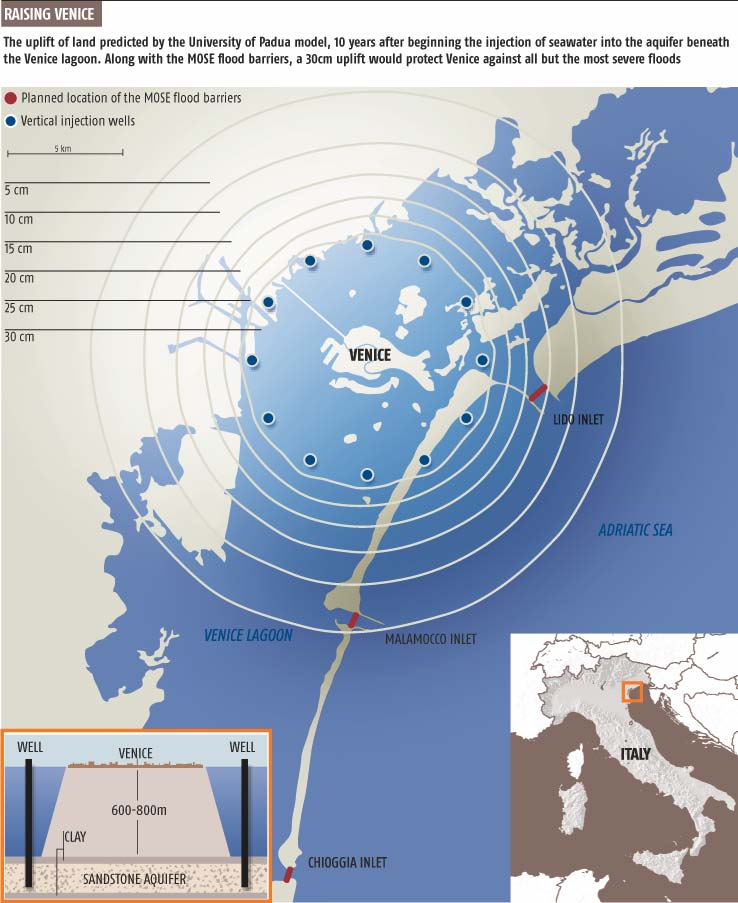
[Image: New Scientist, July 2004; worth clicking on to enlarge].
BLDGBLOG has been doing its homework, and we’ve found that the New Scientist explained all this way back in 2004: “Venice’s problem is largely one of subsidence, both natural and man-made. From the 1930s to the 1970s, fresh water was pumped out of underground reservoirs beneath the city to supply surrounding factories. As the water was pumped out of these aquifers – which are rather like rocky sponges – their water-filled pores compressed and the ground sank. Combined with sea-level changes, this has produced an effective rise in sea level of 23 centimetres over the past 100 years.”
Thus the whole raise-the-city-with-water-pumps idea.
“Numerous plans have been proposed to prevent Venice succumbing to the floodwaters, many of them controversial,” New Scientist continues. “But if the latest idea gets the go-ahead it will raise more than a few eyebrows. Rather than trying to control the rising water level by keeping the sea out, engineers at the nearby University of Padua want to lift the entire city out of harm’s way by raising the ground upon which it sits.”
Fair enough.
But I still think they should put the whole thing onto an arched labyrinth of mechanized legs – inter-connected offshore oil platforms that can walk – and let the city flee inland by itself.
King Kong 2: Contro Venezia! The love-crazed simian dukes it out – with Spider-Venice.

UPS Vernacular
I was looking at this UPS label when I realized it contains some interesting architectural assumptions.

It offers me a porch, a deck, a garage, a back door, a patio, etc., on which to collect my package.
But no cheese cave or tower or footbridge; no Zen rock garden or prefab container village; no offshore Texas tower; no private helipad…
How does UPS account for other architectural styles? Oh – you tic Other! Now I get it. The international option.
“Just leave it in the harem,” I’ll say. “Leave that one beneath the torii gate, sir.” “Leave it in the Other.”
It’s the UPS Vernacular.
Lifting Venice
“Italian experts are proposing a dramatic new solution to the watery threat facing the city of Venice,” the BBC reports.

“Rather than battling to keep the sea out – they want to use it to help raise the sinking island-city. The scheme would involve pumping huge quantities of sea water into the ground beneath Venice down 12 pipes each of which would be 700m (765 yards) long. The sea water would make the sand beneath the city expand lifting Venice by 30cm (11.8 inches) in 10 years.”

This, of course, comes after the so-called “Moses Project,” which, as the BBC describes it, is “a series of 78 mobile steel barriers to be activated during exceptionally high tides. The barriers, due to be in place by 2011, will lie on the seabed most of the time, but will be filled with air to create a dam when Venice is threatened.”

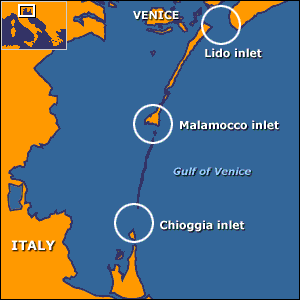
Of course, soon they’ll just put the whole city atop a mechanized webwork of spindly little hydraulic legs that will stand up and walk inland – taking the Bridge of Sighs with it. The fully automated Robo-Venice of the future.
Meanwhile, for comparison, there’s always the Thames Barrier –


– but everyone knows that won’t save us…

Amazonia Britannica
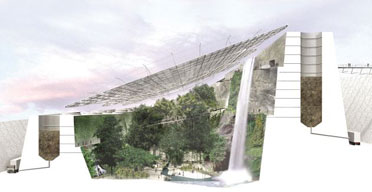
“The team of architects behind the Eden Project in Cornwall is planning to turn a Lancashire rubbish dump into a tropical rainforest which would heat itself with decomposing garden and kitchen waste.”
That doesn’t excite you?
Well, the plan also “includes one of England’s highest waterfalls, walkways through the treetops and possibly Europe’s biggest compost heap, capable of using most of the green waste of a city the size of Manchester.”
Bedrock: The Film
In the previous post – about the films of Stan Brakhage – I complained that you could not make a film using bedrock; but I stand corrected.
“It is entirely possible to project light through bedrock,” an email I soon received explained. “Thin sections, samples of rock ground to a thickness of 30 microns for viewing under a microscope, are a standard tool of petrology.”
So I was pointed to a website, did some research – including petrographic imagery at Humboldt State University, a Parisian Atlas minéralogique, and some “plutonic microtextures” at UNC-Chapel Hill – and it’s true: you can make your own Mothlight using slices of bedrock. The continental plates as a kind of underground Hollywood. Film in mineral form.
Some examples? Just look below:


How would you do it? As but one example, you could animate the following sequence –


– which would not only display a very obvious sense of visual continuity, it would offer its own short geo-metamorphic narrative: anorthosite becoming gneiss becoming biotite-rich granite.
You could explain and demonstrate simultaneously the formational history of the earth, using abstract patterns of mineral imagery.
Bedrock: The Film.
(Thanks to Mike Weber for the initiating email; and all images above are by Kent Ratajeski at UNC-Chapel Hill).
Stan Brakhage: Cellscapes
I first heard of Stan Brakhage as if he were an urban myth or some kind of artistic rumor: some guy had supposedly taped thousands of mothwings – real mothwings – onto a reel of celluloid and released it as a “film.” Thousands of mothwings, with light projected through them, flickering.
Turns out, of course, it was true, and the film is called Mothlight.
Having been reminded of this by the preceding BLDGBLOG post – which has some ridiculously beautiful images of cyanobacteria – here’s a quick glimpse.


[Images: Stills from Stan Brakhage, Mothlight (1963)].
Brakhage taped actual pieces of animals and plants to a reel of celluloid! You’re watching shadows of an actual landscape, in cross-section – core samples – projected onto a screen like any other cinematic experience. Landscape as cinema.
It’s too bad you can’t do something like this with bedrock, I have to say – but you could make an entire film out of fossilized amber, for instance…

Anyway, you can watch Mothlight on DVD. (Which, of course, eliminates the fun of the actual mothwings – but no matter).
Alien Planet
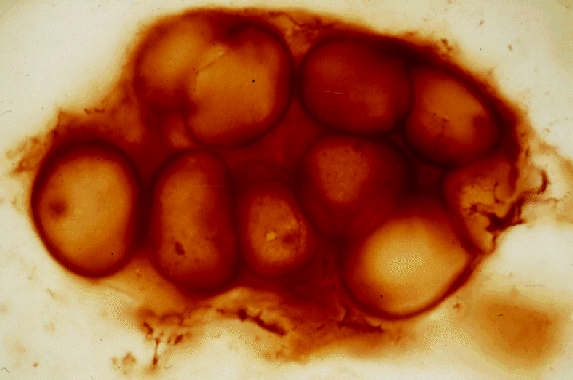

[Images: Fossilized cyanobacteria from Bitter Springs, Australia; and nonfossilized cyanobacteria].
The early Earth, in its so-called Hadean phase, was a constantly exploding storm of rocks and asteroid impacts. Lava flows wider than the Mediterranean and deeper snaked across barren igneous landscapes, forming deltas of volcanic glass – that were then shattered by iron-rich debris falling from space.
This went on for millions of years.
No rocks survive from this period; it was a landscape that entirely destroyed itself.
“How did life emerge amidst this mayhem?” asks physicist Paul Davies, in what is surely one of the most interesting New York Times editorials (10 April 2005) published this year.
“Quite probably it was a stop-and-go affair, with life first forming during a lull in the bombardment, only to be annihilated by the next big impact. Then the process was repeated, over and over.”

[Images: Fossilized cyanobacteria from Bitter Springs, Australia].
What’s interesting here is that one colony of microbes finally survived long enough to get its foot – excuse the anatomical metaphor – onto the evolutionary escalator, and thus we’ve got life as we know it. Terrestrial life.
But, Davies asks, what if another microbe colony, locked in its place of safety – burrowed into bedrock, or buried under rising seas – what if it too survived?


[Images: Like screen captures from a Stan Brakhage film, these are the elegantly named Oscillatoria and Spirulina cyanobacteria].
“It’s possible that pockets of microbes could have survived in obscure niches… opening up the tantalizing prospect of two or more different forms of life co-existing on the same planet. Although they would compete for resources, one type of life is not necessarily bound to eliminate the rest.”
“Thus,” he concludes, “microbes from another genesis – alien bugs, if you will – could conceivably have survived on Earth until today.”
Are you sure that’s your little brother?
This would be “a form of biology that is unrelated to familiar life” – and coming soon to a sci-fi novel near you. Or, in Jerry-Bruckheimer-meets-BLDGBLOG part 473: A mining operation in the Australian outback discovers weird subsurface geological formations that appear to be fossilized bacteria – only the team members are getting headaches, and they’re coughing up black phlegm… They have infected themselves with a disease from the Hadean era.
Anyway, check out this NOVA interview with Harvard scientist Andrew Knoll about the origin of life on earth – while I try to kick-start a career in Hollywood…