Unhinged and treeborne

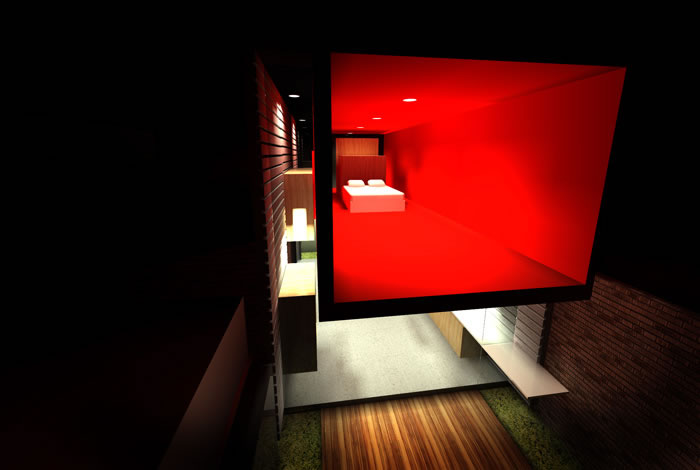
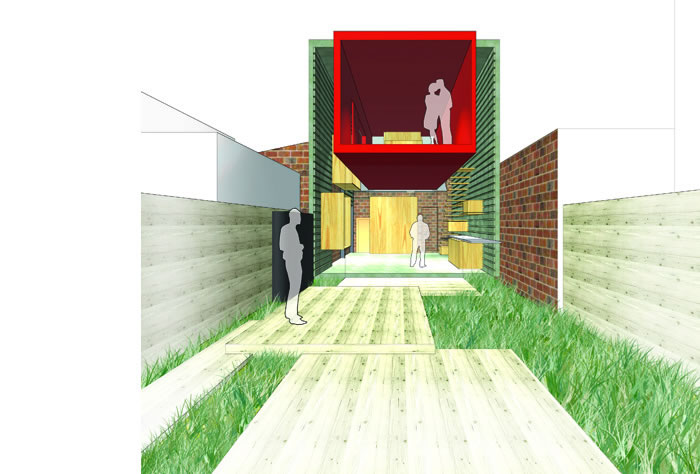
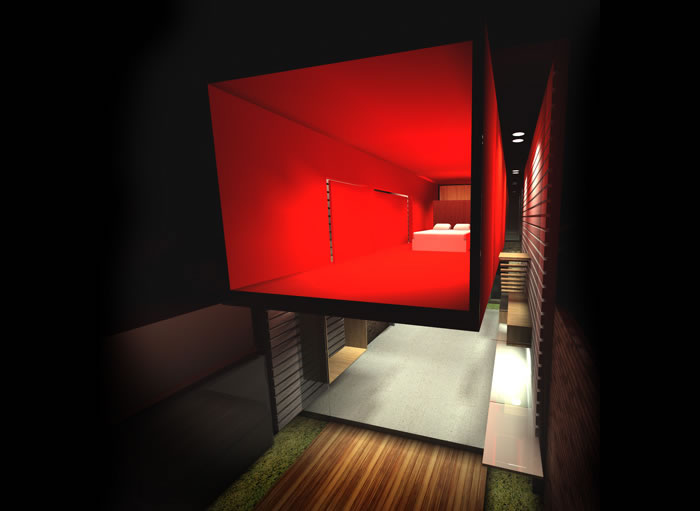
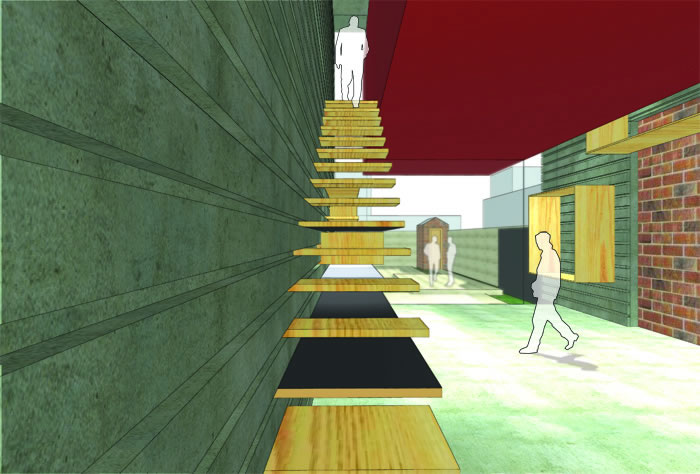
Andrew Maynard‘s Holl House starts off as a vertical column, then unlocks into a horizontal network of hinged structures –
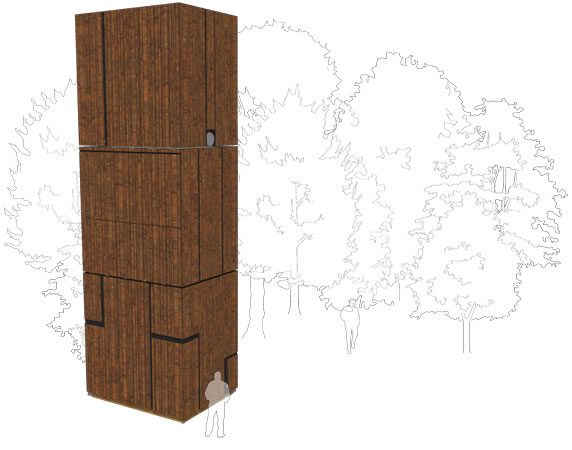
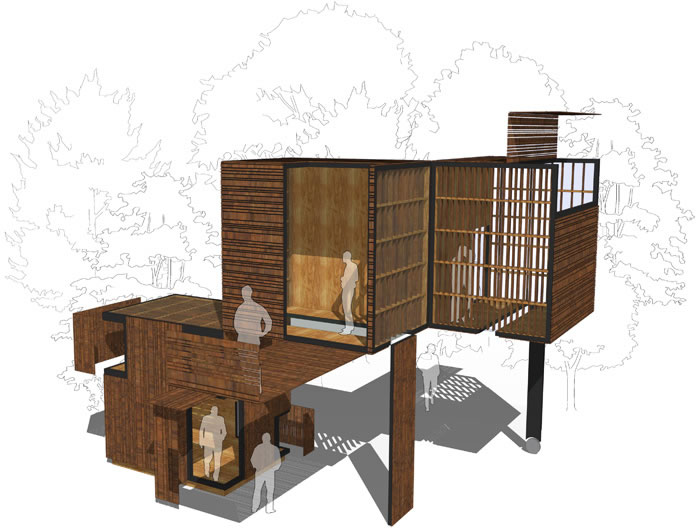
– in a process described by this diagram:
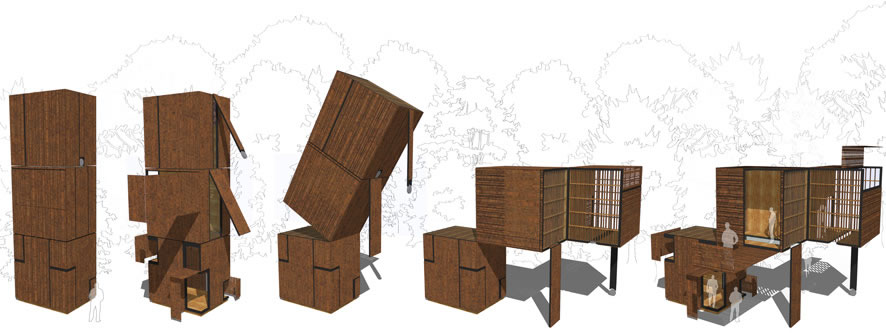

Sure, there could be loads and loads of stress fracture problems, pinched fingers and drunken accidents – the whole damn thing folding up as you hit the wrong button, collapsing into bed – but put several of these things together and you’ve either got the most exciting micro-city in the world, or an Oscar-winning set for a new science fiction film. Or both.
If I were rich, I’d buy fourteen of them.
But meanwhile, the designer, Andrew Maynard, appears to have no shortage of great ideas. I only today got around to reading a whole profile of his work posted on Archinect last month, and I was practically laughing out loud some of it’s so good.
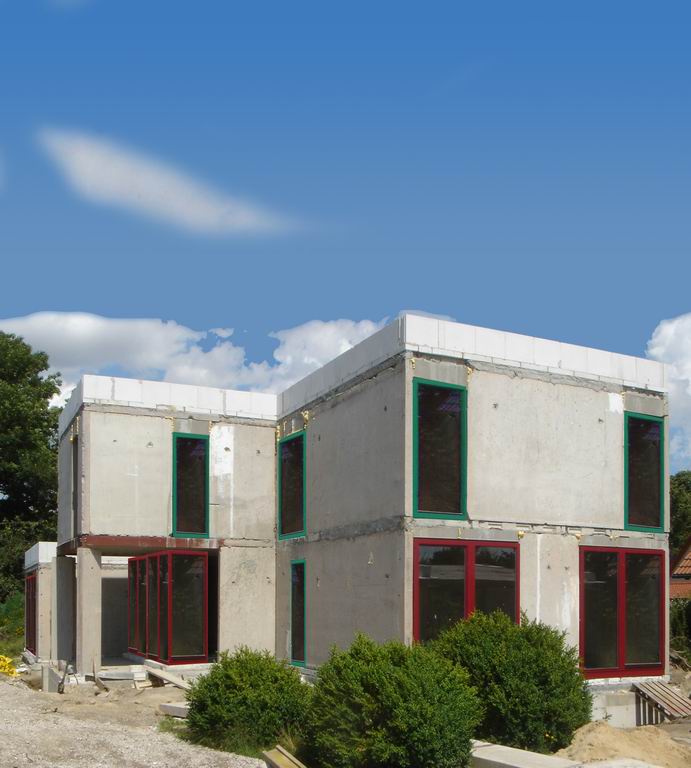
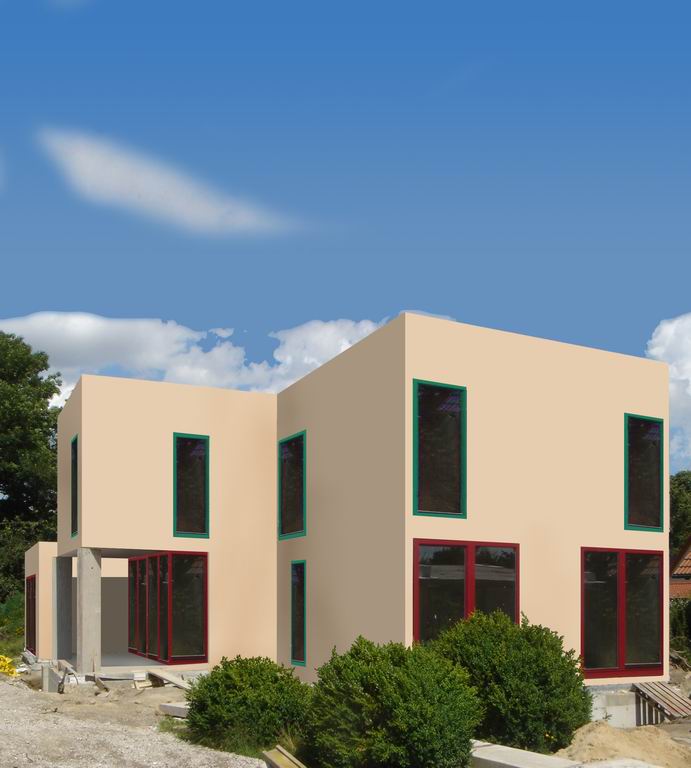
Check out his prefab entry to the 2004 VicUrban affordable housing competition.
“How can the housing industry make exciting, well designed and cheap housing?” Maynard asks. “Easy, mimic the car industry.”
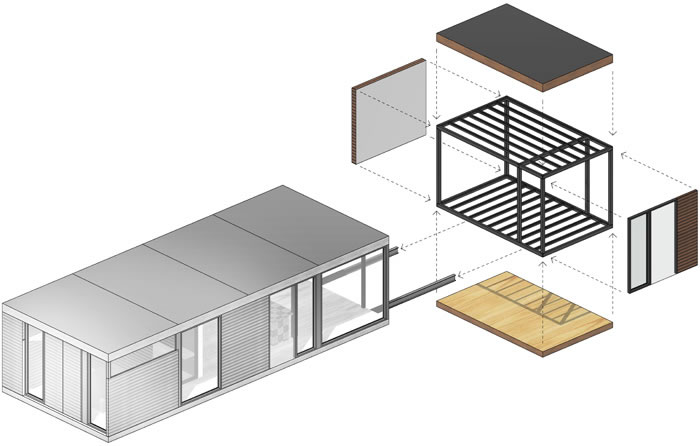

“The dimensions of the basic module are dictated by the maximum dimensions available to be transported legally on Australian roads without permits.”


The house is then assembled on-site –
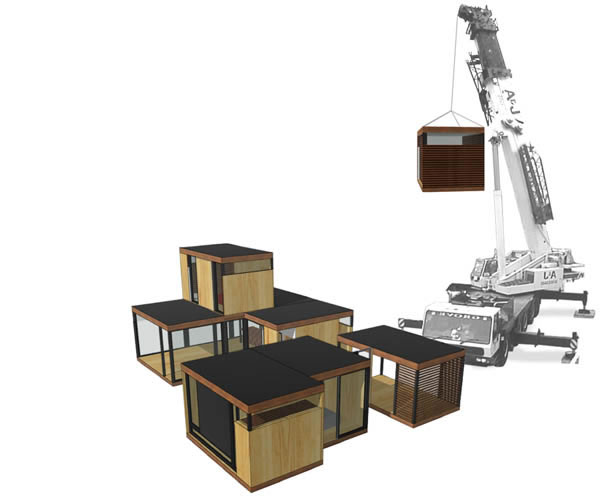

– where “work is minimised to the installation of a steel ‘train track’ footing system allowing the prefabricated modules to simply be slid into place. The prefabricated module is based on a rigid galvanised steel frame with plasterboard internal finish and stained farmed pine external skin.”
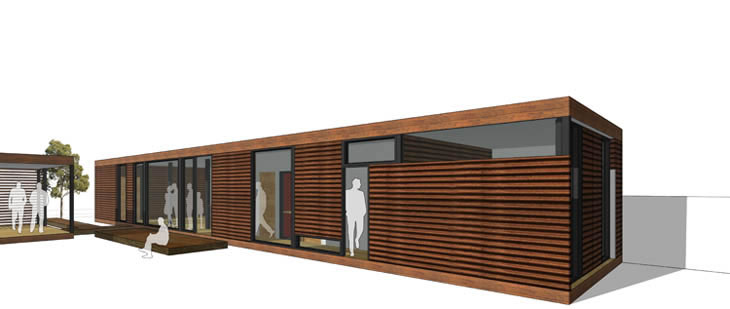

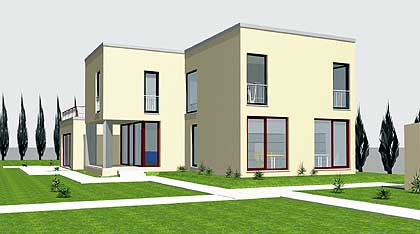
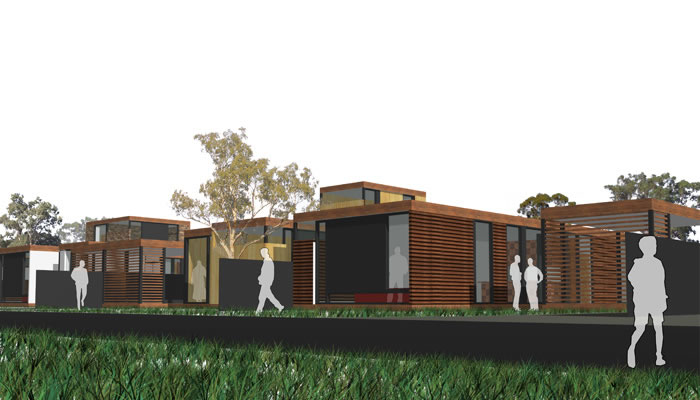
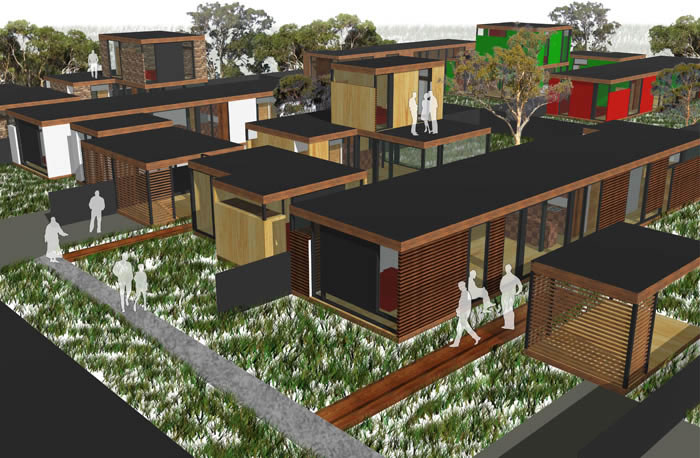
Soon you could have an entire community: “Alternating between single storey and double storey allows estates to have a visual diversity based on a single modular form. The flat bituminous roof also allows rooves to easily become trafficable outdoor areas for second storey spaces.”
Then there’s Maynard’s Styx Valley Protest Structure, which was designed to assist anti-logging protests in Tasmania’s Styx Valley Forest.
As Maynard writes: “The Styx Valley Forest is a pristine wilderness in south western Tasmania. It is home to the tallest hardwood trees in the world averaging over 80 metres… Many of the trees are over 400 years old… Unfortunately the Styx Valley falls just outside [Tasmania’s] South West National Park and it is now under attack from logging companies.”
How does the Protest Structure work? “Rather than inserting the structure into the canopy of a single tree, the structure is designed to attach itself to three trees,” so that only “a small number of structures can secure the well being of a large area of pristine wilderness.”
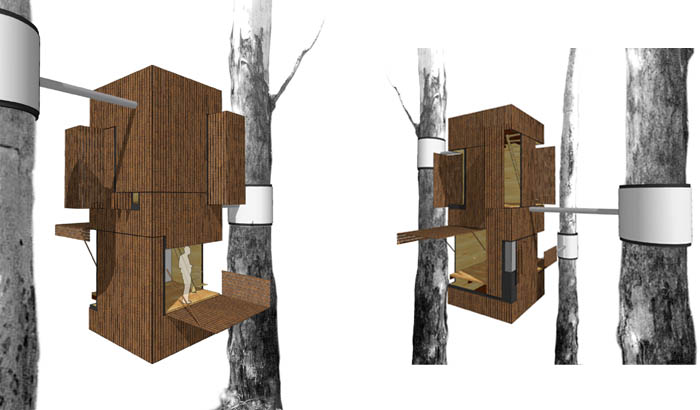
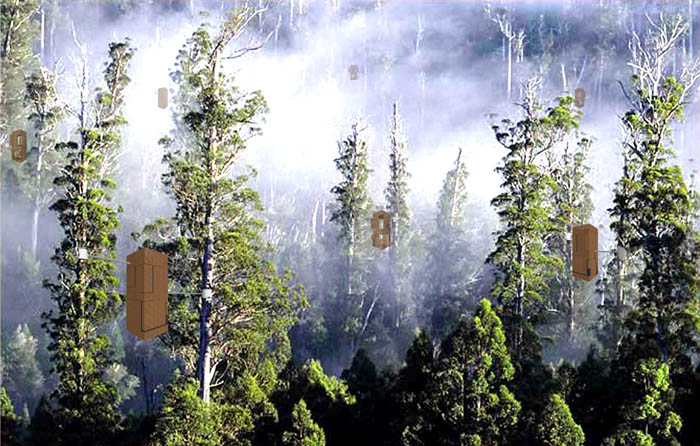
I would think, however, that even without this ostensibly protective purpose, such structures would be amazing places to spend time. Somewhere between Swiss Family Robinson and Return of the Jedi, they could serve as little writing labs, up in the trees, or just places where you can clear your mind and breathe.
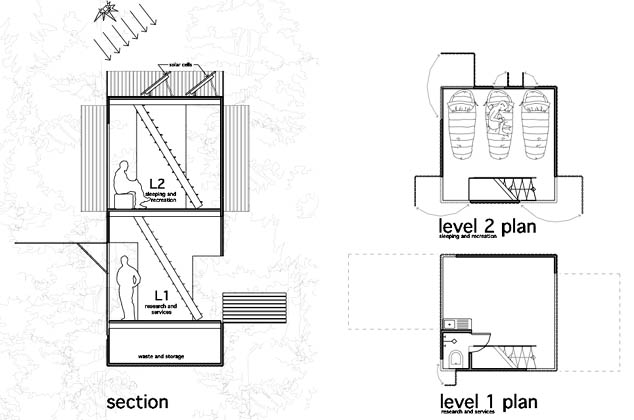

Again, BLDGBLOG would buy fourteen of them if it could.
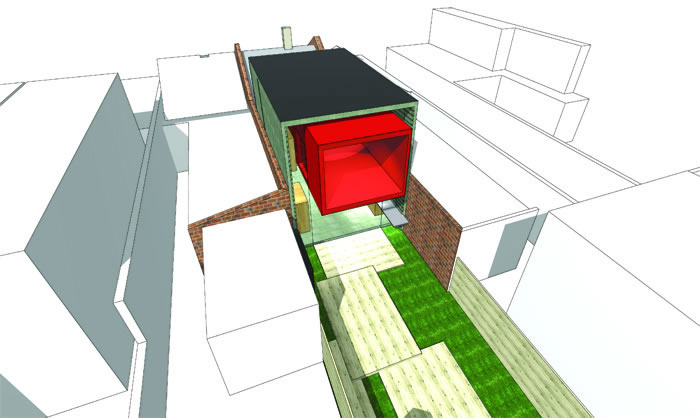
Somewhere between furniture and inhabitable architecture, there are some really great ideas on Maynard’s site; check out the Design Pod, the 2nd Sproule House, the Conceptual Library for Japan and the Cog House for starters.
Here are some images of the 2nd Sproule House – but check out the site for more:

(For some other cool and prefabulous structures, see BLDGBLOG’s own Garage conversions, and Inhabitat’s frequently updated prefab database).
Quonset


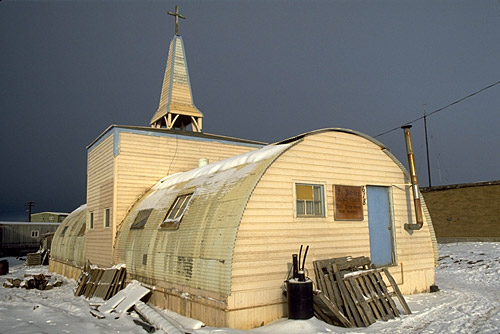
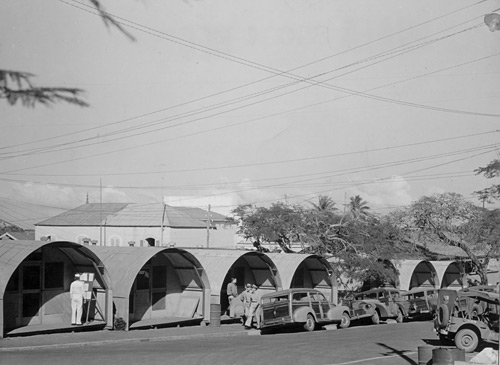
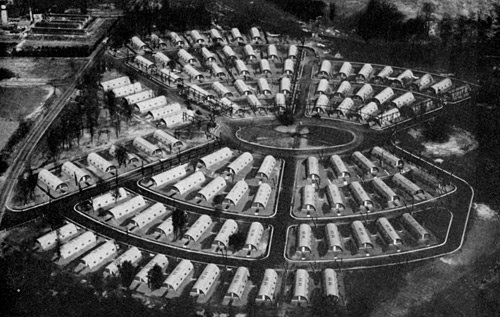
The Quonset hut was a portable, easy to construct architectural unit that allowed for the rapid deployment of forward bases in war zones. A hut could be flown in by helicopter and just as easily removed.
Whole cities could be built in a day.
The Quonset contributed, in many subtle and overlooked ways, to the global, mid-20th century spread of U.S military power. By enabling a new kind of nomadic military utopia – or, modular instant cities maintained on inhospitable terrains – the Quonset hut literally sheltered America’s overseas Army presence.


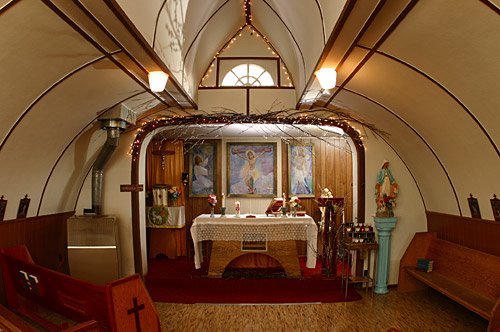
“During the housing crunch of the late 1940s,” however, as a press release from the National Endowment for the Humanities explains, “thousands of people across the nation converted these surplus military huts into unconventional homes, churches, and restaurants. Today, the Quonset has largely vanished from most of the American landscape – and most people’s memory.”
A new book and exhibition hope to correct that fading memory.
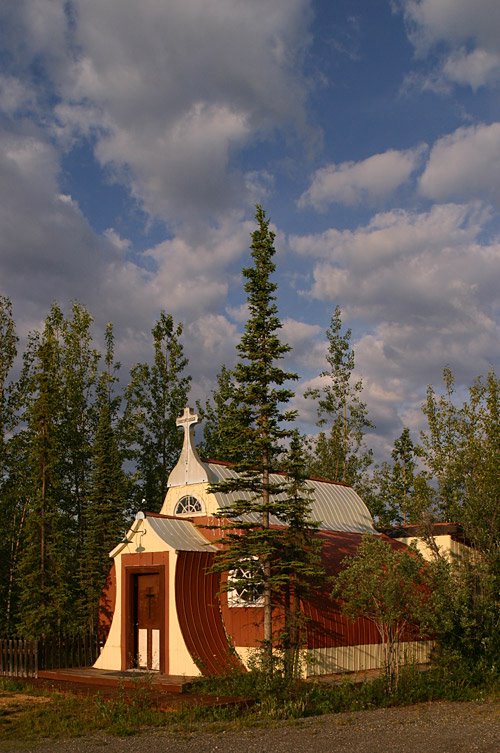
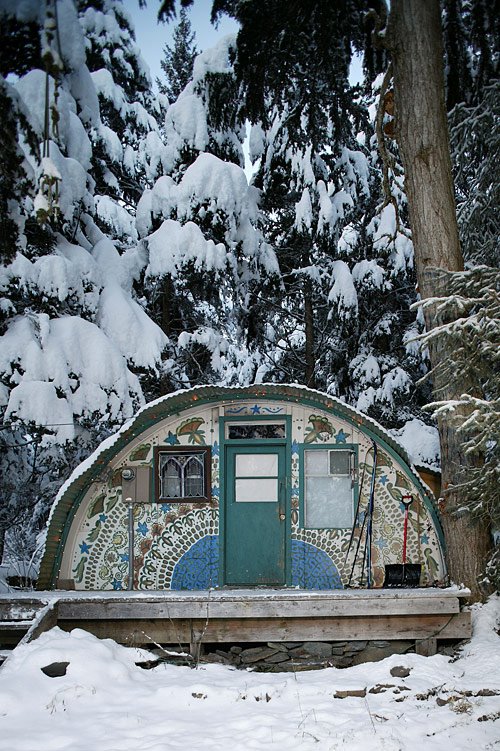
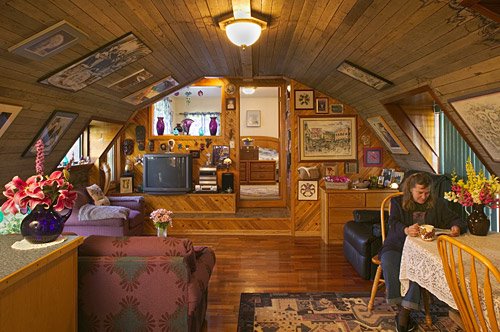
As these photos from that book show, the Quonset has many cool uses – and could even experience something of a renaissance in today’s pro-prehab architectural climate.


I, personally, would love a little BLDGBLOG village out in the desert somewhere, made entirely of Quonset huts: I could write books, use solar power, watch the stars…

(Via Archinect‘s omnipresent Bryan Finoki).

Florida’s Secret Prison City


There’s a secret prison city in Florida: “It looks like your normal neighborhood, but you won’t find this place on any map. The county property appraiser doesn’t even have a record of it. In this secret community, some streets have names, others do not. When we plugged in one street name, mapquest said it doesn’t exist.”
The town is called Starke. According to the Florida Department of Corrections it consists entirely of “staff housing” for a nearby prison. Starke’s “lawns are personally cut by the prisoners.”
The whole place exists behind high-security barricades, and the news team which wrote the above-linked story was refused entry.


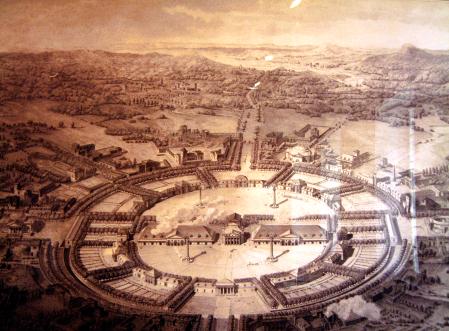
For some reason, however, when I first heard of Starke, I immediately thought of Claude-Nicolas Ledoux’s 18th century plans for the royal saltworks at Chaux, in Arc-et-Senans, France. Chaux may not have been a prison, but it was a quasi-utopian (read: radial) community of workers, each of whom had their own assigned home and workspace. The whole thing was overseen by what was in effect a plantation master. With all the workers living on-site, the community formed a kind of early industrial “factory town,” a total-living experience – that, for some reason, seems oddly like Starke. Maybe not.
It is Chaux whose images you see here.


[Image: Ledoux’s saltwork utopia, from Gallica].

(Via Archinect‘s own live-in avant-garde, Bryan Finoki).

Plattenbauten

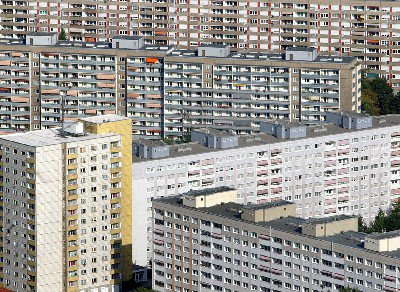
“Made from prefabricated concrete panels, they were churned out fast and cheap in a handful of blankly functional, almost indistinguishable designs, usually five to 11 storeys high, arranged in long, relentless blocks.”


[Image: Germany Online].

They’re Germany’s Plattenbauten, or towering and monotonous slab houses, and they’re increasingly standing empty.
“What to do with a tower block that no one wants to live in?” an article in The Guardian asks. “The solution: pull it down, slice it up, turn it into pleasant family homes.”
As Der Spiegel explains: “Eastern Germany’s population is shrinking and leaving hundreds of thousands of empty buildings behind. With plans afoot to demolish 350,000 apartments worth of hideous, communist-era buildings made from pre-fab concrete, a Berlin architectural firm is recycling the material into immensely livable single-family homes.”
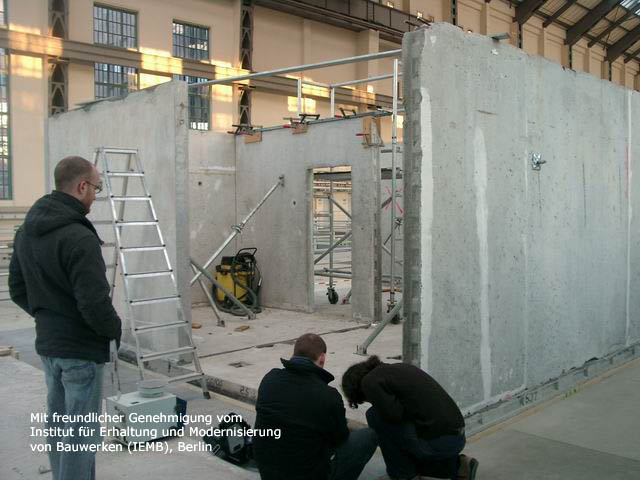
That firm, Conclus, is literally re-using the intact walls, floorplates, and ceilings of these Plattenbauten, putting old modules into new designs, like puzzle pieces. “The only thing we have to do is take the wallpaper off them,” says Conclus founder Hervé Biele.


[Images: From Conclus].

Meanwhile it’d be interesting to see if you could take apart the Empire State Building, floor by floor. You could then purchase the 54th floor, and the 54th floor only, and have it transported to you, on a piece of land outside London or in the Scottish Highlands – where you could live in it, floorplan-intact.
Or you could buy an office on the 63rd floor of Taipei 101 – and have it removed, shipped to you in Arizona. The global real estate market becomes a weird spectacle of moving rooms, intact, decontextualized, shipped elsewhere.

(Via Archinect‘s unflappable Bryan Finoki).

beirut.bldg

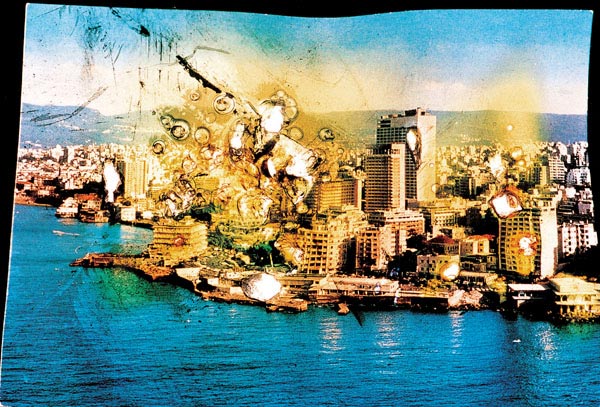
“War, however tragic, is often a source of architectural invention,” writes Farès el-Dahdah.
“Beirut’s recent civil warfare produced many such inventions,” he suggests. “Black drapes, eight stories high and hung across urban interstices shielded pedestrians from the deadly trajectory of a sniper’s view so as to veil one fighting camp from another. Shipping containers were filled with sand and arranged as divisive labyrinths along frontlines… Entering a building became an oblique experience as one was forced to slither sideways behind oil barrels filled with concrete. War is inevitably linked with architectural experience…”

[Image: From Wonder Beirut, 1997-2004, by Joana Hadjithomas and Khalil Joreige].
According to architect Rodolphe el-Khoury in an article for Alphabet City #6, “In Beirut’s centre-city, where the busiest and densest structures once stood, now lies an empty field… a tabula rasa at the very heart of the city. This cleared ground has no discernible physical differentiation: all traces of streets and building masses are now erased. Also obliterated are the property lines, zoning envelopes and other invisible but no less ‘real’ demarcations which customarily determine or reflect urban morphologies.”


The larger, urban-geographic effects of war are well-described in this article by Katja Simons: “In the years of war, Beirut was divided along ideological and religious lines. A new mental map of the city emerged. The city was renamed East and West Beirut and was divided by the Green Line of demarcation… Self-sufficient sub-centers developed in different parts of the city, preventing civic interaction throughout Beirut. People fled the city and moved to safer places at the periphery. Shop owners and businesses followed, moving to the coastal areas north of the city where new suburban commercial centers mushroomed.”
A new geography of investment soon followed; and, beyond the bombs, Beirut’s infrastructure was transformed.
These internal erasures also affected the city’s natural coastline. The port of Beirut, for instance, served as a dumping ground for rubbish, as disposal of waste by other means was too dangerous. A moving coastline of garbage slowly infilled the sea.

[Image: By Gustafson Porter].

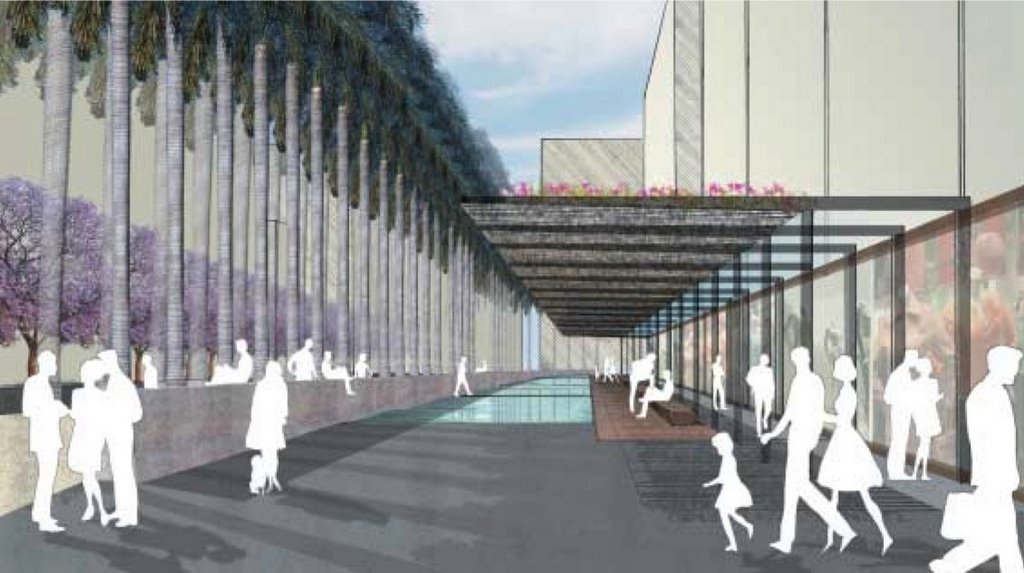
“The shoreline of Beirut has continuously evolved throughout history,” a landscape proposal by Gustafson Porter explains. In that proposal, Beirut’s “lost city coastline has become the inspiration for the creation of a series of new urban spaces.”

[Images: By Gustafson Porter].

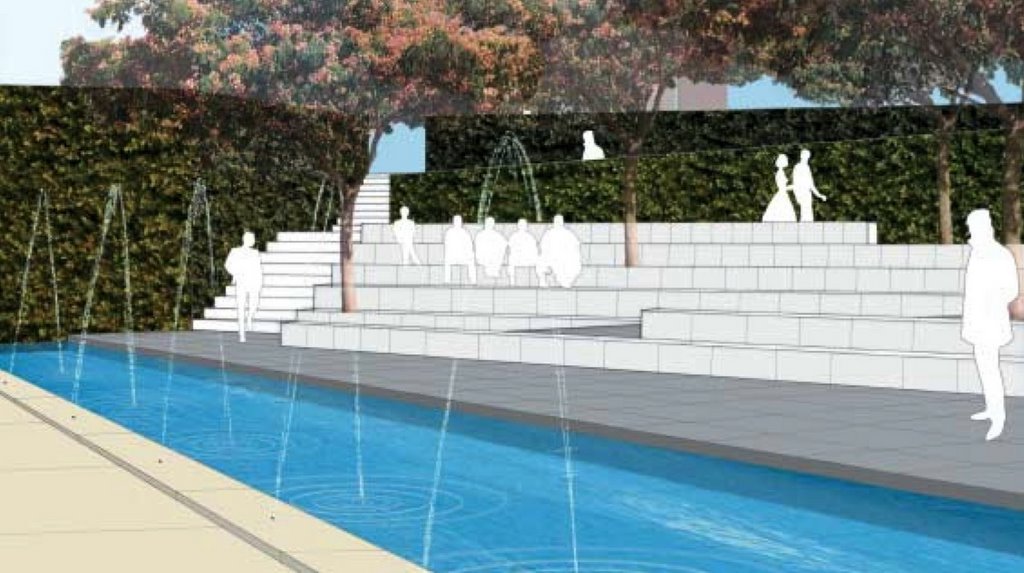
“Within the historic context of the evolving shoreline, Gustafson Porter has suggested a new line… revealing elements of the changing historical coastline and acting as a connective spine. On the ground it is marked by a continuous line of white limestone that is accompanied by a wide pedestrian promenade lined by an avenue of distinctive palms (Roystonia regia).” (Download their PDF for more).

[Image: By Gustafson Porter].

What’s interesting here is the idea of building a new coastline, internal to the city. Framing that as a walk, an urban unit, and then leading people along this imagined shore. A new outside, inside.
All the old Devonian coastlines of Manhattan recreated for a day by a series of guided walks. You can download an MP3; it tells you how deep the water was at the corner of Front and John. Where reefs once grew. Marking those with white limestone: here was the sea
BLDGBLOG Presents: The Paleo-Coastal Walkway, a new guide to the lost seas of Manhattan.

[Image: Bernard Khoury, Checkpoints, 1994].

In any case, Lebanese architect Bernard Khoury seems to view war as architecture pursued by other means. (Or perhaps vice versa).
Khoury, for instance, directly confronts the architecture of military control in a series of sci-fi urban checkpoints: “Our proposal plans for high-tech retractable and inhabitable structures that include monitoring systems. While at rest, the checkpoints are dissimulated below the tarmac, they are brought back above the surface when their operators are on duty. The checkpoints establish new roadmaps, they create another battlefield through which the whole territory is linked. The public transits through the selected points in the city, moves into the matrix to be referenced, crosschecked.”

[Image: Bernard Khoury, B018, 1998].

Khoury’s most famous work, however, is the Beiruti nightclub, B018, which melds an urban, post-war bunker aesthetic with the world of hydraulic disco: “The project is built below ground. Its façade is pressed into the ground to avoid the over exposure of a mass that could act as a rhetorical monument. The building is embedded in a circular concrete disc slightly above tarmac level. At rest, it is almost invisible. It comes to life in the late hours of the night when its articulated roof structure constructed in heavy metal retracts hydraulically. The opening of the roof exposes the club to the world above and reveals the cityscape as an urban backdrop to the patrons below.”
Checkpoints, bunkers, new walkways, moving coastlines, oblique forms of entry – architectural responses to urban warfare could take up a whole website of their own. It’s a theme I’ll return to.
For a bit more reading, meanwhile, check out this paper on war and anxiety, from the excellent Cabinet Magazine.

What Remains

Perhaps this answers the question of what remains once civilization blows away:


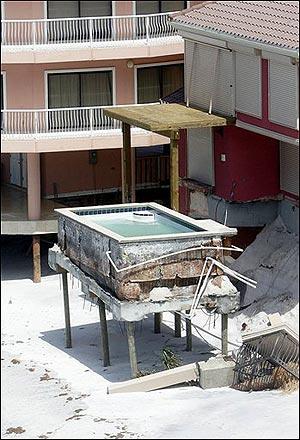
[Image: “DESTIN, Fla. – A swimming pool stands alone on the beach near Destin, Fla., Monday, July 11, 2005, after having been separated from the building complex by the effects of Hurricane Dennis passing through the area on Sunday.” WFTV].

Ruined swimming pools. On stilts. A few minutes’ walk from the sea.

The Torino Scale


[Image: A scene from Deep Impact].

Will civilization end? Will the planet be destroyed? Will a hundred cities burn?
Just consult the Torino Scale.
The Torino Scale is supposedly a “Richter scale for earth impact hazards.” It’s been freshly revised to inform us how worried we should be about near-earth objects in space – it’s even color-coded.


[Image: NASA; click on to enlarge – but surely number 10 is not the worst it can get? Are they withholding parts 11-20? Earth splits in two. The solar system is destroyed. The universe disappears].

Meanwhile, they need Torino Scale: BLDGBLOG Edition. It tells you what sorts of hazards to expect if someone starts hurling architectural masterpieces at the earth. Saarinen’s TWA terminal – wham! Your house shakes. Philip Johnson’s – ooh: that’s not a masterpiece. The Great Wall of China – close one. The ground is still shaking.
The Eiffel Tower.
St. Paul’s.
The entirety of Manhattan?!
Robo-Venice!


[Image: Let’s see what President Freeman has to say… (from Deep Impact)].

Mount St. Helens of Glass

“Each second,” the New York Times reports, “about a cubic yard of new mountain—roughly a pickup truck’s worth—is pushed to the surface [of Mount St. Helens], adding to a dome growing inside the crater.” Each second.

[Image: “Mount St. Helens, its second dome visible, is being shaken constantly by earthquakes.” John S. Pallister/USGS Cascades Volcano Observatory/New York Times].
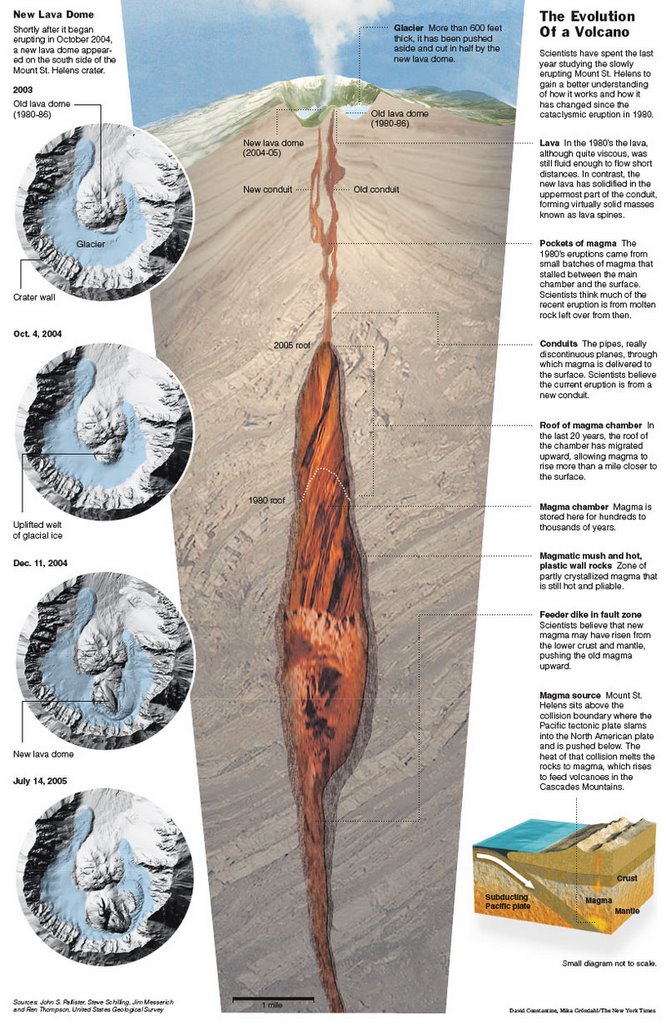
The mountain, it seems, as evidenced by a recent and ongoing series of minor earthquakes, is undergoing a slow, quiet eruption. “Beneath the mountain,” we read, “the magma rises through fractures in the rock from a fairly small magma chamber about five miles below. Beneath that chamber is probably another pipe that taps the deeper mantle.”

Those fractures and pipes look something like this:

[Image: New York Times; this diagram kicks ass at a larger size].

Further, “As the current eruption empties the conduit, scientists have detected a slight deflation of the flanks of the volcano, though not quite as much as predicted, which suggests that the chamber has partially been refilled by new magma.”

The insane thing here is that one of the scientists profiled in this article knows that the magma chambers are refilling because he has found fresh glass on the mountainside. I can’t help but wonder if, at any phase of the earth’s history, there might have been whole mountain chains made entirely of glass, translucent, marbled, veined with stained metals and colored by minerals, like cathedral windows in mountain form—

[Image: ArtLex].

—that would would have fractalized sunset into angles and shards, the horizon ablaze. Mountains, shining from within.

Whole islands emerge from the Pacific, made of translucent colored glass. You can watch fish through them. Comets reflect in ripples across their smoothly ridged surfaces. A minor earthquake makes the planet ring like a fragile glass bell.

What species could evolve on glass islands? What would they eat? What would riverbeds look like, and could you watch streams from below?

Could you watch treeroots pop slowly, expanding through layers of bedglass? Glass tectonics. The mountains are literally shattering from below.

Or imagine Shelley, arriving by ship at a tropical archipelago made of glass. Thousands of small islands, and he sails between each one. He soon begins a series of epic poems to be published exclusively on BLDGBLOG, inspired by a moonlit tour of ruined glass arches shaped by natural erosion. He carves a cup directly from the mountain and he drinks wine with it. The earth breaks down into transparent soil.

Anyway, the New York Times article also includes this photographic demonstration of the volcanic dome’s growth. I guess I just like volcanoes

Scientological Circles

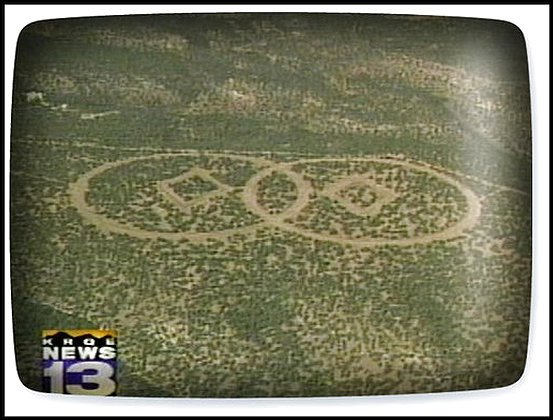
Large geoglyphs in the surface of the New Mexican desert have been discovered by an Albuquerque news channel.

[Image: KRQE-TV/Washington Post].

Turns out, the glyphs mark the location of a subterranean archive-complex “built into a mountainside” by the Church of Scientology.

The futuristic archive “was constructed to protect the works of L. Ron Hubbard, the late science-fiction writer who founded the church in the 1950s. (…) The archiving project, which the church has acknowledged, includes engraving Hubbard’s writings on stainless steel tablets and encasing them in titanium capsules.” Ironically, this is exactly what I’ve been doing with my old BLDGBLOG posts…

From the Washington Post: “‘Buried deep in these New Mexico hills in steel-lined tunnels, said to be able to survive a nuclear blast, is what Scientology considers the future of mankind,’ ABC’s Tom Jarriel said in his report. ‘Seen here for the first time [are] thousands of metal records, stored in heat-resistant titanium boxes and playable on a solar-powered turntable, all containing the beliefs of Scientology’s founder, L. Ron Hubbard.'”

[Image: USGS/Terraserver].

But the deep desert glyphs may not only be geographical markers: “Former Scientologists familiar with Hubbard’s teachings on reincarnation say the symbol marks a ‘return point’ so loyal staff members know where they can find the founder’s works when they travel here in the future from other places in the universe. ‘As a lifetime staff member, you sign a billion-year contract. It’s not just symbolic,’ said Bruce Hines of Denver, who spent 30 years in Scientology but is now critical of it… ‘The fact that they would etch this into the desert to be seen from space, it fits into the whole ideology.'”

(With thanks to Javier Arbona for the tip!).

Attack of the lawn-pavers


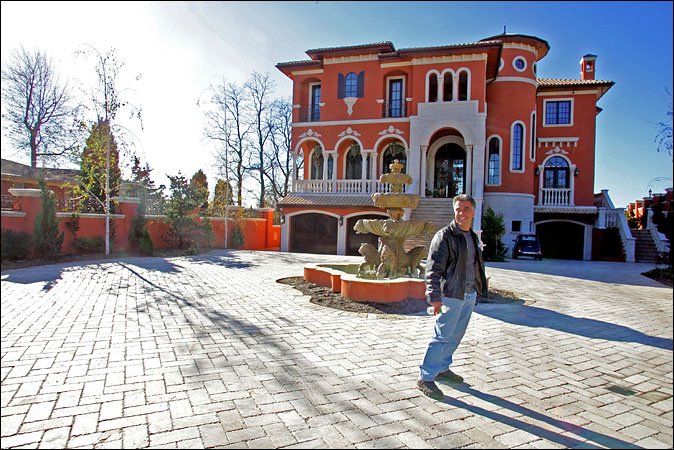
[Image: “Peter Oppedisano at his home with paved yard in Malba, Queens.” Suzanne DeChillo/New York Times].

“The grassy front lawn, once a staple of the American dream, is steadily being usurped by the pave-over. Many homeowners, opting for grayer pastures, are pouring concrete over their patches of green.”
Perhaps living proof that you can read too much J.G. Ballard, when “Christina Groza moved from an older building in Astoria, Queens, into a recently built one in College Point, the new home had a major selling point… the original lawn outside the new building had been paved over with concrete.”
One instantly wonders how many pave-overs you could get away with, and what law it is you’d be breaking if you tried: wait till everyone’s away on holiday vacation, wake up your cousins – then pave everything.

The Newest River in China

[Image: Replacing the rivers and militarizing the water supply: “Soldiers in Harbin, in northeast China, checked water supplies on Tuesday.” Imaginechina/New York Times].

“On the streets of Harbin, life seemed normal, if somewhat surreal, given that a major metropolitan area of several million people had almost no running water or usable toilets and that thousands of residents seemed to have fled,” the New York Times reports.
A sign of things to come, then, as China’s clean water supplies succumb to industrial pollution: this week China covered-up the fact – then quietly admitted – that a benzene factory had contaminated the Songhua River – which just happens to be the only source of drinking water for the city of Harbin.
Or not the only source: there is also the newest river in China, a de-terrestrialized landscape of plastic bottles trucked in from elsewhere, hydrology under military escort.
So what is the lesson of Harbin? When a river becomes too polluted, we will simply replace it with bottled water. (Until there is nothing left to bottle).
It’s the new landscape of militarized world resources.