Lifting Venice

“Italian experts are proposing a dramatic new solution to the watery threat facing the city of Venice,” the BBC reports.


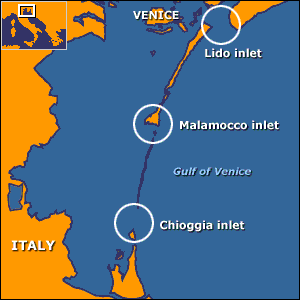
“Rather than battling to keep the sea out – they want to use it to help raise the sinking island-city. The scheme would involve pumping huge quantities of sea water into the ground beneath Venice down 12 pipes each of which would be 700m (765 yards) long. The sea water would make the sand beneath the city expand lifting Venice by 30cm (11.8 inches) in 10 years.”


This, of course, comes after the so-called “Moses Project,” which, as the BBC describes it, is “a series of 78 mobile steel barriers to be activated during exceptionally high tides. The barriers, due to be in place by 2011, will lie on the seabed most of the time, but will be filled with air to create a dam when Venice is threatened.”


Of course, soon they’ll just put the whole city atop a mechanized webwork of spindly little hydraulic legs that will stand up and walk inland – taking the Bridge of Sighs with it. The fully automated Robo-Venice of the future.
Meanwhile, for comparison, there’s always the Thames Barrier


– but everyone knows that won’t save us…

Amazonia Britannica

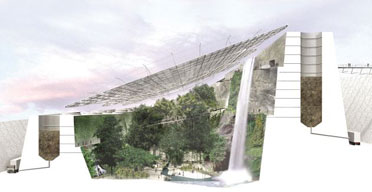
“The team of architects behind the Eden Project in Cornwall is planning to turn a Lancashire rubbish dump into a tropical rainforest which would heat itself with decomposing garden and kitchen waste.”


That doesn’t excite you?
Well, the plan also “includes one of England’s highest waterfalls, walkways through the treetops and possibly Europe’s biggest compost heap, capable of using most of the green waste of a city the size of Manchester.”

Bedrock: The Film

In the previous post – about the films of Stan Brakhage – I complained that you could not make a film using bedrock; but I stand corrected.
“It is entirely possible to project light through bedrock,” an email I soon received explained. “Thin sections, samples of rock ground to a thickness of 30 microns for viewing under a microscope, are a standard tool of petrology.”
So I was pointed to a website, did some research – including petrographic imagery at Humboldt State University, a Parisian Atlas minéralogique, and some “plutonic microtextures” at UNC-Chapel Hill – and it’s true: you can make your own Mothlight using slices of bedrock. The continental plates as a kind of underground Hollywood. Film in mineral form.
Some examples? Just look below:


How would you do it? As but one example, you could animate the following sequence –


– which would not only display a very obvious sense of visual continuity, it would offer its own short geo-metamorphic narrative: anorthosite becoming gneiss becoming biotite-rich granite.
You could explain and demonstrate simultaneously the formational history of the earth, using abstract patterns of mineral imagery.
Bedrock: The Film.

(Thanks to Mike Weber for the initiating email; and all images above are by Kent Ratajeski at UNC-Chapel Hill).

Stan Brakhage: Cellscapes

I first heard of Stan Brakhage as if he were an urban myth or some kind of artistic rumor: some guy had supposedly taped thousands of mothwings – real mothwings – onto a reel of celluloid and released it as a “film.” Thousands of mothwings, with light projected through them, flickering.
Turns out, of course, it was true, and the film is called Mothlight.
Having been reminded of this by the preceding BLDGBLOG post – which has some ridiculously beautiful images of cyanobacteria – here’s a quick glimpse.


[Images: Stills from Stan Brakhage, Mothlight (1963)].

Brakhage taped actual pieces of animals and plants to a reel of celluloid! You’re watching shadows of an actual landscape, in cross-section – core samples – projected onto a screen like any other cinematic experience. Landscape as cinema.
It’s too bad you can’t do something like this with bedrock, I have to say – but you could make an entire film out of fossilized amber, for instance…


Anyway, you can watch Mothlight on DVD. (Which, of course, eliminates the fun of the actual mothwings – but no matter).

Alien Planet


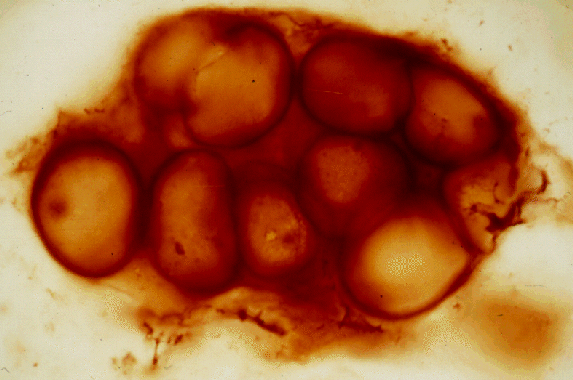
[Images: Fossilized cyanobacteria from Bitter Springs, Australia; and nonfossilized cyanobacteria].

The early Earth, in its so-called Hadean phase, was a constantly exploding storm of rocks and asteroid impacts. Lava flows wider than the Mediterranean and deeper snaked across barren igneous landscapes, forming deltas of volcanic glass – that were then shattered by iron-rich debris falling from space.
This went on for millions of years.
No rocks survive from this period; it was a landscape that entirely destroyed itself.
“How did life emerge amidst this mayhem?” asks physicist Paul Davies, in what is surely one of the most interesting New York Times editorials (10 April 2005) published this year.
“Quite probably it was a stop-and-go affair, with life first forming during a lull in the bombardment, only to be annihilated by the next big impact. Then the process was repeated, over and over.”


[Images: Fossilized cyanobacteria from Bitter Springs, Australia].

What’s interesting here is that one colony of microbes finally survived long enough to get its foot – excuse the anatomical metaphor – onto the evolutionary escalator, and thus we’ve got life as we know it. Terrestrial life.
But, Davies asks, what if another microbe colony, locked in its place of safety – burrowed into bedrock, or buried under rising seas – what if it too survived?


[Images: Like screen captures from a Stan Brakhage film, these are the elegantly named Oscillatoria and Spirulina cyanobacteria].

“It’s possible that pockets of microbes could have survived in obscure niches… opening up the tantalizing prospect of two or more different forms of life co-existing on the same planet. Although they would compete for resources, one type of life is not necessarily bound to eliminate the rest.”
“Thus,” he concludes, “microbes from another genesis – alien bugs, if you will – could conceivably have survived on Earth until today.”
Are you sure that’s your little brother?
This would be “a form of biology that is unrelated to familiar life” – and coming soon to a sci-fi novel near you. Or, in Jerry-Bruckheimer-meets-BLDGBLOG part 473: A mining operation in the Australian outback discovers weird subsurface geological formations that appear to be fossilized bacteria – only the team members are getting headaches, and they’re coughing up black phlegm… They have infected themselves with a disease from the Hadean era.
Anyway, check out this NOVA interview with Harvard scientist Andrew Knoll about the origin of life on earth – while I try to kick-start a career in Hollywood…

Tectonic Warfare

In the 1985 James Bond film A View to a Kill – with a theme song by Duran Duran – Christopher Walken plays the bad guy, Max Zorin.


Zorin goes speed-boating with Grace Jones and grins a lot. He has blonde hair.
His plan? To blow-up the San Andreas fault outside San Francisco. This will cause a massive earthquake that will flood Silicon Valley and thus do something or other for Zorin’s own microchip business.
This will allow him to take over the world.
The plan is worked out – this is fascinating – using a model of the city, while flying around in a blimp. You’re in the realm of simulation, hovering anti-gravitationally above the planet – even while discussing a plan to weaponize the earth.


They may as well have hired BLDGBLOG to write the screenplay…
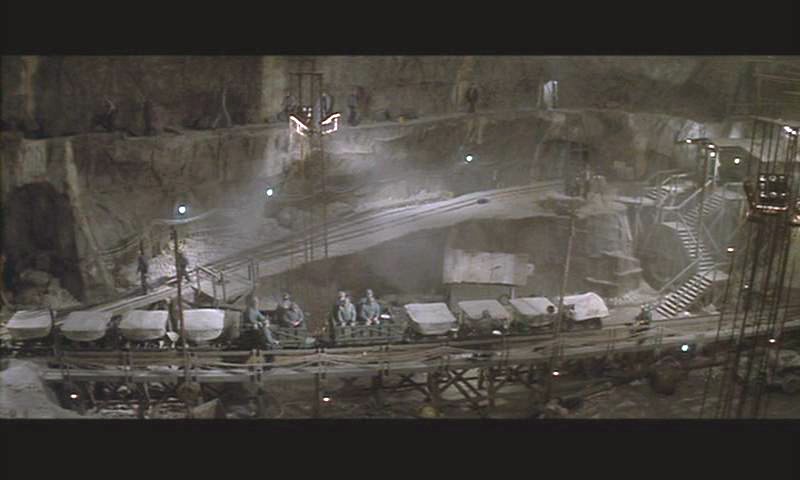
Because then Zorin goes beneath the earth’s surface, wearing a hardhat, where he gets into a discussion with some engineers about the geotechnical nature of the San Andreas fault – including how to blow the thing sky high.


Max Zorin, in other words, has declared tectonic war on the United States.


[Images: The mine Zorin’s dug, the sacs of explosives Zorin’s laid, the militarization of seismic activity Zorin has therefore achieved: yes, it’s James Bond in his mid-80s heyday].

Bond teams up with a female geologist to thwart this evil plan; needless to say, they thwart it.


Two quick points: harddrives are already landscapes, of magnetized silicon; therefore by bombing the San Andreas to achieve a kind of microchip/harddrive monopoly, Zorin is imploding the macro- into the micro-, one landscape into the other. William Blake would have loved this film!
Second, I’d bet $100 the U.S. military already has something like this in the works: surprise earthquakes in Iran, anyone? Surprise earthquakes in Pakistan?
I mention all this because I was thinking of Max Zorin and his View to a Kill when I read about Bill Ellsworth of the US Geological Survey and his suspicious seismic plan: “Ellsworth, his USGS colleague Stephen Hickman and Mark Zoback of Stanford University in California… will use an oil drilling rig to burrow to within metres of where earthquakes are born [on the San Andreas fault]. Then they plan to set up an electronic network and watch the tremors go off again and again… By drilling directly into the fault, the team will be able to observe the chemistry and physics of what happens before, during and after quakes as never before. “
Or so they claim.


[Image: A cross-section of Ellsworth’s San Andrean lab; from New Scientist].

The New Scientist reports that Ellsworth’s team will also use a strategy called the “virtual quake”: “During a natural quake, seismic waves created by movement at a fault are detected at the surface and analysed to estimate their point and time of origin. In their virtual quake the researchers turned this on its head by firing off seven explosions at the surface. They then used the newly installed sensors to detect these seismic waves at depth. Since the timing and location of the explosions were known, the team was able to map the structure of rock even more precisely” – and future strategies of tectonic warfare were no doubt noted…
Anyway, you can read more about it here and here; or you can watch the Bond film – or you can even declare tectonic war on some country yourself – earth as the planet-weapon – but either way be sure to think of BLDGBLOG…


You know he is.

Lunar urbanism 4

So you sign-up for a reality TV show under the premise that you’ll be flown to a Russian space-training camp for 8 days, and then blasted into near-earth orbit. The whole thing will be filmed. You will perform some kind of experiment involving the decay rate of tomatoes in space. You will high-five each other and think holy shit, mate – we’re astronauts
Back to earth, then, and you’re a celebrity, fresh from space. You tell all your friends and appear on talkshows. Everything’s exciting again.
Being terrestrial has never felt so good.


Only you weren’t actually flown to Russia – and you never quite made it into space.
You were flown in circles around the North Sea – at night – and then deposited with the other contestants at a remade air base in northern England. Your “space-training” was not performed by real astronauts, but by actors, with Russian accents.
The air base, meanwhile, “has been given a complete overhaul with plug sockets, manhole covers and light bulbs exchanged for their Russian counterparts. Food, toilet paper, matches and cigarettes have been imported from Russia and, when the contestants first arrive, they will be greeted by Russian military and taken in convoy through checkpoints… just one British crisp packet could give the game away.”
Meanwhile is it reassuring to know that the ideological difference between a British air base and a Russian one can be overcome using a bit of graphic design and some interior decoration?
Worth pondering, that.

The coming Kerouac

Signers of the so-called Asian Highway Agreement will convene their first meeting in a little less than a month, where they’ll discuss what the BBC calls a “new Silk Road… expected to start in Tokyo and terminate in Istanbul – passing though North and South Korea, China and countries in South-East, Central and South Asia.”

[Image: The Asian Highway Route Map].

It will, of course, look remarkably like yet another sprawling, concrete motorway system – but no matter. You’ll be able to drive from Japan to Finland without leaving the highway system.

[Image: An insanely uninspiring view of the AH1 near Bangkok, from the Asian Highway project’s own photo gallery].

What exactly will this new Silk Road allow you to see? Here’s a list of tourist attractions just waiting to be driven past – as well as a warning that the superhighway may help the spread of AIDS.
Meanwhile, I’d say give it 10-15 years once construction is complete before a new Kerouac goes riding that route, driving 90mph into the Himalayas, passing through Isfahan, arriving on the shores of the Bosporus, his or her mind-bending manuscript in hand… (Or maybe just a book about the first trans-Asian BLDGBLOG roadtrip).
Meanwhile, see this earlier post on your favorite source for Asian highway news (scroll down toward the bottom).

Cities that clean themselves

“A new type of concrete can clear the air by dissolving pollutants. Using light and air, photocatalytic concrete breaks down organic and inorganic substances responsible for air pollution,” reports Concrete Monthly (my latest cure for insomnia).
In 2003, as Wired tells us, the Italian firm Italcementi “coated 75,000 square feet of road surface on the outskirts of Milan with photocatalytic cement. It found nitrogen oxide levels were reduced by up to 60 percent, depending on weather conditions. A similar experiment in France found nitrogen oxide levels were 20 percent to 80 percent lower in a wall plastered with photocatalytic cement than one with regular cement.”
Let’s just hope they use that on the new Asian Highway project

On literary hydrology

“Imagine a river, wide and majestic, which flows for miles and miles between strong embankments, where the land is firm. At a certain point, the river, out of weariness, because its flow has taken up too much time and too much space, because it is approaching the sea, which annihilates all rivers in itself, no longer knows what it is, loses its identity. It becomes its own delta. A major branch may remain, but many break off from it in every direction, and some flow together again, into one another, and you can’t tell what begets what, and sometimes you can’t tell what is still river and what is already sea…” — Umberto Eco


[Image: “Canning River,” by Ursula Schneider].

(Yes, it’s cheesy as hell to quote Umberto Eco, but I don’t really care – because check out this one: “How beautiful the world would be if there were a procedure for moving through labyrinths…” How beautiful, indeed).

tropical.bldg

“Tropical Green” runs 9-10 February 2006, down in sunny Miami: “The two-day Tropical Green conference will be an invaluable experience for architects, interior designers, developers, city planners, politicians, and voters in search of learning the ways of 21st century design that will both help the environment and their wallets.” Check it out.

It’s funny, meanwhile, but I’m reading The Drowned World by J.G. Ballard, even as I post this, and his descriptions – written in 1962 – of a flooded, neo-tropical London have totally changed my conception of what “a tropical city” actually is.

In Ballard’s novel the sun has developed a kind of astrophysical Tourette’s Syndrome, and it’s started scorching the planet with radiation storms and UV bursts. This has melted the icecaps, raised the ambient global temperature to 120º+ and forced everyone to move to northern Canada and Siberia.

London has become a kind of backed-up toilet of silt and Jurassic vegetation, “a nightmare world of competing organic forms returning rapidly to their Paleozoic past.” Huge iguanas lumber around in the heat. Buildings left and right are collapsing, their lower six floors immersed in polluted seawater, “miasmic vegetation… crowding from rooftop to rooftop.”

The city is fossilizing.

As Ballard writes: “A few fortified cities defied the rising water-levels and the encroaching jungles, building elaborate sea-walls around their perimeters, but one by one these were breached. Only within the former Arctic and Antarctic Circles was life tolerable.”

[Image: The Drowned World‘s rather unimpressive cover…].

So the story goes that a research biologist is touring this neo-tropical London, boating from hotel to hotel across fetid lagoons, recording the types of plants that infest the city. Meanwhile monsoons are coming up from the south, everyone is dying of skin cancer and no one can sleep. The intensity of the sun’s radiation is making everything mutate.

In between some eyebrow-raising moments of bad pop-Nietzschean pseudo-philosophy – the surviving humans find themselves psychologically regressing down the totem pole of evolution toward… something or other; it’s all very psychedelic and 2001 – there are some cool descriptions of these new urban tropics:

“Giant groves of gymnosperms stretched in dense clumps along the rooftops of the submerged buildings, smothering the white rectangular outlines… Narrow creeks, the canopies overhead turning them into green-lit tunnels, wound away from the larger lagoons, eventually joining the six hundred-yard-wide channels which broadened outwards toward the former suburbs of the city. Everywhere the silt encroached, shoring itself in huge banks against a railway viaduct or crescent of offices, oozing through a submerged arcade… Many of the smaller lakes were now filled in by the silt, yellow discs of fungus-covered sludge from which a profuse tangle of competing plant forms emerged, walled gardens in an insane Eden.

Anyway, one could analyze the metaphors and all that – Ballard uses the word “competing” twice in the examples above (is he projecting a neo-Hobbesean vision onto Nature…? etc.) – but one could also find something better to do.

And, of course, one could also attend the sustainable design for tropical cities conference in Miami – and tell them you heard about it on BLDGBLOG…