The Transgondwanan Supermountain

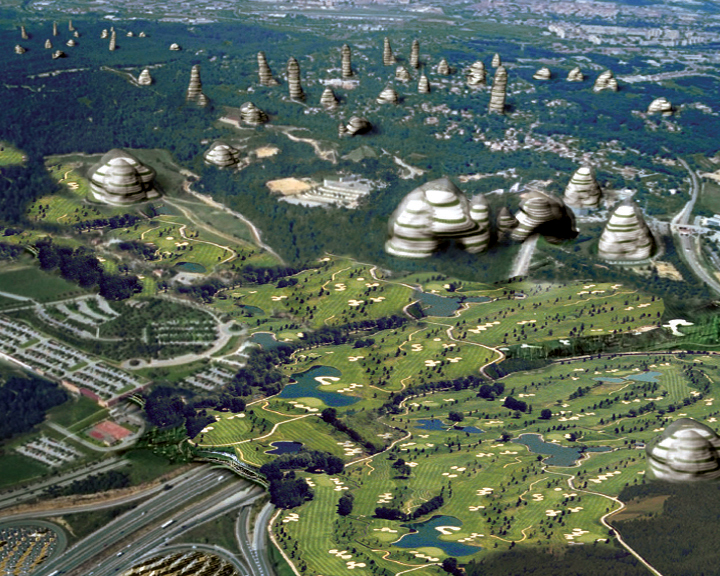
[Image: Vicente Guallart, a Barcelona-based architect whose work explores the mineralogical remaking of whole terrains – including how to make a mountain].

Two articles have appeared in the last ten days or so about the impact of landscape on animal evolution.
In the first case, New Scientist reports, “one of the biggest mountain chains in the Earth’s history may be responsible for the explosive diversification of animals more than 500 million years ago. Sediments washed from the mountains – dubbed the Transgondwanan Supermountain – added vital nutrients to the ocean, opening new evolutionary opportunities.”
According to the theory’s main advocate, Rick Squire – whose research interests include “tectonic processes affecting the early evolution of animals” – it was all a question of landscape, the geochemical erosion of super-topographies into biologically accessible micro-nutrients:

[T]he trigger was the collision of a series of three large continental blocks – roughly corresponding to Arabia, India, and Antarctica – with the eastern edge of Africa from 650 to 515 million years ago. The drawn-out continental impact raised a vast 1000-kilometres-wide mountain range that stretched for more than 8000 kilometres along the equator on the ancient land mass known as Gondwana. Heavy rains typically fall along the equator, which would have produced a high level of erosion – it was before the evolution of land plants. Squire’s research group has traced the resulting offshore sediment deposits around the world, and say they eventually amounted to more than 100 million cubic kilometres – enough to cover the entire US up to 10 kilometres deep.

So the explosion in animal life was a kind of unintended by-product of landscape design; the surface of the earth became food – and anatomical structure, in the form of “protective carbonate shells” – for new species.
Leading to a question for landscape architects: how could your urban park design affect the bodily structure of future organisms…?
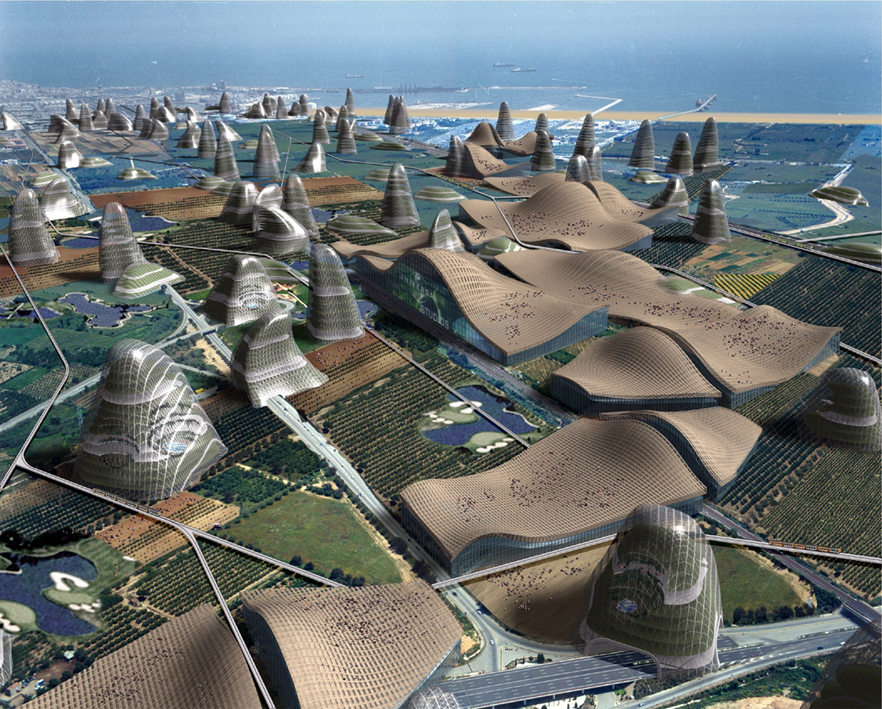
[Image: Vicente Guallart. Guallart’s speculations about “how to make a mountain” include the following: “The geological structure of the hill, on the micro, the medium and the macro scales, offers us rules with which to put forward a mineralogical system that will guide its functioning.” These are the internal rules of a landscape – and, Guallart implies, they can be reproduced architecturally].

Then there was an article published just yesterday about multi-million year extinction cycles in mammalian species, and how these cycles might actually be linked to “regular wobbles in Earth’s orbit“:

Changes in the Earth’s tilt and the shape of its orbit lead to climate cycles of around 1.2 and 2.4 million years. At their extremes both these cycles cause global cooling, expansion of polar ice sheets and changes in rainfall patterns. [Mammalian] extinction peaks coincided with global cooling maxima, while new appearance peaks coincided with periods of stable climate.

First of all, I like the idea of “new appearance peaks,” or moments in planetary history when speciation hits a kind of mutational warp-speed, and even your own generation might be the quiet origin of a new species. Cue X-Files soundtrack here.
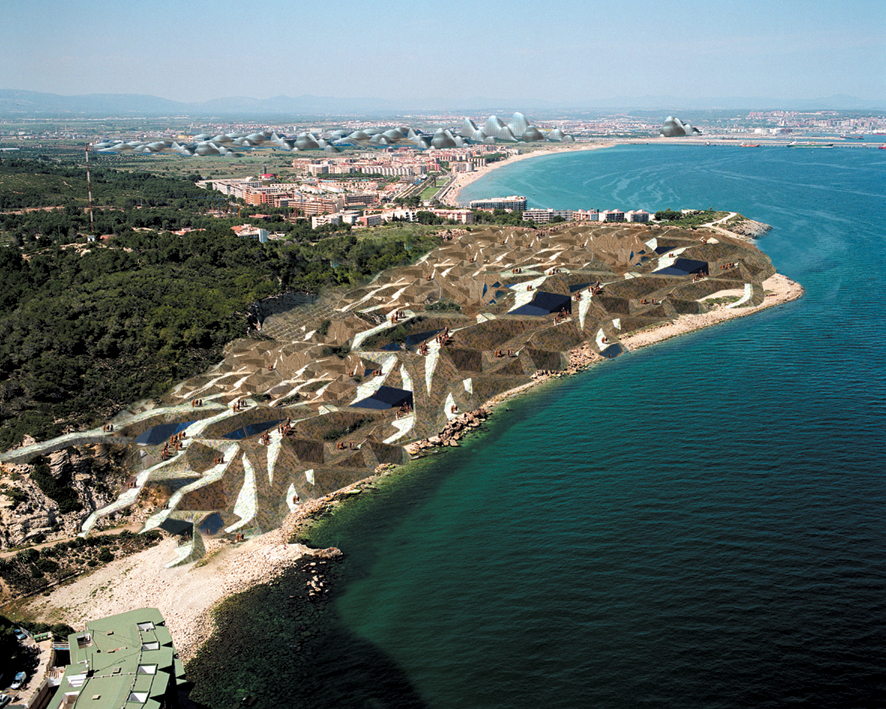
[Image: Vicente Guallart. Guallart’s terrestrial speculations continue: “The limestone of the hill and its rhombohedric crystals of calcite enabled us to conceive, at multiple scales, a crystalline genesis for the project.” This thus forms a “coherent system, from the structure itself to its outer limit, that responds to a single system of crystallization. In this way, the skin, like soil in the hills, directly reflects the internal logic of the mass and its interaction with the environment.” With these rules in place, Guallart says, his firm could make mountains].

Second of all, this intertwining – of plate tectonics, planetary rotation, large-scale topographical change, and the birth, death, and even wholesale pruning of genetic lines – surely has a place in landscape design courses. At the very least, a phenomenally great architectural pamphlet, or even course syllabus, could be written about the possibilities: artificial mountain chains spurring micro-speciation; gardens as centers of genetic novelty; even mega-earthworks and the architectural manipulation of continental drift.
Which makes me wonder, for instance, since single architectural projects are apparently enough to cause earthquakes, that perhaps architecture itself could be used to over-weight the earth and thus guide, or subtly control, its changing rotation… thus destroying all mammalian life on the planet. Terrestrial weaponization.
The next Bond villain.
Or print t-shirts: Architecture is killing us all.

(Similar thoughts appear toward the end of this post).

Airports, Tracks, and Factories

9_gr[Image: Thomas Weinberger, “Zone 60”, München 2003].

Munich-based photographer Thomas Weinberger has a radiantly beautiful series of industrial and infrastructural landscape photographs called synthesen.
The images are otherworldly, Ballardian, gemlike. The thick, almost surreal dimensionality of their lighting comes from Weinberger’s technique, which is to combine two different photographs of the same scene – one taken during the day, one taken at night.
His shot “Nizza” (2004), for instance, almost literally glows, the city burning with a white light as if liquid chrome has drowned the streets; while “Alexanderplatz” (Berlin, 2003) makes the Kaufhof look stroboscopically frozen, even extraplanetary or ossified. Then there’s “Cracker” (2003), where we’re greeted with an ESSO gas refinery in Ingolstadt – down to its shining vortices of pressure tubes and valving. “Zone 30” (Munich, 2004) looks like the opening shot of a sci-fi thriller about radiation poisoning in suburban Germany… Etc.
The crispness – and gleaming, semi-symmetrical intricacy – of the shots totally amazes me.

13_gr[Image: Thomas Weinberger, “Flughafen München” 2003].

Readers of German can download five short reviews of Weinberger’s work; everyone else can just visit his website and gape.

(Discovered via Alexander Trevi and juniorbonner; also seen at Conscientious, kottke.org, things magazine – and so on. For photos of a very vague aesthetic similarity see The Total Horizon).

Respiratory Oases

0
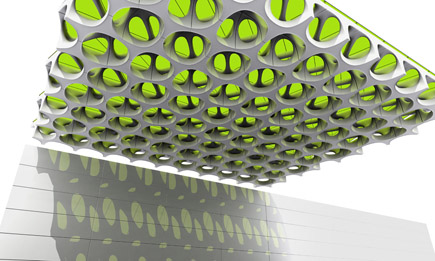
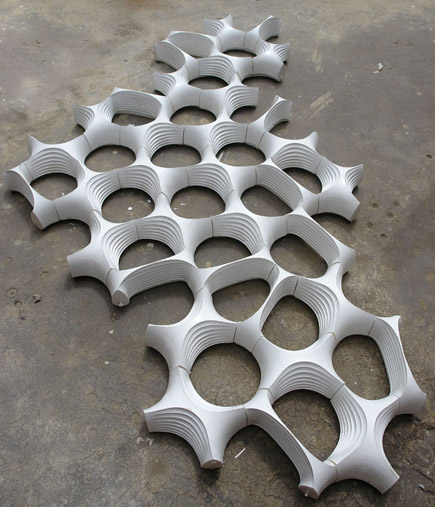
Over at WorldChanging, I’ve posted about “a decorative, three-dimensional architectural tile” by a Berlin- and London-based design firm called Elegant Embellishments.
The tiles – algorithmic in design and modular in assembly – are built to reduce vehicular air pollution, including nitrous oxide and ground-level ozone; they can thus “rapidly improve urban environments in terms of air quality and visual appeal.”
According to the company’s own press release:

The tiles are coated with titanium dioxide (TiO2), a pollution-fighting technology that is activated by ambient daylight. TiO2 is a photo-catalyst already known for its self-cleaning and germicidal qualities; it requires only small amounts of naturally occurring UV light and humidity to effectively reduce air pollutants into harmless amounts of carbon dioxide and water. When positioned near pollution sources, the tiles neutralise NOx and VOCs (volatile organic compounds) directly where they are generated. They transform previously inert urban surfaces into active surfaces, re-appropriate polluted spaces for safer pedestrian use, and invert problem spaces – dark, polluted, uninhabitable – to benevolent spaces that benefit communities.

0
The rest of the post explores how the tiles can be used – how they assume “endless varieties of physical structures” even whilst being “composed with only two modules.” Chemically scrubbing the air, so to speak, the grids also define respiratory oases within the city – becoming what Elegant Embellishments call “a recognizable symbol of a safer place to breathe.”

0
The piece ends by speculating about other, more explicitly artistic uses of the tiles – including how someone should install abstract, sculptural assemblages of them on plinths across London…
Somewhere between an alien totem pole and a new artwork by Alexander Calder, the tiles could then mark pedestrian routes and historical sites, offering residents a geometric glimpse of the city’s green future. Trafalgar Square, Berlin’s U-Bahn, even J.G. Ballard’s The Crystal World – all get thrown in for good measure.
So check it out.

The Hearth at Thunder Edge Knoll

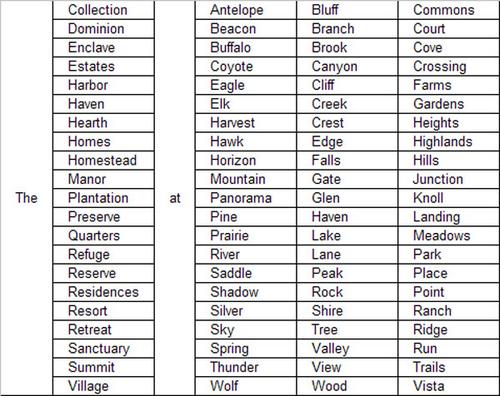
Real estate magnates: if you have to name your newest subdivision, look no further. The below grid does it all for you.


The Quarters at Eagle Shire Place, perhaps? Or maybe The Plantation at Hawk Falls Run? Tough choice. I might have to go with The Harbor at Coyote View Cove. Or The Refuge at Buffalo Peak Ridge. The Summit at Wolf Tree Point.
As Curbed LA points out, the Southern California version of this table is still waiting to be made. In which case I hope to see, say, The Cañon at Dolphin Mesa.
The Villa at Del Hercules Grove.

(Grid and original idea from the DenverInFill Blog).

Glass avenues of Paris 2054

I finally got a chance to see Christian Volckman’s Renaissance last week, even after having posted about the film several months ago.

Paris_2054
The movie’s not bad, though the writing leaves a lot to be desired, the “acting” is rather dubious, and realistic character motivation seems somewhat lacking, to say the least.
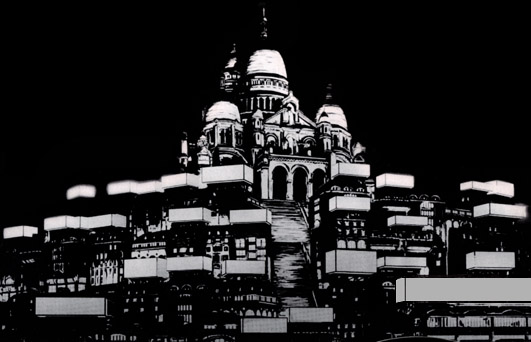
On the other hand, the movie is gorgeous, and its architectural vision of Paris in the year 2054 deserves comment. The city’s streets have been replaced with bulletproof glass, for instance, so action on the underground Metro platforms can be seen from above – and vice versa. Weird little houses rise and fall on hydraulic platforms; a geneticist’s home, on the mansard-roofed top floor of a riverside flat, contains a whole indoor forest; the city itself has become a massively cross-buttressed machine of arches, superhighways, and elevated trains. There are tunnels, archives, and holographic surveillance screens – and lots of iron, glass, and brick. The Seine has been concretized into a kind of industrial mega-canal. At one point, the mosque at Cordoba appears, faithfully reproduced as a gangster’s steambath. Etc. etc.
As it happened, there was a short article by Volckman in a magazine I picked up after the movie; there we read how Renaissance was intended as “an expressionistic film, transforming Paris into a futuristic metropolis, using motion capture and creating everything from scratch in 3D.” Volckman cites film noir as both a structural and aesthetic influence: “Great shadows, wild angles, and weird characters living in dark cities where the line between good and evil is not so obvious.”
So it’s a great film to catch, on a purely visual level – though beware of the screenplay, which nearly does the whole thing in.

(PS: Renaissance is dubbed, not subtitled, and includes the voice of Daniel Craig).

[Originally spotted on gravestmor].

Enter the Mini-Anti-Earth

Scientists from the University of South Florida have come up with a way to reduce the effects of gravity – albeit on a very small scale. It’s a kind of mini-anti-earth, on demand.
Their technique uses microgravity to grow cancer research cells:

Tiny beads of gelatine – around 200 micrometres in size – are mixed together with collagen and fine particles of magnetite (the magnetic iron oxide used to coat recording tape). This mix is then sealed in a gas-permeable bag and dosed with the cells to be cultured. The bag sits on a platform and is sandwiched between two graphite plates, beneath a powerful permanent electromagnet. The magnet is used to exert an upwards force on the magnetite particles that exactly counters the downward force of gravity. The tissue cells, gelatin and collagen can then grow suspended in “zero-g.”

So here’s my vote for finding new applications in the world of landscape architecture: entire zero-g gardens grown in gas-permeable bags. Sent drifting across the Pacific.
Leading to the question: if a medieval theologian had proposed that the Garden of Eden was actually a zero-g garden floating across the Dead Sea in a gas-permeable bag… would he or she have been excommunicated?

(Via).

Radio Astronomy

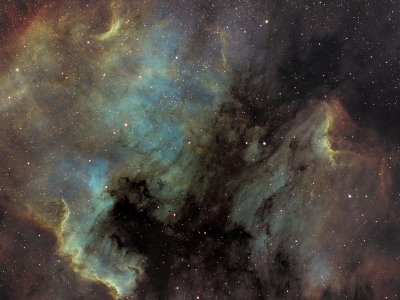
[Image: The North American and Pelican Nebulas; from NASA’s Astronomy Picture of the Day].

This is quite possibly the coolest thing I’ve read in months: in order to combat light pollution, city officials in Reykjavik, Iceland, “will turn off street lights on Thursday evening and people are also being encouraged to sit in their houses in the dark.” The clincher: “While the lights are out, an astronomer will describe the night sky over national radio.”

(Via WorldChanging and Z+).

B.Y.O.B.

Perhaps alcohol is the future of urban infrastructure: “Russian customs officers say they have discovered a mile long pipeline that was pumping vodka to Latvia.” This illegal but brilliant act of international infrastructure is referred to as “running hooch across the border.”

Next up: a million-dollar condo tower in New York City where, for $199/month, you can subscribe, via faucet, to the Vodka Of The Month Club…

(Via).

Human Ash Reactions

Another quick (and self-indulgent) note: an article of mine, about the photography of David Maisel, has been published in the new issue of Contemporary Magazine (Issue #86).


Called “Human Ash Reactions,” the article looks at chemical similarities between the landscapes and objects Maisel photographs, and the developmental process of photography itself.
If you’re unfamiliar with Maisel’s work, be sure to check out this interview with him, published last Spring on Archinect. The images are gorgeous, haunting, and ironically otherworldly. His own website – a former Yahoo! Pick of the Day – is well worth the visit.
And if you do read the article in Contemporary, let me know what you think.

Struck by loops

At the risk of turning BLDGBLOG into some sad and unofficial subsidiary of New Scientist, let me point out in any case that “[h]uge loops of gas – similar to those found on the Sun – have been found soaring above the galactic plane near the centre of the Milky Way.”


“The tube-like structures may be responsible for the formation of giant star clusters near the galaxy’s centre and also might be behind the region’s mysteriously powerful magnetic field.”
To quote the article at length:

“I was struck by the loops when I saw them,” says study leader Yasuo Fukui of Nagoya University in Japan. “But it took a few years for me to understand that they represent magnetic loops.” The team believes they formed the way glowing arches, called prominences, do on the Sun – from the stretching and bending of magnetic field lines.

The rest of the story is weirdly fascinating; we read how the “detailed structure and cause of the galaxy’s magnetic field lines are not well understood,” although Fukui’s team has produced a computer model “that can produce gas loops similar to the ones observed.” If we’re to believe the model’s version of the story, then, “small vertical hills in the initially horizontal field lines cause gas to start flowing down into the valleys between them. With less gas at the tops of the hills, the magnetic field there becomes free to expand upwards even more, leading to giant loops.”
The energy involved is extraordinary: for instance, the “observed speed of the gas as it gushes down the sides of the loops… carries roughly the same amount of kinetic energy as is produced in a supernova explosion.”
This immensely powerful magnetized landscape of interstellar gas undergoes turbulence, pooling, waves, and condensation – eventually hitting a point at which stars can form, spooling themselves together gravitationally from loose strands of an ethereal topography. Structured wisps of polarized light soon shine.


There’s a poem – though I can’t seem to find it anywhere now – by John Burnside, which beautifully describes a sort of Christianized cosmology in which the remains of angels have been found hovering in space, titanic, made of color and transparency – and a part of me likes to think that the “glowing arches” and otherwise unexplained astral loops that New Scientist introduces us to are really part of some huge and ongoing theological archaeology of the sky. Mythic remnants: forgotten gods become astro-tectonic structures in space.
One night, a man with a home telescope discovers the chemical ruins of a church the size and shape of whole galaxies, domes of helium and osmium drifting across the outer tangents of the Milky Way – a mobile landscape that survives even universal catastrophe.

The Ring

“An enormous ring of superconducting magnets similar to a particle accelerator could fling satellites into space, or perhaps weapons around the world,” New Scientist reports. “The advantage of a circular track [over a linear one] is that the satellite can be gradually accelerated over a period of several hours.” It will just whirl and whirl in the desert for hours, vertiginous yet grounded, till it falls upward, hurled into space…
For some reason, though, I find New Scientist‘s description totally fascinating:

The satellite, encased in an aerodynamic, cone-shaped shell that would protect it from the intense heat of launch, would be attached to a sled designed to respond to the forces from the superconducting magnets. When the sled had been accelerated to its top speed of 10 kilometres per second, laser and pyrotechnic devices would be used to separate the cone from the sled. Then, the cone would skid into a side tunnel, losing some speed due to friction with the tunnel’s walls. The tunnel would direct the cone to a ramp angled at 30° to the horizon, where the cone would launch towards space at about 8 kilometres per second, or more than 23 times the speed of sound. A rocket at the back end of the cone would be used to adjust its trajectory and place it in a proper orbit.

Rather than satellites encased in sleds, however, how about sheds? Ice-fishing sheds. Or whole suburbs, thrown into space.

(Related: Hurling Taj Mahals into the Sky and Mineral TV and the Archipelago of Abandoned Shopping Malls).