Audio Architecture

[Note: This post was originally written for Blend – so it reads a bit like an article – though it was not actually published].

The company known as Muzak claims to provide “audio architecture” for its clients.
Audio architecture may sound wonderful; the phrase may conjure up images of cathedrals made from noise – whole buildings connected by bridges of music – but, in the world of Muzak, it means something less exciting. Audio architecture, Muzak writes, is “the integration of music, voice and sound to create experiences designed specifically for your business.”
In other words, audio architecture is about making you feel comfortable – so that someone else can sell you things.
The “power” of audio architecture, Muzak‘s website continues, “lies in its subtlety.” These subtle sounds, played incessantly in the background, can “bypass the resistance of the mind and target the receptiveness of the heart.” It is thus almost literally subliminal. “When people are made to feel good in, say, a store, they feel good about that store. They like it,” Muzak claims. “Audio architecture builds a bridge to loyalty. And loyalty is what keeps brands alive.”
If there is a connection between background sounds and customer loyalty, perhaps sound could also inspire a kind of urban loyalty, where the sound of a certain city plays its own subtle role in making that place more inhabitable.
Like Muzak, the city’s sound makes residents “feel good” – which “builds a bridge to [urban] loyalty.”

Of course, this would not be the first time someone has suggested that cities have a certain sound, unique to them, or that cities should learn to cultivate their unique sonic qualities.
More than thirty years ago, the World Soundscape Project called for the “tuning” of the world. Cities would be treated as vast musical instruments: certain sounds would be eliminated altogether; others would be promoted or even subtly redesigned. The World Soundscape Project was about sonic improvement, making the world sound better, one city – one building – at a time.
Where the Project went wrong, however, and where it began to act a bit like Muzak, was when it thought it had a kind of sonic monopoly over what sounded good. Industrial noises would be scrubbed from the city, for instance, and a nostalgic calm would be infused in its place. Think church bells, not automobiles.
But where would such sensory cleansing leave those of us who enjoy the sounds of factories…?
In any case, we could still have fun with the World Soundscape Project, designing alternative sonic futures for the cities of the world, by turning, ironically, to the techniques of Muzak itself: Muzak imitates. Rock, jazz, blues, Mozart – even Muzak: anything at all can be absorbed, and replaced, and reproduced, by Muzak.
There could be a Muzak version of the street sounds of Amsterdam – played on a continuous loop in the supermarkets of London. The sounds of yesterday could be replayed today, transformed into Muzak – and Muzak versions of your old phone conversations could be broadcast over the radio… where laughter is replaced with synthesizer trills.
University lectures and Books on Tape could be replaced with Muzak, pushing us toward a post-verbal society.
Or we forget Muzak altogether and we simply swap urban soundtracks, cities imitating cities to sound entirely unlike themselves.
In the elevators of the Empire State Building, you hear the elevators of the Eiffel Tower. The sounds of the Paris Metro are replaced with the sounds of the Beijing subway, complete with squeals from overworked brakes and the metallic thud of sliding doors.
If you don’t like Rome, you can make it sound like Dubai.

In his 1964 novel Nova Express, William Burroughs described a series of elaborate, even hallucinatory, assemblages of tape recorders and microphones that could be carried from city to city.
Borderless, these roving sound installations, with their capacity for instant playback, would blur the line between your own thought processes and the sounds of the city around you. Like Muzak, Burroughs’s legion of rogue microphonists could thus “bypass the resistance of the mind,” installing a soundtrack where there once had been thought.
A few years ago I read about a sound artist who had been reproducing the exact placement of microphones used to record the live performances of orchestras around the world, only he did so in unexpected places: in the middle of rain forests, or on top of sand dunes, or in towns on the English coast and inside empty warehouses.
Whether or not the story’s even true, recording the everyday noises of, say, Oslo as if Oslo is an ongoing symphony – and then re-playing that symphony through hidden speakers in San Francisco – perhaps even transforming it into Muzak – should certainly be the next artistic step.
It would be a question of acoustic urban design – of true audio architecture.

(Earlier on BLDGBLOG: Cover Bands of Space and Amplifier House: Original Domestic Soundscapes. See also AUDC’s The Stimulus Progression).

50 manifestos

The manifestos that I posted about last week are now online at Icon: 50 manifestos for a 50th issue.
So click on over and read manifestos by Rem Koolhaas

(“Europe is doing almost ridiculously well. We fly for next to nothing, we have the highest quality prisons, Europe gave us millions of new friends, Frisian Lakes are maintained in order, sewers that ruined the most beautiful beaches are gone, the Spanish countryside is now a polished backdrop for whizzing high-speed trains”)

and Bruce Mau

(“So long as architects self-marginalise by purposely excluding the business of development and its real burden of complexity and decision making from their education, from their business, architecture will remain a gentleman’s weekend culture, unwilling or unable to take on the heavy lifting and big problems, happy to polish fancy baubles for our urban entertainment”)

and Sam Jacob

and a press release by Joshua Prince-Ramus and an ad for an event by Hans Ulrich Obrist and some crap by BLDGBLOG

(“Everything is relevant to architecture – from plate tectonics and urban warfare to astronomy and the melting point of steel. There is architecture lining the streets of New York and Paris, sure – but there is architecture in the novels of Franz Kafka and W.G. Sebald and in The Odyssey. There is architecture on stage at the Old Vic each night, and in the paintings of de Chirico, and in the secret prisons of military superpowers. There is architecture in our dreams, poems, TV shows, ads and videogames – as well as in the toy sets of children. The suburbs are architecture; bonded warehouses are architecture; slums are architecture; NASA’s lunar base plans are architecture – as are the space stations in orbit [above] us”)

along with more manifestos by Peter Saville

(“Pop culture used to be like LSD – different, eye-opening and reasonably dangerous. It’s now like crack – isolating, wasteful and with no redeeming qualities whatsoever”)

and Bernard Khoury

(“Relevant architecture should not be limited to exceptional programs such as schools, corporate headquarters of international companies, museums, and public libraries”)

and Vito Acconci

(“…if people can’t ‘get’ the buildings we make, then those buildings are meant to appear as a force of nature, and we expect from people only belief”)

and Paola Antonelli

(“I consider design the highest expression of human creativity because it is concise and distilled. I am baffled that the world does not yet understand not only how important, but also how tremendously engrossing and entertaining design is”)

and Steven Holl

(“At the beginning of the 21st century, architecture can be the most effective instrument for reconstructing the relations between our species and the earth”)

and Philippe Rahm

(“Architecture has to generate new nature in this artificial global environment”)

and Jasper Morrison

(“Design, which used to be almost unknown as a profession, has become a major source of pollution. Encouraged by glossy lifestyle magazines and marketing departments, it’s become a competition to make things as noticeable as possible by means of colour, shape and surprise. Its historic and idealistic purpose, to serve industry and the happy consuming masses at the same time, of conceiving things easier to make and better to live with, seems to have been side-tracked. The virus has already infected the everyday environment. The need for businesses to attract attention provides the perfect carrier for the disease”)

and so on
So check it out.

Event 14312160

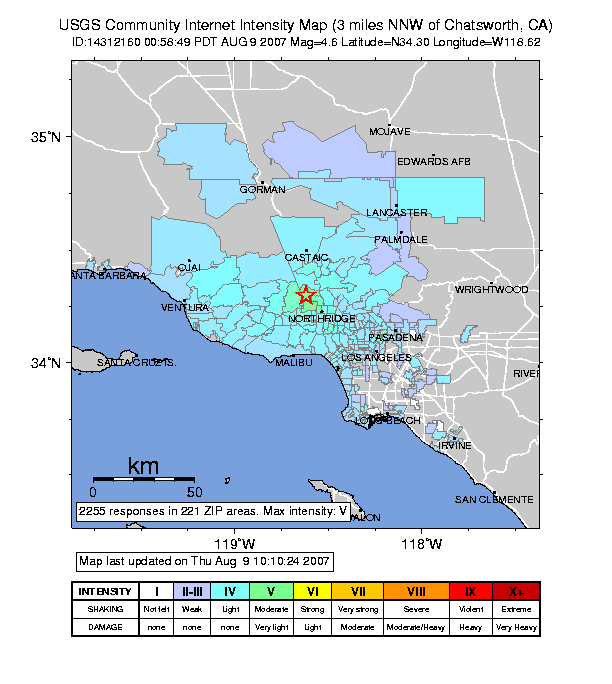
About twenty minutes after writing the previous post, I felt my first earthquake out here in L.A. It had a magnitude of 4.6, with an epicenter near Chatsworth; it struck at 12:58am local time; and it’s being referred to as “Event 14312160.”
Check out the official shake map of that experience.
Our apartment trembled for a few seconds – as if a large, but totally silent, truck was rumbling by – before the building, which is on stilts, sort of jolted.
That was it.

One or two nights in the Sodium Hotel

[Image: Bolivia’s salt hotel; photographed by Jose Luis Quintana/Reuters].

Ten years ago this month, I took a Polish-language tour of a salt mine outside Kraków – because, at the bottom of the mine, there was a church made from salt.
It was carved from the walls of the mine itself.
That increasingly distant and somewhat surreal experience – I don’t speak a word of Polish, and everyone on the tour was from Austria – came to mind when I read about a new salt hotel in Bolivia.
It’s a hotel made from salt.
According to National Geographic, the hotel is “constructed solely of salt blocks on the white plains of the Salar de Uyuni in southwestern Bolivia.” The Salar de Uyuni is the world’s largest salt desert. Until tourists began visiting it, however, “the only inhabitants of the chilly, harsh region were salt miners, who still extract 25,000 tons of salt annually from the 10 billion tons available.”
I know at least this writer is curious if they’ll someday build an exact, to-scale replica of the city of Edinburgh: shining there, in the Andean heat, with white cubic walls, the city will then be shaved down – bit by bit, brick by brick – and drunk with shots of tequila. You can salt your chips with it.
Or perhaps architectural enthusiasts will forego the Snow Show… and buy tickets to Bolivia, instead: the Salt Show.
Mineral pavilions designed by Zaha Hadid. Sodium towers by OMA.

(Via Super Colossal and Boing Boing).

Infrastructure is patriotic

[Image: Photo by Allen Brisson-Smith for The New York Times].
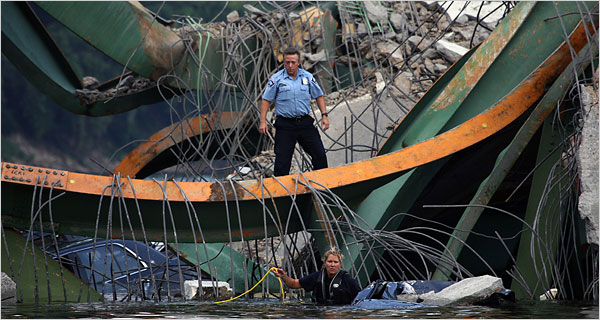
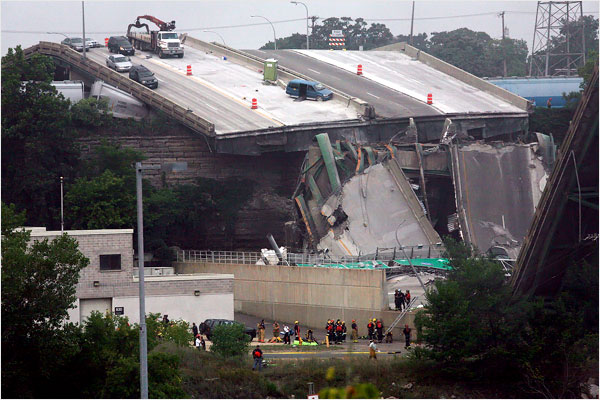
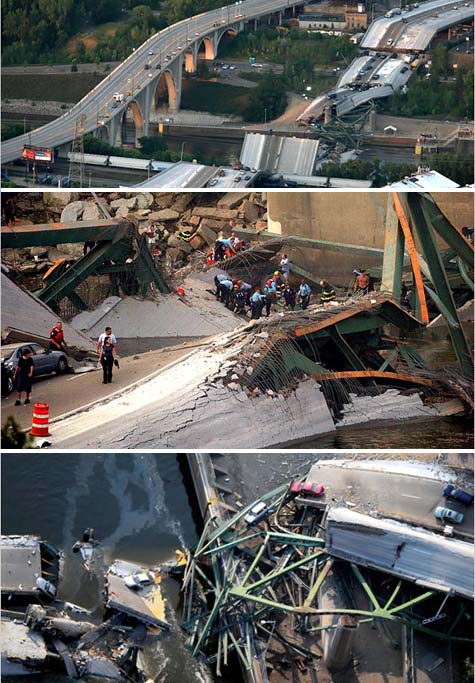
After yesterday’s bridge collapse in Minneapolis – a bridge my sister and her family drove across everyday – the decaying state of American infrastructure is becoming all the more apparent.
Last month it was an exploding steam pipe in Manhattan; a few years ago it was the levees of southern Louisiana; and anyone who drives a car in the U.S. has probably noticed that the roads here are not particularly well-kept. The sheer number of potholes in the city of Philadelphia, for instance, was enough to convince me, only half-jokingly, that if the city was not going to spend any money fixing the streets, then they should at least help underwrite repair bills for all the broken axles, blown suspensions, and sometimes major fender benders caused by the city’s rather obvious display of custodial irresponsibility.

[Image: Photo by Jeff Wheeler/The Star Tribune/AP; via The Guardian].
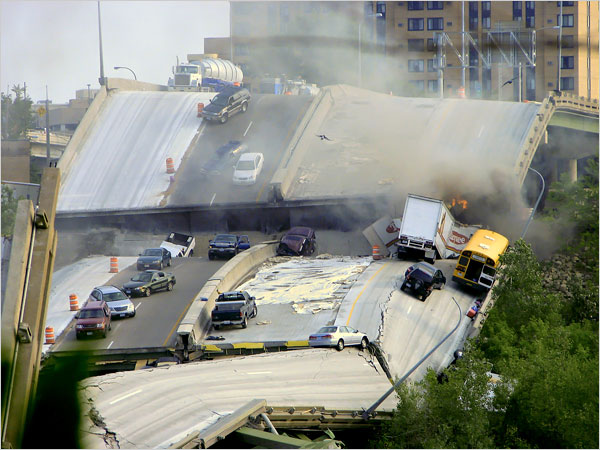
In any case, The New York Times opines today that these system-wide failures “are an indication that this country is not investing enough in keeping its vital infrastructure in good repair.”

Transportation officials know many of the nation’s 600,000 bridges are in need of repair or replacement. About one in eight has been deemed “structurally deficient,” a term that typically means a component of the bridge’s structure has been rated poor or worse, but does not necessarily warn of imminent collapse.
Most deficient bridges, which included the span of Interstate 35W over the Mississippi River in Minneapolis, remain open to traffic.

Worse, 13.6 percent of U.S. bridges – i.e. more than 81,000 bridges – are “functionally obsolete.”

[Image: Photo by Heather Munro/The Star Tribune/AP; via The Guardian].
Ironically, only six days ago the Federal Highway Administration announced a $5.3 million grant program meant to stimulate and reward innovative research in bridge repair and design.
“Nearly $5.3 million in grants will be awarded to bridge projects in 25 states to help develop new technologies to speed bridge construction and make them safer,” we read on the FHA website.
None of those grants will be going to Minnesota.

[Images: Photos courtesy of The New York Times].

It’s interesting to point out, then, that the Federal Highway Administration’s annual budget appears to be hovering around $35-40 billion a year – and, while I’m on the subject, annual government subsidies for Amtrak come in at slightly more than $1 billion. That’s $1 billion every year to help commuter train lines run.
To use but one financial reference point, the U.S. government is spending $12 billion per month in Iraq – billions and billions of dollars of which have literally been lost.
Infrastructure is patriotic.
There is no reason to question the political loyalties of those who would advocate spending taxpayer dollars on national infrastructure – from highway bridges and railway lines to steam pipes, levees, electrical lines, and subway tunnels – instead of on military adventures abroad.
Four months of foreign war would be enough to double the annual budget for the Federal Highway Administration – if that’s what one would choose to spend the money on – taking care of quite a few of those 81,000+ bridges which are still open to traffic and yet “functionally obsolete.”
Perhaps the best way to be “pro-American” these days is to lobby for modern, safe, and trustworthy infrastructure – and the economic efficiencies to which that domestic investment would lead.
At the risk of promoting a kind of isolationist infrastructural nationalism, I’d say that urban design and engineering is a sadly under-appreciated – yet incredibly exciting – way to serve your country.

Ant Urbanism

Ant FarmFuture Australians perplexed by the design of their cities might have ants to blame: “The movement of ants could help solve traffic jams and crowd congestion, Australian scientists say, and the findings could be used in future town planning systems.”
Indeed, we’re told, “Humans could learn from ants about how to deal with… exiting large venues after concerts or sporting events.” Eat grass, for instance, and dig lots of orderly holes.
Apparently, whilst being studied, “ants moved in an orderly fashion, and never seemed to panic, even when there was danger or congestion.”
In any case: do ants offer interesting analogies and parallels for fields such as robotics? I’m sure they do.
But I have to admit I’m a bit skeptical when it comes to using ant behavior as a model for urban design; something tells me ants act like ants because they’re ants, and that to rebuild our cities and streets so that the built environment responds best to those of us who might act like ants might be artistically fascinating – but perhaps a little foolish.

(Thanks, Steve! Previously on BLDGBLOG: Tracking Ants and Nest-casting. See also inhuman urbanism, animal urbanism, and simian urbanism).

Manifesto, or: “the nihilistic ravings of insomniac bohemians”

For its landmark 50th issue, British architecture and design magazine Icon put out a call for manifestos “from 50 of the most influential people in architecture and design” today.

[Image: The cover of Icon #50].

The manifestants – manifestators? manifestees? manifestors? – “include Rem Koolhaas, John Maeda, Zaha Hadid, Hussein Chalayan, Jasper Morrison, Peter Eisenman, Peter Saville, Foreign Office Architects, Joep van Lieshout, the Bouroullecs and Ken Livingstone,” the “rebel mayor” of London.
In Livingstone’s case, he, Richard Rogers, and Peter Bishop have basically submitted a new press release for Design for London (“Design for London wants London to be a city that works for all its people, for its economy and for the environment”); in Zaha Hadid’s case, she sent in what appears to be a three-part digital rendering of… London? From the air? Gone topographically sinuous and structurally cubic?
Or perhaps she’s redesigned Peter Eisenman’s recent Memorial to the Murdered Jews of Europe by moving it to the banks of a river and constructing it from glass.
In any case, the issue also contains manifestos by design titans like Bruce Mau, John Thackara, and Stefan Sagmeister; architects such as Joshua Prince-Ramus, Thom Mayne, Bernard Khoury, Sam Jacob, Stephen Holl, Vito Acconci, Greg Lynn, Teddy Cruz, and UN Studio; curators Hans Ulrich Obrist and Paola Antonelli; and -ahem- an L.A.-based architecture blogger called BLDGBLOG.
As the only blogger included in the fifty manifestos, I’m a little stunned – even half-seriously convinced that some sort of mistake has been made – but hey: it’s always fun to be asked for your own architecture manifesto.

[Image: Some page-spreads from Icon #50].

On the other hand, is BLDGBLOG really written by one of “the most influential people in architecture and design”…? Next to Rem Koolhaas, Bruce Mau, Ken Livingstone, and Zaha Hadid? I would suspect not, frankly. I would imagine that there’s a little bubble of influence somewhere; but globally? Historically? I wouldn’t exactly complain if that were the case – if people really wanted a bit more J.G. Ballard, John McPhee, Jeff VanderMeer, terrestrial prostheses, heliocentric Pantheons, and undiscovered bedrooms in their architectural discourse – but I’m not actually convinced that’s true.
I think people would rather learn where to buy designer couches.
Anyway, long-term readers of BLDGBLOG won’t find any surprises in what I have to say:

There is architecture lining the streets of New York and Paris, sure – but there is architecture in the novels of Franz Kafka and W.G. Sebald and in The Odyssey. There is architecture on stage at the Old Vic each night, and in the paintings of de Chirico, and in the secret prisons of military superpowers. There is architecture in our dreams, poems, TV shows, ads and videogames – as well as in the toy sets of children. The suburbs are architecture; bonded warehouses are architecture; slums are architecture; NASA’s lunar base plans are architecture – as are the space stations in orbit [above] us.”

But, still, if you run into a copy of Icon #50, be sure to check it out.
And I should also mention that the issue includes a positive review of Postopolis!, written by Bill Millard, who sat through all five sweaty days of the event with us, taking notes and asking questions. More on Postopolis! can be found here and here.

(Note: The phrase “nihilistic ravings of insomniac bohemians,” used in the title of this post, is an excerpt from Icon editor Justin McGuirk’s introduction to the 50 manifestos).

Some thoughts on desert gardens

[Images: Cacti at the Huntington Library in Pasadena].

My wife and I went out to the Huntington’s Desert Garden yesterday. I have to admit to a certain wild amount of enthusiasm for high-end botanical environments like that.
Being a fan of Kew Gardens, for instance, or Longwood Gardens, or even small local greenhouses and the like, I have a huge soft-spot for regions of the Earth’s surface that have been deliberately cultivated to support rare – or at least highly condition-dependent – plantlife.
In the case of Kew and Longwood, you walk through elaborate, mist-filled greenhouses, passing orchids and ferns – but the word greenhouse is actually a form of structural shorthand, saying, in fact, that architecture has been put to use in the evolutionary hybridization of plantlife: flowers, fruits, and other animate forms that would, naturally, have grown elsewhere.
By establishing micro-climates, with often extreme variation from building to building, in both temperature and humidity, architecture participates directly in botanical speciation.

[Image: Cacti at the Huntington Library in Pasadena].

In any case, these thoughts don’t actually apply to the Huntington Desert Garden, which is entirely outdoors – or, at least, the part of it that we visited was entirely outdoors, in the dry heat of a spectacular, arm-sunburning day – but no matter: either way, it’s hard to have a bad time walking around in the Huntington’s linked network of curved paths past biomorphically avant-garde cacti and spiked trees so surreal they appear literally extraterrestrial.
Briefly, all of this reminds me of an incredible fact I read last week in the London Review of Books: Stefan Buczacki, the author of Garden Natural History, has “calculate[d] that private gardens [in England] occupy an area about the size of Somerset, and they play an important part in maintaining the populations of many species.”

[Image: Somerset County, England].

That is to say: an area in England the size of Somerset is actually a kind of biological transplant: a deliberately cultivated micro-climate, or genetic testing site, with its own yet to be calculated effects both on native plants and animals and on the British climate.
At what point, then, do privately held and cultivated landscapes become naturalized as a region’s terrain, or as part of that region’s native biosphere?
It’s a surrogate, or prosthetic, ecosystem – a kind of skin graft – masquerading as the thing that’s been replaced.
Think of it as the English family garden as replicant.
In other words, if English private gardens proliferate to the point where an area not just the size of Somerset County, but of, say, Somerset, Wiltshire, and Gloucestershire combined, then do artificial landscapes become indicative of England itself?
Or, to use an absurd analogy, if the band Napalm Death now has no connection to the original band – because all of the original members have left – indeed, as Wikipedia points out, “by the second side of their debut album… they did not contain any original members” – is it possible that, in a thousand years’ time, or in five thousand years’ time – or even in fifty – that “England” will soon be England in name only, having been slowly replaced, piece by piece – a garden here, a garden there – until the Britannic landscape is entirely manmade and it’s become impossible to locate even a trace of native vegetation? A kind of ecological bait-and-switch?
You book a trip to England – but you’re visiting an island made entirely from private gardens, a vast, unnatural landscape ruled over by a King.
In any case, the Huntington Desert Garden is a spectacular place to visit, and as good a place as any in which to think about the local cultivation of non-native landscapes. So if you’re ever in Los Angeles, consider stopping by.

(Earlier on BLDGBLOG: Kew Brew, or: turning endangered landscapes into beer).

Liberation Hydrology: Miami, 2107 A.D.

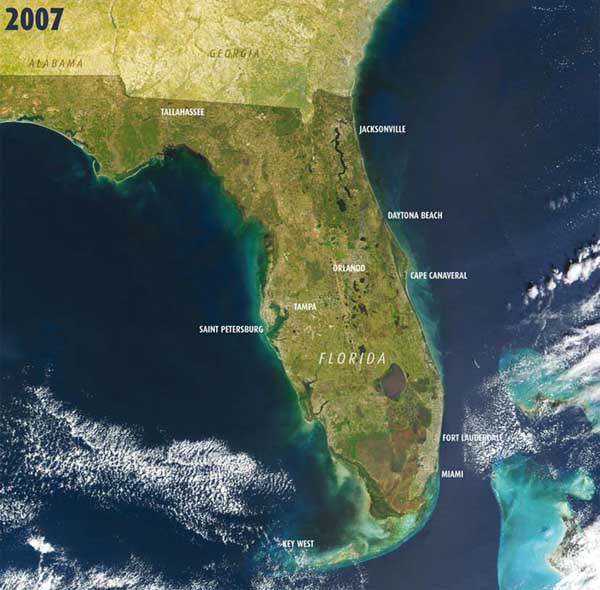
[Image: Florida in 2007; via New Scientist].

In a subscriber-only article over at New Scientist, NASA climate scientist James Hansen describes what the planet might look like after a “runaway collapse” of the West Antarctic ice sheet.
The collapse, or melting, of the sheet, of course, would be caused by increased global temperatures – temperatures altered by the atmospherically unique quantity of carbon dioxide that’s now floating around up there. That carbon dioxide has been released by human industrial processes.
“There is not a sufficiently widespread appreciation of the implications of putting back into the air a large fraction of the carbon stored in the ground over epochs of geologic time,” Hansen writes.

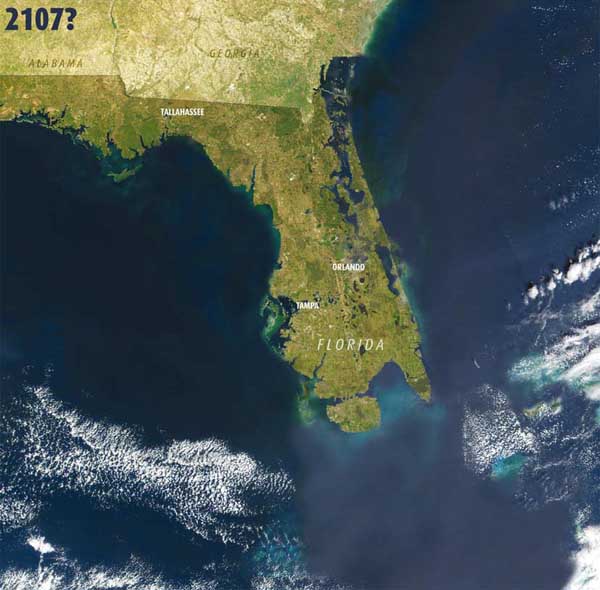
[Image: Florida in 2107; via New Scientist].

In any case, the article points out that this future sea-level rise will actually increase over time, as the melting of the ice sheet itself accelerates.

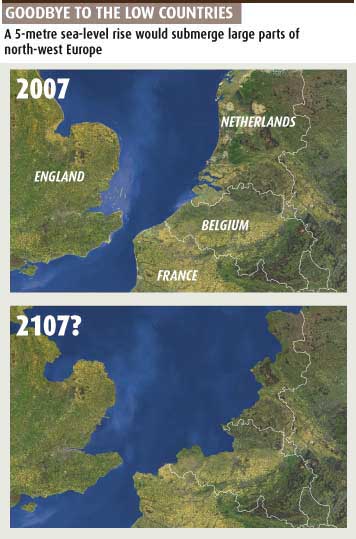
As an example, let us say that ice sheet melting adds 1 centimetre to sea level for the decade 2005 to 2015, and that this doubles each decade until the West Antarctic ice sheet is largely depleted. This would yield a rise in sea level of more than 5 metres by 2095.

That would be more than enough to flood London, as discussed in the previous post – not to mention Shanghai, New York, Mumbai, and so on.
From the article:

Without mega-engineering projects to protect them, a 5-metre rise would inundate large parts of many cities – including New York, London, Sydney, Vancouver, Mumbai and Tokyo – and leave surrounding areas vulnerable to storm surges. In Florida, Louisiana, the Netherlands, Bangladesh and elsewhere, whole regions and cities may vanish. China’s economic powerhouse, Shanghai, has an average elevation of just 4 metres.

This is obviously meant as a warning.
However, the main problem I have with using maps and scenarios like this to get people worked up about climate change is that these warnings often seem to have the opposite effect.
In other words, these things are actually so evocative, and so imaginatively stimulating, that it’s hard not to get at least a tiny thrill at the idea that you might get to see these things happen.
Nothing against Miami, but all of south Florida under several meters of water? With Cape Canaveral lost under a subtropical lagoon and St. Petersburg an archipelago?
The problem, it seems, is that climate change scientists, in describing these unearthly terrestrial reorganizations, are science fictionalizing, so to speak, our everyday existence. The implicit, if inadvertant, message here seems to be: hey, south Floridians, and all you who are bored of the world today, sick of all the parking lots and the 7-11s, tired of watching Cops, tired of applying to colleges you don’t really want to go to, tired of credit card debt and bad marriages, don’t worry.
This will all be underwater soon.
It could be called liberation hydrology.
Climate change becomes an adventure – the becoming-science-fiction of everyday life.

[Image: Northwestern Europe in 2107; via New Scientist].
It seems no wonder, then, that the more apocalyptic these scenarios get, the more we find the same blasé reaction: oh, you mean Manhattan will be underwater? In 100 years?
I think the way to get people truly concerned about climate change – if fear-mongering is, in fact, the correct strategy to use here (after all, if you don’t like fear-mongering in the War on Terror, then why should you apply the same tactics to climate change?) – is not by talking about unprecedented and spectacular transformations of the Earth’s surface. New archipelagos! Forests in Antarctica!
Drowned cities!
Instead, it would seem, you have to point out quality of life issues: you might starve to death, for instance, as organized agriculture and food distribution chains are interrupted. Malnourished, your teeth will fall out and your hair will grow thin. You may be living in a refugee camp, with neither privacy nor close friends nor personal safety. The governments of the world may have collapsed, overwhelmed by the logistical burden of displaced populations and by the loss of the world’s economic centers, like NY, London, and Shanghai; there will thus be no police; you might be physically assaulted on a regular basis. There will be rats, roaches, and rivers of human sewage – followed closely by disease, infection, infant mortality, and premature death. And you won’t just be able to drive away, leaving the catastrophe behind – because the roads will be potholed, without a government to fix them, and your car will probably have been stolen, anyway. Clean water will be a luxury; you’ll be drinking radiator water out of abandoned pick-up trucks, rusting on the sides of highways outside St. Louis.
In any case, my point is just that the more outlandish and imaginatively evocative your predictions get, describing some new, fantasy geography of rising sea-levels and tropical lagoons – a whole new Earth, coming your way soon – the more people will actually want to see that happen. Of course, the same thing is no doubt true for what I just wrote, above, in describing the apocalypse: after all, there are many people who will actually want to experience that – unpoliced refugee camps included.
Still, showing maps of an unrecognizable future world doesn’t scare people; it taps into their explorer instinct – new lands, terra incognita.
And it gives people some truly awesome scenarios to think about – like scuba-diving through the submerged remains of Cape Canaveral, or rediscovering Amsterdam, a city lost to the silt and seaweed.
If this is what people think climate change will bring them, then a whole lot of people are probably looking forward to it.

British Hydrology

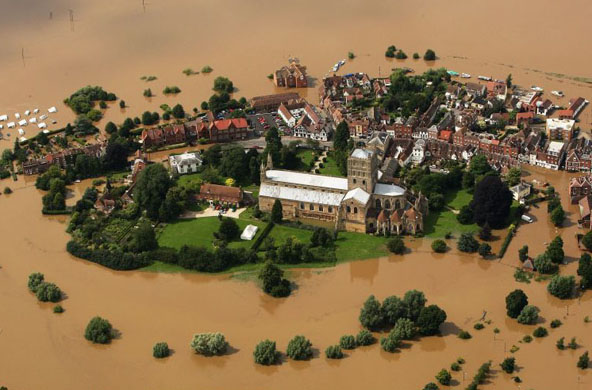
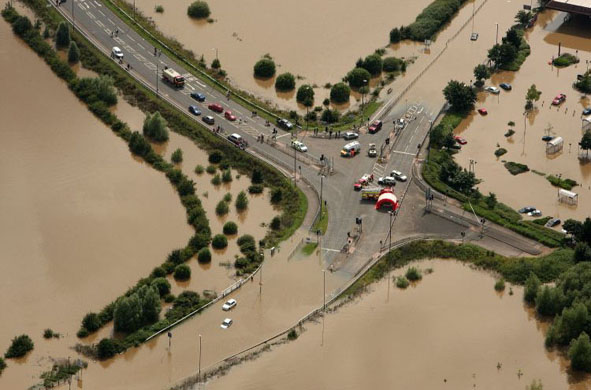
[Image: A thoughtfully signposted British flood; photo by Matt Cardy for Getty Images].
I’m totally fascinated by the idea that adventure tourism firms might someday lead wreck-diving tours through the flooded ruins of London: in your expensive re-breathing gear, you’ll roll backward off a boat, flashlight in hand… and the coral-specked vaults of St. Paul’s are now yours to explore.
All the churches of Nicholas Hawksmoor, as seen through a diving mask. Or the Tube, full of moray eels, awaiting the truly brave.
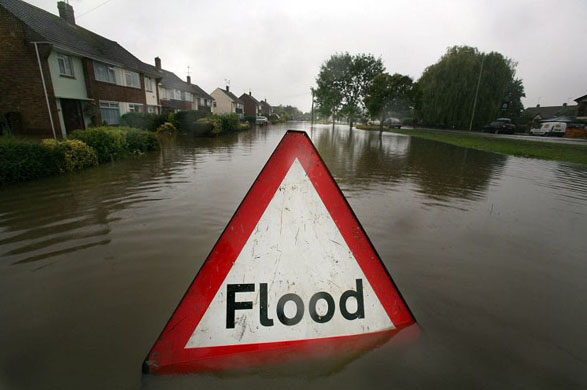
Fantastically, that’s not so unrealistic an image – because London, after all, is sinking.
Using satellite measurement, tide gauges, GPS, and a few other devices called “absolute gravimeters,” a new study proves that London is moving downward into the Earth’s surface in “a general pattern of subsidence of 1-2mm a year. With waters rising in the region by about 1mm a year, the combined effect is a 2-3mm a year rise in sea level with respect to the land.”

The investigation confirms geologic studies that show the Earth’s crust is still responding to the loss of the heavy ice sheet which covered much of Britain more than 10,000 years ago – with southeast England, including London, slowly sinking.

Do some basic math, and that puts London under three meters of water in roughly 1000 years – and London, incredibly, will have passed through the other side of the planet in less than – whoa – 
To help protect against these encoaching waters, the city contains or is surrounded by a rarely noticed hydrological labyrinth: “300km of tidal defences including embankments, walls, gates and barriers.”
However, “at some stage, [these will] have to be adapted or moved” – at least until “new types of defences [are] created that make better use of the natural floodplain.”
I love this stuff. In fact, I’m 100% convinced that if architectural magazines really wanted to discuss what the London of tomorrow will look like, they’d have stopped talking to architects a long time ago – and they’d have flood consultants on the phone.
The future of London will be determined by hydrological engineers.

[Image: The Tewkesbury flood of 2007, as seen from the air; photo by Daniel Berehulak for Getty Images].

In any case, London is also jostling up and down on the Earth’s surface, everyday, bobbing up and down like a buoy with the tides; these micro-movements need to be taken into account by anyone who hopes to study the effects of so-called post-glacial rebound.

London itself will rock by 10mm, twice a day, with loading from ocean tides. The seasons also alternately load and unload the ground, making the Earth’s crust “breathe” up and down over a longer period.

London, your tides are breathing you. An Albionic lung.
But if you want more stuff like that, this older post is rather heavy on British hydro-speculation.
Meanwhile, a “lost” village in Wiltshire might offer a glimpse of London’s own future to come. From the BBC:

A team of divers who set out to solve the mystery of the drowned village of Bowood in Wiltshire has found the remains of buildings under a lake.

If that sounded easy, though, consider that “[p]revious attempts to find the village included a dive by Bowood owner Lord Lansdowne, the 9th Marquis of Lansdowne, who donned his scuba gear 20 years ago. His attempt was unsuccessful.”
So will aquatic archaeologists someday dive into the kelp-choked canyons of what was once Islington High Street, looking for lost malls and cinemas…?
This blogger thinks so.
Moving on: in an amazing story that was reported – and repeated – all over the place last week, we learned that a thin ridge of chalk once connected SE England to NW France.
The image, below, is BLDGBLOG’s own highly inaccurate, and grossly out of scale, representation of what that ridge might have looked like.

Calculated to stop the hearts of English people the world over, those maps show us a land-bridge, continentalizing Kent, putting Franco in the Anglo and de-Saxonizing the island from its royal isolation. And I have no idea what that sentence means, either.
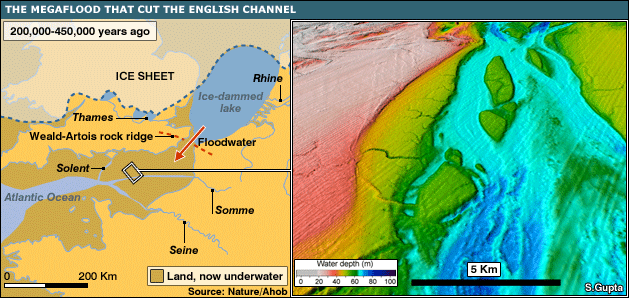
[Image: A slightly more accurate map of both the chalk ridge and the glacial lake it held back; via the BBC].
According to New Scientist: “Half a million years ago, Britain was connected to mainland Europe by a broad chalk ridge that spanned what we now call the Dover Strait. But somehow that ridge was destroyed, forever separating England and France.”
A new theory holds that this ancient chalk ridge was “breached and toppled by a monumental torrent that gushed from an overfilling glacial lake that the ridge had been damming on its northern side.” As evidence of its passing, the catastrophic flood left “deep valleys gouged into the channel’s bedrock,” turning what is now England, Scotland, and Wales into one big happy island.
“At its peak,” the BBC adds, “it is believed that the megaflood could have lasted several months, discharging an estimated one million cubic metres of water per second.”
However, New Scientist quietly points out that Alec Smith, of Bedford College, London, once suggested this exact same idea, back in 1985 – and he was ridiculed. Nobody believed him.
Sorry, Alec.
Finally, it would have been hard to miss all the news about last week’s floods across England – so I’ll just supply these links and let the pictures do the talking.

[Image: The Tewkesbury flood of 2007, as seen from the air; photo by Daniel Berehulak for Getty Images].
But, of course, England has a deep history of flooding…

(Note: The Wiltshire lost village link was discovered via an amazing post at things magazine, a reliable source of great links and information – for anyone out there who doesn’t already know it).

The Wit of the Staircase

Last summer, BLDGBLOG interviewed author Erik Davis about his new book The Visionary State – a book originally sent to me on the advice of a woman named Theresa Duncan.
Theresa was the author of an often disarmingly sharp blog called The Wit of the Staircase.

[Image: Artist/photographer unknown. From an old post on The Wit of the Staircase].

I was stunned, saddened, and horrified to learn, in the middle of an otherwise casual email exchange, that Theresa committed suicide two weeks ago. Somehow I had missed the news.
A few days later, her boyfriend, Jeremy Blake, left behind a note in a pile of clothes on the beach and then “walked into” the Atlantic – and his body has yet to be found.
The story’s been all over The New York Times, The L.A. Times, Modern Art Notes – basically everywhere – even as author Ron Rosenbaum has been using their deaths, somewhat irresponsibly, to speculate about what he wants to believe was a murder.
Of course, Theresa was well-known for her “paranoiac” writings about Scientology, the art world, CIA black ops, secret FBI files, and the like – this post, in particular, has received a huge amount of attention this past week (and it’s a crazy thing to read) – but to throw her entire blog away as mere political ravings overlooks the vast majority of the site’s actual content: short observations – often limited to single quotations and photographs – with an articulate precision and interpretive confidence other writers would only dream of achieving. She could be writing about supermodels, the occult, music, 9/11, Percy Bysshe Shelley, perfume, Los Angeles, or the films of Quentin Tarantino.
Not everyone will agree with the political views espoused in this essay, for instance, but Theresa wrote one of the best and most energetic reviews of Grindhouse I’ve ever read; and she posted a long interview with Father Frank Morales, an Episcopal priest, in which they talk about everything from Philip K. Dick and Jerry Falwell to the Moonies, Freud, Marx, science fiction, and Disneyland – all by way of a discussion about Jesus Christ.
Here’s an excerpt:

Wit of the Staircase: You know, Philip K. Dick is really interesting on this, too, because he had a conversion experience in California – he famously lived next door to Disneyland – and a woman came to the door. She was wearing a fish sign, a Pisces sign that the early Christians used. And he claims he had this sort of mystical experience that was across dimensions of time. And he actually suddenly felt that time was an illusion. So he said ever after he had the feeling time was essentially created by Satan to prolong and delay the return of Jesus Christ, the Second Coming. So, under all of the supposed progress and all of the change, he says it’s just an overlay over the same unchanging reality. It’s still like the day that Christ died, and he felt the anticipation of resurrection, the thrill, he says, constantly.

Frank Morales: I totally agree with that.

Wit: So other than the hucksters, the Falwells and the L. Ron Hubbards of the world, there are these startlingly generous and original religious thinkers. P. K. Dick – obviously, he’s a little wiggy, but he’s an original thinker, and this old narrative was just completely alive for him. And Slavoj Žižek is great on the continuing radicality of Christian love and forgiveness, particularly in his book The Puppet and The Dwarf, which is also thankfully very good on Freud and Marx.

Morales: As a matter of fact, to use that metaphor again, without sounding preachy, reminds me of Buckminster Fuller’s comments, why do you think they call the basic element of time “the second”? Because it’s not the first.

Wit: Well, because P.K. Dick lived next to Disney World, he talked about the animatronics there – the servo operated puppets and the moving pirates and the fake birds – a place everything was artificial. And he said that that’s like the second reality. But he said, someday a real bird was going to sing at Disneyland and uncover the first reality.

Morales: Ah, beautiful.

In any case, this is personal news creeping onto an architecture website – but I’m stunned. And I don’t mean to imply that we were close friends – we weren’t – in fact, we only communicated through email. But sometimes you look away and people disappear.