Hog Island

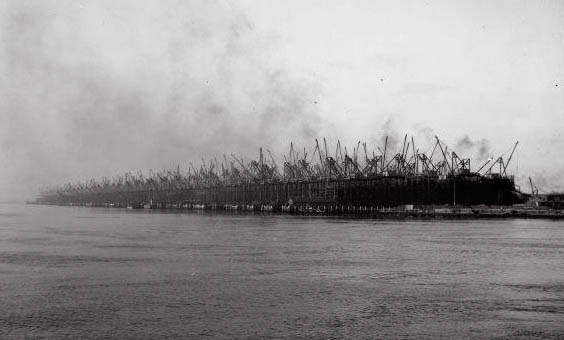
Around a year ago, Andrew Evans – of Reinterred City fame – sent me this image of a place called Hog Island, Philadelphia.

Hog Island was a shipbuilding yard – in fact, we read, it was “the largest shipyard in the world” during WWI.

The yard covered 846 acres and comprised 250 buildings. It had 80 miles of railroad track; 3,000,000 feet of underground wiring; a hospital; YMCA, hotel, cafeteria, trade school, 12 service restaurants and 5 mess halls. Twenty locomotives, 465 freight cars and 165 motor trucks hauled material within the yard. Hog Island’s telephone traffic was equivalent to that of a city of 140,000 inhabitants.

And though Hog Island is now barely known outside of war historical circles, it was a true industrial behemoth:

There never before had been conceived or executed a plan for the fabrication of ships on such an enormous scale. Every steel fabricating plant in America, 88 of them in all, from Montreal to Kansas City, funneled steel plate into Hog Island and machinery and gear from hundreds of manufacturing plants all over the country poured into the mammoth assembly plant.

It was “a sizable piece of land – about a thousand acres – between Philadelphia and Chester, south of what was known then as League island,” but it was also something of a manmade artifact, an artificial terrain.
Partially constructed from dredged fill in a “glorified bog,” the industrialized earthworks were then turned – as you can see in the image, above – into a kind of machine-island, built to order.
And while this has nothing to do with architecture, I was fascinated to learn, as a former resident of Philadelphia who never knew this, that Philadelphia’s hoagie sandwiches are actually named after the lunches once eaten by workers on Hog Island.
In any case, this island of ship-assembly machines is now lost to the muck, bogs, and marshes – and entombed beneath the concrete runways of Philadelphia International Airport.
Perhaps this could even kick off a new series of architectural guidebooks, written to explore that little-known terrestrial subcategory: manmade islands lost beneath airports

(Thanks, Andrew!)

Air Unit

Last week, Toronto’s Lateral Architects premiered a brand new “deployable condo unit… that is light as air.”

[Image: The Air Unit by Lateral Architects].

Lateral’s “exciting new freehold residential unit” not only attaches to the sides of existing buildings – indeed, it is “a portable unit that can fit into any community and be attached to any building” – but it also floats on water.
Fill it will helium, meanwhile, and perhaps it will even float on air…
BLDGBLOG would like at least three units, please.
I’ll attach them to the side of the Golden Gate Bridge and telecommute.

Lights among the ruins

The New York Times reports today on what it calls the “Pompeii of World War II,” an abandoned village in Italy now “overtaken by vines and lime trees.”
That village is San Pietro, an “11th-century cobblestone mountain village nestled among wild figs and cactus,” as well as the scene of months of horrific fighting between Allied and German troops.

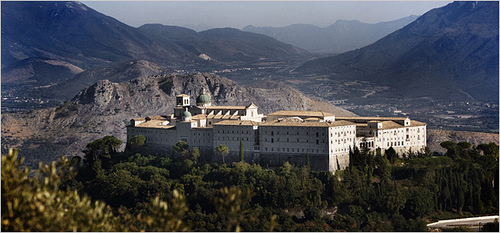
[Image: The reconstructed abbey atop Monte Cassino, as photographed by Stephanie Kuykendal for The New York Times].

Nearby, atop Monte Cassino, was “one of the holiest sites in Christendom,” a monastery “founded by St. Benedict in the sixth century, a shrine of Western civilization” – indeed, “a center of art and culture dating back nearly to the Roman Empire” – which the Allies bombed into rubble, suspecting (or not suspecting, but caught up nonetheless in the machinations of bad intelligence and unquestioned orders) that German troops had taken refuge there.
“After the battle ended,” we read, the entire chain of small mountain valleys in which San Pietro once stood “would be left uninhabitable for years, demolished by Allied bombs, beset by malaria.”
So this may be a bit rambling, and otherwise unrelated, but while working on The BLDGBLOG Book tonight (due out Spring 2009! from Chronicle Books! buy loads!), I was re-reading W.G. Sebald’s extraordinary On the Natural History of Destruction.
At one point in the book Sebald describes the literally shell-locked life of people who had managed to stay on in the destroyed cities of northern Germany during WWII. He describes “the unappetizing meals they concocted from dirty, wrinkled vegetables and dubious scraps of meat, the cold and hunger that reigned in those underground caverns, the evil fumes, the water that always stood on the cellar floors, the coughing children and their battered and sodden shoes.”
Battling grotesquely bloated rats and enormous green flies, these “cave dwellers,” as Sebald calls them, lived with the “multiplication of species that are usually suppressed in every possible way,” amidst the gravel and shattered windowframes of their now “ravaged city.”
Based on an eyewitness account written by an Allied Air Commander, Sebald then refers to “the terrible and deeply disturbing sight of the apparently aimless wanderings of millions of homeless people amidst the monstrous destruction, [which] makes it clear how close to extinction many of them really were in the ruined cities at the end of the war.”
For some reason the next line just haunts me:

No one knew where the homeless stayed, although lights among the ruins after dark showed where they had moved in.

Which leads me to ask myself whether it’s simply a factor of my age – I’m not exactly getting younger here – though I do drink a lot of orange juice – or if it’s something more closely related to the weirdly militarized political climate in which we now live, but I’ve started to react to things like this with a kind of concentrated studiousness, as if reading – absurdly – for advice on how to survive my own generation’s coming, perhaps even more calamitous, future.
What “monstrous destruction” of world war and oil shortages and global terror and climate change might we, too, have to face someday?
In twenty years’ time will I be out holding up some pathetic light among the ruins of a destroyed city, wondering where my wife is, dying of thirst, deaf in one ear, covered in radiation burns?
Or is that just a peculiarly American form of pessimist survivalism? Or do I just read too much Sebald?

Sound Pressure

Wired just published a conversation between neurologist Oliver Sacks and journalist Steve Silberman – the latter of whom is also now my neighbor – hello, Steve! – about music, memory, the neurological benefits and pressures of sound, blindness, and the (possible) dangers of urban noise pollution.

[Image: Luigi Russolo and his noise machines… something otherwise irrelevant to this post].

An excerpt:

Wired: When you were growing up, hearing music often required going to see it performed. But iPods make music ubiquitous, like mental air-conditioning. What have we gained or lost by that?

Sacks: At first it would seem to be a wonderful gain. Darwin might have had to go to London to see a concert. But I can’t help wondering if the incidence of earworms and musical hallucinations is higher now, with background music in every public place. You can’t go to a restaurant without music, and they get offended if you ask them to turn it off. They feel it’s part of their creativity – they’re doing it for you.

The brain is very sensitive to music; you don’t have to attend to it to record it internally and be affected by it. I think we may be exposed to too much loud and repetitive music. One patient of mine has epileptic seizures induced by music and has to wear earplugs in New York City. It’s a dangerous place for him.

Read the rest at Wired.
For some reason, though, this reminds me of an anecdote I read five or six years ago about French minimalist/proto-ambient composer Erik Satie – about whom you can read more in David Toop’s excellent book Ocean of Sound.
So Satie, the anecdote goes, once tried to compose – and have performed, live, in a Paris restaurant – literal background music. It was music meant to flavor a room the way perfume might scent the boudoir: something you don’t quite notice but is there nonetheless. Or, in a slightly more famous analogy, it was music meant to be experienced like furniture: it may be there in the room with you – but you didn’t have to pay attention to it.
It was just part of the design.
In any case, social conventions of the time being what they were, whenever Satie’s musicians, installed there in the restaurant, started to play, all the diners would stop talking, put their utensils down, and politely listen.
But that wasn’t the point.
Satie thus had to walk around the restaurant almost continuously for the next half-hour, passing from patron to patron, demanding that they stop listening to his music…

Urban Noise Generation

The Observer this week takes a look at the sounds of cities.
“For some,” we read, “living in a city is a loud, unpleasant babble of intrusive noise. For others it is a soundscape of calming tones that lift the spirits and brighten the day. Now a £1m, three-year research project is building a database of noises that people say improve their environment. It will translate those findings into design principles to help architects create sweeter-sounding cities.”
Wonderfully, the leader of the study “is looking for members of the public to take part in mass ‘sound walks’ through cities or in laboratory listening tests, where the team will use MRI scanners to measure participants’ brain activity as they are played a variety of urban noises.”
They will thus develop an artificial soundtrack for the urban future.

Some of the “surprisingly agreeable” sounds discovered thus far include “car tyres on wet, bumpy asphalt, the distant roar of a motorway flyover, the rumble of an overground train and the thud of heavy bass heard on the street outside a nightclub.”
We even read that the sounds of “skateboarders practising in underground car parks” are considered “kind to the ear.”
As part of his auditory interest in urban design, then, the leader of the study wants “to see more water features and sound-generating sculptures next to busy roads,” and he wants to use buildings and trees “to scatter, deaden or reflect sound.”
The entirety of city space could thus be instrumentalized – literally made more musical.
However, I’m curious how this study will deal with different moral and/or cultural expectations for urban noise. The sounds of neighbors having sex, for instance, and those who voyeuristically listen-in: should you play copulatory noises through hidden speakers in the downtown park? Thus calming a certain segment of the population?
What about the Muslim call to prayer?
And could your city someday start a season-long program, inviting sonic grandmasters to come in once a month and play new sounds for the whole metropolis, resoundtracking highways and civic infrastructure, giving the sewers a tune, adding audio to everything?
Or is that just called a radio DJ?

(Thanks, Nicolai! Earlier on BLDGBLOG: Audio Architecture and New York City in Sound).

Inhaling 9/11

[Image: The South Tower of the World Trade Center on 9/11; photographer unknown].

On the flight over to Chicago last week I read an intense and frightening article in Discover about the wide range of post-9/11 illnesses that have begun to develop in New York City.
As most people no doubt know, tens upons tens – if not hundreds – of thousands of people literally inhaled the World Trade Center towers in the collapse and aftermath of 9/11.
It was the malign aerosolization of late modernist architecture, producing “the most dangerous atmospheric conditions ever to occur on American soil.”
The “sky was glittering with glass” that day:

A toxic cloud composed of industrial waste and human remains crept out from the aching, smoldering pit at Ground Zero and wound its way into the adjoining streets. Its vapors circled around and up buildings, pumped in and out of nostrils, mouths, and lungs, and stung the eyes of every woman, child, man, bird, and beast within a wide range. It spread itself on building walls and inside boiler rooms and left its trail on parked cars, handrails, and public benches. That day, New York City was blinded by a perpetually sickening haze. It poisoned the minds of politicians who acted with hubris and paranoia. It obscured the vision of responders and residents, many of whom acted with heroism and reckless bravado, never thinking that their actions might be endangering themselves, their families, their cities, and their very future. The cloud billowed southward, over the river, enveloping everything in the dust and debris of blown-apart lives.

Breathing this “toxic cloud” has led to people coughing up “brown and pinkish-bloody” clots of tissue; it has led to organ failure; and the article even introduces us to a man who, five years later, “started bleeding everywhere – out of my ears, mouth, penis, and anus, and none of the doctors could figure out why.”
Indeed, the “number of seriously ill New Yorkers could climb to 300,000 in the near future,” and these serious illnesses run the gamut from “internal chemical burns” and “chronic respiratory and gastrointestinal conditions,” many of which will be fatal, to “rare blood cancers” and asthma attacks.

[Image: “Within a few hours’ time, a person exposed to the fumes could ingest toxins that would otherwise take a year to accumulate in a typical environment”; photographer unknown].

None of which seems surprising when you read about what actually went up in the air that day:

The Twin Towers contained tens of thousands of computer terminals, each housing about four pounds of lead, and an untold number of fluorescent bulbs that contained mercury. Released metal particles from the smoldering pit of the World Trade Center were so fine that they could easily slip past a paper face mask and reach deep into lung tissue, where they are poorly soluble in lung fluid. Metals and glass can remain trapped there for long periods of time and make their way into the heart.

It’s also important to note, for my voting American readers, that the leadership of Rudy Giuliani does not fare very well in this article.
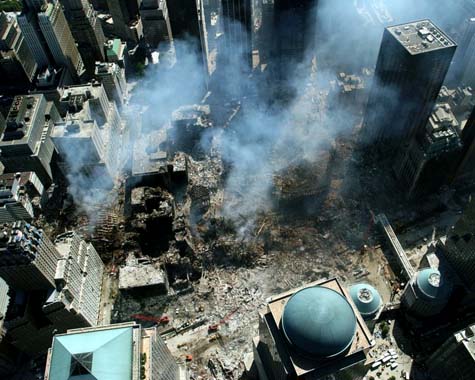
[Image: After the towers’ collapse; photographer unknown].

After much more detail about both the “plume” itself and about the various environmental failures that occurred up and down the political chain of command, the article ends magnificently: “While the courts try to determine who is responsible for the environmental debacle following 9/11, countless New Yorkers continue to live and work near Lower Manhattan with the assumption that it is safe. The dust is now out of sight, out of mind, and possibly in their lungs, hearts, and bloodstreams.”
So this is what happens when you pulverize and burn modern architecture: plumes of cadmium, thallium, benzene, silver, zinc, osmium, carbon monoxide, sulfuric acid, nickel, and lead drift outward into the city, snowing invisibly into local waterways, settling on windowsills and dusting the floors of homes, shops, and offices, salting food on plates at outdoor cafes, entering bloodstreams and sticking to clothes. Fiberglass and fire retardants, arsenic and rubber – asbestos, soot, and paper – all enter the atmosphere and form undetectable weather systems too vaporous and ghostlike to track.
Which leads me to wonder about what sort of post-bombardment aerial conditions existed in cities like Dresden or Hiroshima, after they were destroyed in World War II, when architecture was not made from such things – when there were not home computers and circuitboards to burn and when homes weren’t full of flame retardant fabrics and PVC.
Were different and earlier forms of pulverized architecture somehow safer to breathe?
In fact, if I can be excused a brief moment of contextually inappropriate speculation, would it be possible to impregnate buildings with good things – with good chemicals: with vitamins and medicines and even seeds – so that future 9/11s release beneficial plumes and so that the inhalation of architectural smoke is no longer catastrophic?
Or would that just encourage terrorist attacks, arson, and urban warfare?
In any case, the article in Discover is well worth a half-hour or so of your time – especially if you lived or worked in lower Manhattan or Brooklyn during the weeks after 9/11.
Galaxy Chicago

[Image: Famous buildings in Chicago, via the Chicago Architecture Foundation].

I’m in Chicago, wandering around the city for the first real time since I left six years ago, looking at a hundred thousand new brick-and-limestone private condo developments, crossing and recrossing the Chicago River on foot, staying in various hotels, visiting houses, checking out gigantic roof decks, writing up stories for work, attending dinners, feeling almost overwhelmingly nostalgic, giving a talk about BLDGBLOG, hanging out soon with this guy… but I’ll almost definitely be back in San Francisco before I have time to post again.
In the meantime, hello from Chicago!

A Pavilion in New York

[Image: Glowing pavilion by Minsuk Cho, at the Storefront for Art and Architecture, NYC].

New York’s Storefront for Art and Architecture today kicks off nearly a month’s worth of events, in celebration of the Storefront’s 25th anniversary. The list of speakers is long and well-curated; they’ll be speaking inside Minsuk Cho’s pavilion, in Petrosino Park, and the nightly events will last until October 16.
So if you’re in New York, you now have something to do every night for the next 26 days. Be sure to stop by.

(The Storefront for Art and Architecture, of course, also hosted Postopolis!)

It came from outer space

This is how the world will end: with a quiet bit of news on the BBC.
I got home from work last night to find out, incredibly, that “[h]undreds of people in Peru have needed treatment after an object from space – said to be a meteorite – plummeted to Earth in a remote area.”

[Image: A spectacular glimpse of the Leonid meteor shower, circa 1999; photo by Wally Pacholka].

The object “left a deep crater” that immediately began “spewing fetid gases,” and everyone who has “visited the scene” has since “been complaining of headaches, vomiting and nausea.”
A local villager, worried for himself and for his neighbors, says: “We don’t know what is going on at the moment, that is what we are worried about.”
It’s a virus from space!
So I half-seriously expected to wake up this morning and read that the entire population of Peru has been wiped out by clouds of alien zombie-dust; that militaries have been mobilized; that families are now scrambling in all possible directions to find a safety that will no longer come; and that the catastrophe continues to spread… In eight days’ time it reaches the streets of San Francisco, where I’ll be live-blogging the outbreak from behind a plywood barricade.
But it turns out that we don’t need to worry after all: the scientists quoted in the original article are right.
It wasn’t an object from space at all but “a fireball,” the appearance of which led people to hike out into the wild and find “a lake of sedimentary deposit, which may be full of smelly, methane rich organic matter.”
This “rich organic matter” made everyone ill – infected by rot and vegetation. It’s a kind of petro-illness.

Limey

[Image: Habitat 825, by Lorcan O’Herlihy].

In an earlier post I mentioned a housing project by LA architect Lorcan O’Herlihy.
That building, called Habitat 825 – built right next door to the Schindler House and deliberately designed so as to cast no shadows onto its historically listed neighbor – has a particularly memorable use of the color lime green.
Now, thanks to a coworker of mine, I have a few photos…

[Images: Habitat 825, by Lorcan O’Herlihy].

And I love this building! O’Herlihy’s use of volume and color just knocks me out.
For more Lorcan O’Herlihy, visit the firm’s website or read this earlier post on BLDGBLOG.

(Thanks, Chelsea!)

The school of 5000 corpses

In the Guardian today, Jonathan Glancey reports on London’s subterranean housing boom, pointing out that the urge for literally underground architecture has now hit the city’s public sector.

Case in point: the St. Marylebone school.
With the advisory input of their architect, the school’s officials decided that “the only way the school could expand physically was onwards and downwards through its pocket-sized playground.”
Unfortunately, the resulting project, a “fine example of intelligent urban design, thoughtful landscape gardening, worthwhile architecture and quiet delight,” dug straight into the “remains of some 5,000 corpses” almost as soon as construction began.
Rather than unearthing some super-virulent strain of the Black Death, however, sending all the small schoolgirls home coughing, decimating the population of northwest Europe… the project was completed to everyone’s satisfaction, and now St. Marylebone has an underground gymnasium.
And Glancey likes what he sees. He concludes:

It is also a project that deserves to set a precedent for much new city architecture. Much of this can be built underground, when not in flood zones, in one form or another, sometimes because this is the only way to go for a client unable to afford the price of land, or else restricted by perfectly sound conservation policies, and sometimes because – like most supermarkets, shopping malls and other structural detritus – it should be, as a matter of common decency, buried out of sight.

I’m not exactly in agreement with him that we should start putting our supermarkets underground; in fact, an upcoming article in Dwell makes the opposite case quite convincingly: i.e. supermarkets shouldn’t be windowless boxes but pleasantly open places in which to walk around, complete with outdoor horizons and panoramic views.
But imagine the future settings for novels and films! Underground malls in Canterbury. Irish theme-bars 27 stories below the surface of the Earth. Three kilometers of escalators take you down and down – and down – passing through mirrored corridors… till you arrive at the local arts cinema. There are rumors of a BMW dealership another mile or so below.

(Thanks, Nicky! Earlier on BLDGBLOG: Hello. Welcome to my squash cave)