Feral Cities

I’ve got two more events coming up in London, both on Wednesday, November 26. I’ll post more info about the first event in a bit. The second one, in the evening, has been organized by the Complex Terrain Laboratory, and it will take place in the J.Z. Young Lecture Theatre at UCL, inside the Anatomy Building on Gower Street. Here is a map.

I’ll be teaming up with Antoine Bousquet, Lecturer in International Relations at Birkbeck College, and author of the forthcoming book The Scientific Way of Warfare: Order and Chaos on the Battlefields of Modernity to discuss our work in relation to space, war, and the city.
A description of the event itself:

Contemporary political discourse on armed violence and insecurity has been largely shaped by references to spatial knowledge, simulation, and control: “human terrain,” “urban clutter,” “terrorist sanctuaries,” “failed states,” “core-periphery.” The historical counterpoint to this is to be found in the key role the successive technologies of clock, engine, computer, and network have all played in spatializing the practice of warfare. In this context, what implications do “feral” Third World cities, “rogue” cities organized along non-Western ideas of urban space and infrastructure, and “wild” cities reclaimed by nature, have for the battlespaces of today and tomorrow?

Antoine and I will both be giving short talks, followed by a general Q&A. The event is wide-open to the public, so please feel free to stop by. At the very least, you’ll get an early preview of Antoine’s forthcoming book – in which he introduces the term chaoplexic warfare in a survey of everything from ant “swarms” and the use of 18th-century battlefield metaphors to the distributed geographies of the Russian mafia, the Medellín drug cartel, and Al-Qaeda – and that’s already quite a lot right there.
For my own part, I’ll be discussing a pretty broad swath of ideas about “feral cities” – what I like to call cities gone wild – ranging from Richard J. Norton’s seminal paper on the topic to Mike Davis’s research on “the Pentagon as global slumlord,” via reference to J.G. Ballard, Eyal Weizman, Stefano Boeri, Reza Negarestani, and many others.
I’ll also briefly mention the radical ecology of a biologically wild city, or the city regressed (perhaps advanced?) into an extraordinary state of nature after abandonment and war.

Some of the basic themes we should be approaching: If a growing majority of the human population has now been urbanized, moving into what are often incorrectly described as “cities,” what will warfare mean – and how will it be practiced – in these increasingly complex spatial environments? If urban insurgency is, indeed, the future of the global battlefield, as many theorists have proposed, how does the changing nature of urbanism itself help to redefine war? Conversely, how does insurrection work to redefine the space of the modern city?
Finally, if the future of war can be seen as Military Operation on Urban Terrain – or MOUT – what mutations will we see when that one key variable, the urban, is redefined?
So I’m really looking forward to this. I’ve got loads and loads of notes and references to bring with me, and it’ll be good to meet Antoine, whose book I’ve been reading this month.
So if you’re in London that night, stop by! It’s free and open to the public. Wild cities, rogue cities, feral cities, future cities.

(Note: This event is sponsored by the excellent Symbio Design, who also produced our web banners, ads, and flyer).

Code 46

On Monday, November 24, I’ll be hosting a live interview at the Barbican in London with director Michael Winterbottom, for a special screening of his film Code 46. You can read a bit more about the event – as well as buy tickets – here.
This is part of an ongoing series called Architecture on Film, curated by the Architecture Foundation.

[Image: From Michael Winterbottom’s Code 46, courtesy of United Artists].

The purpose of the event is to talk about film and architecture – or, in this case, cities, urban design, memory, science fiction, landscape, globalization, and the built environment. As you can see from the list of locations used for the film’s production, Code 46 is very well-traveled, stitching together urban – and exurban – environments from London, Shanghai, Dubai, Hong Kong, and even the deserts of Rajasthan.
That the film achieves the feel of science fiction simply through a well-edited depiction of existing landscapes says as much about the film as it does about the nature of city-building today; perhaps one might only half-jokingly suggest that people build cities today in order to live inside science fiction films.

[Image: Shanghai, from Code 46, directed by Michael Winterbottom, courtesy of United Artists].

As BLDGBLOG explored the other week in a long post, “cities today are well known for popping up in the middle of nowhere, history-less and incomprehensible.”

That’s what cities now do. If these cities are here today, they weren’t five years ago; if they’re not here now, they will be soon. Today’s cities are made up, viral, fungal, unexpected. Like well-lit film sets in the distance, staged amidst mudflats, reflecting themselves in the still waters of inland reservoirs, today’s cities simply arrive, without reservations; they are not so much invited as they are impossible to turn away. Cities now erupt and linger; they are both too early and far too late. Cities move in, take root and expand, whole neighborhoods throwing themselves together in convulsions of glass and steel.

What does it mean, then, to set a film inside a mix of such spaces? And as more and more instant cities appear in the world, built from zero in less than a decade, how can cinema capitalize on the lack of recognition these historically too-new and culturally all but anonymous environments inspire?
What does it mean, as well, that the depiction of the future in Code 46 – a depiction of the future through architecture – involves no U.S. cities at all and only very brief glimpses of urban infrastructure in Europe?

[Image: Shanghai, from Code 46, directed by Michael Winterbottom, courtesy of United Artists].

This brings up one of the more interesting aspects of the film – something not internal to it, but created by the current state of global urbanization. The film makes it deliberately unclear, in other words, that it was shot in multiple locations at all; the opening sequence blurs together landscapes, buildings, and infrastructures from very different cities – yet this unfamiliar new place to which we’re being introduced might very well exist.
For all many viewers know, perhaps Shanghai really is in the middle of a desert; perhaps Dubai really does look exactly like Hong Kong.
This confusion only seems possible, however, within a very narrow window of historical time. As the skylines and iconic hotel interiors of Dubai, Shanghai, Hong Kong, and elsewhere become visually familiar to many more people, it will become much harder to do what Code 46 has done – which is to edit them all up into a convincing pastiche. They are a spatial collage, an urban cut-up – William S. Burroughs as architectural director.
In ten years, then, would this be akin to cutting from a shot of the Empire State Building to a shot of the Eiffel Tower and pretending that these landmarks are in the same city – only to find that almost no one has been genuinely tricked?
In a funny but negative Amazon review of the film, a disappointed viewer actually mocks this very aspect: “If I have to keep seeing these movies with the I haven’t a clue which Metro I’m in look I’m going to scream.”
But what does it mean that Asian cities – cinematically depicted as a kind of monolithic urban Other – are, for the time being, so visually unfamiliar to Western audiences that they can be edited into a seamless Global Metropolis, a vast agglomeration of spatial alterity that we can cut-and-paste together on film?
Where might Code 46 have been made if it had been produced fifteen years from now? What explosive urban outgrowths between now and then will be sufficiently unfamiliar to literally hundreds of thousands of filmgoers that they could be combined into one convincing location?
Will the sci-fi films of tomorrow be set in Lagos, Delhi, Rabat, or Shenzhen? All of the above?
It’s the future science fiction of global third-tier urbanism.
For instance, one of the most striking aspects of the urban environment in The Matrix came simply from the fact that many – though not all – of the outdoor scenes were shot in Sydney, a city with which most American viewers are not visually familiar. The urban world of the Matrix thus took on an uncanny sense of near-resemblance, looking an awful lot like a city everyone has seen before – is that Houston? Tampa Bay? Fresno? – but not enough like any single one of them to be clear.
The film Primer, shot in Dallas, is an amazing example of this: the whole time you’re watching it you have no idea where you are… though absolutely everything about it looks familiar.
The effect, particularly in Code 46, is almost literally uncanny.

[Image: The Shanghai skyline, from Code 46, directed by Michael Winterbottom, courtesy of United Artists].

Briefly, I’m also reminded here of Tativille, the massive film-set city built by Jacques Tati to produce his own film Playtime. Constructed solely for the purpose of hosting camera crews – and later disassembled – Tativille was a city of the image, its design shaped only by how it would look on screen. With Tativille in mind, what might future audiences think if, say, Dubai really does run out of money in the global economic downturn, its towers abandoned and eroding back to sand? It will be visible in films like Code 46 – but nowhere else. It will have ceased to exist.
It will have been a kind of Tativille of the Emirates, built only to host film crews and car commercials.
In any case, the film’s visions of desert poverty – scenes in Rajasthan – and desert opulence – scenes in Dubai – bring up the topic of uneven development. If, as William Gibson‘s oft-quoted line goes, the future is already here, it’s just unevenly distributed, then this also appears to be true in the context of architectural form and urban landscapes.
But which one is the future: the nationless desert of rights-deprived exiles or the golf course-filled desert of the stateless business class?
Or are these perhaps one and the same, requiring each other as the flipsides of their own formation?

[Image: The opening titles of Michael Winterbottom’s Code 46, courtesy of United Artists].

None of these questions are new, of course, going back in some form or another to Sergei Eisenstein, Fredric Jameson, and many, many others; but the opportunity to discuss all this with Michael Winterbottom himself in reference to a specific – and, as it happens, visually stunning – film, in a monumental and legendary architectural complex like the Barbican, is something of which I’m genuinely excited to be a part.
So if you’re in London on Monday, November 24, consider stopping by. Tickets can be purchased directly through the Barbican’s website, and you can learn a bit more about the film here.

Resampled Space

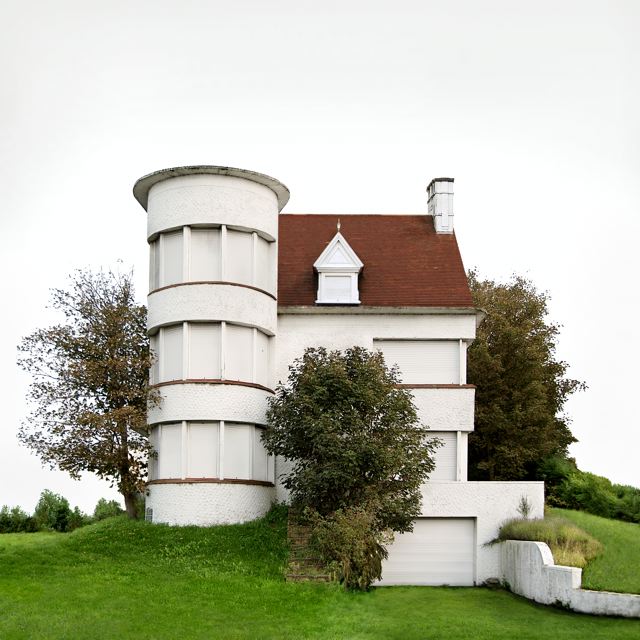
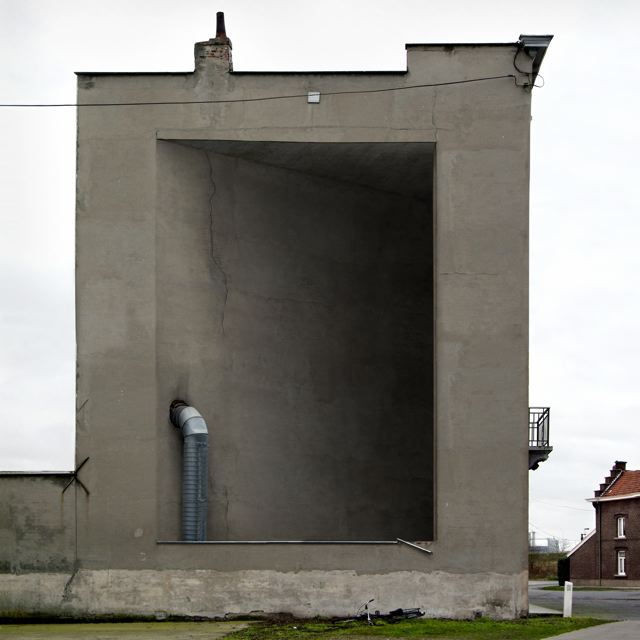
[Image: Photo by Filip Dujardin, courtesy of the artist].

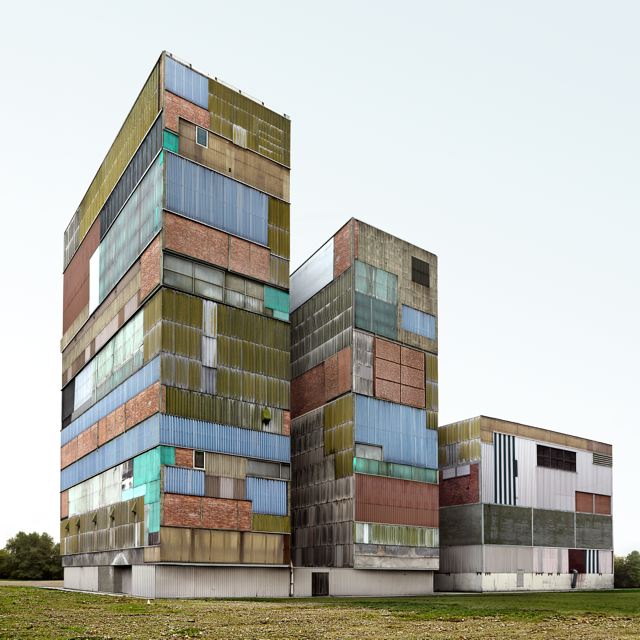
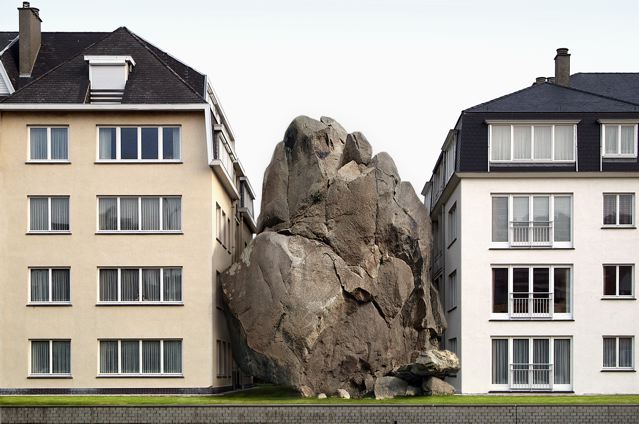
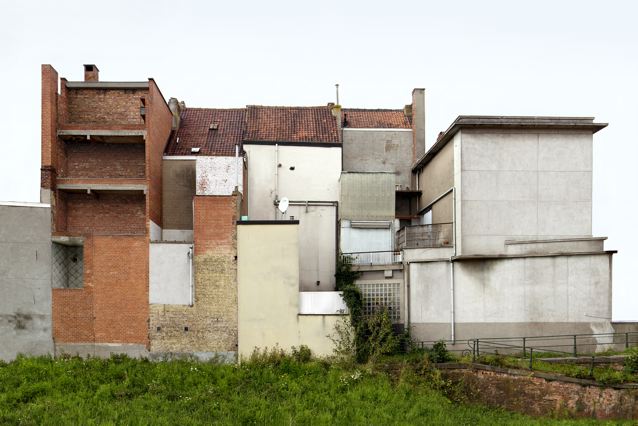
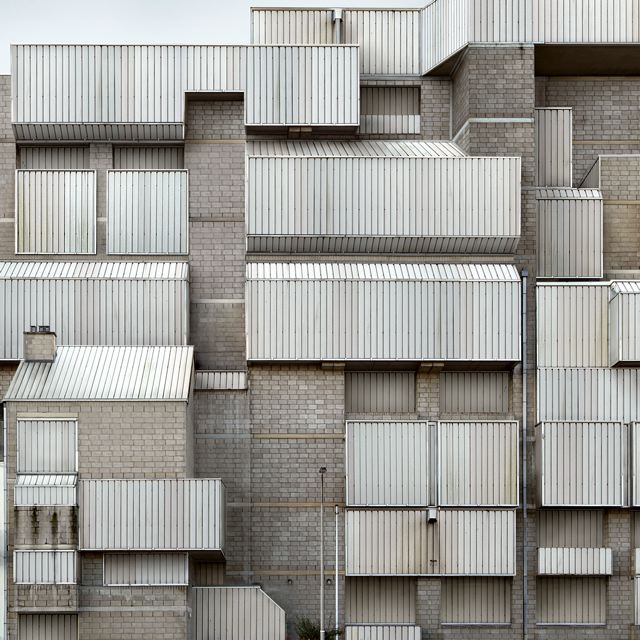
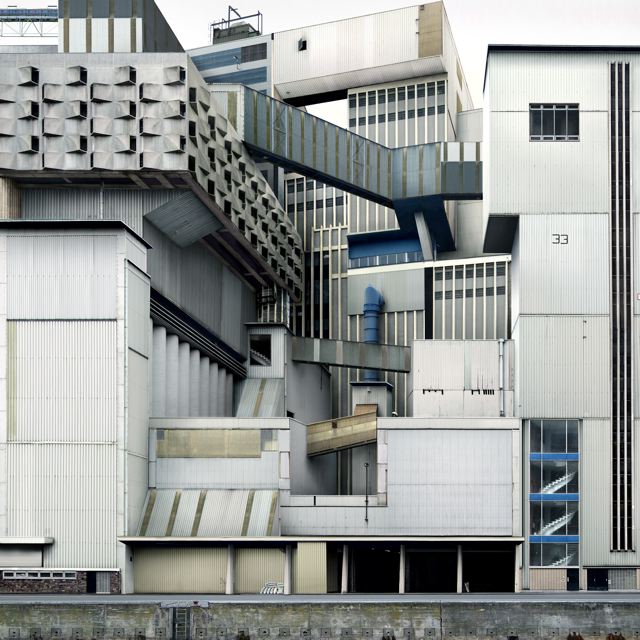
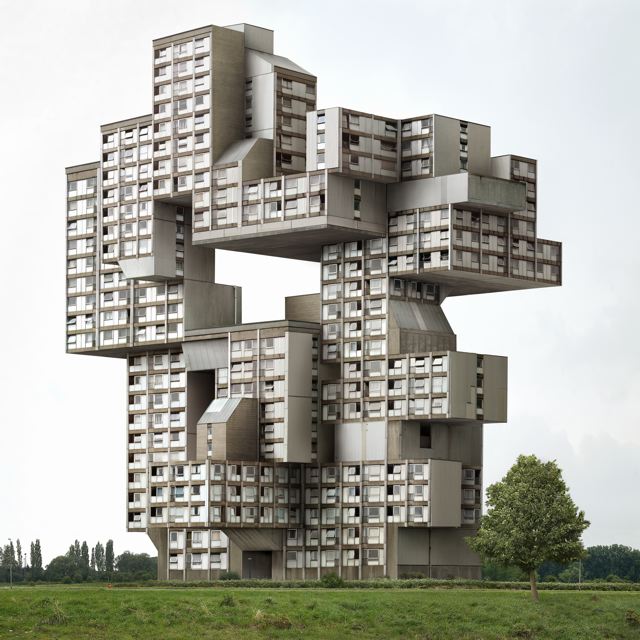
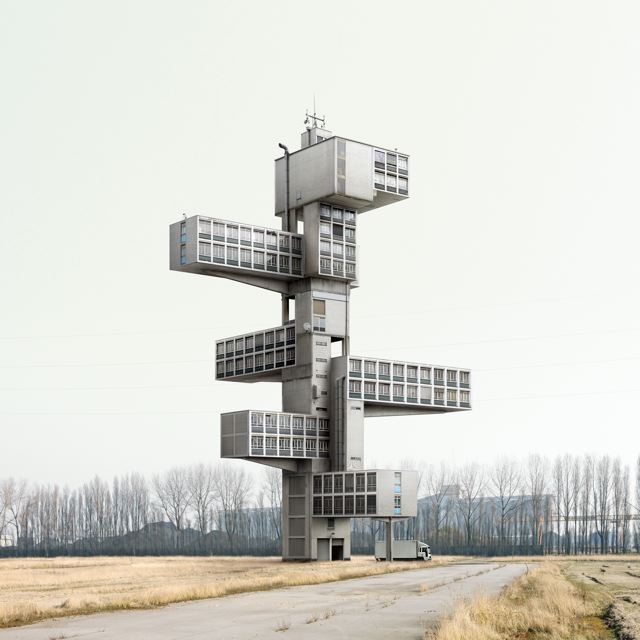
Belgian photographer Filip Dujardin makes images of unexpected buildings – that is, he “combines photographs of parts of buildings into new, fictional, architectonic structures,” Mark Magazine explains.
The resulting projects look like old factory sites in the American rust belt – Mark describes them as “informal and often dilapidated structures with unspecified functions” – or, in some cases, new projects by LOT-EK, Simon Ungers, or OMA.

[Image: Photo by Filip Dujardin, courtesy of the artist].

From Mark Magazine:

Every montage, says Dujardin, is one project. It begins with an idea for a specific image. Often he starts off by building a model of the form he is trying to achieve – at first in cardboard, but he has recently discovered SketchUp. He then goes on a photo safari, often just around the corner, to find suitable buildings “with a lot of the same things,” so that they can be cut and pasted and serve as building material. In fact most of the fictional structures are buildings in Ghent, just resampled

There seem to be multiple sub-themes, and even sub-projects, within the larger effort. There are surreal detached structures, for instance, like the image that opens this post, standing free amidst a recognizable but anonymous landscape. In some of these we see that even geological forms become subject to resampling.

[Image: Photo by Filip Dujardin, courtesy of the artist].

But then there are also what could be called a back series – that is, the backs of incredible buildings whose facades you can barely imagine.
These are groves of architecture, weird islands of form, like the city as seen from a rail line: sheds and retaining walls, stained by rain, their bricks chipped away behind piles of rubbish, their corrugated steel repeating ever onward in infinite ridges.

[Images: Photos by Filip Dujardin, courtesy of the artist].

Then there are Dujardin’s relatively well-known images of impossible structures, buildings made from ambitious cantilevers and strained central masts. They form vertical braidworks of halls and corridors woven through the sky above otherwise empty parks and dead fields.

[Images: Photos by Filip Dujardin, courtesy of the artist].

As Dujardin comments to Mark Magazine, “Perhaps the works come out of frustration. That I actually want to play at being an architect, instead of only recording the buildings of others.”
You can read more about the photographer on his website.

[Image: Photo by Filip Dujardin, courtesy of the artist].

(Related: Fictional ruins from fictional worlds).

Offshoring Audacity

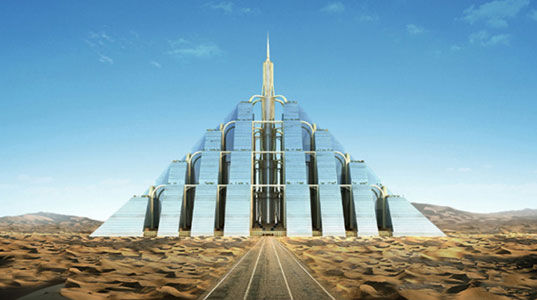
[Image: Dubai’s “carbon-neutral” ziggurat, designed by Timelinks].

I’ll be in Chicago next week to host a panel on Saturday, November 8, as part of this year’s Chicago Humanities Festival. The other participants are Joseph Grima, Jeffrey Inaba, and Sam Jacob.
More info:

Look abroad: Whole cities are planned, built, and inhabited in less than a generation. Artificial islands, indoor ski slopes, and the world’s tallest this-and-that are being constructed, not in the West, but in the Middle East, China, and beyond. The result: a sense that the West’s cities are falling behind and, increasingly, watching from the sidelines. A dynamic panel will discuss the accuracy of this assessment of today’s architectural situation. What are the urban implications of so-called offshoring audacity and how can the phenomenon be described without resorting to nationalism, nostalgia, or even uncritical celebration?

The panelists will be Joseph Grima, executive director of New York’s Storefront for Art and Architecture and author of Instant Asia; Jeffrey Inaba, principal architect, Inaba Projects, and professor of architecture at SCI-Arc and Columbia University; and Sam Jacob, visiting professor at Yale University and founding director, Fashion Architecture Taste, a London-based practice. The discussion will be moderated by Geoff Manaugh, author of BLDGBLOG and senior editor of Dwell magazine.

The panel, called Offshoring Audacity, will begin at 2:30pm, lasting till 4:00, and it will take place at the Chicago History Museum, 1601 N. Clark Street. It costs $5.
I hope some Chicago-based readers might stop by.

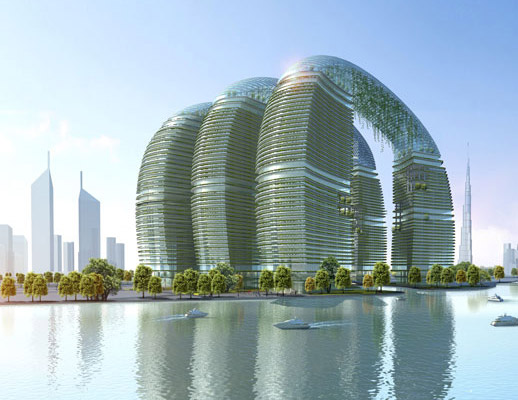
[Image: Park Gate, Dubai, by Adrian Smith + Gordon Gill Architecture].

The overall theme for the Humanities Festival this year is “big ideas,” inspired by architect Daniel Burnham’s (possibly apocryphal) statement that one should “make no little plans.” Since we’re coming up on the 100-year anniversary of Burnham’s urban plan for Chicago, not only does a “big ideas” – or “big plans” – Festival seem appropriate, but a panel about cities and urban design even more so.

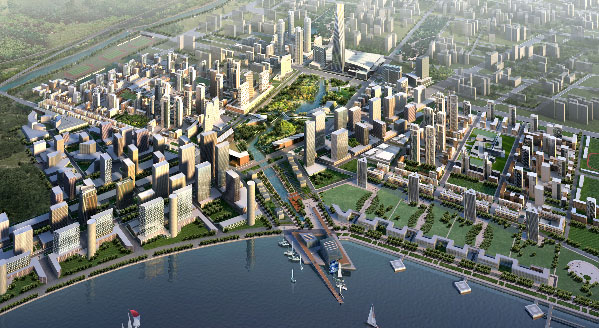
[Image: New Songdo City, South Korea].

The specific goal, then, is to discuss the idea that the West has begun “offshoring audacity” – urban and architectural audacity – to places like Dubai, Shanghai, Abu Dhabi, Beijing, and South Korea.
The United States, in particular, seems to have ceded its role as an architectural and infrastructural innovator. Every week, a new indoor ski resort or artificial island-city or hyperbolic “green” pyramid is announced somewhere, in a non-Western nation – or the Chinese government announces a program of urban weather control – leaving the U.S. a nation of failed levees, foreclosed suburbs, and collapsing bridges.
These examples of 21st-century spatial exotica are our era’s new fantasy environments – instant cities rolled out across the desert like magic carpets, with all of their plumbing and services intact.
It is architecture at its most audacious (or so we’re told).

[Image: RAK Gateway, Ras Al Khaimah, United Arab Emirates, by OMA].

The question becomes: How can we discuss all of this without resorting either to chest-puffing nationalism (it’s not true, the West is the best) or to a kind of knee-jerk Spenglerian resignation (it’s true, the West is over)?
Put another way: Is there really any purpose in celebrating the newest mile-high tower or solar-powered private golf community, as every architecture blog in the world seems to think we need to do right now – or, conversely, is cynicism in the face of mile-high towers really the most interesting or appropriate response?

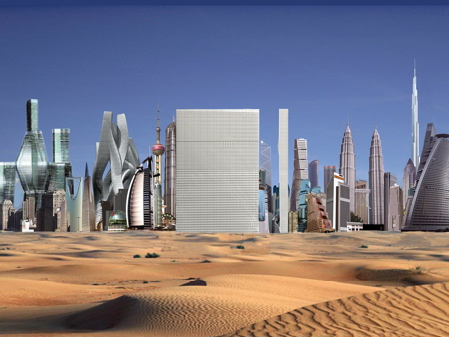
[Image: Contemporary architecture’s well-rendered visual overload, parodically assembled by OMA].

There’s an interesting exchange in Joseph Grima’s new book Instant Asia: Fast Forward through the Architecture of a Changing Continent. There, Qingyun Ma describes the trajectory of the Chinese architect as one of concentration: You start off huge, designing million-square-foot office complexes – if not whole cities from scratch – before gradually being established and respected enough in your field simply to design a house, say, or a single storefront.
With this in mind, is the steroidal grandeur of today’s Chinese architecture simply the visible articulation of a different professional arc? Start fast – start big – then concentrate?
Are these architects building resumés, not cities?
On the other hand, if many of these towers continue to be designed, engineered, and built by western firms, are we actually witnessing a kind of bizarre projection of the West’s own subconscious needs onto the blank slates of other nations? I’m reminded here of Marcus Trimble’s quip that China, with its replicant Eiffel Towers and fake chateaux, has become a kind of architectural back-up harddrive for the French.
Are developing nations being used as blank spatial slates upon which the West will rewrite its own architectural history?
This also brings to mind Martin Heidegger’s under-appreciated comment that American gigantism – Koolhaasian Manhattanism – is simply a grotesque reflection of intellectual tendencies within the trajectory of Europe itself. The U.S., he wrote, was a “concentrated rebound” of European thought, a camouflaged return of Europe’s own monstrous offspring.
Is this what we’re now witnessing, then, taking architectural form abroad?
Or, conversely, is the presupposed difference here between the West and the Rest so impossible to maintain or to define rigorously that nothing’s being “offshored” anywhere – because there’s no outside to offshore to?

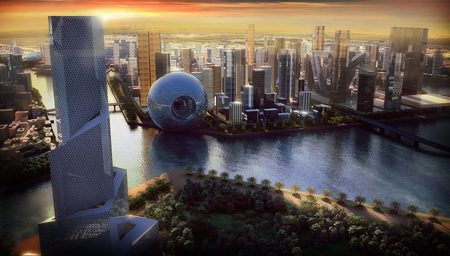
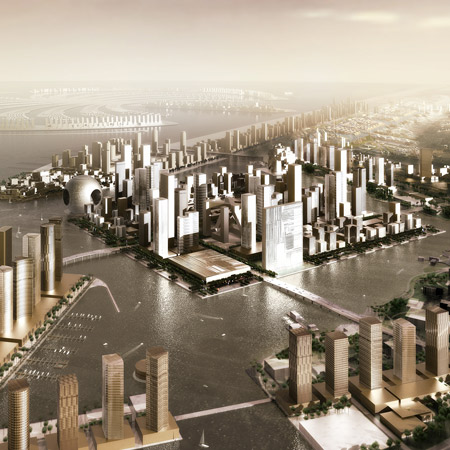
[Images: Waterfront City masterplan, Dubai, by OMA. It’s worth reading counter-discussions of this project by Nicolai Ouroussoff and Lebbeus Woods, respectively].

In the end, then, how are we to judge these claims to architectural monstrosity made by 7-star hotels and indoor ski ranges – buildings that supposedly demonstrate alternative futures, or space on maximum overdrive?
Are these places really that extraordinary – or are they a kind of imaginative cul-de-sac, a sign that architects have resolutely failed to design a more interesting spatial future?
Have we mistaken sheer scale and algorithmic excess for formal bravery?
Has “audacity” in architecture really been “offshored” to other nations, after all – or is audacity something that architecture has lost altogether?
Where should we look to find the truly audacious?
Stop by the panel on November 8 to hear these and other questions discussed: Offshoring Audacity.

Slow Decay

[Image: By Yvette Molina, 2008; oil on 7″ convex aluminum disc. Via Johansson Projects].

Opening at Johansson Projects in Oakland this week is a show by artists Katy Stone and Yvette Molina “that considers the ephemeral thrills and underlying decrepitude of the natural world” – it is “a nature walk through a mysterious and delicate landscape, where organic beauty blossoms in the midst of slow decay.”

[Images: All works by Yvette Molina, 2008; all are oil on 7″ convex aluminum discs. Via Johansson Projects].

These gorgeous paintings here, using layers of oil paint and glazes, are all by Yvette Molina, depicting “hazy forest scapes.”

The Atlas of Hidden Water

[Image: From the “atlas of hidden water.” Check out the original PDF or simply view it
larger].

An “atlas of hidden water” has been created to reveal where the world’s freshwater aquifers really lie. “The hope,” New Scientist reports, “is that it will help pave the way to an international law to govern how water is shared around the world.”
This prospective hydro-geopolitical legislation currently includes a “draft Convention on transboundary aquifers.”

[Image: The “hidden water” of South America].

“What the UNESCO map reveals,” New Scientist adds, “is just how many aquifers cross international borders. So far, the organisation has identified 273 trans-boundary aquifers: 68 in the Americas, 38 in Africa, 155 in Eastern and Western Europe and 12 in Asia.” One of these is the Nubian Sandstone Aquifer System, whose waters are nearly a million years old.
According – somewhat oddly – to the International Atomic Energy Agency:

The ancient system’s massive reserves, estimated at 375,000 cu km of water (equivalent to about 500 years of Nile River discharge), are confined deep inside the earth’s underground chambers – staggered, tiered, and pooled beneath the sands of the Sahara Desert, oasis settlements, wadis (dry riverbeds that contain water only during times of heavy rain), small villages, towns, and large cities.

If the surface landscapes there are already so beautiful, how exciting would it be to explore those underground staggered tiers and pools…
A more detailed map is due out in 2009 – meanwhile, several more can be downloaded here.

The immersive sculpture of linked voids

When you pull back the curtain of Manhattan, what do you find?

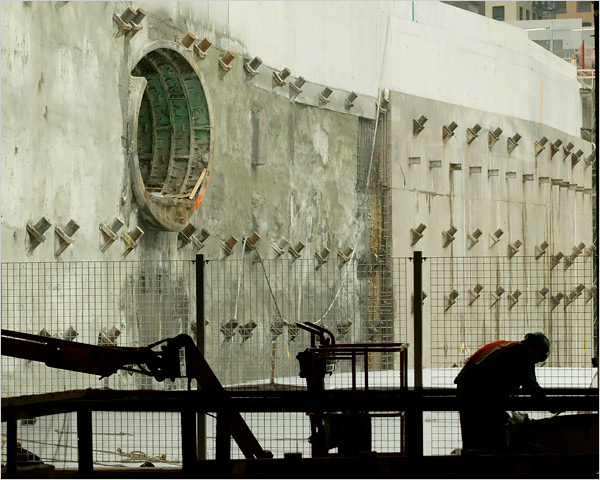
[Image: Photo by Andrea Mohin for The New York Times].

The so-called “birthmark of the World Trade Center” has been removed from the earth of New York City. These “colossal cast-iron rings,” as The New York Times describes them, were “the last visible remnant of the Hudson & Manhattan Railroad” that once crossed through the World Trade Center site.
In an excavatory act that would seem to combine the best conceptual aspects of Rachel Whiteread, Michael Heizer, and Gordon Matta-Clark, what was once a tunnel – an underground space of air – has been strangely inverted, transformed into an object, freed from its terrestrial context.
Perhaps leading to the question: What if Michael Heizer had retired altogether from the art world – only to get a job, under an assumed name, as an engineer on the New York City subway system? What strange resonances might that mobile underworld now take?
An immersive sculpture of linked voids beneath the city.

[Image: Photo by Fred R. Conrad for The New York Times].

Meanwhile, as the construction work at Ground Zero continues, the whole site has become a massive archaeological site, exposing an earlier phase of planetary history.
Also from The New York Times:

A fantastic landscape in Lower Manhattan – plummeting holes, steep cliffsides and soft billows of steel-gray bedrock, punctuated by thousands of beach-smooth cobblestones in a muted rainbow of reds and purples and greens – has basked in sunlight this summer for the first time in millennia.

This monumental carving was the work of glaciers, which made their last retreat from these parts about 20,000 years ago, leaving profound gouges in the earth and rocks from the Palisades, the Ramapo Mountains and an area of northern New Jersey known as the Newark Basin.

Plumbing these glacial features and souvenirs has been critical in preparing the foundation for Tower 4 of the new World Trade Center, being built by Silverstein Properties. The concrete footings from which its columns rise must rest on firm bedrock. Engineers need a clear understanding of the rock’s contours.

These “contours” form “an abstract canvas of swirling, concentric rings,” we read, which help to reveal “a period far more ancient than the glaciers, about 500 million years ago, when the edges of the colliding North American and African continental plates got shuffled together.”
Ground Zero has thus become a kind of horizontal stargate, a terrestrial windowpane pulled wider and wider in the landscape of Lower Manhattan.

[Image: Photo by David W. Dunlap for The New York Times].

In any case, what about those colossal cast-iron rings? Now that they’ve been pulled from the earth, they’ve been warehoused: “These have been taken to Hangar 17 at Kennedy International Airport, where large-scale trade center artifacts are stored.”
But might I suggest that they be shipped upstate to Dia:Beacon, instead?

Waste Towers

[Image: London waste towers, designed by Dow Jones Architects, via Building Design].

London’s Dow Jones Architects have proposed “a radical series of waste-crunching towers across London to help meet recycling targets and generate low-cost energy for local communities,” Building Design reports.

[Image: London waste towers, designed by Dow Jones Architects, via Building Design].

In order for the city to reach its goal of becoming “85% self-sufficient in terms of waste by 2020,” a new waste-management infrastructure is required – thus the need for “new buildings in Greater London to house advanced waste technologies.”

These would offer an alternative to the greenhouse gas-producing incineration method used by most waste service providers contracted by councils. Dow Jones and Arup assessed the scale of buildings that would be needed to deal with certain amounts of waste using specific technologies, then scattered them on four hypothetical urban sites, proposing them as “parts of the city and building types that would form an appropriate match.”

While this further convinces me that today’s most interesting architectural projects are the ones that thoroughly rethink civic infrastructure – waste-treatment plants, algae farms, solar towers, tide-power generators, high-speed rail lines, space elevators – it also makes me wonder what an even more distributed form of sustainable waste-management might look like.
Why not ten sites, for instance, scattered throughout the city, instead of four – or twenty-five, or a hundred?

[Image: London waste towers, designed by Dow Jones Architects, via Building Design].

By decentralizing waste infrastructure as much as possible, you could much more thoroughly integrate quote-unquote sustainable behavior into the spatial fabric of everyday life.
I’m reminded of the differences in public recycling infrastructures between a city like Berlin and a city like Los Angeles. In L.A., for instance, you actually have to drive – often quite far out of the way – to a neighborhood recycling drop-off point simply to get rid of things like wine bottles and old magazines, whereas in Berlin you’re almost constantly walking past what could be called recycling micro-stations: color-coded clusters of separate waste receptacles organized by type (glass, paper, aluminum, etc.).
My point is simply that recycling becomes what you do there – like breathing, it’s the autonomic nervous system of the city – in much the same way that throwing things away is simply what you do in the United States. After all, as has been widely remarked elsewhere, urban infrastructure in the U.S. seems to be built to encourage the thoughtless and efficient throwing away of more things.
So it’s a change in lifestyle that would come about through the ubiquitous, lace-like distribution of micro-infrastructure across the urban landscape.

[Image: London waste towers, designed by Dow Jones Architects, via Building Design].

On the other hand, I don’t mean to imply that Dow Jones’s waste towers are just recycling stations. From Building Design:

Waste that can’t be recycled or composted would be turned into energy or useful materials using techniques such as anaerobic digestion – which produces the low-cost fuel biogas plus compost – and advanced thermal treatments, which produce syngas for industrial processes plus a vitreous slag that can be used as a construction material. The gases produced can be routed in closed loops to produce power for local electricity and heating networks serving nearby homes and workplaces.

Nonetheless, eliminating large travel distances between key pieces of “green” infrastructure and its users – i.e. the residents of the city – can be one of the most important steps in ensuring that this infrastructure will be used at all.
Knowing that a power-generating, construction waste-processing, compost-accumulating bio-tower exists somewhere in the northern suburbs of the city is certainly inspiring as a first and early step toward the design of a 21st-century city – but these sorts of things should, wherever possible, be more thoroughly integrated into the everyday streetscape.
Instead of superblock, think filigree.
Sustainable waste management will become simply what a city does.

Underground Rivers Frozen in Place

[Image: The Large Hadron Collider photographed by Claudia Marcelloni, ©CERN, via The Big Picture].

One of the most interesting engineering details from the construction of the Large Hadron Collider (LHC) is the fact that they had to freeze an underground river in place, using liquid nitrogen, in order to assemble the detector. This allowed them “to create a permafrost medium through which they could drill out the massive underground caverns” in which the LHC would then sit, the Independent reported back in 2003.
But London’s got some underground rivers; they should do this there and create a subterranean skating rink.
A huge cube of ice beneath Los Angeles that’s then melted slowly, over four decades, to form the city’s water supply.
Meanwhile, the actual magnets of the collider itself “must be cooled to within a couple of degrees of ‘absolute zero,'” we read, “the theoretical limit for how cold anything can get. This requires a constant supply of liquid helium pumped down from eight over-ground refrigeration plants – about 400,000 liters per year in total.”
This temporary refrigeration of the planet reminds me of at least two things: 1) the so-called “freeze wall,” no less than 30-feet thick, being constructed by Shell underground in the American Rockies as a way to access oil shale deposits, and 2) the constantly refrigerated underground mines of South Africa.
A crazed billionaire installs a pipework labyrinth of liquid helium pumps beneath his home in Barcelona – and he proceeds to create a subterranean glacier inside the faults of the earth itself, freezing the soil down to a depth of six miles and altering the local climate, before carving a spectacular series of show caves out of the permafrost, wearing Antarctic expedition gear, armed with remote control micro-tunneling machines.

Zip Line Tours Through City Space

[Image: Photo by Ryan Collerd for The New York Times].

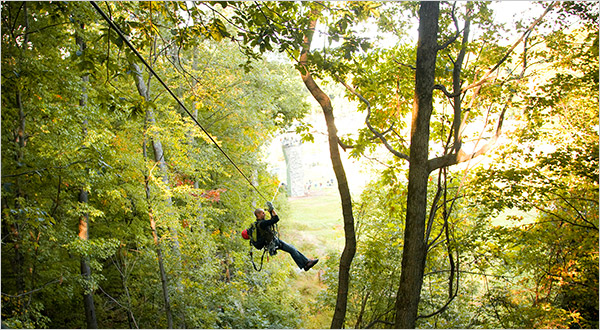
Riding zip lines through the autumn tree canopies of rural Pennsylvania is something of a growth industry, it seems, exploring ski resorts during the off-season by speeding downhill at 50 mph in a roped-up harness.
From The New York Times:

Some zip lines are basically thrill rides that follow the cut of ski slopes and at this time of year offer expansive views of the autumn blaze of colors, along with an adrenaline rush.

Other courses (like the one we were on) are marketed as canopy tours, designed with a challenging combination of swaying sky bridges, cable traverses and zip line pathways cut through the deep forest. Once we climbed a cargo net to reach our first tree platform, we were literally amid the autumn foliage, not quite in the canopy of fully grown oaks and poplars but close enough to squirrels to guess their sex as they scampered from limb to limb just above us.

This kind of vertical immersion in an otherwise inaccessible overhead landscape is incredibly interesting, in and of itself – but 1) it also reminds me of a 2007 project by artists Steve Lambert and Packard Jennings in which they reimagined the city of San Francisco as a city of roller coasters, wildlife preserves, underground libraries and health clubs installed inside BART cars, and, of course, zip lines across the San Francisco Bay.

[Image: Riding zip lines to Oakland; by Steve Lambert and Packard Jennings].

And 2) the two of these together seem to imply a new kind of urban tourism, where you don’t talk guided walks or buy tickets for double-decker buses: you ride zip lines above Notre-Dame cathedral and down Fifth Avenue, getting up close and personal with architectural ornament at a level of detail you would otherwise never have seen.
Sky Tours of Manhattan.
In the same way that you can take, for instance, Entourage-themed bus tours of Los Angeles, you could take Spiderman-themed zip line tours of New York.
You call up Canopy Tours and ask them to price-out the entirety of Chicago. Or Istanbul. (At the very least, they could map it).
Zip lines through the London financial district.
Zip lines through the sandstone arches of Utah.
Zip lines through Angkor Wat.
A Zip Line Olympiad across the domes and spires of central Europe.
Or don’t use zip lines for humans at all; attach plants to them for the hanging zip line gardens of the 21st century. Flowering plants and ferns and oak trees go whizzing by in an aerial gardenry that defies belief.
And if zip lines could realistically open up a whole new world of spatial volume in the modern high-rise metropolis, what new architectures and city surfaces might result?

The Game

[Image: (Untitled) by Priscilla Monge, photographed by Alexandra Wolkowicz. Part of the 2006 Liverpool Biennial].

A post earlier this week here on BLDGBLOG raised the question of whether or not an urban candidate might be inherently better suited for the job of U.S. president than a rural one – but what exactly do we mean when we say “urban”?
When we read that the world is rapidly urbanizing, for instance, and that more than 50% of the earth’s human population now lives in cities, what do we mean by “cities” and how can we tell when a dense assortment of buildings becomes a truly “urban” experience?
What if we are surrounded by more buildings than ever before – but there isn’t a single real city in sight?

[Image: The Garston Embassy, of the Artistic Republic of Garston, part of the Liverpool Biennial International 08].

This summer I was commissioned by the recently opened Liverpool Biennial International 08 – the theme of which is MADE UP – to write an essay about the idea of “made-up” cities. That essay, called “The Game,” was just published in the Biennial’s gigantic, 300-page catalog alongside stories and essays by Haruki Murakami, Bruno Latour, Jonathan Allen, Rana Dasgupta, Brian Hatton, and many others.
“The Game” explores the idea that we might not actually know what it means to be urban, using a remark by Ole Bouman as a jumping-off point. In an essay of his own called “Desperate Decadence,” published in Volume magazine #6, Bouman writes: “We have come to take for granted that those locations with large congregations of architecture must be cities.”
I’ve re-posted the complete essay below.

• • •

[Image: The Liverpool Biennial International 08].

The internet briefly lit up two years ago with the story of Gilles Tréhin, an autistic savant, artist, and amateur urban planner who had invented a city that he calls Urville. Urville, imagined as an island metropolis for 12 million inhabitants, begun when Tréhin was only five years old, is a triumphant example of a city made up almost from nothing. Tréhin’s own guidebook to the city includes hundreds of perspectival pencil drawings; these depict, in often astonishing detail, recognizable buildings and building types that have been combined to form a cityscape that itself exceeds recognition.

With imaginary spaces like the Square des Mille Astres, the Gare d’Italie, and the Place des Tégartines, Urville’s visual appearance could perhaps be described as a kind of Belgian Venice, crossbred with Chicago, as master-planned by Baron Hausmann for an upstart hotelier in Las Vegas. In other words, the city is derivative; it is a collection of landmarks. One can make out the Sears Tower, the Rialto Bridge, the Grande Arche de La Défense, and what could easily pass for New York’s World Trade Center towers—among many other sites on the global tourist circuit—but what Urville lacks is a human face. Although the jacket of Tréhin’s book explains that the city comes complete with “cultural anecdotes grounded in historical reality,” including the long-lasting spatial effects of Vichy France, World War II, and what is broadly referred to as globalization, the city is something of a void, an open-air museum of unchallenging urban artifacts.

As Charlotte Moore wrote for the Guardian back in May 2006, Urville is “curiously timeless, swept clean of the detritus of human lives.” She suggests that the city even has “no sense of character.” Indeed, Urville is a strange sight. It is vast, referentially comprehensive, and visually detailed—but, outside of its sheer curiosity, there is very little there that might recommend a visit. It is Brussels or The Hague. One might even say that Urville is framed to avoid the emotional vicissitudes of everyday life.

Urville has plenty of buildings—but there is no real city.

[Image: (Untitled) by Matej Andraz Vogrincic, photographed by Alexandra Wolkowicz. Part of the 2006 Liverpool Biennial].

In a short essay called “Desperate Decadence,” published in Volume magazine #6, Ole Bouman quips: “We have come to take for granted that those locations with large congregations of architecture must be cities.” When I later asked him about this comment during an interview, he added: “If you don’t distinguish between those two—if you think that applying urban form is the same as building a city, or even creating urban culture—then you make a very big mistake.” The question, then, in this context, is: Is it possible to invent—to make up—a city that isn’t simply a collection of buildings? Is it possible to create a genuine city from nothing—or can we only construct large congregations of architecture?

We’ve all heard by now, for instance, that for the first time in history the majority of our species—more than 50% of the Earth’s human population—lives in an urban environment today. We’ve been told, by journalists intoxicated with the superlative, that this a moment of great Darwinian consequence, an evolutionary point of no return. More urbanized than we have ever been before, have humans have apparently changed the very nature of the species: Humans are now animals that live together in cities. We are builders, dwellers and thinkers of towers and streets.

But for all the talk of the ancient hunter-gatherer finally succumbing to the bright lights of the big city, it is not at all clear that we even know what cities really are. Can we be certain, for all of the buildings currently under construction in places like Dubai, Shenzhen, and even Dallas-Ft. Worth, that it is cities we are creating? We are surrounded by more buildings than ever before, but perhaps this observation alone is not enough to say that human life has been thoroughly urbanized.

[Image: Air-Port-City by Tomas Saraceno, photographed by Adatabase. “Since 2002,” we read in the Biennial’s pocket guide, “Saraceno has continued, in sculptures, installations and experimental flights, to make a series of incremental steps towards his ultimate goal of cities built in the air.” From the Liverpool Biennial International 08].

An interesting analogy comes to us here from the history of videogame design. In her 2001 pamphlet called Utopian Entrepreneur, published by MIT, author Brenda Laurel describes what she calls an “ugly” time in the corporate career of videogame super-firm Atari. In 1984, Atari’s sales figures, reputation, and game quality all began to nosedive. “So began the great videogame darkness of 1984 that lasted until almost the end of that decade,” she writes. But what exactly happened—and how does it relate to urban design?

“The Atari corporation paid very little attention to designing for computer games,” Laurel diagnoses. After all, “no one except a few isolated programmers who actually built the games was looking at the requirements for good interactivity, play patterns, or design principles.” Worse still, “There was no market research on what players liked in a game.” In other words, entire games and game worlds were being produced from scratch, without any real grasp of what might make a game work.

At the same time, hordes of Harvard MBAs began churning out business plans, and transplants from aerospace middle management drew up elaborate production schedules, and Procter & Gamble veterans happily began planning marketing and distribution. Great commercials were produced. Except for the programmers, however, no one was in the business of creating great videogames.

Atari had a stellar business plan and a first-rate marketing team—but, for all intents and purposes, it had nothing interesting to sell.

Following the logic of this example, it is easy enough to see Dubai—or even Tucson, Arizona—as a failed videogame in the desert, ironically under-designed and over-promoted. One could even say that we have perfected the art of the anti-city—that we have made up anything but truly urban environments. Dubai, for instance, is famously difficult to navigate on foot, requiring a ten minute car ride down six-lane motorways, complete with frequently lethal U-turns, simply to get to the hotel across the street. The city has a sum total of eleven pedestrian bridges—and twenty-five percent of the world’s cranes. While pedestrian-friendliness is by no means the only marker of ‘good interactivity, play patterns, or design principles’ in a future metropolis, it is nonetheless worth highlighting the disjunction here between the city as a dense, somewhat autistic collection of buildings and the city as a user-friendly environment.

It’s as if Dubai has perfected the art of construction, but in securing a market niche it has forgotten what needed to be built. Paraphrasing Brenda Laurel, perhaps Dubai did not do enough “market research on what players liked in a game”—only here the game is a city.

[Image: Opertus Lunula Umbra (Hidden Shadow of Moon) by U-Ram Choe, part of the artist’s “archaeology of undiscovered futuristic organisms,” photographed by Adatabase. Part of the Liverpool Biennial International 08].

But cities today are well known for popping up in the middle of nowhere, history-less and incomprehensible. There are slums, refugee camps, army bases—and Dubai. That’s what cities now do. If these cities are here today, they weren’t five years ago; if they’re not here now, they will be soon. Today’s cities are made up, viral, fungal, unexpected. Like well-lit film sets in the distance, staged amidst mudflats, reflecting themselves in the still waters of inland reservoirs, today’s cities simply arrive, without reservations; they are not so much invited as they are impossible to turn away. Cities now erupt and linger; they are both too early and far too late. Cities move in, take root and expand, whole neighborhoods throwing themselves together in convulsions of glass and steel.

Except, as Mike Davis memorably points out in his recent book Planet of Slums, the “cities of the future, rather than being made out of glass and steel as envisioned by earlier generations of urbanists, are instead largely constructed out of crude brick, straw, recycled plastic, cement blocks, and scrap wood. Instead of cities of light soaring toward heaven, much of the twenty-first-century urban world squats in squalor, surrounded by pollution, excrement, and decay.” This is “pirate urbanization,” he writes, and it consists of “anarchic” anti-cities on the fringes of “cyber-modernity.” We might be making up new cities everywhere around the world today, but very few of them look like Norman Foster’s eco-metropolis of Masdar, that well-rendered city constructed from nothing but petrodollars atop the sands of Abu Dhabi. Davis writes, or example, that, in “an archipelago of 10 slums” outside Bangalore, India, “researchers found only 19 latrines for 102,000 residents.” There is thus what Davis calls an ‘excremental surplus’ to these rapidly expanding environments—yet these are the landscapes to which we refer when we say that humans have become an urban species.

These are not cities in any recognised infrastructural or legislative sense; they are, rather, dense collections of buildings. In contrast to Dubai’s Atari–like desert failure, with its arid combination of over-thought business plans and an absolute lack of content, these super-slums compress far too much content into a radically unplanned space.

[Image: The Gleaming Lights of the Souls by Yayoi Kusama, photographed by Adatabase. Part of the Liverpool Biennial International 08].

On the other hand, sometimes a made-up city does not even require acts of construction. That is, what might appear simply to be a field of cloned single-family houses, buffered by vast tracts of manicured green space, can be transformed into a city with the stroke of a pen. Cities are thus created everyday, in other words, within the administrative guidelines for managing inhabited landscapes—and no new ground need ever be broken. These made-up cities are, in fact, boomburbs, according to Robert Lang and Jennifer LeFurgy, two sociologists with the Washington D.C.-based Brookings Institution.

In their 2007 book, Boomburbs: The Rise of America’s Accidental Cities, Lang and LeFurgy explain that many of the largest cities in the United States today are simply hypertrophied suburbs—they are boomburbs. The mayors of established cities have had a hard time adjusting to this fact. Mesa, Arizona, for instance, an otherwise anonymous tumescence on the air-conditioned desert edge of Phoenix, is a “stealth city”: Its population, incredibly, is larger than both Minneapolis–St. Paul and Miami. The authors also describe how the mayor of Salt Lake City once “dismissed the idea” that his city might have anything in common with suburban North Las Vegas, “despite the fact that North Las Vegas is both bigger and more ethnically diverse than Salt Lake City.” What these boomburbs have, in lieu of historic centrality and international name-recognition, is a flexible legal and financial infrastructure. They have water rights boards and waste disposal networks, even local schools and sales tax—and though they don’t necessarily have mayors (though some do), they have “landscape management” committees and homeowners associations. These are cities made up less by buildings than by tax codes and the law.

The mayor of Salt Lake City’s widely shared cognitive dissonance, being somehow unable to see that Mesa, Arizona, is bigger than a city like St. Louis—with its Eero Saarinen-designed Gateway Arch along the banks of the Mississippi—is part of what the authors call “a national ambivalence about what we have built in the past half century.” This featureless landscape of low-rise retail parks and residential cul-de-sacs—of video shops, hockey moms, and 24-hour supermarkets—has become the dominant architecture of American urbanism, despite (or perhaps because of) the fact that it remains critically invisible. One could even say that this landscape is all life and no landmarks—an almost exact inversion of Gilles Tréhin’s Urville, with its tapestry of landmarks and no signs of life. From boomburbs to Urville, via super-slums and Dubai, these instant cities take shape in less than a single generation and cross a fantastic landscape of competing urban forms.
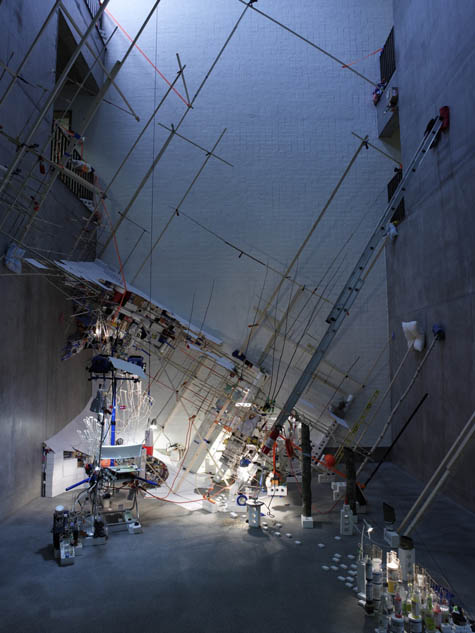
[Image: An installation by Sarah Sze, photographed by Adatabase. Sze’s installations “are like highly organic ecosystems, colonizing the space they inhabit.” Part of the Liverpool Biennial International 08].

Is it really possible, though, that we could continue to make up and construct the wrong kinds of cities? One could perhaps be excused here for concluding that successful cities cannot be made up at all, that there is something fundamentally unthinkable or excessive to this process, something that simply cannot be planned in advance.

But that doesn’t stop us from looking for what we believe is the secret recipe—for exactly the right balance of marketing plans, water laws, historic monuments, public spaces, and so on. A thriving subsidiary industry has thus arisen in these cities’ shadows, forming a new, deliberately carnivalesque genre of international reportage. We are city-hunting. Writers fly halfway round the world to describe their newest adventures in Middle Eastern air-conditioning. These are new sights in human history, we’re told, and they’re meant to dazzle the modern mind. Every urban day is remarkable, we read, for it is different—and somehow bigger, more extreme—than the last.

So if we continue to get so many things about our cities so wrong, then the only thing to do is to keep looking—to track down Zaha Hadid’s newest building, to host design competitions for skyscrapers in St. Petersburg, to commission private islands, domes, and pyramids. We experiment with Olympic Villages. Amidst all of the dust and the eye-popping budgets, it seems impossible to believe that we won’t get at least one place right.

It’s as if, hovering there in the future possible tense, at the imaginative vanishing point of urban design itself, is the perfect city, sending ripple effects back into the spaces of today—and we can trace the outlines of its utopian arrival in the empty streets and construction sites of the spaces that now surround us.

Because it no longer matters if we are wrong about our cities; we will always be right if we just make up more.