Chinese Islam and the Case of the Disappearing Prison

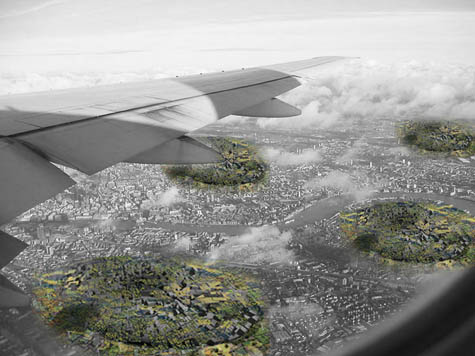
What do you do when you’re trying to shut down a high-profile prison for unofficially accused international terrorists? Ship the prisoners off to a nation of disappearing islands.
The U.S. might shortly begin sending Chinese Muslim prisoners from its facility at Guantanamo Bay – itself an extra-judicial territory, or semi-sovereign administrative enclave, that both is and is not part of the United States – to a terrestrially complicated new situation in the Pacific island nation of Palau.
Palau, of course, is disappearing.
From one black hole to another, then.

(Via @pruned).

Pardon the Disruption

Just a quick note that I’m off to Turin tomorrow to participate in a conference called I Realize: The Art of Disruption, if any readers out there are in that city of long shadows and automobiles.

[Image: The massive Mole Antonelliana, Turin (1875); view larger].

The point of the conference is to look at “breaking radically with the past, moving the horizon and embracing ambitious challenges.”
Even better, it takes place inside a “Virtual Reality & Multimedia Park” (here’s a map) – and the other speakers include the one and only Bruce Sterling, legendary designer Peter Saville, architect Andrea Branzi, Nicolas Nova, Jennifer Higgie, Gianluigi Ricuperati, Nicola Perullo (director of Slow Food Italia), and many, many others.
If you’re around, be sure to introduce yourself (although my Italian, unfortunately, è inesistente).

Urban X-Ray / Ancient Orchard

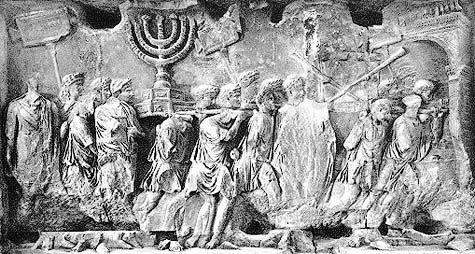
[Image: A Roman Triumph following the sack of Jerusalem].

Amongst the many books I’m reading here in Rome this month – including Tobias Jones’s surprisingly good Dark Heart of Italy, the incredible Anatomy of Fascism by Robert Paxton (J.G. Ballard wrote that he “found Paxton’s post-mortem deeply unsettling, with its strong hint that the corpse [of fascism] might sit up at any moment and seize us by the throat” – Exhibit A here might be Andrew Brons‘s election this week to the European Parliament), and Roger Deakin’s Waterlog – I’m making my way through two books by Mary Beard.
Beard, of course, was the subject of a long, two-part interview with BLDGBLOG back in 2007.
What I want to mention here comes from her book The Roman Triumph; it’s only a brief quotation, but I like it.
At one point Beard refers to the “theaters and porticoes” built in ancient Rome using wealth taken during Pompey‘s “eastern campaigns” in Armenia and elsewhere. However, she writes:

The term “theaters and porticoes” hardly does justice to this vast building complex, which stretched from the present day Piazza Campo del Fiori to the Largo Argentina, covering an area of some 45,000 square meters. A daring – and, for Rome, unprecedented – combination of temple, pleasure park, theater, and museum, it wrote Pompey’s name permanently into the Roman cityscape. Even now, though no trace remains visible on the ground, its buried foundations (and particularly the distinct curve of the theater) determine the street plan and housing patterns of the city above; it remains a ghostly template which accounts for the surprising twists and turns of today’s back-streets, alleyways, and mansions.

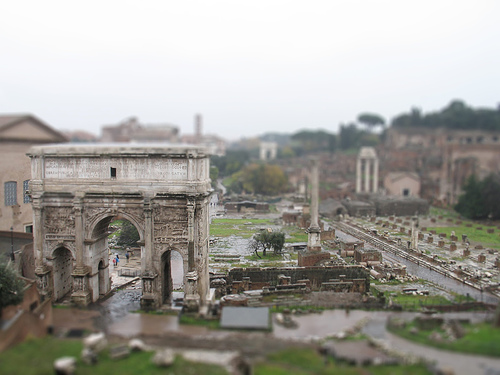
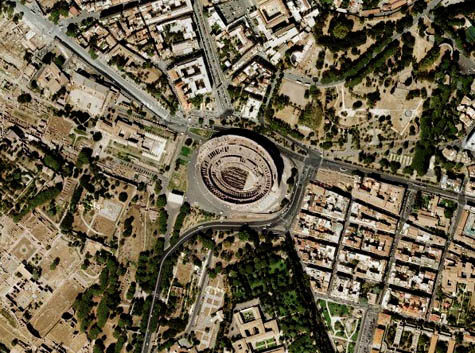
The not entirely surprising realization that the present-day street grid of Rome is actually an articulation of other, previously buried cities – cities not lost to history, then, but accessible in outline through the indirect archaeology of contemporary urban planning – reminds me of something that came up back at Postopolis! LA.

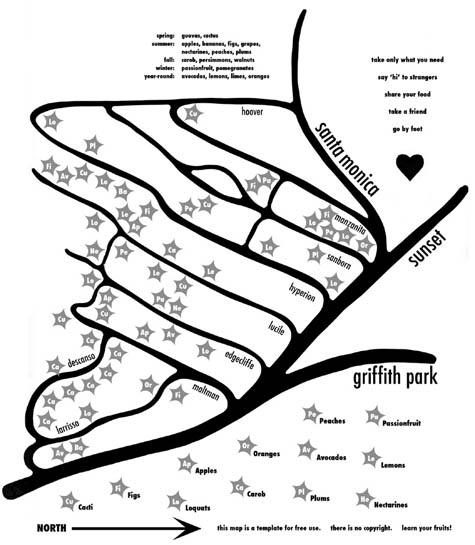
[Image: Fallen Fruit‘s map of the lost orchards of Silver Lake].

During their presentation, the ingenious duo Fallen Fruit mentioned that, when they were mapping fruit trees in today’s Los Angeles, they stumbled upon the borders of much older, abandoned fruit orchards.
In other words, what appeared simply to be a random fig tree growing in someone’s front yard was, when seen on a map together with other such trees, actually the remnant presence of a now-forgotten farm.
Those trees, to use Beard’s term, are the “ghostly template” from an earlier phase of land use.
There is a different grid inside the grid, you might say – where each tree becomes something like a legal document, marking the outer boundaries of a lost landholding.
Of course, both of these examples together bring to mind the lost airports of Los Angeles, those geographies of aerial experience that now sit buried and all but forgotten beneath millions of tons of pavement throughout the greater L.A. region.
Other such examples are easy to come by – but their interest, for me, never dissipates. Whether it’s the lost rivers of London still giving shape to the street plan above (or lost streams of Manhattan turning into underground fishing ponds), there are remnant geographies and ghostly templates everywhere.
In fact, as I recently wrote in an introduction to photographer Shaun O’Boyle’s forthcoming book Modern Ruins: Architectural Monuments of the Mid-Atlantic – definitely check it out upon publication in 2010 – this even includes our own bodies: forgotten anatomies still make themselves known through the structure and layout of our nerves and bones.
But Rome, Los Angeles, London – these urban examples simply give our ghostly ancestors architectural shape.

Shells, Tube Structures, and Minimal Surfaces

Reader Louis Schultz has pointed out the work of Lithuanian-born artist Aleksandra Kasuba, who used curved surfaces of fabric stretched and attached between space frames in order to create inhabitable rooms and corridors.

[Images: The Live-in-Environment (1971) by Aleksandra Kasuba; the project “was built on a parlor floor of a brownstone house in New York City,” we read. “The intent was to abolish the 90-degree angle and create an environment that would capture changes in daylight, provide variations in terrain, and introduce the unexpectedness of views found in nature without simulating nature”].

These ephemeral installations were intended, spatially, as a way to “abolish the 90-degree angle and create an environment that would capture changes in daylight, provide variations in terrain, and introduce the unexpectedness of views found in nature without simulating nature.” I love that latter caveat: to retain the experiential impact of unexpected natural vistas without simply copying, or simulating, the spatial details and material palette of the natural world.
Instead, a somewhat stark world of undecorated surfaces curves around us – call it biomorphic minimalism – thus eliding the differences between architecture and large-scale tailoring.
In any case, her Live-in-Environment, from 1971, seen in the images above, is a great example of this – but don’t miss the Roof Deck Study from 1974; the Barbarella-meets-IBM world of torqued geometry from her Office Renovation Study (1975); the aerial tunnels of Art-in-Science I (1977), which look like some megafaunic form of undersea life, stretched through the canopies of a North American thicket (“With the assistance of three students during an eight week stay,” Kasuba writes, “we explored the topology of 78 fabric structures, hardened 32 with resins, and erected 4 weather structures”); and the simplicity of Blue Shade (1978).
Better yet, Kasuba supplies a section called How It Was Done – where you can learn how to create finishes, arches, and doors, for instance – and this includes Kasuba’s extraordinary, lo-fi guide to shells, tube structures, and minimal surfaces.
It’s what The North Face might have become had their tent division been bought by Kenneth Snelson.

Rome Thunderdome

[Image: Little Rome Ruins by Bernat Gallemí].

An early burst of thunder woke me up this morning, before a brief wash of rain blew through – but what was extraordinary was that the sound of the thunder didn’t pass all at once: it kept opening and echoing, as if moving outward through the city to trace the shapes of piazzas, streets, river banks, and alleyways.
There was a kind of Dopplered geometry to it – an acoustic version of Rome exactly opposite the city’s angles and walls. Live here long enough, and perhaps you could even tell when a storm has reached the Campo del Fiori – echolocating yourself amidst urban geography – because the thunder has opened out again, getting louder, or more resonant, only then to dampen itself back in a tight squeeze through surrounding alleyways. The sound moves through the city like a spider.
You might say that thunder could be used here as a kind of horizontal space-detection device. It’s urban radar: an acoustic sensing of the city that moves through that city, seeking out cracks and passageways. Only to fill those empty spaces with sound.
A guild of blind mapmakers uses thunderstorms to pursue prehistoric radar cartography.
It occurred to me, though, that every city – or, at least, every city with a different street grid – must react to thunder differently. Urban design becomes a direct sonic engagement with the atmosphere through storms, using the unique form of your city as a precise acoustic frame for the sky.
Could there even be building types that funnel the sound of thunder? Like Athanasius Kircher‘s talking statues, they would be talking buildings: acoustically activated by thunder for the purpose of public spectacle.
You could actually test people with this: put them blindfolded in different locations during foreign thunderstorms and ask them to deduce where they are from the widening concussions of sound around them.
Moscow, Cairo, Rome, Fez. London, Barcelona, New York. All with their own sonic signatures: you pinpoint an aerial detonation and acoustically trace its spatial after-effects.

Urban Haunting

I’m in Rome now for the month of June, living across from a prison near the banks of the Tiber, listening to seagulls, on a fairly awful and inexplicably expensive wireless internet connection, fearing that I might only be able to post every few days.

In fact, my early morning attempts to find domestic hotspots – putting my computer near the windows, or moving books and papers just a few more feet away – reminds me of stories I’ve read about high-end audio equipment aficionados, people who purchase arcane bits of scientifically dismissible, wildly overpriced stereo attachments in the hopes that they can affect, clarify, or otherwise improve their home-listening experience.
Pieces of piezoelectric crystal, or unsustainably harvested rain forest wood milled into odd shapes – combined with bizarre new alloys imported from metallurgical research labs in southern Germany – all wired up and placed around your home stereo, like a deviant altar. Where consumer goods meet Arthur C. Clarke’s 3rd law.
But is there an equivalent for wireless internet connections?
You put a small piece of copper near your USB port, hoping for magical cross-interference, or, in a fit of antihistamine-influenced mania, you rewire your whole house, splicing electrically unnecessary strands of tellurium through the switchboards inside the walls.
Or why not take the Ghostbusters route and construct a whole building as an urban antenna, an architectural attractor for that strange wireless haunting that allows you to Google things in foreign cities from a desktop that isn’t yours.
In other words, are there micro-practices of wireless superstition that people engage in so that they can achieve, or believe they achieve, stronger wireless internet signals?
You implant rods inside all of Rome’s statuary, and inside the ruined walls of the city’s periphery, in order to boost your home internet access. A conspiratorial geometry of antennas that no one else recognizes, pulsing with airborne data.
Rome, reconceived as a counter-Vatican of wireless downloads. Catholicism of the megabyte.
It’s what might happen if Telecom Italia opened an urban design wing after reading too much Aleister Crowley.
In any case, while the internet is still functioning here, I also wanted to thank everybody who came out to see Thrilling Wonder Stories last week at the Architectural Association. My own talk was something of a jumble, to be honest – sorry about that, especially for those of you who were meeting me for the first time – but the rest of the day really impressed.
For those of you who missed it, participant Jim Rossignol has a great write-up of the event on his blog; Rossignol’s account of Francois Roche is well worth a read. Here’s an excerpt:

Then the most extraordinary storm of science-madness came from Francois Roche (of architects R&Sie) whose thick accent masked incredible phrases: “strategies of sickness,” “protocolising the witch in the forest,” “the necrosis of the building,” “the penis of the wall”… He talked about feeding death and traditional fairy tales into design, and about creating a machine that would build an un-navigable glass maze in the courtyard between buildings, into which people would wander, and then die, unable to escape without GPS. “They die to become part of the building,” he said, grinning, and propping expensive sunglasses on his styled bonce. He talked about a building which would be constructed from vast, moulded versions of bullet holes on wet clay, covered in rotting vegetation collected from the Korean de-militarized zone by a purpose-built “witch” robot, referencing Tarkovsky’s Stalker on the way.

With any luck, the whole of Thrilling Wonder Stories will soon be made into an AA publication by the end of this summer.
So expect more posts soon – and if anyone has tips for obscure archaeological sites in Rome that need to be visited, let me know.

Thrilling Wonder Stories

This Friday at the Architectural Association here in London, Liam Young and I will be hosting Thrilling Wonder Stories: Speculative Futures for an Alternate Present: a 6-hour event with an unbelievable line-up, discussing the thematic, imaginative, technical, and even structural connections between science fiction and architectural design.

[Image: Thrilling Wonder Stories: Speculative Futures for an Alternate Present at the Architectural Association. Poster design by Wayne Daly, with art direction by Zak Kyes; view larger for more info].

I’ve repeatedly asked here on the blog what architects might learn from science fiction – whether this latter term is understood to mean Star Trek, Dune, ancient myth, or The Book of Revelation – but, of course, this also works the other way around. What can producers and fans of sci-fi take away from the offshore utopias, Walking Cities, artificial reefs, vertical farms, genetically-modified living megastructures, intelligent machinery, and reengineered urban rivers of contemporary architectural design?
This symposium, hosted from 11am to 5pm in the Lecture Hall of the Architectural Association (here’s a map), will be an incredible way to explore these questions in depth.
From the event description:

We have always regaled ourselves with speculative tales of a day yet to come. In these polemic visions we furnish the fictional spaces of the near future with objects and ideas that, at the same time, chronicle the contradictions, inconsistencies, flaws and frailties of the everyday. Slipping suggestively between the real and the imagined, they offer a distanced view from which to survey the consequences of various social, environmental and technological scenarios.

In this symposium we will hear stories from such foreign fields as gaming, film, comics, animation, literature and art. These speculative practitioners present alternative models as test sites for the deployment of the wondrous possibilities, or dark cautionary tales, of our own architectural imaginings. And so we wander off the map to embark on a future safari into the brave new worlds that may evolve from our own.

Following an introduction from Brett Steel, Director of the Architectural Association, and short welcomes from both myself and Liam Young, you’ll hear a genuinely fantastic line-up:

—Sir Peter Cook, cofounder of Archigram and CRABstudio, and designer (with HOK) of the 2012 London Olympic Stadium

Warren Ellis, comic book author and graphic novelist – with a portfolio ranging from X-Men, Wolverine, and Iron Man to Ellis’s legendary Transmetropolitan, FreakAngels, and Fell – and author of Crooked Little Vein

—Architects Francois Roche and Stephanie Lavaux of R&Sie, designers of, among other things, the awesome Spidernethewood house

—Novelist Ian MacLeod, winner of the 2009 Arthur C. Clarke Award and author of The Light Ages and The House of Storms

—Journalist and games critic Jim Rossignol, author of This Gaming Life: Travels in Three Cities and subject of a long interview here on BLDGBLOG last week

Viktor Antonov, art director for Half-Life 2 and production designer for Christian Volckman’s film Renaissance

Squint/Opera, independent media studio and producers of last year’s widely publicized Flooded London

—Nic Clear, interviewed last year by Ballardian, editor of “Architectures of the Near Future,” a forthcoming issue of Architectural Design, and director of Unit 15 at the Bartlett School of Architecture

The event is free, open to the public, takes place at 36 Bedford Square, and will last all day, from 11am to 5pm; definitely feel free to stop in and check it out. The AA will also be opening up their Wifi network for event attendees, so you’ll be able to live-blog the proceedings, if you wish – and, even better, the whole thing will be livestreamed, which means that, even if you’re not in London, you can still tune-in.
So expect some amazing presentations, live interviews, and open discussions – as well as an ongoing flurry of mind-bending ideas, visuals, and architectural designs. It’s not often that Archigram, Half-Life 2, and Transmetropolitan get together in the same room.
Hope to see you there!

Zone for Cloud

[Image: Detail of a zoning map for New York City].

Earlier this month, mammoth – just two months old, but already one of the more interesting architecture blogs out there – cited climatological research that certain land use patterns can dramatically affect the formation of clouds above.

In other words, pastures, forests, suburbs, cities, farms, and so on, all affect the skies in very particular spatial ways. Deforestation, for instance, has “substantially altered cloud patterns” in the Amazon; specifically, we read that “patches of trees behave as ‘green oceans’ while cleared pastures act like ‘continents’,” generating a new marbling of the local atmosphere.

The same thing can be found to happen above cities, of course. Instead of “being zoned ‘R-3 Residential Low Density’,” mammoth continued, “a block might be zoned ‘Cumulus H-2’.” Or Mammatus H-3. In this tongue-in-cheek vision of sky-centric urban development, all new buildings would have to be cleared with a Meteorological Bureau to ensure that they produce the right types of cloud. Atmospheric retrofitting comes to mean attaching bizarre cantilevers, ramps, and platforms to the roofs and walls of existing houses till the clouds above look just right.

Sky vandals are people who deliberately misengineer the weather through the use of inappropriate roof ornamentation.

Over generations, you and your friends and the descendants of your friends sculpt vast, urban-scale volumes of air, guiding seasonal rain events toward certain building types – where, as mammoth‘s own earlier paper about fog farming suggests, “fog nets” might capture a new water source for the city.

(Incidentally, there is a short vignette in The BLDGBLOG Book about bespoke, privatized, and extremely local weather control).

The Immersive Future of the Architectural Monograph

[Image: A Tribute to Sir Christopher Wren (1838) by Charles Robert Cockerell].

Yesterday in the architecture galleries of the V&A, I found myself looking at a painting by Charles Robert Cockerell called A Tribute to Christopher Wren, from 1838.
The image is a spatially overwhelming lamination of various buildings all designed by the legendary English architect; in a way, it’s an early predecessor of today’s total city renderings by firms like Foster & Partners and OMA: a complete metropolis designed in one fell swoop by a master architect.
What first came to mind, though, when seeing Cockerell’s image, was something that I’ve mentioned on the blog before – as recently as in the interview with Jim Rossignol – which is that the era of the architectural monograph is over: perhaps we will soon enter the age of the architectural videogame.
In other words, what if Charles Robert Cockerell had not been a painter at all, but a senior games designer at Electronic Arts? His “tribute to Christopher Wren” would thus have looked quite different.
The architect’s buildings would still be visually represented, all standing in the same place, but thanks to the effects of immersive digital media and not the intensely beautiful but nonetheless materially obsolete techniques of a different phase of art history.
Might we yet see, for instance, A Tribute to Sir John Soane, complete with scenes of zombie warfare beneath the arches of ruined bank halls, released by Joseph Gandy Designs Corporation™?
When it comes time to release a major monograph, MVRDV instead releases a videogame.
Bjarke Ingels has already released a comic book – the game, as another narrative medium, as simply another option for architectural publishing, can’t be far off.
Learning about the buildings of Erich Mendelsohn… by hurling virtual grenades at them.

[Image: The Professor’s Dream (1848) by Charles Robert Cockerell, courtesy of the Royal Academy of Arts].

Until then, here are some more or less unrelated close-up views of another of Cockerell’s works, the otherworldly pyramids, domes, and steeples from The Professor’s Dream (1848), courtesy of the Royal Academy of Arts.

[Images: The Professor’s Dream (1848), and several details thereof, by Charles Robert Cockerell, courtesy of the Royal Academy of Arts; say what you like about pastiche, but a part of me wishes that all cities looked like this].

Gaming our way through the future of architectural history.

London Yields: Urban Agriculture

[Image: The King’s Vineyard, London, by Soonil Kim, one of many projects featured in London Yields: Urban Agriculture].

One of the many benefits of being in London this week is that I get to stop by the Building Centre, one of my favorite urban galleries and architectural exhibition spaces, to check out their new show London Yields: Urban Agriculture.
While imagining what it might be like to eat extremely local food, grown right there in your city – a line of 96th Street Honey, for instance, or, in light of Times Square’s recent (but unfortunately temporary) pedestrianization, perhaps a Times Square Tomato (why not agriculturalize parts of Times Square?) – we also need to ask how we might make such a vision come true.
How can a city like London be at least partially turned over to food production – so that London Fields might produce southeast England’s newest yields of meat, fruit, and vegetables?
I have to admit that urban agri-utopianism is easily one of the most seductive visions of the 21st century city that I’ve yet seen – from farming new medicinal plants on the rooftops of schools to hybridizing sci-fi flowers on vast and heavily perfumed highway-farms stretching across one borough to another – and it’s hard not to get excited when thinking about such things.

[Images: From Ian Douglas-Jones’s awesome Towards New Capital project, also featured in London Yields. Douglas-Jones asks us to project ahead to London in 2070 A.D.: “Food imports dried up 20 years ago when oil peaked at $1000 a barrel. Our new self-reliance has necessitated the development of dense enclaves of self-subsistence, and self sustenance; each enclave provides the optimum population density with the exact amount of energy and food,” he writes].

Even better, tomorrow morning the Building Centre will be hosting a related event called London Yields: Getting Urban Agriculture off the Ground. Featuring Mark Brearley (Design for London), Jamie Dean (East London Green Grid), architect Carolyn Steel (author of Hungry City: How Food Shapes Our Lives), architects Bohn & Andre Viljoen, Mikey Tomkins and Ruth Coulson (Croydon Council), and a representative from Sustain (“the alliance for better food and farming”), the whole thing will be hosted by none other than David Barrie.
Coincidentally, my wife and I picked up a copy of Steel’s book yesterday; it looks fantastic. From the food supply infrastructure of ancient Rome to today’s exurban British megamarkets, by way of a brief feminist history of cooking (the TV dinner as misguided step toward female liberation) and the carefully engineered landscapes of London waste processing (including a short tour through the city’s eastern marshes), it seems to have no shortage of general interest.
So the event tomorrow costs £35, unfortunately, but if you’re up for it, stop by; if not, consider checking out the exhibition before it comes down on May 30!

(Note: Check out the other work on Ian Douglas-Jones’s site, including his Aeronautica Sovereign State).

Sound-Sensitive Maze Labs of a Sewer-Spelunking Blog

While standing in the check-out line of a grocery store the other day, I remembered that the new issue of Wired might feature a review of The BLDGBLOG Book.

And, lo! In a moment of brief mania, I saw that The BLDGBLOG Book is right there on on p. 66.
As a very long-term reader of Wired – since at least 1995 – it’s hard to exaggerate how cool it was to see that, especially as it’s still hard to believe that the book has really been published and that it actually will be out on people’s shelves this summer.
So what does Wired think of The BLDGBLOG Book?

Geoff Manaugh’s long-form riff on his building blog skips through Soviet sleep labs, sound-sensitive rice genes, transborder mazes, and the life of a sewer-spelunker. His energy and imagination make him an excellent tour guide: Manaugh sees architecture – past, future, and fantasy – through an arts-and-culture lens. By pondering how humans shape the environment with, say, fiction or film, he turns his enthusiasm into our own.

So exciting to see that!
Meanwhile, if you’ll excuse this obvious commercial interlude, the book is beginning to get good reviews from sources as diverse as Sunset magazine and Joerg Colberg’s widely-read photography blog, Conscientious.
Allison Arieff, Editor-at-Large of Sunset and author of the New York Times blog By Design, writes:

Trapped icebergs, Dollywood, fossil rivers, and the “undiscovered bedrooms of Manhattan.” These are just a few of the million preoccupations writer/blogger Geoff Manaugh explores in The BLDGBLOG Book, just published by Chronicle Books. Driven by unfettered curiosity, Manaugh delves into pet obsessions including but not limited to 19th century paintings of ruins, the architecture of video games, the Garden Museum of London, and storms on demand… Highly recommended reading.

The book itself starts shipping in North America on June 10, I believe, and a bit later – in early July – in the UK and Australia. Amazon has it for sale at a pretty steep discount right now, so definitely take advantage of the price and preorder a copy soon – that, or order the book directly through Chronicle.
Finally, I hope to have information about some public events that will take place around the book release coming up soon. And, of course, expect more info about the book itself.
So thanks again to everyone who’s seen and reviewed the book so far!