Messianic Urbanism

I mentioned Tom Zoellner’s book Uranium the other day, in the context of atomic geology, but there is another brief comment in that book worth calling attention to here.

[Image: Azadi Tower in Tehran’s Azadi Square].

At one point late in the book, Zoellner is discussing Iran’s uranium-processing program and that country’s president, Mahmoud Ahmadinejad—who, as Zoellner points out, earned his doctorate in Traffic and Transport. Ahmadinejad, that is, is an urban designer. However, he “is also said to be a fervent believer in a Shiite folk belief,” Zoellner writes. This “folk belief” is “the return of the ‘hidden imam,’ a holy man who disappeared in the ninth century and is believed by Shiites to be the Mahdi, a salvation figure whose dramatic reentry into the world will trigger a final confrontation between good and evil before the dawning of a final age of justice and peace. This is not found in the Koran, but millions believe it to be true.”

This Second Coming, as it were, or the eagerly awaited return of someone or something that left us long ago, has its own spatial requirements, however—and, Zoellner again points out, “There have also been reports that the president—a doctor of traffic—has studied the layout of Tehran to make sure the city can handle the crush of people who will arrive for the imam’s first procession.”

The idea that the Second Coming of a messianic figure—from any religion—will bring with it enormous traffic-engineering concerns is something that had not, in fact, occurred to me. What would Tom Vanderbilt have to say about this, I wonder?

But has there been any serious study of what we might call messianic urbanism: the theologically motivated preemptive re-design of a city in order that that metropolis might better receive a future, supernatural guest? Somewhere between the work of Walter Benjamin and Robert Moses, it would be the city spatially formatted in an urbanism of End Times arrival.

The City and its Flooded Double

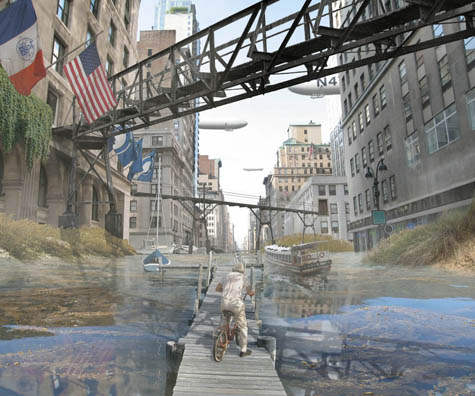
[Image: “Aqualta: 5th Avenue & 35th Street, NYC,” by Studio Lindfors; view larger].

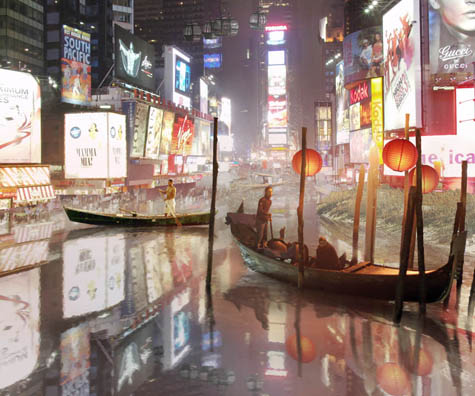
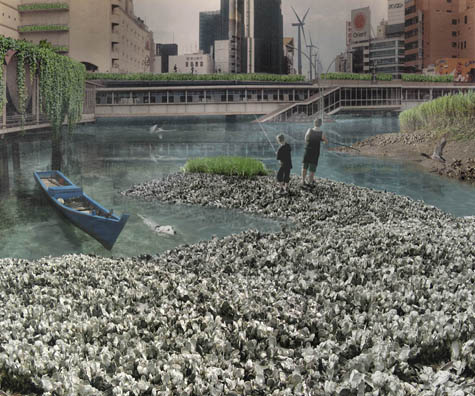
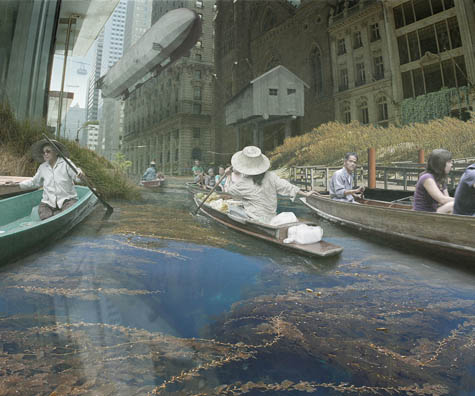
Studio Lindfors—of Cloud Skippers and Cloud City fame—have released a stunning new series of images, published here on BLDGBLOG for the first time, in which we see New York City and Tokyo after a catastrophic flood.

[Image: “Aqualta: Garment District, NYC,” by Studio Lindfors; view larger].

Called Aqualta, the project is an exquisitely produced tour of a hydrologically transformed metropolis. Gondolas float through a still-blazing Times Square; people fish atop gravel banks that have built up beside inundated skyscrapers; and an aerial network of blimps, catwalks, pedestrian skyways, and cable cars passes and sways above the Venetian streets.

I can’t emphasize enough how beautifully detailed the images are; I’ve put them into a Flickr set for closer viewing. They knock me out.

[Images: “Aqualta: Times Square at Night, NYC,” “Aqualta: Roppongi Minato-ku, Tokyo,” and “Aqualta: W. 29th Street & Broadway, NYC” by Studio Lindfors].

Similar in spirit to Squint Opera’s earlier look at a Flooded London, Aqualta is hard—if not impossible—to separate from the context of melting ice caps and global climate change. However, it deserves visual attention in its own right, even outside such politically charged discussions.

Far from stoking fear about a coming catastrophe, both of these projects—Studio Lindfors and Squint Opera—offer a vision in which people, and the cities they live in, have learned to adapt to the overwhelming presence of water. Indeed, Times Square, in Studio Lindfors’s vision, is radiant, markedly improved by the reflective waters that now flow through it. Of course New York should be at least partially flooded, one might be tempted to think; of course the future of urban planning involves designing with water.

[Image: “Aqualta: Shibuya Station, Tokyo,” by Studio Lindfors; view larger].

In fact, there’s a memorable, if brief, scene in Steven Baxter’s recent novel Flood—a surprisingly thought-provoking book about a global flood that, in Wikipedia‘s words, “even covers Mount Everest in 2052, submerging all landmasses on Earth”—where we see a character scraping barnacles off the rocky sides of New York high-rises after the city has been lost to the sea. South Manhattan has been transformed into a tidal world of mussels, clams, and seaweed—and, even then, the waters continue to rise. But if that novel were ever to be adapted for film, I’d unhesitatingly suggest that Studio Lindfors’s visual firepower be snapped up for art direction and set design.

[Image: “Aqualta: 5th Avenue & 53rd Street, NYC,” by Studio Lindfors; view larger].

The architects got in touch after reading the urban premise of DJ /rupture‘s new album with Matt Shadetek, mentioned a few days ago; in an interview with New York magazine, /rupture says the new mix “paints a picture of New York 40 years in the future, where the water line is at the fourth story of buildings and the rich people are dry in the Catskills. Kids are making music on their cell phones and grilling octopi. So, it’s postapocalyptic, but not necessarily grim.”

Again, check out the images in more detail.

The Turbulence Biennial

While I’m on the subject of events, I’ll be speaking at the University of Pennsylvania School of Design this coming Monday, November 16; I’m giving a talk called The Turbulence Biennial. It’s free and open to the public, and it starts at 6pm in Room B1 of Meyerson Hall.

[Image: A map of pilot-reported turbulence above the U.S. east coast].

The basic idea will be to revisit and extend some of the material from the climate change/weather control chapter of The BLDGBLOG Book—looking at everything from John Constable and the Cloud Appreciation Society to urban weather-engineering and airplane turbulence as a kind of invisible landscape in the sky.

So if the sky is a geography, how can we both map and design it?

If you’re near Philadelphia, definitely come by; I’d love to see you there, and it should be a fun night.

World of Giving

Jeffrey Inaba and C-LAB will be hosting a book launch this evening—Thursday, November 12—at the New Museum in New York. The party kicks off at 6:30pm, lasts two hours, and it’s free and open to the public—but you have to RSVP. Just send a quick note to dthiem@newmuseum.org; tell them you read about it on BLDGBLOG.

[Images: From World of Giving, published by Lars Müller, the New Museum, and Columbia University].

The book, called World of Giving, explores the financial infrastructure—and the resultant networks of social capital, or what Inaba calls Aid Capital—that arise in global philanthropy. But this is not just the expected cultural gift-giving of building opera houses in developed cities, funding commerically-unattractive graduate research, or opening new hospitals halfway around the world; it is also a darker philanthropy, we might say, of money-laundered financing for terrorism, arms deals, and more—the terrain of mobile capital and secret bank accounts that Loretta Napoleoni explores in her book Terror Incorporated: Tracing the Dollars Behind the Terror Networks. The World of Giving, in this sense, is not just a Hallmark world in which generosity rules, but an entire shadow economy of often unpredictable impulses and results.

The book itself, meanwhile, is basically a translation of C-LAB’s installation at the New Museum, Donor Hall. Donor Hall is, the museum writes, “a bold, immersive graphic environment that identifies and quantifies public and private philanthropy around the world. The presentation is based on research on dozens of organizations—from sports, media, politics, education, religion, finance, paramilitary, and non-governmental organizations—and tracks the amounts of money various organizations donate to culture.”

Bomb Grid


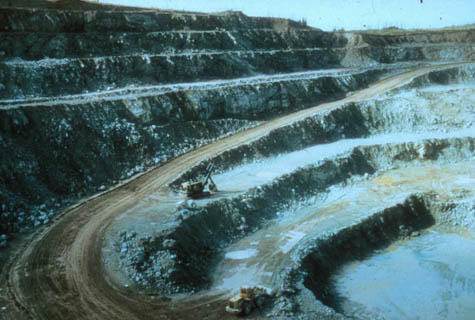
[Image: The Key Lake uranium mine].

I’m in the process of finishing Tom Zoellner’s new book Uranium, and I’m finding it extremely hard to put down. A beautifully written history of the radioactive mineral used in nuclear weapons, it includes some amazing anecdotes and descriptions.

What’s particularly interesting about the book, however, as least for me, is that it very firmly locates nuclear weapons as geological devices. That is, atomic bombs are both of and from rocks—they are mineralogy pursued to its most explosive ends, metals transformed into “mammoth amounts of energy,” able to level cities and mountains both.

Indeed, uranium, Zoellner writes, is “the mineral of apocalypse.” There is “a fearsome animal caged in this exotic metal,” he writes, “hot as the sun, but one whose instabilities could be accurately charted and precisely aimed.”
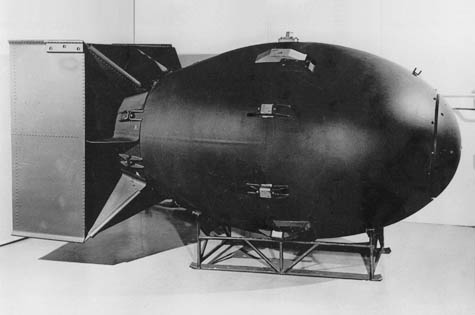

[Image: The uranium-powered Fat Man bomb].

There is a moment in John Milton’s Paradise Lost, which I mention in The BLDGBLOG Book, where Milton—writing in the 1600s—describes mineral weaponry pulled from the surface of the earth by Satan’s minions as they launch an insurrectionary terrorist assault on God. It is geological siege-warfare, we might say.

Milton describes, in Book Six, “materials dark and crude” located “deep under ground”; they “shoot forth / So beauteous, opening to the ambient light” when illuminated by “Heaven’s ray.” These crude materials, Milton writes, are then rammed down into cannons to form long-range weaponry:

These in their dark nativity the deep
Shall yield us, pregnant with infernal flame;
Which, into hollow engines, long and round,
Thick rammed, at the other bore with touch of fire
Dilated and infuriate, shall send forth
From far, with thundering noise, among our foes
Such implements of mischief, as shall dash
To pieces, and o’erwhelm whatever stands
Adverse, that they shall fear we have disarmed
The Thunderer of his only dreaded bolt.

While I’m aware that this is simply a poetic extrapolation from existing technologies of the time—i.e. the “dilated and infuriate” energy of gunpowder—Paradise Lost has the often uncanny feeling of being a description of militararized uranium three centuries in advance of the Manhattan Project.

At one point, Zoellner himself refers to uranium as “a mineral demon,” bringing to mind Milton’s Pandemonium—that is, the place of all demons.


[Image: The weaponization of geology in the form of the Little Boy atomic bomb].

In any case, Zoellner’s book is full of incredible descriptions. For instance, “Testing [uranium-fueled nuclear weapons] at the Nevada Proving Ground has revealed that a nuclear bomb buried in a deep shaft underneath a mountain would vaporize the surrounding rock and make a huge cathedral-like space inside the earth, ablaze with radioactivity.”

Or take Zoellner’s short history of something called Project GNOME, which experimentally deployed a small atomic bomb underground in New Mexico in order to see if its detonation could flash-vaporize groundwater, providing steam for a subterranean power plant.
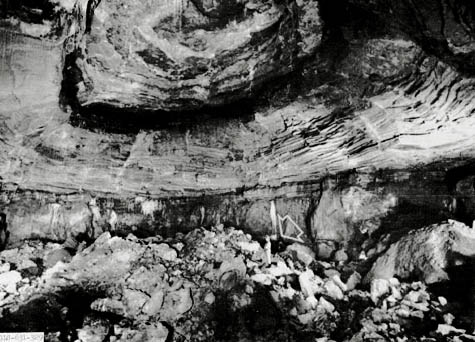

[Image: Inside the underground chamber created by the Project GNOME explosion].

The “muffled bang” of this experiment produced an extraordinary false geology:

When workers tunneled in more than half a year later to inspect the damage, they found a hollow chamber about the size of the U.S. Capitol dome. The rock walls were colored brilliant shades of blue, green, and purple and bore an angry surface temperature of 140 degrees Fahrenheit. Drilling at the site is prohibited today; the radiation still poses a danger.

Architectural metaphors come easily to Zoellner, and he makes good, illustrative use of specific buildings; who knew the Monadnock Building in Chicago could serve as a metaphor for the structure of uranium?

The Monadnock was stone and mortar, and sixteen stories was the breaking point with those materials. Any higher and the whole thing would fall into a pile of rubble, or require walls so big and windows so small that the rooms would have resembled dungeon cells… The building is so obese with masonry that it sank nearly two feet into Chicago’s lakefront soil after it opened. It is still the tallest building in the world without a steel frame, and it represents a monument of sorts: the very brink of physical possibility…

There is a similar invisible limitation inside atoms, and uranium is the groaning stone skyscraper among them, pushing the limits of what the universe can tolerate and tossing away its bricks in order to forestall a total collapse. This is radioactivity.

There is one more longish quotation I want to draw attention to. The middle-third of the book is about the uranium rush that erupted in the American southwest in the 1950s; uranium, far from being rare in nature, was found at a wide range of sites, including near the town of Moab, Utah.


[Image: Yellowcake uranium].

In the Book of Zephaniah, Zoellner points out, no less a figure than God refers to a settlement called Moab, saying it is “a place of weeds and salt pits, a wasteland forever.” That a town in Utah might name itself this is either self-deprecation at its most extraordinary or an unfortunate error (indeed, Zoellner mentioned that the town tried, unsuccessfully, to rename itself for several decades).

[Image: Pitchblende, via Wikipedia].

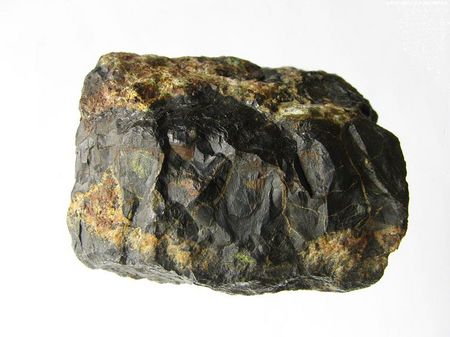
What’s fascinating, though, is that uranium was not hard to come by out there; indeed, one could often find these chromosome-mutating, highly radioactive rocks literally just sitting on the surface of the desert, sometimes shining yellow in the arid sunlight. I was thus blown away by a passing comment Zoellner makes when he describes the scabbed desert cliffs, canyons, and hills within which American uranium was found:

In the shaded alcoves of some of the cliffs, a race of Indians called the Anasazi had left paintings of gazelles and misshapen humans: the people themselves had vanished in the thirteenth century.

Pictures of misshapen humans. This is clearly something for anthropologists and art historians to discuss, but how absolutely extraordinary to consider the possibility that depictions of humanoid forms in Anasazi rock art were not, in fact, fantastic depictions of mythological figures or a creative exploration of the human anatomy—a desert Demoiselles d’Avignon six hundred years before Picasso—but realistic depictions of people mutated by the rocks around them.

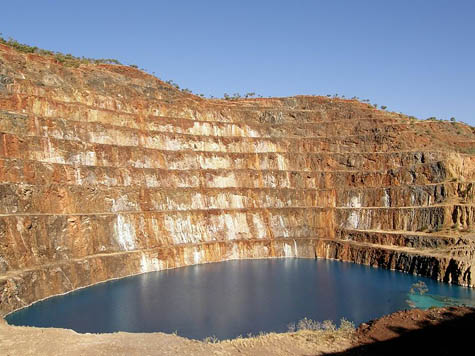
I could go on at great length; Uranium is a fascinating book, and, as I mentioned, it takes several steps in the direction of what I might call a geological history of the atomic bomb (something I would love to read or write).

[Image: Abandoned pit of the Mary Kathleen uranium mine, Queensland, Australia; via Wikipedia].

But I was also specifically reminded of the book when I read last night that 10% of the U.S. power grid is fueled by dismantled nuclear warheads—including many purchased from the former Soviet Union.

“Salvaged bomb material now generates about 10 percent of electricity in the United States,” the New York Times reports; “by comparison, hydropower generates about 6 percent and solar, biomass, wind and geothermal together account for 3 percent. Utilities have been loath to publicize the Russian bomb supply line for fear of spooking consumers: the fuel from missiles that may have once been aimed at your home may now be lighting it.” As one consultant interviewed in the article quips: “‘You can look at it like a couple of very large uranium mines,’ he said of the fissile material that would result from the program.”

Known officially as the Megatons to Megawatts program, it comes with the poetic implication that any forensic dissection of the U.S. national power grid would eventually come up against mineral remnants of Cold War Soviet weaponry. Ticking away somewhere inside the infrastructure of the United States is the radioactive dust of an undeclared nuclear war.

It also makes one wonder what John Milton might do with the U.S. electrical grid—what mythic scenes of electrical warfare, fueled by repurposed missiles and clouds of fallout, he would describe being unleashed upon the scarred bedrock of continents.

But, even at its most mundane, this is stunning: it’s as if, on the one hand, we have Hoover Dam, spinning its turbines and sending power to the people of the American southwest, and, on the other, we have an unlocked stockpile of old weapons, like some strange archaeological site, fizzing down somewhere in a power plant, generating light for our cities.

The Fourth Plinth: London Planetarium

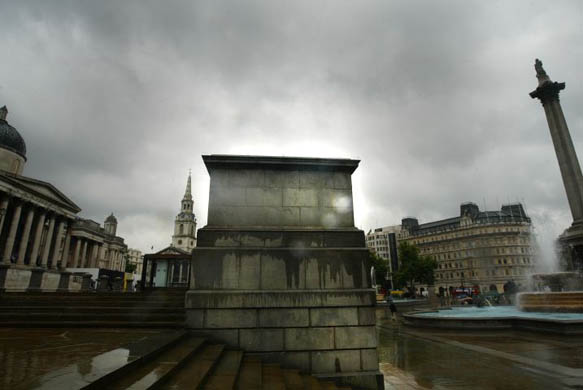
[Image: London’s Fourth Plinth, via Google Image search].

In an odd coincidence with the previous post, I actually saw a show at the American Museum of Natural History’s planetarium yesterday—an experience which reminded me not only how much I love planetaria, and that planetaria should be built all over the city, inside subway cars (and subway tunnels and subway stations), and inside children’s bedrooms, and in the back rooms of bookshops, in public buses, in bars, in department stores, in regular cinemas everywhere, in every city’s opera house, but I was reminded of the ongoing Fourth Plinth project in London.

The Fourth Plinth is the only plinth in Trafalgar Square without a statue; as such, it has been the site of (not always successful) public art installations for the past decade. But what if the Fourth Plinth, in tandem with London’s cloudy skies, could take on a more astronomical bent?

[Image: Planetarium projection equipment].

A rain-proof planetarium machine could be installed in public, anchored to the plinth indefinitely. Lurking over the square with its strange insectile geometries, the high-tech projector would rotate, dip, light up, and turn its bowed head to shine the lights of stars onto overcast skies above. Tourists in Covent Garden see Orion’s Belt on the all-enveloping stratus clouds—even a family out in Surrey spies a veil of illuminated nebulae in the sky.

The Milky Way rolls over Downing Street. Videos explaining starbirth color the air above Pall Mall and St. Martin in the Fields goes quiet as ringed orbits of planets are diagrammed in space half a mile above its steeple.

[Image: From a review of David Wright’s The Tenth Planet].

The sky becomes a writing board for astronomical imagery: planets rise and fall, constellations form, and the death of the universe is animated down to its slowest moment of heat-death. New shows are developed specifically for the London Planetarium, as Trafalgar Square is grudgingly called, and speakers installed in the nearby Pret A Manger allow customers to listen in while eating their evening sandwiches.

Eventually the idea is exported to other cloudy cities around the world. Astronomers in San Francisco’s Mission District project roiling animations of solar magnetism onto the fogbanks above Tank Hill.

Grilling Octopi in a Flooded New York

[Image: A flood strikes Manhattan; image via New York magazine]/.

Jace Clayton, aka DJ /rupture, who is interviewed in The BLDGBLOG Book, has a new album out with Matt Shadetek—and he’s suddenly everywhere. The newest issue of New York magazine, for instance, has a short feature in which Rupture describes their new album; called Solar Life Raft, it comes with its own architectural premise. The mix “paints a picture,” we read, “of New York 40 years in the future, where the water line is at the fourth story of buildings and the rich people are dry in the Catskills. Kids are making music on their cell phones and grilling octopi. So, it’s postapocalyptic, but not necessarily grim.” Flavorwire has also just run a list of /rupture’s favorite pairings: cities twinned with music.

And on Friday, November 13, from 9pm to 1am, the album will be premiered at no less a site than the planetarium at the American Museum of Natural History; BLDGBLOG and Edible Geography will both be there, and there are still a few tickets left. Attendees apparently get a free show at the planetarium! Hope to see some of you there.

Editing the Shadow Volume

[Image: The multiple-shadow casting cube by Niloy Mitra and Mark Pauly].

Spotted via New Scientist is an amazing new computer model that allows designers to create objects based on the multiple and highly specific shadows that those objects will cast when lit from different angles.

Seen above is one, relatively mundane example of the technology, by Niloy Mitra and Mark Pauly: three paintings by Andy Warhol are being cast from the same object. “Their computer model can calculate the object shape needed to cast up to three distinct shadows simultaneously,” New Scientist explains. The designers call it “editing the shadow volume.”

Niloy’s and Pauly’s accompanying video is amazing:


But what if we could do this with a glass tower in midtown Manhattan? Or if there was an elevator moving upward through an all-glass shaft, and as the lights in the lobby around it switch on and off, different—often wildly unexpected—shadows are cast within the building?

What are the architectural possibilities of multiple-shadow casting design?

You hook this modeling software up to huge CNC-milling machines, and then you attach the whole assembly to a warehouse-sized block of plywood. You come back one week later to find a sprawling labyrinth of immersive three-dimensional shapes carved directly and seamlessly into the wood, like the mathematical spires of some alien cathedral—it’s an extraordinarily beautiful landscape of precision-cut wood—but it’s only when the lights go off above you and a wall of klieg lamps on the northern wall switch on that you see the jaw-dropping shadows this wooden landscape can cast. But then those lights turn off, and the eastern wall lights up—and more, incredible, seemingly contradictory shadows appear. Then the west wall.

Each time, an impossibly unique scene of shadows is displayed, often too complex to be believed. It is Wayang Kulit for an age of semi-intelligent milling machines and theatrical light.

Or perhaps someday the perfect, cinematic object will be designed: it rotates in all directions amidst a battery of programmed lights, and the shadows that it casts are narrative, moving scenes in a two-hour film, displayed on the walls around it.

Instead of DVDs, we will store our movies in the cuts and grooves of milled wooden objects. Mahogany harddrives. Spirit-objects brought to animate life by angled light.

Of swarms, media, and design education

Architect and filmmaker Ed Keller has organized a fantastic day-long conference next weekend here in New York City about multi-agent systems, cities, swarms, media, hives, collectives, outbreaks, disruptions, and more. The idea is to look at how momentary but extremely consequential losses of equilibrium can affect, offer metaphors for, and even physically instigate new design processes.

After all, if there are “unanticipated forms of public space, communication, and subjectivity” emerging in the contemporary metropolis, as Keller suggests, then this conference is an opportunity to discuss how and under what circumstances such things might more frequently appear.

[Image: A British Airways jet swarmed by birds; photographer and location unknown].

Participants include Benjamin Bratton, Katherine Von Jan, Jamer Hunt, Roland Snooks, Cameron Tonkinwise, Mark Leiter, myself, Warren Neidich, and others.

Called Shockwave Riders: Collective Intelligence & TransDisciplinary Pedagogy, the symposium goes from noon to 7pm on Saturday, November 14th; it’s free, open to the public, and hosted by Parsons, The New School for Design, at 560 Seventh Avenue. Here’s a map.

While the overarching conversation will look at multiply-authored systems, from natural processes to global stock markets, the final point is to discuss how all of this might change design education:

This symposium marks a continuation of the School of Design Strategies’ work to map out the ways in which emerging forms of social media, global information exchange and new models of pedagogy meet, and it brings together thought leaders from architecture and urban design, the business world, new media entrepreneurs, and media / culture theorists, to discuss and dispute the consequences of technological change in the next decade and outline strategies for developing a design and design-education models that can meet the challenges ahead.

It lasts all afternoon, and will be well worth stopping by. Check the symposium website for more info, including, as we get a bit closer, the actual timetable for the speakers.

1984–2001

[Image: From 2001, directed by Stanley Kubrick].

I’m participating in a panel discussion later today (Sunday), over in Brooklyn at a place called Smack Mellon. The topic is 1984–2001, and it’s a look at utopian and dystopian visions in science fiction—with, in my case, a specific focus on architecture. The other participants are Ed Halter, Carrie Hintz, Brian Francis Slattery, and Deborah Taylor; Matt Borruso will moderate.

[Image: From the film 1984, directed by Michael Radford].

Here’s an excerpt from the day’s description:

George Orwell’s 1984 was written during the Second World War and Stanley Kubrick’s 2001 was released in 1968. That these moments of cultural upheaval produced two such extreme visions of the future is hardly a surprise; sometimes referred to as speculative fiction, science fiction is premised on a radical re-imagining of the cultural moment. Whether optimistic or cautionary, any representation of a set of social conditions that differs from the author’s own are bound to that author’s aspirations for the present, making science fiction a genre often read for its political import.

It starts at 3pm, and is free and open to the public. Here’s a map.