Printable Airplanes and the Future of Fiction


[Image: “The Polecat UAV is pictured flying at 15,000 feet by a chaseplane. Polecat’s airframe was ‘laser printed’ rather than machined.” New Scientist Tech].

The same week we found out that jets of the future will be made with plastic, we also read that the U.S. military has been working toward printable airplanes – unmanned drones made by “rapid prototyping.” As New Scientist Tech reports: “In rapid prototyping, a three-dimensional design for a part – a wing strut, say – is fed from a computer-aided design (CAD) system to a microwave-oven-sized chamber dubbed a 3D printer. Inside the chamber, a computer steers two finely focussed, powerful laser beams at a polymer or metal powder, sintering it and fusing it layer by layer to form complex, solid 3D shapes.”
Of course, 3D printing is nothing new; several months ago, for instance, just about everyone in the universe learned that 3D buildings and cityscapes can be printed using images from Google Earth.


Even more strangely, you can also print fully-functioning body parts using “droplets of ‘bioink’,” which are “clumps of cells a few hundred micrometres in diameter.” In other words, if you “alternate layers of supporting gel, dubbed ‘biopaper’, with the bioink droplets,” and if you “build tubes that could serve as blood vessels, for instance,” then, through bio-printing, these will become the “successive rings containing muscle and endothelial cells, which line our arteries and veins.”


This Frankenstein-meets-Hewlett-Packard technology can be used to “print any desired structure.” Indeed, there are now “printing heads that extrude clumps of cells mechanically so that they emerge one by one from a micropipette. This results in a higher density of cells in the final printed structure, meaning that an authentic tissue structure can be created faster.” (What about a photocopier?) Finally, skeptics will benefit from learning that “cells seem to survive the printing process well. When layers of chicken heart cells were printed they quickly begin behaving as they would in a real organ. ‘After 19 hours or so, the whole structure starts to beat in a synchronous manner.'” (A bit more on this here).
The Oliver Twist of tomorrow, then, will be a poor boy, printed in obscurity…
So the question naturally arises: what if you were to combine all these? You’d get a vast, self-printing city-organism, whose skies are criss-crossed with machine-birds of prey; when buildings reach the age of senility, forgetting how many floors they contain, they are melted down into rivers of ink and pooled in living reservoirs to be printed once again; molds and fungi and architectural infections bloom, growing atop one another till new parasite structures form, small Gothic rooms in which the homeless live.
All of which reminds me, somewhat disjunctively, of the following rather unoriginal statement: the default condition of all literary genres will soon be science-fiction. You simply will not be able to write about the world without incorporating these weird new technologies.
Science-fiction and social realism will become one and the same thing.
Look at the recent genre-defying work of Kazuo Ishiguro, Michel Houellebecq, David Mitchell, Rupert Thomson, Alex Garland; soon even Ian McEwan will be writing sci-fi. Note, as well, that whilst mainstream American literary novelists appear increasingly incapable of doing anything other than reimagining their own national past – Philip Roth, say, or the forthcoming Thomas Pynchon – as if endlessly recycling historical micro-narratives will result in something new – Anglo-European fiction appears to have accepted, with great success and enthusiasm, the futurist inclinations already so obvious in everyday life.
To be rather broad here – for instance, does Michael Cunningham invalidate my argument? do I even have an argument? – it seems that while British fiction in particular has already accounted for the slippage of contemporary life into sci-fi, even welcoming this phenomenon with a newfound literary ambition, mainstream American fiction is content simply to enroll itself in unnecessary MFA programs, writing 800-page novels about family farms, the period between WWI and II, shopping, or the supposedly “atmospheric” end of the 19th century.
Run-of-the-mill student architectural proposals are already more stimulating than most of today’s American novels. Architectural proposals have ideas.
Meanwhile, the rest of the world has already discovered the future, and it’s no real wonder that the U.S. publishing industry is in the midst of a kind of slow financial crisis. In fact, you only have to look at the ongoing revival of interest in Philip K. Dick – sci-fi novelist and volunteer FBI informant – to see that Americans don’t exactly lack a literary taste for the future; it’s just that all the wrong novels keep getting published here.
In any case, there are a million exceptions to this argument; feel free to rip it apart. For example, where does The Da Vinci Code fit in all this? Etc. etc.

Voyage to Utopia and the City Obscure


These images are spatio-structural urban fantasies taken from Urbicande. Les cités obscures, the source material, is a 12-volume graphic novel by François Schuiten and Benoît Peeters, in which “references to our world abound, especially in regard to architecture.” It is a “parallel universe,” we read, full of utopian construction projects and urban expeditions, strange villages and—

—moving machine-labyrinths made from decontextualized walls. Its “coherence is constantly growing with time.”

All images, including those below, are copyrighted by and fully credited to this creative team.


(Thematically related: gravestmor introduces us to The Mysterious Geographic Explorations of Jasper Morello, and Pruned gives us some Brodsky & Utkin. In the process, don’t forget BLDGBLOG’s own look at cinematic urbanism, or Archidose’s reconsideration of the strangely inspiring film, La Jétee).

The Dune Sea

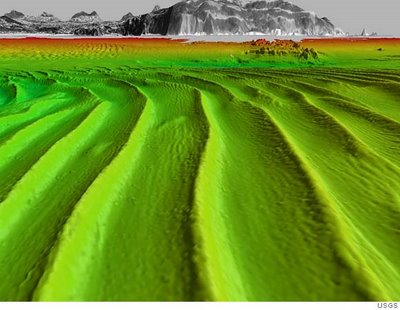
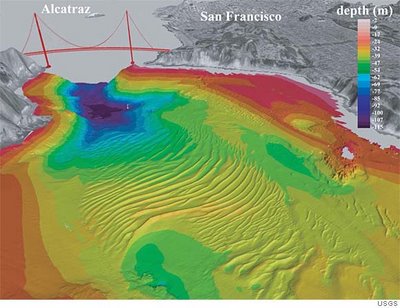
From today’s San Francisco Chronicle: “‘These are some of the largest sand waves in the world,’ said Patrick Barnard, a coastal geologist with the Santa Cruz office of the U.S. Geological Survey. ‘They’re certainly in the upper 10 percent.'”
Unfortunately – or perhaps more interestingly – they’re underwater, lining the bottom of San Francisco Bay like tectonic corrugation: “The sand waves range up to 700 feet long and reach heights of more than 30 feet, Barnard said. It is a dynamic system, he said, with the configuration of the individual dunes changing significantly with each tidal cycle. But overall and over time, the net change to the entire field is slight.”
In that regard, and if you were pretentious, you could say that the landscape inhabits a kind of fractal temporality

As it is, “scientific interest in sand waves has been growing around the world because sonar technology has improved to the point that high resolution, three-dimensional maps can now be made of the ocean’s floor” – which was actually explored in an earlier post on BLDGBLOG: The Geoacoustic Sea.

There we read the following: “It’d be interesting, meanwhile, if you could take geoacoustic data and release it as an MP3: you could then listen to the suboceanic landscape’s raw sonic topography, compressed aquatic echoes, complete with deepsea ridges and audio-thermal vents. Non-visual mapping of unreachable landscapes. An MP3 of the surface of Mars. The rings of Saturn.”
And now we’ve read it again – because, for the record, I still think it’d be interesting. After all, if you can’t actually visit the landscape, you could simply download it as an MP3… Audio geotechnics. Or convective audio cartographies, 3D podcasts of unexplored worlds.

(Thanks to Bryan for the tip!)

Dumpster Gardens


“You may not know his name,” the New York Times wrote four years ago, “but you have probably enjoyed the public spaces he has created.”
He is Ken Smith, “the Elvis Costello of landscape architecture.”
“Perhaps,” the Times continues, “you sat on an Art Deco bench and admired the Islamic geometric patterns of the paving stones at Malcolm X Plaza in Harlem or walked through the Glowing Topiary Garden he and Jim Conti, a lighting designer, installed three years ago at Liberty Plaza for the winter solstice. If you’ve been to Toronto, you may have walked through his idiosyncratic Village of Yorkville Park, with its 700-pound rock and miniforests and the rain curtain that freezes into icicles in winter.”
Smith, we read, has a “Seussian mind,” which means that he freely combines glass elevators with bamboo gardens – moving, earthless landscapes; horticultural Cubism – and he adds “glacial hummocks, grasslands, [and] honey locusts,” even while opening up space for ice skating. And so on.
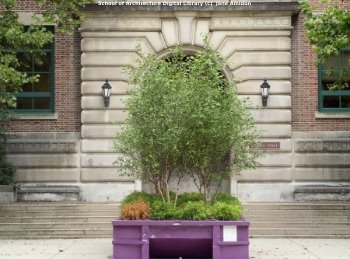
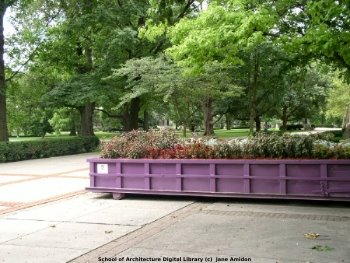
But what interests me here are Smith’s so-called Dumpster Gardens, where you take a dumpster – or skip, if you’re British – and grow a garden in it. Portable landscapes.
In 2003, Smith installed three such Dumpster Gardens at Ohio State University


– as these photographs attest.
“Each of the three Dumpsters houses different plant life,” Ohio State University’s student newspaper tells us. “One contains a fragment of lawn and a second has juniper shrubbery and river birch. The third stands in front of Ohio State President Karen A. Holbrook’s office with a bed of scarlet (celosia) and gray (artemisia) flowers. (…) Each of the Dumpsters is three feet deep and 20 feet long. The bottom is covered with gravel to allow for drainage and the rest is filled with planting soil.”
But Smith’s dumpsters are not doomed to spend the rest of their days in the empty, mausolean fate of decorating university campuses; indeed, returning to the New York Times: “Dumpsters would also be a great way to enliven traffic medians, Mr. Smith said. ‘You could grow corn, or have a portable meadow of Queen Anne’s lace and juniper,’ he suggested.”
Of course, you could also link them all together into a walled labyrinth, a postmodern hedge maze that twists and meanders through the city; you could grow hybrid flowers and Aspen trees, poisonous fungi and ergotic growths, in others, a kind of dumpsterized botanical taxonomy; you could tow gardens all over the country, even, driving every mile of the US highway system (and terrestrially out-performing Robert Smithson in the process); you could ship the things to the middle of the Atlantic Ocean where they’d be permanently anchored, forming tax havens, utopian atolls, a new Earth; or, better yet, you could skip the dumpsters outright and use enormous wicker baskets: plant amazing and weird asymmetrical gardens in each, then attach them to hot-air balloons – bulletproof, Artificially Intelligent hot-air balloons. Set them loose in the sky.
Aerobiology.


Gardens drift slowly above your head on trade winds, trailing creeper vines; a jellyfish, made of kudzu, flying through the stratosphere. New weed species auto-hybridize, evolving super-seeds, and they re-invade the earth from above. Literal new levels of biological warfare. Hugo Award-winning novels are written, documenting the vegetative horrors.
One of the balloons then crashes in the forests of Papua New Guinea and, instead of a cargo cult, you find a cult of landscapes-that-fall-out-of-the-sky.
Gardens in a space capsule. They re-enter Earth’s atmosphere and crash outside London 5000 years from now. Ken Smith is there to greet it – turns out it was his idea in the first place…
In any case, Smith also has a book. More info on some of his other projects here and here and here.

Kew Brew, or: turning endangered landscapes into beer

Two years ago, Young’s brewery began producing bottles of Kew Brew, a beer made from rare hops grown in London’s Royal Botanic Gardens at Kew. And preserving endangered landscapes by turning them into alcoholic beverages sounds like a good idea to me…


“Sales [of the beer] will help Kew’s conservation work as a donation per bottle is given to the Gardens which runs the international Millennium Seed Bank Project.”
Not everyone likes the taste, of course, but the beer is, at the very least, an amazing idea; from the perspective of landscape design and preservationist horticulture, it’s even brilliant. Avant-gardeners will soon forget all about topiary mazes – and install huge vats of beer instead. Liquid gardens you internalize.
Indeed, one wonders what other plants could be rescued from the brink of extinction simply for the purpose of becoming beer: extinct ferns, perhaps, cloned from scraps of DNA, are fermented in bottles of Jurassic Park Pale Ale… Rare African orchids, saved from planetary disappearance, aromatically flavor BLDGBLOG’s new Lost Eden Stout. Hybridized roses suddenly explode in genetic vitality due to the appearance of Pruned‘s Meta-Botanical Bitter.
Next up: architectural historians join in. Condemned Futurist masterpieces are ground up and served as salt at French dinner parties. You may not save the building – but you can season your shrimp with it… Stuff sausages with Philip Johnson.
The Building Burger.
Ionic Pie.

(With thanks to Nicky!)

Psychoacoustic UK


“My Psychoacoustic Maps of Milton Keynes explore ways of translating visual compositions into sound environments,” Timon Botez of the London-based design firm CO-Designers writes. Botez is describing an event and exhibition he organized as part of last month’s Architecture Week 2006, hosted in London.


“I have composed a series of maps based on colours I like,” he continues. “The maps are visual environments, snapshots of a time of day, a mood or an experience in Milton Keynes. I have built a software that analyses the images and produces sound based on the colours. This forms the basis for the audio compositions that accompany the maps. The psychoacoustic maps are not functional, but they use the geometrical forms of the original city map as a basis for artistic expression.”


Some of the audio tracks are quite mesmerizing; but if you don’t like drumless electronic space or digitally glitched crackling background drones, then Botez’s shudder-filled sci-fi audio-maps of Milton Keynes are probably not for you. But I particularly like the track called FridayEvening (or FridayEvenening, if its file name isn’t a typo): here’s the MP3. There’s also Commute1 (MP3) and Sunday2 (MP3) – as well as five others, all available here.
At the very least, you can irritate dogs with them…
To some extent, though, Botez’s project reminds me of two other urban-acoustic works. One is a piece called Surface Noise, by Scanner, which used one of London’s old double-decker buses as an acoustic focus.
“Making a route determined by overlaying the sheet music from London Bridge Is Falling Down onto a map of London,” Scanner writes, “I recorded the sounds and images at points where the notes fell on the cityscape. These co-ordinates provided the score for the piece and by using software that translated images into sound and original source recordings, I was able to mix the work live on each journey through a speaker system we installed throughout the bus, as it followed the original walk shuttling between Big Ben and St Paul’s Cathedral.” The MP3s are downloadable from Scanner’s site (scroll down), but certainly nothing to rush out for.
The other project I’m thinking of is an old CD-R called .murmer, released by Patrick McGinley. As McGinley himself explains, studiously avoiding upper-case letters, because only Fascists capitalize: “the source recordings for .murmer were all taken during my first six months as a resident of the city of london. hence they document my exploration and discovery of a new home, as well as of a new medium. i purchased my first recorder and microphone upon arrival here, and began exploring their possibilities alongside exploring the city. however, these sounds are not a portrait of a location; i made no attempt to map a geography. they are more personal. many originate from within my private space (the refrigerator and grill provided in a bedsit; the wind through an apartment window) and all are tied strongly to my personal movements (the air vent on my local bus, the heater in my place of work).” And so on.
Accordingly, McGinley’s track “.errum” was made using the following urban sources: “air vent on a 73 bus, malfunctioning gas heater, feedback, escalator at pimlico tube station.” Meanwhile, McGinley’s photo diary


– of which the above are several examples, apparently documents some of the more landscape-architectural references in his work; and his radio show – featuring “contextual and decontextualized sound activity” – can also be downloaded or streamed.
Finally, here are links to McGinley’s own music; it’s sparse stuff, but not bad if you simply want acoustic company. The track “.meurm” (MP3), for instance, was built entirely from the mechano-solipsistic moan of McGinley’s refrigerator and gas grill (as mentioned above).
Soundtracks for architecture, indeed.

(Earlier: Urban sound walks and How to podcast a landscape).

Architectural Tetris


A new block of flats on the edge of Copenhagen, designed by Bjarke Ingels and Julien De Smedt of PLOT, was toured, analyzed, and photographically documented in last month’s issue of Metropolis. The article is by Tom Vanderbilt, a writer whose career I find well worth following. (Here’s his book).
The article will tell you a lot more about the project than this brief and hurried post will – but, basically, the building is like a huge game of architectural Tetris, with a bewildering variety of interlinked floorplans. Specifically, there are “76 floor plans in 221 units,” Vanderbilt writes, “with none repeated more than a dozen times and well over a dozen of them unique.” Further, he says, “flipping through the sales booklet, which has pages of unit plans, is like reading the assembly blueprints for some massive urban machine with interlocking component parts.”
So what does it look like? First, here are some 3D shape-diagrams for the “V block” of the building; they almost look like proteins – enzymes of European domesticity.


Below is the “M block.”


As Vanderbilt explains, the “V” and the “M” building shapes only entered into the design process after the architects “experimented with any number of permutations, the totality of which – collected on a display board – looks like some strange alphabet. They eventually settled on fashioning the south-facing block into a V and the north-facing block into an M. ‘By bending the shapes,’ Ingels says, ‘you open up the maximum toward the two canals, which ensures that the apartments, instead of just looking at one another, all have orientation toward the landscape.’ It also ensures that both evening and morning sun can enter the courtyard. The move shatters what would be a dense rectilinearity into a kind of crystalline parallax-view refraction of light and circulation.”
The whole complex was also finished with very tastefully bold, solid neo-Modernist colors. These eye-popping central corridors will, at the very least, wake you up every morning as you stumble out the door for work.


Finally, a note to property developers: “all 221 units sold out in three weeks, 80 percent on the first day.”
Good design pays.
Read more in Metropolis.

Fire Maps of Africa


[Image: NASA’s Earth Observatory points us to this incredible series of images, showing the southward migration of agricultural fires across Africa over the course of 2005: “Season after season,” they explain, “year after year, people set fire to African landscapes to create and maintain farmland and grazing areas. People use fire to keep less desirable plants from invading crop or rangeland, to drive grazing animals away from areas more desirable for farming, to remove crop stubble and return nutrients to the soil, and to convert natural ecosystems to agricultural land. The burning area shifts from north to south over the course of the year, in step with the coming and going of Africa’s rainy and dry seasons.” Of course, if you want to know – or see – more, this page has an eye-popping quantity of global fire maps, spanning no less than six years and offered in three levels of resolution. While you’re at it, then, check out the somewhat less exciting MODIS Active Fire Mapping Program or the so-called Web Fire Mapper. Pyro-cartographers, rejoice].

Living batteries and the wire garden


“Bacteria can be persuaded to produce wire-like appendages that conduct electricity,” New Scientist reports. These wires are shown in the image, above: a bio-geometrical tangle.
“A deficit of metal atoms in the close vicinity of the bacteria can cause a bottleneck,” we read, “so the proliferation of nanowires allows the bacteria to consume more fuel.” In other words, the bacteria can use these metal atoms as structural parts of their own “bodies,” as they interact with and metabolize the immediate environment – in which case, does this constitute a kind of living metal? That simultaneously doubles as an electrical appliance?
“Now a study by Yuri Gorby of Pacific Northwest National Laboratories in Washington State, US and colleagues reveals that several other kinds of bacteria produce similar nanowires.” And in ten years’ time, your own dear son will start sprouting extension cords… You can plug Hoovers into him.
Meanwhile, Gorby studies something called biogeochemistry.
So will the electrical network installed in the walls of your house become a living thing someday, an organism of light and electricity, made of wires, prone to growing so you have to prune it back on Saturdays, a new chore – electro-topiary? Or you’ll grow whole gardens of the electrically self-modified, vines and ivy coiling through the undergrowth, lit up like Christmas lights, shining.
Wire gardens.