There are tornadoes of light erupting from the sun.
I was recently interviewed by National Public Radio’s On The Media for a show that aired this past weekend. We talked about architectural models, Die Hard, special effects and renderings, Saddam Hussein, Albert Speer, and so on. I sound pretty inarticulate, to be frank, but I’m still excited to have been on NPR. You can read a transcript of the show here, or you can download the MP3. The entire program was about urban and architectural space: check out all the segments through On The Media’s website.
Stadiums of disaster and war
A “tennis dome/emergency center” outside Kobe, Japan, gets a quick review in the new issue of Architectural Record.
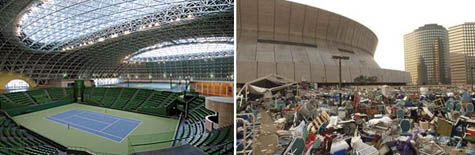 [Image: Shuhei Endo’s “tennis dome/emergency center” (left), photographed by Kenichi Amano, next to the New Orleans Superdome, post-Katrina].
Designed by Shuhei Endo, the building is both a sports complex and a regional disaster preparedness center – it can become a field hospital, refugee camp, and even perhaps a prison in times of national emergency.
In the event of an earthquake or typhoon, supply trucks can drive directly into the 174,000-square-foot building, thanks to movable glass panels at four locations around the perimeter. But on normal days, athletes enter primarily through a domed foyer on the building’s east side.
We’ve already seen the (as it happens, disastrous) transformation of sports infrastructure into emergency housing during the aftermath of Hurricane Katrina; but will we all find ourselves someday huddling under floodlights on repurposed football fields after the Big One hits?
I’m reminded of that famous scene from J.G. Ballard’s excellent novel Empire of the Sun, wherein the European prisoners of war are led into Shanghai’s former Olympic Stadium:
This concrete arena had been built on the orders of Madame Chiang Kaishek, in the hope that China might be host to the 1940 Olympic Games. Captured by the Japanese after their invasion in 1937, the stadium became the military headquarters for the war zone south of Shanghai.
The prisoners – former doctors, lawyers, businessmen, and their families – are forced to camp out on the “wet grass” of the overgrown soccer pitch, “waving away the mosquitoes that had followed them into the stadium.” The whole structure has been gutted, meanwhile, stuffed full with spoils of war – cars, tables, and Turkish rugs taken from the rich homes of the International District.
Bedsteads and wardrobes, refrigerators and air-conditioning units were stacked above one another, rising in a slope toward the sky. The immense presidential box, where Madame Chiang and the Generalissimo might once have saluted the world’s athletes, was now crammed with roulette wheels, cocktail bars and a jumble of gilded plaster nymphs holding gaudy lamps above their heads.
Are similarly surreal scenes of material juxtaposition lying in wait for structures such as Shuhei Endo’s “single, cavernous space that holds nine tennis courts,” as earthquake-rattled survivors file in to take up residence amidst the dust and fallen walls of the city?
And are sports infrastructure twinned with military-run refugee camps really the end-game of 21st century disaster urbanism?
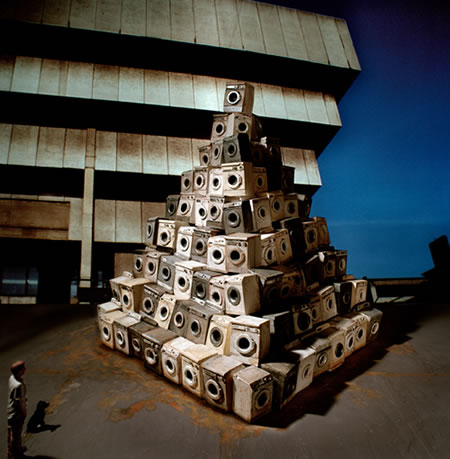 [Image: Stacked washing machines, from the J.G. Ballard-inspired series Future Ruins by Michelle Lord].
Of course, I’m also reminded of a scene toward the end of 28 Weeks Later, when the American military helicopter lands on the grass football pitch of Norman Foster’s new Wembley Stadium: the grass, untended now for 28 weeks, is waist-high, like a wild English meadow, the stalks blowing in slow, flattening spirals from the crosswinds of the aircraft’s blades.
How ironic to think that sports stadiums – justifiably bemoaned by certain urban planners for their financial short-sightedness – might someday prove to be the most valuable buildings in the city.
Is the U.S. “operating ‘floating prisons‘ to house those arrested in its war on terror”? The Guardian reports this morning that “the U.S. may have used as many as 17 ships as ‘floating prisons’ since 2001.” Of course, the “floating prison” in this specific case is simply a warship – but actual, purpose-built floating prisons do exist, for instance, in Amsterdam. There, an illegal-immigrant detention center “sits on two concrete platforms, each in turn moored to large steel pilings,” moving up and down with the tides, like a building only temporarily docked on the edge of the city. Bryan Finoki calls this the “ongoing narrative of sea-bound detention,” drawing parallels between this and the practice of extraordinary rendition, wherein detainees are shipped through the skies of the world inside unmarked airplanes. So are airborne prisons far off? Clusters of hot air balloons in the mid-Pacific, “moored” to the Trade Winds, in a strange, post-sovereign airspace outside the reach of international law.
Machine Dreams
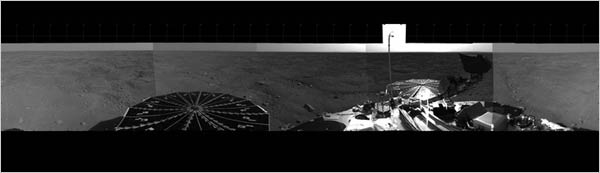 [Image: A Mars polar panorama, taken by the Phoenix lander. Courtesy of NASA/JPL-Caltech/University of Arizona].
Two unrelated bits of news this week strangely merged for me, to surreal effect.
First, we learned that two monkeys were able to move a robotic arm “merely by thinking.” The arm, which included “working shoulder and elbow joints and a clawlike ‘hand’,” was controllable after “probes the width of a human hair were inserted into the neuronal pathways of the monkeys’ motor cortex.”
This field of research is referred to as “mind-controlled robotic prosthetics” – but the mind in control here is not human.
Second, the New York Times reported that “NASA’s Phoenix Mars lander has successfully lifted its robotic arm” up there on the surface of another planet.
“Testing the arm will take a few days,” we read, “and the first scoops of Martian soil are to be dug up next week.”
And while I know that these stories are not connected, putting them together is like something from a Thomas Pynchon novel: monkeys locked in a room somewhere, controlling the arms of machines on other planets.
 [Image: A mountainous horizon; photo courtesy of NASA/JPL-Caltech/University of Arizona].
As if we might discover, at the end of the day, that NASA wasn’t a human organization at all – it was a bunch of rhesus monkeys locked in a lab somewhere, enthroned amidst wires and brain-caps, like some new sign of the Tarot, lost in private visions of machines on alien worlds. An experiment gone awry.
Their “dreams” at night are actually video feeds from probes moving through outer darkness.
“An army of inflatable, spherical robots might one day roll around on the Martian surface,” New Scientist reports. These “rolling spherical rovers” could prove key in mapping other planets – and they might even be put to work spelunking deep caves here on earth. Or, say, exploring large architectural structures: unmanned drones bouncing down the steps of Angkor Wat.
In what sounds like a fairy tale written by Freud, a woman in Japan was arrested last week for living inside another man’s flat – without his knowledge or consent. The Woman Inside. The man noticed food had gone missing from his refrigerator, and so he set up a home surveillance network… which revealed the woman coming and going from a small “cubby hole” in the floor of his closet. She had apparently been living there for nearly a year. BBC. (Thanks, Alex!)
Buildings and books
 [Image: From The Transparent City by Michael Wolf; browse through the project on Wolf’s website].
I’ve got some essays coming out this year in books that might be of interest to BLDGBLOG readers; so while the blog has been a little slow over the past few months, I’ve been working like crazy on other projects.
In any case, one of those books has already been published, and the others will be available in the next few months.
The already published book is What is a City? Rethinking the Urban After Hurricane Katrina, edited by Rob Shields and Phil Steinberg.
 For that book, published by the University of Georgia Press, my wife and I co-wrote a chapter about New Orleans and urban flood control, citing John McPhee, China Miéville, the floating houses of Dura Vermeer, the “engineered deterrestrialization” of the lower Mississippi through the implantation of genetically modified artificial marshlands, and maybe a hundred other things, including a short history of the Army Corps of Engineers.
It was an extremely fun chapter to write, and it appears alongside some great papers; those run the gamut from geography and public policy to community activism and philosophy – and it would look great in your own university library…
A book forthcoming this Fall, meanwhile, is Library of Dust by David Maisel.
 [Image: From Library of Dust by David Maisel; read about the project on Maisel’s website].
If you haven’t read the long interview I did with David a few years ago for Archinect, then I would urge you to check it out.
For that book, published by Chronicle, I used a few scenes from Haruki Murakami’s novel Hard-Boiled Wonderland and the End of the World to discuss the universal presence of dust and what Walter Benjamin might call the auratic nature of historical artifacts (the essay does not use the word “auratic,” you’ll be happy to hear).
Maisel’s book also has essays by Terry Toedtemeier, curator of photography for the Portland Art Museum, and Michael Roth. Maisel’s own description of the work is fantastic:
Library of Dust depicts individual copper canisters, each containing the cremated remains of patient from a state-run psychiatric hospital. The patients died at the hospital between 1883 (the year the facility opened, when it was called the Oregon State Insane Asylum) and the 1970s; their bodies have remained unclaimed by their families.
He continues:
On my first visit to the hospital, I am escorted to a dusty room in a decaying outbuilding, where simple pine shelves are lined three-deep with thousands of copper canisters. Prisoners from the local penitentiary are brought in to clean the adjacent hallway, crematorium, and autopsy room. A young male prisoner in a blue jumpsuit, with his feet planted firmly outside the doorway, leans his upper body into the room, scans the cremated remains, and whispers in a low tone, “The library of dust.” The title of the project results from this encounter.
The book should be out in September.
 Coming out even sooner is Night Vision: The Art of Urban Exploration by Troy Paiva; that’s also published by Chronicle. For that book I wrote an introduction, citing W.G. Sebald, the Romanticism of desert ruins, and the strange visual appeal of catastrophe.
Troy’s Flickr page is a must-see as you wait for the book to be delivered; there’s even a special set for Night Vision (and many others). Don’t miss High Desert Nights.
Troy’s first book was Lost America: The Abandoned Roadside West.

 [Images: The Cube and Lenticular by Troy Paiva, from his forthcoming book Night Vision].
And, last but not least, there’s The Transparent City by Michael Wolf, which also contains an essay by Natasha Egan.
Wolf is an amazing photographer; his Architecture of Density series is now legendary, and his many other projects are worth several hours – whole days – of your time. Glimpses of The Transparent City, shot entirely in Chicago, can be found on Wolf’s website.
My essay in that book draws heavily on J.G. Ballard’s novel High-Rise, exploring the psychology of large architectural structures. Harvard’s Project on the City also makes a brief appearance. You can read an excerpt from it here.
 [Image: The Lake Shore Drive Apartments by Mies van der Rohe, photographed by Michael Wolf, from The Transparent City].
So check those books out if you get the chance!
Amazon Links:
— What is a City? Rethinking the Urban After Hurricane Katrina edited by Rob Shields and Phil Steinberg
— Library of Dust by David Maisel
— Night Vision: The Art of Urban Exploration by Troy Paiva
— The Transparent City by Michael Wolf
Olympic Choreography
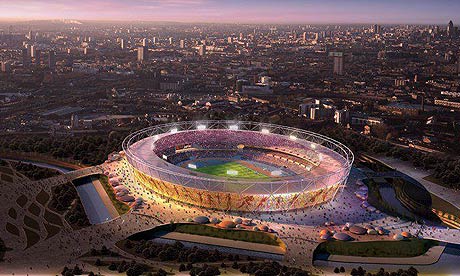 The visually underwhelming London Olympics stadium, designed by HOK Sport, might actually be broken down into its constituent parts once the 2012 Summer Games are over and shipped off to Chicago – where it will be partially reassembled.
Perhaps this act will open the door to a new choreography of reused, plug-and-play architectural structures, with fragments of existing buildings being FedEx’d around the world to fit one into the other in a delirium of improvised building space. Cathedral pods and office modules meet in a haze of stadium seating and hobby lobbies on the outskirts of San Francisco. New rooms are trucked in from somewhere east of Reno.
You buy part of the London stadium for yourself and build a treehouse with it.
Of course, does this also imply that there could be architectural stowaways? Crossing borders and exploring the complex fringes of territorial sovereignty by hiding out within pieces of mobile architecture – riding conference halls and classrooms throughout the circuits of global commerce… before stepping out, like a scene from an Alfred Hitchcock film, onto the tropical streets of Manila. You then jump into a nearby taxi and disappear.
The taxi is then shipped to New York.
Where surrealism meets the postal service. Or perhaps surrealism is a kind of postal service, with objects popping up where they are not supposed to be.
The Other Night Sky
Every once and a while there’s a flash in the sky, lasting roughly twenty seconds, and – provided you look into these things in advance – you can accurately predict when the flash is coming. It’s thus possible to be there when it happens.
You can point up at the sky for amazed friends, saying watch this – and a light appears, way up above you, beyond even where airplanes fly.
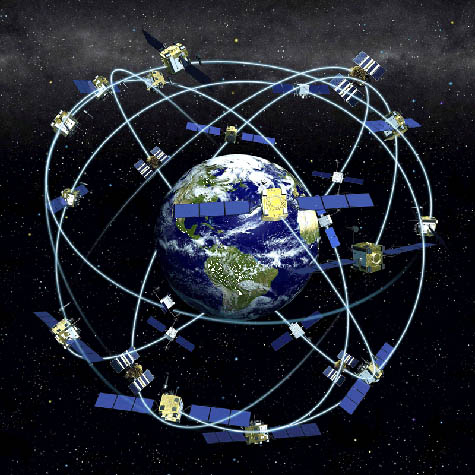 What’s passing overhead in this instance is something called the Iridium constellation, an artificial pattern made of 66 telecom satellites (there were supposed to be 77, which would have corresponded with the number of electrons in an atom of iridium).
The whole thing was sold less than a decade ago for a mere $25 million to private investors – after being launched and constructed, in the 1980s, at a price of nearly $6 billion.
 The company that initially sponsored the project went bankrupt in 1999 – raising the prospect, like something from Greek mythology as rewritten by Philip K. Dick, or perhaps something out of Arthur C. Clarke as rewritten by Homer, that our sky will someday be full of artificial constellations, their human creators having long since disappeared. Cold, dead objects, they’ll encircle the world in silence.
 Along these lines, a new exhibition of photographs by geographer Trevor Paglen opens here in the Bay Area next week, called The Other Night Sky. The Other Night Sky “looks to the night sky as a place of covert activity,” we read:
[W]orking with data compiled by amateur astronomers and hobbyist “satellite observers,” cross-referenced across many sources of information, [Paglen] tracks and presents what he calls “the other night sky.” Large-scale astro-photographs isolate barely perceptible traces of surveillance vessels amidst familiar star fields, and a digitally animated projection installation covers the globe with 189 currently orbiting satellites.
In other words, Paglen has been tracking surveillance satellites – false stars that would otherwise have blended in with astronomy.
It genuinely amazes me to think that, 45,000 years ago, groups of cognitively modern humans were wandering around Australia and the Middle East and Africa and South Asia, and they were looking up at and navigating themselves by recognizable patterns in the sky – but, now, we can just install our own stars there and guide ourselves by them, instead.
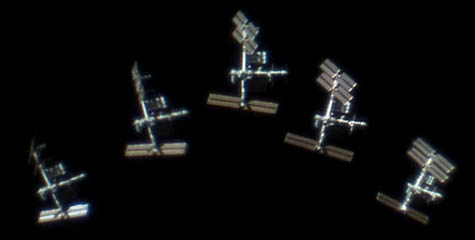 [Image: The International Space Station, from a series of photos by Dirk Ewers].
We are now partially building ourselves a new night sky – yet this surrogate astronomy is being put there simply so we can spy each other and make international phone calls.
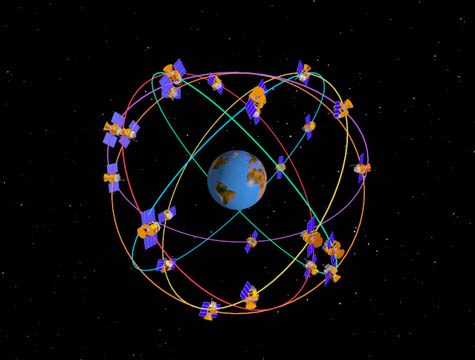 In some ways, I’m reminded of a line from Richard Kenney’s 1993 book of poetry The Invention of the Zero. At one point, Kenney writes: “Imagine, all new constellations!” as if it is some impossible, heroic act of celestial reinvention yet to occur in human history.
But the weird irony of life is that we’ve already done that – and we didn’t overthrow the astronomers, or plan a coup in the planetarium of human thought, we just launched some telecom satellites and bought a bunch of mobile phones, and now we have it: we have new constellations – what Kenney calls “unfamiliar skies” – flashing through the night at timed intervals.
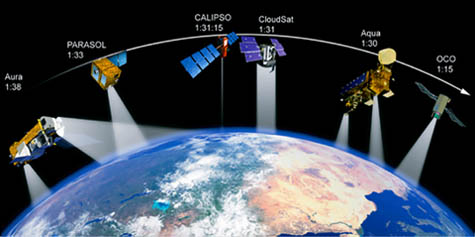 In any case, I’ve been tracking these constellations on a little Applet today – but there’s a certain sinister side to all of this, too. Space warfare, we read, is the militarization of the earth’s high atmosphere, weaponizing low-orbit space. You can thus strike anyplace on the earth within mere minutes of ordering an attack – including the infamous “rods from god,” which are non-explosive tungsten rods dropped from extremely high altitude:
These rods, which could be dropped on a target with as little as 15 minutes notice, would enter the Earth’s atmosphere at a speed of 36,000 feet per second – about as fast as a meteor. Upon impact, the rod would be capable of producing all the effects of an earth-penetrating nuclear weapon, without any of the radioactive fallout. This type of weapon relies on kinetic energy, rather than high-explosives, to generate destructive force.
All these coordinated astronomical stand-ins – patterned groups of satellites moving around the world – thus might also someday serve as malign horoscopes of impending war. To what zodiac would such military constellations correspond? What defensive measures might a person take when a strange metallic glint appears in the evening sky, a 20-second flash on the horizon?
 [Image: The Perseus Cluster, photographed by Jean-Charles Cuillandre & Giovanni Anselmi].
And what would we do if we found out that Orion, say, or the Southern Cross, was not a natural constellation at all, but something placed there, installed above us, in our imaginations, in our myths?
(Trevor Paglen’s The Other Night Sky, from which this post’s title was taken, opens June 1st at the Berkeley Art Museum).
Caverns in light
 [Images: An exploding star’s “light echo,” as captured by the Hubble Space Telescope back in 2002. View larger!].
“In January 2002,” NASA reported half a decade ago, “a dull star in an obscure constellation suddenly became 600,000 times more luminous than our Sun.” This “mysterious star” produced, in the process, a “light echo” that “uncovered remarkable new features” in that star’s astral architecture. “These details promise to provide astronomers with a CAT-scan-like probe of the three-dimensional structure of shells of dust surrounding an aging star.”
In the above sequence of images, then, you are looking at “continuously changing cross-sections of the dust envelope” – a visual effect compared by NASA to “a spelunker taking a flash picture of the walls of an undiscovered cavern,” where the “cavern” in question is an exploding sphere of light. A spectacular geology, indeed.
Imagine if the most beautiful thing in the universe only exists for a billionth of a second.
Imagine if no one sees it.