I’m enamored with this cutaway diagram, by Christopher Klein of National Geographic, depicting Egypt’s so-called “tunnel to nowhere.”
[Image: A cutaway of Seti’s tomb by Christopher Klein, courtesy of National Geographic].
In fact, it is a “mysterious tunnel that links the ancient tomb of Pharaoh Seti I to … nothing.”
After three years of hauling out rubble and artifacts via a railway-car system, the excavators have hit a wall, the team announced last week. It seems the ancient workers who created the steep tunnel under Egypt’s Valley of the Kings near Luxor abruptly stopped after cutting 572 feet (174 meters) into rock.
Christopher Klein’s image shows the complex in its full volumetric glory, a void hewn into the depths of the cliff face, “painstakingly chipped into high limestone cliffs above the Valley of the Kings.” Exploring its interior was a kind of reverse mining operation: these “recent excavations had to take new precautions, most notably bracing the tunnel roof with metal supports to prevent collapse, as in mines.”
That the sprawling tunnelwork would eventually lead—it seems—to nowhere was not a credible option at the start of these recent explorations: “The ancient Egyptians never built something without a plan,” we read back in 2008, “without an aim or a target to do this, so I think this tunnel will lead to something important.”
On the other hand, it’s an interesting additional detail that this particular pharaoh was called Seti.
Returning to Klein’s image, it would be amazing to see his take on, say, the entire New York subway system, its tunnels drilled through bedrock, or a cutaway diagram drawn by Klein, explaining the underground nuclear waste storage facilities at Yucca Mountain (or, for that matter, at Onkalo). Or, why not, a weird hybrid of all three: a pharaonic tomb crossed with a densely packed urban subway system that eventually leads, after thousands of loops and coils, to some throbbing subterranean underworld stacked with Dantean spirals of nuclear waste.
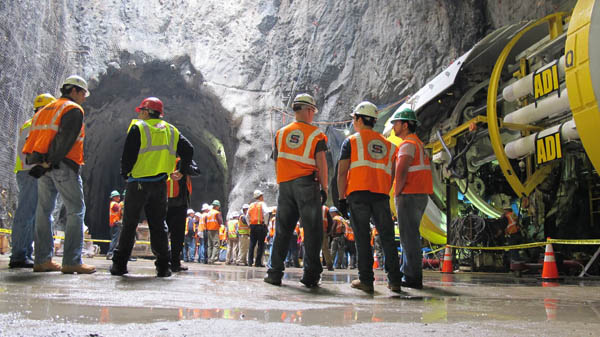
1) Have you been reading The Launch Box? “The purpose of this blog is to document activities in and around the 2nd Avenue Subway Tunnel Boring Machine Launch Box construction site between 91st and 95th streets in Manhattan.”
[Image: “This odd looking structure is part of the steel form that is being used to cast a concrete lining for the 72nd Street work shaft. This shaft, and the other one that’s just like it [at 69th Street], will be used during the construction of the 72nd Street station”; photo by The Launch Box].
As such, it features a pretty fascinating weekly catalog of the shifting surface structures found on-site—from plywood shacks to piles of tarps—as well as the actual subterranean work sites, including temporary elevators, off-duty digging equipment, and even rat infestations (“a Maginot Line of rat traps has been deployed along the east fence line of the work site”), associated with this massive urban engineering project. Start here, perhaps—but also don’t miss what The Launch Box calls “the official New York City rat map.”
3) Check out this book about Improvised Architecture in Amsterdam Industrial Squats and Collectives. “This web-book presents a visual-conceptual-experiential documentation of four occupied industrial sites in central Amsterdam, researched and recorded between 1990 and 1997 and between 2006 and 2008.”
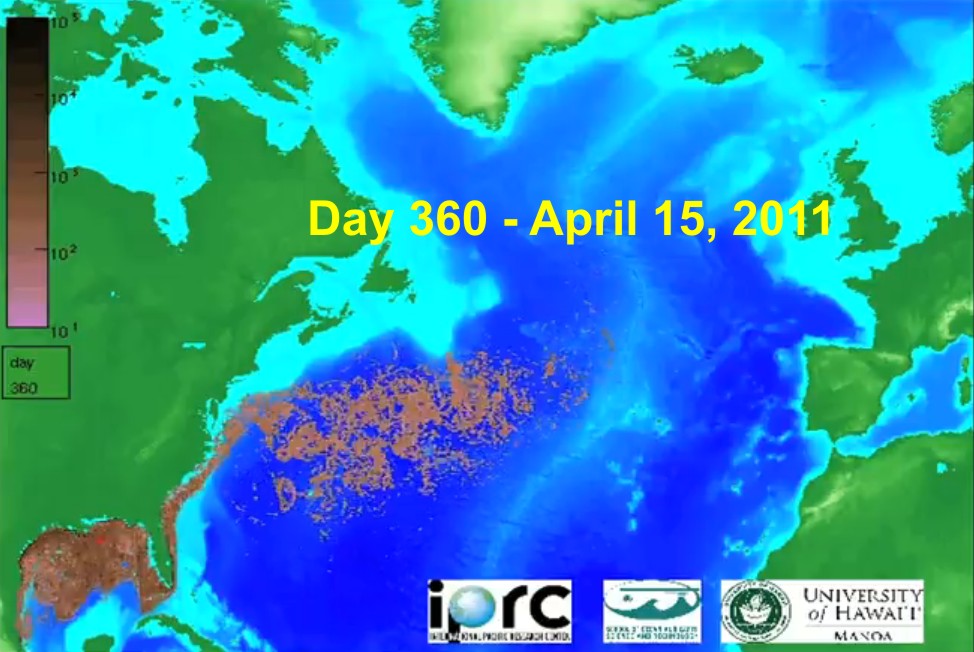
4) “There are more than 27,000 abandoned wells in the Gulf of Mexico, according to AP,” we read in the Guardian, “of which 600 belonged to BP.”
The oldest of the abandoned wells dates back to the late 1940s and the AP investigation highlights concerns about the way in which some of the wells have been plugged, especially the 3,500 neglected wells which are catalogued by the government as “temporarily abandoned.” The rules for shutting off temporarily closed wells is not as strict as for completely abandoned wells.
Further:
AP quoted state officials as estimating that tens of thousands are badly sealed, either because they pre-date strict regulation or because the operating companies violated rules. Texas alone has plugged more than 21,000 abandoned wells to control pollution, according to the state comptroller’s office. In state-controlled waters off the coast of California, many abandoned wells have had to be resealed. But in deeper federal waters, AP points out, there is very little investigation into the state of abandoned wells.
On a side note, this all reminds me of an architectural detail from H.P. Lovecraft’s scifi/horror story “The Shadow Out Of Time.” The story’s narrator discovers a massive abandoned city full of “never-opened trap-doors,” we read, “sealed down with metal bands and holding dim suggestions of some special peril.” He keeps returning to these doors, over and over again, as if obsessed by what they might be holding back—”those gigantic sealed trap-doors in the lowest level, around which such an aura of fear and forbiddenness clung,” “sealed trap-doors,” he says again, as if stuttering, constructed “for strategic use in fighting the elder things if ever they broke forth in unexpected places”—only here, in the Gulf of Mexico, it is a shapeless presence older than human history, an “elder thing” made of black liquid petroleum, leaking slowly into the subtropical waters of the planet. So will our “sealed trap-doors” hold over time? Generations from now, will ruptured fittings and broken “metal bands” release untold amounts of shapeless toxicity into the sea?
[Image: “A tapping machine used in tests to evaluate the ability of floor coverings to reduce the transmission of impact sound from one floor to another in multi-family dwellings,” courtesy of the National Research Council Canada].
Sabine von Fischer: The tapping machine, as it was first published in 1930 and as it was standardized in the 1960s, has five steel rods that hammer against the floor. The speed has changed a bit over time—and its speed is now standardized—but it just tramples on the floor. It’s a very basic machine.
The principle of the machine can be found in older apparatuses, such as those used in grinding food items, but this particular application was to simulate the sound of footsteps, furniture, and machines on the floors of multistorey buildings. In this form—with five hammers, which are electrically operated—it was first published in 1930, in the Journal of the Acoustical Society of America.
Everyone who has been working on building acoustics claims that, since 1923 or 1926, they’ve been doing similar tests on structure-borne sound, but almost all of those earlier tests were done with women in high-heeled shoes. High-heeled shoes make a very distinct sound… [T]he National Bureau of Standards, in the period between the wars, had ladies in high-heeled shoes walking around inside buildings.
8)GOOD reports on the UK’s Empty Shops Network: “For Dan Thompson, helping to get empty shops back into action has become a full-time job. The founder of the Empty Shops Network, Thompson says that the United Kingdom has seen a surge in pop-up shops, galleries, and community spaces that tap into a wider national mood: “There’s a DIY movement going on with more and more people setting up their own events… you get knitting groups setting up in pubs and cafes, [gardening] groups, people are really engaging with their local community. It’s a huge shift in the national culture.”
9) Doomsday economics. As the New York Times reports, “market forecaster and social theorist” Robert Prechter “is convinced that we have entered a market decline of staggering proportions—perhaps the biggest of the last 300 years.” Believing that a series of “repetitive patterns, or ‘fractals,’ in the stock market” will destabilize the global economic system, Prechter warns that “investors will be devastated in a crash much worse than the declines of 2008 and early 2009 or the worst years of the Great Depression or the Panic of 1873.”
The Dow, which now stands at 9,686.48, is likely to fall well below 1,000 over perhaps five or six years as a grand market cycle comes to an end, he said. That unraveling, combined with a depression and deflation, will make anyone holding cash “extremely grateful for their prudence.”
Indeed, Schechter compares the current state of the global stock market to the South Sea Bubble.
Extra Credit: “Disneyland, with its far-flung colonies in Florida, Japan and France as well as affiliated city-states such as EPCOT, is a key symbol of contemporary American culture… The Architecture of Reassurance: Designing the Disney Theme Parks follows the layout of the parks themselves—from berm to Main Street, and from hub to ‘lands’: Frontierland and Adventureland, playing on the relationship between humankind, myth, and nature; Fantasyland, with its imagery from the movies; and Tomorrowland, with its once optimistic visions of the future becoming sinister, playful and ironic.” Think of it as an architectural variation on Susan Willis’s Inside the Mouse: Work and Play at Disney World.
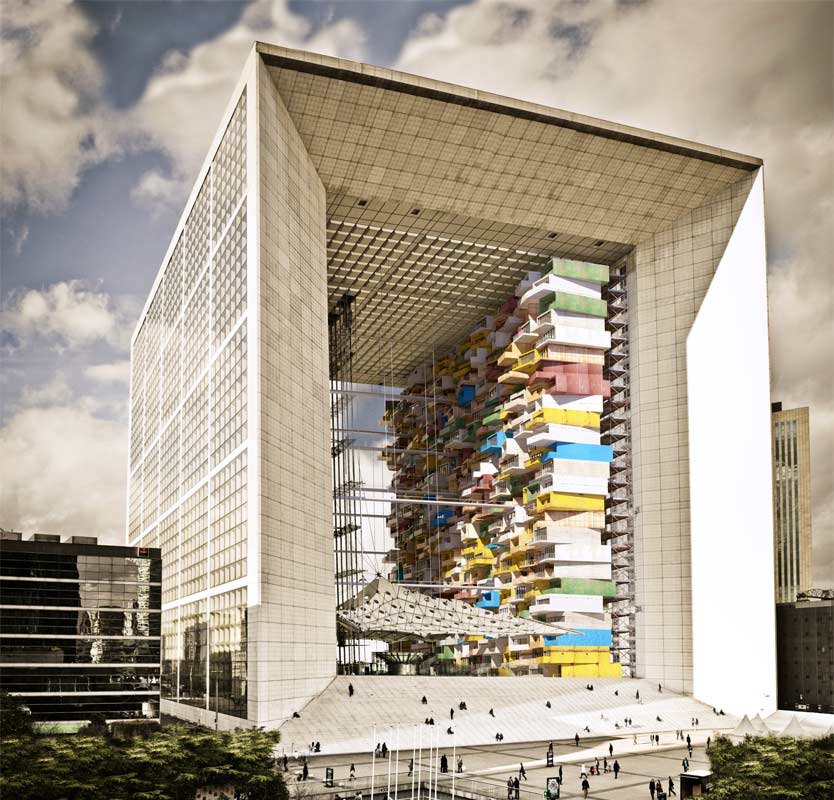
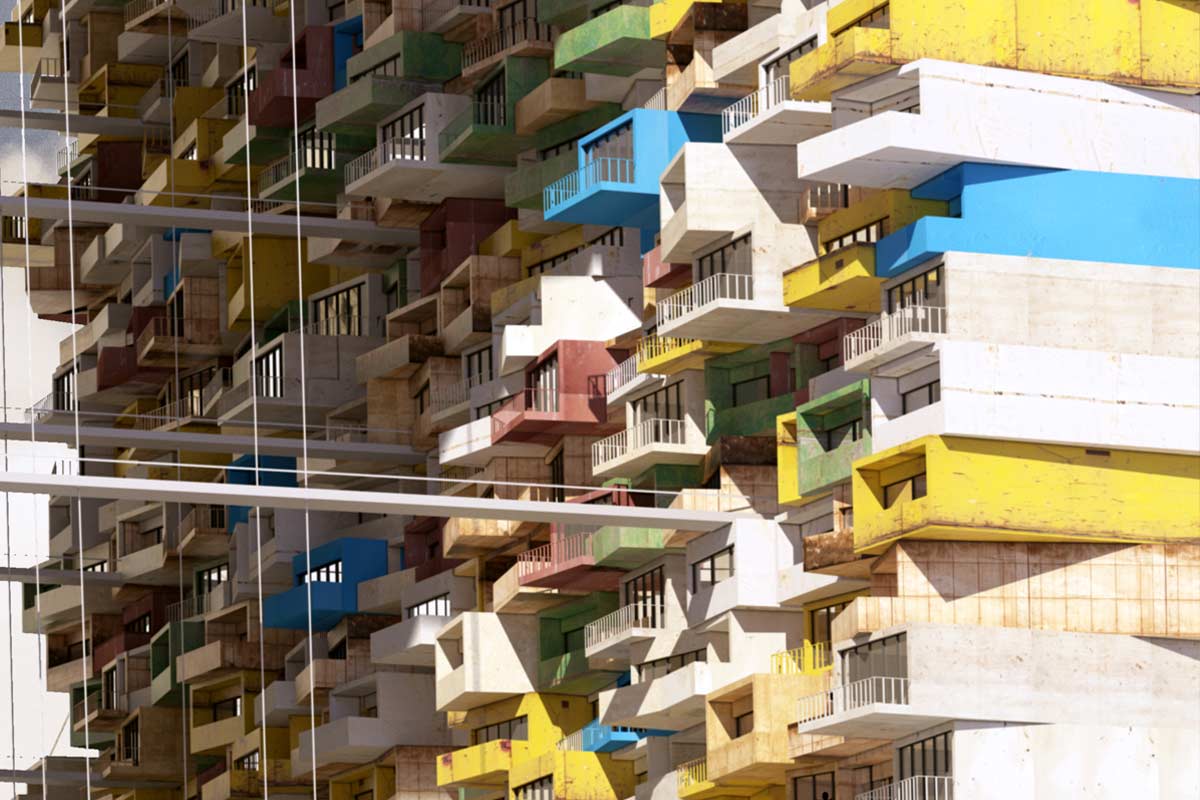
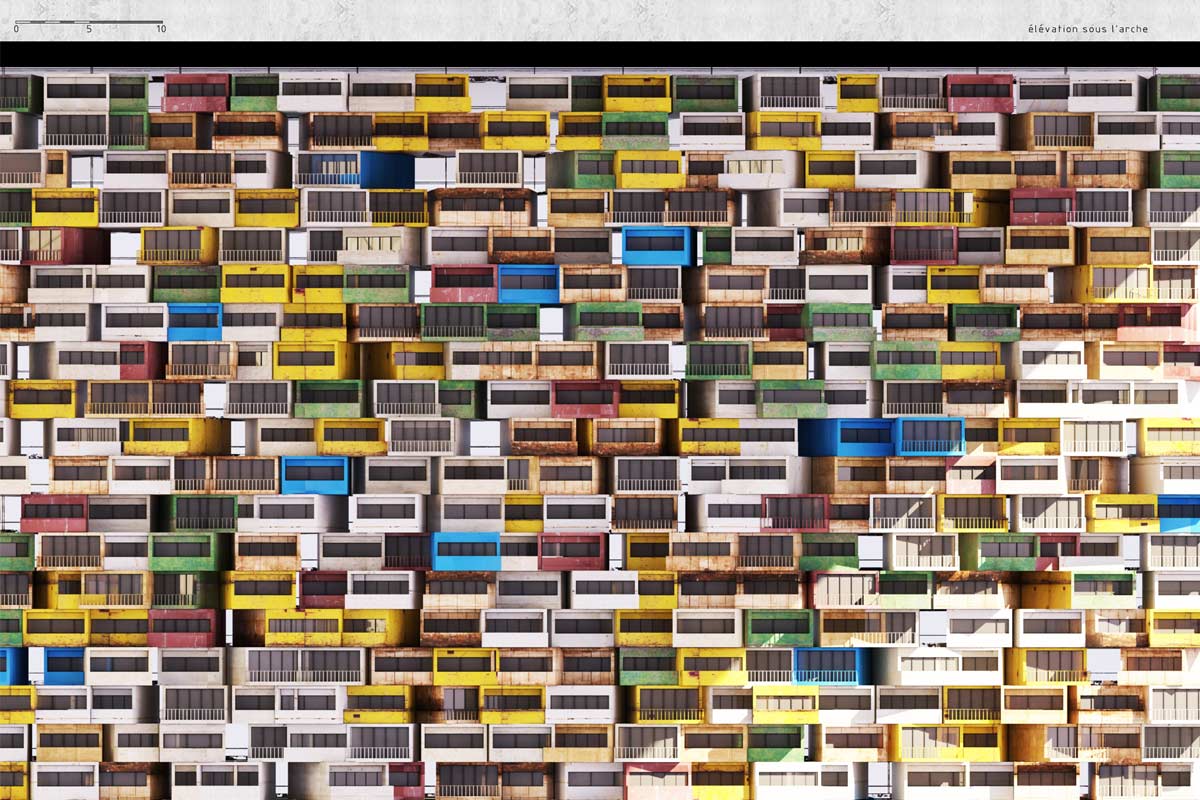
In the second of two projects by architect Stéphane Malka that I want to look at here, the Arche de la Défense in Paris has been transformed into a honeycomb of subsidiary spaces: encrusted with modules that have been attached to the inside of the existing building’s vast interior.
As writer and curator Maryse Quinton describes it, “this study imagines the hijacking of a building that is symbolic for its monumentality and its location: the Arche de la Défense.”
A pocket of active resistance installs itself within the building in the form of a modular complex offering an alternative and militant lifestyle. The project bears with it a permanent insurrection and unites all malcontents, whether refugees, stateless persons, dissidents, outcasts or utopians. Referring to the notion of concretion, its construction principle allows for expansion tailored to the effervescence of this spontaneous community. It bases itself on the existing fabric using walkways grafted on to the lifts and a system of scaffolding leaning against the rear facade. A guerrilla architecture project that aims to hijack the great arch of fraternity.
In a detail that seems slightly tongue-in-cheek to me, Malka estimates that each module would cost only 3,000 Euros—as if you, too, could simply purchase your own plot of permanent insurrection, without need for a long-term mortgage or loan. Which leads me to wonder if there might someday be an insurrection bubble, with derivatives traded exclusively by Goldman Sachs.
In any case, I really like this overhead view (below): the precarious spatial state of these revolutionary modules becomes readily apparent from above, as if this inspired reclaiming of urban space is really just one or two steps away from total collapse.
These units, of course, could also very easily be adapted to other buildings or sites, just as symbolic for their monumentality and location, as Quinton writes; in Malka’s hands, the images would be equally breathtaking.
From U.S. Federal Buildings to overseas military bases; from the Kremlin to the Great Wall of China; from Parliament Square to historic battlefields; even as a structural cousin to Raimund Abraham’s Church on the Berlin Wall—a project I hope to write about soon—where else could Malka’s modular counter-utopias be anchored and what political scenarios might result?
Malka writes that architecture now “means reclaiming territory in the marginalized areas of our cities, with projects that bear insurrection and civic mobilization,” thus “creating new potentials for collective use.”
This methodology seeks to promote public participation as an act of resistance against urban restrictions. It is a colonization of neglected public spaces by the participation of a non-specialized labor collective that elaborates on prefabricated and hijacked construction systems.
As this and Malka’s Galerie Bunker project indicate, parasite spaces—and the incredible idea of “hijacked construction systems”—are one surprisingly fast way to begin rebuilding the modern city.
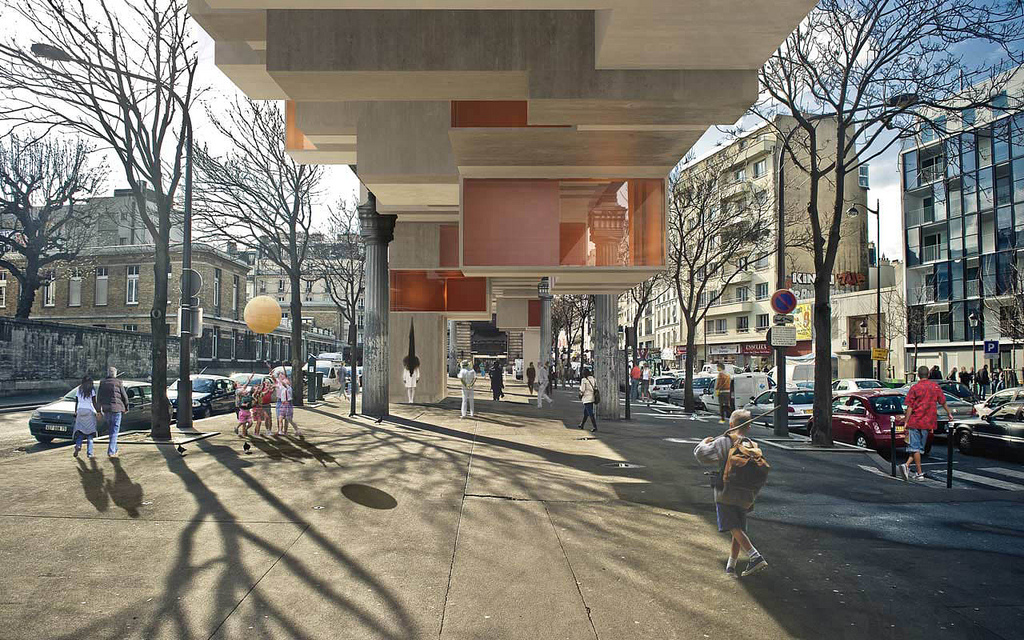
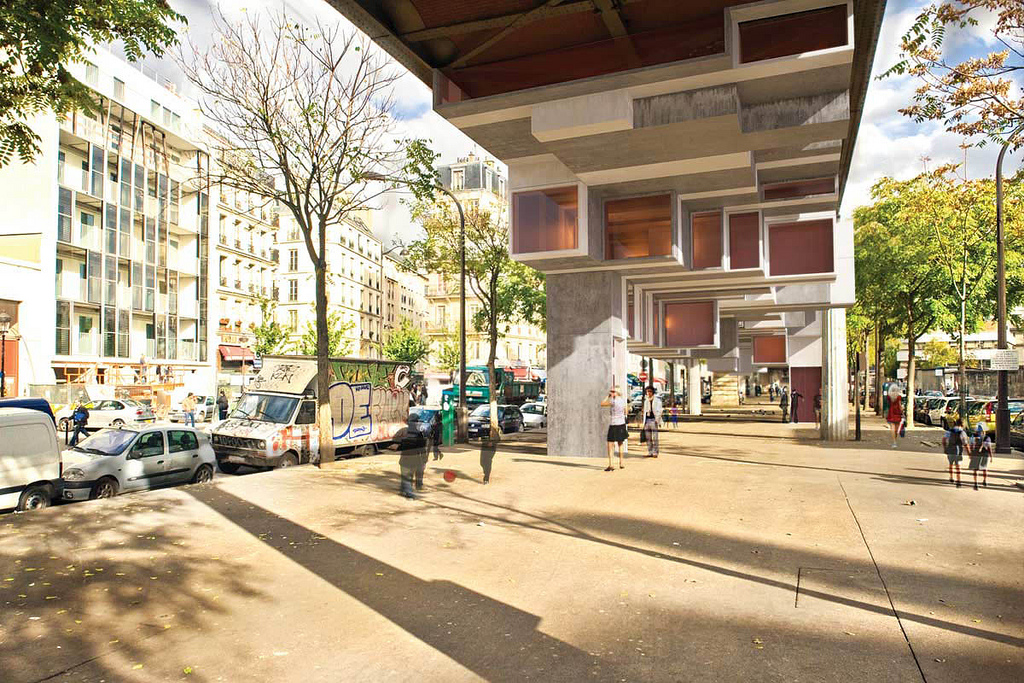
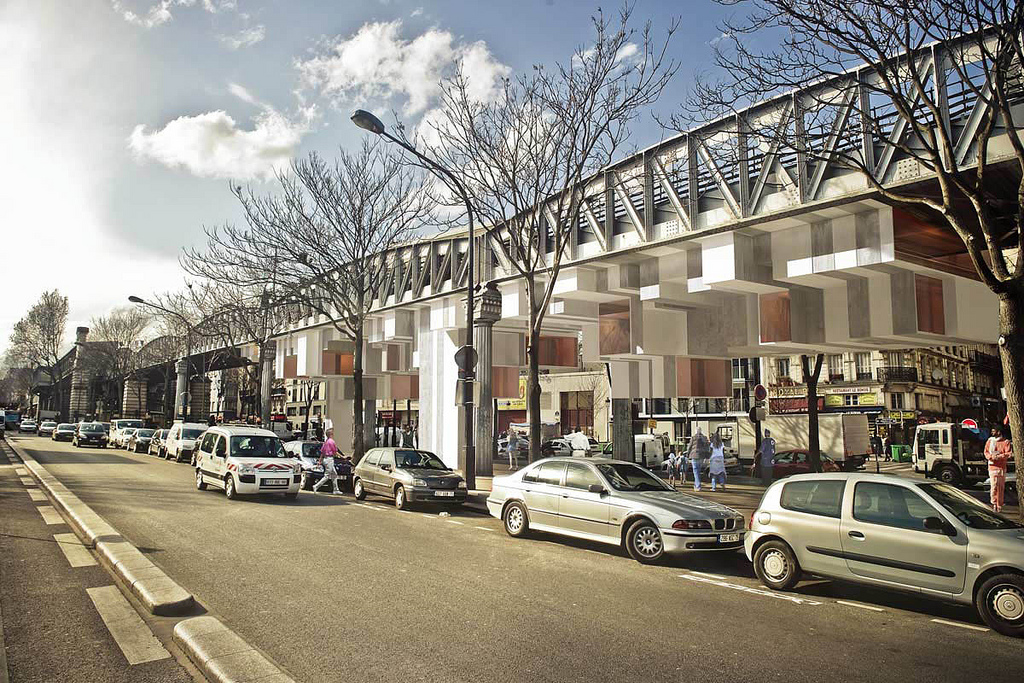
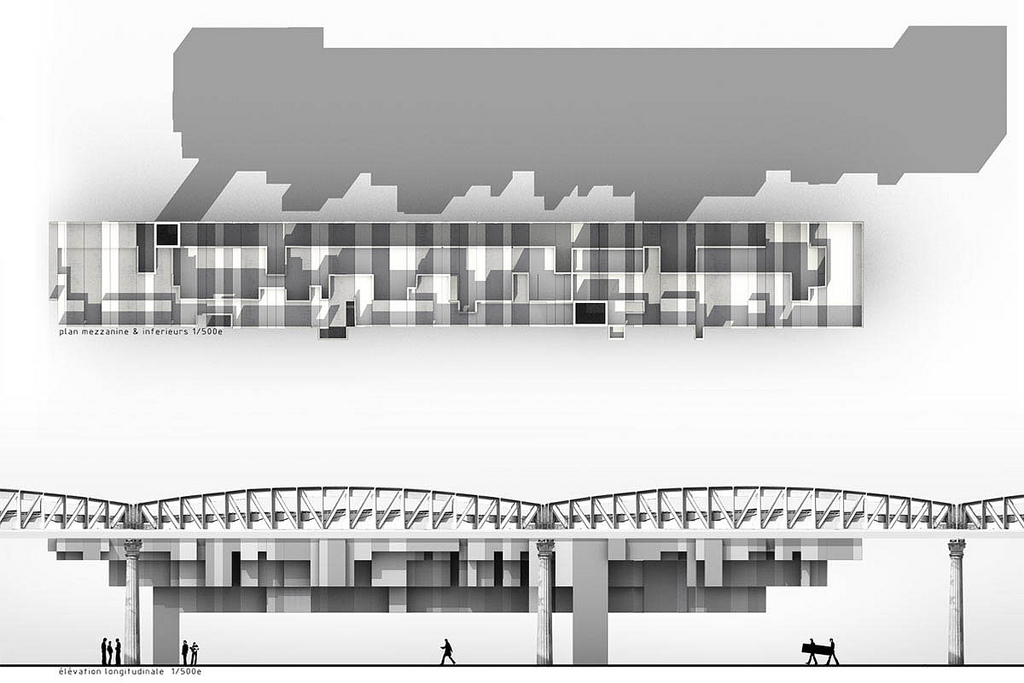
In the first of two proposals by Stéphane Malka that I want to post about here, we see what Malka calls “an alternative art gallery” installed like vertical parasites beneath the tracks of the Barbès–Rochechouart metro station in Paris.
An assemblage of powerfully simple rough precast concrete, the modules are attached to each other and secured to the beams of the viaduct. The alignment of different blocks creates spatial diversity while the unified whole protects the artwork and creates a strong interiority. Nevertheless, lateral openings introduce unexpected light from below as well as elevationally reframing views to the site.
He refers to the project as a “bunker,” or Galerie Bunker. “The gallery responds to the challenge of addressing neglected spaces,” he adds, “generating a singular place, a spontaneous cultural space divergent from the restrained exhibition spaces of Paris.”
Photographer Will Webster got in touch the other week with a large batch of photos taken behind the scenes of the “world’s largest tent,” designed by Norman Foster, which opened this week in Astana, Kazakhstan.
The Khan Shatyr, a 100,000 sq metre complex designed by Lord Foster, holds a city within a city, with shops and restaurants, cinemas, water park, botanical garden, mini-golf course, and a monorail. The aim of the tent is to provide escape to a people subjected to some of the harshest climes of Central Asia’s vast steppe. Temperatures in Astana, in northern Kazakhstan, regularly dip well below -30C in winter.
The “aim of the tent,” of course, is also to monumentalize the ego of Nursultan Nazarbayev, which the Guardian describes as “Kazakhstan’s increasingly autocratic president.”
But the building was assembled by everyday workers, amidst the mundane landscapes of this growing, purpose-built capital city, watched by Astana’s own residents.
Webster’s photos—a selection of which you see reproduced here—offer a welcome, unpolished, backstage view of the building as its construction approached an end.
Future fun rides sit patiently wrapped in plastic as men in mountaineering gear fix cabled meshes and high-tension wires high inside the volcanic space.
All told, the building cuts an unlikely profile in its only semi-urban context. At dusk, through Webster’s lens, it looks less like a structure parachuted in from the future, than the shell of an old expo whose excitement has long since faded.
[Image: A former torpedo-testing facility, now a £4 million private home; courtesy of Knight Frank].
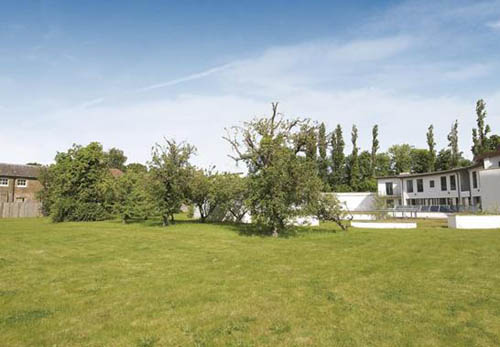
This £4 million property located in the suburbs southwest of London “must be one of the most unique spaces to have come to the market in recent local history,” estate agents Knight Frank justifiably claim.
[Images: Former torpedo-testing facility in the London suburbs; courtesy of Knight Frank].
After all, it is “a former torpedo testing tank, set within the wonderful Royal Park of Bushy, close to Hampton Court, converted into an amazing house.”
Standing within walled private gardens of 1.3 acres and extending to approximately 10,133 sq ft (940 sq m) this curved property offers not only a great and unique space but the potential to create a very special property indeed… The site was used by the Admiralty during the Second World War and was a circular domed building containing a 46m pool used to test torpedoes as they spun around at the end of a metal arm. After the war, the architects Norman and Dawbarn were commissioned to turn the tank into a modern house. They utilised the 4ft thick “blast proof” curved concrete walls in a very contemporary style using an abundance of glass and aluminium beneath a copper roof to create a very light and open space. There is huge scope to further improve the property and make use of large subterranean areas to provide a fabulous leisure facility.
Being able to say—without lying—that your house has the form it does because, long ago, “torpedoes as they spun around at the end of a metal arm” outlined its foundational geometry would be awesome, indeed.
[Image: The kitchen of a former torpedo-testing facility; courtesy of Knight Frank].
And while £4 million seems a bit steep, if you can still test torpedoes in the basement—while boiling you and your mysterious Eastern European paramour a pot of strozzapreti in the roomy kitchen up above—then it’s probably worth every cent.
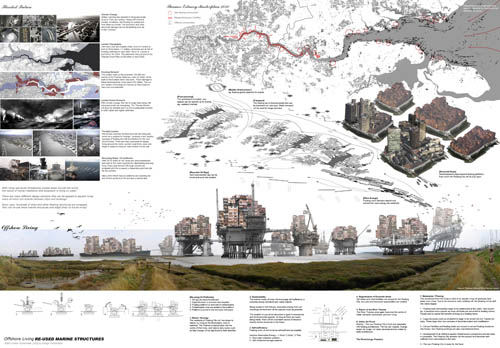
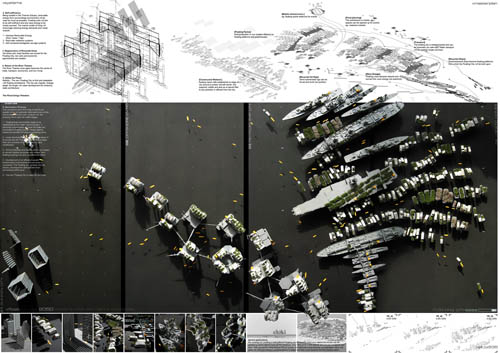
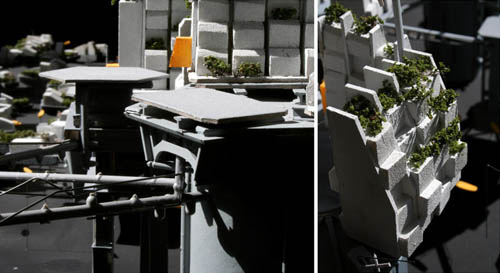
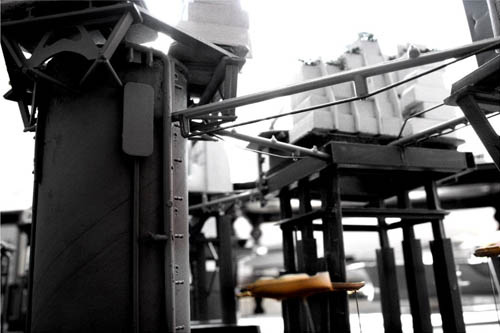
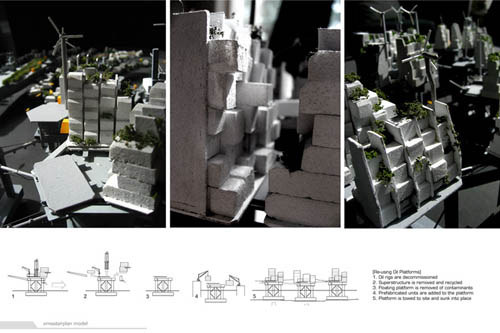
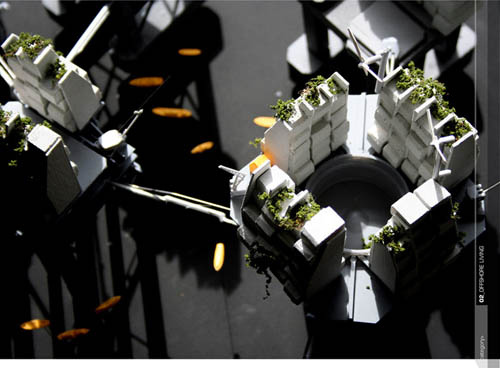
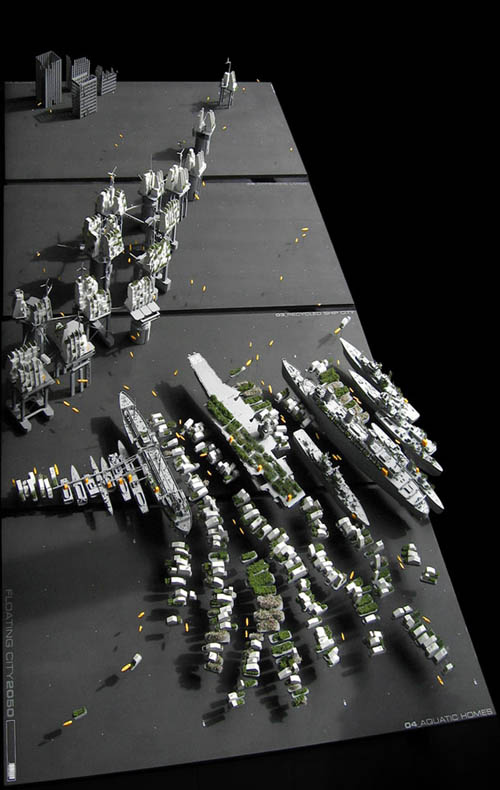
Continuing with a look at some noteworthy student projects—which kicked off this week with thesis work by Taylor Medlin—we now look at a proposal by Anthony Lau, submitted back in 2008 at the Bartlett School of Architecture in London. For that project, Lau designed a “floating city” for the Thames Estuary, ca. 2030 A.D. This “Thames Estuary Aquatic Urbanism,” as Lau refers to it, “gives new life to decommissioned ships and oil platforms by converting them into hybrid homes adapted for aquatic living.”
While the idea of offshore architecture has been relatively depleted of its novelty over the last few years, the presentation and imaginative extent of Lau’s idea is of sufficiently high quality to deserve wider exposure and a longer look.
“Most modern floating architecture involves new-build modular systems for mass production,” Lau writes. “Although this may be the most efficient for space planning, it often lacks character.” His alternative:
The multitude of hull shapes and sizes can inspire unique and inventive design. The proposal aims to express the beautiful forms and internal steel structures of hulls. The hulls serve as nautical reminders of the ship’s past and our previous closeness to water, which we will now embrace once again.
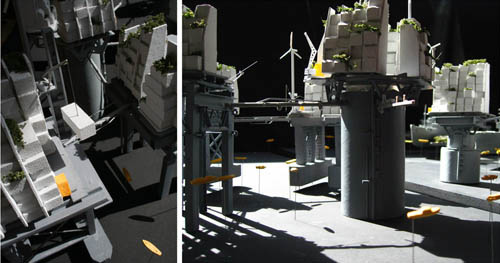
The level of detail in Lau’s resulting models is astonishing; bridged superblocks of partially rebuilt oil platforms rise from the wetlands, amidst floating gardens and forest barges, like scenes from a maritime-industrial Avalon.
You can see larger versions of these images (some of which have been cropped down and recombined to fit the vertical nature of this post, which means that you will see different groupings at this link) here.
As Lau writes: “By utilising the flooded landscape, a floating city of offshore communities, mobile infrastructure and aquatic transport will allow the city to reconfigure through fluid urban planning. Wave, tidal and wind energy will be ideal for this offshore city and the inhabitants will live alongside the natural cycles of nature and the rhythms of the river and tides.”
He adds that “this strategy for creating a self sufficient floating city by reusing ships and marine structures can also be applied to island nations such as the Maldives. Over 80% of its 1,200 islands are around 1 m above sea level. With sea levels rising around 0.9 cm a year, the Maldives could become uninhabitable within 100 years. Its 360,000 citizens would be forced to adapt and they could become the first floating nation.”
Looking to a 100 year horizon of climate change predictions, we will address how the urban, built environment needs to react now. Conservative estimates predict sea-levels to continue ro rise as the oceans warm and the ice caps melt. Coupled with isostatic rebound (the South sinking relative to the North) the effects grow ever more dramatic for large centers of population on the coast. Predicted weather patterns show increased rainfall intesity, leading to sever problems of surface water flooding in built up areas.
The ensuing paper explores the architectural implications of three different hydrological strategies: retreating from the coast, defending what we’ve built there, and attacking the incoming waters with aggressive engineering.
Interestingly, meanwhile, one of Lau’s initiatives since graduating from the Bartlett is to form a company focusing on urban bicycle infrastructure, specifically the Cyclehoop, “an award-winning design that converts existing street furniture into secure bicycle parking.” It’s also quite colorful. But perhaps a Boathoop is in the works for residents of his future Floating City…
For substantially larger project images, click here.
(Follow Lau’s Cyclehoop project on Twitter: @cyclehoop).
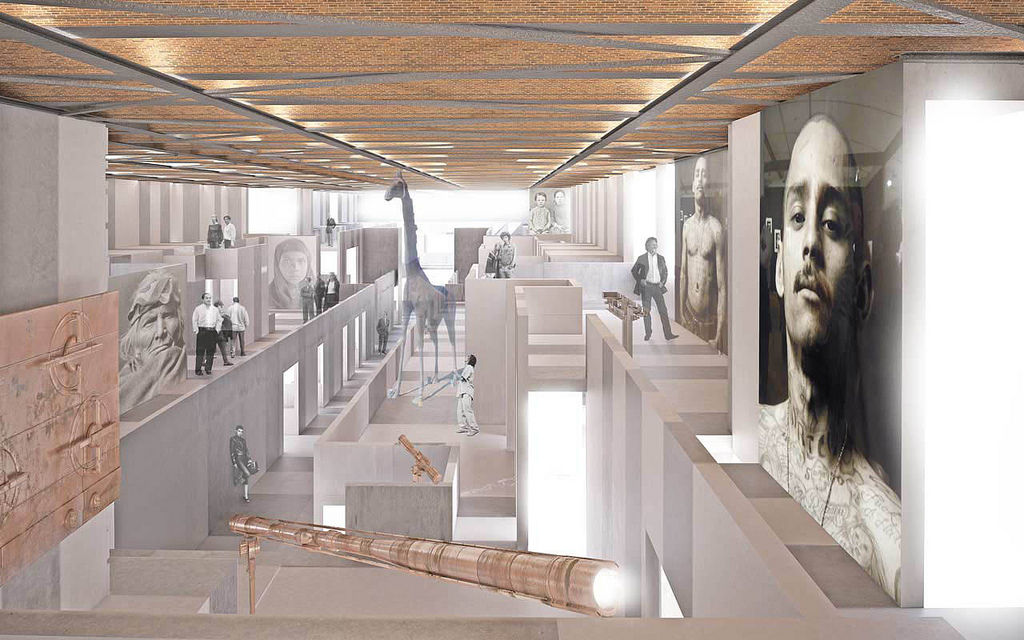
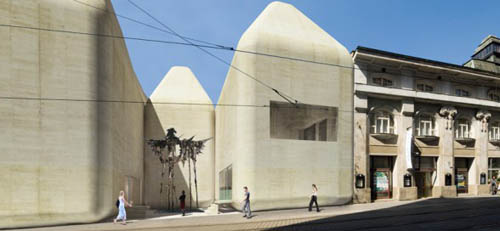
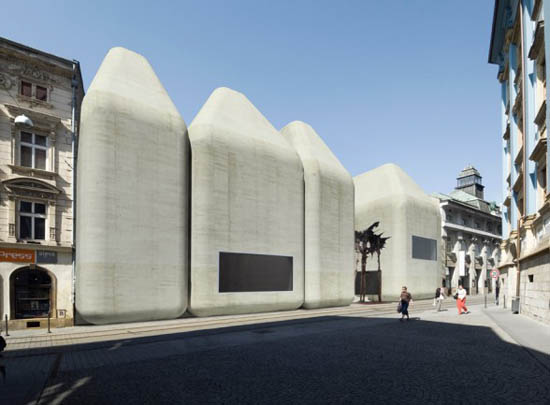
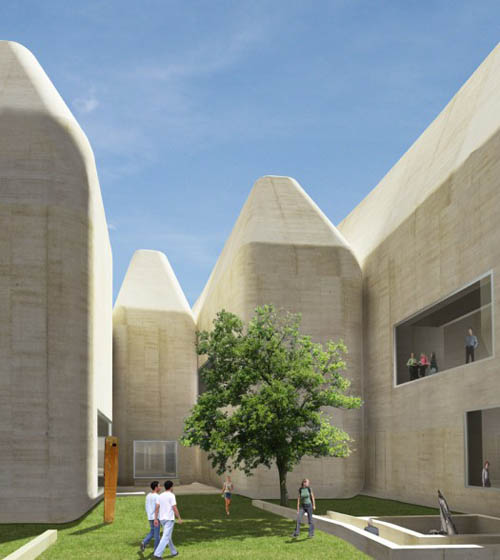
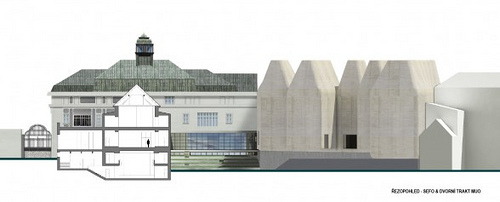
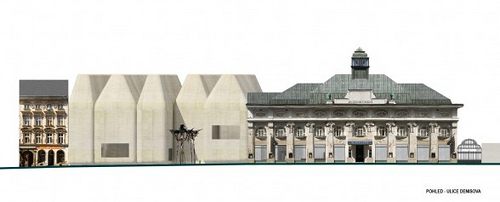
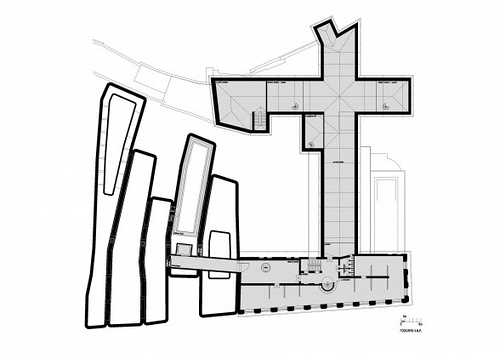
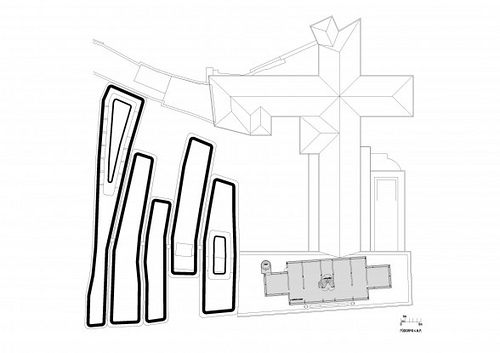
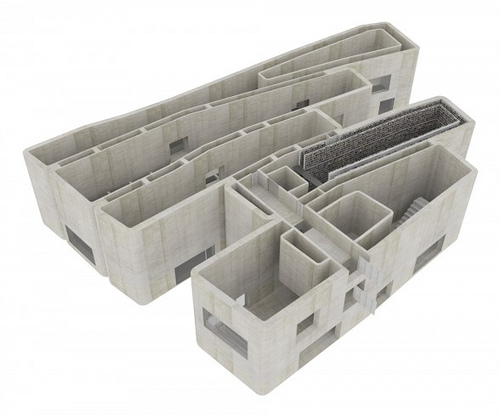
I’m a fan of this strangely megalithic museum and cultural center made from a series of concrete shells, colored white with crushed marble, proposed for the Czech city of Olomouc.
According to the designers, Šépka Architekti, the project “attempts to draw inspiration from both… a small scale of mediaeval subdivision of land on the one hand and the large scale of palaces, ecclesiastical and military buildings of the Předhradí beginning here on the other.”
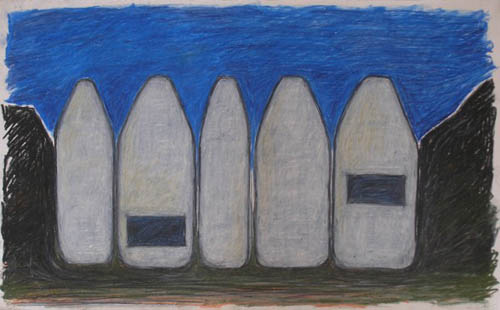
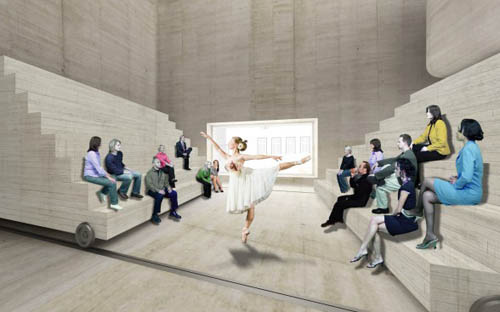
The museum is divided into five apparently separate but linked buildings; this is due to “the necessary separation of the individual functions of the exhibition halls, library, entry hall or bookshop and refreshments,” a “necessary separation” that also generates a convenient spatial identity for the overall project.
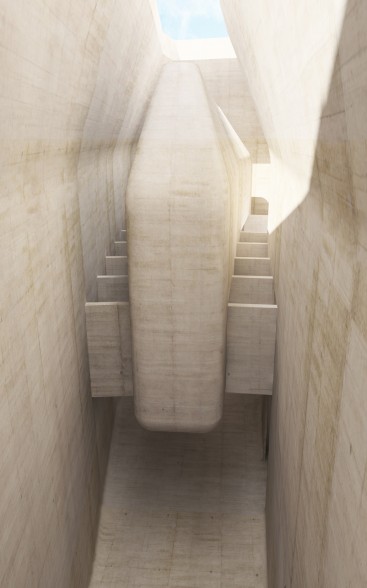
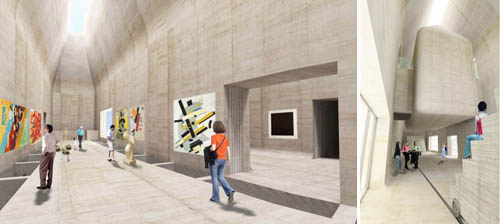
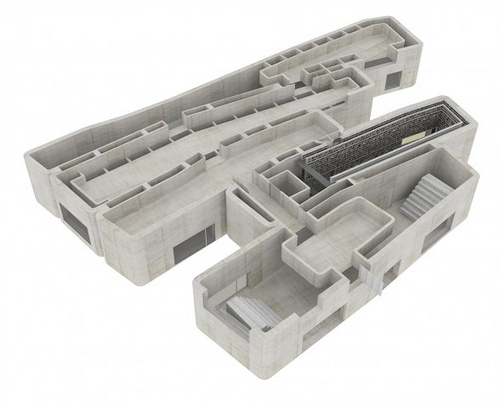
One of the coolest things about the design, though, is what Šépka Architekti call their “house in a house” idea, inspired by access to indirect sunlight: “Even in the cases when an upper floor is inserted in an individual building, daylight is ensured on the lower floor through placement of a smaller structure. We thus approach the topic of a ‘house in a house’, which ensures favourable conditions for the the display of exhibits on the walls while providing light from above on both floors.”
You can see the formal implications of this in the below image, where a massive, seemingly hovering trapezoid acts both as another, elevated room for gallery use and as a massive, light-filtering device for the skylights further above.
It’s a mass that casts shadows inside the building.
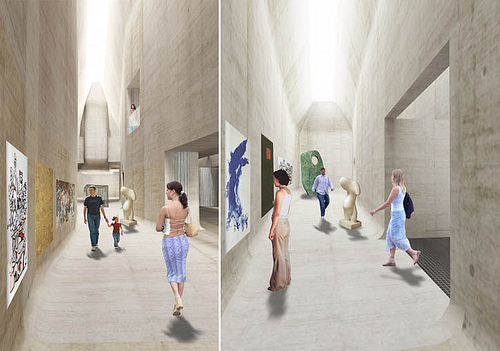
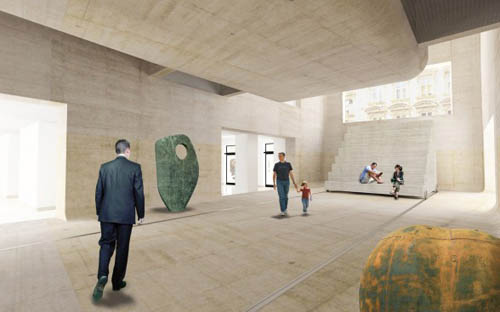
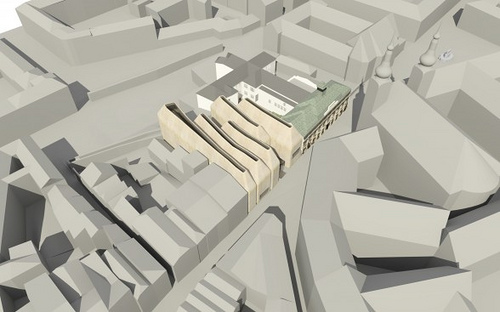
Provided the exterior concrete ages well, the museum’s fivefold street presence—briefly stepping back at one point to form a public plaza—is actually pretty stunning. It manages to allude to design languages as diverse as Neo-Brutalism, the Romanesque, a kind of Tatooine Moderne, and computer harddrive casings (although I’m reminded of Owen Hatherley’s recent quip about “a modernised classicism, monumental yet free in details, that usually gets subsumed under the meaningless retrospective coinage ‘art deco'”—here, we might say, “modern geometries, imposing in size, built from concrete, and thus subsumed under the meaningless retrospective coinage ‘Neo-Brutalism'”).
The results are quite beautiful in profile, even when simply rising up behind the walls of neighboring buildings.
In any case, the interior volumes also lend themselves well to defining an overall spatial experience, even while departing from one another just enough to keep each bay or gallery distinct.
As mentioned earlier, that interior is a mix of art galleries, a library, a bookshop/cafe, performance spaces, and, oddly enough, as if Photoshopped in simply to prove a point, a basketball court. Note that the stadium seating visible in many of these images has been mounted on rails for ease of rearrangement.
In plan, it’s interesting to remember that the separate units of the building here were generated from what Šépka Architekti referred to as the “small scale of mediaeval subdivision of land.” In other words, the buildings take their formal cue—at least abstractly—from ancient real estate divisions on the ground in Olomouc, not from some overzealous application of the architects’ own stylized form of site analysis.
Further, the “small scale of mediaeval subdivision of land” that I’ve mentioned three times now also means that what could very easily be an imposing, alien monolith made from smooth white concrete, stuck irresponsibly in the center of the city, actually manages to be appropriate in scale.
The building hasn’t been constructed, of course, and we have no real idea how the concrete will age; but I was struck by the images from the instant I saw them, flipping through a back issue of a10 yesterday afternoon.
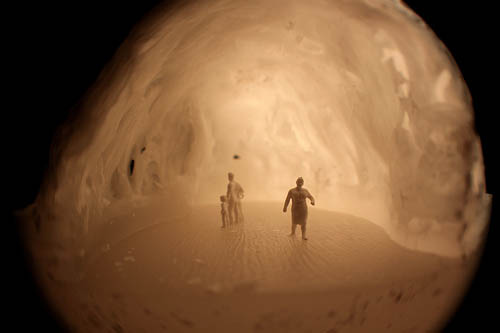
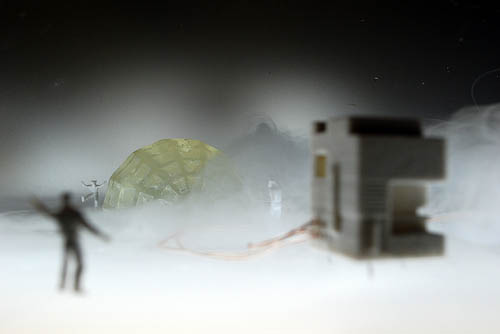
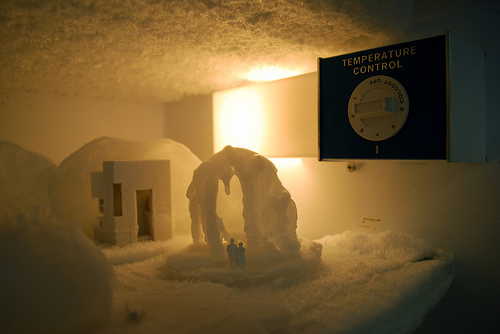
For a stunningly realized thesis project submitted last month at the University of California, Berkeley, Taylor Medlin focused on what he called “Towards a New Antarchitecture.” Presented through a combination of miniature wax models and sculpted ice, the project aimed to show how new, more sustainable construction techniques could be developed for the continent of Antarctica.
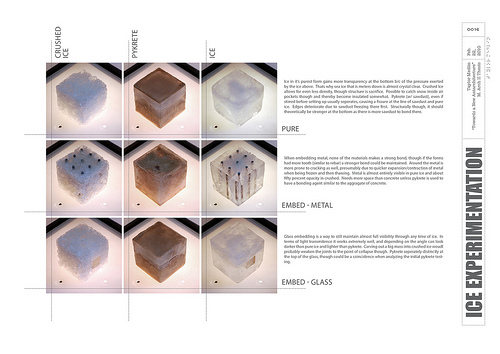
The only slightly tongue-in-cheek project involved everything from Pykrete—sawdust-reinforced ice once proposed as a genuine alternative to steel in constructing warships—to semi-metalized igloos and ice curtain walls threaded with cylinders of glass.
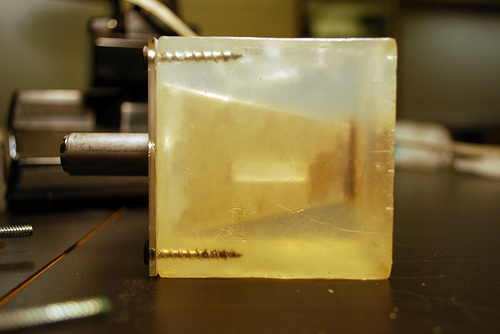
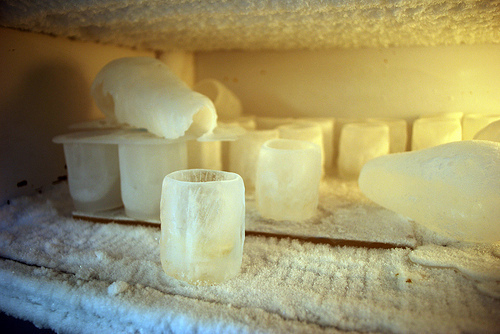
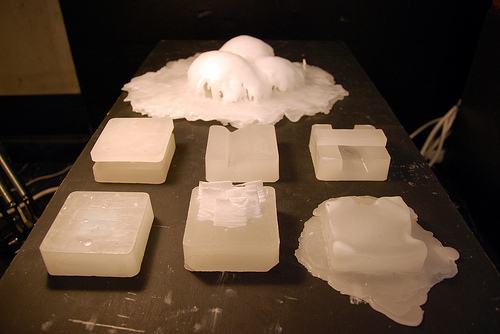
Medlin even created sample ice blocks in a university freezer in order to test a number of these emerging material possibilities. He called this “Ice Experimentation.”
Antarctica, the most recently explored large land mass in the world, is also currently one of the most unsustainable place on the earth when viewed through the lens of construction techniques. There are over sixty research stations from thirty different countries already built on the continent, all of which are completely constructed out of materials foreign to Antarctica, necessitating huge logistical resources to set up and maintain life there. Though some stations have begun to experiment with energy collection techniques, most remain completely dependent on diesel generators consuming fossil fuels brought from the mainland.
Is it possible to develop construction techniques that take into consideration the materials already present in Antarctica as building blocks for design? And furthermore, what are the possibilities for energy production and conservation that have not yet been explored?
Through the design of a methodology of construction relating to ongoing research stations in Antarctica, I wish to show the plausibility and environmental advantages of designing research stations through the utilization of ice as a principal construction material.
Buildings made of ice as a sustainable alternative to projects like Halley VI is a compelling—if perhaps not altogether realistic—idea. Strengthening the ice they’d be made from, using a diverse series of additives—not unlike the “cake mix” mentioned in an earlier post—not only makes it more interesting but materially testable.
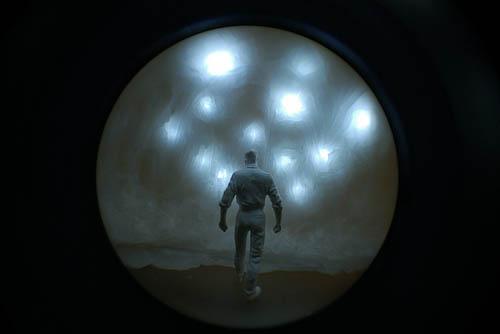
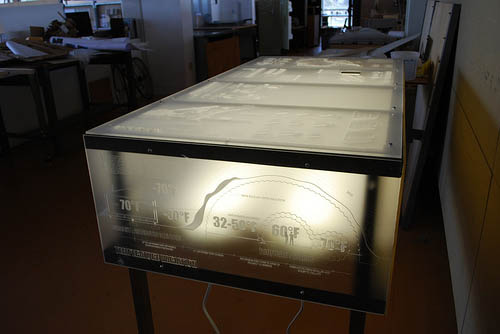
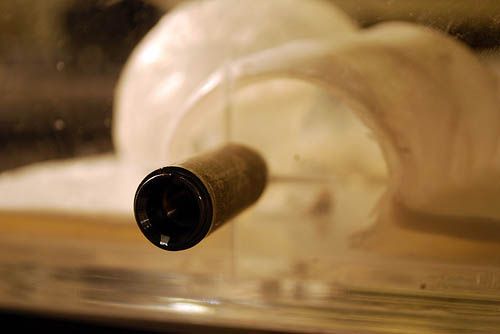
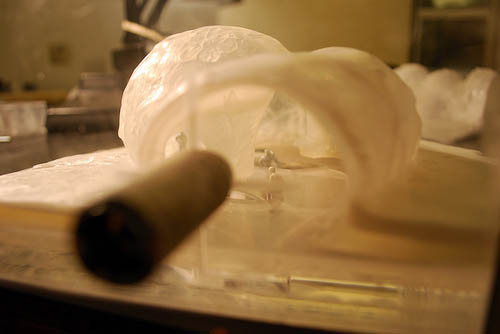
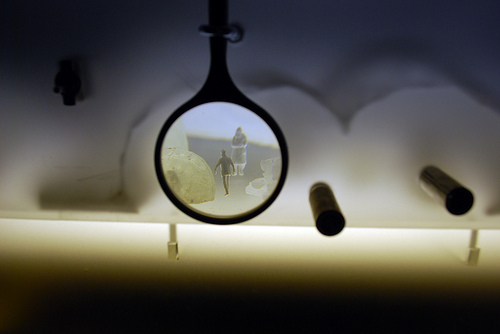
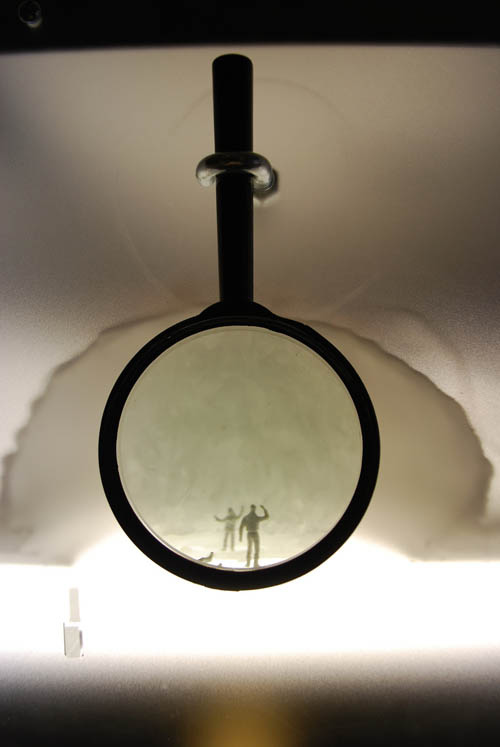
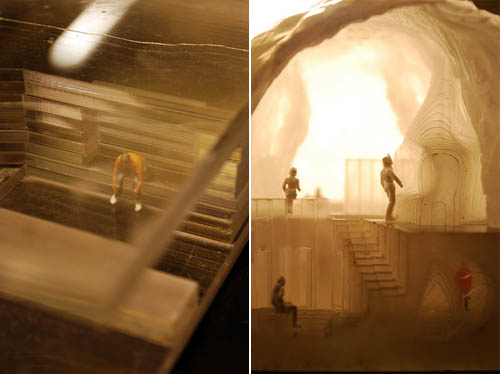
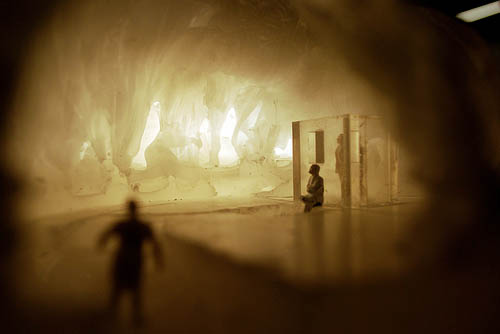
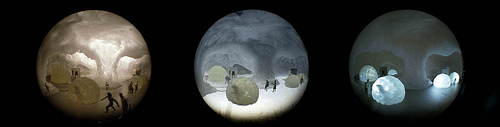
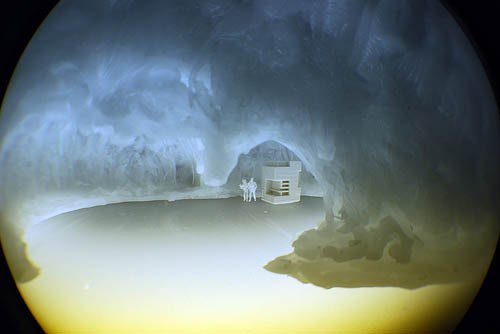
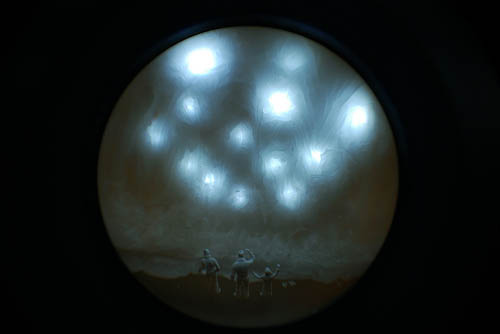
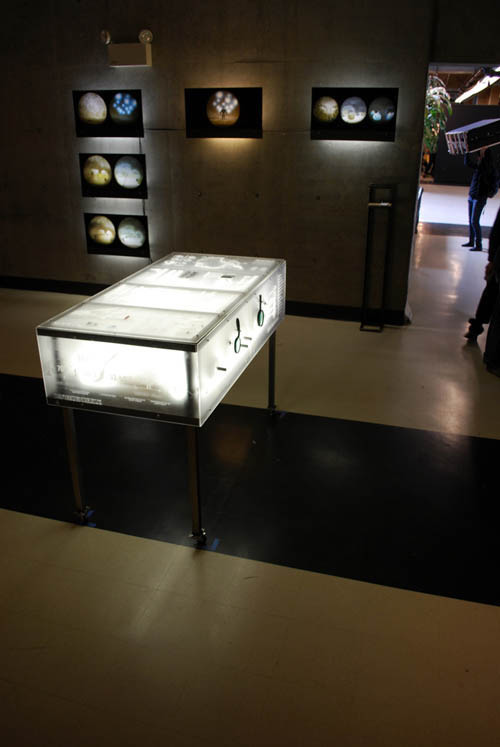
Medlin’s execution of the final project cabinet is jaw-dropping. Wax models, fisheye lenses, frozen ice maquettes, human figurines, and laser-etched descriptive text, all often lit from within, result in one of the most beautiful student presentations I’ve seen in a long time.
Here are some photos, taken by Medlin, starting off with the miniature wax rooms into which his lenses were embedded—reverse-periscopes looking down into a frozen world:
As objects, these are extraordinary; the design potential for portable lensed microcosms is something well worth exploring in other projects elsewhere.
But Medlin offered other ways of seeing into his final project. I think this is genius: in realizing that the fisheye lens approach would not work for everything he’d built, Medlin simply attached magnifying glasses to the exterior of the cabinet. You could thus look through them into a world, one expanding before your very eyes, stocked with people living infra-glacially in an imaginary Antarctic metropolis.
Finally, the ice structures inside of which Medlin’s Antarctic researchers—or future sovereign residents—might live ranged from cuboid huts to geodesic ice domes:
Medlin’s behind-the-scenes process documentation is also worth a look; we see him experimenting with battery-powered light sources, hot glue guns, freezer racks, and more. Again, here are some images showing the final display cabinet being assembled.
It’s worth clicking through the project Flickr page to see many more angles on the work, as well as several whole pages’ worth of preparatory images, including templates for the descriptive text that was laser-etched onto the outside of the cabinet.
However, it is also worth taking a spin through Medlin’s sketchbook. Extensively detailed in 149 separate scanned pages, it is a treat in its own right. From cave dwellings in both Italy and Turkey to MacchuPicchu, Australian Aboriginal stilt houses, and a bizarre glimpse of tree-borne “baby graves,” those sketches collectively form a pretty awesome record of Medlin’s recent globetrotting adventures (all of which were funded by a John K. Branner Fellowship, which Medlin’s fellow student Nick Sowers, often mentioned here, also deservedly received).
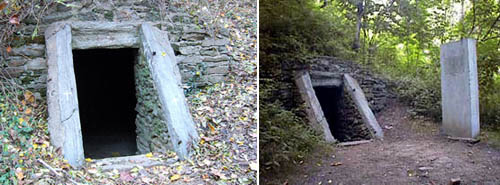
One of many things I hope to do next weekend while visiting family outside Philadelphia is take a trip to the so-called “Cave of Kelpius,” an artificially enlarged “cave,” complete with stone doorframe, on the banks of the Wissahickon.
There, in the humidity and quiet of what is now Fairmount Park, “Philadelphia’s first mystical guru came to meditate and await the Second Coming.” He was called Johannes Kelpius, “and his followers arrived in newly-founded Philadelphia from Germany in 1694 and chose the wild and beautiful Wissahickon as the best place to await the millennium.”
Wikipedia adds that “this belief, based on an elaborate interpretation of a passage from the biblical Book of Revelation, anticipated the advent of a heavenly kingdom somewhere in the wilderness during that year. Kelpius felt that the seventeenth-century Province of Pennsylvania, given its reputation for religious toleration at the edge of a barely settled wilderness, was the best place to be.” That the heavily vegetated old valleys and hills outside Philadelphia were, at that time, wild enough to be seen as the possible site for an unnamed “heavenly kingdom” in the woods is not, in fact, all that surprising to anyone who has walked around on a particularly humid August evening, through the massive trees and rocky pathways of the region.
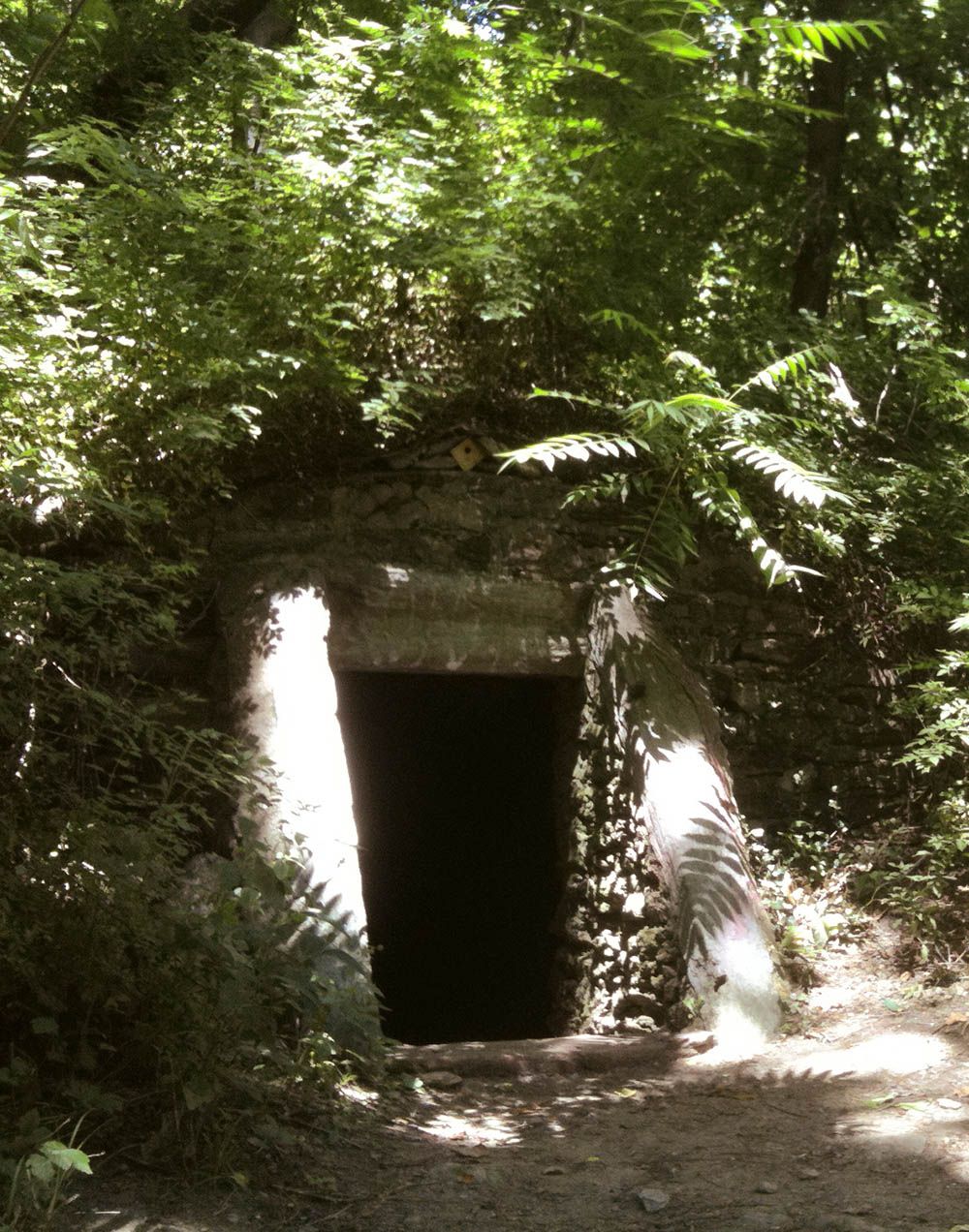
Oddly enough, though, this subterranean meditation chamber for a 17th-century doomsday cult—a kind of RosicrucianNORAD in an era of breeches and buckled shoes—appears to be only a few hundred yards from the running paths on which my cross-country team practiced in high school. Yet it was something I had never heard of till a few weeks ago—probably because it’s more likely a former springhouse, and not the Waco-like cave of a mystical group at all.
[Image: The Cave of Kelpius, photographed by BLDGBLOG after this post was written].
Nonetheless, a quick visit to the Cave of Kelpius—now in the absurd position of being ringed with suburbs—is in the cards.
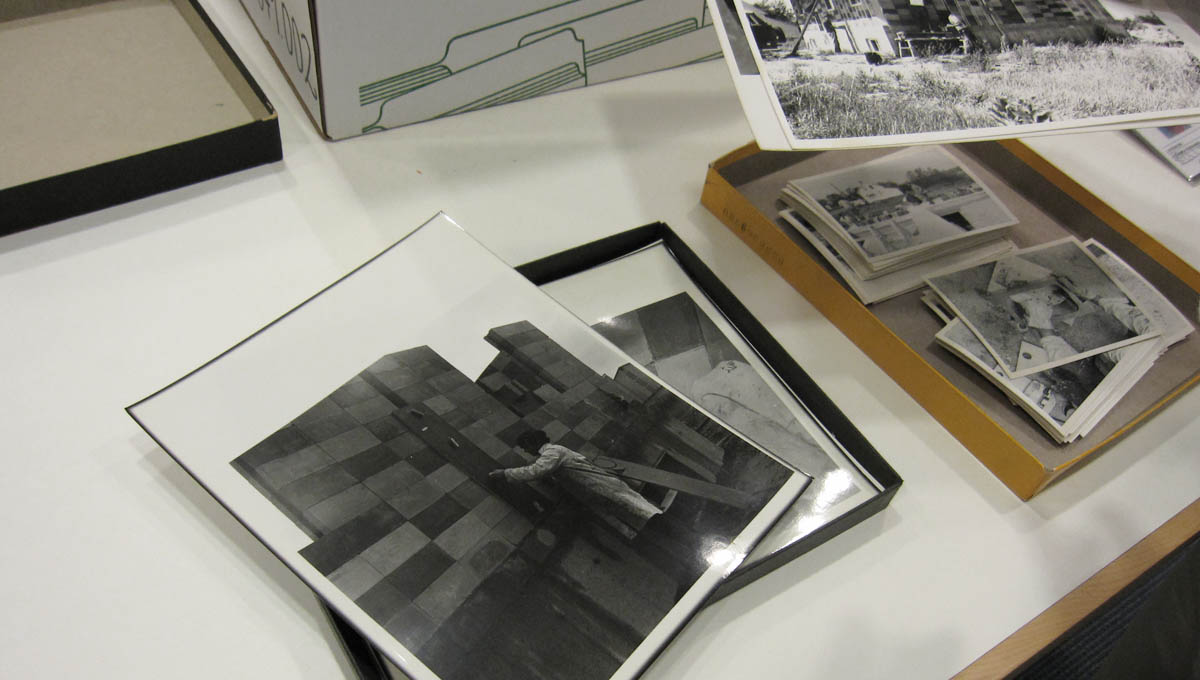
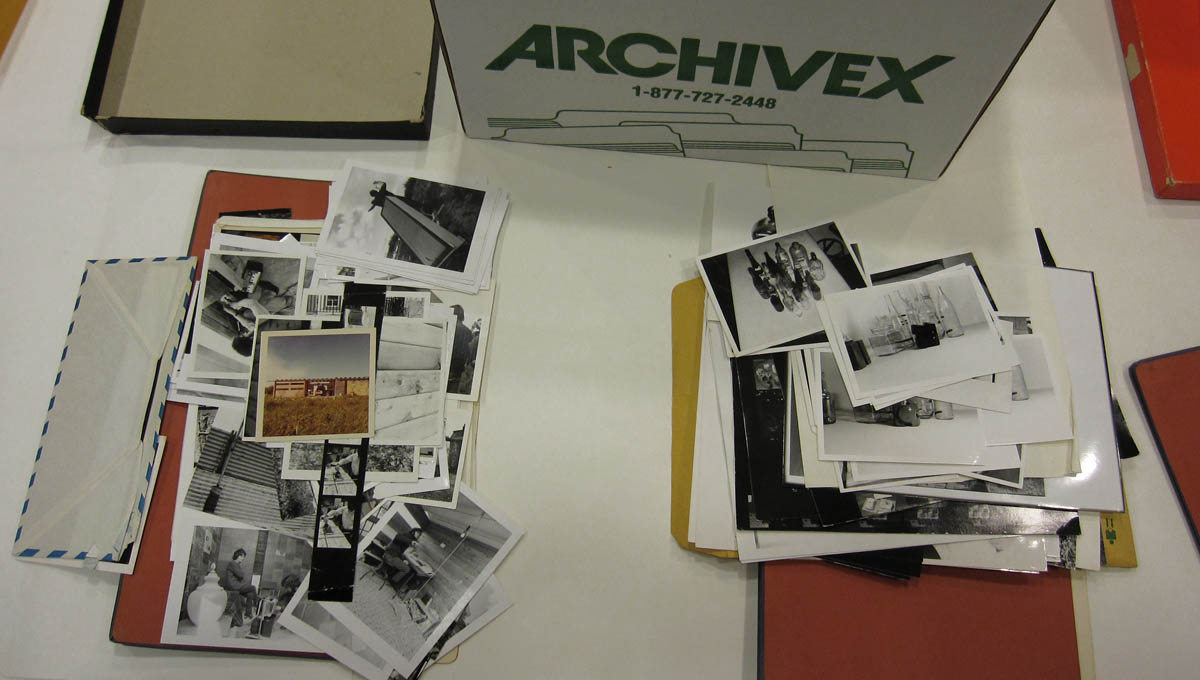
I had the pleasure last week of being introduced to the archives of Vikram Bhatt here at the Canadian Centre for Architecture, going through a mass of new material that is still in the process of being accessioned and catalogued.
Most of the files, artifacts, and documentary images found in this recently acquired subcollection are related to Bhatt’s work with the Minimum Cost Housing Group (MCHG) at McGill University. The MCHG—founded by Alvaro Ortega, Witold Rybczynski, Samir Ayad, Wajid Ali, and Arthur Acheson—describes itself as “an educational and research program with an international orientation that focuses attention on the human settlement problems of poor nations.”
Bhatt’s current work—and, now, the focus of the MCHG—is urban agriculture. There is, for instance, a program called Making the Edible Campus, winner of a 2008 National Urban Design Award. The awarding jury explained their decision as follows:
With simple, direct layouts [Making the Campus Edible] aims to employ underused corners and spaces within the public realm to grow produce linked to a food collection and meal delivery system, creating a sustainable prototype that could potentially be expanded to other university campuses and across the city.
This program is accompanied by Bhatt’s Making the Edible Landscape initiative, “a three-year collaborative project [that] aims to demostrate the value of including urban agriculture as a permanent feature in city planning and housing design.” The related “Edible Landscape Tools” catalog, featuring graduate student work produced in the winter of 2005, “gives a simple set of instructions on the basics of integrating urban agriculture into and around the home, and throughout the community. Areas explored include street furniture as planters, water reclamation, basic site planning and composting.” Or, as we read elsewhere: “The act of growing in cities exists and has existed for millennia for various reasons, including food security. Our goal is to formalize its existence and to establish it permanently as an urban feature.”
With the help of CCA assistant curator Pierre Édouard Latouche, I was able to see a voluminous quantity of archival material related to Bhatt’s earlier experiments with alternative building technologies. These included sulphur bricks of his research group’s own invention.
Sulphur is one of many chemical byproducts from, among other things, oil refining, and it is produced in such enormous quantities now that there is actually a sulphur glut. Is there a way, Bhatt asked, to reuse waste sulphur as a building material, reducing its unpleasant odor and strengthening its structural properties?
A series of chemical experiments, using baking trays, different concrete mixes—which Latouche referred to as “cake mix”—and large kilns resulted in a functional prototype. Sulphur concrete, as it is known, is produced through “a very simple process and the use of energy is low,” The Ecology of Building Materials explains. “Sulphur blocks are even waterproof as long as there are not many fibers in the mix.”
For some reason the interest in this material disappeared after a very prolific period of use near the end of the nineteenth century, and the idea was first taken up again about 20 years ago by the Minimum Housing Group [sic] at McGill University in Canada, which has built a number of houses in sulphur concrete.
Bhatt’s group later discovered that these new sulphur bricks were also capable of being infused with full-color images transferred directly from the newspapers or other documents in which they had been wrapped.
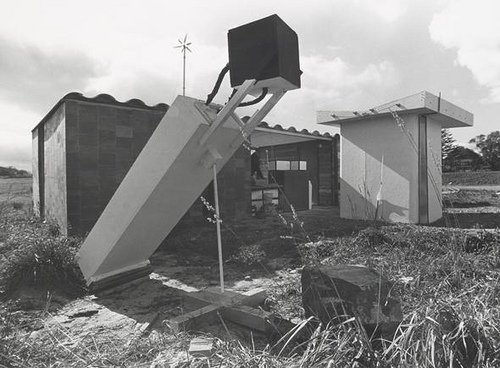
What you see in the above photo, as well as in the photograph at the head of this post, is an image that has transferred from a newspaper or magazine onto one of Bhatt’s sulphur bricks. This, too, then became a focus of experimentation for the group, leading to houses that had been pre-wallpapered, so to speak, with images taken directly from print media and chemically fused with the brickwork. The graphic possibilities of this sort of image-transfer technology seem well worth exploring in more detail.
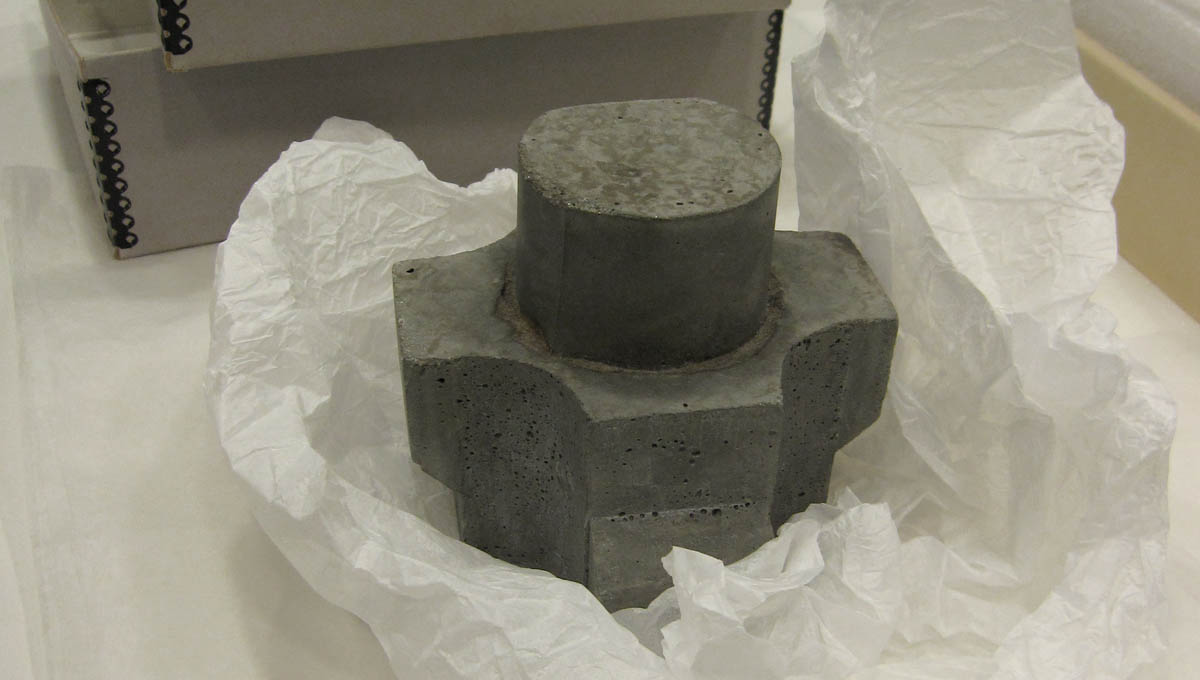
However, the bricks could also be “baked” into any mold a designer made for it, resulting in unique shapes, sizes, and formats—including the jack-like form you see above and in the left-hand side of the opening image. Buildings could be assembled like puzzle pieces, bright with baked-in imagery, produced from a deodorized industrial waste product available in huge quantities almost anywhere in the world.
For instance, the Ecol House project, constructed at McGill, “was built from modular components, often the result of innovative ideas and approaches based on simple techniques introduced and tested by the group,” we read in the catalog for Sorry, Out of Gas, an earlier exhibition at the CCA. “The walls were built, in part, of sulphur concrete blocks made by a method suited to small-scale production.” This was at least part of the reason that McGill’s Minimum Cost Housing Group became “an international point of reference for energy conservation, use of unusual materials, and experimental construction techniques” in the 1970s.
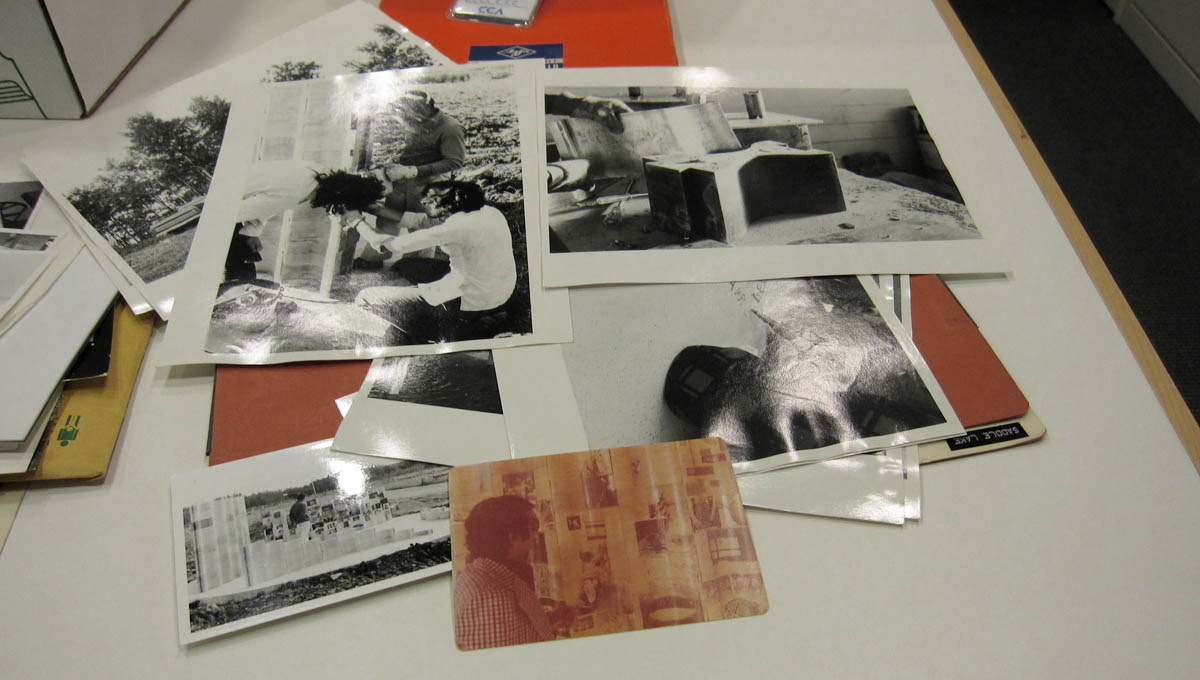
At one point, even Buckminster Fuller visited Bhatt’s labs; you can see Fuller in the image, below, talking to Bhatt in one of the black-and-white prints near the center.
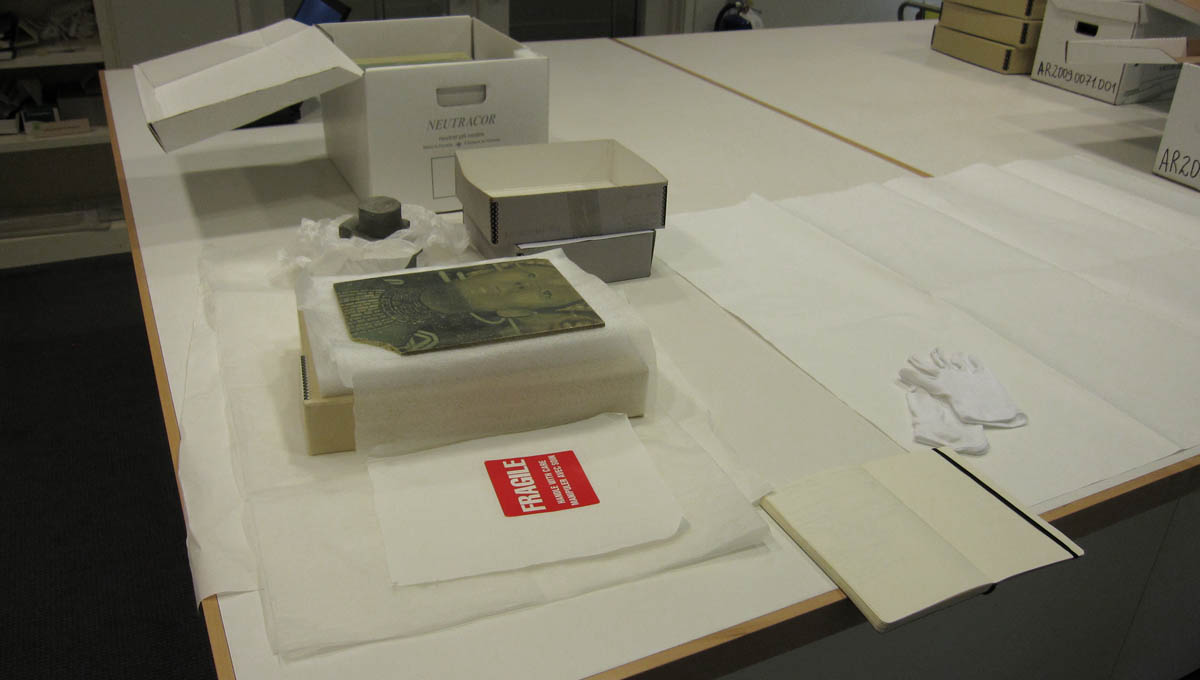
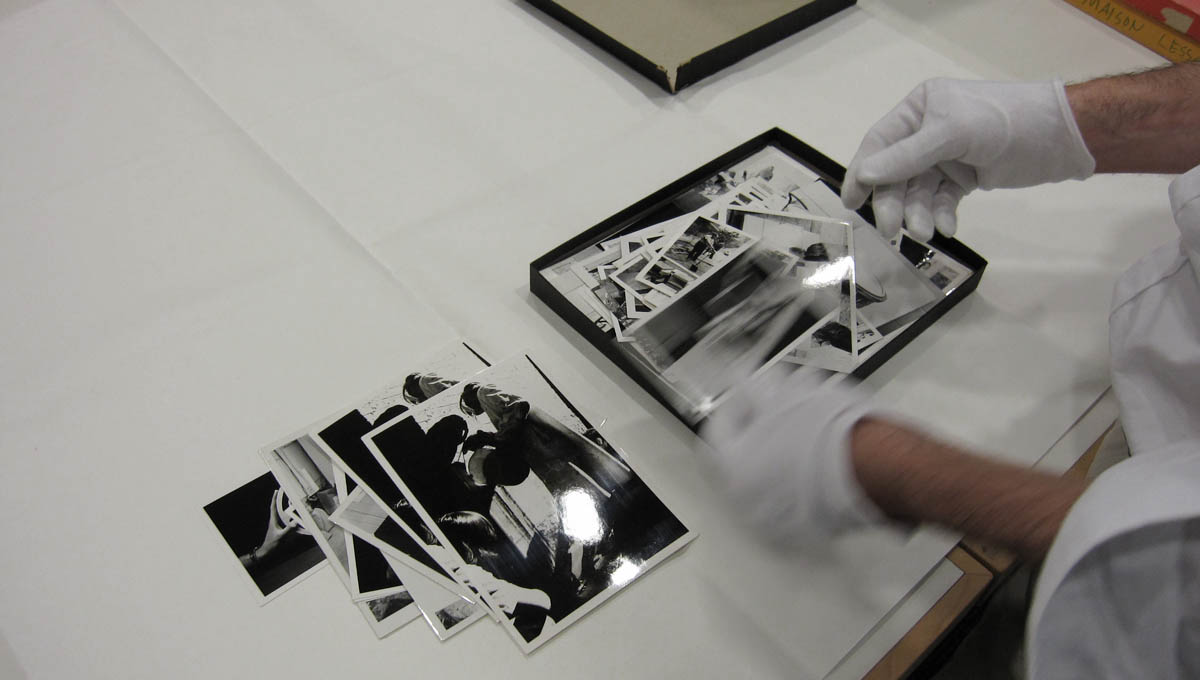
The boxes and boxes of materials, of which you can barely see the beginning here, is an amazing—and seemingly totally unexplored—resource, one that deserves a return visit. I will see what I can do to get deeper into this over the summer, with more images and more information, both, including, I hope, a Q&A with Bhatt himself.
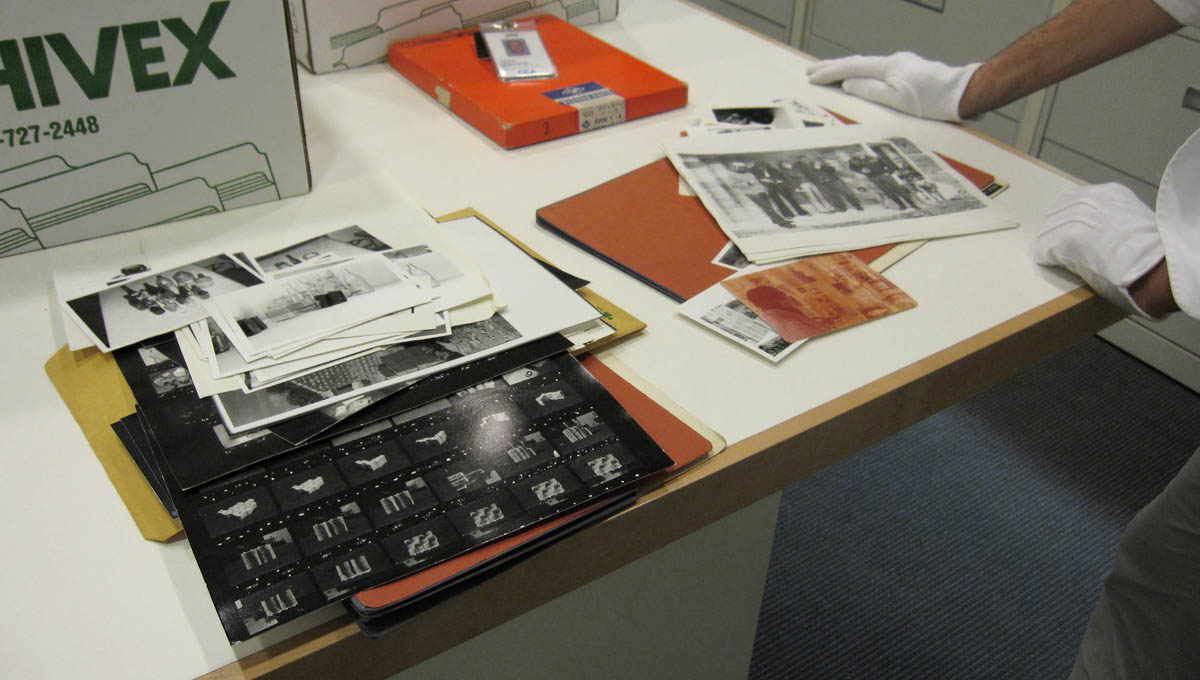
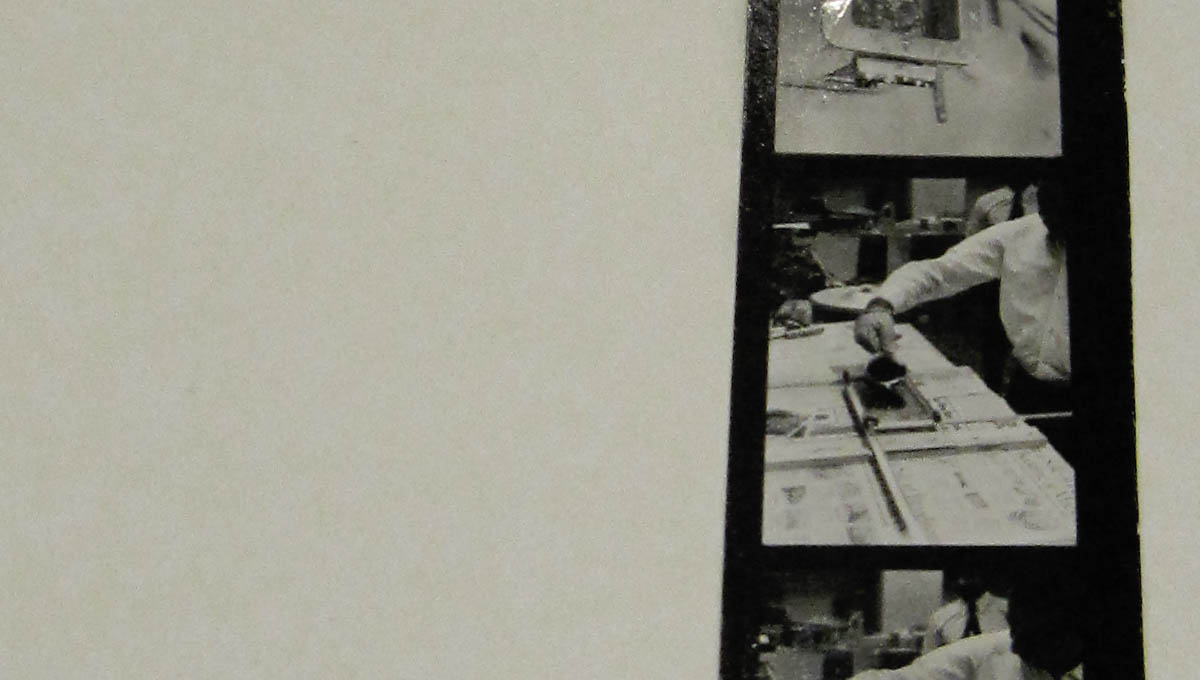
For now, here are some more photos of the various documents and files that we were able to go through that day.
[Images: Sample documents and files from the Vikram Bhatt archives at the Canadian Centre for Architecture; in the final image you can see Bhatt experimenting with the proper “cake mix” and associated baking trays. Photo by BLDGBLOG].
Larger versions of these—and one or two others—are all available in this Flickr set.
 [Image: A cutaway of Seti’s tomb by Christopher Klein, courtesy of National Geographic].
 [Image: “This odd looking structure is part of the steel form that is being used to cast a concrete lining for the 72nd Street work shaft. This shaft, and the other one that’s just like it [at 69th Street], will be used during the construction of the 72nd Street station”; photo by
  [Image: Photo by
  [Image: A projection for day 360 of the oil spill, courtesy of the
  [Image: “A tapping machine used in tests to evaluate the ability of floor coverings to reduce the transmission of impact sound from one floor to another in multi-family dwellings,” courtesy of the National Research Council Canada].
 [Image: From
  [Image: From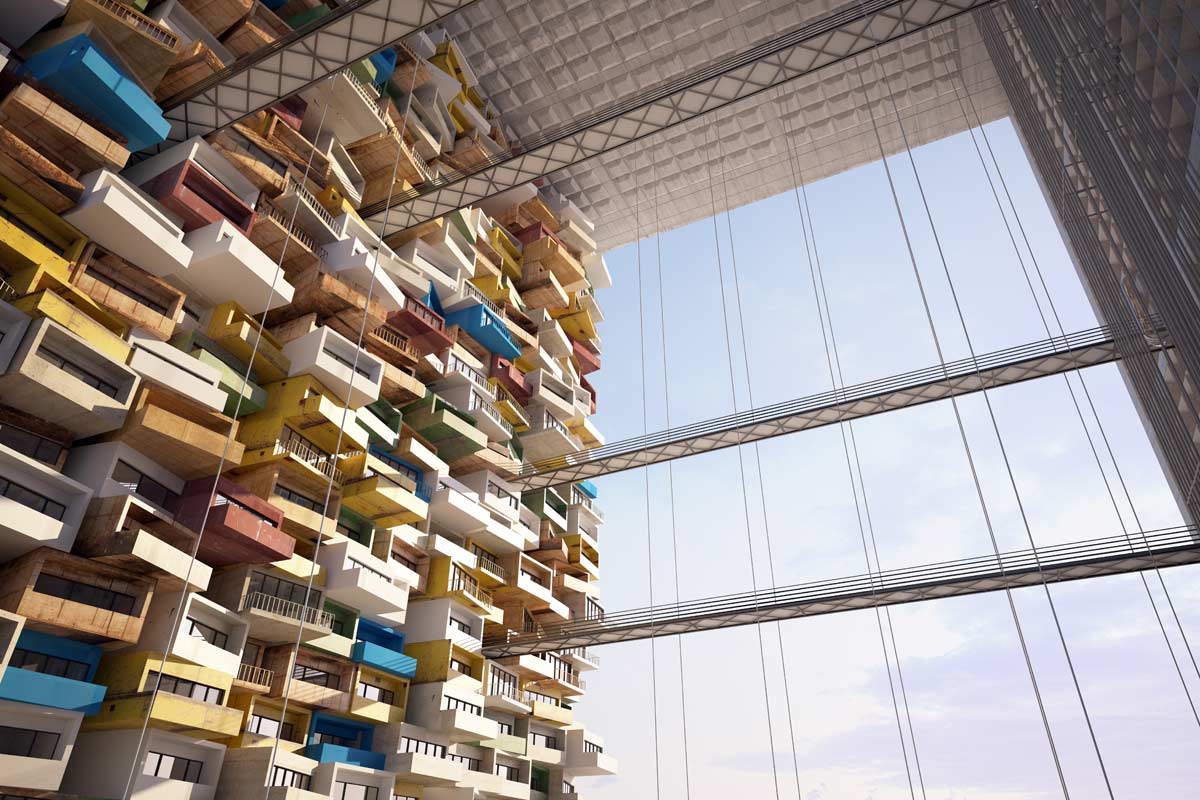
 [Images: From
  [Image: From
  [Image: From
 [Image: Proposal for a “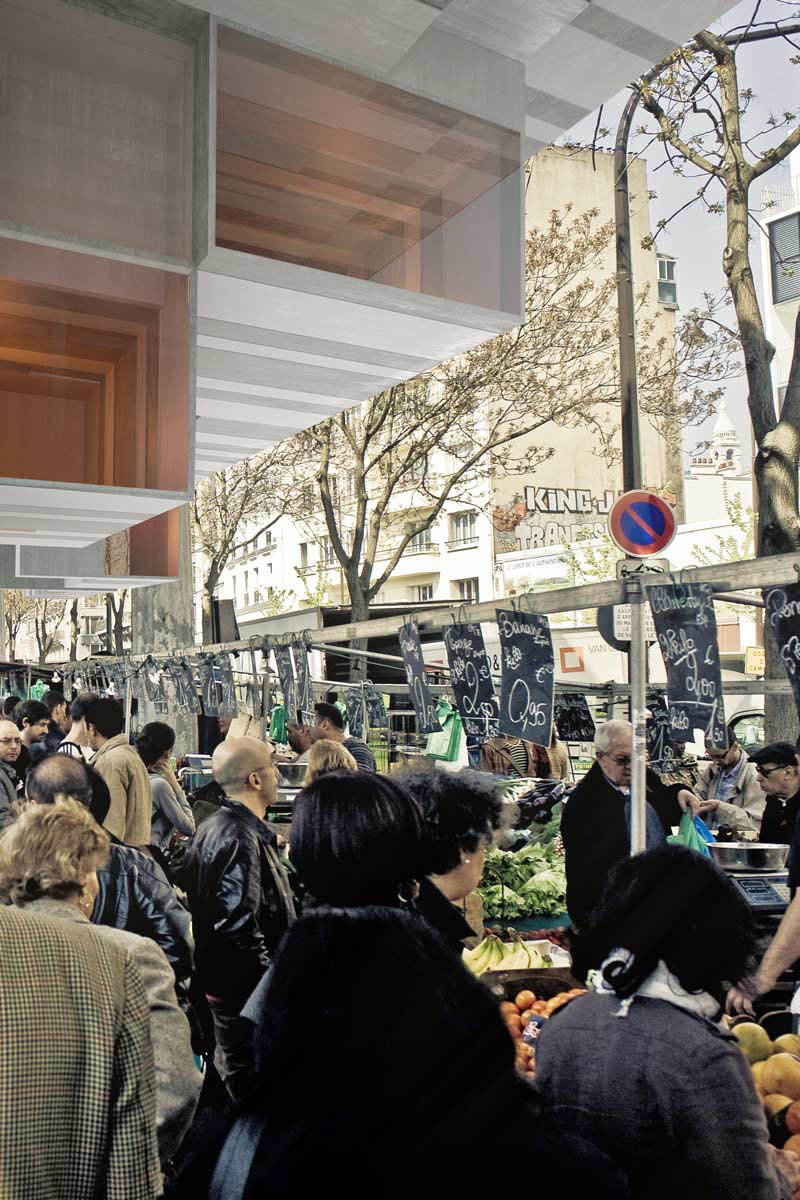
 [Images: Proposal for a “
 [Image: Proposal for a “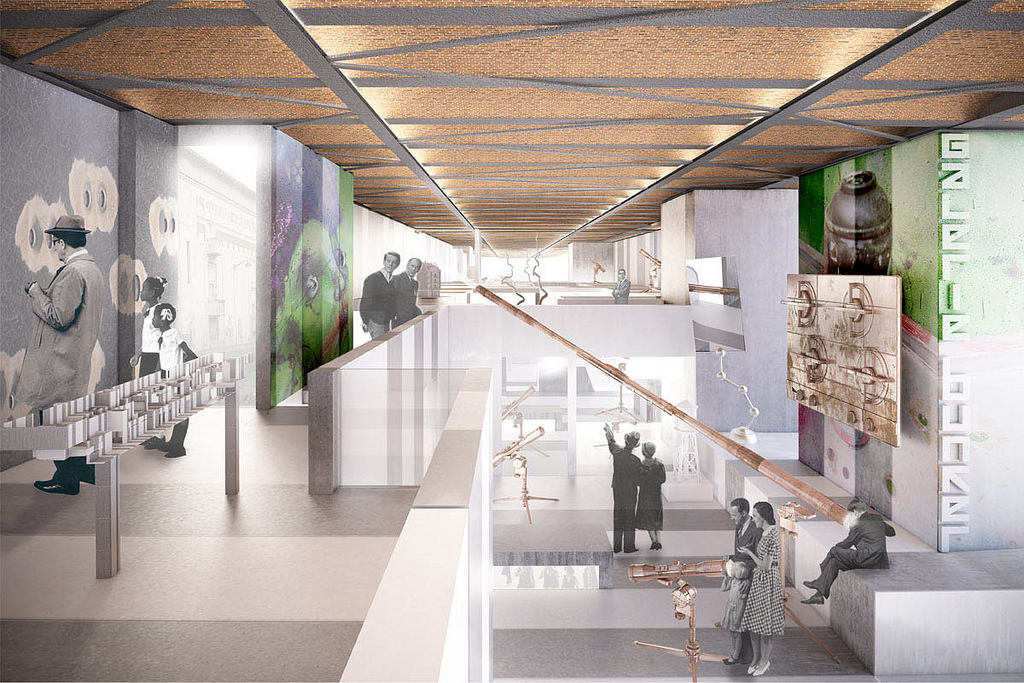
 [Images: Proposal for a “
 [Image: Photograph by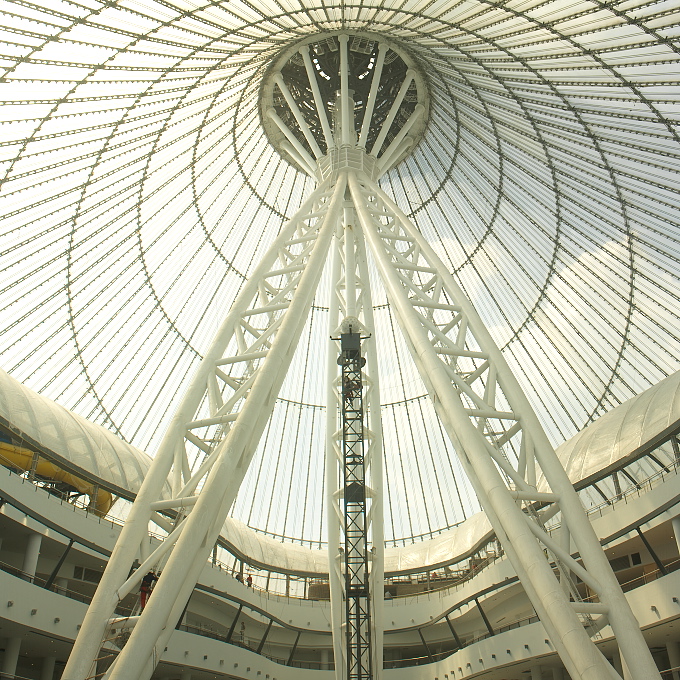

 [Images: Photos by
  [Image: Photograph by

 [Images: Photos by
  [Image: Photo by


 [Images: All photographs by
  [Image: Photo by
 [Image: A former torpedo-testing facility, now a £4 million private home; courtesy of


 [Images: Former torpedo-testing facility in the London suburbs; courtesy of
  [Image: The kitchen of a former torpedo-testing facility; courtesy of
 [Image: From “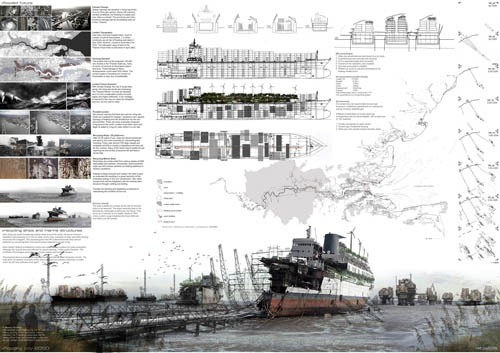
 [Images: From “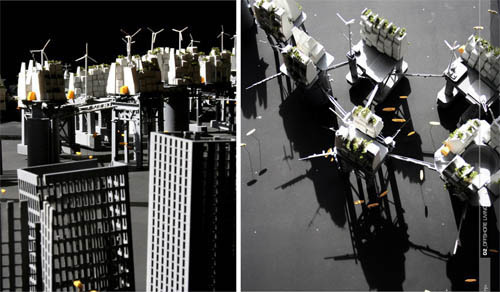
 [Images: Models from “
 [Image: From “
 [Image:
  [Image: Sketch of the
  [Image: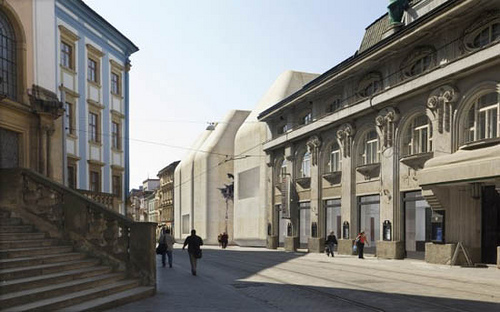
 [Image: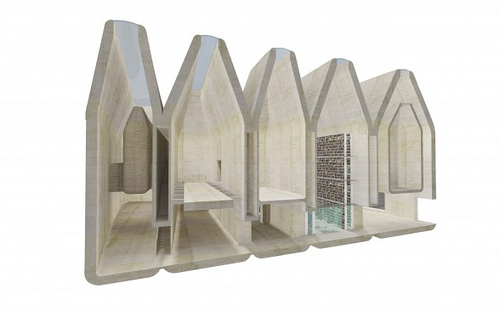
 [Image: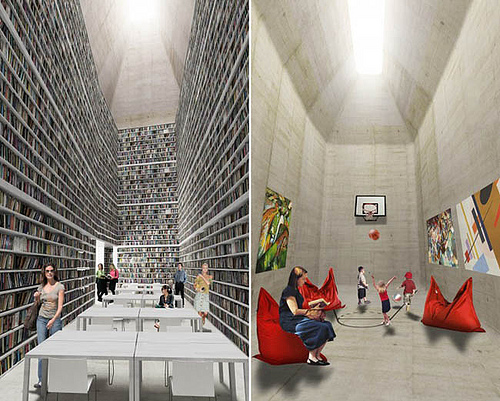
 [Image: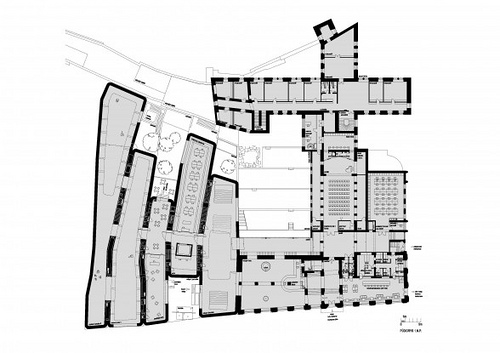
 [Image: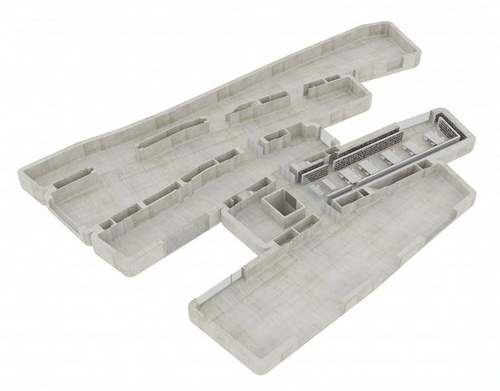
 [Image: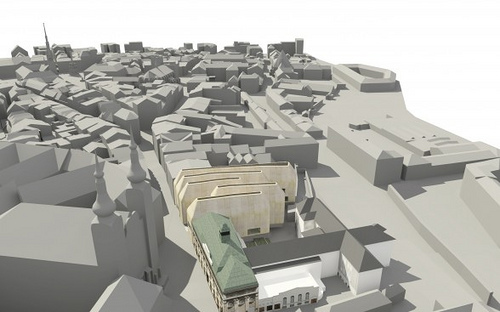
 [Image:
 [Image: From “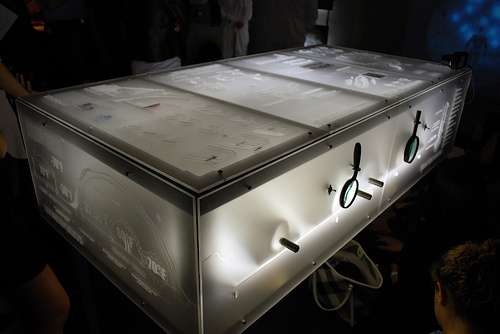
 [Images: From “
 [Images: From “
 [Image: From “
 [Images: From “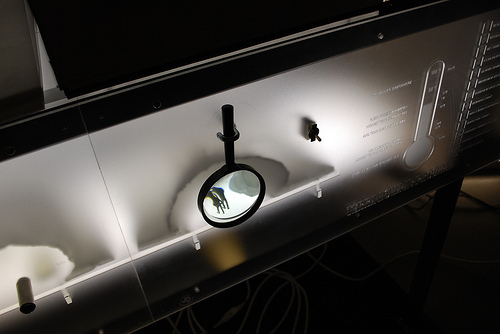
 [Images: From “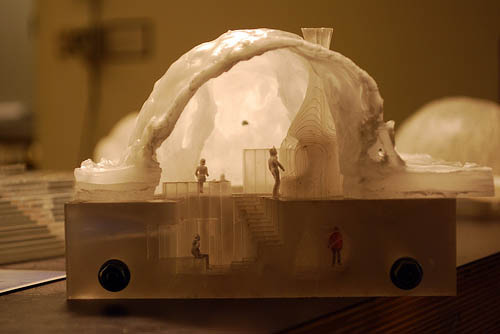
 [Images: From “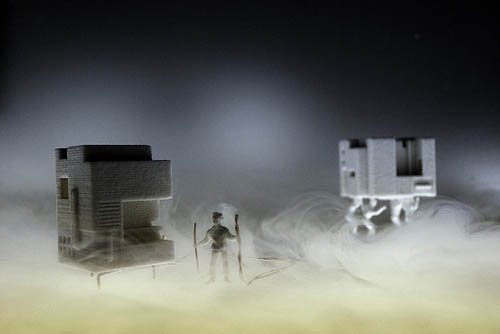
 [Images: From “
 [Image: From “


 [Images: From “
 [Image: From “
 [Images: The Cave of Kelpius, via Flickr-user
  [Image: The Cave of Kelpius, photographed by BLDGBLOG after this post was written].
 [Image: A sulphur tile from the
  [Image: A photo from the
  [Image: Brick-stacking in an image from the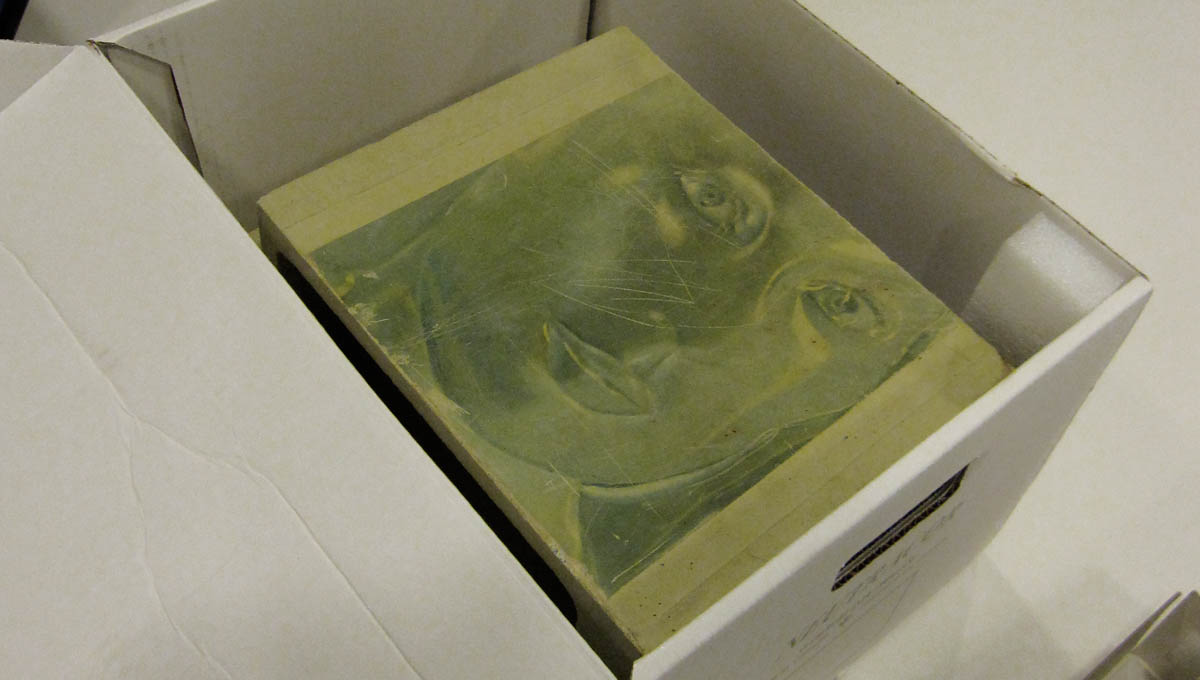
 [Images: A sample sulphur brick and tile from the
  [Image: One example of the endless modularity afforded by molded concrete. From the
  [Image: The
  [Image: Buckminster Fuller visits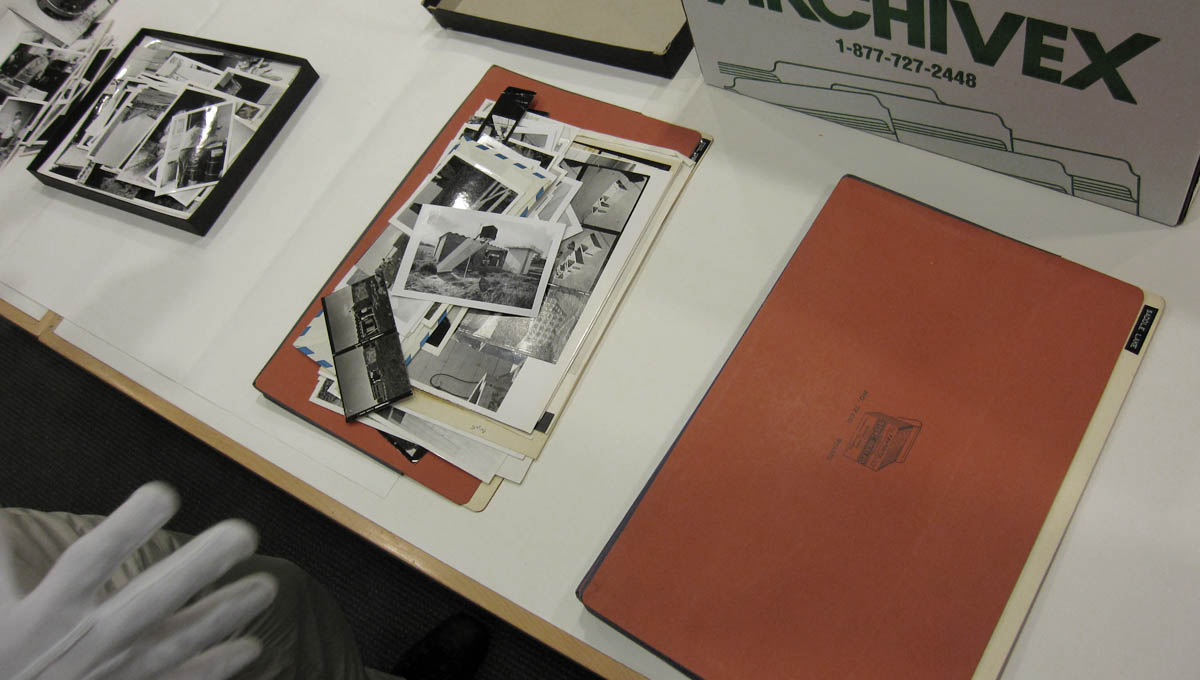

 [Images: Sample documents and files from the Vikram Bhatt archives at the