New York City of Sound


In 1999, New York-based sound artist Stephen Vitiello was awarded a five-month studio residency on the 91st floor of the World Trade Center. For his project World Trade Center Recordings: Winds After Hurricane Floyd, he taped contact mics to the studio windows, “picking up the sounds outside of passing planes, helicopters, storm clouds and traffic, the building itself swaying in the wind.”
You can listen to a short NPR piece about the project (and find other sounds here); meanwhile, Vitiello was recently interviewed in Artkrush, if you want a bit more information.
But this reminds me of two other, related projects: 1) I read a review once in The Wire about a guy who taped contact mics to his window to record the sound of snowflakes hitting the glass – a recording which was then released on CD. Unfortunately, I can’t find any information about this at all.
2) Extensive seismic readings were taken by Columbia University during the World Trade Center attacks of September 11th – the Precambrian bedrock of Manhattan was rumbling as the two towers collapsed, and this showed up on Columbia’s seismometers. Sound artist Mark Bain then transformed this information into audio files, so you can actually listen to the wounded, melancholic howl of Manhattan as its two tallest buildings fall to the ground.
Ultimately, Bain produced “a 74-minute recording of the ground vibrations of the World Trade Centre’s collapse and contiguous mayhem,” The Guardian writes. “It certainly does not make easy listening. The piece begins with a low, disconcerting rumble and proceeds through a range of fluctuating sounds. Bain says the vibration of the towers as they were hit by the hijacked passenger planes sounds like ‘tuning forks’.” He then seems quick to add that he “sees nothing morally questionable in making an artwork out of the event.”
“I guess I’m the black sheep,” he says, “the anti-architect.”
If you have RealPlayer, you can download a 2-minute excerpt.
Another vaguely related story, of course, is William Basinski

(This post was extensively updated on 26 January. For more on urban soundscapes see Orchestra of Bridges, London Instrument, Sound Dunes, and – an old favorite – musicalized weather events).

Orchestra of Bridges


[Image: Michel Bayard].

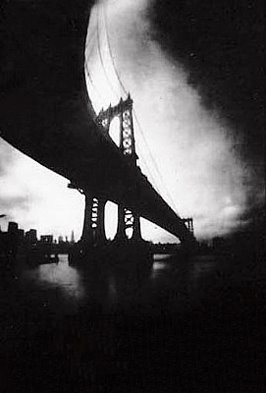
Singing Bridges seeks to record, using contact microphones, the sounds of various bridges: stressed cables, rumbling footplates, geotechnical strain.
It’s all about playing “stay-cabled and suspension bridges as musical instruments.”
The artist’s own justification for the project leaves a bit to be desired – claiming it has something to do with global information flow and Indra’s Net – but the musicalization of urban infrastructure is something that totally fascinates me, and it’s popped up on BLDGBLOG before.
If we can go back to Coleridge for a second, and imagine him striding across the retractable bridges of Chicago, iPod in hand, plugging himself into the audial foundations of the city, the trembling of concrete and iron, how every atom vibrates, Aeolian, strummed by the world; or Coleridge wandering London, stepping onto the Thames foreshore, microphones ready, pushing away sand to record the passing of subterranean trains (or whalesong, for that matter); or, yet again, perhaps somewhere in the scoured volcanism of rural Iceland, contact mics taped down on the surface of the earth, Coleridge stands listening to the Atlantic expand, every subtle rumble of tectonic plates spreading; then the bridges of the world, specifically built for how they sound, humming in the wind, can join in – and it’s worth considering that the vibrations of a bridge’s pillars might record themselves in patterns in the subsurface soil, small figures of agitation inscribed into the earth, and that those might fossilize, and in a million years you’ll have a musical score hardened into rock, sandstone evidence of how the earth once sounded, back then, which is now: a planet covered with bridges, vibrating in the wind.

(Singing Bridges spotted at Ruairi Glynn’s excellent Interactive Architecture dot Org).

London Canyonlands

In a recent post I compared the fissured earth of Morocco’s Atlas Mountains to the Grand Canyon.


Whether or not such a comparison holds – and I’ve received several opinionated emails either side – it’s still interesting to speculate about the “peculiar geological circumstances surrounding the Grand Canyon” and whether they might be found elsewhere – even if that’s a few hundred million years from now.
As it happens, I’m reading Richard Fortey’s fantastic new book Earth, and lo! He’s been thinking what I’m thinking:
“If we could wave a tectonic magic wand,” he writes, “and gently elevate southern England, the River Thames would excavate a canyon of its own, another magnificent thing – and, deep enough, there would be the equivalent of the [Grand Canyon’s] Vishnu schist. If we do the same in northern France, the Seine would carve through a sequence of hard and soft layers back to a deep and ancient metamorphic foundation. The same goes for Texas, or the Pirana Basin, or the Arabian Peninsula, or western Africa, or much of Siberia.”
There are Grand Canyons everywhere, in other words, waiting for the right conditions in which to form.


The question, then, is what can be done to further this process? Could we “gently elevate southern England,” as Fortey says, perhaps learning from the project to lift Venice?
Could we prop-up Texas on some oil derricks, for instance, moving those platforms further and deeper underneath the continental plate every year till the whole thing is an artificial Himalaya – then let the Rio Grande carve away?
For that matter, could you perform an exact, laser-measured study of the internal volume of the Grand Canyon – then carve another one, in western China, or right in the heart of Greater London?
Open a chain of hotels nearby, and you’d make all your money back through tourism. And geologists would love you. The world’s first university-sponsored Grand Canyon. Harvard will buy it.
Fortey himself compares the Grand Canyon to an act of carpentry: “The strata appear unwaveringly horizontal, like an infinity of stacked plywood worked with a giant fretsaw.”
So what are our geotechnical options here?
How could we realize a world full of new Grand Canyons?

(Earlier: sandblasting Manhattan into a new Arches National Park).

Morocco Double-Exposures


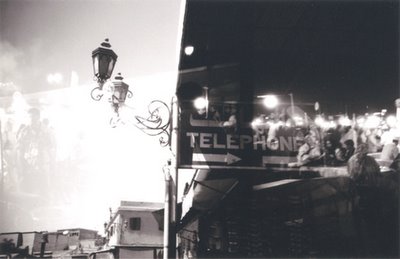
There are about two dozen more of these images, taken during a trip through Morocco, September-October 2002, studies of light and proximity, architecture, routes and detours, space.


What I noticed in Marrakech almost immediately is that inside the networked markets that reflect one another through rows of glass lamps, bronze trinkets, polished rocks and small pieces of jewelry, laid out in tilted cases or stacked inside stalls, you find a collapse of expected proximities: everything’s too close.


Toward the end of our trip, for instance, because of a gut parasite I’d picked up, I developed this insane fever that torqued the whole visual field into a funnel; then, while trying to figure out how I got that sick, we walked past a fruit stall – this was in Fes – immediately to the side of which, unprotected, out in the open, was a man taking a ball peen hammer to the skull of a dead cow, and chips of bone were flying everywhere, even landing on the fruit. People were buying the fruit, and serving it in restaurants.
Everything was too close, in other words; hygiene and distance became unexpected synonyms.


What’s interesting, though, is when you get out of the cities and into the desert, and a kind of hydro-topographical narrative begins: while there’s water in the coastal plains, collecting in small valleys or oases, and supporting urbanization, as you pass away on looping roads into the hills the entire continental shield seems to dry out. The rocks are abstract and red; Mars conspiracists could probably argue NASA’s rovers are actually tootling around in the iron-rich void of central Morocco.
In any case, the continent is shattering; large rocks get smaller, weathered by thousands of years of wind and sandstorms – what Richard Fortey calls “the blast of erosion,” in his awesomely great Earth – and you can actually watch as the terrain chips away at itself, getting closer and closer to the consistency of sand: sand which you then see on the horizon, in great dunes of the outer Sahara.
Meanwhile, you’ve passed over massive fissures in the earth, the planet breaking open, and so the twisting claustrophobia of the urban market has been replaced by its apparent opposite: geological time, ripped open right in front of you in stratigraphic abysses that can rival the Grand Canyon.
The continent is abrading to sand, there is no one in sight, the heat is amazing, and you’ve barely even set foot in the interior.
But you realize that the complexity of the local architecture, especially in the markets and casbahs – which any labyrinth aficionado would fall in love with right away (I fell in love right away) – is not only a kind of terrestrial tactic, i.e. keeping small pieces of the planet (sand) out of the inner rooms, it’s also a philosophical response to the utterly gigantic north African landscapes collapsing all over themselves, ground down to sandy fissures in the distance: you want to control space, and limit the perimeter. Keep the walls close.


Whole rooms, entire buildings, seem to overlap with everything else – till it’s like walking through double-exposures.

(All images: Geoff Manaugh/BLDGBLOG; please link/credit if using elsewhere!)

“The city as an avatar of itself”

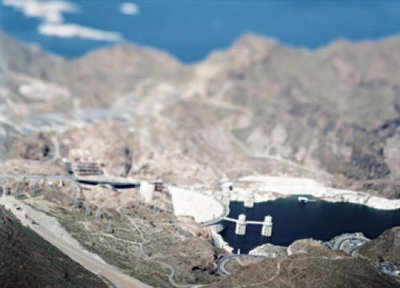
“It’s often hard to convince people that Olivo Barbieri’s aerial photographs are real,” Metropolis writes.


“They look uncannily like hyperdetailed models, absent the imperfections of reality. Streets are strangely clean, trees look plastic, and odd distortions of scale create the opposite effect of what we expect from aerial photography – a complete overview, like military surveillance.”


Barbieri “achieves the distinctive look by photographing from a helicopter using a tilt-shift lens – a method, he says, that ‘allows me to choose what I really like in focus: like in a written page, we don’t read [it as an] image but one line at a time.'”
It’s geology disguised as sculpted chocolate; a Claymation paradise. Herculean examples of American civic infrastructure look like nothing more than cardboard, flimsy and ridiculous. (Amazingly, the second image, below, is a photograph of Hoover Dam).


“For Barbieri,” Metropolis says, “it is ‘the city as an avatar of itself.'” So if he did take photos of city models someday… would they look real?


I’m left wondering what this techique would achieve in the field of human portraiture. The blurred heads of Francis Bacon meet some kind of plasticized mannequinization of the subject… Pickman’s Model.
The results could be horrific.

(See also BLDGBLOG’s look at the work of Oliver Boberg; and click here for another photo by Barbieri. Meanwhile, thanks to Brent Kissel for the initiating email! Thanks, as well, to Dan who I think might have mentioned Barbieri once…).

Alluvial terrains


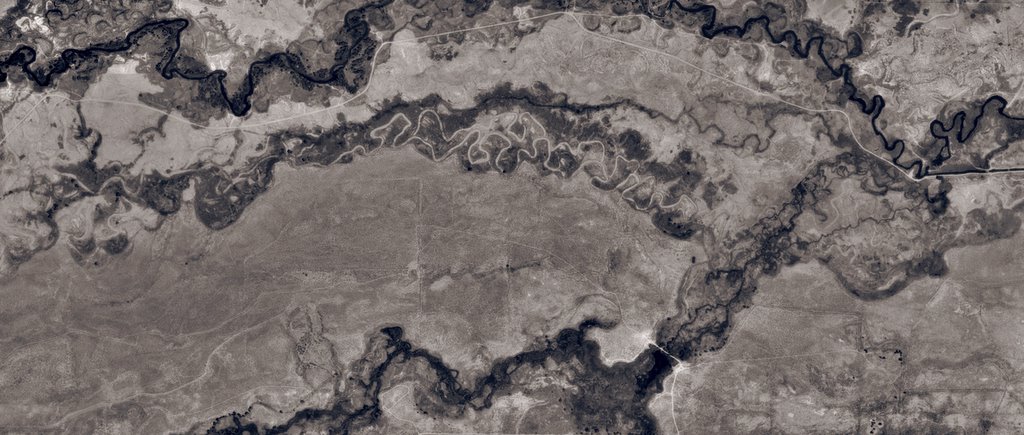
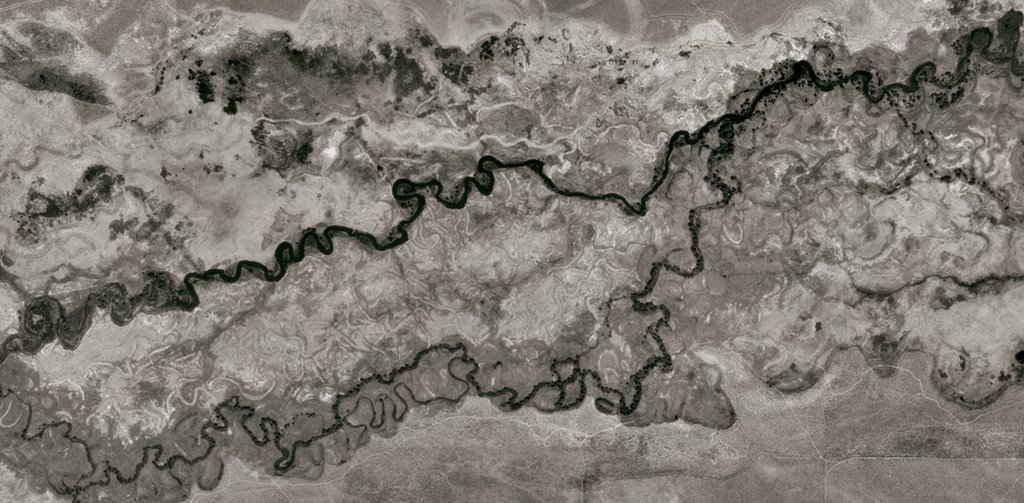
A composite of riverine meanders, ancient hydrological scars in the earth of California, Owens Valley, like glimpses of old Chinese landscape scrolls –


– taken from the satellites of TerraServer. Fossilized wakes and side-streams, eroding banks of fractal continents. Silt on silt. Everything ending in self-similarity.


Click-on to enlarge! Please!
Meanwhile, see Pruned‘s uploaded set of geological investigations from the lower Mississippi alluvial basin.

Sky Tunnels of Toronto


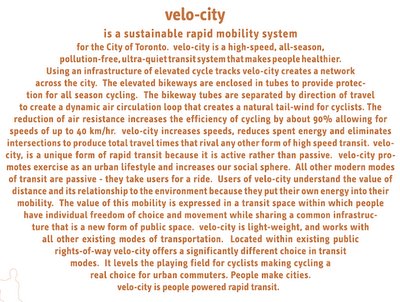
As the above text describes – and as you can read here – architect Chris Hardwicke has recently proposed a network of elevated bike trails – glass tunnels soaring above Toronto, in a “dynamic air circulation loop” – that would allow city residents to travel by bicycle at speeds of up to 40kph.
It would look like this:


Two thoughts: 1) the Tour de France of the future will be a Tour de Sky Tunnels of Toronto; and 2) why not build a moving version, nomadic, hinged, flexible, a kind of glass octopus of dynamic sky-routes, accessible only by pedestrians, going nowhere except into itself, knot-like, a mobile marathon route torquing above the city at night, reflective, looping over Roncesvalles, utopian junctions in space?

(Spotted at Archinect).

An electromagnetic Grand Canyon, moving through space


[Image: It’s the “N44 superbubble complex,” and it spans 325 lightyears. But are we drifting dangerously close to another such superbubble? And what would such a cosmic ring sound like? (Thanks, Bryan!) Meanwhile, is the Milky Way – and everything near it – being pulled toward something, a region of “superdensity,” a “Zone of Avoidance,” the “most massive known structure in the observable universe”? Finally, is this –


– the fate of the sun, bursting over a ruined earth of half-molten continents and liquified alluvial cities 7.5 billion years from now?].