Water vs. World

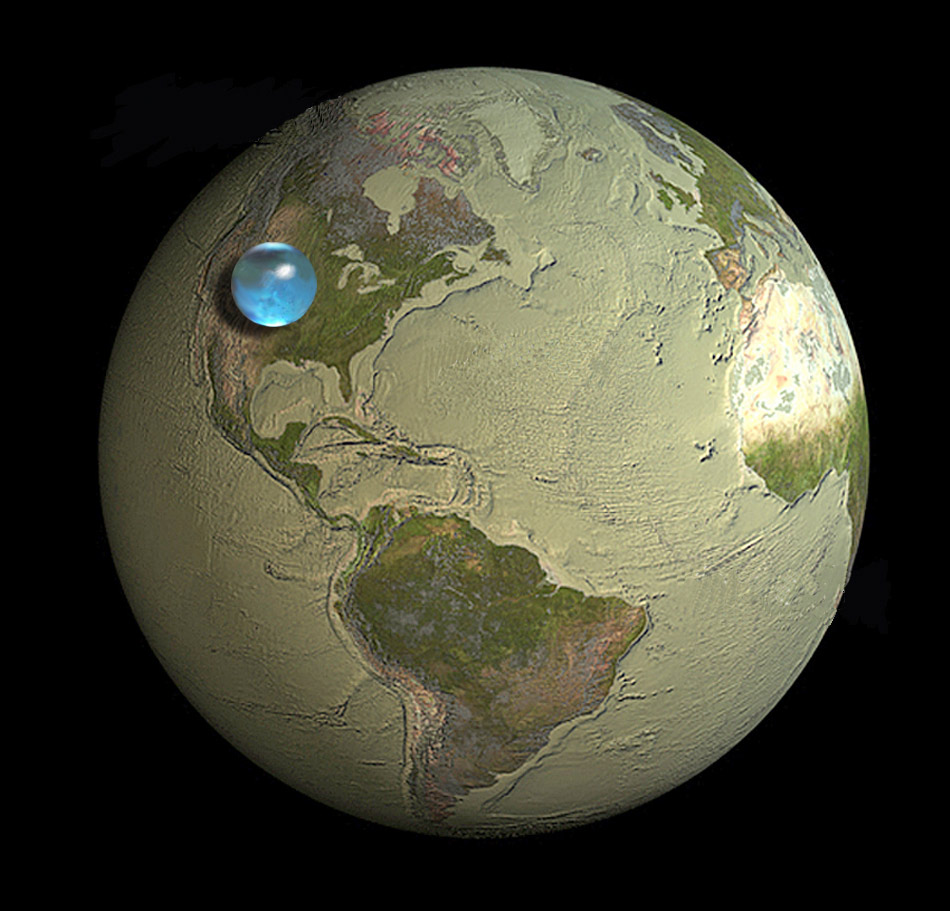
[Image: Illustration by Jack Cook, Woods Hole Oceanographic Institution; courtesy of the USGS].

In Charles Fishman’s compelling exploration of water on Earth, The Big Thirst, there is a shocking statement that, despite the apparent inexhaustibility of the oceans, “the total water on the surface of Earth (the oceans, the ice caps, the atmospheric water) makes up 0.025 percent of the mass of the planet—25/10,000ths of the stuff of Earth. If the Earth were the size of a Honda Odyssey minivan,” he clarifies, “the amount of water on the planet would be in a single, half-liter bottle of Poland Spring in one of the van’s thirteen cup holders.”

This is rather remarkably communicated by an illustration from the USGS, reproduced above, showing “the size of a sphere that would contain all of Earth’s water in comparison to the size of the Earth.” That’s not a lot of water.

Only vaguely related, meanwhile, there is an additional description in Fishman’s book worth repeating here.

[Image: The Orion nebula, photographed by Hubble].

In something called the Orion Molecular Cloud, truly vast amounts of water are being produced. How much? Incredibly, Fishman explains, “the cloud is making sixty Earth waters every twenty-four hours”—or, in simpler terms, “there is enough water being formed sufficient to fill all of Earth’s oceans every twenty-four minutes.” This is occurring, however, in an area “420 times the size of our solar system.”

Anyway, Fishman’s book is pretty fascinating, in particular his chapter, called “Dolphins in the Desert,” on the water reuse and filtration infrastructure installed over the past 10-15 years in Las Vegas.

(Via @USGS).

Lost Lakes of the Empire State Building

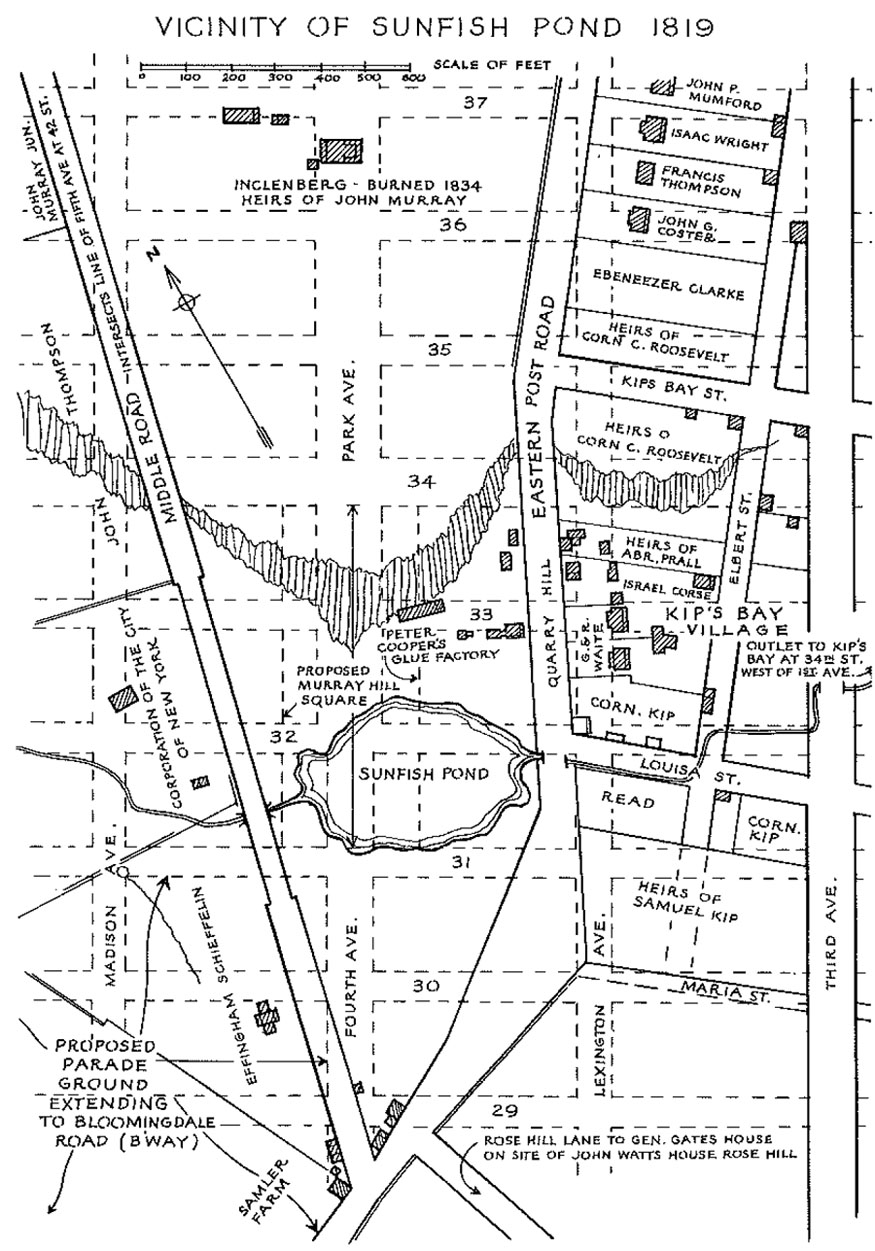
[Image: Sunfish Pond].

Something I’ve meant to post about for awhile—and that isn’t news at all—is the fact that there is a lost lake in the basement of the Empire State Building. Or a pond, more accurately speaking.

After following a series of links leading off from Steve Duncan’s ongoing exploration of New York’s “lost streams, kills, rivers, brooks, ponds, lakes, burns, brakes, and springs,” I found the fascinating story of Sunfish Pond, a “lovely little body of water” at the corner of what is now 31st Street and Fourth Avenue. “The pond was fed both by springs and by a brook which also carried its overflow down to the East River at Kip’s Bay.”

Interestingly, although the pond proper would miss the foundations of the Empire State Building, its feeder streams nonetheless pose a flood risk to the building: the now-buried waterway “leading from Sunfish Pond still floods the deep basement of the Empire State Building today.”

To a certain extent, this reminds me of a line from the recent book Alphaville: “Heat lightning cackles above the Brooklyn skyline and her message is clear: ‘You may have it paved over, but it’s still a swamp.'” That is, the city can’t escape its hydrology.

But perhaps this makes the Empire State Building as good a place as any for us to test out the possibility of fishing in the basements of Manhattan: break in, air-hammer some holes through the concrete, bust out fishing rods, and spend the night hauling inexplicable marine life out of the deep and gurgling darkness below.

Astrobiology and Drowned Nations

There’s a lot going on again this week at Studio-X NYC. Two quick things to put on your radar, in case you’re near New York:

[Image: NASA astrobiologist Lynn Rothschild measures solar radiation, via NASA].

1) Tonight at 6:30pm, we’ve got NASA astrobiologist Lynn Rothschild coming in to discuss her work, from extreme environments here on Earth, where scientists test for the limits of life, to the irradiated landscapes of Mars. We’ll look at the nature of biology, the possibilities for synthetic life, unexpected alternatives to DNA, and other mind-bending experiments that ask, in Rothschild’s words, “Where do we come from? Where are we going? and Are we alone?” Architect Ed Keller will be co-moderating this live interview.

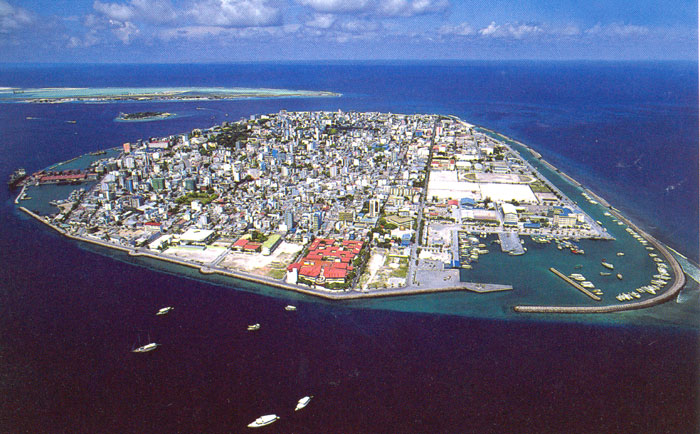
2) Tomorrow, beginning at 6pm, we’ve got a massive line-up, including, I’m thrilled to say, an interview with Michael Gerrard, Andrew Sabin Professor of Professional Practice at Columbia Law School, discussing “drowning nations and climate change law. The list of whole countries at risk from sea-level rise is both extraordinary and growing, from the Marshall Islands to the Maldives, posing a series of unanswered questions about migration, citizenship, geopolitical power, and even the very definition of a state. As a 2010 article on ClimateWire asks, citing Gerrard’s work, “If a Country Sinks Beneath the Sea, Is It Still a Country?”

[Image: Male, capital of the Maldives, via Wikipedia].

Gerrard was instrumental in organizing a conference last year called “Threatened Island Nations: Legal Implications of Rising Seas and a Changing Climate,” inspired by the “unique legal questions posed by rising oceans.” Central to our conversation tomorrow night will be what that last link calls “the sovereignty of submerged nations”:

Would the countries continue to have legal recognition like the Order of Malta, which ceded its island territory long ago but continues to be treated like a sovereign for some purposes? Would they retain their seats in the United Nations and other international bodies?

Here, it’s interesting to note recent suggestions that the “entire nation of Kiribati” might—or might not—move en masse to Fiji, to escape rising sea levels.

We will be interviewing Michael Gerrard only from 6-6:45pm, so don’t be late.

Immediately following that live interview, we will kick off a roundtable discussion on the future of sovereignty, governance, citizenship, and the nation-state, looking at a range of unique geographic and spatial scenarios, from the Arctic to the Internet. Joining us—many via Skype—will be: Benjamin Bratton, director of the Center for Design and Geopolitics at UC-San Diego; architect Ed Keller; Tom Cohen, co-editor with Claire Colebrook of the Critical Climate Change series from Open Humanities Press; science fiction novelist Peter Watts; architect and urbanist Adrian Lahoud, editor of Post-Traumatic Urbanism; and Dylan Trigg, author of, among other things, The Aesthetics of Decay.

Studio-X NYC is at 180 Varick Street, Suite 1610, 16th floor; here is a map. These events are free and open to the public, and no RSVP is required.

Performing Mars

[Image: Image via Karst Worlds].

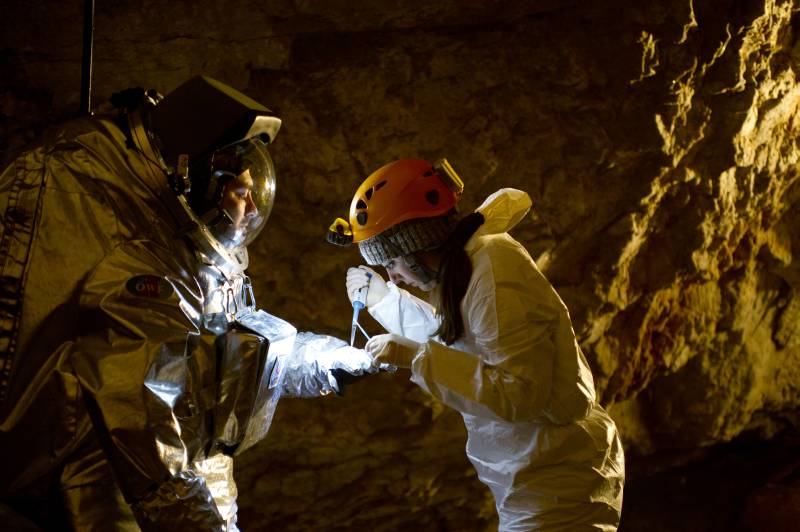
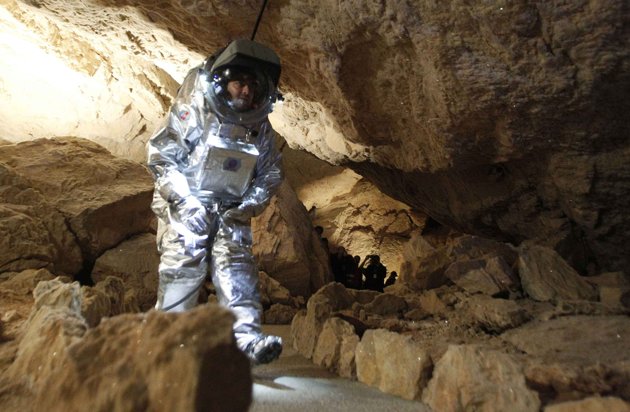
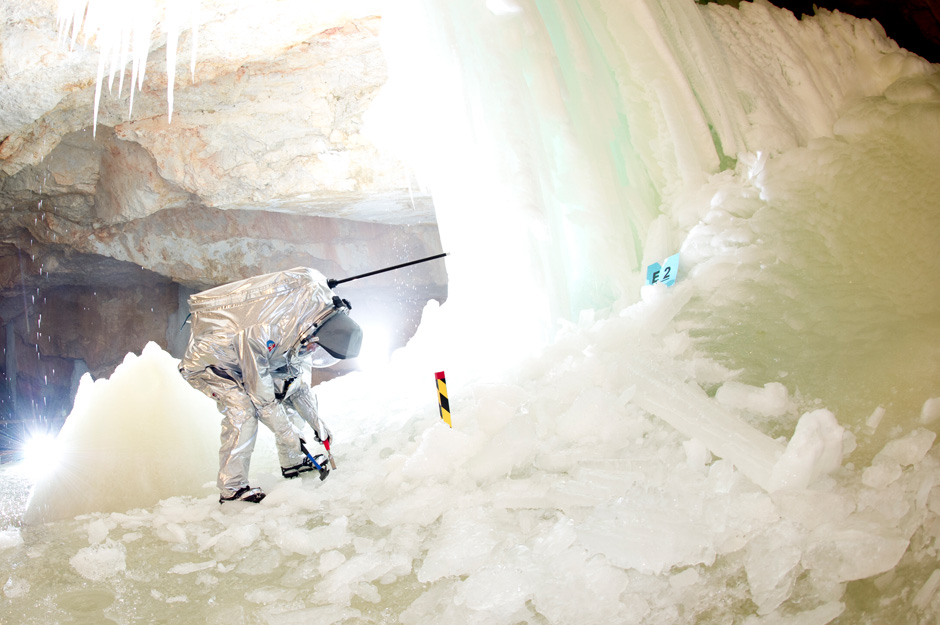
An ice cave in Austria was recently used as a test landscape for experimental spacesuits and instrumentation systems—including 3D cameras—that might someday be used by humans on Mars.

The Dachstein ice cave was chosen, Stuff explains, “because ice caves would be a natural refuge for any microbes on Mars seeking steady temperatures and protection from damaging cosmic rays.”

[Images: (top and bottom) Photos by Katja Zanella-Kux; middle photos via Karst Worlds].

Many images available at the Dachstein Mars Simulation Liveblog—including this series of 25 images courtesy of the Austrian Space Forum—document the testing process, which ranged from the beautifully surreal, as a fully space-suited man rolls strange devices down slopes of ice inside the planet, to the nearly postmodern, as crowds of normally dressed tourist onlookers are revealed at the edges of the show cave, watching this odd performance unfold.

And all this is in addition to the “obstacle course” developed for wearers of the spacesuit—reverse-engineering terrain from a particular type of clothing, or landscape design as an outgrowth from fashion—in the parking lot and nearby paved spaces of a research center in Austria. “The course included four snow-mountain passages, almost 40 meters of rock climbing and more than 60 meters of slushy snow terrain amongst others”—including “drawing bright ‘rocks’ to make the simulation happen” accurately.

Walking amidst painted representations of geology, wearing a suit designed for the atmosphere of another planet, and temporarily moving below the surface of the earth to throw pieces of specialty equipment down ice slopes, attached to ropes, the team was able to, by means of props and in William L. Fox’s words, “perform Mars on Earth.”

(Spotted via Karst Worlds).