Glass avenues of Paris 2054

I finally got a chance to see Christian Volckman’s Renaissance last week, even after having posted about the film several months ago.
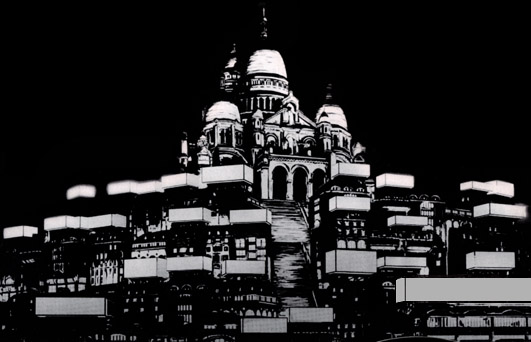
Paris_2054
The movie’s not bad, though the writing leaves a lot to be desired, the “acting” is rather dubious, and realistic character motivation seems somewhat lacking, to say the least.
On the other hand, the movie is gorgeous, and its architectural vision of Paris in the year 2054 deserves comment. The city’s streets have been replaced with bulletproof glass, for instance, so action on the underground Metro platforms can be seen from above – and vice versa. Weird little houses rise and fall on hydraulic platforms; a geneticist’s home, on the mansard-roofed top floor of a riverside flat, contains a whole indoor forest; the city itself has become a massively cross-buttressed machine of arches, superhighways, and elevated trains. There are tunnels, archives, and holographic surveillance screens – and lots of iron, glass, and brick. The Seine has been concretized into a kind of industrial mega-canal. At one point, the mosque at Cordoba appears, faithfully reproduced as a gangster’s steambath. Etc. etc.
As it happened, there was a short article by Volckman in a magazine I picked up after the movie; there we read how Renaissance was intended as “an expressionistic film, transforming Paris into a futuristic metropolis, using motion capture and creating everything from scratch in 3D.” Volckman cites film noir as both a structural and aesthetic influence: “Great shadows, wild angles, and weird characters living in dark cities where the line between good and evil is not so obvious.”
So it’s a great film to catch, on a purely visual level – though beware of the screenplay, which nearly does the whole thing in.

(PS: Renaissance is dubbed, not subtitled, and includes the voice of Daniel Craig).

[Originally spotted on gravestmor].
Enter the Mini-Anti-Earth

Scientists from the University of South Florida have come up with a way to reduce the effects of gravity – albeit on a very small scale. It’s a kind of mini-anti-earth, on demand.
Their technique uses microgravity to grow cancer research cells:

Tiny beads of gelatine – around 200 micrometres in size – are mixed together with collagen and fine particles of magnetite (the magnetic iron oxide used to coat recording tape). This mix is then sealed in a gas-permeable bag and dosed with the cells to be cultured. The bag sits on a platform and is sandwiched between two graphite plates, beneath a powerful permanent electromagnet. The magnet is used to exert an upwards force on the magnetite particles that exactly counters the downward force of gravity. The tissue cells, gelatin and collagen can then grow suspended in “zero-g.”

So here’s my vote for finding new applications in the world of landscape architecture: entire zero-g gardens grown in gas-permeable bags. Sent drifting across the Pacific.
Leading to the question: if a medieval theologian had proposed that the Garden of Eden was actually a zero-g garden floating across the Dead Sea in a gas-permeable bag… would he or she have been excommunicated?

(Via).

Radio Astronomy

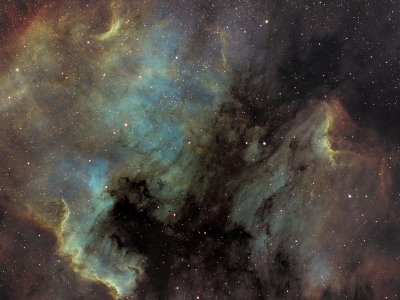
[Image: The North American and Pelican Nebulas; from NASA’s Astronomy Picture of the Day].

This is quite possibly the coolest thing I’ve read in months: in order to combat light pollution, city officials in Reykjavik, Iceland, “will turn off street lights on Thursday evening and people are also being encouraged to sit in their houses in the dark.” The clincher: “While the lights are out, an astronomer will describe the night sky over national radio.”

(Via WorldChanging and Z+).

B.Y.O.B.

Perhaps alcohol is the future of urban infrastructure: “Russian customs officers say they have discovered a mile long pipeline that was pumping vodka to Latvia.” This illegal but brilliant act of international infrastructure is referred to as “running hooch across the border.”

Next up: a million-dollar condo tower in New York City where, for $199/month, you can subscribe, via faucet, to the Vodka Of The Month Club…

(Via).

Human Ash Reactions

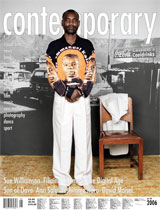
Another quick (and self-indulgent) note: an article of mine, about the photography of David Maisel, has been published in the new issue of Contemporary Magazine (Issue #86).


Called “Human Ash Reactions,” the article looks at chemical similarities between the landscapes and objects Maisel photographs, and the developmental process of photography itself.
If you’re unfamiliar with Maisel’s work, be sure to check out this interview with him, published last Spring on Archinect. The images are gorgeous, haunting, and ironically otherworldly. His own website – a former Yahoo! Pick of the Day – is well worth the visit.
And if you do read the article in Contemporary, let me know what you think.

Struck by loops

At the risk of turning BLDGBLOG into some sad and unofficial subsidiary of New Scientist, let me point out in any case that “[h]uge loops of gas – similar to those found on the Sun – have been found soaring above the galactic plane near the centre of the Milky Way.”


“The tube-like structures may be responsible for the formation of giant star clusters near the galaxy’s centre and also might be behind the region’s mysteriously powerful magnetic field.”
To quote the article at length:

“I was struck by the loops when I saw them,” says study leader Yasuo Fukui of Nagoya University in Japan. “But it took a few years for me to understand that they represent magnetic loops.” The team believes they formed the way glowing arches, called prominences, do on the Sun – from the stretching and bending of magnetic field lines.

The rest of the story is weirdly fascinating; we read how the “detailed structure and cause of the galaxy’s magnetic field lines are not well understood,” although Fukui’s team has produced a computer model “that can produce gas loops similar to the ones observed.” If we’re to believe the model’s version of the story, then, “small vertical hills in the initially horizontal field lines cause gas to start flowing down into the valleys between them. With less gas at the tops of the hills, the magnetic field there becomes free to expand upwards even more, leading to giant loops.”
The energy involved is extraordinary: for instance, the “observed speed of the gas as it gushes down the sides of the loops… carries roughly the same amount of kinetic energy as is produced in a supernova explosion.”
This immensely powerful magnetized landscape of interstellar gas undergoes turbulence, pooling, waves, and condensation – eventually hitting a point at which stars can form, spooling themselves together gravitationally from loose strands of an ethereal topography. Structured wisps of polarized light soon shine.


There’s a poem – though I can’t seem to find it anywhere now – by John Burnside, which beautifully describes a sort of Christianized cosmology in which the remains of angels have been found hovering in space, titanic, made of color and transparency – and a part of me likes to think that the “glowing arches” and otherwise unexplained astral loops that New Scientist introduces us to are really part of some huge and ongoing theological archaeology of the sky. Mythic remnants: forgotten gods become astro-tectonic structures in space.
One night, a man with a home telescope discovers the chemical ruins of a church the size and shape of whole galaxies, domes of helium and osmium drifting across the outer tangents of the Milky Way – a mobile landscape that survives even universal catastrophe.

The Ring

“An enormous ring of superconducting magnets similar to a particle accelerator could fling satellites into space, or perhaps weapons around the world,” New Scientist reports. “The advantage of a circular track [over a linear one] is that the satellite can be gradually accelerated over a period of several hours.” It will just whirl and whirl in the desert for hours, vertiginous yet grounded, till it falls upward, hurled into space…
For some reason, though, I find New Scientist‘s description totally fascinating:

The satellite, encased in an aerodynamic, cone-shaped shell that would protect it from the intense heat of launch, would be attached to a sled designed to respond to the forces from the superconducting magnets. When the sled had been accelerated to its top speed of 10 kilometres per second, laser and pyrotechnic devices would be used to separate the cone from the sled. Then, the cone would skid into a side tunnel, losing some speed due to friction with the tunnel’s walls. The tunnel would direct the cone to a ramp angled at 30° to the horizon, where the cone would launch towards space at about 8 kilometres per second, or more than 23 times the speed of sound. A rocket at the back end of the cone would be used to adjust its trajectory and place it in a proper orbit.

Rather than satellites encased in sleds, however, how about sheds? Ice-fishing sheds. Or whole suburbs, thrown into space.

(Related: Hurling Taj Mahals into the Sky and Mineral TV and the Archipelago of Abandoned Shopping Malls).

Architectural Dissimulation

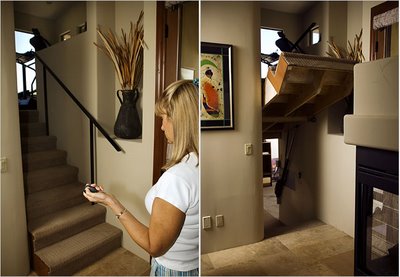
[Image: “Louise Kircher raises the staircase in her home in Mesa, Ariz., to reveal the secret room behind it.” Mark Peterman/New York Times].

“On a recent Saturday morning,” The New York Times writes, “Cami Beghou, 13, pushed the right side of the tall, white bookcase that is built into one of the powder-pink walls in her bedroom. The bookcase, holding rows of books, a stuffed dachshund and a volleyball, silently swung outward, revealing a tiny, well-lighted room. Containing a desk, a chair and a laptop computer, it serves as her study area.”
Apparently, the family gets a kick out of fooling people – it’s suburban normality in an age of architectural dissimulation: “When the home inspector came by to examine the house, our builder shut the bookcase, hiding the room. The inspector went up and down the stairs a couple times – he knew that something was unusual – but he couldn’t figure out what was there.”

[Image: “David Lee of Plano, Tex., got a bookcase door to hide the mess of his workroom, but also because he had wanted a secret room, he said, ‘since watching Scooby-Doo way back when.'” Misty Keasler/New York Times].

And therein lies a Kafka novel for the suburban twenty-first century, in which a real estate appraiser from a national bank is sent to a small town in the cloudy hills of central Pennsylvania to find that all the houses he’s meant to review are similarly unusual: the outsides are bigger than the insides – or vice versa – and indoor corridors trace around what should be whole wings the man can never find. He returns to his small room at the Comfort Inn every night, and, in between watching endless Bruce Willis films on the hotel television, he begins sketching out the neighborhood from memory…
Then he realizes something…
In any case, The New York Times adds that these secret rooms in suburbia have become increasingly popular: “The Beghous’ architect, Charles L. Page, who is based in Winnetka, said he had designed seven other houses with hidden rooms since 2001, after designing none in his previous 40 years as a residential architect. ‘Absolutely, there has been an increase,’ said Timothy Corrigan, an architect and designer in Los Angeles, who noted that he has been practicing for 12 years but was not asked to design a secret room until four years ago. Since then, he has created five.”
Unfortunately, there is no mention of whether anyone has commissioned secret rooms accessible only from other secret rooms – M.C. Escher, Architect, perhaps – or complete, non-intersecting houses built in parallel to each other on the same small lot. Otherwise inconceivable geometries in home improvement form. Knotville.

(Via Archinect).

A chance to put his theories into practice

“The peculiar thing about England,” J.G. Ballard tells Simon Sellars of Ballardian.com, in a long, casually humorous, and interesting new interview, “is that we’re so densely populated. When I say there’s nothing to do except go shopping, that’s almost the truth. You know, you can’t climb into your car and drive off into the wilderness. Shopping is all we have.”

[Image: J.G. Ballard, photographed by Paul Murphy; via Ballardian.com].

In a discussion of Ballard’s most recent novel, Kingdom Come – which Ballard himself describes as “a full-frontal attack on England today” – we read how “the gap between rich and poor is widening to such an extent that, particularly in London, it’s begun to shift the whole demographic. The middle class, the people who sustain modern society – the nurses, junior doctors, teachers, civil servants and so on – are being forced out because vast sums of money are pouring into the housing market and distorting it. Gated communities are springing up everywhere, and the moment they can, people are opting for private medicine, private teaching, private hospitals – cutting themselves off from the rest of society, and that’s not a healthy development.”
Landscape urbanism, car crashes, Harvard psychiatric publications, Playboy magazine, human autopsies, and the quiet fascism of British shopping malls: it’s an interview worth the read.

(For more of J.G. Ballard here on BLDGBLOG, see Concrete Island, Bunker Archaeology, and Silt, in particular).

City of the Pharaoh

[Image: Cecil B. DeMille’s not yet lost city – the set of The Ten Commandments, during filming].

“In 1923,” we read, “pioneer filmmaker Cecil. B. DeMille built the largest set in movie history for his silent (and early Technicolor) epic, The Ten Commandments. It was called ‘The City of the Pharaoh.'”
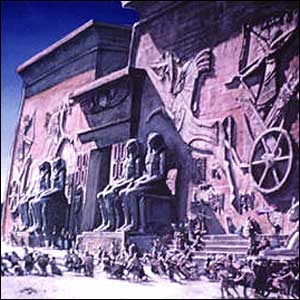
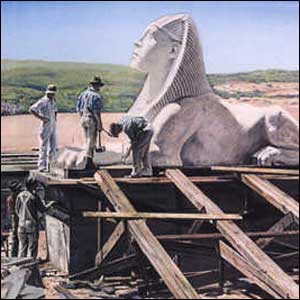
Constructing DeMille’s instant city was no half-effort: “Sixteen hundred laborers built hieroglyph-covered walls 110 feet tall, flanked by four statues of Ramses II and 21 sphinxes, 5 tons each. DeMille populated his city with 2,500 actors and extras, housing them in tents on an adjacent dune.”

[Image: A scene from The Ten Commandments, via NPR].

Not one to leave his creation around for others to use in their own cinematic ways, “DeMille ordered that the entire edifice be dismantled… and secretly buried. And there it lay, forgotten, for the next 60 years,” eventually becoming known as the “lost city of Cecil B. DeMille.”
But then, in 1983, “a group of determined film buffs – inspired by a cryptic clue in DeMille’s posthumously published Autobiography – located the remains of the set. (…) They brought in ground-penetrating radar to scan the sands, and hit pay dirt: the dune-entombed remains of DeMille’s dream.”

[Image: The lost city, via NPR].

Peter Brosnan and John Parker – the “film buffs” mentioned above – arrived at the site to find themselves “in a field of plaster statuary… [T]here had been big storms, and more set was uncovered than had been seen in 30 years.” They thus proceeded with the excavation… about which more can be read here.
Meanwhile, something about this story reminds me (very vaguely) of Skara Brae, a 4000-year old Stone Age village uncovered not by archaeologists but by an especially violent seasonal storm on the far west coast of Scotland.
“In the winter of 1850,” Orkneyjar tells us, “a great storm battered Orkney. Nothing particularly unusual about that, but on this occasion, the combination of Orkney’s notorious winds and extremely high tides stripped the grass from a large mound known as Skerrabra. The storm revealed the outline of a series of stone buildings that intrigued the local laird, William Watt of Skaill. So he embarked on an excavation of the site.”

[Image: Skara Brae, via Orkneyjar].

Orkneyjar goes on to explain that, “[b]ecause of the protection offered by the sand that covered the settlement for 4,000 years, the buildings and their contents are incredibly well-preserved. Not only are the walls of the structure still standing and alleyways roofed with their original stone slabs, but the interior fittings of each dwelling give an unparalleled glimpse of life as it was in Neolithic Orkney.”
In any case, combine Skara Brae and DeMille’s lost city – then add a few ten thousand years – and you get future archaeologists uncovering, by accident, with the help and assistance of an unseasonal storm, the outlines of a buried city. Washington D.C., say, or perhaps Springdale, Utah. Thing is, these future archaeologists conclude that the city wasn’t an actual dwelling place, not a real place to live – they discover far too many parking lots, for instance, and can’t believe anyone would willingly live surrounded by those things – instead, they think, the city had been a monumental film set.
Excavations continue – leading to the controversial conclusion that human civilization in North America was really a massive piece of performance art, from sea to shining sea – a cinematic installation upon the plains – and so whatever film had been made there must surely still exist…
Thus begins a whole new, Paul Austerian chapter of future archaeology – in which they hunt for the lost and secret films of a buried North America.

(Thanks, Juke!)

Edinburgh

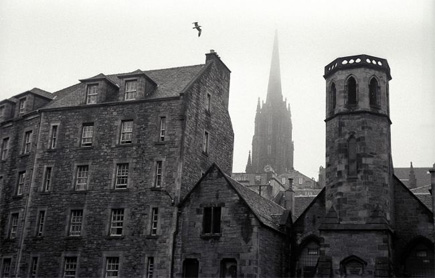
In a (very) short story called “The Antipodes and the Century,” author Ignacio Padilla describes “a great Scottish engineer, left to die in the middle of the desert, [who] is rescued by a tribe of nomads.” Upon recovery, the engineer soon “inspires” his saviors “to build an exact replica of the city of Edinburgh in the dunes.”

edinburgh[Image: Edinburgh, as photographed by Jim Webb in 2002].

There, “amidst the rocks of the Gobi,” Padilla writes, Kirghiz nomads are taught “the exact height that Edinburgh Castle must attain, the precise length of the bridge that connects the High Street with Waverly Station, the correct calculations necessary to establish the perimeter of Canongate Cemetery, [and] the true distance between the two spires of St. Giles’ Cathedral.”
With that knowledge – and with lots of rocks – they construct “an elephantine fortress of streets, bridges, and windows.” It is “a shimmering haze of towers” that blends in architecturally with the inferior mirages of the desert horizon.
Until it is buried by a sandstorm, then, this new, replicant Edinburgh functions as “a kind of global map in the very heart of the Gobi Desert,” we read, “a vague though tangible diorama of the cosmos, its center a replica of the Scottish capital.”

(See also Huangyangtan: or, Tactical geoannexation, Part II, at Pruned).