Where’d the road go?: Cool Hand Luke (1967)

[Image: From Cool Hand Luke, courtesy of Warner Brothers].

Breaking Out and Breaking In: A Distributed Film Fest of Prison Breaks and Bank Heists—co-sponsored by BLDGBLOG, Filmmaker Magazine, and Studio-X NYC—continued last week with Cool Hand Luke (1967), directed by Stuart Rosenberg.

The film tells the story of Luke Jackson, imprisoned for “maliciously destroying municipal property” by cutting the heads off parking meters. The very first word and image of the film is VIOLATION.
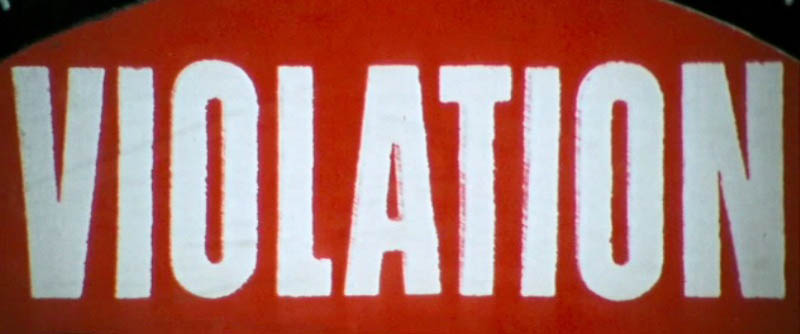
[Image: From Cool Hand Luke, courtesy of Warner Brothers].

Luke is thus arrested and sent to a work camp in Florida, where he becomes, in effect, part of the country’s emerging national transportation infrastructure, paving rural roads through the Florida swamp.

He is immediately introduced to a new set of limitations. “We got all kinds,” the camp warden announces, referring to the prisoners kept behind fences there in the subtropical heat; but all of them have had to learn how to stay put. To this, the warden adds, “in case you get rabbit in your blood and you decide to take off for home,” you’ll be rewarded with more time in prison and a “set of leg chains to keep you slowed down just a little bit, for your own good. You’ll learn the rules.”
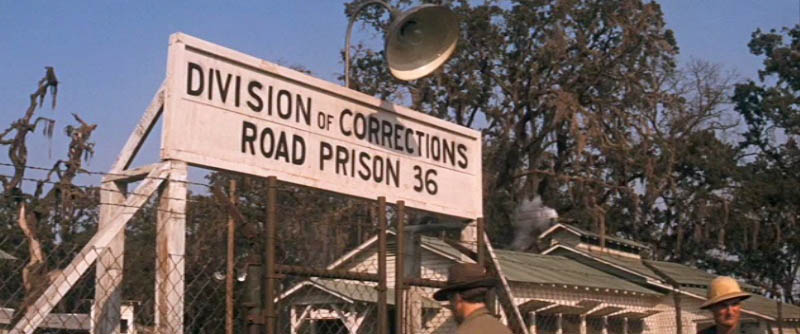
[Image: From Cool Hand Luke, courtesy of Warner Brothers].

Later, Luke meets the camp’s “floorwalker,” a man who keeps watch over the prisoners’ boarding house; the floorwalker unloads an absurd and seemingly endless monologue about how the prisoners can avoid spending “a night in the box,” a small building the size of an outhouse with no pretenses of comfort or hygiene. The list of steps by which to avoid this fate—involving everything from laundry to yard tools—is mind-numbing and absolutely impossible to remember.

When the rest of the camp comes back inside to shower and meet these newly arrived state captives, tension between Luke and the existing group’s ostensible leader, nicknamed Dragline, is established immediately. “You don’t listen much—do you, boy?” Dragline growls, mistaking his own corpulence for an ability to intimidate. Luke barely looks at him in return. “I ain’t heard that much worth listening to,” he mutters. “Just a lot of guys laying down a lot of rules and regulations.”

[Image: The camp; from Cool Hand Luke, courtesy of Warner Brothers].

As such, the film offers an interesting mix of, on the one hand, the surreal impossibility of reasoning with the state and its hired representatives (similar, say, to the writings of Franz Kafka); and, on the other, what seems to be a particularly American breed of libertarianism, one in which even parking meters can be interpreted as “just a lot of guys laying down a lot of rules and regulations,” where all instances of authority are meant to be, if not resisted, than at least publicly mocked and undercut.

[Images: Lucas Jackson meets the blinding lights of the state; from Cool Hand Luke, courtesy of Warner Brothers].

As we’ll see—and this post contains spoilers, for those of you who haven’t seen the film yet—Cool Hand Luke becomes a kind of Trial-like cautionary tale, suggesting that the end result of playfully antagonizing the state can often be repression or death.

[Images: From Cool Hand Luke, courtesy of Warner Brothers].

So Luke, a nonviolent offender, is sent off to pave roads in the heat, clearing weeds and snakes, and otherwise maintaining national infrastructure alongside others in his imprisoned crew. They are, in a sense, tragically ensnared in the geographic project of the state, which seeks to expand ceaselessly into underserved rural areas by means of convict-facilitated construction projects. And thus the nation—brutally, physically, literally—is made.

[Images: From Cool Hand Luke, courtesy of Warner Brothers].

This relentless growth of the well-policed roadway is perhaps the film’s central motif—even above the film’s admittedly more entertaining scenes, such as Luke living up to his own challenge of eating 50 hard-boiled eggs. For instance, in one scene where a particularly manic Luke successfully challenges the rest of his crew to treat the day’s road-paving assignment like a race, they’re left confused and dumbfounded when the tar truck drives away. The inmates are left staring at a STOP sign. “Where’d the road go?” an exasperated Dragline asks, as if they’re now faced with doing nothing.

But that’s precisely it: the only thing left to do is nothing. This recalls how Luke gets his nickname—”Cool Hand Luke”—by bluffing his way to victory in a poker game, holding a hand “full of nothing.”

In any case, Luke responds by laughing at the idiocy of the entire situation. They ran a race against nothing and no one won.

[Image: From Cool Hand Luke, courtesy of Warner Brothers].

For those of you who have seen the film, there is clearly much more in it to discuss that is not spatial or architectural, and I would hope that such a conversation could still take place, either here in the comments or someday with friends; but, given the thematic emphasis of the Breaking Out and Breaking In film series, I’ll focus on just a few more things.

Luke, of course, escapes—three times—but not once, in any long term sense, is he successful, getting hauled back to camp twice in chains.

[Images: From Cool Hand Luke, courtesy of Warner Brothers].

Luke’s various punishments for these attempted escapes grow in severity, suggesting a dark answer to the question proposed by a commenter on an earlier BLDGBLOG post: “How do you design a space to break someone’s spirit? A horrible and unimaginable commission.”

Specifically, Luke first spends “a night in the box” and is then forced—inverting all of the power implications associated with digging, tunneling, and moving dirt that we’ve seen so far in the Breaking Out series—to dig and refill a hole in the prison yard, several times over, effectively breaking his will. At one point he is even pushed back into the hole, as if he has, all along, been digging his own grave.

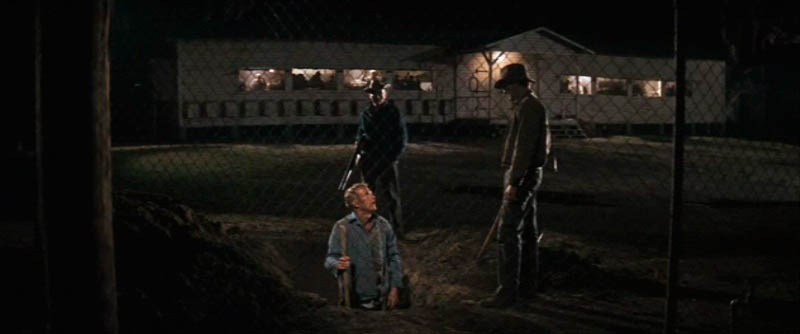
[Images: From Cool Hand Luke, courtesy of Warner Brothers].

After witnessing Luke’s very audible collapse, his fellow inmates refuse to speak with him after he stumbles back to the bunkhouse, as if Luke’s aura of indefatigability has been permanently smudged by this performance of desperate weakness. The “horrible and unimaginable commission” of breaking his spirit has, it seems, been accomplished.

However, Luke has one more escape in him, driving off unexpectedly in a road-servicing truck and disappearing into the parched landscape seen reflected in the mirrored sunglasses of the silent “boss” (and sharpshooter) who watches over him.

[Image: From Cool Hand Luke, courtesy of Warner Brothers].

This, then, will be my final point about the film: in what is otherwise an obvious—even hackneyed—scene, played for all its poetic and metaphoric power, Luke finds himself alone in an empty church at night, unsure of where to run to next. In many ways, this is where the film’s Kafka-esque themes are most clearly foregrounded, as Luke, addressing God for the second time in the film, finds himself simply speaking to empty rafters.

The church is silent, just a bunch of a wood and darkness, and Luke realizes, once and for all, that no one will be answering.
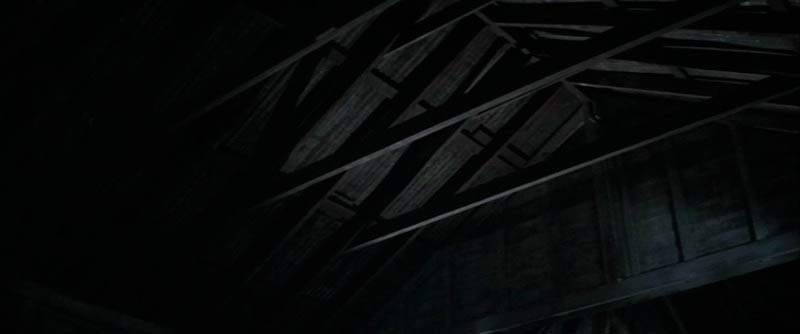
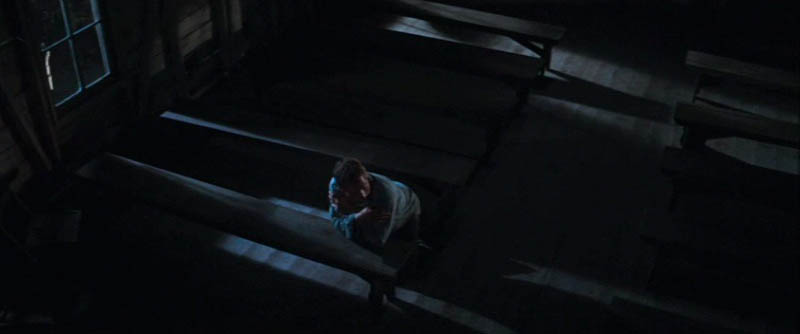
[Images: From Cool Hand Luke, courtesy of Warner Brothers].

Again, this is far from dramatically original, but the scene strongly benefits from its proximity to Luke’s earlier solicitations of authority. In other words, Luke rattles the doors of the divine only to find no response—he finds an empty room and silence. But, when he rattles the doors of the state, an altogether different and more mundane body of authority, it responds by crashing down upon him, relentlessly and absolutely, ultimately leading to his death by sharpshooter (inside the door of a church, no less).

What began as a nonviolent prank, cutting the heads off parking meters, ends, in effect, with a death sentence, as Luke’s ongoing antagonism of the state is seen not as a playful engagement with arbitrary authority, but as an offense so grave—a bluff with an empty hand, holding nothing—that Luke’s very existence is, we might say, reneged or cancelled out. And when he calls up to God, he hears nothing.

[Image: From Cool Hand Luke, courtesy of Warner Brothers].

Briefly, I’m reminded of the extraordinary film The Story of Qiu Ju, in which a Chinese villager calls upon the machinations of the state in order to solve a matter of local justice, only to find, to her growing dismay, that she has set into motion something incoherent, lumbering, deaf, and unstoppable.

Only, here, Luke is at the receiving end of something Qiu Ju only witnesses—as if he has snapped the trip-wire of the state, becoming lethally ensnared in a system from which escapes are punishable by death, no matter how trivial the initial offense might be.

[Image: Luke’s apotheosis, ascending above the cross of the roadway; Cool Hand Luke, courtesy of Warner Brothers].

In any case, Cool Hand Luke is, in the end, a strangely affecting film, seemingly more tragic each time I see it; but I’m sure there’s much more to discuss, so feel free to jump in with any thoughts or comments.

(Up next: Breaking Out and Breaking In continues with Cube. Complete schedule available here).

Cropped

Photographer Gerco de Ruijter—previously seen here for his aerial photographs of tree farms and his pigeon’s-eye-view cinema of the city—has edited together a short stop-motion animation from satellite views of circular crop irrigation systems in the U.S. southwest.

The resulting film seems to promise a strange new form of time-keeping, with the irrigation equipment itself ticking like a stopwatch, but this is never, in fact, realized. Instead, the effect is more like watching a record spinning wildly on its platter, like a planetary-scale version of Bartholomäus Traubeck’s music played from tree rings, where the stylus has been applied to the abstract patterns of human agriculture.

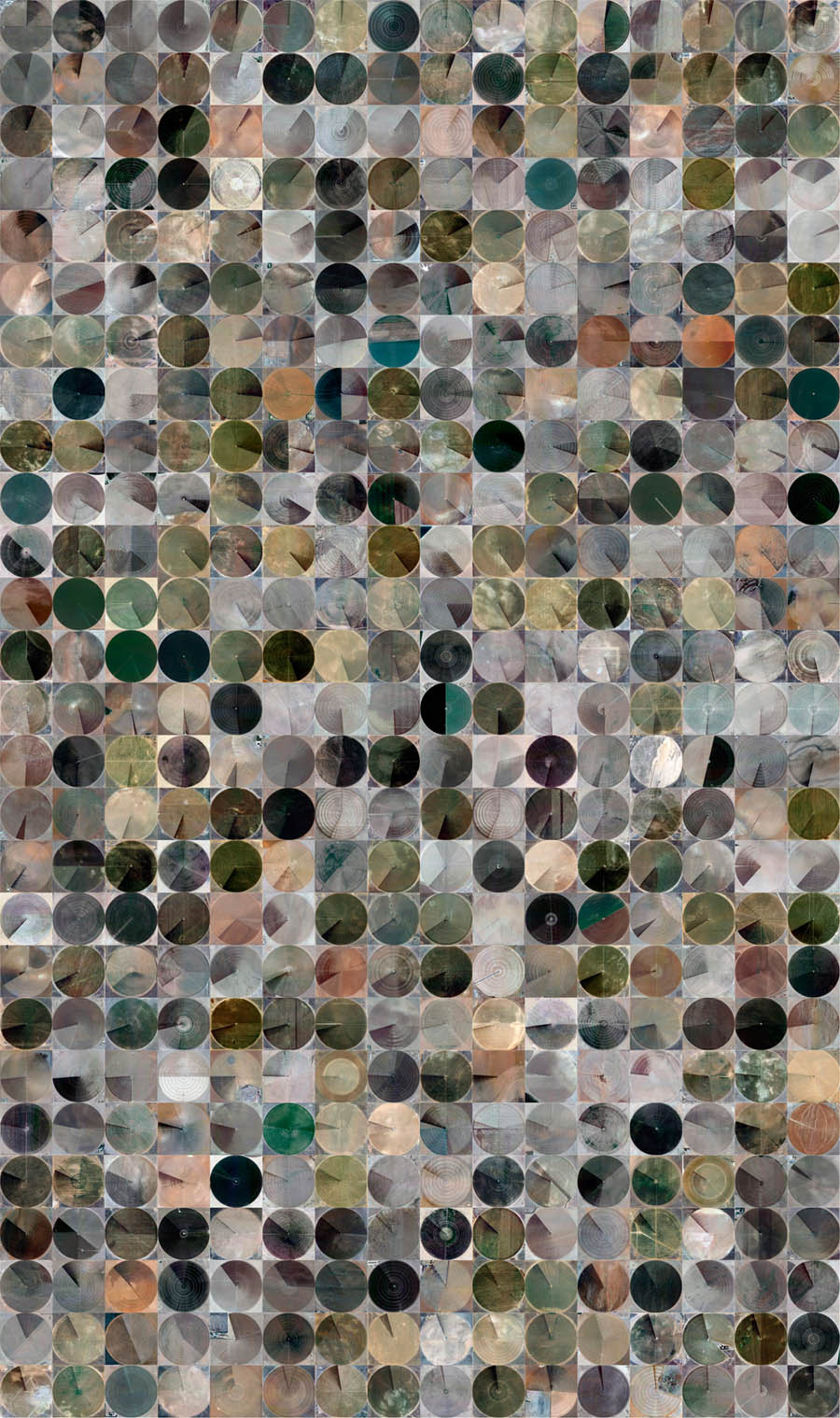
[Image: The source images for Crops by Gerco de Ruijter].

De Ruijter also sent through the source images, above, used as stills—centered and cropped, playing on the film’s title—in the resulting animation.

Forensic Flowers

Two quick botanical stories in the news:

1) A short piece in The Scientist profiles artist Macoto Murayama, who “began applying the computer graphics programs and techniques he had learned while studying architecture at Miyagi University of Education in Sendai to illustrate, in meticulous detail, the anatomy of flowers.”

[Image: A flower by Macoto Murayama, via The Scientist].

Murayama physically dissects flowers in his studio, uncovering what he calls their “hidden mechanical and inorganic elements”; he then “sketches what he sees, photographs it, and models it on the computer using 3dsMAX software, a program typically used by architects and animators. Finally, he creates a composition of the different parts in Photoshop, and uses Illustrator to add measurements and other labels.” See more at The Scientist.

2) Archaeologists in Israel have used pollen trapped in plaster to reconstruct a “luxurious garden created by the Persians.” Their method reads like a rejected pitch for Jurassic Park 4: “Using a specialised technique for separating fossilized pollen trapped in the layers of plaster found in the garden’s waterways, researchers from Tel Aviv University’s Sonia and Marco Nadler Institute of Archaeology have now been able to identify exactly what grew in the ancient royal gardens of Ramat Rahel. By examining the archaeological evidence and the likely settings of specific plants they have also been able to reconstruct the lay-out of the garden.”

The hydrologically complex landscape, as reimagined by the archaeologists, was able to support a huge variety of species, including “ornamentals such as myrtle and water lilies, native fruit trees including the grape vine, the common fig, and the olive and imported citron, Persian walnut, cedar of Lebanon and birch trees. Researchers theorize that these exotics were imported by the ruling Persian authorities from remote parts of the empire to flaunt the power of their imperial administration.”

It would be interesting to reconstruct Central Park based solely on pollen grains trapped inside the painted walls and debris-filled lobbies of ruined hotels of a semi-submerged New York City 2,000 years from now. A Nobel Prize in Landscape Forensics.

(See also: Detection Landscapes).

The Pop It Up

The whole pop-up phenomenon just got a bit more literal, with the debut of tiny robots inspired by pop-up books.

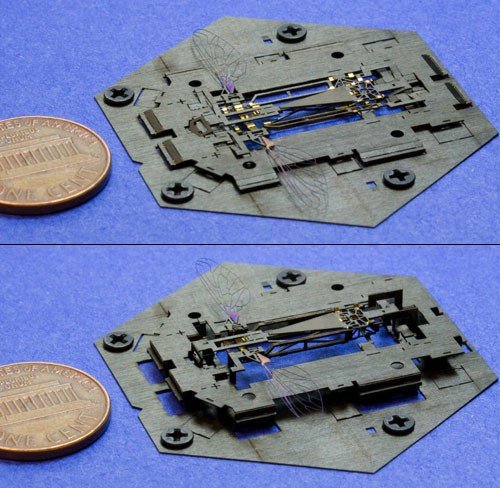
[Image: The pop-up robot sheet, developed at Harvard].

Equal parts origami and electrical engineering, each robot “has 137 folding joints,” PopSci explains. “The assembly scaffold, which has folds of its own, performs 22 origami-style folds, resulting in a fully formed robot you can pop out and turn on.”

Science Daily points out that this “will soon allow clones of robotic insects to be mass-produced by the sheet.”

[Image: A close-up of the pop-up sheet, courtesy of Harvard].

The system, developed at Harvard, “works by combining all the robots’ component layers, [and] sandwiching each piece of metal or carbon fiber into a single sheet. First each layer is laser-etched into the proper design, and the sheets are laminated together. The end result is a hexagonal sheet with a small assembly scaffold, with the whole thing the size of a U.S. quarter.”

On a wildly different scale, and relevant only for reasons of formal resemblance, I’m reminded of Bernard Khoury’s B 018 project in Beirut, a nightclub that “comes to life in the late hours of the night when its articulated roof structure constructed in heavy metal retracts hydraulically. The opening of the roof exposes the club to the world above and reveals the cityscape as an urban backdrop to the patrons below.” Prior to that moment of retraction, Khoury’s “building” is more like a highly compressed 2D surface.

[Images: B 018 by Bernard Khoury].

The point of this comparison being to wonder aloud what sorts of pop-up architecture might be possible using the sandwiched components technique described above. What might “soon allow clones of robotic buildings to be mass-produced by the sheet,” if we could export and scale this up to the world of spatial design? 2D surfaces that pop-up—or pull down—into functional buildings.

[Image: A 2005 installation by Do-Ho Suh; photograph by Marcus Trimble].

Buildings that pop up out of city sidewalks; robots that pop up out of those buildings’ floors; smaller buildings that pop up out of those pop-up robots; tiny, insect-sized robots that pop up out of them.

Electric Landscapes

[Image: An otherwise unrelated photo of marsh grass, courtesy of the USDA].

Gardens might soon be power plants, scaled up to whole landscapes generating domestic electricity. “With a tangle of bright red cables spilling out from among the plants’ roots, this grass is wired to the hilt and produces electricity day and night,” New Scientist reports. After all, there is “potential in harvesting electrons released among plant roots” in damp, conductive soil, and this “could eventually generate a significant portion of our domestic electricity needs, making juice that will be even greener than power from solar panels or wind turbines.”

Researchers in the Netherlands have narrowed in not on trees or other charismatic megaflora—not future forests sparkling with electrical storms between branches—but on any plant “with shallow roots that thrives in damp or waterlogged soil where oxygen is scarce.” More specifically, this means marsh grasses and reeds (though we read that “the technology should have particular appeal in Asia, where it could be used to turn millions of hectares of rice paddies into power stations”).

The techniques under study in Holland currently involve a specially designed electrode that can harvest excess electricity from otherwise organic plantlife. But, as various species (sugar beet, rice, marsh grass) are trialled, and as chemically different soil matrices are reviewed, it’s not hard to imagine a forthcoming scenario for landscape design in which genetically-modified plants grown in carefully mixed artificial soils, fertilized with conductive nutrients and finely wired with grids of geotextile mats, become the gardens of the late 21st century. Warm electric landscapes power houses through the darkness of peak oil, as increasingly efficient landscape formats get tested day after day by amateur planters, who rearrange their backyard plots based not on aesthetics but on the potential for electrical interchange.

(Earlier on BLDGBLOG: Shining Path).

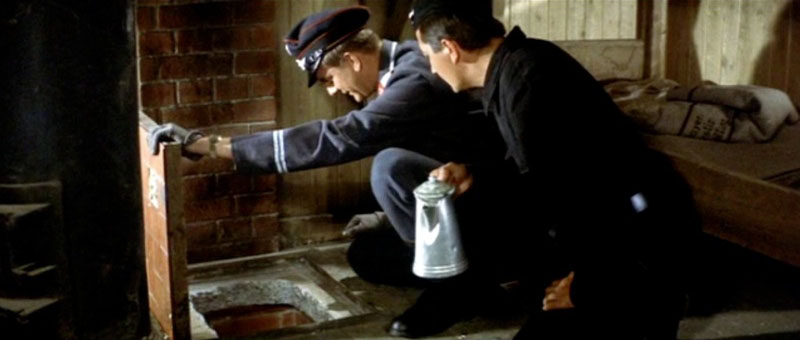
Liberation Terroir: The Great Escape (1963)

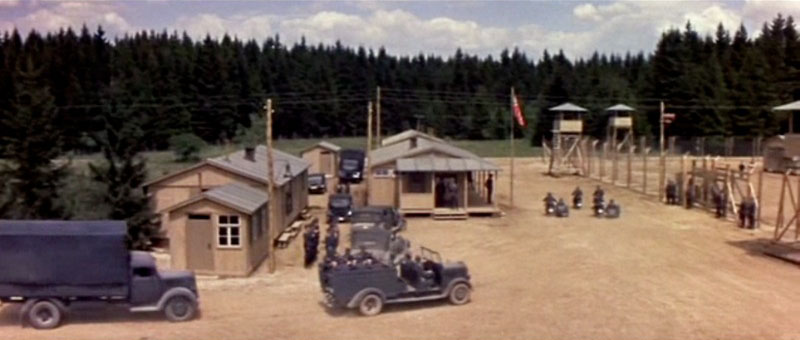
[Image: Stalag Luft III from The Great Escape; courtesy of Metro Goldwyn Mayer].

Breaking Out and Breaking In: A Distributed Film Fest of Prison Breaks and Bank Heists—co-sponsored by BLDGBLOG, Filmmaker Magazine, and Studio-X NYC—continued recently with The Great Escape (1963), directed by John Sturges.

For those of you new to the fest, from January to April 2012 we will be watching a curated series of films at home, then discussing those films online; here is the complete schedule.

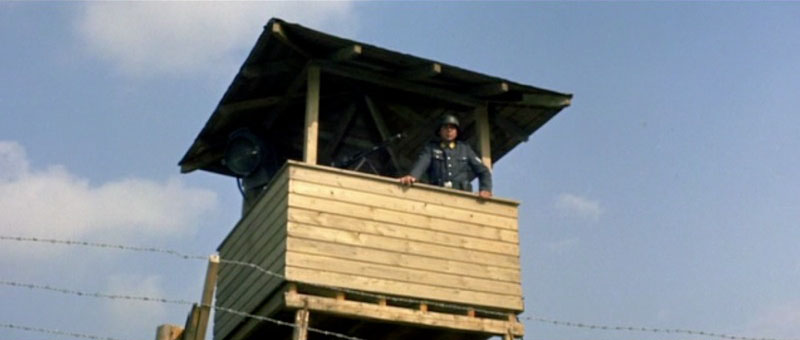
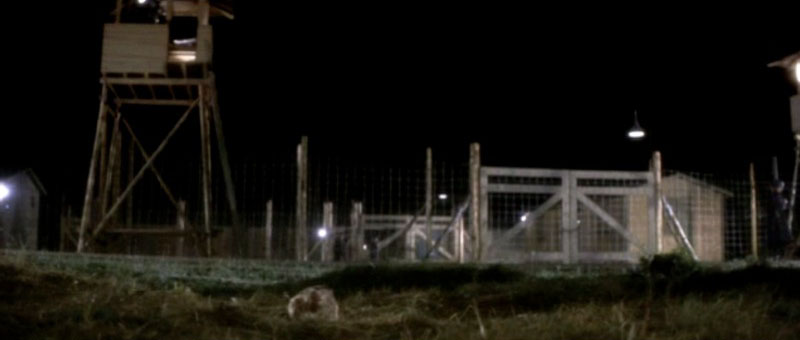
[Image: A guard tower from The Great Escape; courtesy of Metro Goldwyn Mayer].

As usual, I’ll be focusing on the spatial premise of the film, not its directing, characterization, or dialogue; the idea is not to experiment in film criticism but to explore various scenarios of escape.

Also, as usual: there are spoilers ahead!

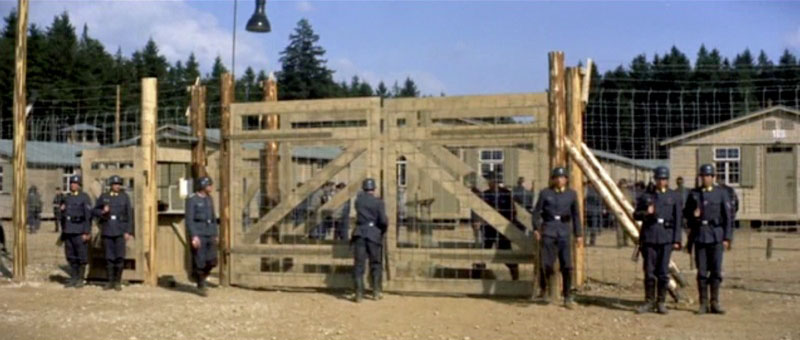
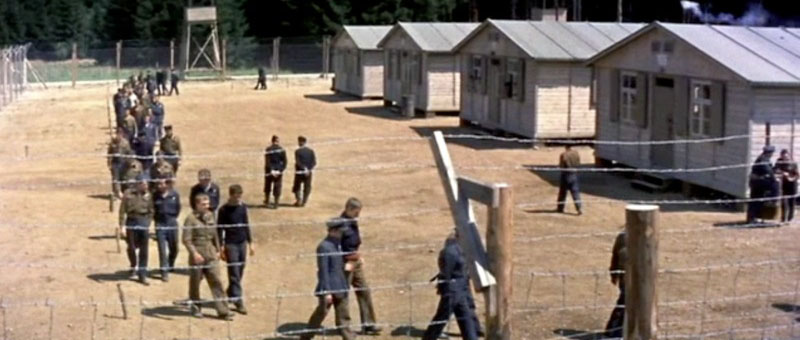
[Images: Establishing the camp; courtesy of Metro Goldwyn Mayer].
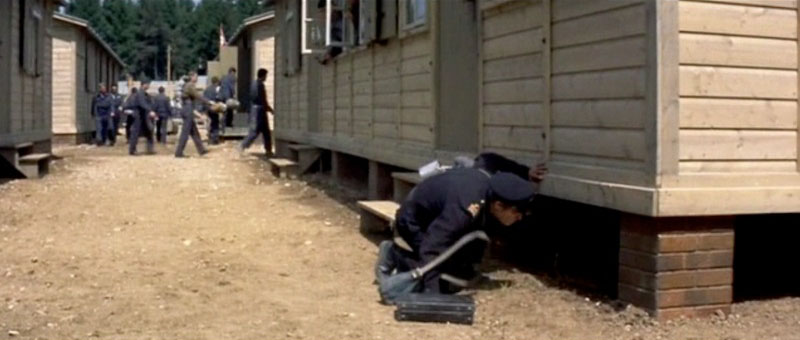
The film opens with the arrival of several truckloads of Allied war prisoners at a well-fortified German camp in the forests of western Poland. The lighthearted and substantially less than serious tone of the film is immediately made clear, however, not only through the jaunty title score but in the actions of the prisoners themselves as they spill out into their new environment.

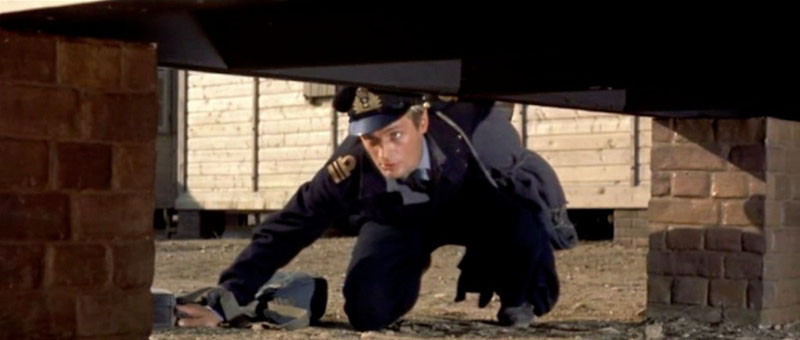
Right away, escape is on their minds; we see them kneeling down to look for weaknesses beneath the boarding houses, scanning the barbed perimeter fence, and discussing the logistics of tunneling out into the woods beyond. In fact, several half-baked attempts at escape are made in the first few minutes of the film.

[Images: Looking for weaknesses; courtesy of Metro Goldwyn Mayer].
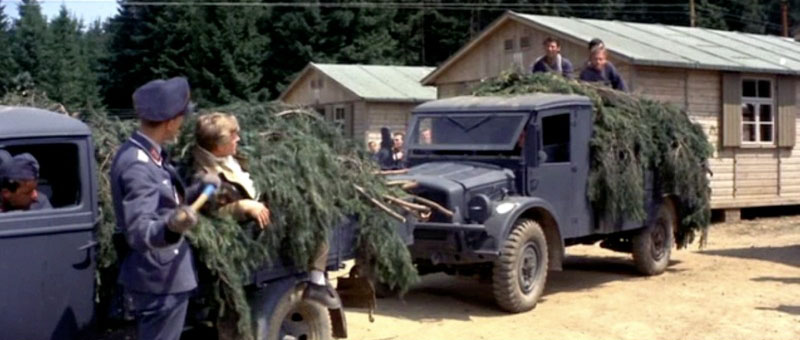
The prisoners disguise themselves as rural day workers, for instance, hoping to sneak out through the front gate, yard tools in hand—but they are spotted right away and sent back. Then several men camouflage themselves beneath forest debris, riding out on trucks under piles of pine branches—before the stabs of a menacing pitchfork convince them to pop out from this botanical ruse and surrender.

[Image: Humans disguised as trees; courtesy of Metro Goldwyn Mayer].

In short order, we learn that the camp was specifically built for these men. Flipping through the files of his newly arrived prisoners, and speaking with obvious exasperation as he reads their dossiers of escape—”escaped, recaptured, escaped, recaptured,” Luftwaffe Colonel von Luger sighs, throwing files across his desk—the superintendent explains that the camp is, in fact, inescapable.

“There will be no escapes from this camp,” he says flatly—to which the British Captain Ramsey replies that “it is the sworn duty of all officers to try to escape. If they can’t, it is their sworn duty to cause the enemy to use an inordinate number of troops to guard them, and their sworn duty to harass the enemy to the best of their ability.”

Escape is part of the soldiers’ contract; it is something they are literally required to try to do.

[Images: Reading the files of failed escapes; courtesy of Metro Goldwyn Mayer].
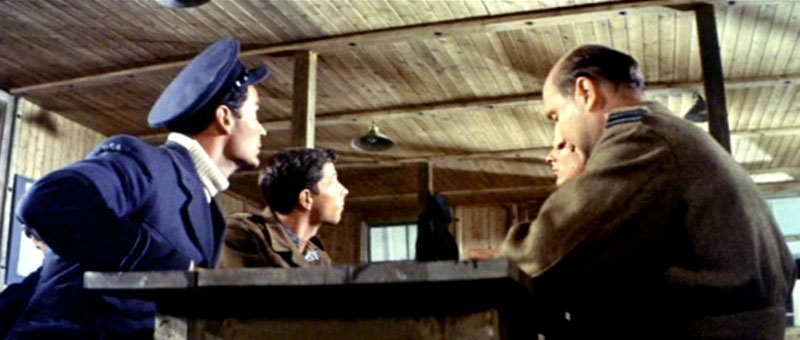
But “it must stop,” the Nazi insists—however, “it is because we expect the opposite that we have brought you here. This is a new camp. It has been built to hold you and your men. It is organized to incorporate all we have learned of security measures. And, in me, you will not be dealing with the common jailer.”

Here, it’s worth recalling that the film is based on a true story, and that the actual camp—called Stalag Luft III—was located for very specific topographical reasons, as if applying the concept of terroir to prison construction. More specifically, the sandy soil upon which the camp was built was seen as all but impossible to tunnel through.

Last month, on his fantastic blog Through the Sandglass, geologist Michael Welland discussed the film’s geology of escape: “The prisoner of war camp was built, intentionally, on the sandy soils of the forests of today’s western Poland, along the banks of the Bóbr river. Intentionally, because the river valley is filled with sandy sediments deposited from melt waters of the Ice Age glaciers and carried by the ancestral Bóbr. And sand is difficult to tunnel through. Very difficult.” Additionally—and much more visibly—”the excavated sand from the tunnels was immediately visible if deposited against the darker topsoil” outside, which leads to one of the escapees’ more interesting innovations.

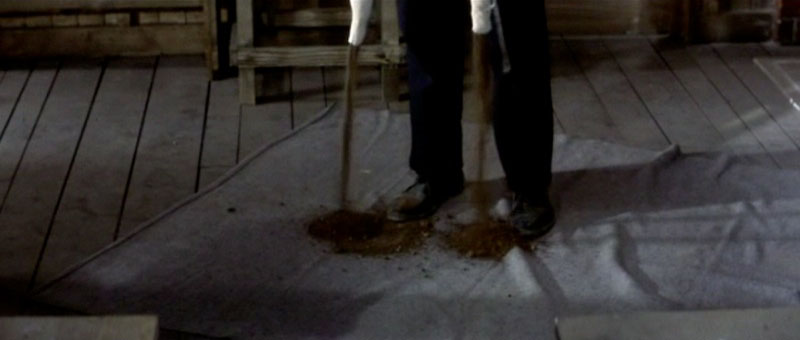
[Images: The relaxing technique of soiling a garden down your pant legs; courtesy of Metro Goldwyn Mayer].
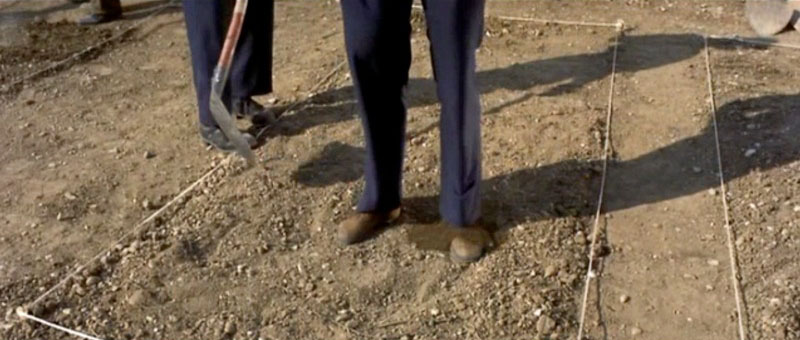
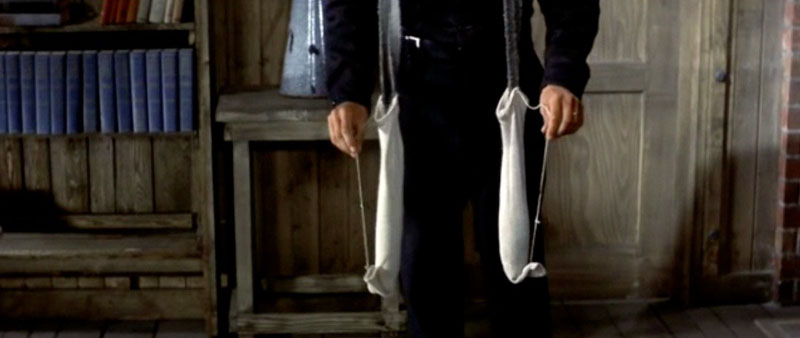
One of the British POWs fabricates a kind of illicit earth-moving garment meant to be worn inside the prisoners’ trousers; filled with dark soil from the tunnels soon underway beneath the boarding houses, these string-operated bags can be dumped surreptitiously into the gardens outside. This is reminiscent, of course, of the garden scene in Grand Illusion, which we watched last month, but it also allows for the oddly comic sight of prisoner after prisoner walking out into the garden, only to evacuate this terrestrial excess down their pant legs, literally soiling the sandy ground.

But this is not the only method the prisoners use for getting rid of surplus soil. In a surreal scene inside the camp’s erstwhile cafeteria and study hall, exaggerated shudders begin to pass through the roof of the building, lurching and convulsing as if in an earthquake—which, in a sense, is exactly what’s happening, as we learn that the diggers have begun storing their dirt above the rafters in the attic of the hall. Alas, the unbelievable rolling seismicity of this scene is the last we see or hear of this comically artificial tectonic activity.

[Image: James Garner looks up with alarm as artificial earthquake waves shudder through the roof; courtesy of Metro Goldwyn Mayer].
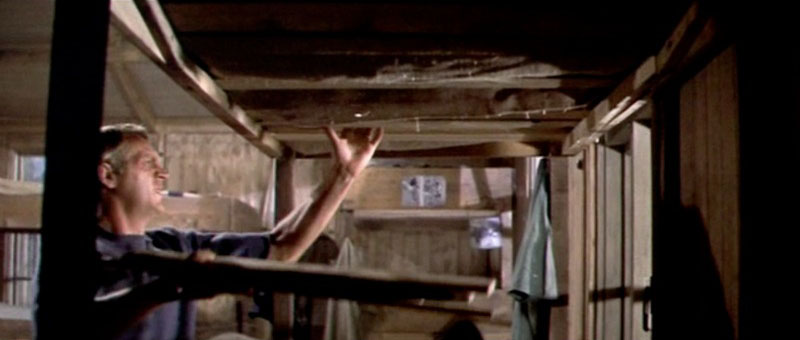
Which brings us to the buildings.

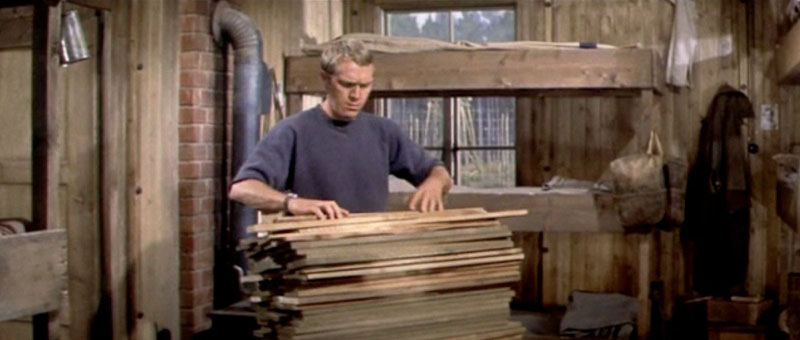
As in A Man Escaped, we see that, by dismantling the everyday environment in which we are trapped, we might reveal hidden tools of escape—and then to assemble ways out. In this case, the boarding houses are taken apart from within, their wooden planks strategically removed so as not to induce structural collapse (save for one scene involving an over-enthusiastic campmate collapsing through his newly weakened bed frame).

In the architectural equivalent of cutting hair with thinning scissors, the buildings are lightened of their wood, which is then taken below ground and assembled into bracing for the tunnels.

[Images: Steve McQueen as erstwhile Matta-Clark of the camp; courtesy of Metro Goldwyn Mayer].

As all this unfolds, the tunnels expand below.

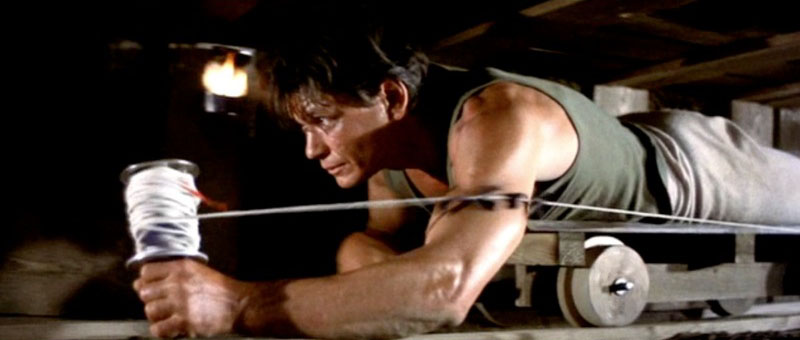
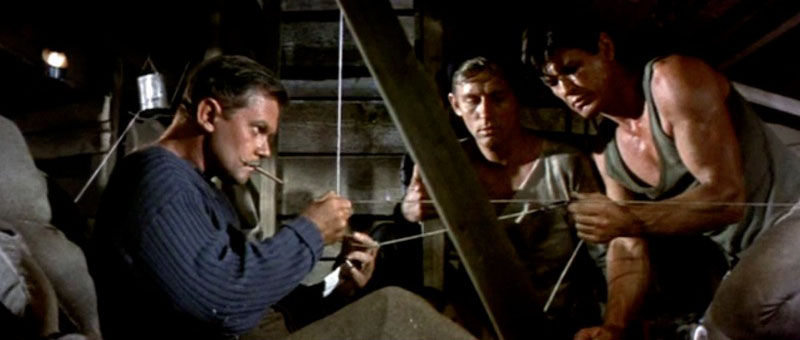
In a well-composed shot, we see Charles Bronson—who has been unspooling string from one end of the tunnel to the other—join two fellow diggers to form a kind of string trigonometry at the tunnel head. Using a plumb bob and pencil, they—incorrectly, as we learn later—determine the tunnel’s length.

[Images: Measuring the tunnel; courtesy of Metro Goldwyn Mayer].
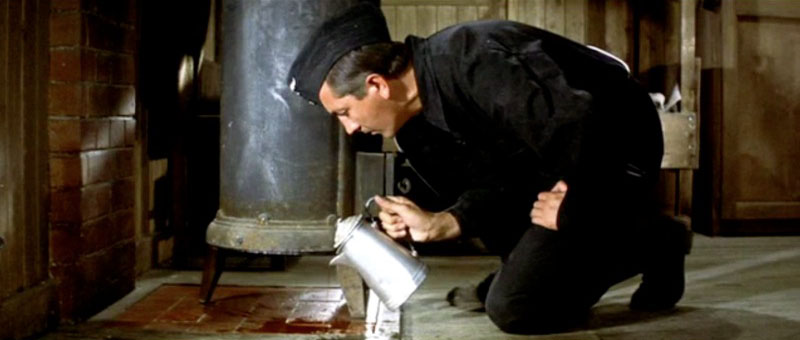
But it’s all for naught. The tunnel (one of three simultaneous excavations) is soon discovered. One of the Nazi guards inadvertently reveals it when he spills tea onto the floor of a boarding house kitchen; the water rapidly drains down through the tiles without trace, indicating some sort of void below. And into the void go the Nazis.

[Images: Discovering the tunnel with tea; courtesy of Metro Goldwyn Mayer].
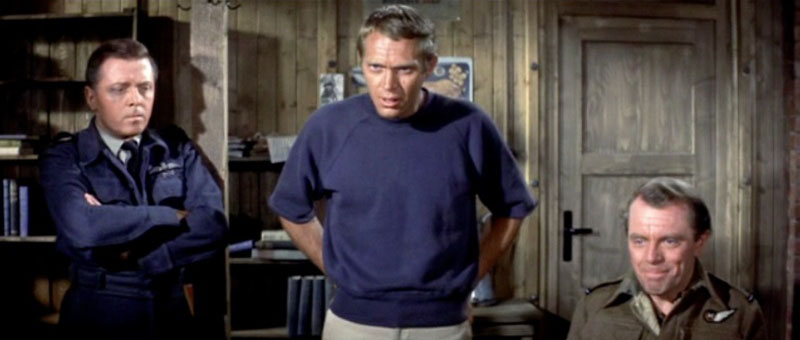
In any case, I could recount the events of the film ad nauseam, as its procedural tracking of the tunneling process—which, luckily for the prisoners, included two other escape routes from which to choose next—lends itself well to description. But I’ll instead just make a few final points, and then recommend that you check out the movie yourselves:

At one point early in the film, Steve McQueen’s baseball-tossing character, Captain Virgil Hilts, proposes an absolutely idiotic method of escape, in which he and a fellow inmate will literally burrow through the earth “like moles,” passing the dirt behind them, one at a time, as if swimming breaststroke through the solid matter of the planet. After detailing his ridiculous idea, McQueen self-confidently juts his head forward, making a kind of monkey face, as his future collaborator tries not to laugh beside him.

[Image: Steve McQueen wants to burrow through the earth like a mole; courtesy of Metro Goldwyn Mayer].
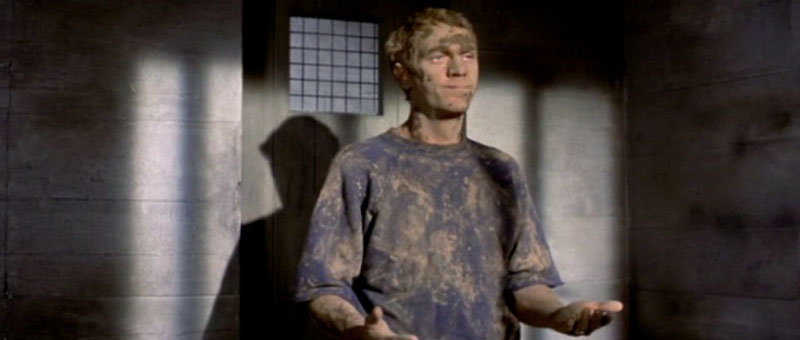
Unsurprisingly, however, the plan doesn’t work.

[Image: Steve McQueen’s mole fantasy remains tragically unfulfilled; courtesy of Metro Goldwyn Mayer].
Captain Hilts and his Scottish sidekick are almost immediately recaptured and sent to “the cooler,” a building filled with unfurnished concrete cells (perhaps foreshadowing McQueen’s role in Papillon a decade later).

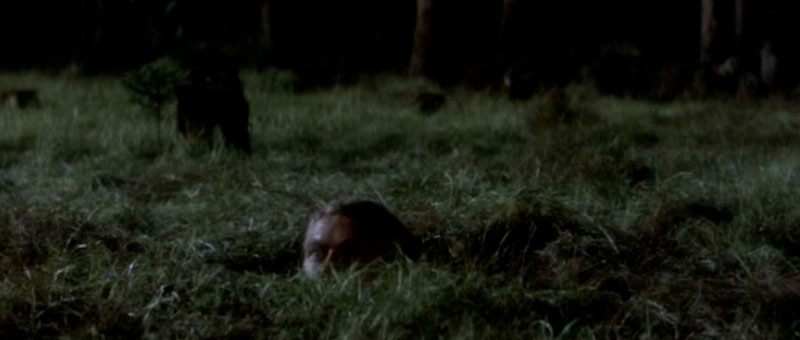
But fear not! Oh, ye McQueenites. Captain Hilts later finds his odd terrestrial fantasy indirectly fulfilled when he has an opportunity to pop his head up out of a hole in the earth—like a mole!—and look back at the camp from which he is about to escape. He is beyond the camp’s perimeter, though there is still a long way to go.

[Images: Steve McQueen as topography: the actor’s head emerges from the surface of the earth; courtesy of Metro Goldwyn Mayer].
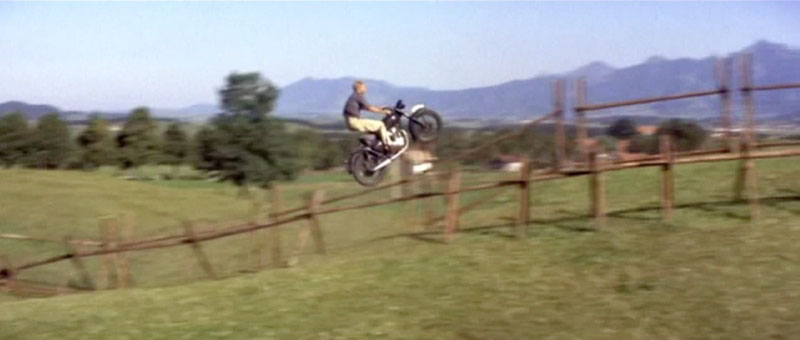
Later, with freedom nearly within his grasp and his fellow inmates scattered throughout the Polish and German countrysides, McQueen tries to jump a stolen Nazi motorcycle over a barbed-wire border into Switzerland.

[Image: Border games; courtesy of Metro Goldwyn Mayer].

But that, too, does not work, and McQueen is thrown back into the cooler.

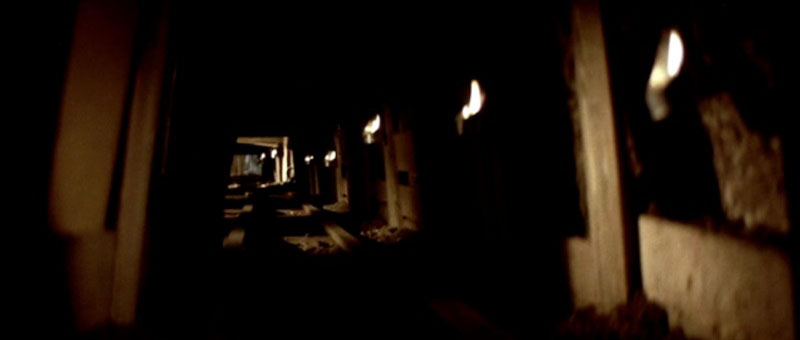
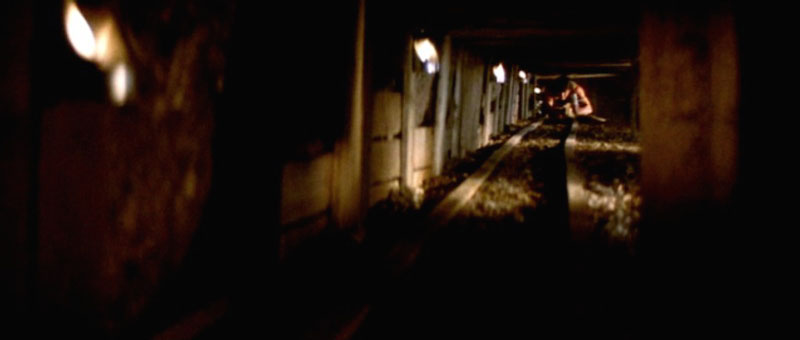
The rest of the film is peppered with counterfeit documents and rewoven clothes, secret desks inside tabletops and cupboards full of smuggled foods, homemade potato whiskey and, all along, the spaces of the tunnels themselves, three simultaneous acts of excavation that, in their real-life versions, were a “legendary feat of engineering,” according to the New York Times.

[Images: One of the tunnels; courtesy of Metro Goldwyn Mayer].

As that article goes on to explain, a team of “British-based engineers, battlefield archaeologists and historians” recently tried to repeat the feat of digging these tunnels, producing a “replica tunnel” to test their theories of how the originals were created:

The team’s task was to employ “reverse engineering” by uncovering the tunnels and what remained of the tunnelers’ jury-rigged equipment to replicate the wartime fliers’ ingenuity. Ultimately, the team members were stunned that, even without the menace of the ever-watchful Nazi camp guards, they were unable to match their wartime counterparts fully, particularly in the most crucial skill, digging a tunnel 30 feet below the camp surface without repeated collapses of the sandy soil above.

The archaeological side of this 2011 investigation revealed the extent of the “improvisational engineering” we mentioned earlier, whereby everyday spaces and objects are dismantled and reassembled into tools of escape. For instance, the archaeologists uncovered “a set of rusting trolley wheels, the metal scavenged from remnants of a campsite stove and a coil spring taken from prison gramophones; wood paneling for the tunnel’s roof and sidewalls, fashioned from the prisoners’ bed boards; and a ventilation pump with a bellows and piping made from a prisoner’s kitbag, ice hockey sticks and tins of powdered milk. The pièce de résistance was a rusting radio made from a biscuit box, the wiring stolen from the prisoners’ huts and batteries scrounged from German guards.”

For more, check out the film itself.

(Thanks to Peter Smith for pointing out the New York Times article when it first came out! Up next: Escape from Alcatraz on Friday, February 17; posts about Cool Hand Luke and Papillon are forthcoming soon).

Initial Points

[Image: Initial Points: Anchors of America’s Grid at the Center for Land Use Interpretation].

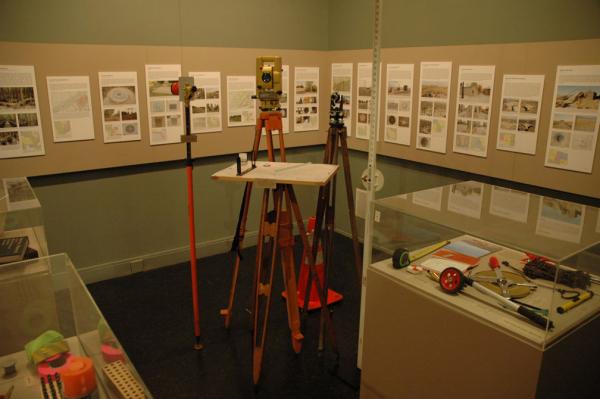
A new exhibition at the Center for Land Use Interpretation opened last week, called Initial Points: Anchors of America’s Grid, produced in collaboration with the Institute of Marking and Measuring.

Through maps, surveying devices, and other artifacts from the process of land marking and measurement, the exhibition “depicts and describes the 37 Initial Points of the Public Land Survey System, the rectilinear grid that covers more than two thirds of the landscape of the USA. These surveying points, located in places such as swamps, under manhole covers, in roads, and on top of mountains, are the physical locations that tie this grid to the ground. Looking at them in a contemporary context explores the process and importance of the endeavor of surveying, and reveals a latent cadastral history of the nation as it expanded westward.”

[Image: A view of the exhibition at CLUI].

An earlier program at CLUI looked at U.S./Mexico border-survey markers, which documented 276 “obelisks” placed at the very limit of the nation, monumentalizing and literalizing a particular vision of state territory.

Initial Points—foregrounding the tools and training that allow state delineation or what we might call “ground control”—is on display until April 15, 2012.

How to dismantle your door: A Man Escaped (1956)

[Image: From A Man Escaped (1956), courtesy of the Criterion Collection].

Breaking Out and Breaking In: A Distributed Film Fest of Prison Breaks and Bank Heists—co-sponsored by BLDGBLOG, Filmmaker Magazine, and Studio-X NYC—continued last week with Robert Bresson’s A Man Escaped (1956). Spoilers ahead!

Bresson’s film tells the story of Fontaine—a French prisoner held by Nazis in a prison in occupied Lyon—and it operates through the “close scrutiny of salient details,” in Roger Ebert’s words. Fontaine himself becomes an avid student of the prison interior, always looking askance for points of weakness. This has the effect of explicitly foregrounding the space of confinement in which Fontaine is held, including, as we’ll see, the objects in the cell with him, deemphasizing characterization in favor of an intense focus on architectural setting. Ebert continues:

In this way, we watch Fontaine examine his cell. We know it as well as he does. We see how he stands on a shelf to look out a high, barred window. We see how the food plates enter and leave, and how the guards can see him through a peep hole. We see the routine as prisoners are marched to morning wash-up.

Amongst these daily routines, we also watch Fontaine slip a note into a fellow prisoner’s pocket. What does the note say? “The exit route from the building and how to dismantle your door,” Fontaine whispers.

[Image: From A Man Escaped (1956), courtesy of the Criterion Collection].

As usual, I want to focus only on specific spatial details, in keeping with the premise of Breaking Out and Breaking In, so I’ll just make two quick points.

1) Breaking out, in A Man Escaped, occurs through the strategic dismantling and reassembly of all designed objects that aren’t architecture. Blankets are cut down to strips then rewoven into rope, finally wrapped and strengthened with wire from the bedframe. The hinges of a small cupboard door are bent and refashioned into grappling hooks. A mere spoon—then another—is sharpened to a chisel with which to cut through the soft wood of the cell door.

It’s as if the tools of escape are, in fact, already hidden all around us, disguised as the overlooked equipment of everyday life—the mundane bits of furniture, clothing, and internal ornament that, provided we teach ourselves how to reassemble them, will lead to an unparalleled state of post-architectural liberation. Put another way, the limits of architecture are exposed by everything normally stored inside it.

[Image: From A Man Escaped (1956), courtesy of the Criterion Collection].

2) The other obvious detail is the film’s overriding non-visual dimension—that is to say, the sound design of solitary confinement.

From the coded coughs of fellow inmates to the banister-tapping approach of a particular guard, and from the reciprocated wall-knocks passed prisoner to prisoner to the soundscape of the final escape itself—with the other-worldly grinding gears of a patrol bicycle and the marching feet on gravel that betray a guard who the escapees might not otherwise have seen—the prison is more an acoustic environment than a visual one. Even the timing of Fontaine and his last-minute assistant, as they scamper across the prison rooftop, is coincident with the passing of a nearby train, using the sonic effects of urban infrastructure as camouflage for their actions.

They thus navigate from ring to ring, passing steadily outward, carrying reconstructed ropes made from bedding and forcibly recurved grappling hooks, arming the building’s contents against the building itself, disguised by the sounds of a city into which they successfully disappear.

(Earlier: A Prison Camp is for Escaping. Up next: watch Cool Hand Luke on Monday, February 6; for the complete Breaking Out and Breaking In schedule, click here).

Making Planning Popular

[Image: Making Planning Popular on display at the RCA in London].

For those of you near London, you have one more day to see David Knight’s Making Planning Popular on display in a group show called GRIST at the Royal College of Art. I’m a huge fan of Knight’s work—an ongoing research project on the strange terrains both encouraged and required by local planning ordinances—and he’s thus become a regular referent here on the blog.

[Image: The manifesto from Making Planning Popular].

Specifically, Making Planning Popular “aims to encourage greater popular knowledge of how the built environment is, or could be, produced.” Accordingly, “David is showing a manifesto, recent articles and essays, and a series of case studies chosen from his growing database of arcane, marginalized, or forgotten planning practices. This work will in time form a popular history of planning”—publishers, take note!—”one in which such practises are brought back to life to explore their relevance to today’s environment, in the belief that putting planning knowledge back into popular culture will lead to a more democratic built environment.”

[Images: Excerpts from David Knight’s “growing database of arcane, marginalized, or forgotten planning practices,” part of Making Planning Popular].

Above are some examples of these case studies; but stop by the RCA before the end of the day on Monday, February 6, to see more. Here’s a map.

Object Cancers

There was a lot of talk last week about the emergence of “physibles,” or downloadable data sets hosted on the Pirate Bay that would allow (potentially copyrighted) objects to be reproduced at home by 3D printers. The idea is that we won’t just share music files or movie torrents, but actual physical objects; I could thus print an IKEA table or a Quistgaard peppermill at home, without ever purchasing an original object.

[Image: A printer known as the Replicator].

Bruce Sterling wrote about just such a scenario in his 2008 novella Kiosk, suggesting that a new “poetry of commerce” would arise in the form of infinitely repeatable, unregulated surrogate objects churned out by desktop factories.

Among many other things about this story, what caught my attention was the specific detail that you could scan any object you happen to have on hand; you could then upload that dataset to a kind of eBay of physibles; and, finally, someone on the other side of the earth—or sitting right next to you—could print out their own “pirate” version. As New Scientist writes, however, we might soon soon see a corporate response in the form of what could be called physible rights management—based on, even repeating, certain aspects of the misguided digital rights management (DRM) policies associated with MP3s. This would mean, for instance, “placing a marker on objects that a 3D scanner could detect and which would stop it operating” (though such marks, the article quickly points out, can simply be covered over with tape or otherwise occluded); in fact, we read, a similar such system is “already used to prevent banknotes from being photocopied.” The article then mentions other forms of watermarks and “marking algorithms,” detectable only by machines, that could be inscribed onto object surfaces, like invisible hieroglyphs of protection, so as to interfere with those objects’ being scanned.

The corporate response to the robot-readable world, mentioned earlier, is thus a kind of robot-blocking world.

In any case, what seems more provocative here, on the level of design, would be to appropriate this protective stance and reuse it in the design of future objects, but emphasizing the other end: to allow for the scanning of any object designed or manufactured, but to insert, in the form of watermarks, small glitches that would only become visible upon reprinting.

We could call these object cancers: bulbous, oddly textured, and other dramatically misshapen errors that only appear in 3D-reprinted objects. Chairs with tumors, mutant silverware, misbegotten watches—as if the offspring of industrial reproducibility is a molten world of Dalí-like surrealism.

[Image: Misprinted objects by Zeitguised and Matt Frodsham].

Put another way, the inadvertent side-effect of the attempted corporate control over objects would be an artistic potlatch of object errors: object cancers deliberately reprinted, shared, and collected for their monstrous and unexpected originality.

Landscape Architecture for Machines

One of the more interesting sub-conversations at last fall’s Art + Environment Conference at the Nevada Museum of Art revolved around the question of whether or not the future of landscape architecture would be for humans at all—and not for autonomous or semi-autonomous machine systems that will have their own optical, textural, and haptic needs from the design of built space. As highway signage networks are adapted to assist with orienting driverless cars, for instance, we will see continent-spanning pieces of infrastructure designed not for human aesthetic needs but so that they more efficiently correspond to the instrumentation packages of machines.

We touched on this a few weeks ago here on BLDGBLOG with the idea of sentient geotextiles guiding unmanned aerial vehicles, and London-based design firm BERG refers to this as the rise of the robot-readable world. I was thus interested to see that Timo Arnall from BERG has assembled a short video archive asking, “How do robots see the world? How do they extract meaning from our streets, cities, media and from us?” Arnall’s compilation reveals the framing geometries—a kind of entoptic graphic language native to machines—and directional refocusings deployed by these inhuman users of designed landscapes. Future gardens optimized for autonomous robot navigation.