Project Runway

A recent landscape design competition sought to rethink the Vatnsmýri airport grounds in Reykjavík, Iceland, putting those old runways to use, for instance, as new urban park space. The entries to the competition are quite interesting, in fact, so I’ve posted some of them, below, focusing on one particular project at the end of this post (so please scroll down if you’ve already read about this competition).
First, then, here’s the old Vatnsmýri airport and its earthen geometry of intersecting runways. This is the site – star-like and stretching out to its surrounding landscapes – within which the designers had to work.

[Images: The Vatnsmýri airport grounds, Reykjavík, Iceland. Photos courtesy of the Reykjavík City Planning Committee].

And here are some of the project entries, which I have posted in order, from shortlisted entries through to the big prize winners – but I have selected them on the purely superficial criterion of my own visual interest. Some of these projects, including two grand prize winners, are, I’m sure, absolutely fascinating, but small JPGs of their proposals simply don’t give you very much to work with.
So, with genuine apologies to those designers whose work does not appear here, take a look at some of the entries.

[Image: By Alexander D’Hooghe, et al.].

[Image: By Antonello Boatti, Birgir Breiðdal, and Nicola Ferrara].

[Image: By Lola E. Sheppard and Mason White].
[Image: By Rolf J. Teloh, et al.].

[Image: By Thomas Forget and Jonathan F. Bell].

[Image: By Andrés Perea Ortega, et al.].

[Image: By Beatriz Ramo, et al.].

[Image: By Peer T. Jeppesen, et al.].

[Image: By Belinda Kerry, Andrew Lee, Fiona Harrisson, and Blake F. Bowers].

[Image: By Manuel Lodi, et al.].

[Image: By Jeff Turko, Guðjón Þór Erlendsson, Dagmar Sirch, and Sibyl Trigg].

[Image: By Graeme Massie, Stuart Dickson, Alan Keane, and Tim Ingleby].

And now I want to zero-in on one of the projects.
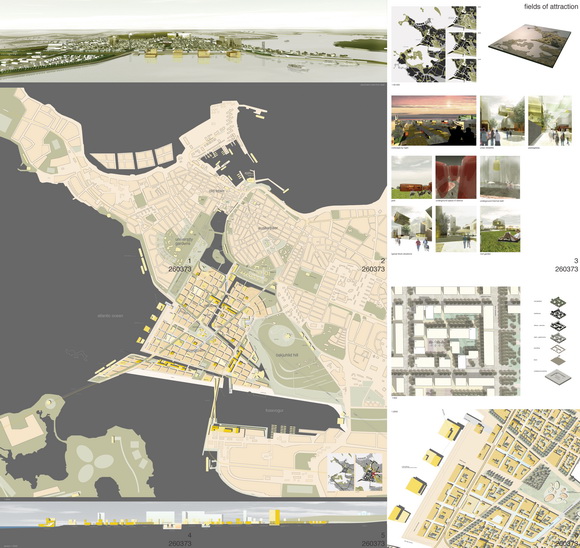
Here, then, is a quick exploration of a shortlisted entry by Lola E. Sheppard and Mason White of the Toronto-based firm Lateral Architecture.

[Image: By Lola E. Sheppard and Mason White].

Their project begins, we read, “by establishing ‘no-build’ zones or public landscapes. The figure of the runway is used to identify three primary axes. Each former runway is converted into a ‘greenway’ that uses a quality of the city as its primary trait.”
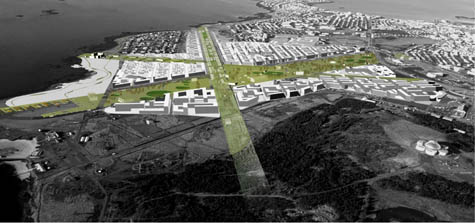
[Images: By Lola E. Sheppard and Mason White].

The greenways are then given new programs, or functions, which the architects define as Ecology, Recreation, and Production.
The Ecology greenway, for instance, “is conceived of as a dot-matrix of cellular ecosystems, organic rooms, landscape surfaces of hard and softscape, gardens and pools.”

[Images: By Lola E. Sheppard and Mason White].

The Production greenway, which I like quite a lot, has been “treated as a barcode of interdependent production activities, with changing densities of fish farming, greenhouses for fruit, vegetable and flower production, allotment gardens, markets and tree farming.”

Fish Farms are located on the western end of the strip and serve both a local populace through an adjacent market and an international market with a distribution port. A series of greenhouses line the edges of the existing runway and create cluster of outdoor ‘rooms.’ Interspersed are modest community garden and farm plots which subdivide the space and integrate the adjacent communities into the strip. A second market, proposed at the triangle intersection, serves to sell these vegetables and flowers to the Reykjavik community. A dense forest continues the barcode and creates wood for the initial construction phases. This forest gains more permanence in successive phases and is used to absorb carbon dioxide and offer oxygen to the new development.

All of which sounds great to me. There is even a “network of geothermal pipes” that does something or other for the fish farms.
But how spectacular to live in a city full of greenhouses! Re-formatting architectural interiors to grow fruit. You wander around at night through certain districts of your city watching strange plants grow behind glass. The air smells alive. It’s quiet.
And there are fewer cars – because entire streets have been blocked off and replaced with greenhouses, freeing up former parking lots to become orchards and small croplands. Microfarms. Perhaps new coastal rivers even cut through the city, engineered by heroic valves tucked away beneath the streets, irrigating various neighborhoods and responding to lunar tides.
What used to be highway flyovers are now orange groves, and over there, in the abandoned airport, fields of medicinal flowers now grow.

[Image: By Lola E. Sheppard and Mason White].

On a vaguely related note, meanwhile, my own description here has reminded me of the discovery last winter that listening to birdsong might actually improve mental health. So imagine ten thousand new birds up in the trees of this greenhouse city as the sun begins to rise over huge warehouses walled with angled glass panes, like something out of analytical Cubism, and you’re just sitting there eating toast with local honey, listening to morning birdsong, surrounded by plants.

[Image: By Lola E. Sheppard and Mason White].

In any case, the final greenway proposed by this project would be a “recreation corridor” in which “spaces for formal and informal activities” will be built, including “soccer fields, running tracks, basketball, tennis and volleyball, local schools and playgrounds.”

[Image: By Lola E. Sheppard and Mason White].

The greenways will all knit together and criss-cross, following the buried logic of the old runways.
In ten years’ time, you can take your kids out into the middle of a forest and say: “They used to land planes here…”

(All of these images are also available in a small Flickr set).
Going Up

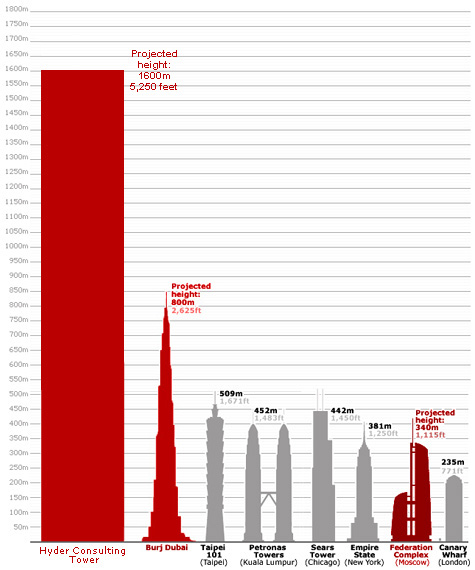
The structural engineers over at Hyder Consulting have announced that they are planning what will be, by an overwhelming margin, the world’s tallest skyscraper, coming in at double the height of the Burj Dubai – or very nearly one vertical mile. The firm has “confirmed that the tower would be located in the Middle East region,” we’re told, “but would not give any further details.” So is it just a media stunt?
I decided, nonetheless, to alter an old BBC diagram about the world’s tallest buildings to give myself a sense of what this might mean, size-wise; the results appear above. I have to assume that the building’s actual profile will not resemble what I’ve created… but you never know.
Note the comparative size of the Empire State Building.

(News item spotted on Archinect – where we’re reminded of Frank Lloyd Wright’s Mile High Illinois project).

Flying-in the Bat House under military escort

[Image: A submission to London’s recent Bat House Project by Andrew Brown, Gareth Jones, and James Falconer; view larger].

The above project, by Andrew Brown, Gareth Jones, and James Falconer, proposes “a home for bats in London.” It was produced for the Bat House Project, the stated aim of which was to highlight “the potential for architects, builders, home-owners and conservationists to work together to produce wildlife-friendly building design. It connects the worlds of art and ecology to encourage public engagement with ecology issues.”
This is pretty old news, of course – but I just saw this particular design yesterday, and I have a thing for architecture delivered from the sky, dropped off by what appear to be military helicopters.
I’d like to see a short, inspirational video in which a dozen U.S. families are standing in a cul-de-sac. Everyone’s hair is whipping to and fro – and there are helicopter gunships flying overhead, dropping off complete Toll Brothers homes. The houses are ready for inhabitation, complete with pots and pans, pillows and sheets. There are five bedrooms, and three and a half baths. Wives are hugging wives; men are cheering.
The slow motion thud of helicopter blades fills all audible space.
The video ends.

Prosthetic Delta

[Image: 3d-printing new deltas into existence, courtesy of New Scientist].
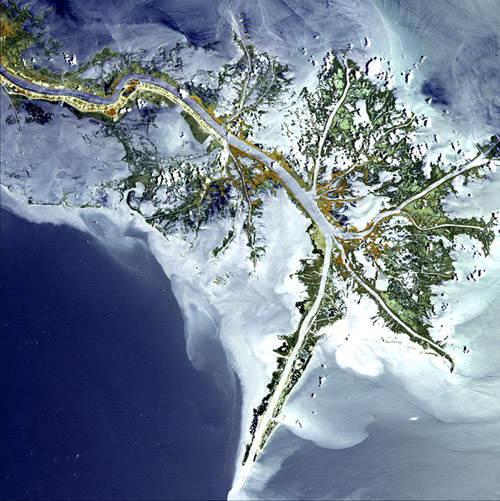
If we could divert certain segments of the Lower Mississippi River into subsidiary canals, we’d “create up to 1000 square kilometres of new wetlands between New Orleans, Louisiana and the Gulf of Mexico, forming a vital storm surge buffer against hurricanes,” New Scientist reports.
It’s prosthetic deltas as the future of landscape design:

The proposed diversion would cut breaches into a levee some 150 km south of New Orleans, Louisiana, and 30 km above where the river empties into the Gulf of Mexico. With the diversions in place, flooding would cause the river to empty into shallow saltwater bays on either side of the river, releasing sediment-rich water to produce new deltas.

As Robert Twilley of Louisiana State University phrases it: “You keep the sediment within the coastal boundary current that keeps it running along the shoreline, whereas now it gets ejected into the Gulf.” This thus constructs “new delta land” instead of uselessly shooting all that sediment over the continental shelf – and that newly aggregated land, like a literal land bank, will help protect New Orleans and its surrounding parishes from future hurricane damage.

[Image: Courtesy of the Center for Land Use Interpretation].

But I’m left wondering if this might not also imply some new form of 3D printing, using river sediments as ink and machine-controlled deltas as printheads: you open certain valves, gates, and locks according to predetermined schedules, in some massive inhabitable printhead complex run by the local flood control board, and you can print deltaic land into existence, at will, moving peninsulas here and there, forming islands, atolls, archipelagos, all through the directed sediments of the Mississippi River… It’d be a kind of horizontal spray-gun, bringing terra nova into existence.
For what it’s worth, meanwhile, my wife and I have co-authored a chapter in a forthcoming book called What Is A City?, published by the University of Georgia Press, in which we talk at great length about these sorts of post-Katrina hydrological projects – including the use of genetically-modified marshgrasses to anchor artificially dredged fill, in a more or less complete deterrestrialization of the earth’s surface. Or, to use a bad pun, you could say that these projects are literally outlandish.
Finally, don’t miss the show up now at the Center for Land Use Interpretation, Birdfoot: Where America’s River Dissolves Into The Sea.

The end of the Mississippi River Delta – the Birdfoot – is a national landscape of disintegration, a fractal labyrinth of dendritic channels, a blend of water and earth, bisected and rerouted by linear, engineered forms of pipeline canals and levees. The people who live and work here, beyond the reach of roads, do so tenuously, in a delicate, disappearing place that is battered by hurricanes, and eroding into the sea.

The closing date for the exhibition is not available.

Asleep beneath the Northern Lights

[Image: Photo by Doug McKinlay, courtesy of The Observer].

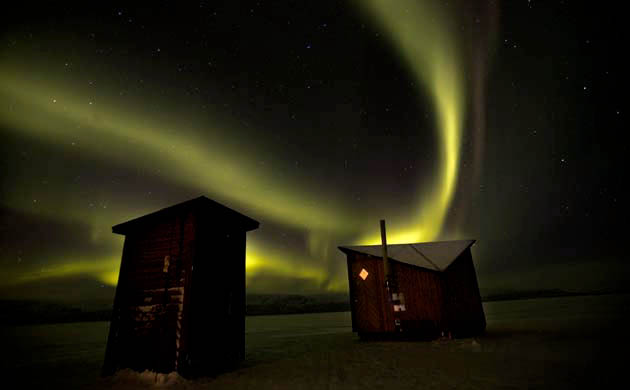
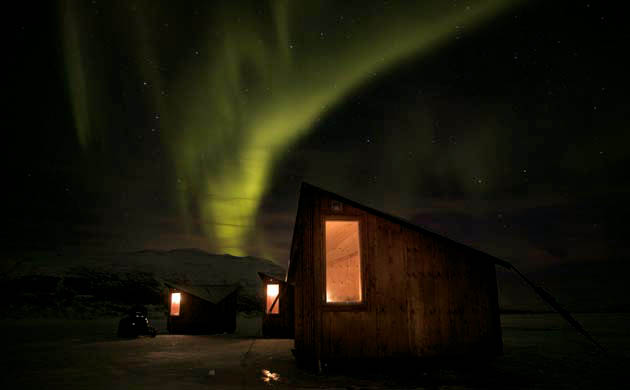
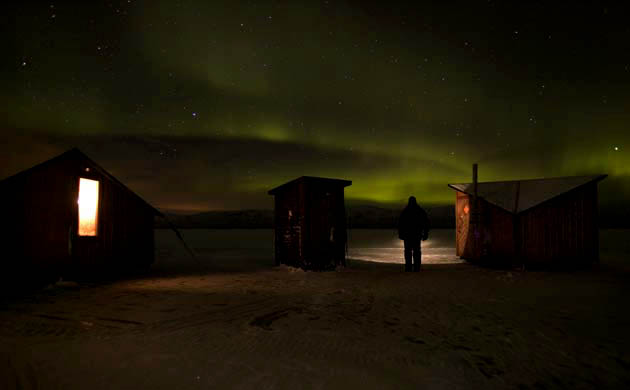
“Deep in the Arctic Circle,” we read, there is “a remarkable hotel made up of fishing huts on a frozen lake.” Of course, you don’t check in for the modern amenities: after all, the hotel is more like “a cross between camping and pottering in a garden shed,” Doug McKinlay writes.

Instead, you check in to watch the Northern Lights.

[Images: By Doug McKinlay, courtesy of The Observer].

Called the Abisko Ark Hotel, it’s located 250km north of the Arctic Circle, on Sweden’s Lake Tornetrask. “Guests are expected to bring essentials such as thermal underwear, fleeces and woolly hats, but the hotel provides thick outerwear and heavy snowmobile boots.”

Each hut “is about six meters square and sleeps three comfortably on single beds. The best part is that by each bed is a resealable hole in the wooden floor, allowing guests to fish from the comfort of their down-filled sleeping bags.”

The Hotel Made From Ice

[Image: Photo by Ben Nilsson of Big Ben Productions].

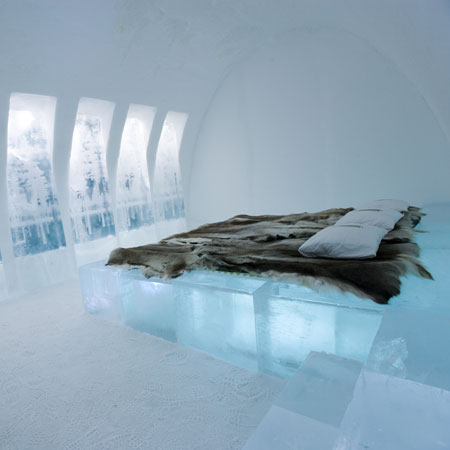
These photos of the ICEHOTEL in Jukkasjärvi, Sweden, just popped up everywhere. I think this might literally be one of the most beautiful hotels in the world. It makes me wonder if architects might someday CNC-mill buildings out of glaciers.
“You sleep in a thermal sleeping bag on a special bed of snow and ice, on reindeer skins,” we read. “You are awakened in the morning with a cup of hot lingonberry juice at your bedside.”

[Images: All photos by Ben Nilsson of Big Ben Productions].
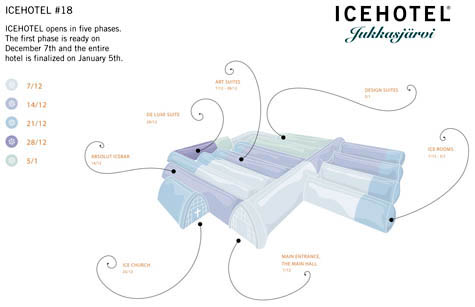
“Breakfast buffet, morning sauna and towels [are] included,” of course – and there’s a restaurant on site, made from ice, serving “whitefish roe, venison and reindeer, cloudberries and arctic raspberries. All transformed into tasty delicacies guaranteed to please the most discerning gourmet.”
This year, the hotel was built with collaborative input from students of Stockholm’s Royal Institute of Technology.

So how is the ICEHOTEL actually built?
“The building process starts in mid-November,” the hotel’s managers explain, “when the snow guns start humming and large clouds of snow start to drift along the Torne River.”

The snow is sprayed on huge steel forms and allowed to freeze. After a couple of days, the forms are removed, leaving a maze of free-standing corridors of snow.

[Image: Photo by Ben Nilsson of Big Ben Productions].
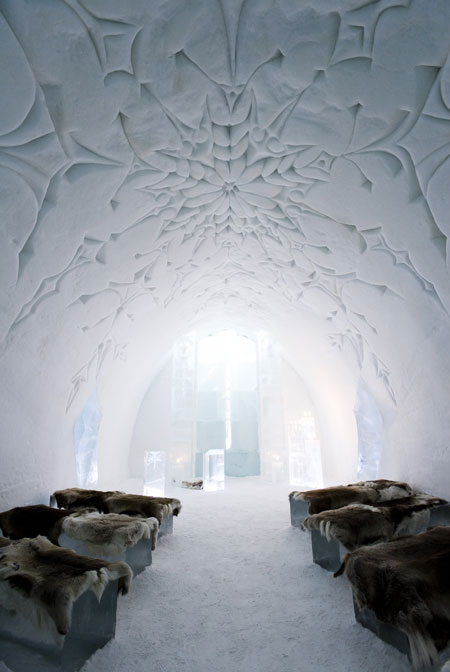
They continue:

In the corridors, dividing walls are built in order to create rooms and suites. Ice blocks, harvested at springtime from Torne River, are now being transported into the hotel where selected artists from all over the world start creating the art and design of the persihable material.

These “corridors of snow,” of course, could be used to form instant cities almost anywhere; with a few “snow guns” and a bunch of “huge steel forms,” you too could build an ICEHOTEL – or an ICECITY, or an ICETOWN, just waiting to be inhabited.
It’s architecture as controlled phase transition: coaxing temporary forms out of what wants to be liquid.
To mis-paraphrase Sanford Kwinter paraphrasing Alfred North Whitehead, we might say that this is an example of Misplaced Concreteness.

[Image: By Ben Nilsson of Big Ben Productions].

In any case, here are some photos of the construction process, documenting how the hotel was made – and here is a price list, in Swedish krona, should you want to book a few nights.
Send me, please!

(Also covered by Dezeen).

Vertical Transport Through Architectural Space

[Image: A cargo elevator beautifully shot by po1yester].

Further proof that elevators have been ignored for too long in contemporary building design – after all, they are moving rooms and could be put to use as something other than mere vertical transport through architectural space – even Harrods, the London department store, is (temporarily) updating its lifts.
According to the Guardian, Harrods is about to open Lifted, “the world’s first exhibition to be displayed in elevators” (a wild over-statement that is, in fact, wrong). The elevator-based exhibition will include work by “Oscar-winning composer Michael Nyman and visual artist Chris Levine.”

Levine’s “Sight” lift will feature a light sculpture using Swarovski crystals and lasers to immerse passengers in mesmerising patterns once the doors close. Nyman’s “Sound” composition aims to trigger feelings of confinement. The “Smell” lift, designed by Aroma Co, emits smells such as pomegranate and fresh laundry via wall-mounted buttons, while the tactile “Touch” lift was devised by the Royal National Institute for the Blind.
The “Sixth Sense” lift, however, created by author and “cosmic ordering” expert Bärbel Mohr, encourages customers to send wishes to the universe and “reconnect with their inner self”.

On an only vaguely related note, meanwhile, I’d be curious to see if you could invert the expected volumetric relationship between stationary floors and moving elevators in a high-rise.
In other words, if elevators usually take up, say, one-twentieth of a building’s internal space, could you flip that ratio – and end up with just one stationary floor somewhere hanging out up there inside a labyrinth of elevators?
You have a job interview on that one, lone floor in a half an hour’s time – but you can’t find the place. You’re moving from elevator to elevator, going down again and stopping, then stepping across into another lift that takes you up four floors higher than you’d expected to be – before you’re going down again, confused. You hear other elevators when you’re not moving, and it’s impossible to locate yourself amidst that system of moving rooms. The only floors you ever exit onto are simply other elevators.
Then, through a coincidence of open lift doors, forming a temporary corridor through space, front and back doors open, stretching off through eight cars at a time, you glimpse the meeting room that you’re even right then supposed to be sitting down in for an interview… and you see people there waiting… but the doors all close and you’re back on the ground floor in no time.
You hear machines, cables, whirring gears.

[Image: Elevator Buttons by Vancouver-based photographer Jason Pfeifer].

Stunned, perhaps mesmerized, and already addicted to that well-machined state of vertically nomadic groundlessness, you smile, hit the UP button, and start again.

(Thanks, Nicky!)

Amsterdam Subcity

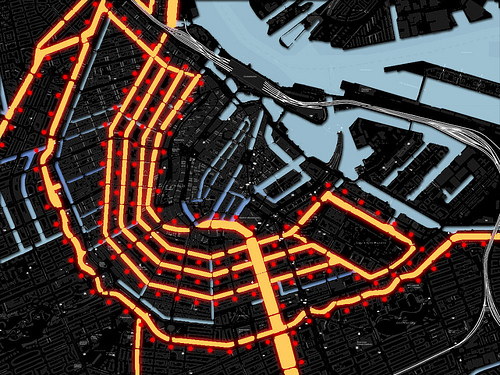
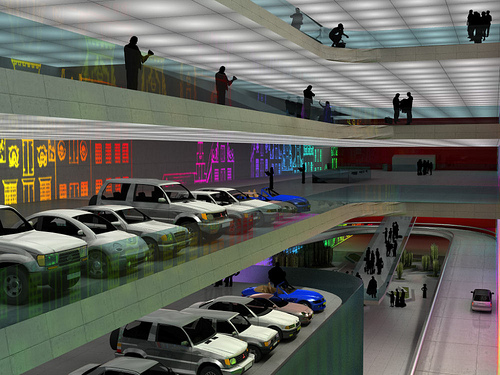
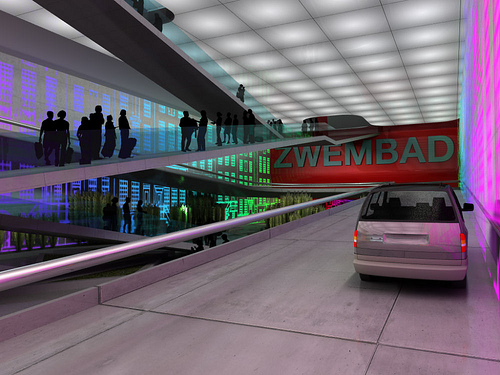
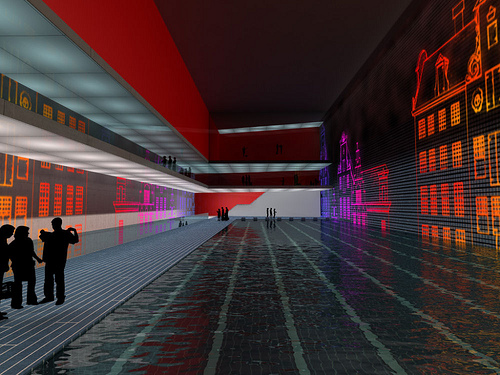
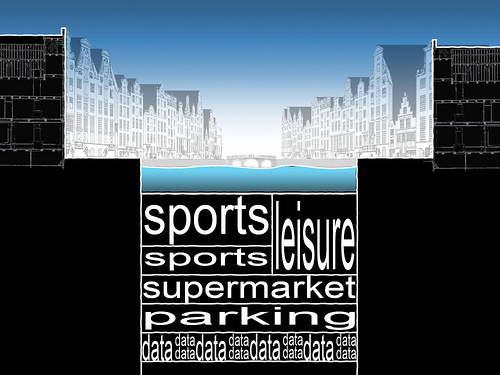
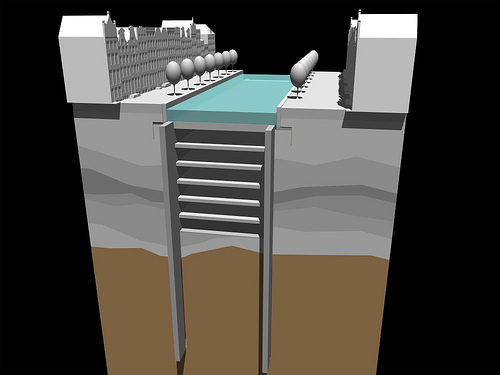
Will the city of Amsterdam soon build “a labyrinth city” beneath its canals?

[Image: A new underground city for Amsterdam, by Zwarts & Jansma].
Maybe so.
According to World Architecture News, “Newspapers around Europe have been reporting on the scheme, which requires the city’s canals to be drained to allow the construction of a vast underground mixed-use complex beneath.”

[Image: Underground Amsterdam by Zwarts & Jansma].

It’s an idea by Zwarts & Jansma architects, whose plans includes excavating “a range of underground facilities… at various levels below the city.”

[Images: Zwarts & Jansma].

Apparently, the project is even technically feasible:

The Dutch capital may be unique as its geology lends itself to the technical feasibility of this scheme. Moshé Zwarts explained, “Amsterdam sites on a 30-metre layer of waterproof clay which will be used together with concrete and sand to make new walls. Once we have resealed the canal floor, we will be able to carry on working underneath while pouring water back into the canals. It’s an easy technique and it doesn’t create issues with drilling noises on the streets.”

But does that mean Amsterdam should really build it? For instance, World Architecture News is quite opposed to the project – yet the Telegraph reports that “the project has been approved by Amsterdam’s city council. Construction work, lasting up to 20 years, is expected to begin in 2018.”

[Image: Zwarts & Jansma].

Maybe they should build it and use it as a penal colony. Imagine the escape attempts – trying to get out of the earth.

(Thanks to Alex Haw for the tip!)

Trash Mandala

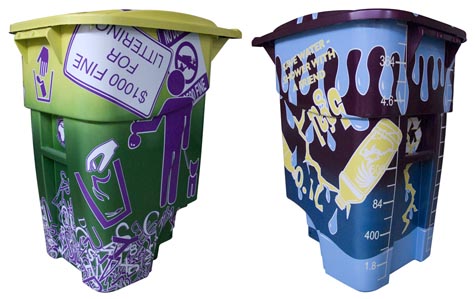
[Image: By Jeffrey Inaba/C-LAB].

Jeffrey Inaba and C-LAB have created this mandala of consumption, refuse, and plastic waste, with one side dedicated to the “hydration compulsion” that helps puts millions of one-use bottles in places bottles aren’t meant to be.

[Image: By Jeffrey Inaba/C-LAB].

There is even a deity of hydration, tempting us with its multi-limbed assortment of tasty beverages.

[Image: By Jeffrey Inaba/C-LAB].

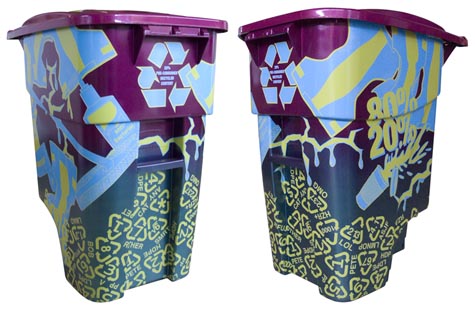
But it’s all part of a new project meant to rethink waste management infrastructure, complete with ironic and colorfully alluring designs for private trash cans.

In this project, the trashcan has been redesigned, and mostly over-designed, to celebrate the taste of suburban culture and to give a form to the can that describes the processes of use, disposal, and management of the things we trash.

The project is thus a look at “our eco-era obsessions that generate trash: the simultaneous rise in environmental awareness and in disposable cleaning goods… the simultaneous rise in global water awareness and the generation of water bottle waste… We made a series of suburban style trash cans to describe these contradictory tendencies.”

The project goes on display today at the Walker Art Center in Minneapolis.

[Images: By Jeffrey Inaba/C-LAB].

Read BLDGBLOG’s interview with Inaba here.

Air Disaster Simulations

[Image: From the series Air Disaster by Richard Mosse].

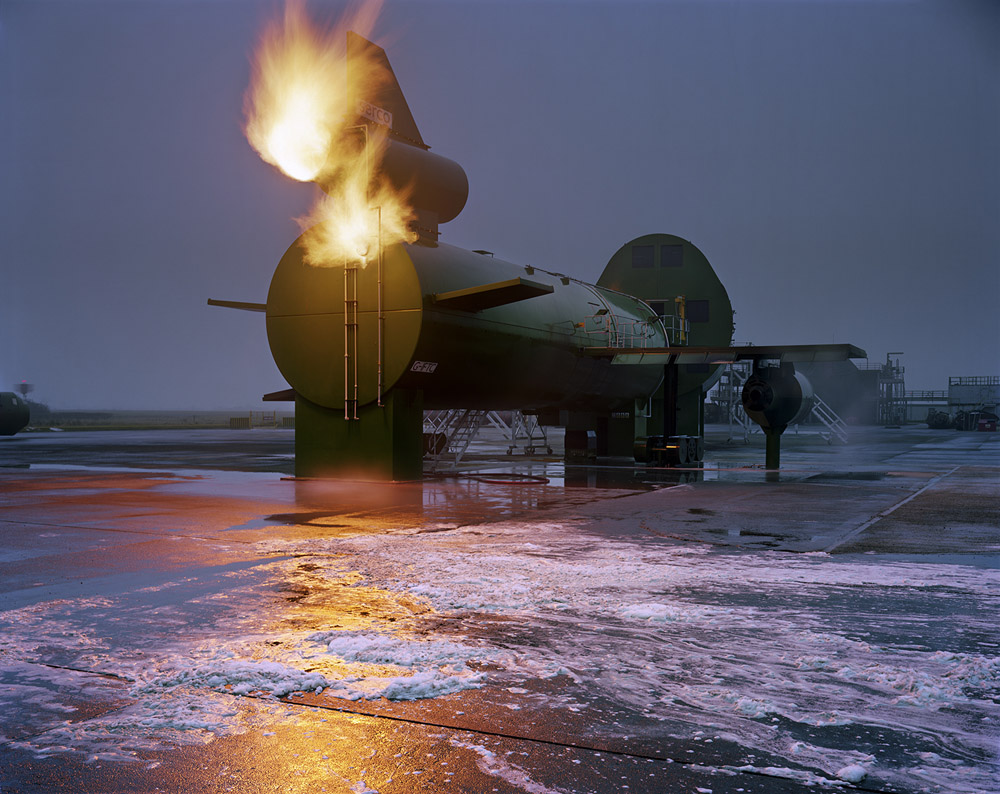
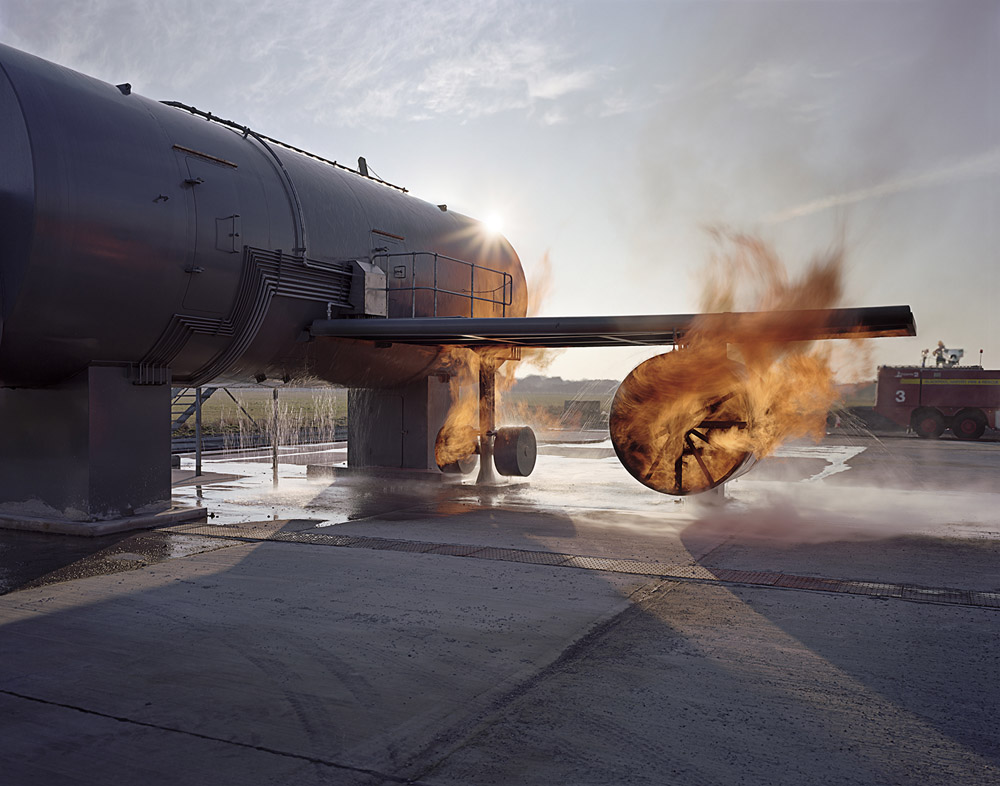
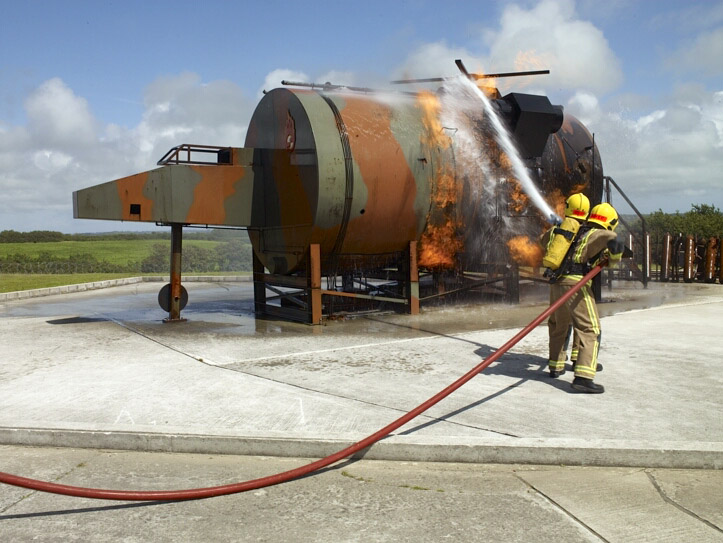
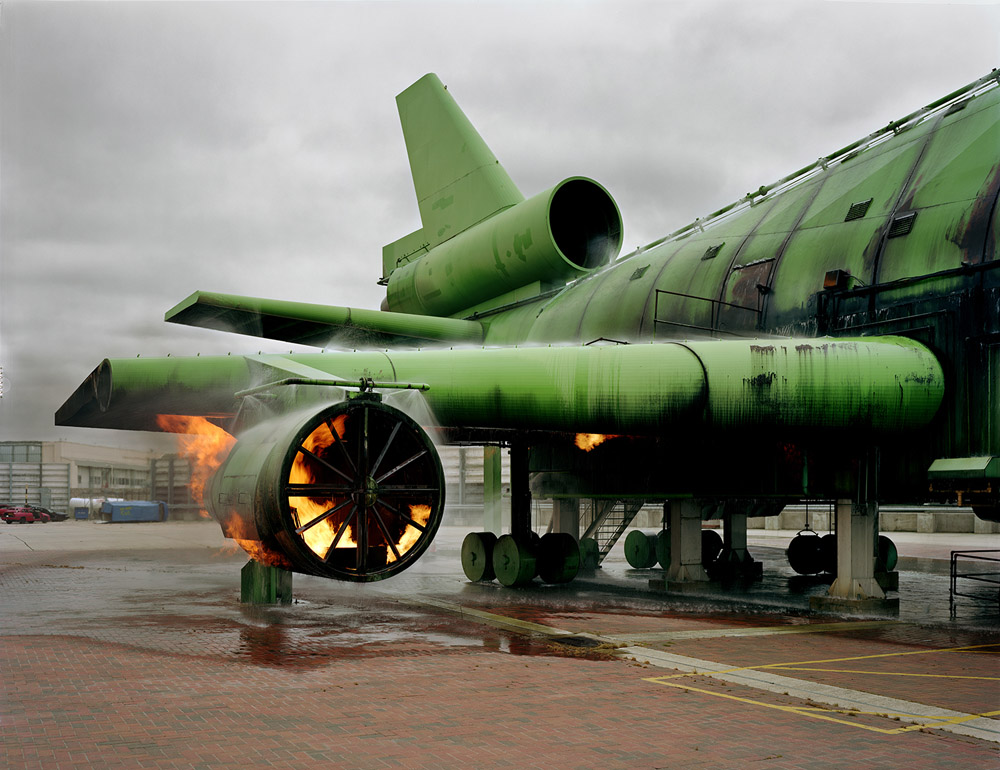
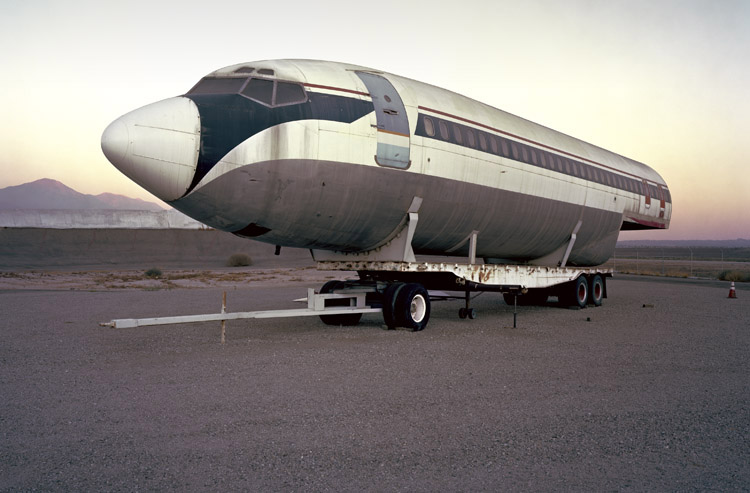
Photographer Richard Mosse got in touch over the weekend with these photographs of air disaster simulations: fire crews racing to put out temporary fires, amidst fake airplane bodies on the runways of airports all over Europe and the United States.
“I spotted my first air disaster simulator on the tarmac at JFK,” Mosse wrote. “You can see it yourself next time you fly into that airport. It’s an intimidating black oblong structure situated dangerously close to one of the runways. Ever since, I have hunted for air trainers while taxi-ing across each new airport that I’ve had the chance to fly into.”

[Images: From the series Air Disaster by Richard Mosse].

When I asked him about the actual photographic process – setting himself up near burning, abstract airplanes in order to get the right shot – Mosse replied: “They are extremely difficult to photograph. First the water jets are turned on to douse the fuselage in water. This is in order to stop the metal warping under the intense heat of the flames. Then a pilot light comes on – and the spectacle begins.”

[Image: From the series Air Disaster by Richard Mosse].

“But before you’ve had a chance to cock your shutter and take the photo,” Mosse continued, “it is all finished.”

The firemen have put out the fire in seconds. That’s their job, after all. They do this with decisive brevity and great courage, sometimes walking right into flames – but it doesn’t make for an easy photograph. It’s all a bit like the sexual act: the flames come up and men run in and spray everything with a high power water hose and then it’s all over.

But that act entails artistry and technique…

[Image: From the series Air Disaster by Richard Mosse].

And each airport is different: “The fire crew at each airport is always fiercely proud of their rig,” Mosse writes.

One crew invited their family along and held a barbeque to watch the training unfold over the course of an evening. Another crew actually let me use their cherry picker bucket to get my camera into position. At one airport, I was even fully equipped to let me work as close as possible to the flames. During one shoot, a Royal Brunei jumbo hit a piece of debris upon take off and the entire crew were mobilized to battle stations. For security reasons, I hid in a small shed while they dealt with the emergency, which they resolved without incident. But that’s why these structures are built: to keep the crew fire fit at all times, always willing to jump into the flames.

It’s a kind of anthropological micro-culture of the air disaster simulation crew, eating barbecued chicken and running through flames.

[Images: From the series Air Disaster by Richard Mosse].

Sometimes mannequins get involved, artificial humans needing to be rescued from situations of extreme peril. Like Ballardian stand-ins, they are scuffed, scraped, and partially blackened by oil and smoke, then surgically repaired with strips of duct tape.

[Image: From the series Air Disaster by Richard Mosse].

Of course, this reminds me of the Center for Land Use Interpretation’s work on law enforcement training architecture, where simulated townscapes play host to staged police raids, fake shoot-outs, and simulated hostage situations. There is even a Laser Village.
As the Center writes: “Whether they are made for police or fire departments, these training sites are stylized versions of ordinary places, with the extraordinary horrors of the anticipated future applied to them on a routine basis.”
One location in particular, the Del Valle Training Center, comes complete with “industrial props (including a portion of an oil refinery), vehicle accident props (including propane-powered bus collisions and a collapsed building prop), concrete slab cutting props, shoring training props, confined space rescue props, and other urban search and rescue facilities.”
Something tells me Richard Mosse would have a field day there.

[Images: From the series Air Disaster by Richard Mosse].

In any case, I asked Mosse what the general idea behind this project was, and he explained that, in all his work, he’s been trying to show “the ways in which we perceive and consume catastrophe.”

The actual disaster is a moment of contingency and confusion. It’s all over in milliseconds. It’s hidden in a thick cloud of black smoke and you cannot even see it. Battles, ambushes, hijackings, air strikes, terrorism: it’s the same with all of these, too. But the catastrophe lives on before the fact and after the fact, as this spectacle. That’s why I wanted to photograph the air disaster simulators; they are the air disaster more than the thing itself. We have built in our airports these enormous, absurd, phallic structures with kerosene jets and water sprinklers. They are monuments to our own fear, made within the pared down, hyper-functional, green and black and grey symbolic order of militarized space.

Mosse has also photographed real plane crash sites:

As for the actual plane crashes, these are also difficult to photograph. You must be prepared to travel immediately in order to photograph one, and you don’t know if you will even be able to get a photograph of it when you get there. For very good reasons, press photographers are always corralled into a pen at a great distance from the disaster. Most photographers take out their longest lens and zoom right in – but I don’t have a zoom lens. I shoot with a wooden field camera, and so I am forced to shoot the disaster in its context, as a landscape photograph. The results end up looking like something approaching early war photography from the 19th century (Roger Fenton, Matthew Brady, Timothy O’Sullivan, etc.).

[Image: From the series Air Disaster by Richard Mosse].

“I think it’s important,” Mosse concludes, “that we understand where catastrophe exists in our cultural imagination – where it actually is in reality – which is why I do what I do.”
Be sure to check out the rest of Mosse’s work on his website, including his photographs of Dubai.