The future warehouse of unwanted books

[Image: The unforgettable final glimpse of a U.S. government warehouse from Raiders of the Lost Ark].

A warehouse is being constructed to house books no one’s reading.

“The warehouse is extraordinary,” the Guardian writes, “because, unlike all those monstrous Tesco and Amazon depositories that litter the fringes of the motorways of the Midlands, it is being meticulously constructed to house things that no one wants.” Those “fringes” are outside London.

“When it is complete next year, this warehouse will be state-of-the-art, containing 262 linear kilometres of high-density, fully automated storage in a low-oxygen environment. It will house books, journals and magazines that many of us have forgotten about or have never heard of in the first place.”

The building’s temperature will be regulated. It will be sealed against moisture. It will hold copies of books that no one actually cares about.

Indeed, this is where unwanted books “will go to serve their life sentences in a secure environment,” the Guardian explains, “thanks to the grace of the provisions of the 1911 Copyright Act [UK] and later government legislation.”

In other words, a relatively random piece of 100-year old legislation – dealing with copyright law, of all things – has begun to exhibit architectural effects.

These architectural effects include the production of huge warehouses in the damp commuter belts of outer London. These aren’t libraries, of course; they’re stockpiles. Text bunkers.

From the Guardian:

“We need this warehouse,” says Steve Morris, the British Library’s head of finance, “not just because it is cheaper than existing rented warehouses we use in London, but also because we are statutorily obliged to house more and more material.”

We thus learn that “low use material” is being relocated “from rented warehouses in London to a cheaper facility where the material will be kept in conditions that ensure it is kept as pristine as possible” – and that this move, along with all the “mind-bending logistical problems” inherent in such a task, are simply par for the course in our era’s ongoing format wars.

In other words, should we be saving books, CDs, PDFs, MP3s…?

And do we know that anyone will ever use them?

I’m tempted to say that we need an injection of Buddhism – or, at least, the doctrine of non-attachment – into the field of library science. But I’m not a Buddhist, so I’m not going to say that. (Interesting, though, that religious beliefs could affect both the shape and the very existence of libraries).

In any case, last month Anthony Grafton took a long look at the future of the library, gazing upon the history of textual accumulation from the Library at Alexandria to Google’s new book-scanning project.

From The New Yorker:

When ships docked in Alexandria, any scrolls found on them were confiscated and taken to the library. The staff made copies for the owners and stored the originals in heaps, until they could be catalogued. At the collection’s height, it contained more than half a million scrolls, a welter of information that forced librarians to develop new organizational methods. For the first time, works were shelved alphabetically.

Of course, then the Library at Alexandria burned down.

Enter the printing press:

The rise of printing in fifteenth-century Europe transformed the work of librarians and readers. Into a world already literate and curious, the printers brought, within half a century, some twenty-eight thousand titles, and millions of individual books – many times more than the libraries of the West had previously held. Reports of new worlds, new theologies, and new ideas about the universe travelled faster and more cheaply than ever before.

And, of course, huge new structures took shape, specifically built to house this growing surplus. This surplus was really the archive, and this archive keeps civilization going, with all of its awareness of the past.

Or so we’re told.

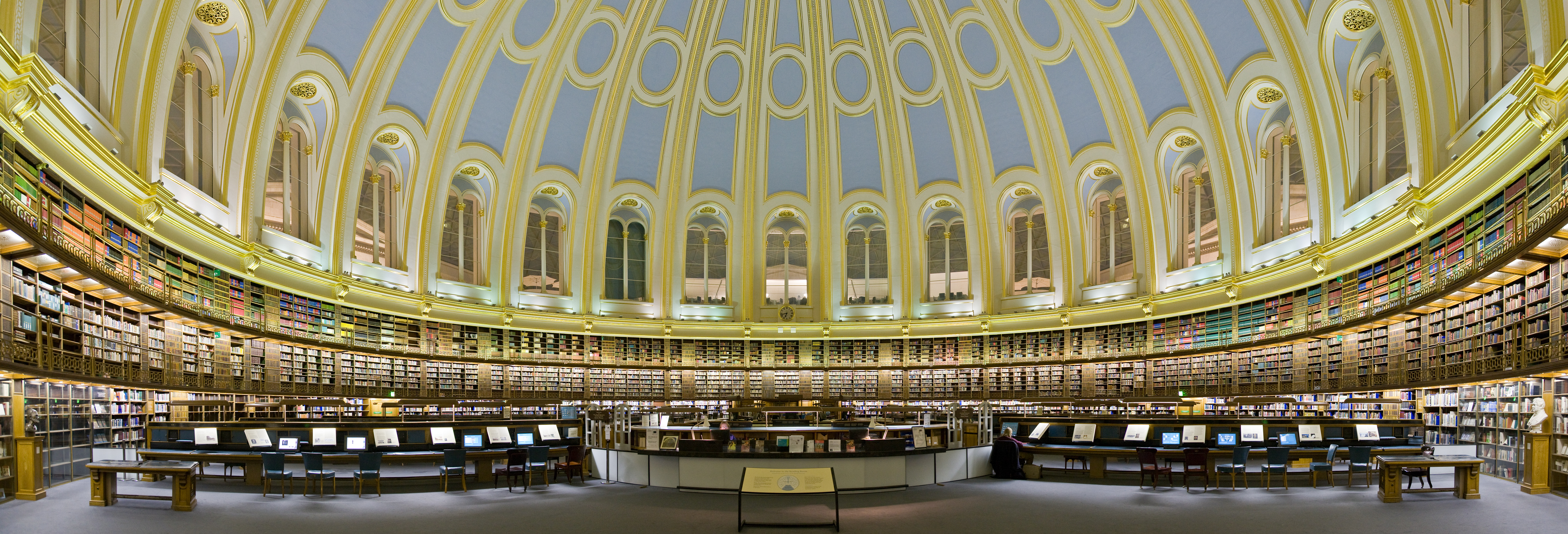
[Image: The British Museum Reading Room: top photo via Wikimedia (view huge), bottom photo by Vlad Jesul].

Fast-forward, then, to the present and you’ll find even more gigantic air conditioned warehouses under almost continual construction on the sides of Western motorways – and you get some sense of how the quest for unrestricted information retrieval has taken on architectural form.

No matter if no one actually visits these places; they’re our era’s equivalent of pharaonic tombs. They’re time capsules.

Quoting once again from the article by Grafton: “Though the distant past will be more available, in a technical sense, than ever before, once it is captured and preserved as a vast, disjointed mosaic it may recede ever more rapidly from our collective attention.”

Perhaps it will take some future moment of cultural archaeology to break into these places, spelunking back into the literate past, to find well-tempered rooms still humming at 50ºF, humidity-free, where the past is refrigerated and Shakespeare’s name can still be recognized on the spines of books.

Until then, these warehouses – again, not libraries – will continue to take shape as abstract windowless volumes outside cities on the freeway.

Finally, I’m reminded of a few lines from The Name of the Rose by Umberto Eco, in which the book’s narrator and his well-read “master,” William of Baskerville, break into a labyrinthine library after dark – a library full of mirrors, unmarked halls, and trick doorways. (While lost in the library, the narrator beautifully remarks: “I proceeded as if in the grip of a fever, nor did I know where I wanted to go.”)

The architects of the library were, in fact, quite clever, mixing climate control with acoustic design:

“The library must, of course, have a ventilation system,” William said. “Otherwise the atmosphere would be stifling, especially in the summer. Moreover, those slits provide the right amount of humidity, so the parchments will not dry out. But the cleverness of the architects did not stop there. Placing the slits at certain angles, they made sure that on windy nights the gusts penetrating from these openings would encounter other gusts, and swirl inside the sequence of rooms, producing the sounds we have heard. Which, along with the mirrors and the herbs, increase the fear of the foolhardy who come in here, as we have, without knowing the place well. And we ourselves for a moment thought ghosts were breathing on our faces.”

“In any case,” the book goes on, “we need two things: to know how to get into the library at night, and a lamp.”

After all, the narrator then says, “I felt inclined to disobedience and decided to return to the library alone. I myself didn’t know what I was looking for. I wanted to explore an unknown place on my own; I was fascinated by the idea of being able to orient myself there without my master’s help.”

And so he goes, lamp in hand, heading into that unlit space full of books no one’s reading, in a surround-sound of breezes, looking for something he knows he’ll never find.

Air Brain

[Image: Bel-Air by Mathieu Lehanneur].

These air filters, by Mathieu Lehanneur, seem so hilariously inefficient and bizarre to me, but hey – I love the idea. They turn plants into air filtration machines – miniature ecosystems put to work. Somewhere between a terrarium and biotechnology.
The designer himself describes the filter as “a vegetal brain enclosed in an aluminium and Pyrex cranial box.” That “brain” then cleans the air in your house for you.

[Image: Bel-Air by Mathieu Lehanneur].

More specifically, Lehanneur’s Bel-Air system “is a mini mobile greenhouse” that “continuously inhales” air into an enclosed system of “three natural filters (the plant leaves, its roots, and a humid bath).”
The air is then released again, “purified.”

This patented principal has two advantages: Bel-Air is to the American and Asiatic common filter appliances what Dyson is to regular vacuum cleaners. Here, the noxious particles are captured, and transformed inside the system. No more filters to change, and no more clogs.

Lehanneur was at least partially inspired by NASA’s old research into space gardens, wherein living plants were to be installed on spaceships in order to filter, clean, and continually recirculate the exhaled breath of astronauts.
As such, this project reminds me of the oxygen garden from Danny Boyle’s film Sunshine.

[Images: The Oxygen Garden from Sunshine, courtesy of DNA Films].

There we see a whole room – full of plants, circular fans, UV lights, and timed irrigation tanks (the Earth in miniature, technologically replaced) – built aboard the film’s main spacecraft, forming “a natural, unmechanical way of replenishing [the ship’s] oxygen supplies.”
All houses should be greenhouses. Imagine going to work in a place like that – in an oxygen garden – bringing the tropics to an exurban office park near you. Creeper vines, and Pyrex-shelled ferns, and huge corridors lined with orange trees – groves and orchards spiraling above you up stairways and halls. The sheer terrestrial weirdness of flowering species.
What is it about plantlife that seems so inherently sci-fi?

(For the Bel-Air’s complete press release, see Dezeen).

The IceCube and the Earth’s Core

Will an astronomical machine buried in the ice of Antarctica someday reveal what the Earth’s core really looks like?

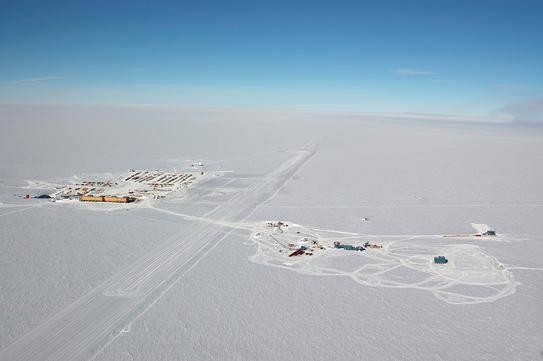
[Image: The IceCube’s surface workings, Antarctica; via New Scientist].

Last week, New Scientist reported that a neutrino detector called IceCube, once constructed, might just do exactly that.
Because the Earth rotates, we read, distant neutrino sources – such as black holes – will be blocked at certain predictable moments by the Earth’s core; piecing together all these temporary blindspots, we can then infer the shape of the core itself.
It’s an absence that generates absences elsewhere.

[Image: A schematic diagram of the IceCube].

The “machine” itself, meanwhile, is actually quite extraordinary: incredibly, it will “fill a cubic kilometre of ice” – and yet it’s really a buried network of connected glass balls.
According to The Daily Galaxy, building the IceCube is less an act of construction than a kind of archaeology in reverse; the process will consist of entombing “glass-globed sensors the size of basketballs on 1-mile-long strings, 60 sensors per string, in 80 deep holes beneath the polar surface.”
This will then allow scientists to develop, that same writer says, a “library of the universe” – something that would make even Borges proud.
So I’m left thinking of at least two things:

1) In John Carpenter’s 1983 remake of The Thing, a team of Norwegian researchers finds something buried in the ice of Antarctica; it turns out to be a spaceship… which, according to a later group of American scientists, must have been there for more than 100,000 years.
It’s frozen solid, and older than writing.
But what if, down there in the ice someday, we find something not unlike the IceCube – only we didn’t put it there, some vast and buried machine with no identifiable purpose, origin, or design?
Or perhaps next year some lone helicopter pilot will go flying around, scanning the ice with radar, only to discover that what appears to be a geological formation is actually a machine, some ancient, hulking technology indistinguishable from bedrock… Or a machine made entirely from ice, still detecting the remnants of galaxies.
Perhaps even telescopes dream.

[Image: A glimpse of the Transantarctic Range].

2) I was joking with a friend the other day that Americans are always stumbling upon the face of Christ in unexpected places, and then ending up on CNN. They find Christ on a pancake, or on a piece of burned toast, or on an Eggo waffle (these sightings often involve breakfast foods), or even in the bark of a tree – and the people who discover these faces never once seem to think that what they’re suggesting is sacreligious: God has sent unto you his only son… disguised as a croissant.
But what if, after all the numbers are crunched and the maps are made, we find that the core of the Earth looks like the face of Jesus? What then? Nevadan entrepreneurs will suggest that we rescue it, digging it up with diamond drills, polishing it and storing it in a church somewhere.
Imagine the core of the planet on display behind stained glass inside a cathedral near Paris, or down in an old consecrated basement in central Rome. Under armed guard. Why is there not more holy geology?
Someone breaks in, using C4, a pair of infrared goggles, and a lot of rope, and they try to steal the center of the planet…

For more on the IceCube and Antarctic science in general give this article in The Economist a quick read – then check out NOVA’s round-up of weird detectors.
Then, if you’re looking for a good book on Antarctica itself, consider picking up a copy of Terra Antarctica: Looking into the Emptiest Continent by William L. Fox (a book previously mentioned on BLDGBLOG here).

Algae Power

[Image: Algae balloon communities in Iceland by the Philadelphia-based 202 Collaborative].

A few years ago I audited a course about Archigram at the University of Pennsylvania, just something to do on a Wednesday morning before I went to work – but one of the things that indirectly came out of that experience was BLDGBLOG. It’s interesting to note, then, that one of the other people in that class now writes Brand Avenue; another’s work was featured here on BLDGBLOG last year; and, this morning, another course attendee emailed to point out a proposal that he’s helped assemble and conceptualize, about hydrogen-powered urban design in Iceland.

[Image: Algae balloons and the houses they serve, by the 202 Collaborative].

That project, originally intended for a design competition, imagines carefully engineered algae ponds and balloons of hydrogen gas fueling the Icelandic city of the future.
It’s Icelandic New Energy (INE).

[Image: An Icelandic hydrogen economy, outlined by the 202 Collaborative; view larger].

As the designers note:

It has long been known that algae produce small amounts of hydrogen as a byproduct of photosynthesis. In 1999, researchers in Berkeley observed that algae alternate between hydrogen production and normal photosynthesis depending on the chemical environment. Depriving algae of oxygen and sulfur, the researchers greatly increased the hydrogen production and triggered the algae to produce hydrogen for an extended period of time. Another research group also discovered that algae will sustain simultaneous production of hydrogen and oxygen from water by illuminating the algae and depriving it of carbon dioxide and oxygen. Researchers estimate that a small pond (1.5 acre or 10 meter diameter) will produce enough hydrogen on a weekly basis to fuel 12 cars.

Of course, a part of me wonders if this whole thing would be easier to solve if we just got rid of those 12 cars – but I understand that that wasn’t the point of this design exercise.

[Image: 202 Collaborative].

However, referring to things beyond the scope of this project, a part of me does find it a bit depressing that we’ll go to all these lengths – we’ll totally redesign the industrial base of society – only to jump back into our Escalades and drive out to buy organic cotton Christmas mittens at the local Baby Gap.
It seems like an awfully long distance to go to get nowhere, in other words. After all of this, we’ll do the exact same things, outshopping one another on greengoods.com and parking our solar-powered sustainable sports cars somewhere in that sprawling tangle of garages and freeways that we never disassembled out back.
Everything will be recycled, yet everything will be the same.
We’ll watch internet sitcoms and judge each other’s social value by the hemp dresses that our girlfriends wear.
In any case, that’s a pet peeve of mine that deals with things well outside of the project featured here.

[Image: A broader view of the plan by the 202 Collaborative; view much larger].

These renderings are gorgeous, meanwhile, and they lead me to wonder what Archigram would be doing today, if they had grown up designing in a world powered by alternative fuels. What strange new worlds of hydrogen balloons and algae ponds extending off past the urban horizon might we then see?
Crops harvested from the roofs of brick tenements in north Philly. Steel frameworks of solar concentration arrays visible in the cracks between buildings as we step over bio-boulevards and water filtration systems on our way to work.
Vast harddrives made entirely from milled crystal move glass elevators floor by floor through the environment ministry, carrying cloned medicinal plant samples up to their examination chambers…
All narratives of the future are fair game when you’re talking about architectural design.
Anywho, although their site is still under construction, be sure to stop by the homepage of the 202 Collaborative.

(Thanks, Patrick!)

Study in Mass

[Image: Boutique Monaco by Mass Studies; view larger].

I’ve mentioned architect Minsuk Cho, of Mass Studies, on BLDGBLOG before: he designed the so-called “ring dome” for the Storefront for Art and Architecture’s Z-A event last month in New York City, and he collaborated with Jeffrey Inaba’s SCI-FI studio to propose an “urban district above the water” in Seoul.
I’d say that Mass Studies is hard to beat for sheer spatial interest and originality; witness their Torque House, Pixel House, or Cheongam Media Headquarters, for instance – let alone the famously freaky Seoul Commune 2026.

[Images: Three rendered views of the building’s lobby and ground level exterior].

Or take a look at the Boutique Monaco, pictured here.
The Monaco is “a high-density, massive building for residential/office/commercial/cultural activities to be located in the heart of the Seoul metropolitan life, the area around Gangnam station.”

[Images: Day and night renders of the project’s exterior, complete with punctuated vertical bays of greenery and residential terracing; view both the top and bottom images larger].

As Mass Studies explains:

Unlike the existing high-rises where one is segregated from the outside world as soon as he [or she] leaves the ground floor, Boutique Monaco will be a building where at each level will be a vertical open space accessible from different spots in the floor. The exterior, designed in an orthogonal pattern in the interest of efficiency in space allocation, is intended to strike a balanced harmony with the surrounding box-type high-rises.

Further: “In the plan for Boutique Monaco, around 172 units are created in 49 different types and sizes and interconnected as if in an enormous puzzle. At the same time, different types of internal/external, private/public areas are to be installed.”
You can see some of the building’s floorplans here.

[Image: A kind of rooftop park and bioscape, complete with what appears to be a helipad].

The project can be seen in renderings, drawings, and diagrams on the Mass Studies website – but also now in photographs.
The building is under construction even as this post is being written, and it should be open for inhabitation by late summer 2008.

[Image: The Boutique Monaco under construction; view larger].

Meanwhile, I don’t mean to uncritically promote the actions of a property developer in Seoul; nor do I wish to suggest that because this building has a few trees growing out of it that it’s “green.”
But I do have to say that I like 1) the project’s use of materials (the wood cladding inside the vegetated nooks is especially brilliant), 2) the punctuated bays themselves, which break up the facade in a really great way and add a spatially and experientially inspired dimension to the project, and 3) the diagonal bracing, however ornamental and non-structural it may be, of the podium. We may be seeing more and more of these sorts of structural weavings – but that’s because they’re cool.

[Image: Bracing at the base of the Boutique Monaco; view larger].
For other projects by Mass Studies, check out their archives.

Mobile Minimalism

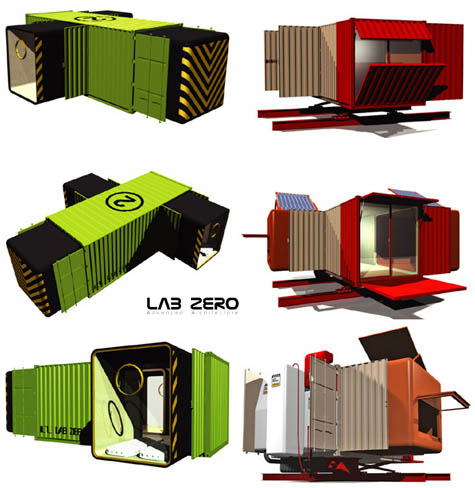
Flavio Galvagni of Lab Zero has a few projects that I think deserve mention here.

[Image: The solar-powered Minimum Mobile Module by Lab Zero].

Let me say right away, though, that I know a lot of people are tired of shipping container architecture – in fact, I think most people are tired of shipping container architecture – yet I have a fairly limitless patience for this sort of thing. Actually, I love shipping container architecture.
But the same questions inevitably arise whenever things like this re-appear in the blogosphere: Are shipping containers comfortable? Is reusing them as a form of readymade architecture even structurally realistic? Would anyone really want to raise a family inside one of these things? And does the appeal of such designs actually cross cultures and income levels and ethnicities and, more important, climates? Sure, these might work in Santa Monica – but would they work in Minneapolis-St. Paul?
To which I would have to say that the answer is: no, they probably aren’t that comfortable when it comes to raising two and a half kids – and they probably don’t equally appeal to, say, bedouins, Russian oil tycoons, Detroit’s inner city poor, suburban parents, or even BLDGBLOG readers.
But I don’t think those are the right questions to ask.
I don’t think the point of cargo container architecture is for us to pretend that it’s a universally appropriate design solution for every situation that could possibly exist in the world today – because it isn’t. Then again, nothing is universally appropriate in architecture.
What I think is, actually, the point of reusing shipping containers as architecture is: 1) when you can, you should reuse existing materials for somewhat obvious environmental reasons, and 2) the spatial, logical, and combinatorial systems that cargo containers imply are simply awesome. The possibilities excite me. Container-made buildings are fun to look at, they’re fun to render, and they’re fun to imagine forming new architectural reefs and Tetris cities, interlocking in a sci-fi future coming soon to a landscape near you.
Whole new outer districts of London made from shipping container towers!

[Image: The Minimum Mobile Module by Lab Zero; view larger].

So arguments about the architectural reuse of shipping containers shouldn’t be based on the claim that it’s all or nothing; it’s not either we replace all existing architecture in the world with cargo containers and then force everyone to live in them or we never construct a single cargo container building anywhere ever again, even for something as simple as a meditation retreat in your own backyard.
Maybe only one cargo container building will ever be built again – or maybe none will – but that doesn’t mean we can’t still screw around for hours on end with them on our home computers, virtually assembling weird new unfolding structures or houses with legs or helicopter-borne instant cities simply because it’s fun and a way to kill time.
In other words, even if these plans serve as nothing but design exercises – studies in volume, combination, and color – then that’s fine with me. We can be done with the ongoing arguments and just enjoy looking at cool imagery.
But I digress.
Lab Zero has put together a number of cool projects, including the solar-powered Minimum Mobile Module, pictured above, and the Carapace House, below.

[Image: The Carapace House by Lab Zero; view larger].

The Carapace House – a larger diagram of which can be seen here – is intended for use in “challenging natural environments.”
Similar to Lab Zero’s own Drop Off Unit, the Carapace House is temporary, mobile, and easy to “drop off” in a variety of locations.

[Image: The Drop Off Unit by Lab Zero; view larger or in more detail].

All of which brings us to the Jellyfish House – not that Jellyfish House – a kind of floating tower perfect for those of us interested in “spatial delocation.”
You can drift around the world’s oceans in it, reading William Gibson.

[Image: The Jellyfish House by Lab Zero; view bigger].

The Lab Zero website is still apparently under construction, meanwhile, but keep your eye out for more of their work in the future. They were featured in Actar’s recent book Self-Sufficient Housing, for instance, and will no doubt be popping up elsewhere soon.
And for more cargo containers on BLDGBLOG see Container Home Kit or even Project Blackbox.

Golf amongst the glaciers

In an old book by John McPhee, called In Suspect Terrain, we meet a geologist named Anita Harris who takes McPhee on a tour of post-glacial North American landscapes.
The two of them drive through and discuss “a confused and thus beautiful topography of forested ridges and natural lakes, stone fences, bunkers and bogs, cobbles and boulders under maples and oaks,” and they follow the moraines, that line of retreat at which the glaciers stopped, hiking over “hills of rock debris” that were dragged into place – by ice – ten thousand years ago.

At one point Harris comments that glaciers and golf go together like wind and surfing:
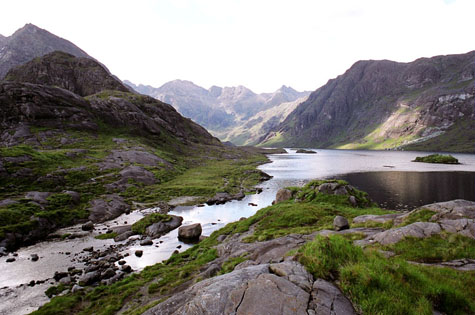
“This would be a good place for a golf course,” Anita remarked, and scarcely had she uttered the words than – after driving two thousand yards on down the road with a dogleg to the left – we were running parallel to the fairways of a clonic Gleneagles, a duplicated Dumfries, a faxed Blairgowrie, four thousand miles from Dumfriesshire and Perthshire, but with natural bunkers and traps of glacial sand, with hummocky roughs and undulating fairways, with kettle depressions, kettle lakes, and other chaotic hazards. “If you want a golf course, go to a glacier” is the message according to Anita Harris. “Golf was invented on the moraines, the eskers, the pitted outwash plains – the glacial topography – of Scotland,” she explained. “All over the world, when people make golf courses they are copying glacial landscapes. They are trying to make countryside that looks like this. I’ve seen bulldozers copying Scottish moraines in places like Louisiana.”

And, sure enough, as only one example, if you read about the golf course in Kohler, Wisconsin, you learn the following:

The River Course at Blackwolf Run is a commanding layout that offers a dynamic golf challenge with sweeping panoramic views of the Sheboygan River valley. A glacier served as early landscape architect for this site, sculpting river valleys with deep ravines, meadow plains, gentle rolling hills and abundant lakes. Ten thousand years later, Pete Dye took this same piece of land, added his signature style and designed one of the best golf courses in America.

All of which indirectly reminds me of one of my favorite posts on Pruned, in which we read about a golf course in Ohio that’s been constructed atop a series of old Native American moon-viewing mounds.
That landscape itself, in other words, is not only artificial – it is, in fact, a 2000-year old earthwork temporarily lost to view under thickets and autumn leaves (until the golf course came through, clearing the scene) – but the whole thing is also astronomically aligned with the cycles of the moon.
Now that this strange overlay has been discovered, we read, “there is an eagerness among many people to see moonrises from the mounds the way the Indians did, a desire that has caused a conflict with the golf club.”
Imagine a golf course deliberately aligned with the universe! You study astronomy with a putter in your hand, hiking amidst coincidence like some strange god on a midwestern hillside.
But the fact that a climatic occurrence ten thousand years ago – the most recent Ice Age – actually formatted the landscape in such a way as to help make golf possible just floors me. That the design of golf courses is thus a continuation of the Ice Age – by means other than geology – is just icing on the cake.
And that this specific type of landscape – the golf course – is then exported, repeated, and cloned, via bulldozer, in decidedly non-glacial landscapes all over the world, from the urban cores of Chinese cities to American military bases in Afghanistan, only adds to the fascination.

[Image: Found, via a Google Images search, here; some of the comments there beggar belief].

We are the glaciers now™.

(More: Pruned‘s Of tumuli, moonrises, and a nice Par 3 and John McPhee’s In Suspect Terrain).

Foundation

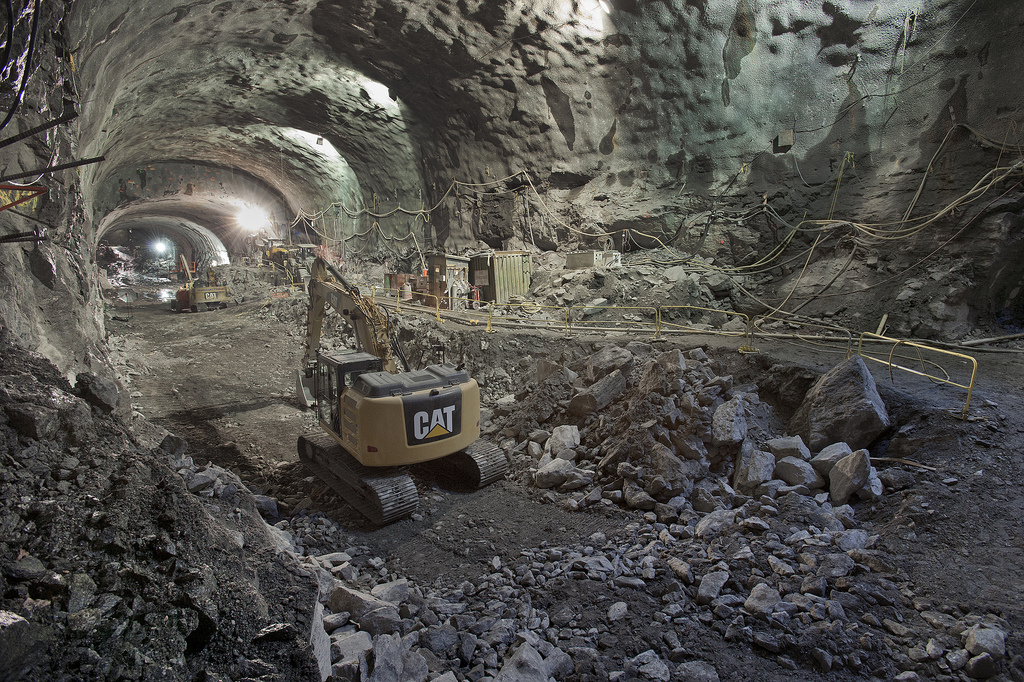
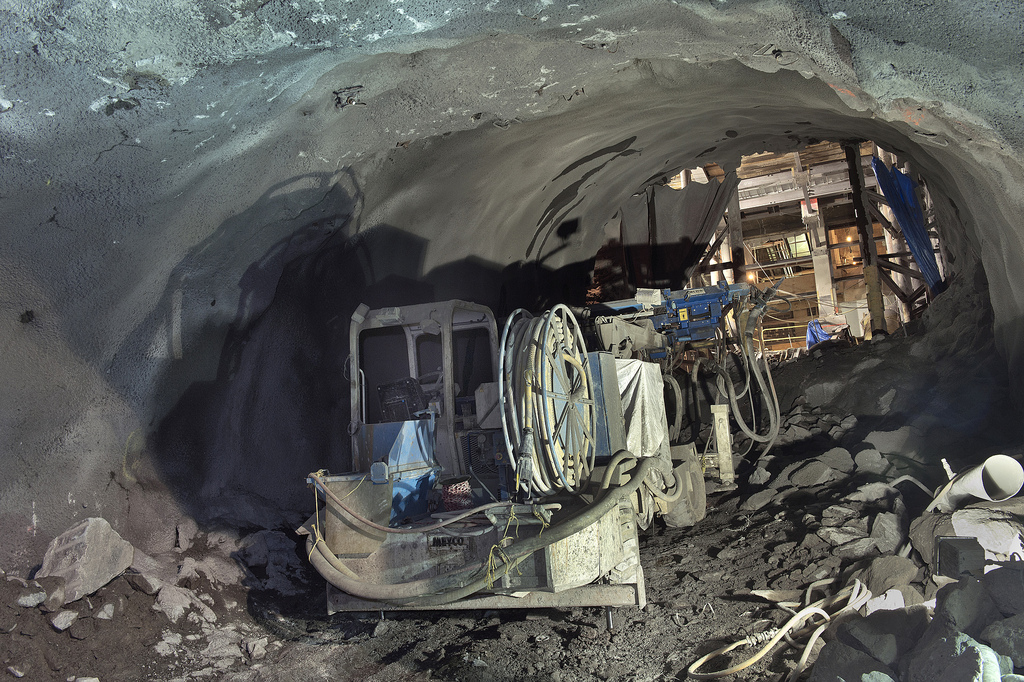
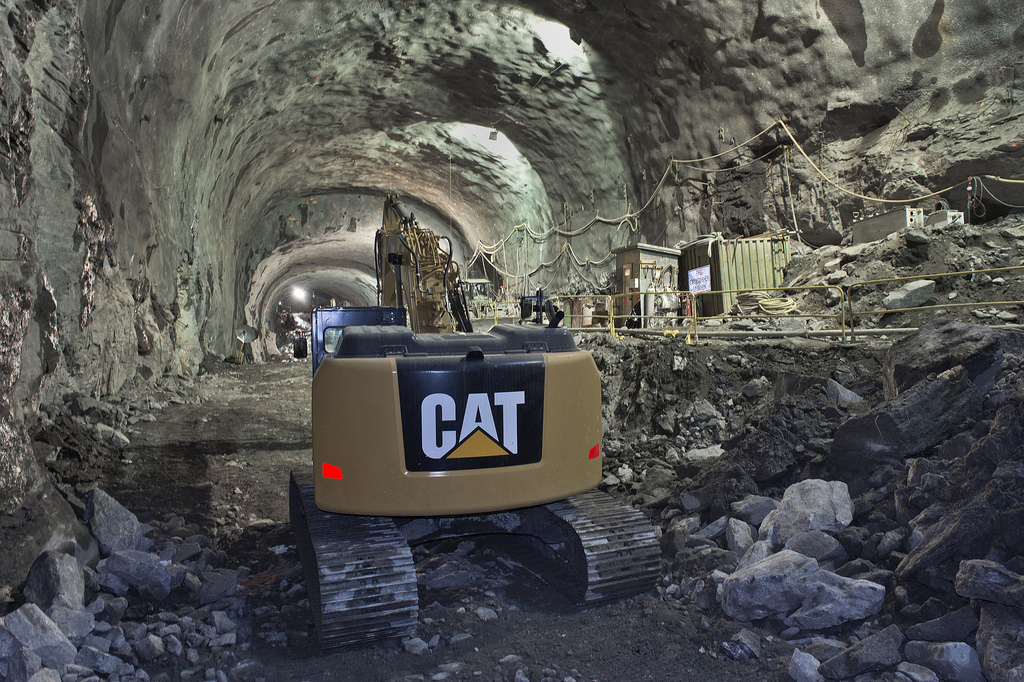
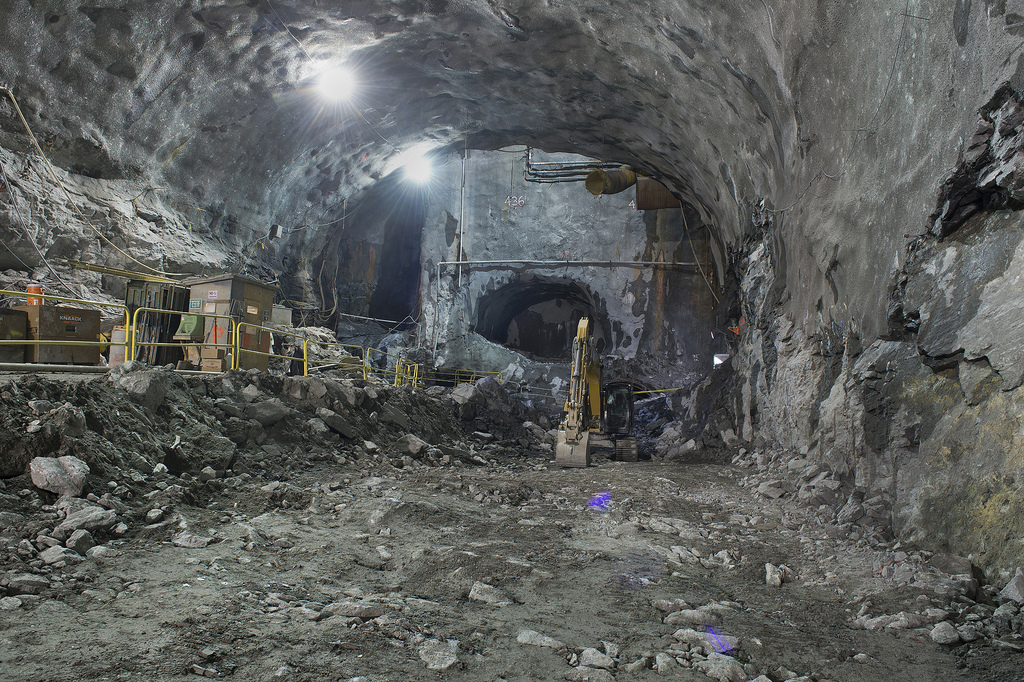
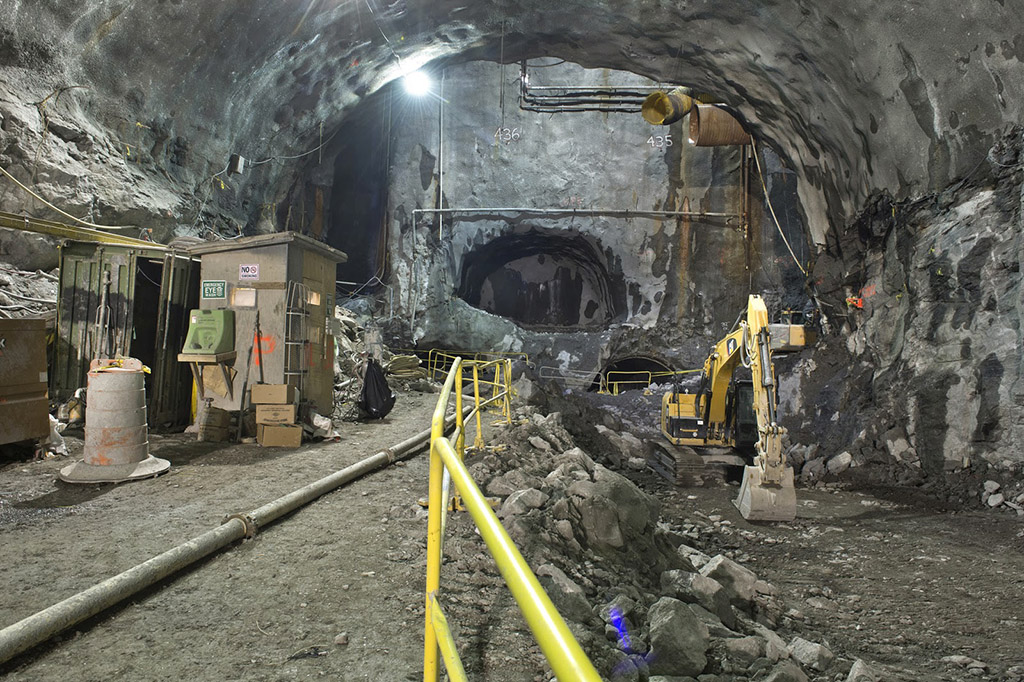
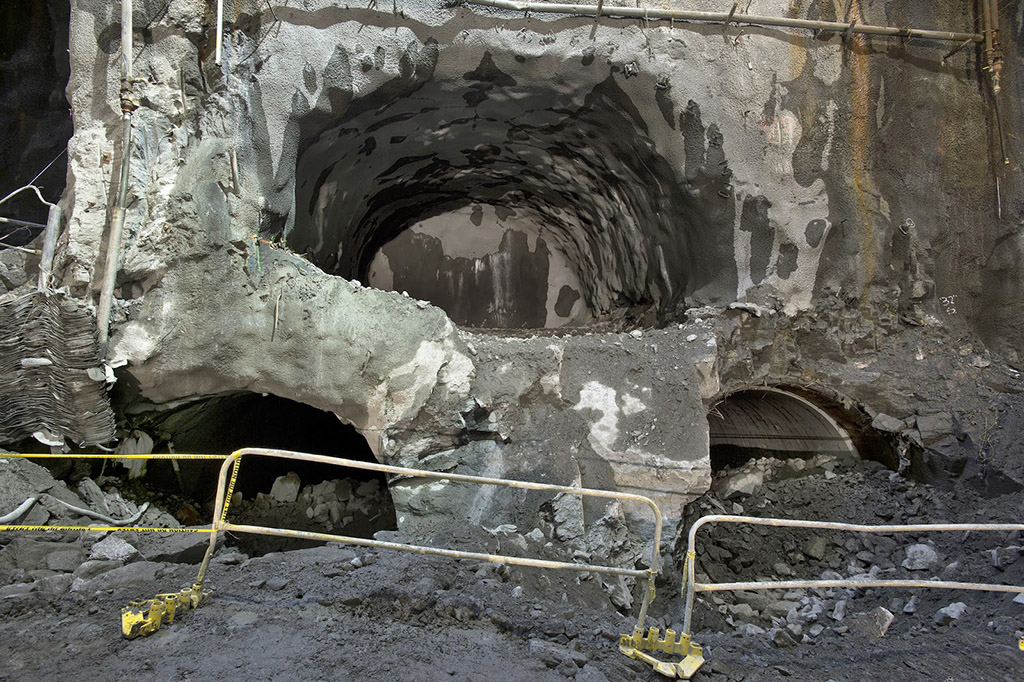
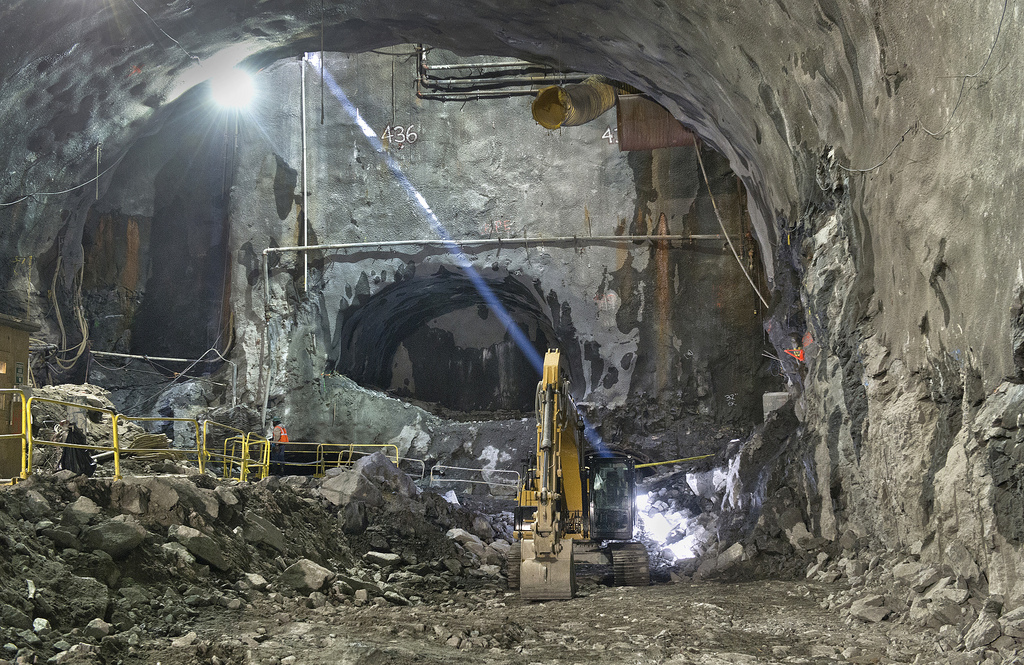
New York’s Metropolitan Transportation Authority has released some new shots by photographer Patrick Cashin of the so-called “86th Street cavern,” through which the future 2nd Avenue subway will someday travel.

[Image: Inside the “86th Street cavern”; photo by Patrick Cashin. View larger!]
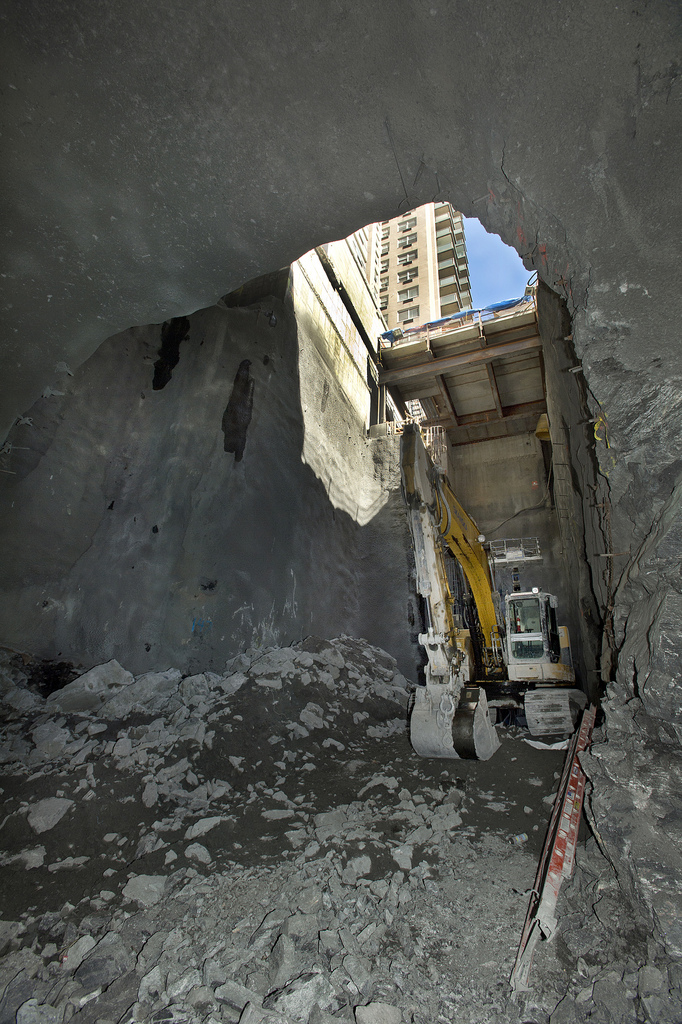
The artificial caves are roughly 100 feet below street level. Quoting from a now-subscriber only article originally published back in 2009 in the trade journal New Civil Engineer, Wikipedia offers a glimpse of the difficulties: “Of the below-ground obstacles, Arup director of construction David Caiden says: ‘It’s a spaghetti of tunnels, utilities, pipes and cables—I’ve never seen anything like it.’ Additionally, the project must go over, or under, subway lines, Amtrak railway lines, and the Queens-Midtown Tunnel linking Manhattan and Queens.” It’s woven through the city like a carpet.

[Image: Photo by Patrick Cashin].

It’s extraordinary, though, to see how easy it is to forget that, when walking up and down stairs inside subway stations, you’re actually walking around inside a series of relatively dark and irregular caverns—

[Image: Photo by Patrick Cashin].

—their walls and ceilings seemingly held in place only by an acupuncture of rock bolts, a monochrome world of uneven geologies smoothed over by shotcrete and disguised by tile.

[Images: Photos by Patrick Cashin].

I bookmarked an old article that seems relevant here, especially in light of the next image, that the tunnels had been “blessed”—made holy—by a Catholic priest back in August 2012. In a short article written with suitably—if obvious—Dantean undertones, we read that “the priest, Rev. Kazimierz Kowalski of the Roman Catholic Church of Our Lady of Good Counsel on East 90th Street in Manhattan, stepped over rocks into a small clearing away from the shaft to be clear of falling objects. And there he began to pray, blessing the underground cavity where the Second Avenue subway tunnel is taking shape.”

[Image: Photo by Patrick Cashin].

Fascinatingly, he then made architectural reference to the urban work of laying down this subterranean layer of the city: “Reading from a letter of Paul to the Corinthians, he added, ‘For no one can lay a foundation other than the one that is there, namely our Lord’,” something I quote not out of theological advocacy but for the interest of a possible religious connection between mining out “a spaghetti of tunnels, utilities, pipes and cables” beneath New York City and the establishment of a metaphoric “foundation” upon which a future city might sit. Tunneling, we might say in this specific and limited context, is God’s work, the subway system secretly a consecrated labyrinth of artificial caves, its stations like chapels drilled into solid bedrock.

[Image: Photo by Patrick Cashin].

The priest then “sprinkled holy water on the ground and invited the sandhogs to sing sometime for his parishioners.”

[Image: Photo by Patrick Cashin].

In any case, I feel compelled briefly to revisit something in Jonathan Lethem’s recent novel Chronic City, in which we read about a tunneling machine that has gone “a little out of control” deep beneath the streets of New York, resurfacing at night like some terrestrial Leviathan to wreak havoc amongst the boroughs. From the book:

“I guess the thing got lonely—”
“That’s why it destroys bodegas?” asked Perkus.
“At night sometimes it comes up from underneath and sort of, you know, ravages around.”
“You can’t stop it?” I asked.
“Sure, we could stop it, Chase, it we wanted to. But this city’s been waiting for a Second Avenue subway line for a long time, I’m sure you know. The thing’s mostly doing a good job with the tunnel, so they’ve been stalling, and I guess trying to negotiate to keep it underground. The degree of damage is really exaggerated.”

Eventually the machine—known as the “tiger”—is spotted rooting around the city, sliding out of the subterranean worlds it helped create, weaving above and below, an autonomous underground object on the loose.

(For a tiny bit more context on the Lethem novel, see this earlier post on BLDGBLOG, from which the final line of the current post is borrowed).

Earthquake Towers, Trapdoors, and other such delights

Just a reminder that I’ll be speaking in Los Angeles tonight at the Southern California Institute of Architecture, in case you’re around. The event is free, it starts at 7pm, it’s open to the public, and it’s located here, with plenty of parking.
It will be the single most exciting thing that’s ever happened, anywhere.