To remain suspended without sinking or falling

I just discovered Floater Magazine, “an inventory for floatation mechanisms within architecture,” published and edited out of Athens, Greece.

[Image: The cover of Floater Magazine #01; view larger].

The first issue includes articles about Laputa Island, OMA’s Riga Port City development, floating territories, and an artistic device called the “Oscillation of the Sea,” among many others, including the magazine’s inaugural editorial statement.
The design of the website itself – with mobile images you can rearrange according to taste – can be quite cool, as in this featurette about the micronational principality of Sealand.
Better yet, all the articles can be downloaded as PDFs – so you can read them on the go.

The Rule of Regulations

[Image: Le Corbusier’s Maison Citrohan undergoes speculative regulatory alterations, as applied by Finn Williams and David Knight].

An interesting architectural exhibition, put togther by Finn Williams and David Knight, closed today in London. Called The Rule of Regulations, it looked at what effect today’s building codes and zoning regulations might have if retroactively applied to an historic structure such as Le Corbusier’s Maison Citrohan.
As the Architect’s Journal described the show’s more wide-ranging spatial implications, “perhaps we can seek out creative opportunities within the current legislative framework, maybe to arrive in a wonderland where new forms of architecture emerge.”

In The Rule of Regulations, Williams and Knight pit architectural conceits – here Le Corbusier’s five points of Modern architecture – against five pieces of current housing legislation. They have remodeled Corb’s early mass-housing prototype, the single-family dwelling Maison Citrohan (1922), to see how it might look in today’s climate of environmental paranoia, lowest cost, equal opportunities and accessibility.

The phrase “environmental paranoia” seems unnecessarily dismissive of very realistic – and reasonable – energy-performance criteria for the construction, maintenance, and use of buildings in the 21st century, but this excerpt still offers us a glimpse of what was at stake in the exhibition’s premise.

[Image: View larger].

And the premise was brilliant.
Architectural practice is so thoroughly shaped from the outside-in by building codes, something which perhaps only becomes obvious when different historical periods are forced to collide.
Semi-absurd thought experiments might ensue: What would the Taj Mahal, or Angkor Wat, look like if subjected to Manhattan’s 1916 Zoning Law, as so thoroughly explored by Rem Koolhaas? Or how might the city of London be different if subject, overnight and without warning, to the urban regulations of Los Angeles, Dubai, or Beijing?
Perhaps cities could even set aside small test-plots, urban labs in which gardens of architectural form can grow. 10 square blocks of west Los Angeles are re-zoned as if they’re part of Paris; when new laws are passed in Paris, they go into force there, too.
What new buildings and lifestyles might result?
Sections of the city could take on the characteristic of a skin-graft. Suddenly three streets in downtown Chicago adopt the building codes of Amsterdam. You fly there on a business trip one summer when you realize that something just isn’t quite right with the layout of a certain building…
Perhaps you could even assign building regulations from different cities to specific rooms in a single Manhattan high-rise; there’s a London room, a New York room, a Moscow room. The whole thing a test structure or legal demonstration project. Architects and architectural students alike come through for tours of the rooms to see what effects, both large and small, a simple change in the rules can generate.

[Image: View larger].

But if architectural interiors and exteriors alike are shaped by the spatial expectations of certain historically specific legal regimes, to what extent are the familiar landscapes and experiences of everyday life shaped off-stage, in the planning books and lunchtime meetings of urban planning boards?
When we look back at what made certain cities thrive in different phases of modern history, are we wrong to cite artistic movements and architectural schools – when we should be crediting their planning departments?
In any case, Williams and Knight raise a series of interesting questions about the relationship between architectural style and architectural regulation, and the historical tensions that exist within that partnership.
I suppose one fundamental question here might be: Do architects need less regulation in order to pursue the art of spatial design – or simply more creative rules?
Indeed, is it really possible to study Le Corbusier without also studying the legal codes within and around which he was forced to design?
I’m reminded of Michael Sorkin’s book Local Code, in which an entire city is described and presented – without the use of a single image – through the droll recitation of absurdly specific building regulations.
How do invisible legislative skeletons shape modern space?

Future Slum

[Image: New flats, part of the AHMM master plan in Barking, England, specifically cited by the BBC as being so small that they’re mere slums in the making; via Building Design].

“Are the gleaming new apartment buildings of the past decade the inner-city slums of tomorrow?” the BBC asks this morning in an interesting, if insufficiently argued, opinion piece about the state of private housing in England.
New, privately developed apartment complexes there – the exact same apartment complexes of visual interest to architecture magazines such as the one for which I work – might, in the end, simply be too small and too cramped to become anything other than the slums of tomorrow.
Affordable now, ghettoized later.
The problem, the essay argues, is that there are no real minimum space standards for private housing developments in England. Tiny flats suitable only for single men and women, or for weekend getaways, are filling up valuable land in city centers – which is great for the duration of a real estate boom, but which might have sociologically frightening future implications.
“Alone in the UK,” the BBC points out, “Scotland does have legislation on minimum sizes for homes in the commercial sector. Northern Ireland has rules on social housing – while in England and Wales many local authorities also have size regulations for affordable housing. But none of this covers private sector developments.”
One point, by no means minor, that goes totally unexplored comes from the BBC‘s own table of apartment space data. There we see that the average apartment size in Italy is actually smaller than the average apartment size in England.
So why all the scare talk about future slums and ghettos? Is there a legitimate concern here that smaller living spaces might become crime-infested labyrinths when the economy dries up – or is this simply fear of other forms of social organization?
Nuclear families living in several comfortable rooms = good.
Single men and women living alone in small apartments = moral hazard.
In any case, I thought suburbs were the next slums?
In fact, it’d be interesting to do a kind of comparative slum futurology: to see what building types different countries and cultures fear will become the “next slum.” What does it say about you, politically? On the left, perhaps, you think it’s the suburbs, waiting to be taken over by wildcats and gangs; on the right, you think it’s affordable housing.
But who’s got the data on their side?

Art + Environment Conference, Reno

I’m excited to announce that I’ll be speaking on a panel at the upcoming Art + Environment Conference hosted by the Nevada Museum of Art in Reno, from October 2-4.
Other speakers include Matthew Coolidge of the Center for Land Use Interpretation, artist and architect Vito Acconci, photographer Michael Light, artists Fritz Haeg and Katie Holten, Bill Gilbert from Land Arts of the American West, and cultural organizer Cheryl Haines, among many others.
The entire thing is being moderated by William L. Fox, a prolific writer, poet, and friend who often documents his own travels through extreme natural environments, describing those landscapes’ effects upon human cognition.
Here is a PDF with all the information you’ll need to register for the conference; for more info about the speakers themselves, and their conference schedules, check out the conference website.

[Image: Panel description; view larger].

My own panel, “Placing Space,” will be on Saturday, October 4, at 9:30am. Hopefully I’ll see a few of you there!
I hope to come back not only with several new posts, but possibly with some interviews. Stop by if you get a chance.

Nuclear Nation

Perhaps in the spirit of the Wonders of the World, the nuclear reactor in Hanford, Washington, has been declared a national historic site.
“National Historic Landmarks,” the Department of Energy explains, “can be nationally significant districts, sites, buildings, structures, and/or objects that possess exceptional value or quality in illustrating or interpreting the heritage of the United States.”
In a late-August news release (PDF) we read:

U.S. Department of the Interior (DOI) Deputy Secretary Lynn Scarlett and U.S. Department of Energy (DOE) Acting Deputy Secretary Jeffrey F. Kupfer today announced the designation of DOE’s B Reactor as a National Historic Landmark and unveiled DOE’s plan for a new public access program to enable American citizens to visit B Reactor during the 2009 tourist season. The B Reactor at DOE’s Hanford Site in southeast Washington State was the world’s first industrial-scale nuclear reactor and produced plutonium for the atomic weapon that was dropped on Nagasaki, Japan to end World War II (WWII).

As the New York Times pointed out yesterday, however, Hanford is but “one of five Manhattan Project facilities designated as historic landmarks, including the Los Alamos Scientific Laboratory in New Mexico and the X-10 Graphite Reactor at Oak Ridge, Tenn.” Another site is the so-called Chicago Pile.
The atomic infrastructure of mid-century American warfare is thus slowly being converted into a distributed landscape of historic monuments.
Perhaps it’s dark tourism with a physics bent – the national memory of nuclear fission, a geography of Cold War nostalgia. They are places where the atom opened up – a series of small entryways into matter.

Servers at Sea

Google has filed a patent for what the New York Times describes as “mobile data center platforms out at sea.”

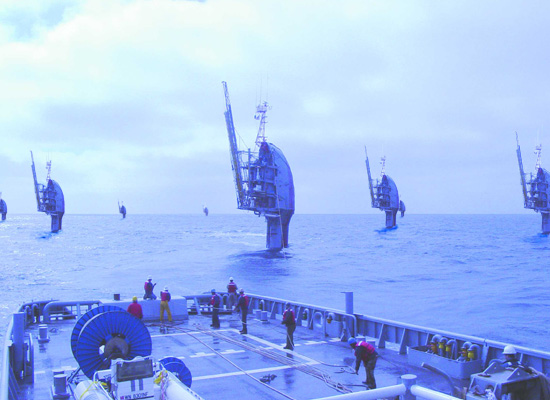
[Image: A view of the R/P FLIP ship, which has absolutely nothing to do with Google’s offshore server plan; it just looks cool and seems appropriate. Image altered by Alexander Trevi].

This means “stacking containers filled with servers, storage systems and networking gear on barges or other platforms.” These would be “‘crane-removable’ data center modules on ships.” From the actual patent application:

In general, computing centers are located on a ship or ships, which are then anchored in a water body from which energy from natural motion of the water may be captured, and turned into electricity and/or pumping power for cooling pumps to carry heat away from computers in the data center.

Perhaps unsurprisingly in this era of alternative energy sources, “Google has theorized about powering these ocean data centers with energy gained just from water splashing against the side of the barges.”

[Image: From Google’s patent application for servers at sea; via the New York Times].

I have to assume, then, that we’re moving ever closer to true deep-water city-states – only they won’t be libertarian ocean-going homesteads, after all, they’ll be distributed networks of supercomputing villages afloat on, and drawing power from, the tides.
Two weeks ago, meanwhile, the NYTimes also looked at the privatization of civic infrastructure – but perhaps Google’s literally offshore experiment in information technology implies a coming world of privatized services at sea.
A fleet of tankers shows up in a nearby port one day… and suddenly your city has telephone services. It’s Archigram‘s instant city all over again, but on the level of specific – and highly billable – urban amenities.
The services show up. The network takes over.
Your city will never be the same.

[Image: The Instant City at work; diagrams by Peter Cook/Archigram. An original interview with Peter Cook appears in the forthcoming BLDGBLOG Book].

I’m further reminded of the five-week-long power outage that struck Auckland, New Zealand, just slightly more than ten years ago. Peter Gutmann describes some of the possible ship-borne solutions to that city’s loss of electricity:

Apparently the idea of moving ships from the naval base on the other side of the harbour across to the Auckland waterfront to act as floating generators was considered, but there are problems with feeding the power from the ships to the city. There’s also the problem that there’s nothing around which can generate even a fraction of the power required. Another idea which was considered is using one of the Cook Straight ferries (which could in theory provide around 10MW) as a floating generator (the term “ferry” is a considerable understatement). Currently a couple of waterfront businesses are being run with power from ships acting as floating generators, and when both repaired cables failed their testing, Mercury finally brought in a diesel-electric trans-Tasman freighter, the Union Rotorua, to act as a 12MW floating generator, and is considering bringing in another ship or installing generators on barges.

In any case, the seafaring future of civic infrastructure is something we’ll have to keep our eyes on. Entire new untold types of urban experience could be yours the minute that strange shape on the horizon comes in to dock.

(Thanks, Nicky!)

The Wildcats of Foreclosure

Wildcats are taking over the foreclosed homes of Southern California. According to the neighbor of an abandoned house near Lake Elsinore, “this is the first she has heard of a wild animal taking over a foreclosure.”

[Image: Karen Brown/The Press-Enterprise].

So is the wild coming back for good – or has the ongoing U.S. real estate bubble simply produced temporarily ideal conditions for the return of bobcats and other large feline predators?
After all, what sort of burgeoning ecosystem does the world of foreclosed homes represent? Mold, lichen, and vines; bears, deer, and wildcats.
Repurposed McMansions, emptied of their human inhabitants, are filled in later by a troupe of mountain lions.
I sense a children’s film here.
But is this really the way the wild will reclaim our world? Starting with foreclosed homes and moving inward, to the centers of cities, from there. Soon ivy crawls across the well-polished tables of New York boardrooms, as the suburbs fall prey to nests of field mice.

Airborne Environments

[Image: Airbus A380, photographed by Robyn Beck/Agence France-Presse for Getty Images, via the New York Times].

Marc Newson’s “retro-futurist” interior design for the new A380 super-jumbo airplane, to be run by Qantas, was the subject of an interesting article in the New York Times writes this morning.

Newson’s “design language” for the airplane, we read, “is defined less by what the passengers see than by how they feel.” One example of this is “the L.E.D.’s that illuminate the cabin”:

They are programmed to wash the interior with colors that change subtly throughout the flight. Each shade is selected to create the ideal mood for a particular activity, like sleeping, waking or eating, regardless of time zone.
“Designing an aircraft is like creating a mini-world,” Mr. Newson said. “You’re putting people in a confined environment and controlling how they’ll feel with the oxygen, humidity and everything they touch and see. It all has an effect.”

Reading this instantly brought to mind a few things – including, somewhat obviously, the idea of the Gesamtkunstwerk, or total work of art, here transformed into a total environment sent aloft into the sky. Perhaps equally unsurprising, I was also reminded of Norman Foster’s infamous choice of the Boeing 747 as his favorite building of the 20th century.

Are airplanes the future of architecture, after all?

Somewhat more obscurely, however, I thought of the dream academy of Konstantin Melnikov – Melnikov’s so-called “Sonata of Sleep.” As the Winter 2007/2008 issue of Cabinet magazine described Melnikov’s bizarre architectural invention:

At either end of the long buildings were to be situated control booths, where technicians would command instruments to regulate the temperature, humidity, and air pressure, as well as to waft salubrious scents and “rarefied condensed air” through the halls. Nor would sound be left unorganized. Specialists working “according to scientific facts” would transmit from the control centre a range of sounds gauged to intensify the process of slumber. The rustle of leaves, the cooing of nightingales, or the soft murmur of waves would instantly relax the most overwrought veteran of the metropolis. Should these fail, the mechanized beds would then begin gently to rock until consciousness was lost.

In many ways, this Willy Wonka-like vision of synaesthetic architecture could be realized in the guise of international airplane travel, Newson inadvertently suggests. Lulled by strange colored lights and slowly changing sounds, passengers can be sent to sleep – or woken up – at the will of the pilot, who assumes a new, psychotropic role. It’s an Esalen Institute in the sky.

[Images: Photos by Brett Boardman, for the New York Times].

A few brief questions:

1) What would an airplane designed by Jonathan Ive look like? Or if Mies van der Rohe had been hired to rethink the internal spaces of American Airlines? I feel like entire, speculative, university-level design courses could be organized around such lines of thought; they could be sponsored by Richard Branson. So does Newson’s success – or, who knows, failure – in designing the Qantas A380 imply that our era needs a new Raymond Loewy? Or will climate change and high oil prices ultimately extinguish this temporary airborne niche in the field of architectural design?

2) Less relevantly, should airports look like the airplanes that depart from them? You walk from one tubular environment into another, and you sit in identical seats, served by similarly uniformed stewards – only the room you’re now in suddenly accelerates, taking you up into the sky… Perhaps the interior design of airports and airplanes should be unified – made continuous – so, after too many drinks one night, waiting to depart from Dallas-Ft. Worth, you realize that you might be sitting in the airplane already… You demand to get off; hijinks ensue.

3) What were the test-environments for this airplane like? Did Newson have entire fake airplane hulls constructed somewhere, inside of which entire fake rooms and galleys could be installed – and what was it like to spend time inside that simulated airplane of the future?

4) Could you purchase one of Newson’s perfectly molded bathrooms, receive it by delivery a week later, and then hook it up somewhere inside your own grounded house? I remember hearing once that the Spice Girls liked the mattresses that they slept on so much when they came through Philadelphia and stayed in the Four Seasons they that they simply bought the beds upon check-out. So could you fill out a form at the end of your trans-Pacific, San Francisco-Sydney flight, and say, sure, I’ll buy two bathrooms and a couchette… deliver them to my house in Marin County? A whole subsidiary industry begins: you send experimental interiors into the skies of the world, aboard international business flights, hoping to sell a few rooms to your well-served, half-drunk passengers. What would happen if you could buy rooms from inside any building you’ve ever visited? Surely every interior could be given a price tag?

The Comparative Literature of Massive Construction Sites

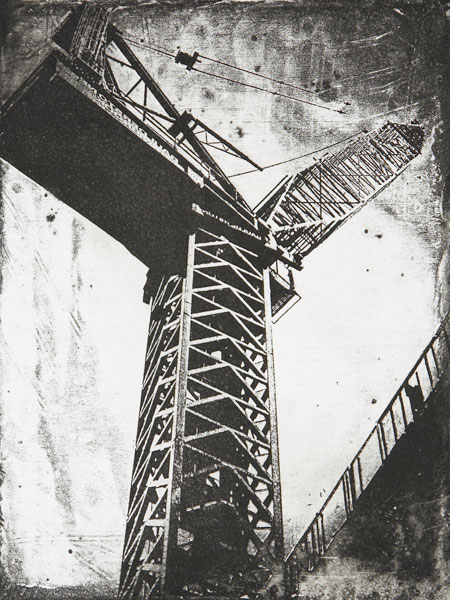
[Image: An etching by Daniel Stojkovich called Tower of Babel 2, exhibited as part of Top Arts 2007 at the National Gallery of Victoria, Australia].

I was clicking around on a local university’s engineering school homepage yesterday morning when I misunderstood the way the page had been organized. For a second I thought that Comparative Literature had been re-classified as a sub-field, or specialty research group, within the university’s engineering school – and so I had to wonder what exactly those students might be reading.
Aside from technical manuals, what might be the comparative literature of engineering?
Before I realized that I’d simply misread the list of links, I thought that perhaps there should be a comparative literature of construction sites: famous monuments, tombs, bridges, houses, and cities throughout history, together with the thoughts of the people who built them.
You collect the oral histories of construction workers all over the world, only identifying what building they were working on in the footnotes; what emerges is a kind of architectural hivework with no clear purpose or outline taking shape all over the planet, with towers and stadiums and whole urban neighborhoods assembled in a fog of exhaustion and low-grade injury.
You then go back through all of literature, from the Bible to the Upanishads to The Odyssey to The New York Times, culling long quotations about construction sites. The private houses of emperors; the pyramids; recollections of the construction of jungle temples; mountain lookouts in a time of war; Victorian train lines; Dubai.
In fact, I’m reminded of the excellent book Dart by Alice Oswald in which conversations with people living along the river Dart have been combined into a single, long-running commentary about the riverine landscape; only here it would be a kind of Dart of architecture: thousands and thousands of construction workers and site engineers and geotechnicians and consultant elevator repair servicepersons all speaking about the act of putting architecture together in space.
Epic poems of building assembly.
I do wonder, meanwhile, if the temporary micro-culture of the construction site has been adequately documented by architectural historians. Industrial yards have certainly had their day, from documentaries about WWII dockworkers to historical surveys of Solidarity; and construction sites have obviously long been a focus for painters and photographers.
But have literature and history given the attention due to sites of architectural assembly?
Do we need a Construction Site Reader – the comparative literature of massive construction sites?

Tactical Landscaping and Terrain Deformation

[Image: A screenshot from Fracture by LucasArts. Via Wired].

Over on Wired this weekend I read about a game called Fracture, by LucasArts, which features “terrain deformation” as a central factor in gameplay.

Fracture is “a game centered on the wanton reformation of land masses,” Wired reports; the author then goes on to introduce us to the game’s “terrain deformation mechanics.”

“Every player is equipped with a tool called an Entrencher,” we read. The Entrencher “gives them the ability to raise or lower most surfaces at will,” including the surface of the earth itself:

Gone are the days of studying a level, and simply memorizing sniper positions and the fastest routes. Resourceful players will be digging trenches, raising their own cover and manipulating level elements to fortify their positions… fundamentally altering the way levels are played.

Which means what, exactly?

Can’t find a way across that slime pit? Raise the ground underneath it. You can also terrain-jump by leaping as you raise the ground beneath your feet, launching yourself into the air.

“The rule of thumb,” the article adds, “is that if you can walk on it, you can probably alter it.”

Using weapons like the Tectonic Grenade, you can reshape the planet. Quoting from the official Fracture website:

The ER23-N Tectonic Grenade sets off localized shockwaves when detonated, causing small, concentrated earthquakes that raise the immediate terrain around the point of impact. The weapon is extremely useful for shaping the terrain and providing cover.

There’s also a Spike Grenade. As LucasArts explains, “Tectonic scientists discovered that lava tubes lying dormant deep below the surface of the earth could be stimulated to eject a pyroclastic column.” These columns can “be used as a ‘natural elevator’ of sorts, allowing a soldier to access hard to reach high elevation areas.”

[Image: A screenshot from Fracture, by LucasArts, showing a pyroclastic elevator at work].

There are even Subterranean Torpedoes that burrow into the planet and create landforms on the surface far away.
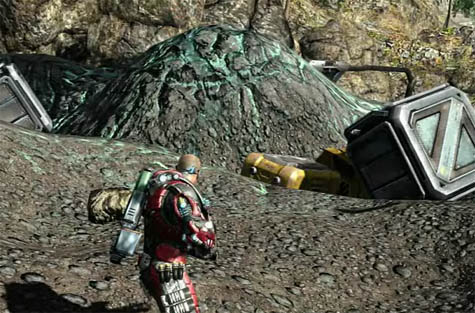
[Image: A screenshot from Fracture by LucasArts].

Of course, the idea that an instantaneous and semi-magmatic reshaping of the earth’s surface might have military implications is an interesting one – and probably not far from technological realization. I’ve written about the weaponization of the earth’s surface before, but Fracture seems to illustrate the concept in a refreshingly accessible way.

However, there are many historical precedents for the idea of politicized terrain creation, and these deserve at least a passing mention here.

I’m thinking, in particular, of David Blackbourn’s recent book The Conquest of Nature: Water, Landscape, and the Making of Modern Germany. The “making” in Blackbourn’s subtitle is meant literally, as the book looks at coastal reshaping, bog- and marsh-draining, and other projects of imperial hydrology; these were the activities through which the territory of Germany itself was physically shaped.

It was terrain deformation: a militarized reshaping of the earth’s surface under orders from Frederick the Great. Frederick sought to transform the lands of northern Germany – then called Prussia – in order to create more space to rule.

In his book, Blackbourn describes what these imperial “hydro-technicians” actually did:

The task of filling in the squares on Frederick’s grids remained. That meant ditching and diking the future fields, constructing sluices, uprooting the old vegetation and planting willows by the new drainage canals, preparing the still heavy, intractable soil, building paths and bridges, houses, farms, and schools, all the while maintaining the new defenses against the water.

These “new defenses” have since been so naturalized that we mistake them for a pre-existing terrain upon which modern Germany was founded – but they were and are constructed landforms, a “brave new world of dikes, ditches, windmills, fields, and meadows.”

These were lands created through military intervention in order to host a particular form of political governance.

In this context, then, Fracture would seem to be simply an accelerated – or what Sanford Kwinter might call an “adrenalated” – version of this tactical landscaping.

[Image: Celestial Impact].

Meanwhile, a commenter over on Wired points out that there are conceptual similarities between Fracture and another game called Celestial Impact.

In Celestial Impact, “the landscape is fully deformable in all directions.”

“Build and dig your way around the landscape in various strategic ways,” we read, ways that are “not limited to destruction”:

[T]he players also have the ability to add terrain to the landscape in the middle of combat using a special tool called Dirtgun. With the Dirtgun, players can add or remove terrain during combat as they see fit, simply by aiming and firing the dirtgun. Depending on the chosen action, this will either add or remove a chunk of dirt from the landscape. So as the teams are battling, the landscape receives vast changes opening up for various tactical approaches each team can use.

When your weapons are set on build-mode, the game’s creators explain, “the Dirtgun adds terrain in the form of a pre-selected shape in front of the player. The shapes could be a simple cube, a part of a bridge or even a defensive wall.”

In many ways, this sounds like a weaponized version of Behrokh Khoshnevis‘s building-printer – subject of one of the earliest posts on BLDGBLOG – here remade as a kind of propulsive instant-concrete mixer retrofit for imperial military campaigns.

As Discover described Khoshnevis’s machine back in 2005, “a robotically controlled nozzle squeezes a ribbon of concrete onto a wooden plank. Every two minutes and 14 seconds, the nozzle completes a circuit, topping the previous ribbon with a fresh one. Thus a five-foot-long wall rises – a wall built without human intervention.”

Now make an accelerated, portable, and fully weaponized version of this thing, put it in a videogame, and you’ve got something a bit like Celestial Impact.

Here are some screenshots.

[Image: From The re-naturalization of territory by Vicente Guallart].

Finally, I couldn’t help but think here of architect Vicente Guallart. Guallart’s work consistently seeks to introduce new geological forms into the built infrastructure of the city – artificial mountains, for instance, and “new topographies” through which a city might expand.
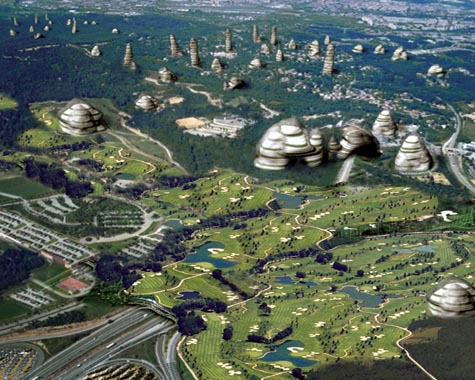
[Image: From The re-naturalization of territory by Vicente Guallart].

I suppose one question here might be: what would a videogame look like as designed by Vicente Guallart? Would it look like Fracture? If Vicente Guallart and Behrokh Khoshnevis teamed up, would they have created Celestial Impact?

But a more interesting, and wide-ranging, question is whether designing videogame environments is not something of a missed opportunity for today’s architecture studios.

After all, how might architects relay complex ideas about space, landscape, and the design of new terrains if they were to stop using academic essays and even project renderings and turn instead to video games?

It seems like you can take your ideas about terrain deformation and instant landscapes and nomadic geology and you can license it to LucasArts, knowing that tens of thousands of people will soon be interacting with your ideas all over the world; or you can just pin some images up on the wall of an architecture class, make no money at all, and be forced to get a job rendering buildings for Frank Gehry.

So would more people understand Rem Koolhaas’s thoughts on cities if he stopped writing 1000-page books and started designing videogames – games set in some strange quasi-Asiatic desert world of Koolhaasian urbanism?

Or do all of these questions simply mistake popularity for engaged comprehension?

The larger issue, though, is whether or not architecture, increasingly popular as a kind of Dubai-inspired freakshow (rotating skyscrapers! solar-powered floating hotels!), is nonetheless not reaching the audience it needs.
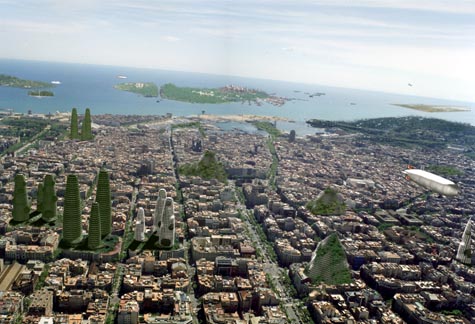
[Image: From The re-naturalization of territory by Vicente Guallart].

If architects and architecture writers continue to use outmoded forms of publication, such as $25/copy university-sponsored magazines and huge books purchased by no one but college librarians, then surely they can expect only people currently enrolled in academic programs even to be aware of what they’re talking about, let alone to be enthusiastic about it or appreciative of the implications.

$100 hardcover books do absolutely nothing to increase architecture’s audience.

So what would happen if architects tried videogames?
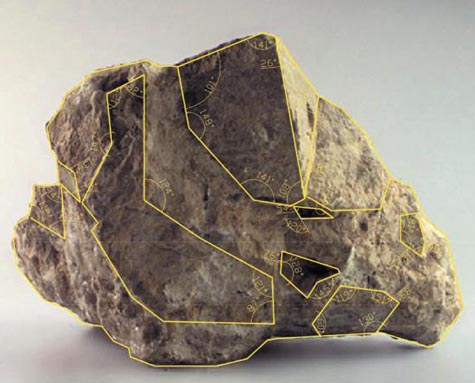
[Image: The constructed geologies of Vicente Guallart, from How To Make a Mountain].

In any case, terrain deformation, dirtguns set on build-mode, and other forms of militarized landscape creation – these seem like good enough reasons to me to add gaming consoles to a design syllabus near you.

Big One in the Big Apple

According to a newly published report in the Bulletin of the Seismological Society of America, New York City is more at risk from earthquakes than previously thought.

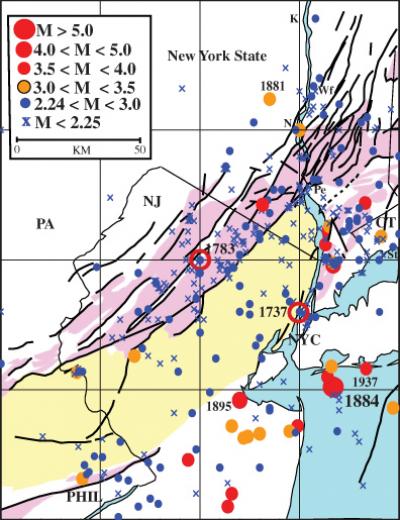
[Image: A seismic map of the mid-Atlantic, via PhysOrg.com].

What’s interesting here, though, is not some disaster film scenario in which the city is shuddered into a rubble of broken bricks and glass, but the fact that the land around Manhattan is actually an “intricate labyrinth of old faults, sutures and zones of weakness caused by past collisions and rifting,” as PhysOrg.com describes it.
Amazingly, for anyone who has ever studied architecture, they even describe “unseen but potentially powerful structures whose layout and dynamics are only now coming clearer.” Gilles Deleuze must be rolling in his grave.
In a long excerpt, worth reading in full for its structural exploration of the land surrounding New York City, we read:

One major previously known feature, the Ramapo Seismic Zone, runs from eastern Pennsylvania to the mid-Hudson Valley, passing within a mile or two northwest of Indian Point. The researchers found that this system is not so much a single fracture as a braid of smaller ones, where quakes emanate from a set of still ill-defined faults. East and south of the Ramapo zone – and possibly more significant in terms of hazard – is a set of nearly parallel northwest-southeast faults. These include Manhattan’s 125th Street fault, which seems to have generated two small 1981 quakes, and could have been the source of the big 1737 quake; the Dyckman Street fault, which carried a magnitude 2 in 1989; the Mosholu Parkway fault; and the Dobbs Ferry fault in suburban Westchester, which generated the largest recent shock, a surprising magnitude 4.1, in 1985.

The 125th Street fault? The Dyckman Street fault? The Dobbs Ferry fault? It was already clear that the built geography of Manhattan has been thoroughly determined by tectonic prehistory, but what future faults might yet be discovered down there – an Empire State fault, a St. Mark’s Bookshop fault (with huge diagonal fissures extending infinitely down from the Critical Theory section), a Lower East Side fault whose all but imperceptible nighttime groaning gives new ideas to poets?
And shouldn’t these faults be added to Google Maps?
Some of these underground structures were actually discovered during excavation work for new subways and water tunnels beneath the city, when digging crews came across sudden breaks in the rock seeming to slice off to nowhere. But if these “ill-defined” interruptions, as PhysOrg.com describes them, in the foundational security of New York City lead anywhere, it is to a “braid of smaller [faults]” that filigrees throughout the area. The whole eastern seaboard around Manhattan becomes a puzzlework of forgotten microcontinents – and someday, again, that puzzle might start to move.