How to dismantle your door: A Man Escaped (1956)

[Image: From A Man Escaped (1956), courtesy of the Criterion Collection].

Breaking Out and Breaking In: A Distributed Film Fest of Prison Breaks and Bank Heists—co-sponsored by BLDGBLOG, Filmmaker Magazine, and Studio-X NYC—continued last week with Robert Bresson’s A Man Escaped (1956). Spoilers ahead!

Bresson’s film tells the story of Fontaine—a French prisoner held by Nazis in a prison in occupied Lyon—and it operates through the “close scrutiny of salient details,” in Roger Ebert’s words. Fontaine himself becomes an avid student of the prison interior, always looking askance for points of weakness. This has the effect of explicitly foregrounding the space of confinement in which Fontaine is held, including, as we’ll see, the objects in the cell with him, deemphasizing characterization in favor of an intense focus on architectural setting. Ebert continues:

In this way, we watch Fontaine examine his cell. We know it as well as he does. We see how he stands on a shelf to look out a high, barred window. We see how the food plates enter and leave, and how the guards can see him through a peep hole. We see the routine as prisoners are marched to morning wash-up.

Amongst these daily routines, we also watch Fontaine slip a note into a fellow prisoner’s pocket. What does the note say? “The exit route from the building and how to dismantle your door,” Fontaine whispers.

[Image: From A Man Escaped (1956), courtesy of the Criterion Collection].

As usual, I want to focus only on specific spatial details, in keeping with the premise of Breaking Out and Breaking In, so I’ll just make two quick points.

1) Breaking out, in A Man Escaped, occurs through the strategic dismantling and reassembly of all designed objects that aren’t architecture. Blankets are cut down to strips then rewoven into rope, finally wrapped and strengthened with wire from the bedframe. The hinges of a small cupboard door are bent and refashioned into grappling hooks. A mere spoon—then another—is sharpened to a chisel with which to cut through the soft wood of the cell door.

It’s as if the tools of escape are, in fact, already hidden all around us, disguised as the overlooked equipment of everyday life—the mundane bits of furniture, clothing, and internal ornament that, provided we teach ourselves how to reassemble them, will lead to an unparalleled state of post-architectural liberation. Put another way, the limits of architecture are exposed by everything normally stored inside it.

[Image: From A Man Escaped (1956), courtesy of the Criterion Collection].

2) The other obvious detail is the film’s overriding non-visual dimension—that is to say, the sound design of solitary confinement.

From the coded coughs of fellow inmates to the banister-tapping approach of a particular guard, and from the reciprocated wall-knocks passed prisoner to prisoner to the soundscape of the final escape itself—with the other-worldly grinding gears of a patrol bicycle and the marching feet on gravel that betray a guard who the escapees might not otherwise have seen—the prison is more an acoustic environment than a visual one. Even the timing of Fontaine and his last-minute assistant, as they scamper across the prison rooftop, is coincident with the passing of a nearby train, using the sonic effects of urban infrastructure as camouflage for their actions.

They thus navigate from ring to ring, passing steadily outward, carrying reconstructed ropes made from bedding and forcibly recurved grappling hooks, arming the building’s contents against the building itself, disguised by the sounds of a city into which they successfully disappear.

(Earlier: A Prison Camp is for Escaping. Up next: watch Cool Hand Luke on Monday, February 6; for the complete Breaking Out and Breaking In schedule, click here).

Making Planning Popular

[Image: Making Planning Popular on display at the RCA in London].

For those of you near London, you have one more day to see David Knight’s Making Planning Popular on display in a group show called GRIST at the Royal College of Art. I’m a huge fan of Knight’s work—an ongoing research project on the strange terrains both encouraged and required by local planning ordinances—and he’s thus become a regular referent here on the blog.

[Image: The manifesto from Making Planning Popular].

Specifically, Making Planning Popular “aims to encourage greater popular knowledge of how the built environment is, or could be, produced.” Accordingly, “David is showing a manifesto, recent articles and essays, and a series of case studies chosen from his growing database of arcane, marginalized, or forgotten planning practices. This work will in time form a popular history of planning”—publishers, take note!—”one in which such practises are brought back to life to explore their relevance to today’s environment, in the belief that putting planning knowledge back into popular culture will lead to a more democratic built environment.”

[Images: Excerpts from David Knight’s “growing database of arcane, marginalized, or forgotten planning practices,” part of Making Planning Popular].

Above are some examples of these case studies; but stop by the RCA before the end of the day on Monday, February 6, to see more. Here’s a map.

Object Cancers

There was a lot of talk last week about the emergence of “physibles,” or downloadable data sets hosted on the Pirate Bay that would allow (potentially copyrighted) objects to be reproduced at home by 3D printers. The idea is that we won’t just share music files or movie torrents, but actual physical objects; I could thus print an IKEA table or a Quistgaard peppermill at home, without ever purchasing an original object.

[Image: A printer known as the Replicator].

Bruce Sterling wrote about just such a scenario in his 2008 novella Kiosk, suggesting that a new “poetry of commerce” would arise in the form of infinitely repeatable, unregulated surrogate objects churned out by desktop factories.

Among many other things about this story, what caught my attention was the specific detail that you could scan any object you happen to have on hand; you could then upload that dataset to a kind of eBay of physibles; and, finally, someone on the other side of the earth—or sitting right next to you—could print out their own “pirate” version. As New Scientist writes, however, we might soon soon see a corporate response in the form of what could be called physible rights management—based on, even repeating, certain aspects of the misguided digital rights management (DRM) policies associated with MP3s. This would mean, for instance, “placing a marker on objects that a 3D scanner could detect and which would stop it operating” (though such marks, the article quickly points out, can simply be covered over with tape or otherwise occluded); in fact, we read, a similar such system is “already used to prevent banknotes from being photocopied.” The article then mentions other forms of watermarks and “marking algorithms,” detectable only by machines, that could be inscribed onto object surfaces, like invisible hieroglyphs of protection, so as to interfere with those objects’ being scanned.

The corporate response to the robot-readable world, mentioned earlier, is thus a kind of robot-blocking world.

In any case, what seems more provocative here, on the level of design, would be to appropriate this protective stance and reuse it in the design of future objects, but emphasizing the other end: to allow for the scanning of any object designed or manufactured, but to insert, in the form of watermarks, small glitches that would only become visible upon reprinting.

We could call these object cancers: bulbous, oddly textured, and other dramatically misshapen errors that only appear in 3D-reprinted objects. Chairs with tumors, mutant silverware, misbegotten watches—as if the offspring of industrial reproducibility is a molten world of Dalí-like surrealism.

[Image: Misprinted objects by Zeitguised and Matt Frodsham].

Put another way, the inadvertent side-effect of the attempted corporate control over objects would be an artistic potlatch of object errors: object cancers deliberately reprinted, shared, and collected for their monstrous and unexpected originality.

Landscape Architecture for Machines

One of the more interesting sub-conversations at last fall’s Art + Environment Conference at the Nevada Museum of Art revolved around the question of whether or not the future of landscape architecture would be for humans at all—and not for autonomous or semi-autonomous machine systems that will have their own optical, textural, and haptic needs from the design of built space. As highway signage networks are adapted to assist with orienting driverless cars, for instance, we will see continent-spanning pieces of infrastructure designed not for human aesthetic needs but so that they more efficiently correspond to the instrumentation packages of machines.

We touched on this a few weeks ago here on BLDGBLOG with the idea of sentient geotextiles guiding unmanned aerial vehicles, and London-based design firm BERG refers to this as the rise of the robot-readable world. I was thus interested to see that Timo Arnall from BERG has assembled a short video archive asking, “How do robots see the world? How do they extract meaning from our streets, cities, media and from us?” Arnall’s compilation reveals the framing geometries—a kind of entoptic graphic language native to machines—and directional refocusings deployed by these inhuman users of designed landscapes. Future gardens optimized for autonomous robot navigation.

A Prison Camp is for Escaping: Grand Illusion (1937)

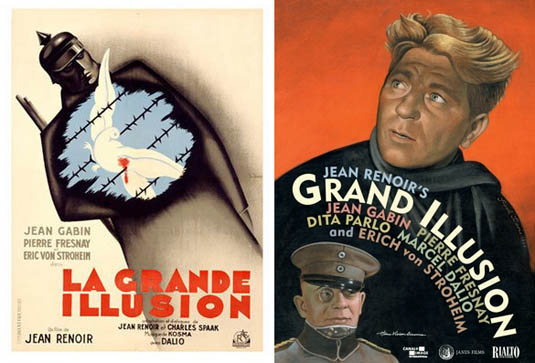
[Image: Posters for Grand Illusion, currently out of print from the Criterion Collection].

For the first film in Breaking Out and Breaking In a distributed film fest—where you watch the films at home and return here to discuss them online—co-sponsored by BLDGBLOG, Filmmaker Magazine, and Studio-X NYC, we watched Jean Renoir’s Grand Illusion (1937), recently described as one of the 100 best films of world cinema (Seven Samurai, if you’re curious, was #1).

I will limit myself to discussing Grand Illusion solely from the perspective of this film fest of prison breaks and bank heists (which will be true for all the films discussed in this series). In other words, I’ll focus specifically on the topology of escape—on holes, tunnels, walls, and borders. And I should note: there are spoilers ahead.

[Images: From Grand Illusion, courtesy of the Criterion Collection].

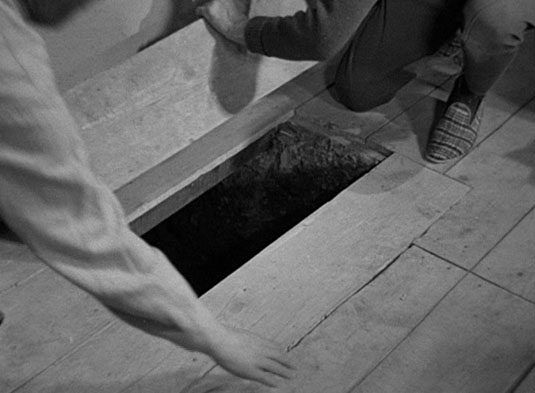
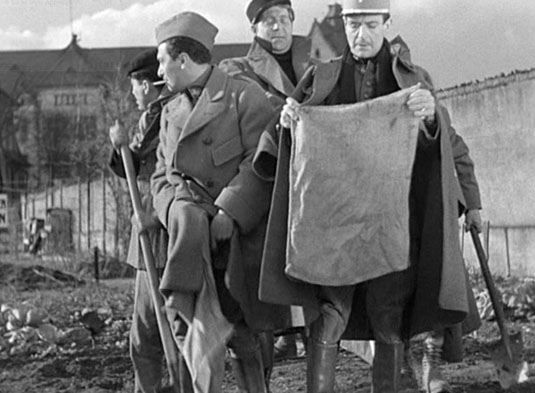
The first attempted escape of the film is through the earth: tunneling from beneath the barracks of a German prison camp with the intention of popping up beyond the outer buildings, in a garden.

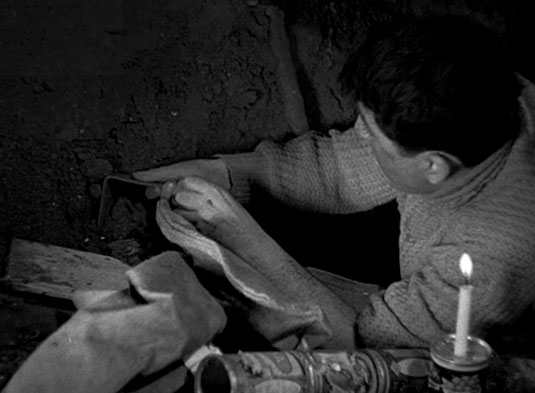
Removing the floorboards and hacking through exceptionally soft soil, the prisoners rig an alarm system and fashion a tentacular speaking-tube to make sure they all know if the person on digging duty has passed out in the carbon dioxide-rich microclimate being created by their tunneling activity. In fact, the speaking-tube—like an old-fashioned game of telephone—initially appears to be a breathing apparatus of some sort, as if they are, in fact, snorkeling through the earth.

[Image: From Grand Illusion, courtesy of the Criterion Collection].

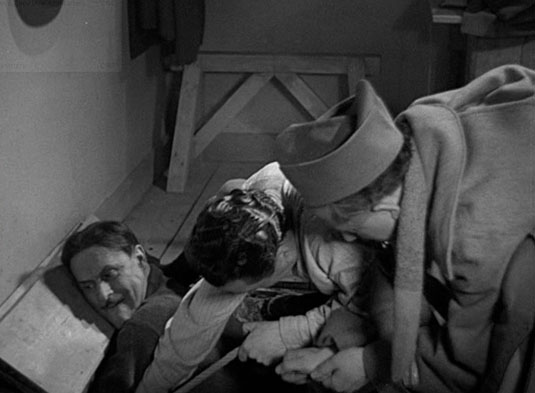
Perhaps unsurprisingly, the digger—an irritatingly effusive French cabaret singer—loses consciousness, his candle goes out, and he must be hauled backward out of the mud by rope.

[Image: From Grand Illusion, courtesy of the Criterion Collection].

There are at least two particularly interesting things about this tunnel.

1) The diggers engage in an illicit earth-moving operation by filling their clothes with the resulting dirt, and then dumping the dirt into the garden. They’re thus generating their own little artificial topography out in the prison yard as they scoop out the earth beneath their barracks house. The negative space of the tunnel becomes this new terrain of dirt piles and rows, which are thus symptoms of this literally underground activity.

[Image: From Grand Illusion, courtesy of the Criterion Collection].

2) More interestingly, the tunnel is soon abandoned: all of the prisoners are moved to new camps, the barracks are emptied, the tunnel still covered by floorboards, and a last-ditch attempt to let the incoming prisoners know that there is a half-completed escape tunnel beneath their bedroom fails. A train pulls away, splitting up the prisoners and bringing them to new camps; all the while, a remnant escape route, unfinished and unknown, lies waiting to be rediscovered.

Immediately before their departure, however, there is a brief exchange between two of the film’s protagonists. Looking out at the clockwork machinations of the German guards, who march in synchrony across the prison courtyard, the imprisoned Captain de Boeldieu quips: “For me it’s simple. A golf course is for golf. A tennis court for tennis. A prison camp is for escaping.”

[Images: From Grand Illusion, courtesy of the Criterion Collection].

While this is by no means a remarkable piece of dialogue in and of itself, it suggests that, internal to and implied by the diagram of the camp, there is a goal or proper use, but one that runs against the grain of the space’s stated intentions. The camp is a landscape that necessitates its own peculiar misuse; escape is just the sport that actualizes this. Put another way, the design of the camp rigorously implies its own escape routes.

Further to this point, however, and as evidenced by the casual manner with which our sporting gentlemen pack up their rackets and coats and abandon their incomplete tunnel, their behavior is motivated more by following unspoken rules (of war, of the camp, of sporting etiquette) than, in a sense, by trying to win.

In any case, from this point in the film it’s onward, out and further, through a series of other camps—shown solely in montage—before the displaced captives arrive at an imposing mountaintop fortress—filmed at the Châteaux du Haut-Koenigsbourg— run by the wounded Von Rauffenstein (who, to my mind, looks remarkably like Darth Vader without a helmet, as seen in Return of the Jedi).

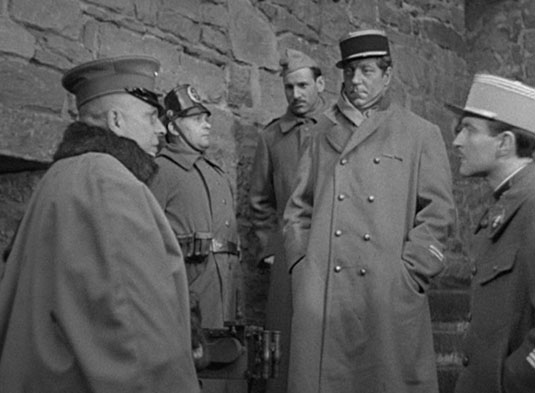
Von Rauffenstein takes his new forced guests on a fortifications tour, walking around the castle’s walls. “Nice castle,” one of them remarks, as another methodically recites the centuries of original construction. “12th century,” he mutters. “13th century.”

[Image: From Grand Illusion, courtesy of the Criterion Collection].

But all along they are looking for blindspots, low points, and ways over the wall.

[Image: From Grand Illusion, courtesy of the Criterion Collection].

The eventual—and final—method of escape is by way of diversion, using small flutes and makeshift drums to distract the castle guards as two prisoners make an improbable break for it down a handmade rope out of a tower. And, after a brief stop by a house in the Alps where a spot of romance pops up, they find their ultimate freedom in a moment that is absurd for all it reveals about the notion of political jurisdiction.

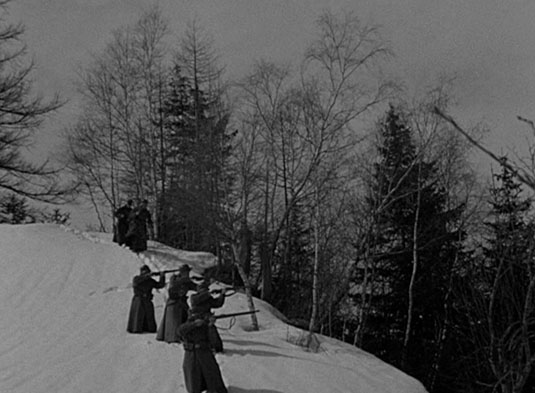
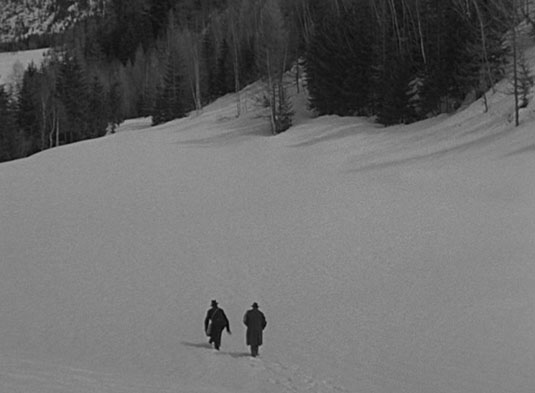
Running in plain view of German soldiers, who have finally caught up to them, our remaining two heroes have nothing to worry about: they have crossed an invisible line in the snow, making a mockery of all their tunnels and secret ropes, as they walk up a hill in neutral Switzerland.

[Images: From Grand Illusion, courtesy of the Criterion Collection].

Clearly, outside the specific context of Breaking Out and Breaking In, there is much more to discuss, including the film’s actual central theme, which is not escape but class divisions.

Hopefully, though, this will serve as a quick intro to the film’s many specifically spatial propositions. If you had a chance to watch Grand Illusion last week, by all means let us all know what you think—and stay tuned in the next day or two for a post about Robert Bresson’s A Man Escaped.

(Note: Friday, February 3, brings The Great Escape).