The Encounter Circus

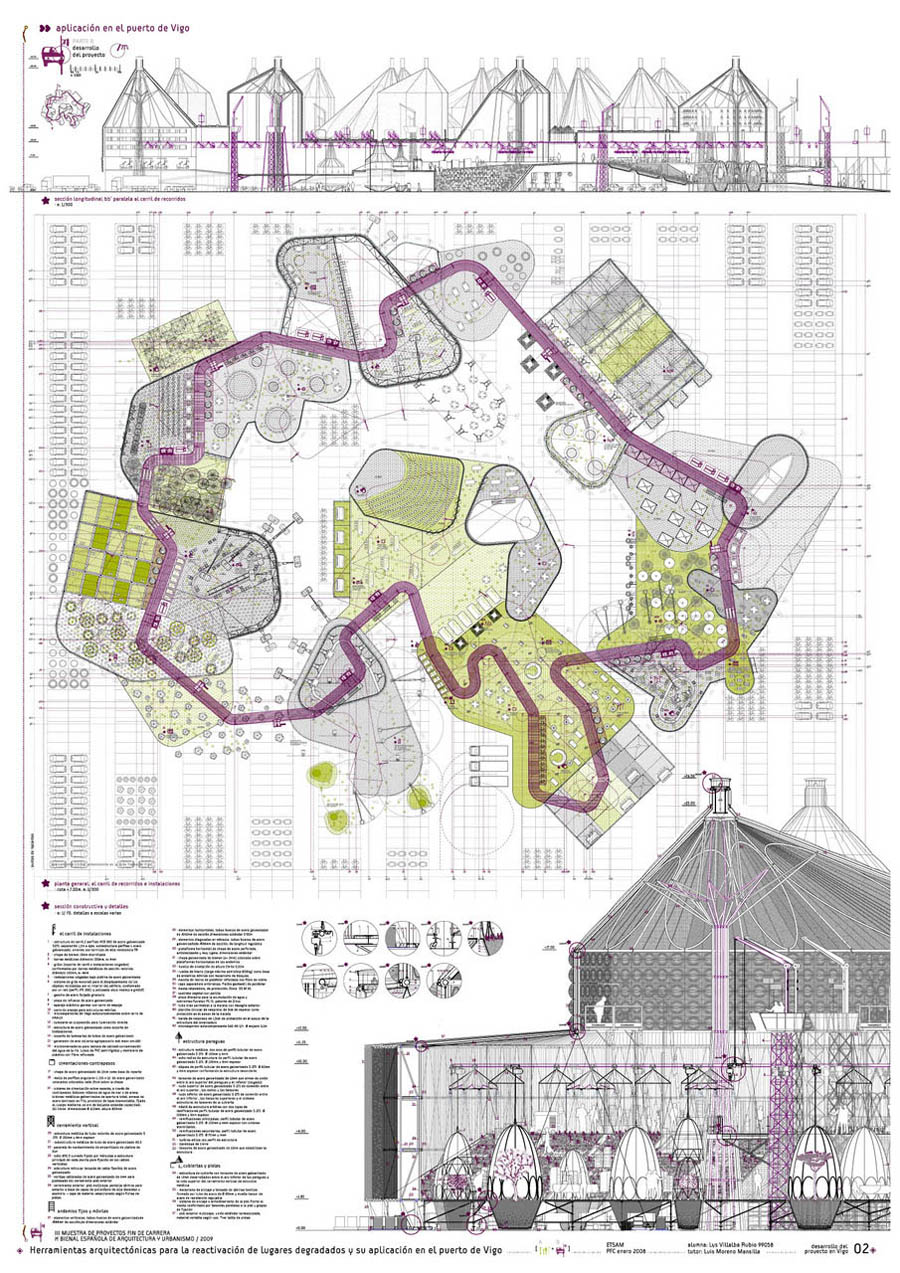
The following project by Lys Villalba Rubio—then a student at ETSAM’s Departamento de Proyectos Arquitectónicos in Madrid—is pitched as a way of using architecture as “an active element” in the “regeneration of degraded places.”

[Image: From a project by Lys Villalba Rubio].

Based on my own non-existent Spanish (and the help of Babelfish), it seems that the project specifically proposes a “hospital of cities.” Villalba Rubio suggests that this is a new building type; acting like a social enzyme, it “activates in each place an urban regenerative process,” allowing spatial healing to begin.

There is also a “toolbox” and an “encounter circus,” the latter of which encourages “citizen participation in the regenerative process: a place in which all contribute, from the expert to the anonymous citizen.”

[Image: From a project by Lys Villalba Rubio].

Those three programs—toolbox, hospital of cities, and encounter circus—would be constructed atop a foundation system that is so easy to assemble and disassemble that it would leave no architectonic trace of its existence, Villalba Rubio writes.

Like an instant, inhabitable roller-coaster of pedestrian paths and new tent-like social spaces, complete with wind turbines and routes of mechanical transport, all coiling above formerly dead zones of the city, Villalba Rubio’s installation would being a strange flash of activity back into the urban skies—before disappearing altogether, leaving no traces, the architect claims, but in memory.

(Via Archidose‘s Tumblr, launched earlier this summer).

Sussex Dew Mine

John Becker, a former student of mine from the Glacier/Island/Storm studio at Columbia’s GSAPP, has had his final semester project published on Dezeen. John’s intensely detailed images depict “the future headquarters of a fictional company that sells bottled water harvested from dew.”

[Image: From An Atmosphere Excavated by John Becker].

He approached the whole thing as a false-historical narrative told through a variety of representational styles; these ranged from stippled and picturesque rural landscapes to yellowing 1960s photography, ending up with both 1990s-style graphic posters and hyper-slick renderings from the year 2074.

The overall story explored vernacular techniques for “harvesting, storing, and distorting the landscape,” including harvesting aerial humidity using dew ponds and then bottling that water for market.

Entitled An Atmosphere Excavated, the story starts in 1786 and continues to 2074, when the “dew pond” system has been commercialized by the Ethereal water brand… In order to meet growing demands, a series of dew collecting nets were pioneered by a London based architecture firm—MJB Architects—which allowed for a 25 fold increase in production. Due to peak production vs. bottling time, storage bladders were constructed on the hillside to provide short term storage for water during the process. The Bladders were placed under the surface of the earth to provide protection from the sun, and to retain the water’s desired temperature.

It was a lot of fun talking to John as he put this together—in fact, one of our in-studio conversations inspired a post on BLDGBLOG earlier this year—so it’s great to see his project get this exposure. Congrats, John!

Check out his work in more detail over at Dezeen.

Transcendent City

Richard Hardy, a recent graduate from the Bartlett School of Architecture in London, produced this eye-popping video—exploring an all-encompassing machine-forest populated with mechanical flowers and fluttering urban biotechnologies, with architectural sponges perched high atop masts—for Nic Clear’s Unit 15.

Called The Transcendent City, the film documents what Hardy describes as “an autonomous artificial machine that extends across the earth adapting to the natural eco-systems it encounters while deriving its energy from the renewable resources available at each particular site. The systems desire is to maintain homeostasis within itself whilst maintaining homeostasis within the greater system, Gaia. Its processes are engineered on the molecular scale by nano technologies controlled by molecular computers that monitor and analyse the environment.”

You can see a handful of Dr. Seussian stills from the film over on Hardy’s Flickr stream.

Buried buildings, like icebergs in the ground

[Image: Watership Down by Maier Yagod and Jon Reed at the Cleveland Public Library].

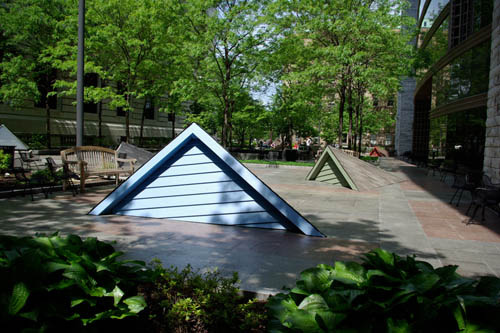
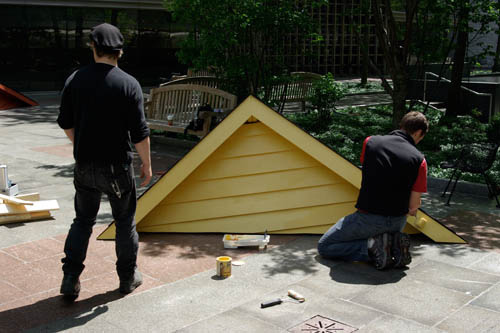
In a project for the Cleveland Public Library, designed by Toronto-based architects Maier Yagod and Jon Reed, “domestic fragments” have been embedded in the pavement, forming a surreal new kind of public bench:

Watership Down creates a scenario where five houses are frozen for a moment in a process of complete submersion into the ground of the Eastman Garden. Placed throughout the Garden, the gables of these houses project out of the earth at various angles. These create focal points of interest within the garden and become follies to climb, sit and rest upon.

Taken too far in one direction, of course, this idea could very easily become a kind of postmodern joke—architectural theme-props for a children’s playground—but the installation manages to avoid explicit dramaturgy, its fragments more like Gordon Matta-Clark’s Building Cuts emerging from the surface of the city.

[Image: Watership Down by Maier Yagod and Jon Reed at the Cleveland Public Library].

A fever of roofs pushing up from below, breaching ground level with the archaeological buoyancy of lost ships.

[Image: Watership Down by Maier Yagod and Jon Reed at the Cleveland Public Library].

While the deliberate use of simulated building fragments can run the risk, mentioned earlier, of simply repeating the PoMo theatrics of things like “upside-down buildings,” the evocation of underground architecture, like tombs, scratching through the earth, buried by an orderly landslide of the urban fabric around them, is an interesting direction to take.

Quick Links 14

[Image: A film still from Wolfen].

<1> Reduced to Rubble | Cartographies of the Absolute:

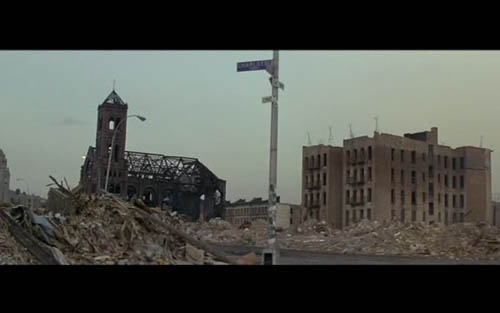
There are a myriad of films that came out in the seventies and eighties that depicted, documented, exploited, and/or contributed to this dystopian image of a section of one of the world’s greatest cities reduced to rubble, not through aerial bombardment but so-called ‘benign neglect’ and ‘planned shrinkage’: Bonfire of the Vanities, Fort Apache, The Bronx, 80 Blocks from Tiffany’s, etc. Most of these, as well as a series of Hollywood films that use NY as a set for acts of shocking violence (one could add Death Wish, C.H.U.D., The Warriors, Escape from New York, Driller Killer, and innumerable others to the list) say little about what created the situations, usually implying that urban decline is a natural process and that the resulting depravity is the inevitable result of packing people together (especially non-white people).

One of the more ambitious and unusual films to fall under this rubric is the 1981 horror film Wolfen. An unusual mix of werewolf movie, police procedural, and serial killer thriller, Wolfen is based on a 1978 novel by Whitley Strieber, and directed by Michael Wadleigh, best known for directing the documentary Woodstock (1969). Entangled in a plot symptomatically torn between political history, capitalist practice and mythologies of the land, Wolfen is an odd and beguiling narrative about a critical moment in the collapse of radical politics and the emergence of a feral neoliberalism against a backdrop of urban dereliction and real estate speculation.

<2> Open Carry | L.A. Times:

More than a dozen people packing pistols on their hips strolled down the Hermosa Beach strand Saturday, picking up garbage and distributing fliers about the rights of gun owners.

The event was part of a burgeoning and controversial “open carry” movement nationwide promoting the right to carry guns in public. Although carrying a concealed weapon is illegal without a permit, California allows people to openly carry guns in many areas as long as they are unloaded, though they can keep ammunition with them.

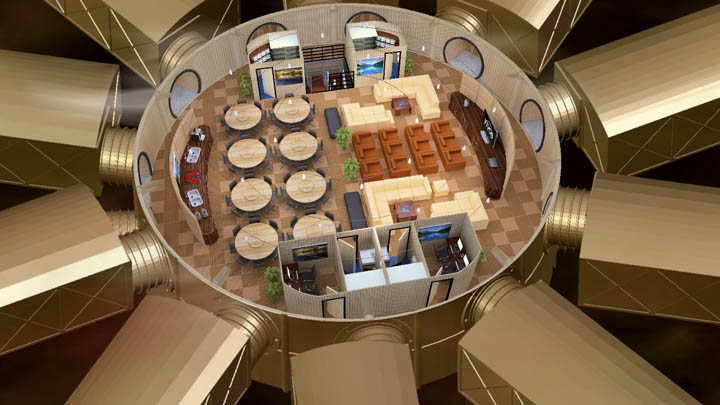
[Image: A 20,000 square-foot underground shelter by Vivos; courtesy of Vivos].

<3> An Investment in Life | USA Today:

Jason Hodge, father of four children from Barstow, Calif., says he’s “not paranoid” but he is concerned, and that’s why he bought space in what might be labeled a doomsday shelter.

Hodge bought into the first of a proposed nationwide group of 20 fortified, underground shelters—the Vivos shelter network—that are intended to protect those inside for up to a year from catastrophes such as a nuclear attack, killer asteroids or tsunamis, according to the project’s developers.

“It’s an investment in life,” says Hodge.

[Image: Photo by Spencer Weiner for the Los Angeles Times].

<4> The Mogi Doughnut | L.A. Times:

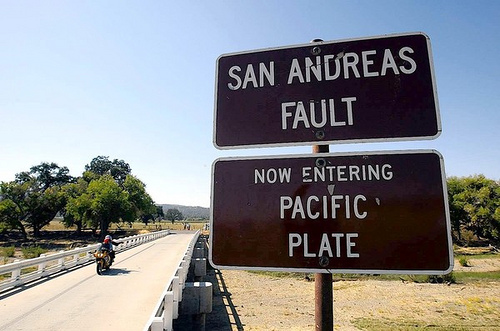
Seismologists call the possible pattern a Mogi doughnut. It’s the outgrowth of a concept, developed in Japan, which holds that earthquakes sometimes occur in a circular pattern over decades—building up to one very large quake in the doughnut hole.

[Images: Emergent North by Lateral Office/InfraNet Lab].

<5> Emergent North | Bustler:

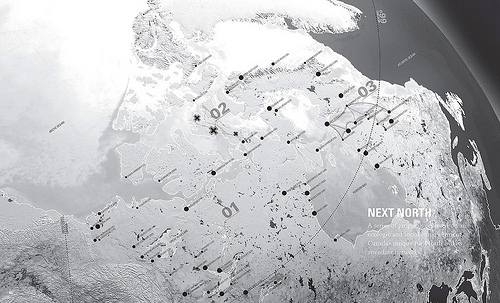
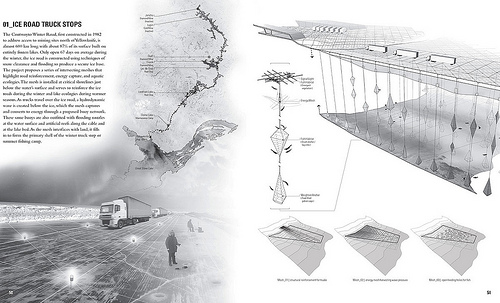
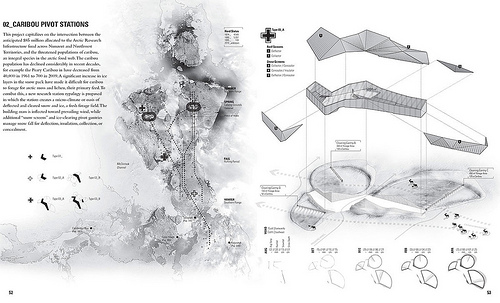
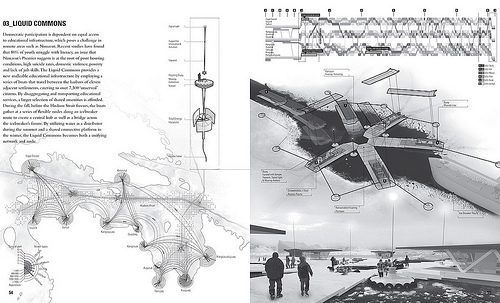
Emergent North looks at the challenges and opportunities of the public realm, civic space, landscape, and infrastructure emerging from a unique geography. Ms. Sheppard and Mr. White will conduct two travel routes through Nunavut, Yukon, and Northwest Territories, as well as Alaska and Greenland, to gather first-hand knowledge and documentation of Far Northern settlements.

[Images: Photos by Linda Pollak, courtesy of Urban Omnibus].

<6> City of Alternate Signs | Urban Omnibus:

[Linda Pollak’s] investigations into mysterious carvings in the granite sidewalks of Lower Manhattan have much to teach us about the ways natural forces determine urban form. They also have yielded photographic imagery that is visually arresting on its own. I happened to glance at one of these images in Linda’s office last winter, and immediately afterward I started seeing the “cuts and patches” they depict everywhere I went. Turns out many of them are coal chute covers, relics of a different era of energy infrastructure in formerly industrial neighborhoods like SoHo or TriBeCa.

<7> City of Acoustic Side-Effects | Local Ecologist:

If you stand at the edge of the inner most ledge of the spiral and utter “Ah” you are supposed to hear “Ah” as if you spoke it into an echoing microphone.

[Image: Institute of Oriental Studies, St. Petersburg/Giraudon/Art Resource, via Saudi Aramco World].

<8> Great Tent Cities in Muslim Lands | Saudi Aramco World:

From the Middle Ages onward, European travelers… wrote admiringly of great tent cities in Muslim lands—especially in Central Asia, but also in Turkey, Egypt and later Mughal India. They were astonished at the size and organization of these cities that at times numbered thousands and even tens of thousands of tents.

The cities that amazed Europeans were not simply the black camel-hair ridge tents of the Arab world or the domed yurts of the nomadic Central Asian tribes. They included movable palaces, some complete with mosques, that housed traveling royalty and their vast entourages, or were set up to mark important celebrations, such as the marriage or circumcision of members of the ruling house. And it was not just the size of these tents that caught western eyes, but their splendor and comfort, and the way they served as showcases for wonderful textiles: cloth of gold, brocade, ikat, embroideries, velvet, chintz and appliqué.

<9> The Man Who Moves Buildings | Guardian:

Jeremy Patterson moves large structures from place to place… Patterson’s latest monster move involved a 19th-century brick mansion on a hill, which the owners wanted transported five miles south to their winery… Patterson and his crew dug out the foundations and cut holes in them at intervals, into which they slotted a lattice of 110-foot steel beams. Then they pumped the beams up on jacks, demolished the foundations, slid some wheels underneath and drove the whole thing away… He can’t stop talking about what an insane idea moving a building is. He kept mentioning the threat of the house collapsing and killing everyone. A few minutes later he collapsed himself, of a suspected heart attack.

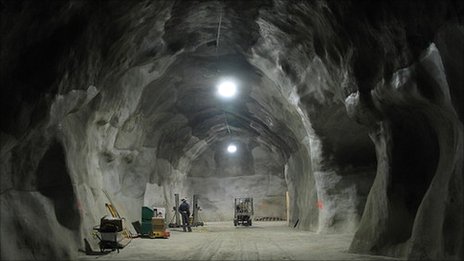
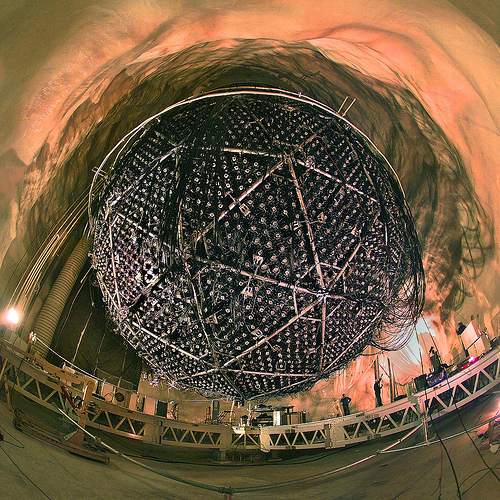
[Images: The SNOLAB neutrino detector and mine in Ontario, Canada].

<10> The Light Below | BBC:

Scientists are looking to relocate an underground experiment searching for dark matter to an even deeper site. Cosmic rays striking the Earth could completely mask the rare dark matter events sought by the experiment. Team members want to cut out as much of this cosmic ray interference as possible, even if it means moving the experiment 2km below ground. This could help them positively identify the particles thought to make up dark matter. Dr. Marek Kos, who is a team member on the Cryogenic Dark Matter Search II (CDMSII) project, outlined details at the International Conference on High Energy Physics (ICHEP) in Paris. He said the experiment could be relocated from a mine in Minnesota to a deeper facility in Ontario, Canada.

(Some links via Steve Silberman, Jim Rossignol, Nicola Twilley, and possibly others I’ve forgotten; don’t miss Quick Links 1, 2, 3, 4, 5, 6, 7, 8, 9, 10, 11, 12, and 13).

Live and direct

As some of you might know, I am @bldgblog on Twitter—but I’ve also started an account called @bldgbloglive so that I can live-tweet events, lectures, sites, interviews, panel discussions, and more without clogging up @bldgblog and driving readers insane with an avalanche of instant messages.

So far, I’ve covered graduate research presentations here at the CCA given by Léa-Catherine Szacka, Zubin Singh, S. Faisal Hassan, and Molly Wright Steenson, but I hope to post at least a few live notes from Foodprint Toronto this Saturday—and then many more events and lectures to come.

So if you want to see occasional, quantitatively intense bursts of descriptive micro-messages sent live from the front lines of the lecture hall, consider adding @bldgbloglive to your list of sources; if you’d prefer—or would also like—the odd link to good articles here and there, don’t miss @bldgblog. And, of course, if you are wondering why you might also consider using Twitter, here are some random thoughts about its note-taking potential.

Indefinite in number, but of certain fixed shapes

[Image: One of many pages from the voluminous archive of Richter’s toy manuals at the CCA].

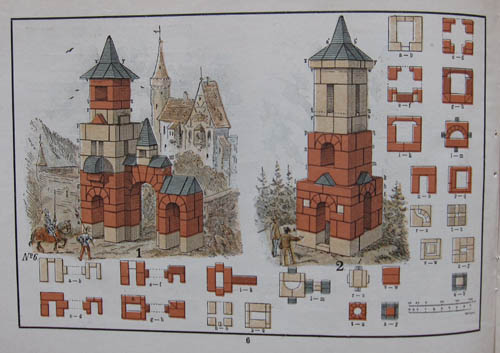
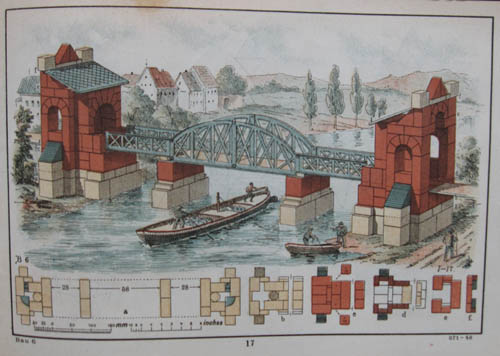
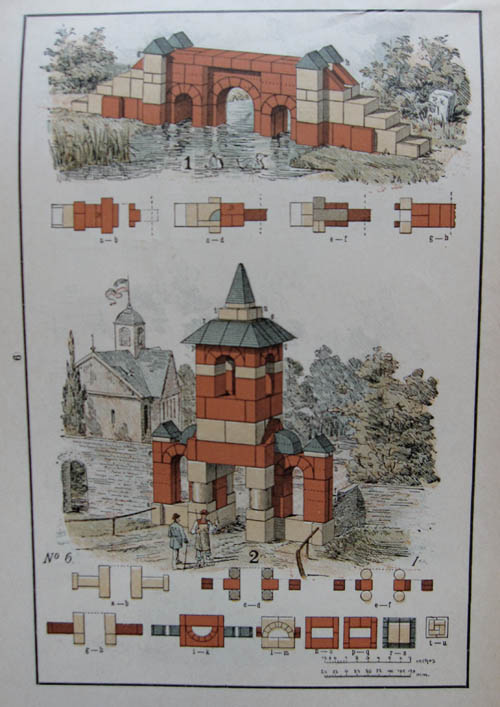
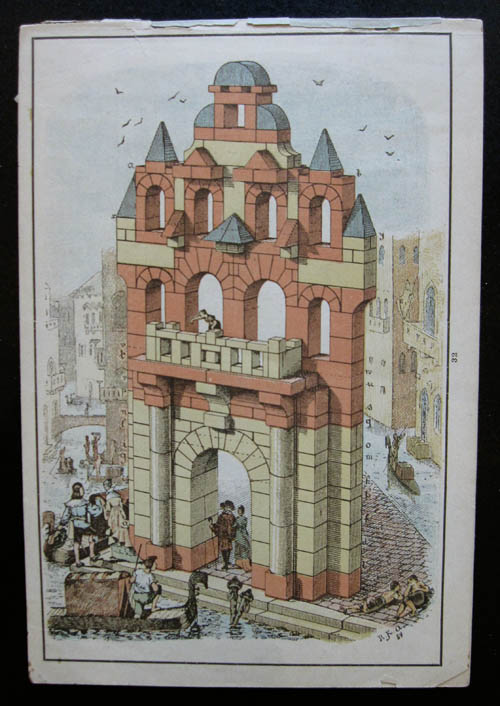
While down in the CCA archives last week, I had some time to explore a number of old instructional booklets for wooden children’s toys.

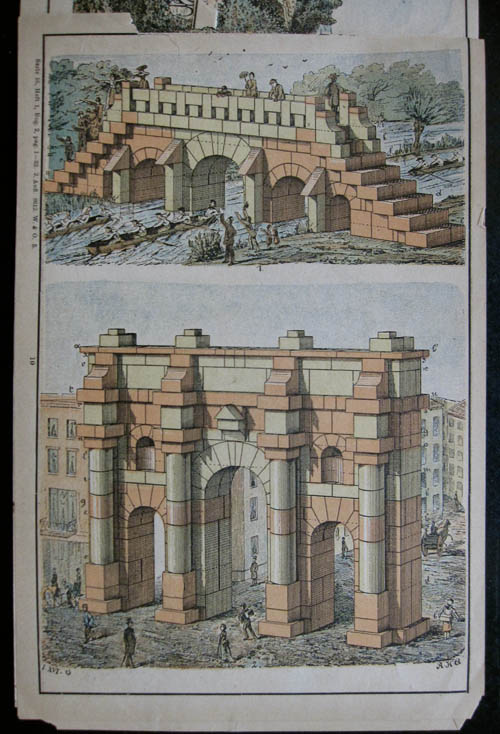
One such book, called The Art of Architecture of Building With Given Model Stones, explains that “It will be seen from the title of this book that it is intended to be a guide in the construction of larger buildings with the aid of model stones, indefinite in number, but of certain fixed shapes.”
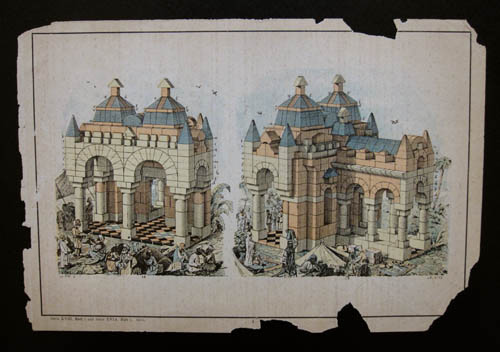
[Image: Page from a Richter’s toy manual; courtesy of the CCA].

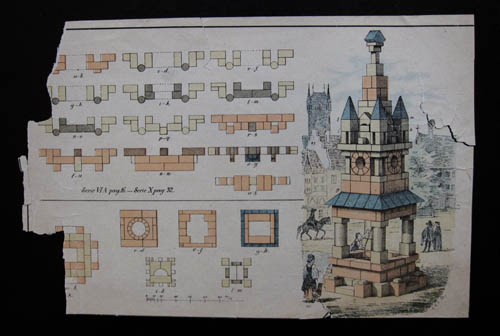
From the very basic—
[Image: An early stage in assembling Richter’s “anchor blocks”; courtesy of the CCA].

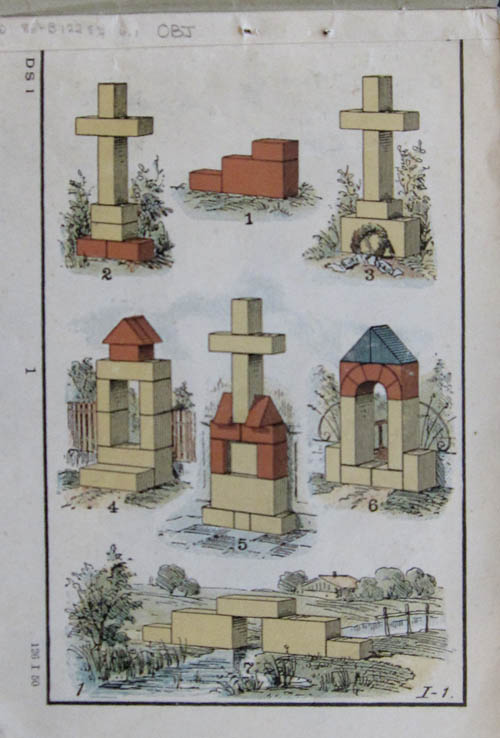
—to the much more complex—
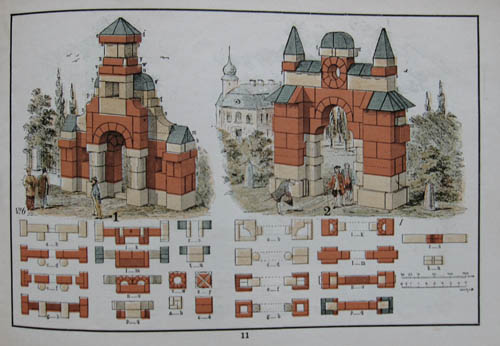
[Images: Complex spatial objects from an advanced stage of the Richter’s toy system; courtesy of the CCA].

—these toys were imagined as pedagogical tools for the training of the young human mind.

As such, Richter’s toys did not at all seem out of place down there in the CCA archive, stored near other such fading boxed sets as the “Object-Teaching Forms and Solids” of A.H. Andrews & Co., Chicago, dating from 1890, or even “Kinsey’s Ornamental Lock Block and Toy” set, from 1875, which unfortunately used tiny wooden swastikas—hundreds of swastikas—to teach children how they, too, can fill space with interlocking, modular parts.
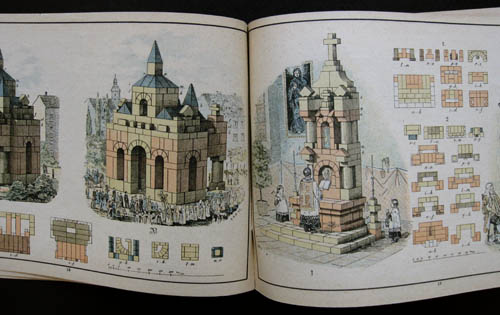
[Images: Into the hypnotic spreads of a geometrical universe; courtesy of the CCA].

Produced in the late 1800s by a company called Richter’s—”Designed and Executed by Dr. Richter’s Art-Department,” then located at 74-80 Washington Street, New York, NY—the blocks and their instructional manuals that you see here were no mere playthings; they were marketed as intellectual stimulants, Frobelian educational props, for teaching children nothing less than how to think.

At this point I might offer a slightly long quotation from the Los Angeles-based Institute For Figuring about the origins and purpose of Frobelian education:

Most of us today experienced kindergarten as a loose assortment of playful activities—a kind of preparatory ground for school proper. But in its original incarnation kindergarten was a formalized system that drew its inspiration from the science of crystallography. During its early years in the nineteenth century, kindergarten was based around a system of abstract exercises that aimed to instill in young children an understanding of the mathematically generated logic underlying the ebb and flow of creation. This revolutionary system was developed by the German scientist Friedrich Froebel whose vision of childhood education changed the course of our culture laying the grounds for modernist art, architecture and design. Le Corbusier, Frank Lloyd Wright and Buckminster Fuller are all documented attendees of kindergarten. Other “form-givers” of the modern era—including Piet Mondrian, Wassily Kandinsky and Georges Braque—were educated in an environment permeated with Frobelian influence.

I might also then suggest that we seem sorely lacking today in analogue children’s toys inspired by an instructional need to teach lessons in space, relation, cause, effect, etc.
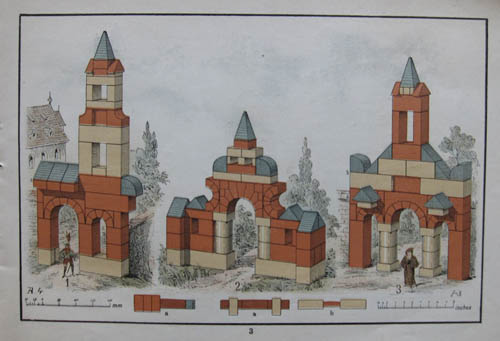
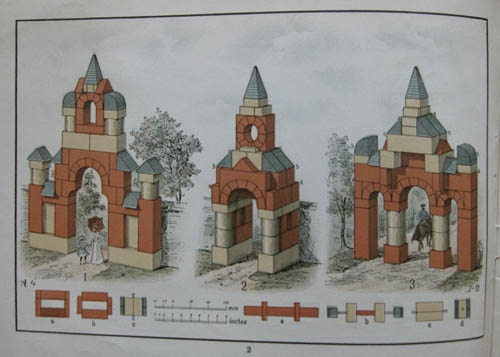
[Images: Variation, adaptation, memory; courtesy of the CCA].

In any case, Richter’s blocks worked, we’re told by the company itself, because “instruction must be united with amusement.”

Indeed, an entire philosophy of child-rearing is outlined in these toy manuals. They seem to have been written more with the purpose of explaining how the human brain processes information than for telling future consumers how to use their new toys.

They are not product manuals at all, then, but manifestos of human cognitive development.
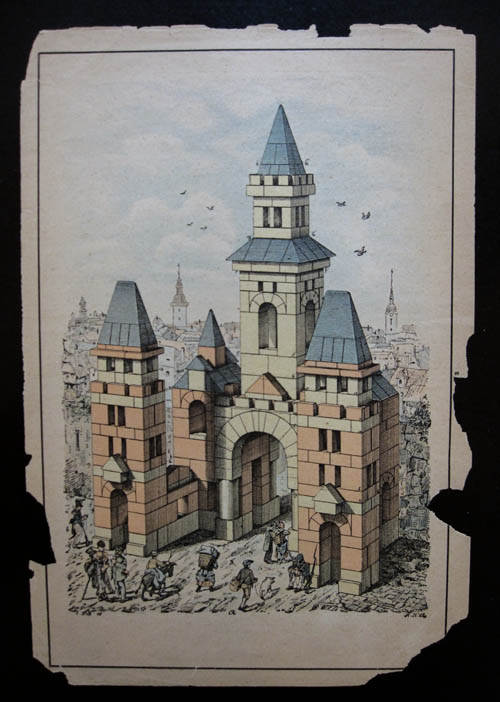
[Image: Cognitive tools in the guise of toys, manufactured by Richter’s; courtesy of the CCA].

Richter’s system, in particular, “trains [children] to habits of orderliness and tidiness, especially when they know what they must keep the boxes they already possess intact, if they wish to be able to build the designs of the next Supplement Box.”

Raised in a world of these carefully regulated Supplements, Richter-building children learn to master consumer self-control and the rudiments of cognition itself—as if undergoing training in some woodblock remake of Inception.
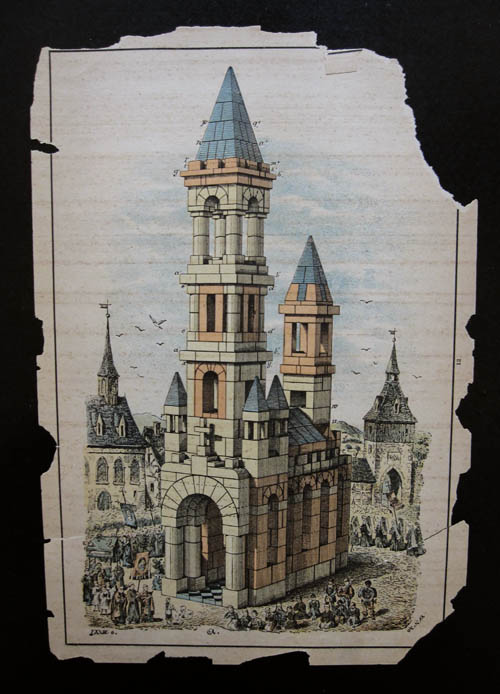
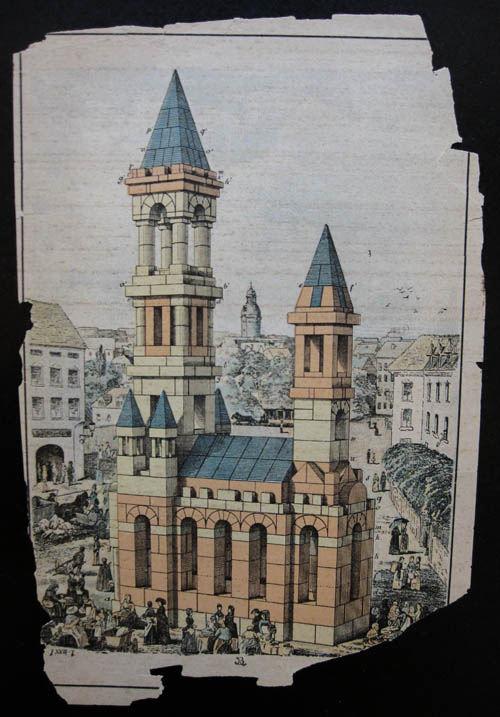
[Images: The same building, rotated 90-degrees; by Richter’s. Courtesy of the CCA].

There are ample warnings against straying from these directions. Not paying attention to the order of Supplements, for instance, as if your child is being initiated into a Masonic cult of basic geometric shapes, means that the child’s mind may become lost.

The children should not be permitted to construct [the designs in this book] until they have thoroughly mastered the First Stage. In this way the little architects, even the smallest of them, will be able of their own initiative successfully to overcome the various architectural problems of the present Book, and parents will soon get to recognize the importance of the Anchor Blocks as a means of inducing children to think for themselves.

However, “When once they are mastered, building becomes an unfailing source of joy as well as of instruction for children and their elders alike.”

At that point, the successful little builder “should show his parents as many well constructed buildings as possible and get them occasionally to join him in building.”
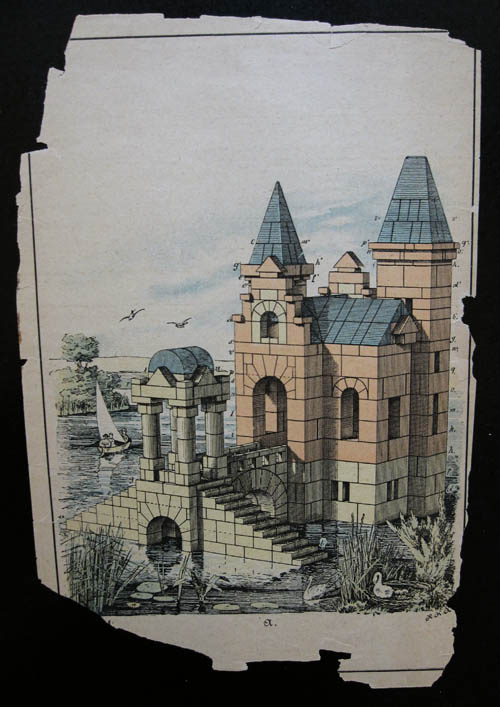
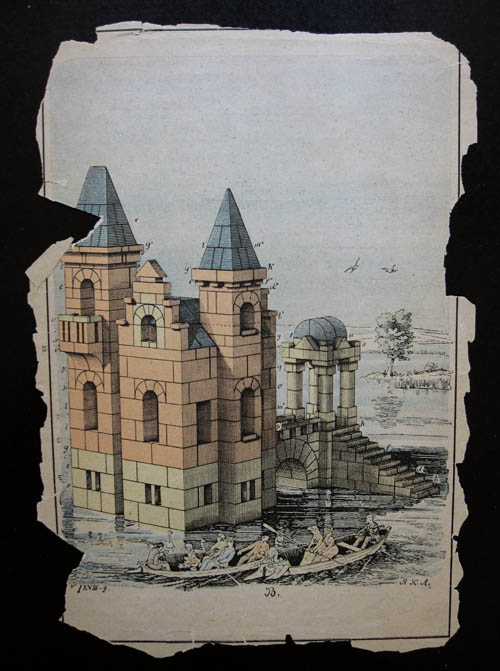
[Images: Another structure, rotated 180-degrees for ease of spatial perception; courtesy of the CCA].

Note the gender. These toys were specifically marketed as cognitive training devices for boys. Girls were instead given flat, two-dimensional patterns, called “mosaic-games,” not at all unlike quilting templates, to play with, instead.
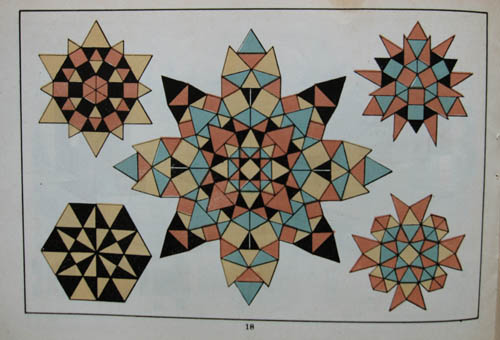
[Image: A “mosaic-game” from Richter’s; courtesy of the CCA].

“We have also introduced a number of most interesting marble mosaic-games specially designed for girls,” Dr. Richter’s guidebooks explain. “Contained in a handsome wooden box, [these consist] of a laying-plate and a number of specially shaped stones, which are made with the utmost precision. The patterns which can be laid with these stones are quite charming and often produce most striking and unexpected effects.”

This vision of girls reduced more or less to the status of imbeciles, tripping out on “quite charming” patterns while pushing little pieces of colored stone around on a “laying-plate,” would be a hilarious anachronism if it wasn’t also so tragic.

Men will learn to build and inhabit three-dimensional space; women can make mosaics, push rocks around, sew quilts together, and drool.
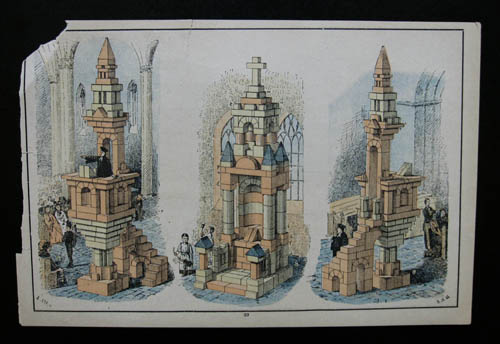
[Image: Richter blocks, courtesy of the CCA].

I photographed nearly one hundred pages of designs from the Richter series; I’ve included just a few here to give a sense for the overall visual language of the pavilions, churches, altars, towers, bridges, houses, walls, and more into which the woodblock pieces were meant to be assembled.
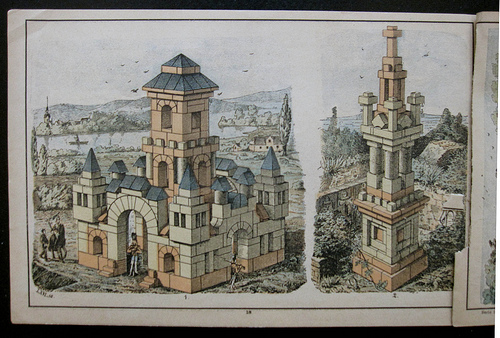
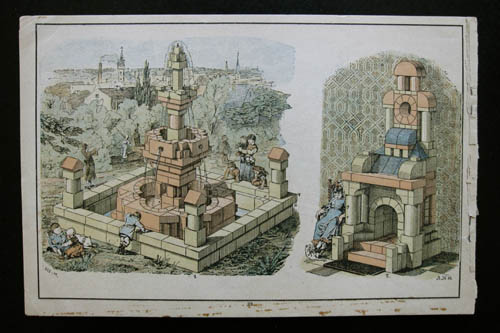
[Images: Richter blocks, courtesy of the CCA].

However, if this sort of thing interests you beyond a single blog post, I’d recommend taking a look at the Institute For Figuring’s Inventing Kindergarten page; but I would also point you toward the CCA’s exhibition Potential Architecture: Construction Toys from the CCA Collection (1991-1992), with architecturally-themed children’s toys selected by Norman Brosterman.

A pamphlet was published to coincide with that show, and is itself worth checking out.
[Image: Courtesy of the CCA].

In describing the exhibition, the CCA wrote that Brosterman chose to focus on “twenty-one construction toys, made in the hundred years from 1850 to 1950.” These are toys, now held in the CCA’s underground archives, “that were designed to challenge a child’s creativity. The toys illustrate how children learn to invent relationships between space, structure, and building forms, and hence to better understand the world around them.”

Each one of these modular toy sets “invited children to organize its prefabricated toy buildings into entire cities”—a remark that once again brings to mind those early, all too brief training scenes seen in Inception, where Leonardo DiCaprio describes the flexible architecture of urban maze-creation to a pupil named Ariadne, who then takes to her lessons suspiciously well.

But might a dream academy of Inception-scale urban alteration be the Frobelian education to come, for a future, highly fortunate generation of children? In a kindergarten of machine-assisted sleep, they will assemble cities indefinite in number, but of certain fixed shapes, outdoing any urban form that’s come before.

#CCA

Gunnery Pagodas / Manhattan Niagara / The University of War

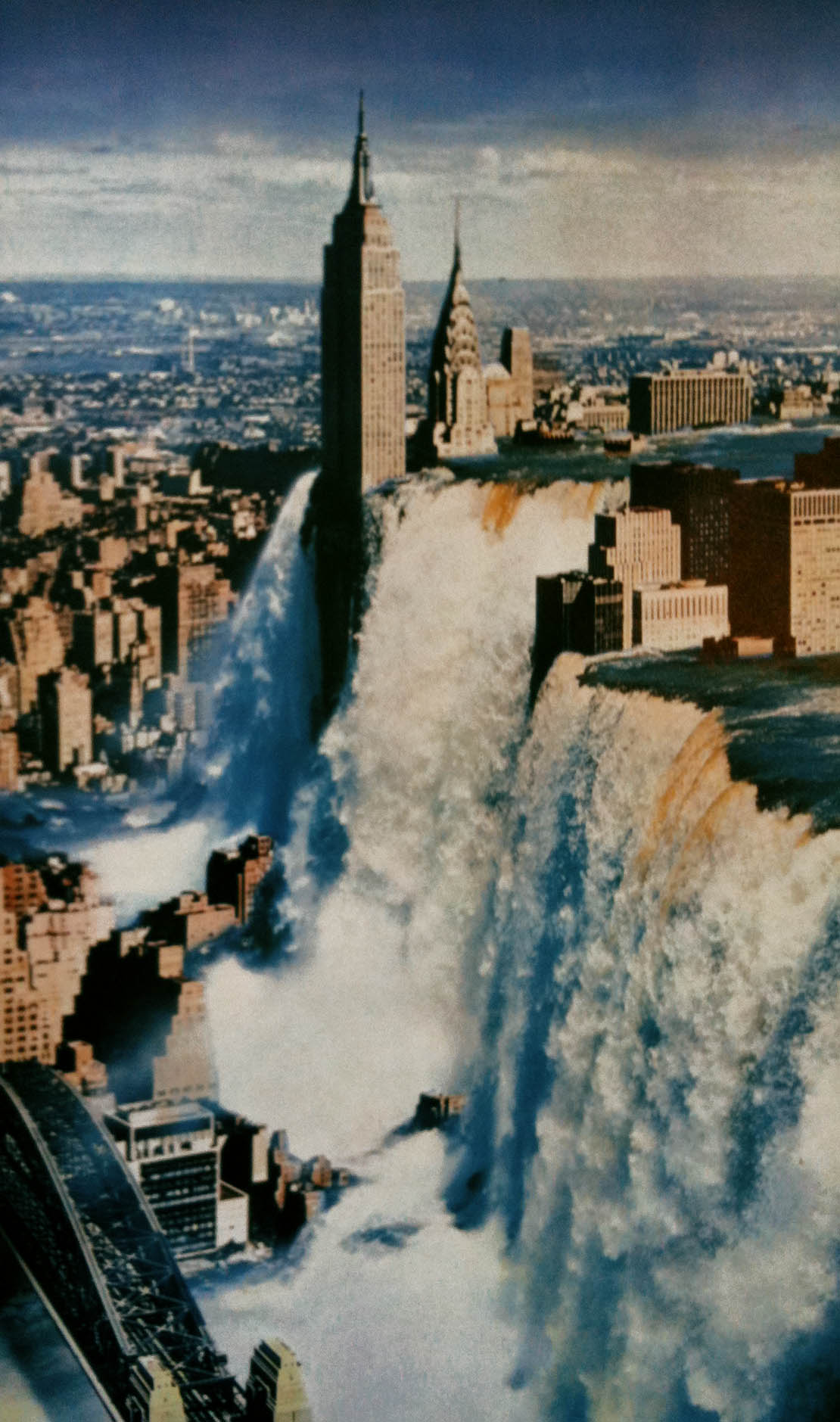
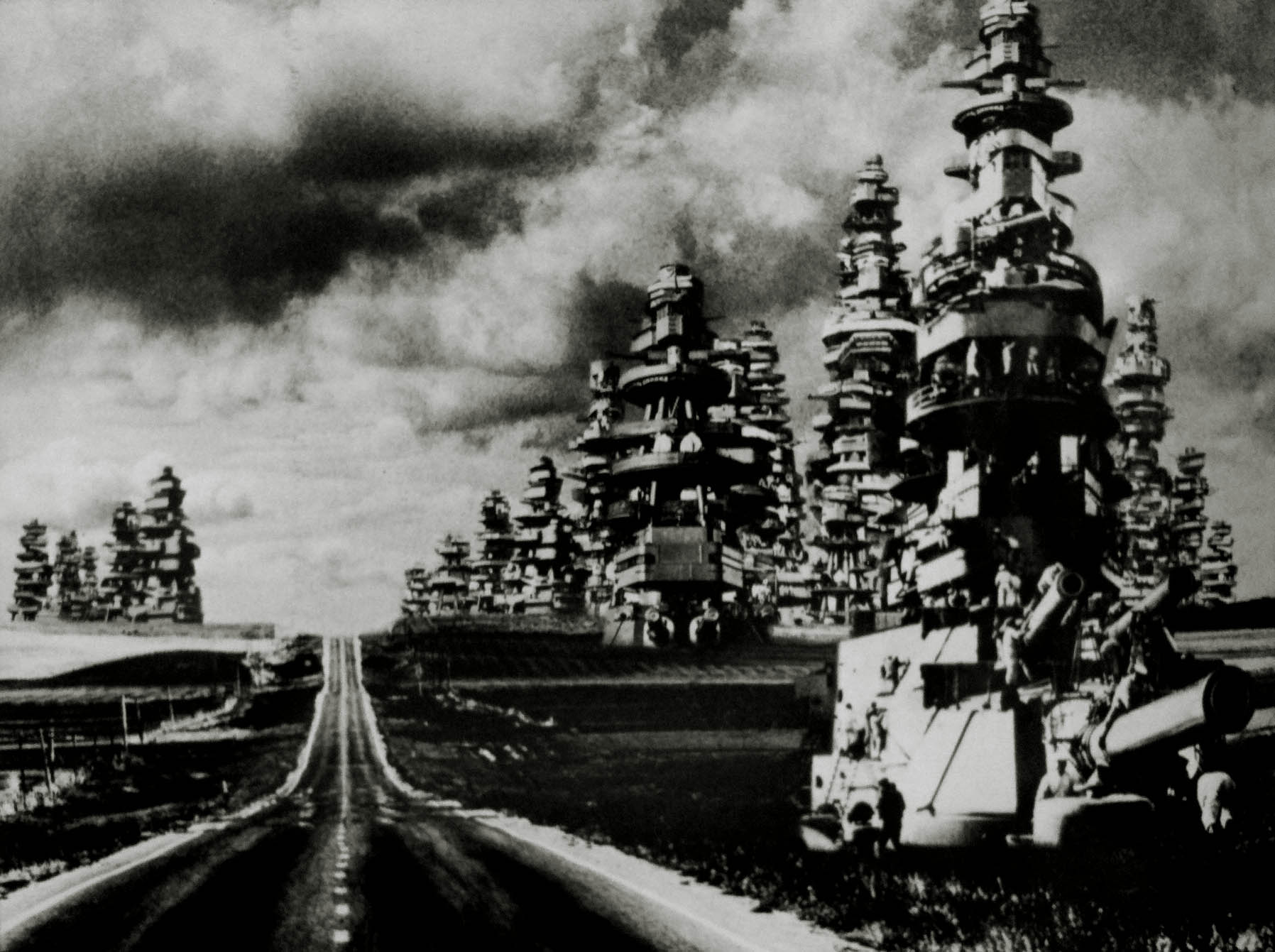
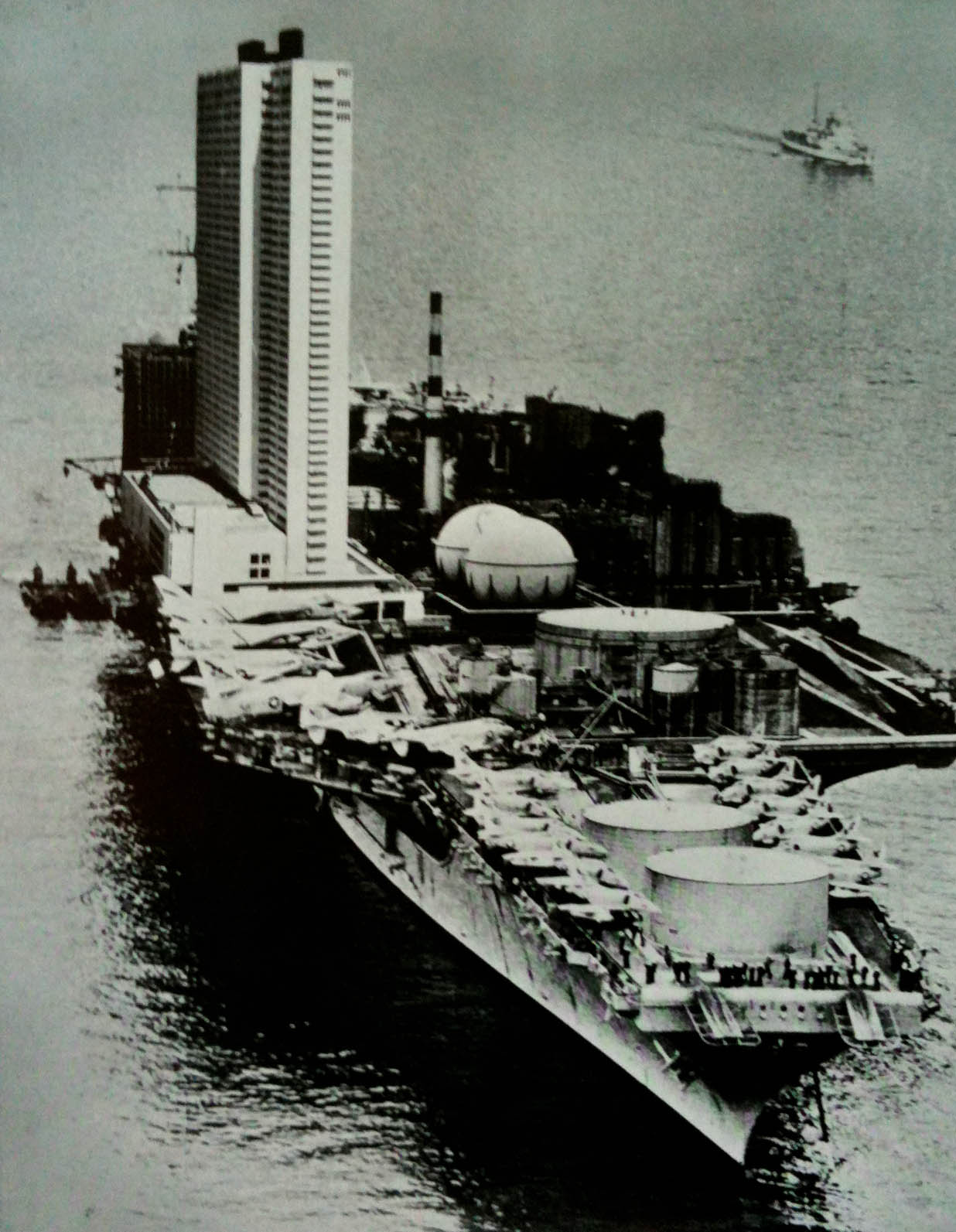
[Image: By Tsunehisa Kimura, from Tsunehisa Kimura’s Visual Scandals by Photomontage].

A copy of the 1979 book Tsunehisa Kimura’s Visual Scandals by Photomontage, now out of print, popped up the other day in the CCA library, and many of the images are jaw-dropping.

I photographed a few of the book’s glossy pages—as the scanner system here doesn’t really make sense to me—and I thought that three images, in particular, were of sufficient architectural interest to warrant posting.

[Image: By Tsunehisa Kimura, from Tsunehisa Kimura’s Visual Scandals by Photomontage].

The artist—who passed away in 2008—was well-known for his startlingly realistic collages of urban scenes, often animated with a kind of end-of-the-world, scifi-inflected festivity. Impact craters in the centers of wrecked cities share chaotic page space with Dalí-esque visions of giant human breasts in the sky.

Waterfalls scour sublime new cliffsides from the architectural canyons of Manhattan; modern tower blocks pitch and yaw atop aircraft carriers at sea; battleship gun turrets are cloned and repeated into Baroque stupas—cathedrals of artillery—along the empty roads of agrarian landscapes. For my money, these latter structures outdo Hans Hollein’s Aircraft Carrier City in Landscape, with which they nonetheless share a certain tectonic similarity.

Gunnery pagodas and blasted metropolitan cores meet surreal scenes of burning astronauts on the moon, while the neon lights of artificial volcanoes melt nameless city districts under radiative tides of surprise eruption. Apollo rockets are unearthed from Mesopotamian tombs in the shadow of Stone Age petroleum tanks. Tatlin’s Tower stands proud in a junkyard, stuffed full of broken TVs. The Woolworth Building wakes up to find itself at the bottom of a cave, and there are construction sites everywhere.

[Image: By Tsunehisa Kimura, from Tsunehisa Kimura’s Visual Scandals by Photomontage].

However, these are not the explicitly psychedelic photo-collages of someone like, say, James Koehnline, in which machine-mandalas and nude fakirs intermix with jungle leaves inside heavily tiled cosmic temples. They are more like diagnostic slices taken through a militarized imagination formed in the context of post-War Japan.

In some ways, in fact, I’m reminded of an interview with Paul Virilio, published in AA Files a few years back. There, Virilio quips that “The Second World War was my university,” and he goes on to describe the various ways in which abandoned military fortifications and the total annihilation of once-thriving cities affected his ideas of what architecture should be.

Tsunehisa Kimura’s “visual scandals,” I’d suggest, bring together a similarly rogue education—star pupils in a university of war—with a Ballardian afterglow, a nuclear flash from the Pacific Rim, delivering images of cities that escaped erasure by American bombs only to be buried under electronic goods of Japan’s own making, sometimes literally faceless citizens staggering through landscapes no one ever thought the last century would bring.

#CCA

The Design Future of the Sacred Grove

[Images: Ships botanically assembling themselves in the forest, from “Growing a Hidden Architecture” by Christian Kerrigan, a proposal that actually seems to grow more interesting every time I think about it].
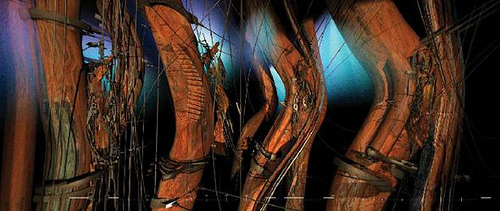
I’ve got a longish post up over at the CCA about sacred groves, trees that fruit machine-parts, forests that twine their canopies together through collars, tourniquets, corsets, and belts to form sea-ready ships ready for harvesting, the Moon Trees of Apollo, and much more.

[Image: From “Growing a Hidden Architecture” by Christian Kerrigan].

Design proposals by Christian Kerrigan, Sascha Pohflepp, and BOARD loom large, along with an historical essay by Patrick Bowe from a journal called Studies in the History of Gardens & Designed Landscapes.

Take a look if you have a chance: The Design Future of the Sacred Grove.

#CCA

Foodprint Toronto

[Image: The Ontario Food Terminal; image via Pruned].
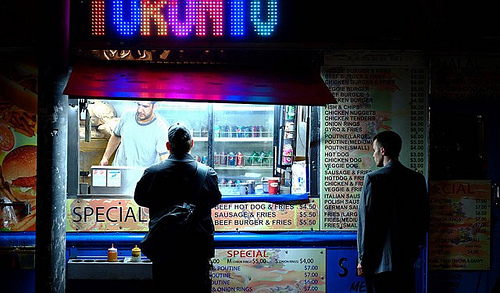
Foodprint Toronto is coming up fast—the afternoon of Saturday, July 31—and it will be well worth attending. Pruned has just posted an interview with the event’s curators, Nicola Twilley and Sarah Rich, who explain the origins and purpose of the Foodprint series.

As Nicola describes it: “The Foodprint Project is basically an exploration of the ways cities and food shape each other. So far, it’s taken the form of panel discussions, one city at a time, but Sarah and I are imagining that it will gradually evolve and expand beyond that format as we go along.”

Pruned: Many aspects of urban food systems are inextricably linked to a much wider system within an even wider system, from the regional to the national to the continental and then further on up to the inter-continental scale. But the project, at least in these first two iterations, is squarely focused on the city. Why this focus?

Twilley: I think a large part of the reasoning behind our city-by-city focus is for exactly the reason you describe: urban food systems are inextricably tied to a much wider system—so we can use the former as a way into the latter. In other words, we can talk about NAFTA in terms of the evolution of the Ontario Food Terminal or corn subsidies in terms of bodega inventory. It can be really helpful to have that sort of grounded, place-specific way in to the larger discussion.

Another part of our reasoning is that most people—and more of them everyday—live in cities. Twenty-first-century urbanism is increasingly going to define and reshape our relationship with food: why not try to understand that and even flip it, to see how food could redefine twenty-first-century urbanism?

Sarah adds that “the way we want to look at the relationship between food and cities has a lot to do with urban planning, architecture, infrastructure and the way unintentional or intentional manipulations of physical space can steer patterns of consumption and behavior.”

[Image: Foodprint Toronto is on Saturday, July 31].

Find out more not only by reading the interview, but also by attending the event: it takes place Saturday, July 31, from 12:30 p.m. to 5 p.m., at Artscape Wychwood Barns. There is a small entry fee of $5, but also a very long list of great speakers, including recent Prix de Rome co-recipient Lola Sheppard.

(BLDGBLOG, Pruned, and Edible Geography are all part of Future Plural’s blog network).

Slow City

There’s an interesting article in the New York Times today about the design and implementation of “aging-improvement districts“—that is, “parts of the city that will become safer and more accessible for older residents.”

[Image: Photo by Emily Berl for The New York Times].

One particular detail that stands out is also the first they mention: “New York City has given pedestrians more time to cross at more than 400 intersections in an effort to make streets safer for older residents.”

While most adults average four feet per second when crossing the street, older residents manage only three, transportation experts say. So signals have been retimed at intersections like Broadway and 72nd Street, where pedestrians now have 29 seconds to cross, four more than before.

Introducing time-delay into city services by splicing an extra stretch of the present into New York’s infrastructure, this is a temporal re-engineering of urban space: a longer stroll across the street with friends, no longer having to run to avoid that yellow light, becomes experiential evidence that a subtle though highly deliberate retuning of time in the city has occurred.

There are many other evocative details for how New York will be re-designed into an “age-friendly” city. “What people say they want most of all,” for instance, “is to live in a neighborly place where it is safe to cross the street and where the corner drugstore will give them a drink of water and let them use the bathroom.” Aging residents say they also “want better street drainage, because it is hard to jump over puddles with walkers and wheelchairs.” And there are very straight-forward architectural ideas in the mix, as well: “One of her ideas [Linda I. Gibbs, New York’s deputy mayor for health and human services] is to hold a contest to design a ‘perch’ to put in stores or on sidewalks where tired older residents doing errands could take a break.”

However, I’m also reminded of the fake bus stop that was added outside a hospital in Germany so as to calm—and, frankly, to trap—Alzheimer’s patients who had wandered out onto the street: “The result is that errant patients now wait for their trip home at the bus stop, before quickly forgetting why they were there in the first place.” Does decoy infrastructure, similar to these bus stops, already play a role in New York City—and, if not, will it—for the psychiatric well-being of elderly residents? What unexpected forms might these well-camouflaged psychological props take?

After all, how will the aging minds, and not just the aging bodies, of New York City find solace through design—a “perch” for psychological respite? Perhaps, channeling architects Arakawa + Gins, New York could become the city of reversible destiny.