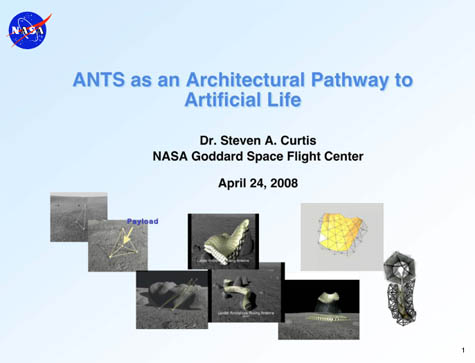
 [Image: NASA’s ANTS].
Alex Trevi sent me a link last week – which he later posted – about the so-called ANTS program. ANTS is an “autonomous nano technology swarm” developed by NASA for possible use in the “lunar base infrastructure” of tomorrow.
ANTS consist of “highly reconfigurable networks of struts, acting as 3D mesh or 2D fabric to perform a range of functions on demand.”
The ANTS approach harnesses the effective skeletal/muscular system of the frame itself to enable amoeboid movement, effectively ‘flowing’ between morphological forms. ANTS structures would thus be capable of forming an entire mobile modular infrastructure adapted to its environment.
However, I was especially excited to see that the ANTS system has been hypothesized as “an architectural pathway to artificial life.”
Might the artificial biology of tomorrow be buildings that have come to life?
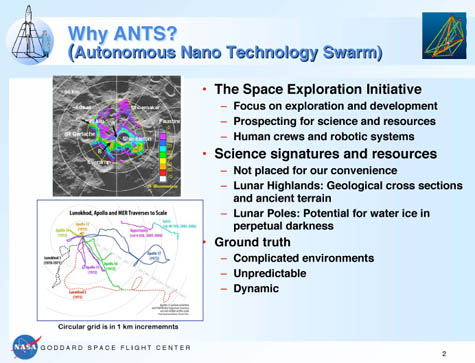
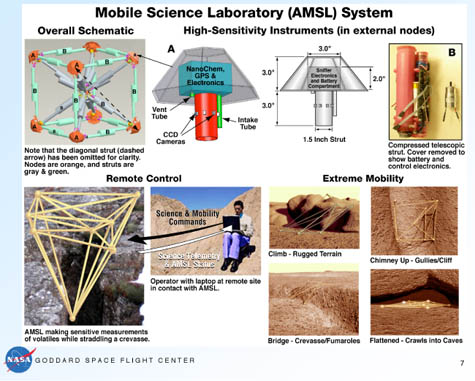 [Images: NASA’s ANTS].
I’m reminded here of Philip Beesley’s Implant Matrix, or Theo Jansen’s Strandbeesten, machine-architectures that cross over into animation and back, convincingly evincing signs of life.
But NASA’s recent research into ANTS suggests that these units could actually be used to build whole bases and instant cities under extreme – and literally lunar – living conditions, where the village itself would not be just a substrate or infrastructure but a kind of artificially intelligent labyrinth of living architecture that coils round itself in a cascade of walls and air locks. All under the constant radiative glare of the sun.
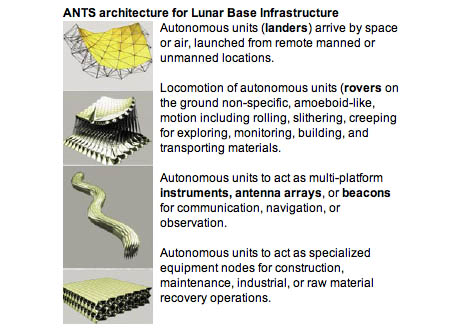 [Image: NASA’s ANTS].
These “autonomous remote systems,” as NASA refers to them, are already coming into existence, of course; one need only look as far as the skies of the Middle East, for instance, which now buzz with unmanned aerial drones, or at the deep desert labs of the U.S. Air Force, where shape-shifting airplanes are taking (and re-taking) shape.
But is there a drone architecture?
Unmanned buildings – server farms, parking garages, airport terminals, and offshore cargo-processing warehouses (or RoboVault, say) – that, given mobility, could approach the condition of biology?
And is this what the haunted house genre has always been about: a fear of architecture that has come to life?
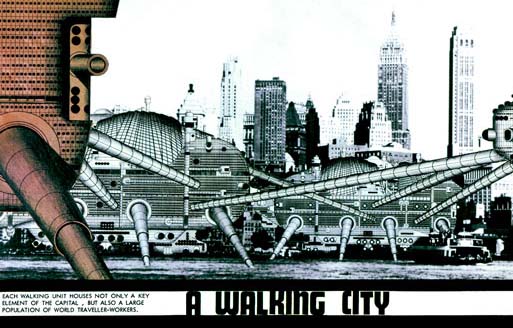 [Image: Ron Herron’s Walking City, first proposed in Archigram 4 (1964)].
It’s NASA meets Archigram meets Manuel de Landa meets Theo Jansen – a walking city gone off-world, communicating via secure satellite to earthbound observers back home.
(See also Pruned‘s take on this).
 [Images: From Current TV’s short segment, “Building Blogs“].
 The
The